

ASTM A893/A893M-03(2022)
(Test Method)Standard Test Method for Complex Dielectric Constant of Nonmetallic Magnetic Materials at Microwave Frequencies
General Information
- Abstract
SIGNIFICANCE AND USE
3.1 This test method can be used to evaluate batch type or continuous production of material for use in microwave applications. It may be used to determine the loss factors of microwave ferrites or help evaluate absorption materials for use in microwave ovens and other shielding applications.
3.2 The values obtained by use of this practice can be used as quality assurance information for process control, or both, when correlated to the chemistry or process for manufacturing the material.
SCOPE
1.1 This test method covers the measurement of the complex dielectric constant of isotropic ferrites for extremely high-frequency applications.
1.2 The values stated in either SI units or inch-pound units are to be regarded separately as standard. The values stated in each system may not be exact equivalents; therefore, each system shall be used independently of the other. Combining values from the two systems may result in non-conformance with the standard. Within this standard, SI units are shown in brackets.
1.3 This standard does not purport to address all of the safety concerns, if any, associated with its use. It is the responsibility of the user of this standard to establish appropriate safety, health, and environmental practices and determine the applicability of regulatory limitations prior to use.
1.4 This international standard was developed in accordance with internationally recognized principles on standardization established in the Decision on Principles for the Development of International Standards, Guides and Recommendations issued by the World Trade Organization Technical Barriers to Trade (TBT) Committee.
- Status
- Published
- Publication Date
- 30-Sep-2022
- Technical Committee
- A06 - Magnetic Properties
- Drafting Committee
- A06.01 - Test Methods

Overview
ASTM A893/A893M-03(2022) is the internationally recognized standard test method for determining the complex dielectric constant of nonmetallic magnetic materials, specifically isotropic ferrites, at microwave frequencies. Developed by ASTM International, this standard outlines precise methodologies and equipment requirements for measuring both the real and imaginary components of the dielectric constant, which are critical for assessing material performance in high-frequency applications. The standard provides essential guidance for industries needing consistent evaluation of ferrites and absorption materials designed for use in microwave and electromagnetic shielding environments.
Key Topics
- Complex Dielectric Constant Measurement: The standard focuses on evaluating both the real (k') and imaginary (k'') parts of the dielectric constant, providing insight into a material’s capacity to store and dissipate electric energy under microwave excitation.
- Applicability to Isotropic Ferrites: Testing is specific to isotropic ferrite materials, which are commonly used in microwave technologies due to their unique magnetic and dielectric properties.
- Quality Assurance and Process Control: Data obtained using this method supports both batch and continuous production processes by correlating measurable dielectric properties with material composition and manufacturing variables.
- Cavity Perturbation Technique: Measurement is conducted using a cavity perturbation method, allowing accurate separation of electric and magnetic effects to ensure reliable results.
- Reporting Requirements: The standard mandates systematic documentation of measurement parameters, specimen details, and test conditions for traceability and reproducibility.
- Safety and Compliance: Emphasizes the user’s responsibility to address safety, health, and environmental considerations and to comply with applicable regulations.
Applications
ASTM A893/A893M-03(2022) supports a wide range of industries utilizing microwave technology. Practical applications include:
- Microwave Device Manufacturing: Assists in characterizing ferrites used within waveguides, isolators, and circulators for telecommunications, radar, and scientific equipment.
- Absorption Material Evaluation: Provides a reliable test method for selecting or validating materials used in microwave ovens, anechoic chambers, and electromagnetic interference (EMI) shielding systems.
- Process and Quality Control: Enables manufacturers to track dielectric property variations in real time, ensuring product conformity and aiding in the optimization of ferrite synthesis and processing.
- Research & Development: Serves as a foundation for academic, industrial, and government research in material science, enhancing the understanding and innovation of microwave functional materials.
Related Standards
To ensure comprehensive and consistent material evaluation, ASTM A893/A893M-03(2022) should be considered alongside the following related standards:
- ASTM D150 - Test Methods for AC Loss Characteristics and Permittivity (Dielectric Constant) of Solid Electrical Insulation
- ASTM D2520 - Test Method for Measurement of the Complex Permittivity (Dielectric Constant) of Solid Electrical Insulation at Microwave Frequencies
- IEC 60068 - Environmental Testing for Electrical and Electronic Products
- ASTM D4935 - Test Method for Measuring the Electromagnetic Shielding Effectiveness of Planar Materials
- IEC 61340 - Electrostatics Standards
These standards, when used in conjunction, provide a robust framework for ensuring the reliability, efficiency, and performance of nonmetallic magnetic materials in advanced microwave and EMI applications.
Keywords: ASTM A893, complex dielectric constant, microwave frequencies, ferrites, dielectric loss, absorption material, quality assurance, process control, microwave device testing, permittivity, EMI shielding, cavity perturbation, nonmetallic magnetic materials.
Get Certified
Connect with accredited certification bodies for this standard

IMQ S.p.A. (Certification)
Italian electrical product certification.

SLG Prüf- und Zertifizierungs GmbH
German testing and certification body.

UL Solutions
Global safety science company with testing, inspection and certification.
Sponsored listings
Frequently Asked Questions
ASTM A893/A893M-03(2022) is a standard published by ASTM International. Its full title is "Standard Test Method for Complex Dielectric Constant of Nonmetallic Magnetic Materials at Microwave Frequencies". This standard covers: SIGNIFICANCE AND USE 3.1 This test method can be used to evaluate batch type or continuous production of material for use in microwave applications. It may be used to determine the loss factors of microwave ferrites or help evaluate absorption materials for use in microwave ovens and other shielding applications. 3.2 The values obtained by use of this practice can be used as quality assurance information for process control, or both, when correlated to the chemistry or process for manufacturing the material. SCOPE 1.1 This test method covers the measurement of the complex dielectric constant of isotropic ferrites for extremely high-frequency applications. 1.2 The values stated in either SI units or inch-pound units are to be regarded separately as standard. The values stated in each system may not be exact equivalents; therefore, each system shall be used independently of the other. Combining values from the two systems may result in non-conformance with the standard. Within this standard, SI units are shown in brackets. 1.3 This standard does not purport to address all of the safety concerns, if any, associated with its use. It is the responsibility of the user of this standard to establish appropriate safety, health, and environmental practices and determine the applicability of regulatory limitations prior to use. 1.4 This international standard was developed in accordance with internationally recognized principles on standardization established in the Decision on Principles for the Development of International Standards, Guides and Recommendations issued by the World Trade Organization Technical Barriers to Trade (TBT) Committee.
SIGNIFICANCE AND USE 3.1 This test method can be used to evaluate batch type or continuous production of material for use in microwave applications. It may be used to determine the loss factors of microwave ferrites or help evaluate absorption materials for use in microwave ovens and other shielding applications. 3.2 The values obtained by use of this practice can be used as quality assurance information for process control, or both, when correlated to the chemistry or process for manufacturing the material. SCOPE 1.1 This test method covers the measurement of the complex dielectric constant of isotropic ferrites for extremely high-frequency applications. 1.2 The values stated in either SI units or inch-pound units are to be regarded separately as standard. The values stated in each system may not be exact equivalents; therefore, each system shall be used independently of the other. Combining values from the two systems may result in non-conformance with the standard. Within this standard, SI units are shown in brackets. 1.3 This standard does not purport to address all of the safety concerns, if any, associated with its use. It is the responsibility of the user of this standard to establish appropriate safety, health, and environmental practices and determine the applicability of regulatory limitations prior to use. 1.4 This international standard was developed in accordance with internationally recognized principles on standardization established in the Decision on Principles for the Development of International Standards, Guides and Recommendations issued by the World Trade Organization Technical Barriers to Trade (TBT) Committee.
ASTM A893/A893M-03(2022) is classified under the following ICS (International Classification for Standards) categories: 29.030 - Magnetic materials. The ICS classification helps identify the subject area and facilitates finding related standards.
ASTM A893/A893M-03(2022) is available in PDF format for immediate download after purchase. The document can be added to your cart and obtained through the secure checkout process. Digital delivery ensures instant access to the complete standard document.
Standards Content (Sample)
This international standard was developed in accordance with internationally recognized principles on standardization established in the Decision on Principles for the
Development of International Standards, Guides and Recommendations issued by the World Trade Organization Technical Barriers to Trade (TBT) Committee.
Designation: A893/A893M − 03 (Reapproved 2022)
Standard Test Method for
Complex Dielectric Constant of Nonmetallic Magnetic
Materials at Microwave Frequencies
This standard is issued under the fixed designationA893/A893M; the number immediately following the designation indicates the year
of original adoption or, in the case of revision, the year of last revision.Anumber in parentheses indicates the year of last reapproval.
A superscript epsilon (´) indicates an editorial change since the last revision or reapproval.
1. Scope
k = dielectric constant. If the medium is subjected to an
alternatingelectricfield,theelectricdisplacementisnot
1.1 This test method covers the measurement of the com-
necessarily in phase with the field. This fact may be
plex dielectric constant of isotropic ferrites for extremely
expressed mathematically by taking k as a complex
high-frequency applications.
quantity.Ifwewrite k= k'− jk",theimaginarypart, k",
1.2 The values stated in either SI units or inch-pound units
determines the dissipation in the medium.
are to be regarded separately as standard. The values stated in
2.2 This test method uses a cavity perturbation technique as
each system may not be exact equivalents; therefore, each
a means of separating electric from magnetic effects. Quanti-
system shall be used independently of the other. Combining
ties that must be measured are the resonance frequency, f,of
values from the two systems may result in non-conformance
the cavity with and without the sample, the loaded Q of the
with the standard. Within this standard, SI units are shown in
cavity with and without the specimen, and the cavity and
brackets.
specimen dimensions.
1.3 This standard does not purport to address all of the
2.3 The specimen is in the form of a rod and is placed
safety concerns, if any, associated with its use. It is the
parallel to the microwave electric field in a region of substan-
responsibility of the user of this standard to establish appro-
tially uniform electric and zero microwave magnetic fields.
priate safety, health, and environmental practices and deter-
The perturbation theory requires that the diameter of the
mine the applicability of regulatory limitations prior to use.
samplerodbesmallcomparedtoonequarterofthewavelength
1.4 This international standard was developed in accor-
of the microwave radiation in the specimen. Estimation of this
dance with internationally recognized principles on standard-
wavelengthrequiresknowledgeofthepermittivity,ε= kε ,and
ization established in the Decision on Principles for the
permeability, µ, of the specimen under the conditions of
Development of International Standards, Guides and Recom-
measurement. The wavelength, λ, in the specimen is given by
mendations issued by the World Trade Organization Technical
the equation:
Barriers to Trade (TBT) Committee.
1/2
λ 51/f' µε (2)
~ !
2. Summary of Test Method
For many ferrites, µ may be taken equal to µ , the perme-
ability of empty space, without serious error. The permittivity,
2.1 In an isotropic dielectric medium with a steady electric
ε, is determined by measurement as described below; after
field, E, the electric displacement, D, is given by the equation:
obtaining a value of ε, it is necessary to ascertain with the aid
D 5 kε E (1)
of Eq 1 that the sample diameter is sufficiently small.
where:
2.4 This test method is not suitable for materials with loss
ε = permittivity of free space and tangents ≥0.1, with the loss tangent defined as tan δ= k"⁄k'.
2.5 Theresultsoftheperturbationtheorycalculationmaybe
expressed in the form:
o i o 2
δf/f 5 2 k 2 1 ?Miv E E dv /2?Miv E dv (3)
@ ~ ! # ~ !
This test method is under the jurisdiction of ASTM Committee A06 on
s c
MagneticPropertiesandisthedirectresponsibilityofSubcommitteeA06.01onTest
where:
Methods.
Current edition approved Oct. 1, 2022. Published November 2022. Originally
f = f'+jf'⁄2Q;
approved in 1963. Last previous edition approved in 2015 as A893/A893M–03
Q = loaded Q of the cavity;
(2015). DOI: 10.1520/A0893_A0893M-03R22.
Copyright © ASTM International, 100 Barr Harbor Drive, PO Box C700, West Conshohocken, PA 19428-2959. United States
A893/A893M − 03 (2022)
4. Apparatus
v = specimen volume contained within the cavity,
s
3 3
in. [mm ];
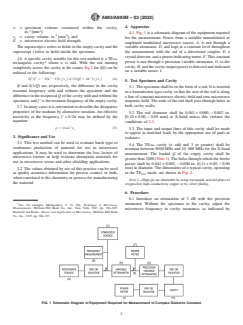
4.1 Fig. 1 is a schematic diagram of the equipment required
3 3
v = cavity volume, in. [mm ]; and
c for the measurement. Power from a suitable unmodulated or
E = microwave electric field strength.
amplitude modulated microwave source, A, is run through a
The superscript o refers to fields in the empty cavity and the variable attenuator, D, and kept at a constant level throughout
superscript i refers to fields inside the specimen.
the measurement with the aid of a directional coupler, E,a
crystaldetector,andapower-indicatingmeter, F.Thisconstant
2.6 Aspecific cavity suitable for this test method is a TE
10n
power is run through a precision variable attenuator, G,tothe
rectangular cavity, where n is odd. With the rod running
cavity, H,andthecavityoutputpowerisdetectedandindicated
completely across the cavity at the center, Eq 2 for δf/f can be
on a suitable meter, I.
reduced to the following:
δf'/f'522~k'21!~v /v !;δ ~1/Q! 5 4k"~v /v ! (4)
s c s c
5. Test Specimen and Cavity
δf and δ(1/Q) are, respectively, the difference in the cavity
5.1 The specimen shall be in the form of a rod. It is inserted
resonant frequency with and without the specimen and the
inatransmission-typecavitysothattheaxisoftherodisalong
differenceinthereciprocal Qofthecavitywithandwithoutthe
a line of constant microwave electric field and zero microwave
specimen, and f' is the resonant frequency of the empty cavity.
magnetic field. The ends of the rod shall pass through holes in
both cavity walls.
2.7 Inmanycasesitisconvenienttodescribethedissipative
properties of the med
...