

ASTM A697/A697M-13(2018)
(Test Method)Standard Test Method for Alternating Current Magnetic Properties of Laminated Core Specimen Using Voltmeter-Ammeter-Wattmeter Methods
General Information
- Abstract
SIGNIFICANCE AND USE
5.1 This test method was developed for evaluating the ac magnetic properties of laminated cores made from flat-rolled magnetic materials.
5.2 The reproducibility and repeatability of this test method are such that this test method is suitable for design, specification acceptance, service evaluation, and research and development.
SCOPE
1.1 This test method covers the determination of several ac magnetic properties of laminated cores made from flat-rolled magnetic materials.
1.2 This test method covers test equipment and procedures for the determination of impedance permeability and exciting power from voltage and current measurements, and core loss from wattmeter measurements. These tests are made under conditions of sinusoidal flux.
1.3 This test method covers tests for two general categories (1 and 2) of cores based on size and application.
1.4 Tests are provided for power and control size cores (Category 1) operating at inductions of 10 to 15 kG [1.0 to 1.5 T] and at frequencies of 50, 60, and 400 Hz.
1.5 Procedures and tests are provided for coupling and matching type transformer cores (Category 2) over the range of inductions from 100 G [0.01 T] or lower to 10 kG [1.0 T] and above at 50 to 60 Hz or above when covered by suitable procurement specifications.
1.6 This test method also covers tests for core loss and ac impedance permeability under incremental test conditions (ac magnetization superimposed on dc magnetization) for the above core types and at inductions up to those that cause the ac exciting current to become excessively distorted or reach values that exceed the limits of the individual test equipment components.
1.7 This test method shall be used in conjunction with Practice A34/A34M and Terminology A340. It depends upon these designated documents for detailed information which will not be repeated in this test method.
1.8 The values and equations stated in customary (cgs-emu and inch-pound) or SI units are to be regarded separately as standard. Within this standard, SI units are shown in brackets. The values stated in each system may not be exact equivalents; therefore, each system shall be used independently of the other. Combining values from the two systems may result in nonconformance with this standard.
1.9 This standard does not purport to address all of the safety concerns, if any, associated with its use. It is the responsibility of the user of this standard to establish appropriate safety, health, and environmental practices and determine the applicability of regulatory limitations prior to use.
1.10 This international standard was developed in accordance with internationally recognized principles on standardization established in the Decision on Principles for the Development of International Standards, Guides and Recommendations issued by the World Trade Organization Technical Barriers to Trade (TBT) Committee.
- Status
- Published
- Publication Date
- 30-Apr-2018
- Technical Committee
- A06 - Magnetic Properties
- Drafting Committee
- A06.01 - Test Methods
Overview
ASTM A697/A697M-13(2018): Standard Test Method for Alternating Current Magnetic Properties of Laminated Core Specimens Using Voltmeter-Ammeter-Wattmeter Methods is an internationally recognized standard developed by ASTM. This standard outlines reliable procedures and equipment for determining the alternating current (ac) magnetic properties of laminated cores made from flat-rolled magnetic materials. The methods described support accurate design, specification acceptance, performance evaluation, and research of magnetic cores, ensuring repeatability and reproducibility across various applications.
Key Topics
- Magnetic Property Assessment: The standard focuses on measuring essential ac magnetic properties such as impedance permeability, exciting power, and core loss using voltmeter, ammeter, and wattmeter setups.
- Test Conditions: Recommendations for equipment and procedures are provided for different core types and operating conditions, particularly under sinusoidal flux.
- Core Categories:
- Category 1: Covers power and control size laminated cores typically tested at inductions of 10 to 15 kG (1.0 to 1.5 T) and at frequencies of 50, 60, and 400 Hz.
- Category 2: Targets coupling/matching transformer cores over a wide induction range (100 G [0.01 T] to 10 kG [1.0 T] and above) at frequencies usually between 50 to 60 Hz or higher.
- Incremental Testing: Procedures for testing core loss and impedance permeability under incremental magnetization-ac superimposed on dc magnetization-are detailed.
- Units of Measurement: Both SI (International System) units and customary (cgs-emu and inch-pound) units are included, though each measurement system is to be used independently.
Applications
The ASTM A697/A697M-13(2018) standard offers substantial benefits and practical value for:
- Design and Specification: Engineers and manufacturers can use the test results to design magnetic components and verify they meet precise magnetic performance specifications.
- Quality Control and Acceptance: Purchasers and suppliers of magnetic laminations and transformer cores can verify compliance during specification acceptance or procurement testing.
- Service Evaluation: Routine checks and service evaluations help confirm ongoing performance and detect degradation or changes in core properties over time.
- Research and Development: The repeatable, well-defined test methods support innovation and comparative studies of new core materials and manufacturing techniques.
- Transformer and Reactor Manufacturing: Vital for the development and assurance of power, control, coupling, and matching transformer cores, ensuring performance in electrical grids, electronics, and industrial systems.
Related Standards
For comprehensive magnetic materials testing and terminology, users of ASTM A697/A697M-13(2018) should also reference:
- ASTM A34/A34M – Practice for Sampling and Procurement Testing of Magnetic Materials. Details specimen selection and handling methods to ensure representative measurement.
- ASTM A340 – Terminology of Symbols and Definitions Relating to Magnetic Testing. Standardizes terminology and symbols used across magnetic testing documentation.
Summary
The ASTM A697/A697M-13(2018) standard is a cornerstone for accurately assessing the ac magnetic properties of laminated magnetic cores. It provides clear, systematic test methods using voltmeter-ammeter-wattmeter techniques, ensuring consistency and reliability. Whether for design validation, quality assurance, or material research, adhering to this standard empowers manufacturers, engineers, and researchers to meet the demands of modern electrical and electronic systems. Using ASTM A697/A697M in conjunction with related ASTM standards guarantees robust and comparable magnetic property measurements across the globe.
Relations
- Effective Date
- 01-May-2018
- Effective Date
- 01-Dec-2023
- Effective Date
- 15-Oct-2019
- Effective Date
- 15-Jun-2019
- Effective Date
- 15-Feb-2019
- Effective Date
- 01-Jun-2018
- Effective Date
- 15-Oct-2017
- Effective Date
- 01-Jul-2017
- Effective Date
- 01-May-2016
- Effective Date
- 01-May-2016
- Effective Date
- 01-Oct-2015
- Effective Date
- 01-Oct-2014
- Effective Date
- 01-Nov-2012
- Refers
ASTM A340-03a(2011) - Standard Terminology of Symbols and Definitions Relating to Magnetic Testing - Effective Date
- 01-May-2011
- Refers
ASTM A34/A34M-06 - Standard Practice for Sampling and Procurement Testing of Magnetic Materials - Effective Date
- 01-Nov-2006
Get Certified
Connect with accredited certification bodies for this standard

IMQ S.p.A. (Certification)
Italian electrical product certification.

SLG Prüf- und Zertifizierungs GmbH
German testing and certification body.

UL Solutions
Global safety science company with testing, inspection and certification.
Sponsored listings
Frequently Asked Questions
ASTM A697/A697M-13(2018) is a standard published by ASTM International. Its full title is "Standard Test Method for Alternating Current Magnetic Properties of Laminated Core Specimen Using Voltmeter-Ammeter-Wattmeter Methods". This standard covers: SIGNIFICANCE AND USE 5.1 This test method was developed for evaluating the ac magnetic properties of laminated cores made from flat-rolled magnetic materials. 5.2 The reproducibility and repeatability of this test method are such that this test method is suitable for design, specification acceptance, service evaluation, and research and development. SCOPE 1.1 This test method covers the determination of several ac magnetic properties of laminated cores made from flat-rolled magnetic materials. 1.2 This test method covers test equipment and procedures for the determination of impedance permeability and exciting power from voltage and current measurements, and core loss from wattmeter measurements. These tests are made under conditions of sinusoidal flux. 1.3 This test method covers tests for two general categories (1 and 2) of cores based on size and application. 1.4 Tests are provided for power and control size cores (Category 1) operating at inductions of 10 to 15 kG [1.0 to 1.5 T] and at frequencies of 50, 60, and 400 Hz. 1.5 Procedures and tests are provided for coupling and matching type transformer cores (Category 2) over the range of inductions from 100 G [0.01 T] or lower to 10 kG [1.0 T] and above at 50 to 60 Hz or above when covered by suitable procurement specifications. 1.6 This test method also covers tests for core loss and ac impedance permeability under incremental test conditions (ac magnetization superimposed on dc magnetization) for the above core types and at inductions up to those that cause the ac exciting current to become excessively distorted or reach values that exceed the limits of the individual test equipment components. 1.7 This test method shall be used in conjunction with Practice A34/A34M and Terminology A340. It depends upon these designated documents for detailed information which will not be repeated in this test method. 1.8 The values and equations stated in customary (cgs-emu and inch-pound) or SI units are to be regarded separately as standard. Within this standard, SI units are shown in brackets. The values stated in each system may not be exact equivalents; therefore, each system shall be used independently of the other. Combining values from the two systems may result in nonconformance with this standard. 1.9 This standard does not purport to address all of the safety concerns, if any, associated with its use. It is the responsibility of the user of this standard to establish appropriate safety, health, and environmental practices and determine the applicability of regulatory limitations prior to use. 1.10 This international standard was developed in accordance with internationally recognized principles on standardization established in the Decision on Principles for the Development of International Standards, Guides and Recommendations issued by the World Trade Organization Technical Barriers to Trade (TBT) Committee.
SIGNIFICANCE AND USE 5.1 This test method was developed for evaluating the ac magnetic properties of laminated cores made from flat-rolled magnetic materials. 5.2 The reproducibility and repeatability of this test method are such that this test method is suitable for design, specification acceptance, service evaluation, and research and development. SCOPE 1.1 This test method covers the determination of several ac magnetic properties of laminated cores made from flat-rolled magnetic materials. 1.2 This test method covers test equipment and procedures for the determination of impedance permeability and exciting power from voltage and current measurements, and core loss from wattmeter measurements. These tests are made under conditions of sinusoidal flux. 1.3 This test method covers tests for two general categories (1 and 2) of cores based on size and application. 1.4 Tests are provided for power and control size cores (Category 1) operating at inductions of 10 to 15 kG [1.0 to 1.5 T] and at frequencies of 50, 60, and 400 Hz. 1.5 Procedures and tests are provided for coupling and matching type transformer cores (Category 2) over the range of inductions from 100 G [0.01 T] or lower to 10 kG [1.0 T] and above at 50 to 60 Hz or above when covered by suitable procurement specifications. 1.6 This test method also covers tests for core loss and ac impedance permeability under incremental test conditions (ac magnetization superimposed on dc magnetization) for the above core types and at inductions up to those that cause the ac exciting current to become excessively distorted or reach values that exceed the limits of the individual test equipment components. 1.7 This test method shall be used in conjunction with Practice A34/A34M and Terminology A340. It depends upon these designated documents for detailed information which will not be repeated in this test method. 1.8 The values and equations stated in customary (cgs-emu and inch-pound) or SI units are to be regarded separately as standard. Within this standard, SI units are shown in brackets. The values stated in each system may not be exact equivalents; therefore, each system shall be used independently of the other. Combining values from the two systems may result in nonconformance with this standard. 1.9 This standard does not purport to address all of the safety concerns, if any, associated with its use. It is the responsibility of the user of this standard to establish appropriate safety, health, and environmental practices and determine the applicability of regulatory limitations prior to use. 1.10 This international standard was developed in accordance with internationally recognized principles on standardization established in the Decision on Principles for the Development of International Standards, Guides and Recommendations issued by the World Trade Organization Technical Barriers to Trade (TBT) Committee.
ASTM A697/A697M-13(2018) is classified under the following ICS (International Classification for Standards) categories: 29.100.10 - Magnetic components. The ICS classification helps identify the subject area and facilitates finding related standards.
ASTM A697/A697M-13(2018) has the following relationships with other standards: It is inter standard links to ASTM A697/A697M-13, ASTM A340-23a, ASTM A340-19b, ASTM A340-19a, ASTM A340-19, ASTM A340-18, ASTM A340-17a, ASTM A340-17, ASTM A340-16, ASTM A340-16e1, ASTM A340-15, ASTM A340-14, ASTM A34/A34M-06(2012), ASTM A340-03a(2011), ASTM A34/A34M-06. Understanding these relationships helps ensure you are using the most current and applicable version of the standard.
ASTM A697/A697M-13(2018) is available in PDF format for immediate download after purchase. The document can be added to your cart and obtained through the secure checkout process. Digital delivery ensures instant access to the complete standard document.
Standards Content (Sample)
This international standard was developed in accordance with internationally recognized principles on standardization established in the Decision on Principles for the
Development of International Standards, Guides and Recommendations issued by the World Trade Organization Technical Barriers to Trade (TBT) Committee.
Designation: A697/A697M − 13 (Reapproved 2018)
Standard Test Method for
Alternating Current Magnetic Properties of Laminated Core
Specimen Using Voltmeter-Ammeter-Wattmeter Methods
This standard is issued under the fixed designationA697/A697M; the number immediately following the designation indicates the year
of original adoption or, in the case of revision, the year of last revision. A number in parentheses indicates the year of last reapproval.
A superscript epsilon (´) indicates an editorial change since the last revision or reapproval.
1. Scope The values stated in each system may not be exact equivalents;
therefore,eachsystemshallbeusedindependentlyoftheother.
1.1 This test method covers the determination of several ac
Combining values from the two systems may result in noncon-
magnetic properties of laminated cores made from flat-rolled
formance with this standard.
magnetic materials.
1.9 This standard does not purport to address all of the
1.2 This test method covers test equipment and procedures
safety concerns, if any, associated with its use. It is the
for the determination of impedance permeability and exciting
responsibility of the user of this standard to establish appro-
power from voltage and current measurements, and core loss
priate safety, health, and environmental practices and deter-
from wattmeter measurements. These tests are made under
mine the applicability of regulatory limitations prior to use.
conditions of sinusoidal flux.
1.10 This international standard was developed in accor-
1.3 This test method covers tests for two general categories
dance with internationally recognized principles on standard-
(1 and 2) of cores based on size and application.
ization established in the Decision on Principles for the
Development of International Standards, Guides and Recom-
1.4 Tests are provided for power and control size cores
mendations issued by the World Trade Organization Technical
(Category 1) operating at inductions of 10 to 15 kG [1.0 to 1.5
Barriers to Trade (TBT) Committee.
T] and at frequencies of 50, 60, and 400 Hz.
1.5 Procedures and tests are provided for coupling and
2. Referenced Documents
matchingtypetransformercores(Category2)overtherangeof
2.1 ASTM Standards:
inductions from 100 G [0.01 T] or lower to 10 kG [1.0 T] and
A34/A34M Practice for Sampling and Procurement Testing
above at 50 to 60 Hz or above when covered by suitable
of Magnetic Materials
procurement specifications.
A340 Terminology of Symbols and Definitions Relating to
1.6 This test method also covers tests for core loss and ac
Magnetic Testing
impedance permeability under incremental test conditions (ac
magnetization superimposed on dc magnetization) for the
3. Terminology
above core types and at inductions up to those that cause the ac
3.1 The terms and symbols listed below apply only to this
exciting current to become excessively distorted or reach
test method.The official list of symbols and definitions may be
values that exceed the limits of the individual test equipment
found in Terminology A340.
components.
3.2 Symbols:
1.7 This test method shall be used in conjunction with
A = E lamination surface area, one side only,
s
Practice A34/A34M and Terminology A340. It depends upon
A = EI lamination surface area, one side only,
ss
these designated documents for detailed information which
h = lamination stack height,
A = dc ammeter,
will not be repeated in this test method. dc
I = dc current,
dc
1.8 The values and equations stated in customary (cgs-emu
N = primary turns,
N = secondary turns,
and inch-pound) or SI units are to be regarded separately as
N = tertiary turns,
standard. Within this standard, SI units are shown in brackets.
R = ammeter shunt resistance,
V = flux voltmeter,
f
w = lamination center leg width,
This test method is under the jurisdiction of ASTM Committee A06 on
MagneticPropertiesandisthedirectresponsibilityofSubcommitteeA06.01onTest
Methods. For referenced ASTM standards, visit the ASTM website, www.astm.org, or
Current edition approved May 1, 2018. Published June 2018. Originally contact ASTM Customer Service at service@astm.org. For Annual Book of ASTM
approved in 1974. Last previous edition approved in 2013 as A697/A697M – 13. Standards volume information, refer to the standard’s Document Summary page on
DOI: 10.1520/A0697_A0697M-13R18. the ASTM website.
Copyright © ASTM International, 100 Barr Harbor Drive, PO Box C700, West Conshohocken, PA 19428-2959. United States
A697/A697M − 13 (2018)
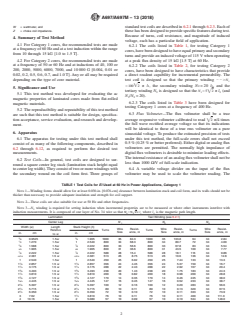
standard test coils are described in 6.2.1 through 6.2.3. Each of
W = wattmeter, and
Z = choke coil impedance.
thesehasbeendesignedtoprovidespecificfeaturesduringtest.
Because of turns, coil resistance, and magnitude of induced
4. Summary of Test Method
voltage, each has a particular field of application.
4.1 For Category 1 cores, the recommended tests are made
6.2.1 The coils listed in Table 1, for testing Category 1
at a frequency of 60 Hz and at a test induction within the range
cores,havebeendesignedtohaveequalprimaryandsecondary
from 10 through 15 kG [1.0 to 1.5 T].
turns and provide an induced voltage of 115 V when operating
4.2 For Category 2 cores, the recommended tests are made at a peak flux density of 15 kG [1.5 T] at 60 Hz.
at a frequency of 50 or 60 Hz and at inductions of 40, 100 or
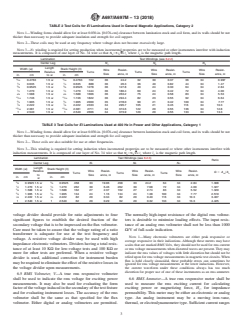
6.2.2 The coils listed in Table 2, for testing Category 2
200, 2000, 5000, 6000, 7000, and 10 000 G [0.004, 0.01 or
cores, have been designed to have characteristics that provide
0.02, 0.2, 0.5, 0.6, 0.7, and 1.0 T]. Any or all may be required
a direct readout capability for incremental permeability. The
depending on the type of core material.
test coil is designed so that the primary winding 22.N
5100=2 π l , the secondary winding N =20 l , and the
1 2 1
5. Significance and Use
tertiary winding N is designed so that the N 55=2 π l (and
3 3 1
5.1 This test method was developed for evaluating the ac
N /N = 20).
1 3
magnetic properties of laminated cores made from flat-rolled
6.2.3 The coils listed in Table 3 have been designed for
magnetic materials.
testing Category 1 cores at a frequency of 400 Hz.
5.2 The reproducibility and repeatability of this test method
6.3 Flux Voltmeter—The flux voltmeter shall be a true
are such that this test method is suitable for design, specifica-
tion acceptance, service evaluation, and research and develop- average responsive voltmeter calibrated to read =2 π/4 times
the full wave rectified average voltage so that its indications
ment.
will be identical to those of a true rms voltmeter on a pure
6. Apparatus
sinusoidal voltage. To produce the estimated precision of tests
under this test method, the full-scale errors shall not exceed
6.1 The apparatus for testing under this test method shall
0.5 % (0.25 % or better preferred). Either digital or analog flux
consist of as many of the following components, described in
voltmeters are permitted. The normally high impedance of
6.2 through 6.12, as required to perform the desired test
digital flux voltmeters is desirable to minimize loading effects.
measurements.
The internal resistance of an analog flux voltmeter shall not be
6.2 Test Coils—In general, test coils are designed to sur-
less than 1000 Ω/V of full-scale indication.
round a square center leg stack (lamination stack height equal
tocenterlegwidth).Theyconsistoftwoormorewindingswith 6.4 A variable voltage divider on the input of the flux
the secondary wound on the coil form first. Three groups of voltmeter may be used to scale the voltmeter reading. The
TABLE 1 Test Coils for EI Used at 60 Hz in Power Applications, Category 1
NOTE 1—Winding forms should allow for at least 0.030-in. [0.076-cm] clearance between lamination stack and coil form, and its walls should not be
thicker than necessary to provide adequate insulation and strength for coil support.
NOTE 2—These coils are also suitable for use at 50 Hz and other frequencies.
NOTE 3—N winding is required for setting induction when incremental properties are to be measured or where other instruments interfere with
induction measurements. It is composed of one layer of No. 34 wire so that N 55 2π l where l is the magnetic path length.
3 œ 1 1
Lamination Test Winding (see 6.2.1)
Center Leg N N N
1 2 3
Length
Width (w) Stack Height (h)
Wire Resist- Wire Resist- Wire Resist-
Relative Turns Turns Turns
Size ance, Ω Size ance, Ω Size ance, Ω
in. cm in. cm
to w
3 3
⁄8 0.9525 1.5w ⁄4 1.905 1000 35 84.3 1000 35 103.8 64 34 2.84
⁄2 1.270 1.5w 1 2.540 800 34 68.3 800 34 80.7 72 34 4.00
5 7
⁄8 1.588 1.5w ⁄8 2.222 800 33 56.6 800 33 67.8 83 34 5.54
3 3
⁄4 1.905 1.5w ⁄4 1.905 800 31 36.6 800 31 43.5 100 34 7.77
7 7
⁄8 2.222 1.5w ⁄8 2.222 588 28 15.4 588 28 18.1 116 34 9.86
15 15
⁄16 2.381 1.5 w ⁄16 2.381 513 26 8.75 513 26 10.6 136 34 12.8
1 2.540 1.5w 1 2.540 450 25 6.02 450 25 7.44 133 34 13.3
1 1
1 ⁄8 2.857 1.5 w 1 ⁄8 2.857 356 24 4.45 356 24 5.37 150 34 16.7
1 1
1 ⁄4 3.175 1.5 w 1 ⁄4 3.175 288 22 2.43 288 22 2.92 167 34 20.4
3 3
1 ⁄8 3.493 1.5 w 1 ⁄8 3.493 238 20 1.43 238 20 1.75 183 34 24.3
1 1
1 ⁄2 3.810 1.5 w 1 ⁄2 3.810 200 18 0.82 200 18 0.98 200 34 28.8
5 5
1 ⁄8 4.127 1.5 w 1 ⁄8 4.127 170 14 0.35 170 14 0.46 245 34 38.0
3 3
1 ⁄4 4.445 1.5 w 1 ⁄4 4.445 147 16 0.45 147 16 0.52 233 34 38.7
1 1
2 ⁄8 5.397 1.5 w 2 ⁄8 5.397 100 12 0.16 100 12 0.20 283 34 56.6
1 1
2 ⁄4 5.715 1.5 w 2 ⁄4 5.715 89 10 0.11 89 10 0.13 320 34 67.5
1 1
2 ⁄2 6.350 1.5 w 2 ⁄2 6.350 72 10 0.10 72 10 0.11 333 34 73.9
3 7.62 1.5w 1 ⁄2 3.810 76 10 0.11 76 10 0.11 400 34 111.0
4 10.16 1.5w 2 5.080 57 10 0.09 57 10 0.10 534 34 148.0
A697/A697M − 13 (2018)
TABLE 2 Test Coils for EI Laminations Used in General Magnetic Applications, Category 2
NOTE 1—Winding forms should allow for at least 0.030-in. [0.076-cm] clearance between lamination stock and coil form, and its walls should be not
thicker than necessary to provide adequate insulation and strength for coil support.
NOTE 2—These coils may be used at any frequency where voltage does not become excessively large.
NOTE 3—N winding is required for setting production when incremental properties are to be measured or other instruments interfere with induction
measurements. It is composed of one layer of No. 34 wire so that N 55 2π l where l is the magnetic path length.
3 œ 1 1
Lamination Test Windings (see 6.2.2)
Center Leg N N N
1 2 3
Length
Width (w) Stack Height (h)
Wire Resist- Wire Resist- Wire Resist-
Relative Turns Turns Turns
Size ance, Ω Size ance, Ω Size ance, Ω
in. cm in. cm
to w
3 3
⁄16 0.4763 1.5 w ⁄16 0.4763 722 36 24.2 32 30 0.37 36 34 0.997
1 1
⁄4 0.635 1.5 w ⁄4 0.635 888 36 26.3 36 40 0.82 44 34 1.47
3 3
⁄8 0.9525 1.5 w ⁄8 0.9525 1278 36 127.8 40 24 0.30 64 34 2.84
1 1
⁄2 1.270 1.5 w ⁄2 1.270 1444 36 180.4 60 24 0.42 72 34 4.00
5 5
⁄8 1.588 1.5 w ⁄8 1.588 1666 36 263.2 75 24 0.58 83 34 5.53
11 11
⁄16 1.746 1.5 w ⁄16 1.746 1822 36 294.4 82 23 0.55 92 34 6.64
3 3
⁄4 1.905 1.5 w ⁄4 1.905 2000 35 278.0 90 21 0.42 100 34 7.77
7 7
⁄8 2.222 1.5 w ⁄8 2.222 2333 34 295.7 105 21 0.45 116 34 10.3
15 15
⁄16 2.381 1.5 w ⁄16 2.381 2711 34 374.6 122 20 0.55 136 34 12.8
1 2.540 1.5 w 1 2.540 2666 34 373.9 120 20 0.55 133 34 13.3
TABLE 3 Test Coils for EI Laminations Used at 400 Hz in Power and Other Applications, Category 1
NOTE 1—Winding forms should allow for at least 0.030-in. [0.076-cm] clearance between lamination stack and coil form, and its walls should be not
thicker than necessary to provide adequate insulation and strength for coil support.
NOTE 2— These coils are also suitable for use at other frequencies.
NOTE 3—This winding is required for setting induction when incremental properties are to be measured or where other instruments interfere with
induction measurements. It is composed of one layer of No. 34 wire so that N 55 2π l where l is the magnetic path length.
3 œ 1
Lamination Test Windings (see 6.2.3)
Ratio
Center Leg N N N
1 2 3
Length
Width (w) Stack Height (h)
Relative Wire Resist- Wire Resist- Wire Resist-
G 5 A /A
ss s
Turns Turns Turns
to Size ance, Ω Size ance, Ω Size ance, Ω
in. cm in. cm
w
3 3
⁄8 0.95251.5 w ⁄8 0.9525 458 33 19.06 458 33 24.2 64 34 2.84 1.308
1 1
⁄2 1.270 1.5 w ⁄2 1.270 262 30 6.46 262 30 7.68 72 34 4.00 1.327
5 5
⁄8 1.588 1.5 w ⁄8 1.588 162 27 2.37 162 27 2.74 83 34 5.52 1.329
3 3
⁄4 1.905 1.5 w ⁄4 1.905 134 24 1.16 134 24 1.38 100 34 7.77 2.519
7 7
⁄8 2.222 1.5 w ⁄8 2.222 82 20 0.34 82 20 0.40 116 34 10.3 3.407
1 2.540 1.5 w 1 2.540 62 20 0.29 62 20 0.32 133 34 13.3 4.425
voltage divider should provide for ratio adjustments to four The normally high-input resistance of the digital rms voltme-
significant figures to establish the desired fraction of the ters is desirable to minimize loading effects. The input resis-
secondary voltage that is to be impressed on the flux voltmeter. tance of an analog rms voltmeter shall not be less than 1000
Care must be taken to assure that the voltage rating of a ratio Ω/V of full-scale indication.
transformer is adequate for use at the test frequency and
NOTE 1—Many electronic voltmeters are either peak responsive or
voltage. A resistive voltage divider may be used with high
average responsive in their indications. Although these meters may have
impedance electronic voltmeters. Dividers having a total resis-
scales that are marked RMS Volts, they should not be used for rms current
tance of at least 10 KΩ for low-voltage tests and 100 KΩ or or rms voltage measurements when distorted waves are present.They may
indicate the rms values of voltages with little distortion but should not be
more for other tests are preferred. When a resistive voltage
relied upon for rms voltage measurements in magnetic test circuits. When
divider is used, additional correction for instrument burden
flux is held closely sinusoidal, these probable errors can sometimes be
may be required to eliminate the effect of the resistive losses in
ignored for rms voltage measurements at the lower inductions. However,
the voltage divider upon measurements.
the current waveform under these conditions always has too much
distortion for proper use of one of these instruments as an rms ammeter.
6.5 RMS Voltmeter, V—A true rms responsive voltmeter
shall be used to indicate the rms voltage for exciting power 6.6 RMS Ammeter—A true rms responsive meter shall be
measurements. It may also be used for evaluating the form used to measure the rms exciting current for calculating
factorofthevoltageinducedinthesecondaryofthetestfixture exciting power or magnetizing force, H , for impedance
z
and for evaluating instrument losses. The accuracy of the rms permeability. This meter may be either an electronic or analog
voltmeter shall be the same as that specified for the flux type. An analog instrument may be a moving iron-vane,
voltmeter. Either digital or analog voltmeters are permitted. thermal, or electrodynamometer type. Sufficient current ranges
A697/A697M − 13 (2018)
within 0.1 % and frequency accuracy within 0.1 % should be maintained.
should be provided to cover the desired range of exciting
The tapped transformer and variable transformer may not be needed when
currents.This meter shall have an accuracy of 1 % of full-scale
such test power sources are used. Electronic power sources using negative
indication or better. Its internal impedance should be less than
feedback from the secondary winding of the test fixture to reduce flux
0.1 Ω for testing Category 1 cores. For Category 2 cores in
waveform distortion may be used.
which the test coil resistance is already high, the ammeter’s
6.12 Wattmeter—An electronic wattmeter with appropriate
input resistance may be higher (Note 2).Atrue rms responsive
voltage, current, and frequency ratings is the preferred instru-
voltmeter (Note 1) of suitable accuracy connected across an
ment. The voltage circuit shall be capable of accepting the
ammeter shunt resistor provides an rms ammeter having an
maximum peak voltage that is induced in the secondary
adequate range and ability of adjustment.
winding during testing. The current input circuitry shall be
NOTE 2—At any test induction the voltage drop across the rms ammeter capable of handling the maximum rms current and the maxi-
(or shunt resistor) should be less than 1 % of the voltage across the test
mum peak current drawn by the primary winding of the test
coil primary windings.
fixturewhencorelosstestsarebeingperformed.Thewattmeter
6.7 Ammeter Shunt Resistor, R —This is a high quality
1 shall be capable of accurate measurements at all frequencies of
resistor that is placed in series with the primary test winding
interest and at low-power factors.
and shall carry the full primary exciting current. A voltmeter
Alternatively, a direct reading low-power factor electrody-
across its terminal completes an ammeter.
namometer wattmeter of high sensitivity may be used. For
6.7.1 This resistor should have an accuracy of at least 0.1 %
general testing the resistance of the potential circuit of this
and should have a very low-temperature coefficient so that its
instrument should not be less than 100 Ω/V of full-scale
errors do not appreciably increase the overall ammeter errors.
potential-circuit voltage rating. The inductance of the
6.7.2 When testing larger Category 1 (power size) cores at
potential-circuit coil should be such that the inductive reac-
high inductions this resistor may carry several amperes and the
tance at the test frequency will not exceed 1 Ω per 1000 Ω of
power dissipation capabilities should be such that the maxi-
resistance of this circuit unless the potential circuit is compen-
mum primary current will not result in destructive heating or
sated for its reactance.
loss of specified accuracy as a result of self heating.
7. Test Specimen
6.7.3 Forsmallercorestestedatlowormoderateinductions,
the power dissipation capabilities may be as low as 5 W
7.1 The test specimen may consist of any size lamination
without causing errors as a result of self heating.
described in Table 4. It shall be composed of sufficient
laminationstoprovidealaminationstackhavingasquarecross
6.8 Tapped Transformer—This transformer shall be capable
section in the leg which is to be surrounded by the test winding
of supplying sufficient current and voltage for the excitation of
(lamination stack height equal to center leg width).
all common Category 1 (power size) laminations. Its core
should consist of high-quality silicon iron laminations and be
7.2 If the test specimen consists of EI, UI, EE, or other
designedtooperateatinductionsof12kGorbelowandshould
two-piece laminations, there shall be equal numbers of both
be able to handle 750 to 1000 VAwhen operating at a primary
types in the test specimen. If it consists of an F type or other
voltage of 115 V and 60 H . For convenience, it should have
one-piece lamination, there shall be an even number of
z
taps at 50, 75, 100, and 125 V. Lower voltage taps may also be
laminations in the test specimen.
useful.
8. Test Specimen Preparation
6.9 Variable Transformer or Autotransformer—For tests of
8.1 Check the specimen before test to see that it contains no
larger Category 1 cores, the variable transformer or autotrans-
dented or bent pieces and that the laminations are reasonably
former should have a rating of 1 or 1.5 kVA. For Category 2 or
flat, without noticeable curvature.
smaller Category 1 cores it is often desirable to use a smaller
variable transformer because it may provide smaller steps of
8.2 Weigh the part of the test specimen upon which calcu-
voltage adjustment.
lations are based with a balance of sufficient sensitivity and
accuracy to determine the specimen mass to an accuracy of
6.10 Choke Coil—This is a high-inductance choke coil
0.1 %.This eliminates the mass as a source of testing error and
having an air gap to prevent magnetic saturation. It shall have
assures that any rounding of test specimen mass will be in the
a wire size sufficiently large to handle the dc incremental
correct direction.
currents and a core size and number of turns that provide
sufficient inductance to meet the requirements of 9.5.7.
8.3 When correlations are to be obtained between the
properties of the lamination stack and the properties of the
6.11 Power Source—To provide satisfactory voltage stabil-
magnetic material of which it is composed, the laminations
ity it is recommended that a 1-kVA constant voltage trans-
shall have a proper stress-relieving anneal after punching and
former of good quality be used. It shall have voltage regulation
before test.
of at least 1 % and harmonic correction or filtering to provide
a voltage waveform which has 3 % or less harmonic distortion.
8.4 The laminations shall be assembled into the test coils by
For more precise testing, both voltage regulation and harmonic
alternatively interleaving the joints (Note 4) one by one unless
distortion should be no larger than 0.1 %.
otherwiseagreeduponbetweentheproducerandtheuser.Take
care to have all burrs the same direction, for example, burrs up
NOTE 3—Test power may alternatively be supplied by an electronic
on both Es and Is (or other shapes). One method of stacking is
source of sinusoidal test power that is characterized by low internal
impedance and excellent voltage and frequency stability. Voltage stability to set equal height piles of Es and Is on either side of the coil
A697/A697M − 13 (2018)
TABLE 4 Dimensional Characteristics of EI Lamination Stacks
Lamination E Lamination Only EI Combined
Center Leg
One Side Surface Area One Side Surface Area
Magnetic Path Length (l )
Special Computer Ratio G =
Length (A ) (A )
Width (w) s ss
Size
Features Code A /A
Relative to ss s
2 2 2 2
in. cm in. cm in. cm in. cm
Width
EI-18 SHT . ⁄16 0.4761 . 0.1985 1.281 0.2680 1.729 . . 1.350
EI-18 H . ⁄16 0.4761 . 0.2336 1.507 0.3031 1.956 . . 1.298
EI-18 NO 0018 ⁄16 0.4761 1.5 w 0.2344 1.512 0.2947 1.901 1.625 4.127 1.300
EI-25 . 0025 ⁄4 0.6350 1.5 w 0.3733 2.409 0.4965 3.203 2.000 5.080 1.330
EI- . . ⁄4 0.6350 . 0.3750 2.420 0.5000 3.226 . . 1.333
EI-31 . 0031 ⁄16 0.7938 1.5 w 0.6962 4.492 0.9042 5.834 2.937 7.460 1.299
EI-37 . 0037 ⁄8 0.9525 1.5 w 0.8134 5.248 1.064 6.865 2.875 7.302 1.308
EI-50 . 0050 ⁄2 1.270 1.5 w 1.206 7.781 1.600 10.32 3.250 8.255 1.327
EI-62 . 0062 ⁄8 1.588 1.5 w 1.746 11.27 2.319 14.96 3.750 9.525 1.329
EI-62 LH 0063 ⁄8 1.588 . . . . . . . .
EI-68 . 0068 ⁄16 1.746 1.5 w 2.115 13.65 2.811 18.14 4.125 10.48 1.329
EI-75 VOP 0074 ⁄4 1.905 . . . . . . . .
EI-75 Std. 0075 ⁄4 1.905 1.5 w 2.519 16.25 3.350 21.61 4.500 11.43 1.330
EI-75 S 0076 ⁄4 1.905 . 2.473 15.96 3.260 21.03 . . 1.318
EI-75 H2L 0077 ⁄4 1.905 . . . . . . . .
EI-75 H2L 0078 ⁄4 1.905 . . . . . . . .
EI-75 H4 0079 ⁄4 1.905 . . . . . . . .
EI-87 H 0087 ⁄8 2.222 1.5 w 3.407 21.98 4.517 29.14 5.250 13.34 1.326
EI-87 HS 0088 ⁄8 2.222 . 3.355 21.65 4.416 28.49 . . 1.317
EI-87 RH 0089 ⁄8 2.222 . 3.407 21.98 4.517 29.14 . . 1.326
EI-93 . 0092 ⁄16 2.381 . . . . . . . .
EI-93 H 0093 ⁄16 2.381 1.5 w 4.261 27.49 5.502 35.50 6.125 15.56 1.312
EI-93 HS 0094 ⁄16 2.381 . 4.204 27.12 5.479 35.35 . . 1.303
EI-93 H6 0095 ⁄16 2.381 . . . . . . . .
EI-100 H 0100 1 2.540 1.5 w 4.425 28.55 5.850 37.74 6.000 15.24 1.322
EI-100 RH 0102 1 2.540 . 4.425 28.55 5.850 37.74 . . 1.322
EI-100 HS 0101 1 2.540 . 4.366 28.17 5.735 37.00 . . 1.313
EI-100 RHS 0103 1 2.540 . 4.366 28.17 5.735 37.00 . . 1.313
EI-112 H 0112 1 ⁄8 2.857 1.5 w 5.620 36.25 7.443 48.02 6.750 17.15 1.324
EI-112 RH 0114 1 ⁄8 2.857 . 5.620 36.26 7.443 48.02 . . 1.324
EI-112 HS 0113 1 ⁄8 2.857 . 5.555 35.84 7.315 47.20 . . 1.317
EI-112 RHS 0115 1 ⁄8 2.857 . 5.555 35.84 7.315 47.20 . . 1.317
EI-125 H 0125 1 ⁄4 3.175 1.5 w 6.956 44.88 9.225 59.52 7.500 19.05 1.326
EI-125 RH 0127 1 ⁄4 3.175 . 6.956 44.88 9.225 59.52 . . 1.326
EI-125 HS 0126 1 ⁄4 3.175 . 6.891 44.46 9.096 58.69 . . 1.320
EI-125 RHS 0128 1 ⁄4 3.175 . 6.891 44.46 9.096 58.69 . . 1.320
EI-125 H6 0129 1 ⁄4 3.175 . . . . . . . .
EI-137 H 0136 1 ⁄8 3.493 . 8.433 54.41 11.19 72.20 . . 1.327
EI-137 HS 0137 1 ⁄8 3.493 1.5 w 8.343 53.83 11.02 71.10 8.250 20.06 1.320
EI-137 RH 0138 1 ⁄8 3.493 . 8.433 54.41 11.19 72.20 . . 1.327
EI-137 RHS 0139 1 ⁄8 3.493 . 8.343 53.83 11.02 71.10 . . 1.320
EI-140 RH 0140 1 ⁄8 3.493 1.5 w 9.206 59.40 12.22 78.84 9.000 22.86 1.328
EI-137 RH6 0141 1 ⁄8 3.493 1.5 w 8.395 54.16 11.12 71.75 9.000 22.86 1.324
EI-150 H 0150 1 ⁄2 3.810 1.5 w 10.05 64.84 13.35 86.13 9.000
...