

ASTM A598/A598M-02(2022)
(Test Method)Standard Test Method for Magnetic Properties of Magnetic Amplifier Cores
General Information
- Abstract
SIGNIFICANCE AND USE
5.1 The method of excitation simulates, to a practical degree, the operation of a magnetic core in a self-saturating magnetic amplifier. The properties measured are related to the quality of performance of the cores in magnetic amplifiers and are useful for the specification of materials for such cores.
SCOPE
1.1 This test method covers the determination of the magnetic performance of fully processed cores for magnetic amplifier-type applications.
1.2 Tests may be conducted at excitation frequencies of 60 Hz, 400 Hz, 1600 Hz, or higher frequencies.
1.3 Permissible core sizes for this test method are limited only by the available power supplies and the range and sensitivity of the instrumentation.
1.4 At specified values of full-wave sinusoidal-current excitation, Hmax, this test method provides procedures of determining the corresponding value of maximum induction, Bmax.
1.5 At specified values of half-wave sinusoidal-current excitation, this test method provides procedures for determining the residual induction, Br.
1.6 At increased specified values of half-wave sinusoidal-current excitation, this test method provides procedures for determining the dc reverse biasing magnetic field strength, H1, required to reset the induction in the core material past Br to a value where the total induction change, ΔB1, becomes approximately one third of the induction change, 2 Bp. It also provides procedures for determining the additional dc reset magnetic field strength, ΔH, which, combined with H1, is the value required to reset the induction in the core material past Br to a value where the total induction change, ΔB2, becomes approximately two thirds of the induction change 2 Bp.
1.7 This test method specifies procedures for determining core gain from the corresponding biasing and induction changes, ΔH and ΔB.
1.8 This test method covers test procedures and requirements for evaluation of finished cores which are to be used in magnetic-amplifier-type applications. It is not a test for basic-material magnetic properties.
1.9 This test method shall be used in conjunction with Practice A34/A34M.
1.10 Explanations of symbols and abbreviated definitions appear in the text of this test method. The official symbols and definitions are listed in Terminology A340.
1.11 The values and equations stated in customary (cgs-emu and inch-pound) or SI units are to be regarded separately as standard. Within this test method, SI units are shown in brackets. The values stated in each system may not be exact equivalents; therefore, each system shall be used independently of the other. Combining values from the two systems may result in nonconformance with this test method.
1.12 This standard does not purport to address all of the safety concerns, if any, associated with its use. It is the responsibility of the user of this standard to establish appropriate safety, health, and environmental practices and determine the applicability of regulatory limitations prior to use.
1.13 This international standard was developed in accordance with internationally recognized principles on standardization established in the Decision on Principles for the Development of International Standards, Guides and Recommendations issued by the World Trade Organization Technical Barriers to Trade (TBT) Committee.
- Status
- Published
- Publication Date
- 30-Sep-2022
- Technical Committee
- A06 - Magnetic Properties
- Drafting Committee
- A06.01 - Test Methods
Overview
ASTM A598/A598M-02(2022), published by ASTM International, specifies a standard test method for assessing the magnetic properties of magnetic amplifier cores. This test method is crucial for evaluating the magnetic performance and quality of fully processed cores used in magnetic amplifier-type applications. By simulating the function of cores in self-saturating magnetic amplifiers, it enables the reliable specification of materials appropriate for these demanding environments.
Designed for practical application, this method applies to a wide range of excitation frequencies (including 60 Hz, 400 Hz, and 1600 Hz or higher) and is adaptable to various core sizes, only limited by test instrumentation and power supply capabilities. It focuses on finished cores rather than raw material properties, providing meaningful data to manufacturers and users in power electronics and related industries.
Key Topics
- Magnetic Core Performance: The method determines key magnetic properties including maximum induction (Bmax), residual induction (Br), and the core’s gain factor. These are evaluated under both full-wave and half-wave sinusoidal-current excitation.
- Excitation Frequency: Tests can be performed at multiple power frequencies, allowing flexibility based on application requirements.
- Core Size and Instrumentation: Core size is only constrained by available testing apparatus, making the standard efficient for research, development, and production environments.
- Biasing Field Strength Measurements: Procedures for determining the biasing magnetic field strength (H1 and ΔH) required to reset induction levels in the core are provided.
- Procedure Integration: The test method must be used alongside Practice A34/A34M, ensuring appropriate sampling and procurement of magnetic materials.
Applications
ASTM A598/A598M-02(2022) is applicable in several practical contexts, including:
- Material Specification: Ensures that core materials meet the performance demands of magnetic amplifier applications, facilitating quality assurance and procurement.
- Design & Manufacturing: Aids engineers in selecting suitable materials and core configurations for advanced power electronics, such as power converters and regulated power supplies, where magnetic amplifiers are used.
- Performance Benchmarking: The defined test parameters enable consistent benchmarking of finished core products across production batches or between suppliers.
- Research & Development: Useful in the development of new magnetic materials and core geometries, especially where magnetic amplifier performance is a critical metric.
Related Standards
For best practices and comprehensive testing, this standard references or should be used in conjunction with:
- ASTM A34/A34M - Practice for Sampling and Procurement Testing of Magnetic Materials. This ensures representative and statistically valid selection of test specimens.
- ASTM A340 - Terminology of Symbols and Definitions Relating to Magnetic Testing. Provides official definitions and symbols, establishing clarity across documentation.
- ASTM A596/A596M - Test Method for Direct-Current Magnetic Properties Using the Point by Point (Ballistic) Method and Ring Specimens. Offers complementary procedures for direct-current measurements.
Practical Value
Implementing ASTM A598/A598M-02(2022) gives manufacturers, engineers, and quality assurance professionals a uniform, reliable method for evaluating the operational magnetic properties of amplifier cores. Consistent application of this method promotes safer, more efficient, and higher-performing magnetic amplifiers-vital components in modern electrical and electronic systems. The standard’s adaptability to different frequencies and core sizes increases its utility across diverse industries that depend on advanced magnetic technologies.
Keywords: magnetic amplifier core testing, ASTM A598, magnetic properties, Bmax, Br, core gain, excitation frequency, power electronics, magnetic materials standard, magnetic amplifier applications
Relations
- Effective Date
- 01-Dec-2023
- Effective Date
- 15-Oct-2019
- Effective Date
- 15-Jun-2019
- Effective Date
- 15-Feb-2019
- Effective Date
- 01-Jun-2018
- Effective Date
- 15-Oct-2017
- Effective Date
- 01-Jul-2017
- Effective Date
- 01-May-2016
- Effective Date
- 01-May-2016
- Effective Date
- 01-Oct-2015
- Effective Date
- 01-Oct-2014
- Effective Date
- 01-Nov-2012
- Refers
ASTM A340-03a(2011) - Standard Terminology of Symbols and Definitions Relating to Magnetic Testing - Effective Date
- 01-May-2011
- Effective Date
- 01-Nov-2009
- Refers
ASTM A34/A34M-06 - Standard Practice for Sampling and Procurement Testing of Magnetic Materials - Effective Date
- 01-Nov-2006
Get Certified
Connect with accredited certification bodies for this standard

IMQ S.p.A. (Certification)
Italian electrical product certification.

SLG Prüf- und Zertifizierungs GmbH
German testing and certification body.

UL Solutions
Global safety science company with testing, inspection and certification.
Sponsored listings
Frequently Asked Questions
ASTM A598/A598M-02(2022) is a standard published by ASTM International. Its full title is "Standard Test Method for Magnetic Properties of Magnetic Amplifier Cores". This standard covers: SIGNIFICANCE AND USE 5.1 The method of excitation simulates, to a practical degree, the operation of a magnetic core in a self-saturating magnetic amplifier. The properties measured are related to the quality of performance of the cores in magnetic amplifiers and are useful for the specification of materials for such cores. SCOPE 1.1 This test method covers the determination of the magnetic performance of fully processed cores for magnetic amplifier-type applications. 1.2 Tests may be conducted at excitation frequencies of 60 Hz, 400 Hz, 1600 Hz, or higher frequencies. 1.3 Permissible core sizes for this test method are limited only by the available power supplies and the range and sensitivity of the instrumentation. 1.4 At specified values of full-wave sinusoidal-current excitation, Hmax, this test method provides procedures of determining the corresponding value of maximum induction, Bmax. 1.5 At specified values of half-wave sinusoidal-current excitation, this test method provides procedures for determining the residual induction, Br. 1.6 At increased specified values of half-wave sinusoidal-current excitation, this test method provides procedures for determining the dc reverse biasing magnetic field strength, H1, required to reset the induction in the core material past Br to a value where the total induction change, ΔB1, becomes approximately one third of the induction change, 2 Bp. It also provides procedures for determining the additional dc reset magnetic field strength, ΔH, which, combined with H1, is the value required to reset the induction in the core material past Br to a value where the total induction change, ΔB2, becomes approximately two thirds of the induction change 2 Bp. 1.7 This test method specifies procedures for determining core gain from the corresponding biasing and induction changes, ΔH and ΔB. 1.8 This test method covers test procedures and requirements for evaluation of finished cores which are to be used in magnetic-amplifier-type applications. It is not a test for basic-material magnetic properties. 1.9 This test method shall be used in conjunction with Practice A34/A34M. 1.10 Explanations of symbols and abbreviated definitions appear in the text of this test method. The official symbols and definitions are listed in Terminology A340. 1.11 The values and equations stated in customary (cgs-emu and inch-pound) or SI units are to be regarded separately as standard. Within this test method, SI units are shown in brackets. The values stated in each system may not be exact equivalents; therefore, each system shall be used independently of the other. Combining values from the two systems may result in nonconformance with this test method. 1.12 This standard does not purport to address all of the safety concerns, if any, associated with its use. It is the responsibility of the user of this standard to establish appropriate safety, health, and environmental practices and determine the applicability of regulatory limitations prior to use. 1.13 This international standard was developed in accordance with internationally recognized principles on standardization established in the Decision on Principles for the Development of International Standards, Guides and Recommendations issued by the World Trade Organization Technical Barriers to Trade (TBT) Committee.
SIGNIFICANCE AND USE 5.1 The method of excitation simulates, to a practical degree, the operation of a magnetic core in a self-saturating magnetic amplifier. The properties measured are related to the quality of performance of the cores in magnetic amplifiers and are useful for the specification of materials for such cores. SCOPE 1.1 This test method covers the determination of the magnetic performance of fully processed cores for magnetic amplifier-type applications. 1.2 Tests may be conducted at excitation frequencies of 60 Hz, 400 Hz, 1600 Hz, or higher frequencies. 1.3 Permissible core sizes for this test method are limited only by the available power supplies and the range and sensitivity of the instrumentation. 1.4 At specified values of full-wave sinusoidal-current excitation, Hmax, this test method provides procedures of determining the corresponding value of maximum induction, Bmax. 1.5 At specified values of half-wave sinusoidal-current excitation, this test method provides procedures for determining the residual induction, Br. 1.6 At increased specified values of half-wave sinusoidal-current excitation, this test method provides procedures for determining the dc reverse biasing magnetic field strength, H1, required to reset the induction in the core material past Br to a value where the total induction change, ΔB1, becomes approximately one third of the induction change, 2 Bp. It also provides procedures for determining the additional dc reset magnetic field strength, ΔH, which, combined with H1, is the value required to reset the induction in the core material past Br to a value where the total induction change, ΔB2, becomes approximately two thirds of the induction change 2 Bp. 1.7 This test method specifies procedures for determining core gain from the corresponding biasing and induction changes, ΔH and ΔB. 1.8 This test method covers test procedures and requirements for evaluation of finished cores which are to be used in magnetic-amplifier-type applications. It is not a test for basic-material magnetic properties. 1.9 This test method shall be used in conjunction with Practice A34/A34M. 1.10 Explanations of symbols and abbreviated definitions appear in the text of this test method. The official symbols and definitions are listed in Terminology A340. 1.11 The values and equations stated in customary (cgs-emu and inch-pound) or SI units are to be regarded separately as standard. Within this test method, SI units are shown in brackets. The values stated in each system may not be exact equivalents; therefore, each system shall be used independently of the other. Combining values from the two systems may result in nonconformance with this test method. 1.12 This standard does not purport to address all of the safety concerns, if any, associated with its use. It is the responsibility of the user of this standard to establish appropriate safety, health, and environmental practices and determine the applicability of regulatory limitations prior to use. 1.13 This international standard was developed in accordance with internationally recognized principles on standardization established in the Decision on Principles for the Development of International Standards, Guides and Recommendations issued by the World Trade Organization Technical Barriers to Trade (TBT) Committee.
ASTM A598/A598M-02(2022) is classified under the following ICS (International Classification for Standards) categories: 29.100.10 - Magnetic components. The ICS classification helps identify the subject area and facilitates finding related standards.
ASTM A598/A598M-02(2022) has the following relationships with other standards: It is inter standard links to ASTM A340-23a, ASTM A340-19b, ASTM A340-19a, ASTM A340-19, ASTM A340-18, ASTM A340-17a, ASTM A340-17, ASTM A340-16, ASTM A340-16e1, ASTM A340-15, ASTM A340-14, ASTM A34/A34M-06(2012), ASTM A340-03a(2011), ASTM A596/A596M-95(2009)e1, ASTM A34/A34M-06. Understanding these relationships helps ensure you are using the most current and applicable version of the standard.
ASTM A598/A598M-02(2022) is available in PDF format for immediate download after purchase. The document can be added to your cart and obtained through the secure checkout process. Digital delivery ensures instant access to the complete standard document.
Standards Content (Sample)
This international standard was developed in accordance with internationally recognized principles on standardization established in the Decision on Principles for the
Development of International Standards, Guides and Recommendations issued by the World Trade Organization Technical Barriers to Trade (TBT) Committee.
Designation:A598/A598M −02 (Reapproved 2022)
Standard Test Method for
Magnetic Properties of Magnetic Amplifier Cores
This standard is issued under the fixed designationA598/A598M; the number immediately following the designation indicates the year
of original adoption or, in the case of revision, the year of last revision.Anumber in parentheses indicates the year of last reapproval.
A superscript epsilon (´) indicates an editorial change since the last revision or reapproval.
1. Scope 1.9 This test method shall be used in conjunction with
Practice A34/A34M.
1.1 This test method covers the determination of the mag-
netic performance of fully processed cores for magnetic 1.10 Explanations of symbols and abbreviated definitions
appear in the text of this test method.The official symbols and
amplifier-type applications.
definitions are listed in Terminology A340.
1.2 Tests may be conducted at excitation frequencies of
1.11 Thevaluesandequationsstatedincustomary(cgs-emu
60Hz, 400Hz, 1600Hz, or higher frequencies.
and inch-pound) or SI units are to be regarded separately as
1.3 Permissible core sizes for this test method are limited
standard. Within this test method, SI units are shown in
only by the available power supplies and the range and
brackets. The values stated in each system may not be exact
sensitivity of the instrumentation.
equivalents;therefore,eachsystemshallbeusedindependently
1.4 At specified values of full-wave sinusoidal-current
of the other. Combining values from the two systems may
excitation, H , this test method provides procedures of
max result in nonconformance with this test method.
determining the corresponding value of maximum induction,
1.12 This standard does not purport to address all of the
B .
max
safety concerns, if any, associated with its use. It is the
1.5 At specified values of half-wave sinusoidal-current
responsibility of the user of this standard to establish appro-
excitation, this test method provides procedures for determin-
priate safety, health, and environmental practices and deter-
ing the residual induction, B .
mine the applicability of regulatory limitations prior to use.
r
1.13 This international standard was developed in accor-
1.6 At increased specified values of half-wave sinusoidal-
dance with internationally recognized principles on standard-
current excitation, this test method provides procedures for
ization established in the Decision on Principles for the
determining the dc reverse biasing magnetic field strength, H ,
Development of International Standards, Guides and Recom-
required to reset the induction in the core material past B to a
r
mendations issued by the World Trade Organization Technical
valuewherethetotalinductionchange,∆B ,becomesapproxi-
Barriers to Trade (TBT) Committee.
matelyonethirdoftheinductionchange,2 B .Italsoprovides
p
procedures for determining the additional dc reset magnetic
2. Referenced Documents
field strength, ∆H, which, combined with H , is the value
2.1 ASTM Standards:
required to reset the induction in the core material past B to a
r
A34/A34MPractice for Sampling and Procurement Testing
valuewherethetotalinductionchange,∆B ,becomesapproxi-
of Magnetic Materials
mately two thirds of the induction change 2 B .
p
A340Terminology of Symbols and Definitions Relating to
1.7 This test method specifies procedures for determining
Magnetic Testing
core gain from the corresponding biasing and induction
A596/A596MTest Method for Direct-Current Magnetic
changes, ∆H and ∆B.
PropertiesofMaterialsUsingthePointbyPoint(Ballistic)
Method and Ring Specimens
1.8 This test method covers test procedures and require-
ments for evaluation of finished cores which are to be used in
3. Terminology
magnetic-amplifier-type applications. It is not a test for basic-
3.1 Definitions—Below is a list of symbols and definitions
material magnetic properties.
as used in this test method. The official list of symbols and
definitions may be found in Terminology A340. (See Table 1
where indicated.)
This test method is under the jurisdiction of ASTM Committee A06 on
MagneticPropertiesandisthedirectresponsibilityofSubcommitteeA06.01onTest
Methods. For referenced ASTM standards, visit the ASTM website, www.astm.org, or
Current edition approved Oct. 1, 2022. Published October 2022. Originally contact ASTM Customer Service at service@astm.org. For Annual Book of ASTM
approved in 1969. Last previous edition approved in 2015 as A598/A598M–02 Standards volume information, refer to the standard’s Document Summary page on
(2015). DOI: 10.1520/A0598_A0598M-02R22. the ASTM website.
Copyright © ASTM International, 100 Barr Harbor Drive, PO Box C700, West Conshohocken, PA 19428-2959. United States
A598/A598M−02 (2022)
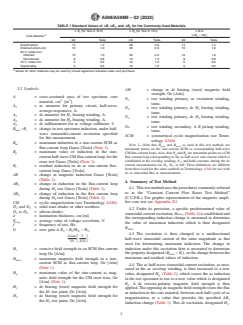
TABLE 1 Standard Values of ∆B, ∆B,and ∆B for the Commonly Used Materials
1 2
∆ B (for Test of 10.5) ∆ B (for Test of 10.4) ∆ B or
1 2
A
(∆B −∆B )
Core Material 2 1
kG Tesla kG Tesla kG Tesla
Supermendur 14 1.4 28 2.8 14 1.4
Oriented silicon-iron 10 1.0 20 2.0 10 1.0
50 % nickel-iron:
Oriented 10 1.0 20 2.0 10 1.0
Nonoriented 8 0.8 16 1.6 8 0.8
79 % nickel-iron 5 0.5 10 1.0 5 0.5
Supermalloy 5 0.5 10 1.0 5 0.5
A
Values for other materials may be used by mutual agreement between seller and purchaser.
3.2 Symbols:
∆H = change in dc biasing (reset) magnetic field
strength, Oe [A/m].
A = cross-sectional area of test specimen core
N = test winding primary, ac excitation winding,
2 2 1
material, cm [m ].
turns.
A = ac ammeter for primary circuit, half-wave,
N = test winding primary, dc H biasing winding,
2 1
average-responsive, A.
turns.
A = dc ammeter for H biasing winding, A.
2 1
N = test winding primary, dc H biasing winding,
3 2
A = dc ammeter for H biasing winding, A.
3 2
turns.
A = dc milliammeter for ac voltage calibrator, V.
N = test winding secondary, ∆ B pickup winding,
B −B = change in test specimen induction, under half-
max r
turns.
wave sinusoidal-current excitation specified
SCM = symmetrical cyclic magnetization (see Termi-
for this measurement.
nology A340).
B = maximum induction in a sine-current SCM ac
m
NOTE 1—Note that H and B , as used in this test method, are
max max
flux-current loop Gauss [Tesla] (Note 1).
maximum points on the sine-current SCM or corresponding half-wave
B = maximum value of induction in the sine-
p CMflux-currentloops.Also,thatH andB aremaximumpointsonaCM
p p
currenthalf-waveCMflux-currentloop,forthe flux-current loop corresponding to the ac half-wave sine current which is
established in the exciting winding, N , and held constant, during the dc
reset test Gauss [Tesla] (Note 1).
current measurements for H , H,or ∆H. These definitions are different
1 2
B = residual induction in an ac sine-current flux-
r
from those used for the same symbols in Terminology A340 for use with
current loop Gauss [Tesla].
dc or sinusoidal-flux ac measurements.
∆B = change in magnetic induction Gauss [Tesla]
(Table 1).
4. Summary of Test Method
∆B = change in induction in the flux-current loop
4.1 Thistestmethodusestheprocedurescommonlyreferred
during H test Gauss [Tesla] (Table 1).
to as the “Constant Current Flux Reset Test Method”
∆B = change of induction in the flux current loop
(C.C.F.R.). For graphic representation of the magnetic ampli-
during H test Gauss [Tesla] (Table 1).
fier core test see Appendix X3.
CM = cyclic magnetization (see Terminology A340).
D and D = solid state diodes or other rectifiers.
1 2
4.2 Under its provision, a specific predetermined value of
D to D = silicon diodes.
3 6
sinusoidal-currentexcitation,H ,(Table2)isestablishedand
max
d = lamination thickness, cm [m].
the corresponding induction change is measured to determine
E = average value of voltage waveform, V.
avg
the value of maximum induction which is then designated
f = frequency of test, Hz.
B .
max
G = core gain ∆ B −B /H,−H ,
2 1 2 1
4.3 The excitation is then changed to a unidirectional
Gauss T
.
F G half-wave sinusoidal current of the same magnitude as that
Oe A/m
used for determining maximum induction. The change in
induction under this excitation then is measured to determine
H = coercive field strength in an SCM flux-current
c
the property designated (B −B ), or the change between the
loop Oe [A/m].
max r
maximum and residual values of induction.
H = maximum magnetic field strength in a sine-
max
current SCM ac flux-current loop, Oe [A/m]
4.4 The ac half-wave sinusoidal-current excitation, as mea-
(Note 1).
sured in the ac exciting winding, is then increased to a new
H = maximum value of the sine-current ac mag-
p
value, designated H (Table 2), which causes the ac induction
p
netic field strength for the CM reset tests, Oe
in the test specimen to rise to a new value which is designated
[A/m] (Note 1).
B . A dc reverse-polarity magnetic field strength is then
p
H = dc biasing (reset) magnetic field strength for
applied.Theopposingdcmagneticfieldstrengthresetstheflux
the H test point, Oe [A/m].
orinductioninthecorematerial,betweeneachhalfcycleofac
H = dc biasing (reset) magnetic field strength for
magnetization, to a value that provides the specified ∆B
the H test point, Oe [A/m].
induction change (Table 1). This dc excitation, designated H ,
A598/A598M−02 (2022)
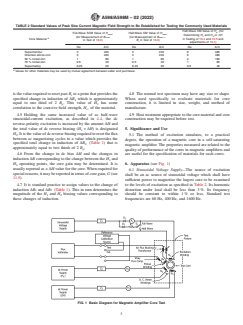
TABLE 2 Standard Values of Peak Sine Current Magnetic Field Strength to Be Established for Testing the Commonly Used Materials
Half-Wave CM Value of H , (for
p
Full-Wave SCM Value of H , Half-Wave CM Value of H ,
max max
Determining H and H or ∆H
1 2
(for Measurement of B (for Measurement of B −
max max
A
in Testing of 10.4 and 10.5 and
Core Material
in Test of 10.2) B in Test of 10.3)
r
adjustments of 10.1)
Oe A/m Oe A/m Oe A/m
Supermendur 3 240 3 240 6 480
Oriented silicon-iron 3 240 3 240 6 480
50 % nickel-iron 1 80 1 80 2 160
79 % nickel-iron 0.5 40 0.5 40 1 80
Supermalloy 0.25 20 0.25 20 0.5 40
A
Values for other materials may be used by mutual agreement between seller and purchaser.
isthevaluerequiredtoresetpastB toapointthatprovidesthe 4.8 The normal test specimen may have any size or shape.
r
specified change in induction of ∆B which is approximately When used specifically to evaluate materials for core
equal to one third of 2 B . This value of H has some construction, it is limited in size, weight, and method of
p 1
correlation to the coercive field strength, H , of the material. manufacture.
c
4.5 Holding the same increased value of ac half-wave 4.9 Heat treatment appropriate to the core material and core
sinusoidal-current excitation, as described in 4.4, the dc construction may be required before test.
reverse-polarity excitation is increased by the amount ∆H and
the total value of dc reverse biasing (H +∆H) is designated 5. Significance and Use
H .Itisthevalueofdcreversebiasingrequiredtoresettheflux
5.1 The method of excitation simulates, to a practical
between ac magnetizing cycles to a value which provides the
degree, the operation of a magnetic core in a self-saturating
specified total change in induction of ∆B (Table 1) that is
magnetic amplifier. The properties measured are related to the
approximately equal to two thirds of 2 B .
p
quality of performance of the cores in magnetic amplifiers and
are useful for the specification of materials for such cores.
4.6 From the change in dc bias ∆H and the changes in
induction∆B corresponding to the change between the H and
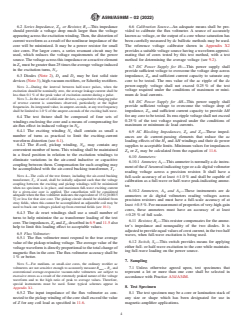
H operating points, the core gain may be determined. It is 6. Apparatus (see Fig. 1)
usually reported as a∆H value for the core.When required for
6.1 Sinusoidal Voltage Supply—The source of excitation
specialreasons,itmaybereportedintermsofcoregain,G(see
shall be an ac source of sinusoidal voltage which shall have
11.5).
sufficient power to magnetize the largest core to be examined
4.7 It is standard practice to assign values to the change of to the levels of excitation as specified in Table 2. Its harmonic
induction ∆B and ∆B (Table 1). This in turn determines the distortion under load shall be less than 3%. Its frequency
1 2
magnitude of the H and H biasing values corresponding to should be constant to within 1% or less. Standard test
1 2
these changes of induction. frequencies are 60Hz, 400Hz, and 1600Hz.
FIG. 1 Basic Diagram for Magnetic Amplifier Core Test
A598/A598M−02 (2022)
6.2 Series Impedance, Z , or Resistor, R —This impedance 6.6 Calibration Source—An adequate means shall be pro-
1 1
should provide a voltage drop much larger than the voltage vided to calibrate the flux voltmeter. A source of accurately
appearingacrosstheexcitationwinding.Then,thedistortionof known ac voltage, or the output of a core whose saturation has
current waveform as a result of the nonlinear impedance of the been carefully measured by dc ballistic methods may be used.
core will be minimized. It may be a power resistor for small The reference voltage calibrator shown in Appendix X2
size cores. For larger cores, a series resonant circuit may be providesasuitablevoltagesourcehavingawaveformapproxi-
used, which reduces the voltage requirements of the power mating that of cores tested by this test method, with a test
source.Thevoltageacrossthisimpedanceorareactiveelement method for determining the average voltage (see 9.2).
inZ mustbegreaterthan25timestheaveragevoltageinduced
6.7 DC Power Supply for H —This power supply shall
in the excitation turns, N .
provide sufficient voltage to overcome the voltage drop across
6.3 Diodes (Note 2), D and D may be fast solid state impedance, Z , and sufficient current capacity to saturate any
1 1 2
devices(Note3),high-vacuumrectifiers,orSchottkyrectifiers. core to be tested. The rms value of the ac ripple of the dc
power-supply voltage shall not exceed 0.25% of the test
NOTE 2—During the interval between half-wave pulses, when the
voltage required under the conditions of maximum or mini-
excitation should be nominally zero, the average leakage current shall be
less than 0.1% of the peak value of excitation current during a pulse. mum dc load currents.
NOTE3—Inthecaseofsolid-statedevices,acapacitativechargingpulse
6.8 DC Power Supply for ∆H—This power supply shall
of reverse current is sometimes observed, particularly at the higher
provide sufficient voltage to overcome the voltage drop of
frequencies. Its integrated value, in ampere-seconds, at any test frequency
shallbelimitedto1.0%oftheampere-secondsoftheexcitinghalf-wave. impedance, Z , and sufficient current capacity to provide ∆H
foranycoretobetested.Itsrmsripplevoltageshallnotexceed
6.4 The test fixture shall be composed of four sets of
0.25% of the test voltage required under the conditions of
windings enclosing the core and a means of compensating for
maximum or minimum dc load currents.
air-flux effect in induced voltage in N .
6.4.1 The exciting winding N shall contain as small a
6.9 AC Blocking Impedances, Z and Z —These imped-
2 3
number of turns as practical to limit the exciting-current
ances are dc current-passing elements that reduce the ac
waveform distortion (see 6.1).
loading effects of the H and ∆H windings and their dc power
6.4.2 The B-coil, pickup winding, N , may contain any
4 supplies to acceptable limits. Minimum values for impedances
convenient number of turns. This winding shall be maintained
Z or Z may be calculated from the equation of 11.6.
2 3
in a fixed position in relation to the excitation windings to
6.10 Ammeters:
eliminate variations in the air-cored inductive or capacitive
6.10.1 Ammeter, A —This ammeter is normally a dc instru-
coupling between them. Compensation for such coupling may
mentofthed’Arsonvalindicatingtypeoradcdigitalvoltmeter
be accomplished with the air-cored bucking transformer, T .
reading voltage across a precision resistor. It shall have a
NOTE 4—The coils of the test fixture, including the air-cored bucking
full-scale accuracy of at least 61.0% and shall be capable of
transformer, T , if used, shall be initially adjusted such that the voltage
calibration as a full-wave or half-wave peak-indicating amme-
coupling between the exciting and pickup windings will be minimized
ter.
when no specimen is in place, and maximum full-wave exciting current
6.10.2 Ammeters, A and A —These instruments are dc
for a given-size core is applied. The cancellation will be considered 2 3
adequatewhenthefluxvoltmeterindicatestheequivalentof15G[0.0015 ammeters or dc digital voltmeters reading voltages across
T] or less for that size core. The pickup circuit should be shielded from
precision resistors and must have a full-scale accuracy of at
stray fields, when this cannot be accomplished an adjustable coil may be
least 60.5%.Formeasurementofpropertiesofvery-high-gain
used to buck out voltages picked up from external fields (see 10.1).
cores, these ammeters must have an accuracy of at least
6.4.3 The dc reset windings shall use a small number of
60.25% of full scale.
turns to help minimize the ac transformer loading of the test
6.11 Resistor, R —This resistor compensates for the amme-
core.Theimpedances,Z andZ ,describedin6.9and11.5also
2 3
ter’s impedance and nonequality of the two diodes. It is
help to limit this loading effect to acceptable values.
adjustedtoprovideequalvaluesofcrestcurrent,inthetwohalf
6.5 Flux Voltmeter:
waves, when full-wave excitation is being used.
6.5.1 The flux voltmeter must respond to the true average
6.12 Switch, S —This switch provides means for applying
value of the pickup-winding voltage. The average value of the
either full- or half-wave excitation to the core while maintain-
voltagewaveformisdirectlyproportionaltothetotalchangeof
ing full-wave loading on the power source.
magnetic flux in the core.The flux-voltmeter accuracy shall be
1% or better.
7. Sampling
NOTE 5—For medium- or small-size cores, the ordinary rectifier ac
7.1 Unless otherwise agreed upon, test specimens that
voltmeters are not sensitive enough to accurately measure B −B , and
max r
conventional average-responsive vacuum-tube voltmeters are subject to
represent a lot or more than one core shall be selected in
excessive errors as a result of the extremely peaked nature of the voltage
accordance with Practice A34/A34M.
waveform and to the high ratio of peak to average values. Therefore,
special instruments must be used. Some typical schemes appear in
8. Test Specimen
Appendix X1.
6.5.2 The input impedance of the flux voltmeter as con- 8.1 The test specimen may be a core or lamination stack of
nectedtothepickupwindingofthecoreshallexceedthevalue any size or shape which has been designated for use in
of Z for any coil load as specified in 11.6. magnetic-amplifier applications.
A598/A598M−02 (2022)
9. Calibration of Test Equipment 10.3 Operate switch S to the half-wave excitation position
and maintain the same value of peak-excitation current, I
p
9.1 The individual instruments used to measure the three
(used in 9.2), so that the half-wave (CM) value of H equals
max
excitation currents must be calibrated against suitable dc
the previous full-wave (SCM) value of H . Again observe
max
reference standards according to good laboratory practice.
and record the flux-voltmeter reading across winding N . This
9.1.1 Ammeter A , used to measure the full-wave and
voltageisproportionaltotheflux-densityshiftinthespecimen
half-wave ac magnetizing currents, is an average-responsive
material during cyclic changes from maximum to residual
ammeter connected in such a manner that for both measure-
induction and is the measure for the quantity B −B .
max r
mentsitseesonlythepositiveunidirectionalhalf-cyclecurrent
wave trains. This dc instrument is calibrated to indicate the
10.4 With switch S remaining in the half-wave excitation
averagevalueoftheachalf-wavewhereI =I ,andthepeak position, readjust the excitation current, I (as calculated for
dc avg p
of the current wave trains is obtained as follows:
10.1), to a value that provides the peak magnetic field strength
specified in Table 1 which is to be maintained during measure-
I 5 πI
p avg
ments for the parameters, H , ∆H, and ∆B. Then adjust the dc
where:
level (form the H power supply) in winding N until the flux
1 2
I = peak value of half-wave ac exciting current, A and voltmeterindicatesthevoltagethatisinducedwhenthedesired
p
I = average value of ac half-wave exciting current, A.
∆B (asshowninTable1)hasbeenestablished.Thisreversedc
avg
biasing current, I , in amperes is used to calculate the value of
9.1.2 Ammeters A and A are dc instruments used to 2
2 3
H in oersteds or A/m (see 11.3).
measure direct current. They require accurate calibration but
no conversion factors.
10.5 WithswitchS remaininginthehalf-wavepositionand
excitation current, I , and reverse-biasing current, I , held to
9.2 Theacfluxmetermaybecalibratedbyeitherareference p 2
the values given in 10.4, adjust the dc current level (from the
core or a reference-voltage calibrator.
∆H power supply) in winding N until the flux voltmeter
9.2.1 Areferencecoreisonewhosefluxchangeisknownor 3
indicates the voltage which is induced when the desired
can be measured. Such measurements can be made by dc
∆B (as shown in Table 1), has been established. This reverse
ballistic methods. A supermalloy core or suitable equivalent
dc biasing current, I , in amperes is used to calculate the value
prepared from 0.001-in. [25-µm] thick material excited to a 3
of ∆H oersteds or A/m (see 11.3). This current represents the
peak excitation of 10 Oe [796 A/m] is suggested. This
change in reverse dc biasing current (or biasing field ∆H
reference core is placed in the test fixture and excited with the
oerstedsorA/m)whichcausestheinductionresultingfromthe
magnetic field strength for which the flux change is known.
ac excitation to change by the value of ∆B G.
The ac flux voltmeter is then calibrated in terms of the known
flux change.
10.6 When a very stable dc power supply is used with 1-dc
9.2.2 The reference-voltage calibrator of Appendix X2 de-
ammeter of the 0.1% class or better, this combination with a
velops a known average voltage having a waveform approxi-
single dc winding, N , may be used for both the H and H or
2 1 2
mating that of the induced voltage in winding N of Fig. X2.1
4 ∆H determinations.
for the measurement of B .
max
10.7 In this test method, the coercive field strength H
c
parameter is not measured directly or calculated from other
10. Procedure
parameters.Anapproximatecorrelationmaybefoundwiththe
10.1 Set switch S to the full-wave position and turn all dc
1 parameter H .
power supplies to zero current. Then, with no core in the test
jig, raise the level of the ac sinusoidal current in the excitation
11. Calculations
winding, N , to the value which produces the peak excitation,
11.1 Table 1 specifies the values of full-wave or half-wave
I , required in Table 1 for the measurement of B . Then adjust
p p
sinusoidal-current magnetic field strength to be used in testing
thecouplingoftheairfluxcompensator,T ,togiveaminimum
various materials. The following equation is used to calculate
readingonthefluxvoltmeterscale(Note4).Thepositionofthe
the peak value of full-wave or half-wave sinusoidal current
stray-flux compensator must also be adjusted to provide the
requiredtoestablishthedesiredmagneticfieldstrength.Where
lowest possible residual-flux voltmeter reading. The exciting
for full-wave excitation,
current, I , value required for this measurement may be
p
calculated from the equation of 11.1. I 5 ℓ H /0.4πN , H inOe
p 1 max 1 max
I 5 ℓ H /N , H inA/m
10.2 Place a test specimen in the test fixture, and with the
p 2 max 1 max
value of full-wave SCM sinusoidal-current excitation, I (cal-
p
and for half-wave excitation,
culated from specified H of Table 2), flowing through the
max
I 5 ℓ H /0.4πN , H inOe
excitation winding, N , observe the flux-voltmeter reading p 1 p 1 p
across winding, N . This voltage corresponds to a total flux
I 5 ℓ H /N , H inA/m
p 2 p 1 p
change from forward B to reverse B (or 2 B in terms
max max max
where:
of half-wave parameters).
I = peak value of current reached during a cycle of the
p
sinusoidal full-wave or half-wave exciting current,
A;
See Practice A34/A34M, Terminology A340, and Test Method A596/A596M.
A598/A598M−02 (2022)
from two different types of material or for other isolated cases,
ℓ = mean magnetic pat
...