

ASTM A1102-19
(Specification)Standard Specification for Sintered Samarium Cobalt (SmCo) Permanent Magnets
General Information
- Abstract
ABSTRACT
This specification applies to technically important, commercially available, magnetically hard sintered (fully dense) permanent magnets commonly known as samarium cobalt (SmCo). SmCo permanent magnets are available in two general composition families abbreviated “SmCo 1:5” and “SmCo 2:17.” These materials have approximate magnetic properties of residual magnetic induction from 0.78 T (7800 G) to 1.18 T (11 800 G) and intrinsic coercivity typically greater than 800 kA/m (10 000 Oe). Special grades and isotropic (un-aligned) magnets can have properties outside these ranges. Specific magnetic hysteresis behavior (demagnetization curve) can be characterized using Test Method A977/A977M.
SCOPE
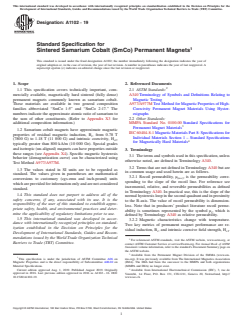
1.1 This specification covers technically important, commercially available, magnetically hard sintered (fully dense) permanent magnets commonly known as samarium cobalt. These materials are available in two general composition families abbreviated “SmCo 1:5” and “SmCo 2:17.” The numbers indicate the approximate atomic ratio of samarium to the sum of other constituents. (Refer to Appendix X3 for additional composition information.)
1.2 Samarium cobalt magnets have approximate magnetic properties of residual magnetic induction, Br, from 0.78 T (7800 G) to 1.18 T (11 800 G) and intrinsic coercivity, HcJ, typically greater than 800 kA/m (10 000 Oe). Special grades and isotropic (un-aligned) magnets can have properties outside these ranges (see Appendix X4). Specific magnetic hysteresis behavior (demagnetization curve) can be characterized using Test Method A977/A977M.
1.3 The values stated in SI units are to be regarded as standard. The values given in parentheses are mathematical conversions to customary (cgs-emu and inch-pound) units which are provided for information only and are not considered standard.
1.4 This standard does not purport to address all of the safety concerns, if any, associated with its use. It is the responsibility of the user of this standard to establish appropriate safety, health, and environmental practices and determine the applicability of regulatory limitations prior to use.
1.5 This international standard was developed in accordance with internationally recognized principles on standardization established in the Decision on Principles for the Development of International Standards, Guides and Recommendations issued by the World Trade Organization Technical Barriers to Trade (TBT) Committee.
- Status
- Published
- Publication Date
- 31-Jul-2019
- Technical Committee
- A06 - Magnetic Properties
- Drafting Committee
- A06.02 - Material Specifications
Buy Documents
ASTM A1102-19 - Standard Specification for Sintered Samarium Cobalt (SmCo) Permanent Magnets
REDLINE ASTM A1102-19 - Standard Specification for Sintered Samarium Cobalt (SmCo) Permanent Magnets
Overview
ASTM A1102-19: Standard Specification for Sintered Samarium Cobalt (SmCo) Permanent Magnets sets forth requirements for technically important, commercially available, magnetically hard sintered (fully dense) samarium cobalt (SmCo) permanent magnets. This international standard developed by ASTM offers a framework for both manufacturers and users of SmCo magnets, covering properties, testing methods, classification, ordering requirements, and packaging. SmCo permanent magnets are widely recognized for their high magnetic strength, thermal stability, and resistance to demagnetization, making them a prime choice in demanding industrial and electronic applications.
Key Topics
- Material Types and Composition: SmCo magnets are classified into two main composition families, "SmCo 1:5" and "SmCo 2:17," indicating their respective atomic ratios. SmCo 1:5 typically contains samarium and cobalt, while SmCo 2:17 includes additional elements like iron, copper, and zirconium. Special grades tailor properties for temperature stability or increased energy product.
- Magnetic Properties: Standard SmCo magnets offer residual magnetic induction (Br) from 0.78 T (7800 G) to 1.18 T (11,800 G), and intrinsic coercivity (HcJ) usually exceeding 800 kA/m (10,000 Oe). Properties are verified using established magnetic testing standards such as ASTM A977/A977M.
- Thermal and Mechanical Performance: SmCo magnets feature outstanding thermal stability, with typical maximum recommended working temperatures up to 250 °C for SmCo 1:5 and up to 350 °C for SmCo 2:17. They are mechanically brittle and not intended for structural use.
- Quality and Testing Requirements: The specification mandates procedures for magnetic property measurement, sampling protocols, and lot certification. Magnets must meet minimum property and appearance requirements as specified in the order.
- Ordering and Packaging: Detailed guidance is provided for ordering, including material grade, magnetic properties, magnetization state, and packaging. Magnetized parts must be properly labeled and packaged to meet transport regulations, especially for air shipment.
Applications
Sintered samarium cobalt (SmCo) permanent magnets are used in a wide range of high-performance and high-reliability applications, thanks to their superior magnetic properties and thermal stability. Typical sectors and use cases include:
- Aerospace and Defense: High-performance actuators, guidance systems, and sensors subject to extreme environments.
- Automotive Industry: Electric motors, sensors, and actuators requiring stable performance across temperatures.
- Medical Devices: MRI equipment, surgical instruments, and miniature motors benefiting from SmCo's resistance to demagnetization and corrosion.
- Industrial Automation: High-precision servomotors, magnetic couplings, and measuring equipment.
- Electronics and Telecommunications: Microwave devices, isolators, and circulators using SmCo magnets for their strong and stable magnetic fields.
Related Standards
For comprehensive product compliance and comparable magnetic material standardization, consider referencing:
- ASTM A977/A977M: Test Method for Magnetic Properties of High-Coercivity Permanent Magnet Materials Using Hysteresigraphs.
- ASTM A340: Terminology of Symbols and Definitions Relating to Magnetic Testing.
- MMPA Standard No. 0100-00: Specifications for Permanent Magnet Materials (historical reference).
- IEC 60404-8-1: Magnetic Materials - Specifications for Magnetically Hard Materials.
Summary
ASTM A1102-19 provides a critical foundation for the specification, procurement, and application of sintered samarium cobalt permanent magnets in advanced technological fields. Through well-defined requirements for magnetic, physical, and thermal properties, as well as detailed testing and packaging guidance, the standard ensures consistency and reliability for both buyers and suppliers globally. For organizations working with rare earth permanent magnets, adherence to ASTM A1102-19 is essential for safety, performance, and quality assurance across a spectrum of cutting-edge applications.
Relations
- Replaces
ASTM A1102-16 - Standard Specification for Sintered Samarium Cobalt (SmCo) Permanent Magnets - Effective Date
- 01-Aug-2019
- Effective Date
- 01-Dec-2023
- Effective Date
- 01-Jun-2020
- Effective Date
- 15-Oct-2019
- Effective Date
- 15-Jun-2019
- Effective Date
- 15-Feb-2019
- Effective Date
- 01-Jun-2018
- Effective Date
- 15-Oct-2017
- Effective Date
- 01-Jul-2017
- Effective Date
- 01-May-2016
- Effective Date
- 01-May-2016
- Effective Date
- 01-Oct-2015
- Effective Date
- 01-Oct-2014
- Effective Date
- 01-May-2013
- Refers
ASTM A340-03a(2011) - Standard Terminology of Symbols and Definitions Relating to Magnetic Testing - Effective Date
- 01-May-2011
Buy Documents
ASTM A1102-19 - Standard Specification for Sintered Samarium Cobalt (SmCo) Permanent Magnets
REDLINE ASTM A1102-19 - Standard Specification for Sintered Samarium Cobalt (SmCo) Permanent Magnets
Get Certified
Connect with accredited certification bodies for this standard

IMQ S.p.A. (Certification)
Italian electrical product certification.

SLG Prüf- und Zertifizierungs GmbH
German testing and certification body.

UL Solutions
Global safety science company with testing, inspection and certification.
Sponsored listings
Frequently Asked Questions
ASTM A1102-19 is a technical specification published by ASTM International. Its full title is "Standard Specification for Sintered Samarium Cobalt (SmCo) Permanent Magnets". This standard covers: ABSTRACT This specification applies to technically important, commercially available, magnetically hard sintered (fully dense) permanent magnets commonly known as samarium cobalt (SmCo). SmCo permanent magnets are available in two general composition families abbreviated “SmCo 1:5” and “SmCo 2:17.” These materials have approximate magnetic properties of residual magnetic induction from 0.78 T (7800 G) to 1.18 T (11 800 G) and intrinsic coercivity typically greater than 800 kA/m (10 000 Oe). Special grades and isotropic (un-aligned) magnets can have properties outside these ranges. Specific magnetic hysteresis behavior (demagnetization curve) can be characterized using Test Method A977/A977M. SCOPE 1.1 This specification covers technically important, commercially available, magnetically hard sintered (fully dense) permanent magnets commonly known as samarium cobalt. These materials are available in two general composition families abbreviated “SmCo 1:5” and “SmCo 2:17.” The numbers indicate the approximate atomic ratio of samarium to the sum of other constituents. (Refer to Appendix X3 for additional composition information.) 1.2 Samarium cobalt magnets have approximate magnetic properties of residual magnetic induction, Br, from 0.78 T (7800 G) to 1.18 T (11 800 G) and intrinsic coercivity, HcJ, typically greater than 800 kA/m (10 000 Oe). Special grades and isotropic (un-aligned) magnets can have properties outside these ranges (see Appendix X4). Specific magnetic hysteresis behavior (demagnetization curve) can be characterized using Test Method A977/A977M. 1.3 The values stated in SI units are to be regarded as standard. The values given in parentheses are mathematical conversions to customary (cgs-emu and inch-pound) units which are provided for information only and are not considered standard. 1.4 This standard does not purport to address all of the safety concerns, if any, associated with its use. It is the responsibility of the user of this standard to establish appropriate safety, health, and environmental practices and determine the applicability of regulatory limitations prior to use. 1.5 This international standard was developed in accordance with internationally recognized principles on standardization established in the Decision on Principles for the Development of International Standards, Guides and Recommendations issued by the World Trade Organization Technical Barriers to Trade (TBT) Committee.
ABSTRACT This specification applies to technically important, commercially available, magnetically hard sintered (fully dense) permanent magnets commonly known as samarium cobalt (SmCo). SmCo permanent magnets are available in two general composition families abbreviated “SmCo 1:5” and “SmCo 2:17.” These materials have approximate magnetic properties of residual magnetic induction from 0.78 T (7800 G) to 1.18 T (11 800 G) and intrinsic coercivity typically greater than 800 kA/m (10 000 Oe). Special grades and isotropic (un-aligned) magnets can have properties outside these ranges. Specific magnetic hysteresis behavior (demagnetization curve) can be characterized using Test Method A977/A977M. SCOPE 1.1 This specification covers technically important, commercially available, magnetically hard sintered (fully dense) permanent magnets commonly known as samarium cobalt. These materials are available in two general composition families abbreviated “SmCo 1:5” and “SmCo 2:17.” The numbers indicate the approximate atomic ratio of samarium to the sum of other constituents. (Refer to Appendix X3 for additional composition information.) 1.2 Samarium cobalt magnets have approximate magnetic properties of residual magnetic induction, Br, from 0.78 T (7800 G) to 1.18 T (11 800 G) and intrinsic coercivity, HcJ, typically greater than 800 kA/m (10 000 Oe). Special grades and isotropic (un-aligned) magnets can have properties outside these ranges (see Appendix X4). Specific magnetic hysteresis behavior (demagnetization curve) can be characterized using Test Method A977/A977M. 1.3 The values stated in SI units are to be regarded as standard. The values given in parentheses are mathematical conversions to customary (cgs-emu and inch-pound) units which are provided for information only and are not considered standard. 1.4 This standard does not purport to address all of the safety concerns, if any, associated with its use. It is the responsibility of the user of this standard to establish appropriate safety, health, and environmental practices and determine the applicability of regulatory limitations prior to use. 1.5 This international standard was developed in accordance with internationally recognized principles on standardization established in the Decision on Principles for the Development of International Standards, Guides and Recommendations issued by the World Trade Organization Technical Barriers to Trade (TBT) Committee.
ASTM A1102-19 is classified under the following ICS (International Classification for Standards) categories: 29.100.10 - Magnetic components. The ICS classification helps identify the subject area and facilitates finding related standards.
ASTM A1102-19 has the following relationships with other standards: It is inter standard links to ASTM A1102-16, ASTM A340-23a, ASTM A977/A977M-07(2020), ASTM A340-19b, ASTM A340-19a, ASTM A340-19, ASTM A340-18, ASTM A340-17a, ASTM A340-17, ASTM A340-16e1, ASTM A340-16, ASTM A340-15, ASTM A340-14, ASTM A977/A977M-07(2013), ASTM A340-03a(2011). Understanding these relationships helps ensure you are using the most current and applicable version of the standard.
ASTM A1102-19 is available in PDF format for immediate download after purchase. The document can be added to your cart and obtained through the secure checkout process. Digital delivery ensures instant access to the complete standard document.
Standards Content (Sample)
This international standard was developed in accordance with internationally recognized principles on standardization established in the Decision on Principles for the
Development of International Standards, Guides and Recommendations issued by the World Trade Organization Technical Barriers to Trade (TBT) Committee.
Designation:A1102 −19
Standard Specification for
Sintered Samarium Cobalt (SmCo) Permanent Magnets
This standard is issued under the fixed designation A1102; the number immediately following the designation indicates the year of
original adoption or, in the case of revision, the year of last revision. A number in parentheses indicates the year of last reapproval. A
superscript epsilon (´) indicates an editorial change since the last revision or reapproval.
1. Scope 2. Referenced Documents
1.1 This specification covers technically important, com- 2.1 ASTM Standards:
mercially available, magnetically hard sintered (fully dense) A340 Terminology of Symbols and Definitions Relating to
permanent magnets commonly known as samarium cobalt. Magnetic Testing
These materials are available in two general composition A977/A977M Test Method for Magnetic Properties of High-
families abbreviated “SmCo 1:5” and “SmCo 2:17.” The Coercivity Permanent Magnet Materials Using Hyster-
numbers indicate the approximate atomic ratio of samarium to esigraphs
the sum of other constituents. (Refer to Appendix X3 for 2.2 Other Standards:
additional composition information.) MMPA Standard No. 0100-00 Standard Specifications for
Permanent Magnet Materials
1.2 Samarium cobalt magnets have approximate magnetic
IEC 60404-8-1 Magnetic Materials Part 8: Specifications for
properties of residual magnetic induction, B , from 0.78 T
r
Individual Materials Section 1 – Standard Specifications
(7800 G) to 1.18 T (11 800 G) and intrinsic coercivity, H ,
cJ
for Magnetically Hard Materials
typically greater than 800 kA/m (10 000 Oe). Special grades
and isotropic (un-aligned) magnets can have properties outside
3. Terminology
these ranges (see Appendix X4). Specific magnetic hysteresis
3.1 The terms and symbols used in this specification, unless
behavior (demagnetization curve) can be characterized using
otherwise noted, are defined in Terminology A340.
Test Method A977/A977M.
3.2 Terms that are not defined in Terminology A340 but are
1.3 The values stated in SI units are to be regarded as
in common usage and used herein are as follows.
standard. The values given in parentheses are mathematical
3.2.1 Recoil permeability, µ , is the permeability corre-
(rec)
conversions to customary (cgs-emu and inch-pound) units
sponding to the slope of the recoil line. For reference see
whichareprovidedforinformationonlyandarenotconsidered
incremental, relative, and reversible permeabilities as defined
standard.
in Terminology A340. In practical use, this is the slope of the
1.4 This standard does not purport to address all of the
normal hysteresis loop in the second quadrant and in proximity
safety concerns, if any, associated with its use. It is the
to the B-axis. The value of recoil permeability is dimension-
responsibility of the user of this standard to establish appro-
less. Note that in producers’ product literature recoil perme-
priate safety, health, and environmental practices and deter-
ability is sometimes represented by the symbol µ , which is
r
mine the applicability of regulatory limitations prior to use.
defined by Terminology A340 as relative permeability.
1.5 This international standard was developed in accor-
3.2.2 Magnetic characteristics change with temperature.
dance with internationally recognized principles on standard-
Two key metrics of permanent magnet performance are re-
ization established in the Decision on Principles for the
sidual induction, B , and intrinsic coercive field strength, H .
r cJ
Development of International Standards, Guides and Recom-
mendations issued by the World Trade Organization Technical
For referenced ASTM standards, visit the ASTM website, www.astm.org, or
Barriers to Trade (TBT) Committee.
contact ASTM Customer Service at service@astm.org. For Annual Book of ASTM
Standards volume information, refer to the standard’s Document Summary page on
the ASTM website.
Available from the Permanent Magnet Division of the SMMA (www.sm-
This specification is under the jurisdiction of ASTM Committee A06 on ma.org). It was previously available from The International Magnetics Association
Magnetic Properties and is the direct responsibility of Subcommittee A06.02 on (IMA). The IMA had been the successor to the MMPA and both organizations
Material Specifications. (MMPA and IMA) no longer exist.
Current edition approved Aug. 1, 2019. Published August 2019. Originally Available from International Electrotechnical Commission (IEC), 3, rue de
approved in 2016. Last previous edition approved in 2016 as A1102 – 16. DOI: Varembé, 1st Floor, P.O. Box 131, CH-1211, Geneva 20, Switzerland, http://
10.1520/A1102-19. www.iec.ch.
Copyright © ASTM International, 100 Barr Harbor Drive, PO Box C700, West Conshohocken, PA 19428-2959. United States
A1102−19
The change in these characteristics over a defined and limited to MMPA Standard No. 0100-00 and IEC 60404-8-1.
temperature range can be reversible, that is, nondestructive.
5. Ordering Information
Thischangeisrepresentedbyvaluescalledreversibletempera-
ture coefficients. The symbol for reversible temperature coef- 5.1 Orders for parts conforming to this specification shall
ficient of induction is α(B ) and of (intrinsic) coercivity is include the following information:
r
α(H ). They are expressed in percent change per degree 5.1.1 Reference to this specification and year of issue/
cJ
Celsius, %/°C, or the numerically equivalent percent per revision.
Kelvin, %/K. The change in magnetic characteristics is 5.1.2 Reference to an applicable part drawing.
nonlinear, so it is necessary to specify the temperature range 5.1.3 Magnetic property requirements, if they are more
over which the coefficient applies. stringent than the minimum values listed in the tables.
3.2.3 The maximum recommended working temperature of 5.1.4 Quantity required.
a permanent magnet, T , is a semi-arbitrary value sometimes 5.1.5 The required magnetization state of the provided
w
assigned by magnet manufacturers to their products. T is not material (unmagnetized, fully magnetized, magnetized and
w
normative. See Appendix X6 for a more complete discussion. thermally stabilized, magnetized and then partially demagne-
tized). This information should appear on the part drawing
4. Classification
whenever possible.
4.1 The classification of samarium cobalt permanent mag- 5.1.6 Certification of magnetic property evaluation.
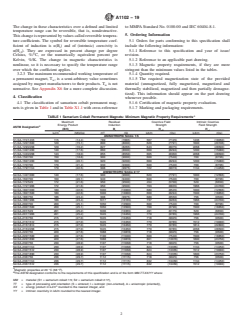
nets is given in Table 1 and in Table X1.1 with cross-reference 5.1.7 Marking and packaging requirements.
A
TABLE 1 Samarium Cobalt Permanent Magnets: Minimum Magnetic Property Requirements
Maximum Residual Coercive Field Intrinsic Coercive
Energy Product Induction Strength Field Strength
B
ASTM Designation
(BH) B H H
max r cB cJ
kJ/m (MGOe) mT (G) kA/m (Oe) kA/m (Oe)
ANISOTROPIC SmCo 1:5
S1-SA-115/1436 115 (14.4) 789 (7885) 567 (7125) 1436 (18050)
S1-SA-120/1600 120 (15.1) 800 (8000) 620 (7791) 1600 (20106)
S1-SA-129/2268 129 (16.2) 827 (8265) 643 (8075) 2268 (28500)
S1-SA-140/1200 140 (17.6) 860 (8600) 660 (8294) 1200 (15080)
S1-SA-143/2268 143 (18.0) 855 (8550) 665 (8360) 2268 (28500)
S1-SA-150/700 150 (18.8) 900 (9000) 600 (7540) 700 (8796)
S1-SA-160/1200 160 (20.1) 920 (9200) 660 (8294) 1200 (15080)
S1-SA-170/700 170 (21.4) 930 (9300) 600 (7540) 700 (8796)
S1-SA-179/1134 179 (22.5) 998 (9975) 722 (9073) 1134 (14250)
ANISOTROPIC SmCo 2:17
S2-SA-140/1000 140 (17.6) 900 (9000) 620 (7791) 1000 (12566)
S2-SA-160/700 160 (20.1) 940 (9400) 600 (7540) 700 (8796)
S2-SA-172/529 172 (21.6) 950 (9500) 454 (5700) 529 (6650)
S2-SA-172/1966 172 (21.6) 950 (9500) 703 (8835) 1966 (24700)
S2-SA-180/1000 180 (22.6) 1000 (10000) 680 (8545) 1000 (12566)
S2-SA-180/1500 180 (22.6) 1000 (10000) 660 (8294) 1500 (18850)
S2-SA-186/756 186 (23.4) 998 (9975) 680 (8550) 756 (9500)
S2-SA-186/1966 186 (23.4) 1017 (10165) 737 (9263) 1966 (24700)
S2-SA-200/700 200 (25.1) 1050 (10500) 600 (7540) 700 (8796)
S2-SA-200/1500 200 (25.1) 1050 (10500) 700 (8796) 1500 (18850)
S2-SA-201/529 201 (25.2) 1036 (10355) 491 (6175) 529 (6650)
S2-SA-201/1966 201 (25.2) 1045 (10450) 779 (9785) 1966 (24700)
S2-SA-215/756 215 (27.0) 1045 (10450) 718 (9025) 756 (9500)
S2-SA-215/1512 215 (27.0) 1045 (10450) 779 (9785) 1512 (19000)
S2-SA-215/1814 215 (27.0) 1045 (10450) 779 (9785) 1814 (22800)
S2-SA-215/2268 215 (27.0) 1045 (10450) 779 (9785) 2268 (28500)
S2-SA-220/756 220 (27.6) 1088 (10878) 718 (9025) 756 (9500)
S2-SA-220/1500 220 (27.6) 1100 (11000) 600 (7540) 1500 (18850)
S2-SA-220/1890 220 (27.6) 1088 (10878) 801 (10070) 1890 (23750)
S2-SA-230/756 230 (28.9) 1107 (11068) 718 (9025) 756 (9500)
S2-SA-230/1134 230 (28.9) 1107 (11068) 824 (10355) 1134 (14250)
S2-SA-230/1512 230 (28.9) 1107 (11068) 824 (10355) 1512 (19000)
S2-SA-230/1890 230 (28.9) 1107 (11068) 824 (10355) 1890 (23750)
S2-SA-236/756 236 (29.7) 1112 (11115) 718 (9025) 756 (9500)
S2-SA-236/1134 236 (29.7) 1112 (11115) 832 (10450) 1134 (14250)
S2-SA-236/1512 236 (29.7) 1112 (11115) 832 (10450) 1512 (19000)
A
Magnetic properties at 20 °C (68 °F).
B
The ASTM designation conforms to the requirements of this specification and is of the form MM-TT-XX/YY where:
MM = material (S1 = samarium cobalt 1:5; S2 = samarium cobalt 2:17),
TT = type of processing and orientation (S = sintered; I = isotropic (non-oriented), A = anisotropic (oriented)),
XX = energy product in kJ/m rounded to the nearest integer, and
YY = intrinsic coercivity in kA/m rounded to the nearest integer.
A1102−19
5.1.8 Exceptions to this specification or special require- applications where the magnet performance is closely speci-
mentssuchasplating,coating,orfunctionaltestingasmutually fied. Such magnetic property evaluations shall be conducted in
agreed upon by the producer and user. the manner described below. Where the magnet shape is not
suitable for magnetic testing, a specimen shall be cut from the
6. Chemical Composition
magnet using appropriate slicing and grinding techniques,
6.1 Samarium cobalt magnets should be specified primarily payingattentiontoanymagneticorientationwithinthemagnet.
by magnetic performance. Chemical composition can have an 8.4.1 The magnetic properties shall be determined in accor-
influence on both magnetic and physical characteristics but dance with Test Method A977/A977M, or by using a suitable,
should only be specified when other options are insufficient to mutually agreed upon magnetometric method.
meet user requirements. Agreement on composition must be 8.4.2 When magnets are being purchased in the fully
mutually arrived at by producer and user. magnetized condition, the testing shall determine the magnetic
properties from the as-received magnetization state, followed
6.2 The general chemical constituents of samarium cobalt
by magnetization to saturation and testing of the magnetic
1:5 magnets are samarium and cobalt. Samarium cobalt 2:17
properties from the fully magnetized condition.
magnets contain samarium, cobalt, iron, copper, and zirco-
8.4.3 When magnets are being purchased in the unmagne-
nium. Approximate chemical compositions are listed in Table
tized condition or in an unknown state of magnetization, the
X3.1 and are typical but not mandatory.
test laboratory shall magnetize the test specimen(s) to satura-
6.3 In some grades of samarium cobalt 1:5, praseodymium
tion in the same orientation as the received specimen’s indi-
is used to substitute for a portion of the samarium to increase
cated direction of magnetization and measure the magnetic
maximum energy product (see Table X3.1 and Appendix X4).
properties from this fully magnetized condition.
In either the 1:5 or 2:17 grades, substitution of a portion of
8.4.4 When magnets are being purchased in a calibrated,
samarium by gadolinium (or a combination of gadolinium and
stabilized, or “knocked-down” condition, magnets should be
dysprosium) will result in “temperature-stable” grades, those
handled with care to prevent exposure to externally applied
which exhibit less change in flux output as a function of
fields. Refer to Appendix X6 for an explanation of these terms.
temperature. These are generally made to customer specifica-
During testing using Test Method A977/A977M, to avoid
tion and are not considered standard grades.
changing the magnetization state of the material prior to test,
the measurement should proceed in the second quadrant only,
7. Physical and Mechanical Properties
without attempting to saturate the magnet specimen.
7.1 Typical thermal and physical properties are listed in
8.4.5 Other test methods may be utilized as agreed to
Table X2.1 in Appendix X2.
between producer and user. Such tests may include the open
circuit magnetic field strength Helmholtz test, field strength
7.2 Physical density values are given for information pur-
measurements in a defined magnetic circuit, or magnetic field
poses only and are not mandatory.
strength measurements adjacent to the magnet surface.
7.3 Samarium cobalt magnets are used for their magnetic
characteristics. The end-use application should not rely on
9. Workmanship, Finish, and Appearance
them for structural purposes due to low tensile and flexural
9.1 Dimensions and tolerances shall be as specified on the
strength. These materials are brittle, and can chip or break
magnet drawing and must be agreed upon between producer
easily. Magnetic properties may also be affected by physical
and user.
stress.
9.2 Though porosity and voids are uncommon in samarium
7.4 Strength testing of brittle materials such as samarium
cobalt magnets, their appearance shall not in themselves
cobalt is difficult, expensive, and time-consuming and there
constitute reason for rejection unless agreed upon between
may be considerable scatter in the measured values. Producers
producer and user. Allowable amounts of porosity and voids
typically make these measurements at the onset of production
shall be documented in writing and included as part of the
and they are seldom repeated.
ordering or contracting process.
8. Magnetic Property Requirements
9.3 Magnets shall be free of adhered magnetic particles and
8.1 Magnetic properties are listed in Table 1.
surface residue which may interfere with assembly or proper
device function.
8.2 The values of essential magnetic properties listed in the
table are specified minimum values at 20 6 2 °C (68 6 4 °F),
9.4 Chips shall be acceptable if no more than 10 % of any
determined after magnetizing to saturation in closed magnetic
surface identified as a magnetic pole surface is removed.
circuit.
9.5 Cracks visible to the naked eye shall not be permitted
8.3 The specified values of magnetic properties are valid
unless otherwise agreed to by producer and user.
only for magnet test specimens with a uniform cross-section
along the axis of magnetization. Properties for anisotropic 10. Sampling
(magneticallyoriented)magnetsaremeasuredalongtheaxisof
10.1 A lot shall consist of parts of the same form and
preferred orientation.
dimensions, produced from a single mixed powder batch or
8.4 Because of the nature of permanent magnet production, sintering run, and from an unchanged process, without discon-
magnetic testing of each lot is recommended, especially for tinuity in production, and submitted for inspection at one time.
A1102−19
10.2 The producer and user shall agree upon a representa- 12.2.4 Results of any other tests stipulated in the purchase
tive number of specimens for testing. Typically, a suitable order or contract.
number of parts, as mutually agreed upon between producer
13. Packaging and Package Marking
and user, shall be randomly selected from each lot. It is
13.1 Packaging shall be subject to agreement between the
advisable to test a minimum of two parts from each lot, and
producer and the user.
more if there is reason to suspect that the magnetic properties
are not uniform throughout the lot.
13.2 Parts furnished under this specification shall be in a
container identified by the name or symbol of the parts
11. Rejection and Rehearing producer.
13.3 Magnetized parts shall be properly labeled as such for
11.1 Parts that fail to conform to the requirements of this
safe handling and shipping purposes.
specification shall be rejected. Rejection should be reported to
13.3.1 Magnetized parts to be shipped via aircraft must be
the producer promptly and in writing. In case of dissatisfaction
packaged in an appropriate manner to meet applicable require-
with the results of the test, the producer may make a claim for
ments for air shipment. These requirements may vary depend-
a rehearing.
ing upon local, national, and international laws. It is the
11.2 The disposition of rejected parts shall be subject to
responsibility of the producer to ensure packaging meets all
agreement between the producer and user.
relevant regulations. This may require rearranging the parts
within the shipping container, adding sheets of steel or other
12. Certification
magnetically soft shielding material, or both, or other special-
ized packaging procedures as determined by regulation, carrier
12.1 When specified in the purchase order or contract, the
policy, or by agreement between producer and user, to reduce
user shall be furnished certification that samples representing
the magnetic field external to the shipping container below the
each lot have been either tested or inspected as directed in this
required levels.
specification and that the requirements have been met.
12.2 When specified in the purchase order or contract, a 14. Keywords
report of the test results shall, at a minimum, include:
14.1 coercive field strength; magnetic field strength; mag-
12.2.1 Grade of material.
netic flux density; magnetic properties; maximum energy
12.2.2 Lot or batch number.
product; permanent magnet; residual induction; samarium
12.2.3 Magnetic test results. cobalt magnet; sintered rare earth magnet
APPENDIXES
(Nonmandatory Information)
X1. CLASSIFICATION
X1.1 See Table X1.1.
A1102−19
TABLE X1.1 Samarium Cobalt Permanent Magnets: Classification
and Grade Cross Reference
NOTE 1—“.” indicates that there is no known published data.
ASTM MMPA IEC
ASTM MMPA B
...
This document is not an ASTM standard and is intended only to provide the user of an ASTM standard an indication of what changes have been made to the previous version. Because
it may not be technically possible to adequately depict all changes accurately, ASTM recommends that users consult prior editions as appropriate. In all cases only the current version
of the standard as published by ASTM is to be considered the official document.
Designation: A1102 − 16 A1102 − 19
Standard Specification for
Sintered Samarium Cobalt (SmCo) Permanent Magnets
This standard is issued under the fixed designation A1102; the number immediately following the designation indicates the year of
original adoption or, in the case of revision, the year of last revision. A number in parentheses indicates the year of last reapproval. A
superscript epsilon (´) indicates an editorial change since the last revision or reapproval.
1. Scope
1.1 This specification covers technically important, commercially available, magnetically hard sintered (fully dense) permanent
magnets commonly known as samarium cobalt. These materials are available in two general composition families abbreviated
“SmCo 1:5” and “SmCo 2:17.” The numbers indicate the approximate atomic ratio of samarium to the sum of other constituents.
(Refer to Appendix X3 for additional composition information.)
1.2 Samarium cobalt magnets have approximate magnetic properties of residual magnetic induction, B , from 0.78 T (7800 G)
r
to 1.18 T (11 800 G) and intrinsic coercivity, H , typically greater than 800 kA/m (10 000 Oe). Special grades and isotropic
cJ
(un-aligned) magnets can have properties outside these ranges (see Appendix X4). Specific magnetic hysteresis behavior
(demagnetization curve) can be characterized using Test Method A977/A977M.
1.3 The values stated in SI units are to be regarded as standard. The values given in parentheses are mathematical conversions
to customary (cgs-emu and inch-pound) units which are provided for information only and are not considered standard.
1.4 This standard does not purport to address all of the safety concerns, if any, associated with its use. It is the responsibility
of the user of this standard to establish appropriate safety safety, health, and healthenvironmental practices and determine the
applicability of regulatory limitations prior to use.
1.5 This international standard was developed in accordance with internationally recognized principles on standardization
established in the Decision on Principles for the Development of International Standards, Guides and Recommendations issued
by the World Trade Organization Technical Barriers to Trade (TBT) Committee.
2. Referenced Documents
2.1 ASTM Standards:
A340 Terminology of Symbols and Definitions Relating to Magnetic Testing
A977/A977M Test Method for Magnetic Properties of High-Coercivity Permanent Magnet Materials Using Hysteresigraphs
2.2 Other Standards:
MMPA Standard No. 0100-00 Standard Specifications for Permanent Magnet Materials
IEC 60404-8-1 Magnetic Materials Part 8: Specifications for Individual Materials Section 1 – Standard Specifications for
Magnetically Hard Materials
3. Terminology
3.1 The terms and symbols used in this specification, unless otherwise noted, are defined in Terminology A340.
3.2 Terms that are not defined in Terminology A340 but are in common usage and used herein are as follows.
3.2.1 Recoil permeability, μ , is the permeability corresponding to the slope of the recoil line. For reference see incremental,
(rec)
relative, and reversible permeabilities as defined in Terminology A340. In practical use, this is the slope of the normal hysteresis
loop in the second quadrant and in proximity to the B-axis. The value of recoil permeability is dimensionless. Note that in
producers’ product literature recoil permeability is sometimes represented by the symbol μ , which is defined by Terminology A340
r
as relative permeability.
This specification is under the jurisdiction of ASTM Committee A06 on Magnetic Properties and is the direct responsibility of Subcommittee A06.02 on Material
Specifications.
Current edition approved Nov. 1, 2016Aug. 1, 2019. Published November 2016August 2019. Originally approved in 2016. Last previous edition approved in 2016 as
A1102 – 16. DOI: 10.1520/A1102–16.10.1520/A1102-19.
For referenced ASTM standards, visit the ASTM website, www.astm.org, or contact ASTM Customer Service at service@astm.org. For Annual Book of ASTM Standards
volume information, refer to the standard’s Document Summary page on the ASTM website.
Available from the Permanent Magnet Division of the SMMA (www.smma.org). It was previously available from The International Magnetics Association (IMA). The
IMA had been the successor to the MMPA and both organizations (MMPA and IMA) no longer exist.
Available from International Electrotechnical Commission (IEC), 3, rue de Varembé, 1st Floor, P.O. Box 131, CH-1211, Geneva 20, Switzerland, http://www.iec.ch.
Copyright © ASTM International, 100 Barr Harbor Drive, PO Box C700, West Conshohocken, PA 19428-2959. United States
A1102 − 19
3.2.2 Magnetic characteristics change with temperature. Two key metrics of permanent magnet performance are residual
induction, B , and intrinsic coercive field strength, H . The change in these characteristics over a defined and limited temperature
r cJ
range can be reversible, that is, nondestructive. This change is represented by values called reversible temperature coefficients. The
symbol for reversible temperature coefficient of Inductioninduction is α(B ) and of (intrinsic) coercivity is α(H ). They are
r cJ
expressed in percent change per degree Celsius, %/°C, or the numerically equivalent percent per Kelvin, %/K. The change in
magnetic characteristics is nonlinear, so it is necessary to specify the temperature range over which the coefficient applies.
3.2.3 The maximum recommended working temperature of a permanent magnet, T , is a semi-arbitrary value sometimes
w
assigned by magnet manufacturers to their products. T is not normative. See Appendix X6 for a more complete discussion.
w
4. Classification
4.1 The classification of samarium cobalt permanent magnets is given in Table 1 and in Table X1.1 with cross-reference to
MMPA Standard No. 0100-00 and IEC 60404-8-1.
5. Ordering Information
5.1 Orders for parts conforming to this specification shall include the following information:
5.1.1 Reference to this specification and year of issue/revision.
5.1.2 Reference to an applicable part drawing.
5.1.3 Magnetic property requirements, if they are more stringent than the minimum values listed in the tables.
A
TABLE 1 Samarium Cobalt Permanent Magnets: Minimum Magnetic Property Requirements
Maximum Residual Coercive Field Intrinsic Coercive
Energy Product Induction Strength Field Strength
B
ASTM Designation
(BH) B H H
max r cB cJ
kJ/m (MGOe) mT (G) kA/m (Oe) kA/m (Oe)
ANISOTROPIC SmCo 1:5
S1-SA-115/1436 115 (14.4) 789 (7885) 567 (7125) 1436 (18050)
S1-SA-120/1600 120 (15.1) 800 (8000) 620 (7791) 1600 (20106)
S1-SA-129/2268 129 (16.2) 827 (8265) 643 (8075) 2268 (28500)
S1-SA-140/1200 140 (17.6) 920 (9200) 660 (8294) 1200 (15080)
S1-SA-140/1200 140 (17.6) 860 (8600) 660 (8294) 1200 (15080)
S1-SA-143/2268 143 (18.0) 855 (8550) 665 (8360) 2268 (28500)
S1-SA-150/700 150 (18.8) 900 (9000) 600 (7540) 700 (8796)
S1-SA-160/1200 160 (20.1) 920 (9200) 660 (8294) 1200 (15080)
S1-SA-170/700 170 (21.4) 930 (9300) 600 (7540) 700 (8796)
S1-SA-179/1134 179 (22.5) 998 (9975) 722 (9073) 1134 (14250)
ANISOTROPIC SmCo 2:17
S2-SA-140/1000 140 (17.6) 900 (9000) 620 (7791) 1000 (12566)
S2-SA-160/700 160 (20.1) 940 (9400) 600 (7540) 700 (8796)
S2-SA-172/529 172 (21.6) 950 (9500) 454 (5700) 529 (6650)
S2-SA-172/1966 172 (21.6) 950 (9500) 703 (8835) 1966 (24700)
S2-SA-180/1000 180 (22.6) 1000 (10000) 680 (8545) 1000 (12566)
S2-SA-180/1500 180 (22.6) 1000 (10000) 660 (8294) 1500 (18850)
S2-SA-186/756 186 (23.4) 998 (9975) 680 (8550) 756 (9500)
S2-SA-186/1966 186 (23.4) 1017 (10165) 737 (9263) 1966 (24700)
S2-SA-200/700 200 (25.1) 1050 (10500) 600 (7540) 700 (8796)
S2-SA-200/1500 200 (25.1) 1050 (10500) 700 (8796) 1500 (18850)
S2-SA-201/529 201 (25.2) 1036 (10355) 491 (6175) 529 (6650)
S2-SA-201/1966 201 (25.2) 1045 (10450) 779 (9785) 1966 (24700)
S2-SA-215/756 215 (27.0) 1045 (10450) 718 (9025) 756 (9500)
S2-SA-215/1512 215 (27.0) 1045 (10450) 779 (9785) 1512 (19000)
S2-SA-215/1814 215 (27.0) 1045 (10450) 779 (9785) 1814 (22800)
S2-SA-215/2268 215 (27.0) 1045 (10450) 779 (9785) 2268 (28500)
S2-SA-220/756 220 (27.6) 1088 (10878) 718 (9025) 756 (9500)
S2-SA-220/1500 220 (27.6) 1100 (11000) 600 (7540) 1500 (18850)
S2-SA-220/1890 220 (27.6) 1088 (10878) 801 (10070) 1890 (23750)
S2-SA-230/756 230 (28.9) 1107 (11068) 718 (9025) 756 (9500)
S2-SA-230/1134 230 (28.9) 1107 (11068) 824 (10355) 1134 (14250)
S2-SA-230/1512 230 (28.9) 1107 (11068) 824 (10355) 1512 (19000)
S2-SA-230/1890 230 (28.9) 1107 (11068) 824 (10355) 1890 (23750)
S2-SA-236/756 236 (29.7) 1112 (11115) 718 (9025) 756 (9500)
S2-SA-236/1134 236 (29.7) 1112 (11115) 832 (10450) 1134 (14250)
S2-SA-236/1512 236 (29.7) 1112 (11115) 832 (10450) 1512 (19000)
A
Magnetic properties at 20 °C (68 °F).
B
The ASTM designation conforms to the requirements of this specification and is of the form MM-TT-XX/YY where:
MM = material (S1 = samarium cobalt 1:5; S2 = samarium cobalt 2:17),
TT = type of processing and orientation (S = sintered; I = isotropic (non-oriented), A = anisotropic (oriented)),
XX = energy product in kJ/m rounded to the nearest integer, and
YY = intrinsic coercivity in kA/m rounded to the nearest integer.
A1102 − 19
5.1.4 Quantity required.
5.1.5 The required magnetization state of the provided material (unmagnetized, fully magnetized, magnetized and thermally
stabilized, magnetized and then partially demagnetized). This information should appear on the part drawing whenever possible.
5.1.6 Certification of magnetic property evaluation.
5.1.7 Marking and packaging requirements.
5.1.8 Exceptions to this specification or special requirements such as plating, coating, or functional testing as mutually agreed
upon by the producer and user.
6. Chemical Composition
6.1 Samarium cobalt magnets should be specified primarily by magnetic performance. Chemical composition can have an
influence on both magnetic and physical characteristics but should only be specified when other options are insufficient to meet
user requirements. Agreement on composition must be mutually arrived at by producer and user.
6.2 The general chemical constituents of samarium cobalt 1:5 magnets are samarium and cobalt. Samarium cobalt 2:17 magnets
contain samarium, cobalt, iron, copper, and zirconium. Approximate chemical compositions are listed in Table X3.1 and are typical
but not mandatory.
6.3 In some grades of samarium cobalt 1:5, praseodymium is used to substitute for a portion of the samarium to increase
maximum energy product (see Table X3.1 and Appendix X4). In either the 1:5 or 2:17 grades, substitution of a portion of samarium
by gadolinium (or a combination of gadolinium and dysprosium) will result in “temperature-stable” grades, those which exhibit
less change in flux output as a function of temperature. These are generally made to customer specification and are not considered
standard grades.
7. Physical and Mechanical Properties
7.1 Typical thermal and physical properties are listed in Table X2.1 in Appendix X2.
7.2 Physical density values are given for information purposes only and are not mandatory.
7.3 Samarium cobalt magnets are used for their magnetic characteristics. The end-use application should not rely on them for
structural purposes due to low tensile and flexural strength. These materials are brittle, and can chip or break easily. Magnetic
properties may also be affected by physical stress.
7.4 Strength testing of brittle materials such as samarium cobalt is difficult, expensive, and time-consuming and there may be
considerable scatter in the measured values. Producers typically make these measurements at the onset of production and they are
seldom repeated.
8. Magnetic Property Requirements
8.1 Magnetic properties are listed in Table 1.
8.2 The values of essential magnetic properties listed in the table are specified minimum values at 20 6 2 °C (68 6 4 °F),
determined after magnetizing to saturation in closed magnetic circuit.
8.3 The specified values of magnetic properties are valid only for magnet test specimens with a uniform cross-section along the
axis of magnetization. Properties for anisotropic (magnetically oriented) magnets are measured along the axis of preferred
orientation.
8.4 Because of the nature of permanent magnet production, magnetic testing of each lot is recommended, especially for
applications where the magnet performance is closely specified. Such magnetic property evaluations shall be conducted in the
manner described below. Where the magnet shape is not suitable for magnetic testing, a specimen shall be cut from the magnet
using appropriate slicing and grinding techniques, paying attention to any magnetic orientation within the magnet.
8.4.1 The magnetic properties shall be determined in accordance with Test Method A977/A977M, or by using a suitable,
mutually agreed upon magnetometric method.
8.4.2 When magnets are being purchased in the fully magnetized condition, the testing shall determine the magnetic properties
from the as-received magnetization state, followed by magnetization to saturation and testing of the magnetic properties from the
fully magnetized condition.
8.4.3 When magnets are being purchased in the unmagnetized condition or in an unknown state of magnetization, the test
laboratory shall magnetize the test specimen(s) to saturation in the same orientation as the received specimen’s indicated direction
of magnetization and measure the magnetic properties from this fully magnetized condition.
8.4.4 When magnets are being purchased in a calibrated, stabilized, or “knocked-down” condition, magnets should be handled
with care to prevent exposure to externally applied fields. Refer to Appendix X6 for an explanation of these terms. During testing
using Test Method A977/A977M, to avoid changing the magnetization state of the material prior to test, the measurement should
proceed in the second quadrant only, without attempting to saturate the magnet specimen.
A1102 − 19
8.4.5 Other test methods may be utilized as agreed to between producer and user. Such tests may include the open circuit
magnetic field strength Helmholtz test, field strength measurements in a defined magnetic circuit, or magnetic field strength
measurements adjacent to the magnet surface.
9. Workmanship, Finish, and Appearance
9.1 Dimensions and tolerances shall be as specified on the magnet drawing and must be agreed upon between producer and user.
9.2 Though porosity and voids are uncommon in samarium cobalt magnets, their appearance shall not in themselves constitute
reason for rejection unless agreed upon between producer and user. Allowable amounts of porosity and voids shall be documented
in writing and included as part of the ordering or contracting process.
9.3 Magnets shall be free of adhered magnetic particles and surface residue which may interfere with assembly or proper device
function.
9.4 Chips shall be acceptable if no more than 10 % of any surface identified as a magnetic pole surface is removed.
9.5 Cracks visible to the naked eye shall not be permitted unless otherwise agreed to by producer and user.
10. Sampling
10.1 A lot shall consist of parts of the same form and dimensions, produced from a single mixed powder batch or sintering run,
and from an unchanged process, without discontinuity in production, and submitted for inspection at one time.
10.2 The producer and user shall agree upon a representative number of specimens for testing. Typically, a suitable number of
parts, as mutually agreed upon between producer and user, shall be randomly selected from each lot. It is advisable to test a
minimum of two parts from each lot, and more if there is reason to suspect that the magnetic properties are not uniform throughout
the lot.
11. Rejection and Rehearing
11.1 Parts that fail to conform to the requirements of this specification shall be rejected. Rejection should be reported to the
producer promptly and in writing. In case of dissatisfaction with the results of the test, the producer may make a claim for a
rehearing.
11.2 The disposition of rejected parts shall be subject to agreement between the producer and user.
12. Certification
12.1 When specified in the purchase order or contract, the user shall be furnished certification that samples representing each
lot have been either tested or inspected as directed in this specification and that the requirements have been met.
12.2 When specified in the purchase order or contract, a report of the test results shall, at a minimum, include:
12.2.1 Grade of material.
12.2.2 Lot or batch number.
12.2.3 Magnetic test results.
12.2.4 Results of any other tests stipulated in the purchase order or contract.
13. Packaging and Package Marking
13.1 Packaging shall be subject to agreement between the producer and the user.
13.2 Parts furnished under this specification shall be in a container identified by the name or symbol of the parts producer.
13.3 Magnetized parts shall be properly labeled as such for safe handling and shipping purposes.
13.3.1 Magnetized parts to be shipped via aircraft must be packaged in an appropriate manner to meet applicable requirements
for air shipment. These requirements may vary depending upon local, national, and international laws. It is the responsibility of
the producer to ensure packaging meets all relevant regulations. This may require rearranging the parts within the shipping
container, adding sheets of steel or other magnetically soft shielding material, or both, or other specialized packaging procedures
as determined by regulation, carrier policy, or by agreement between producer and user, to reduce the magnetic field external to
the shipping container below the required levels.
14. Keywords
14.1 coercive field strength; magnetic field strength; magnetic flux density; magnetic properties; maximum energy product;
permanent magnet; residual induction; samarium cobalt magnet; sintered rare earth magnet
A1102 − 19
APPENDIXES
(Nonmandatory Information)
X1. CLASSIFICATION
X1.1 See Table X1.1.
X2. TYPICAL THERMAL, ELECTRICAL, AND MECHANICAL PROPERTIES
X2.1 See Table X2.1.
TABLE X1.1 Samarium Cobalt Permanent Magnets: Classification
and Grade Cross
...