

ASTM A932/A932M-01(2019)
(Test Method)Standard Test Method for Alternating-Current Magnetic Properties of Amorphous Materials at Power Frequencies Using Wattmeter-Ammeter-Voltmeter Method with Sheet Specimens
General Information
- Abstract
SIGNIFICANCE AND USE
4.1 This test method provides a satisfactory means of determining various ac magnetic properties of amorphous magnetic materials. It was developed to supplement the testing of toroidal and Epstein specimens. For testing toroidal specimens of amorphous materials, refer to Test Method A912/A912M.
4.2 The procedures described herein are suitable for use by manufacturers and users of amorphous magnetic materials for materials specification acceptance and manufacturing control.
Note 2: This test method has been principally applied to the magnetic testing of thermally, magnetically annealed, and flattened amorphous strip at 50 and 60 Hz. Specific core loss at 13 or 14 kG [1.3 or 1.4 T], specific exciting power at 13 or 14 kG [1.3 or 1.4 T], and the flux density, B, at 1 Oe [79.6 A/m] are the recommended parameters for evaluating power grade amorphous materials.
SCOPE
1.1 This test method covers tests for various magnetic properties of flat-cast amorphous magnetic materials at power frequencies (50 and 60 Hz) using sheet-type specimens in a yoke-type test fixture. It provides for testing using either single- or multiple-layer specimens.
Note 1: This test method has been applied only at frequencies of 50 and 60 Hz, but with proper instrumentation and application of the principles of testing and calibration embodied in the test method, it is believed to be adaptable to testing at frequencies ranging from 25 to 400 Hz.
1.2 This test method provides a test for specific core loss, specific exciting power and ac peak permeability at moderate and high flux densities, but is restricted to very soft magnetic materials with dc coercivities of 0.07 Oe [5.57 A/m] or less.
1.3 The test method also provides procedures for calculating ac peak permeability from measured peak values of total exciting currents at magnetic field strengths up to about 2 Oe [159 A/m].
1.4 Explanation of symbols and abbreviated definitions appear in the text of this test method. The official symbols and definitions are listed in Terminology A340.
1.5 This test method shall be used in conjunction with Practice A34/A34M.
1.6 The values stated in either customary (cgs-emu and inch-pound) or SI units are to be regarded separately as standard. Within this standard, SI units are shown in brackets. The values stated in each system may not be exact equivalents; therefore, each system shall be used independently of the other. Combining values from the two systems may result in nonconformance with this standard.
1.7 This standard does not purport to address all of the safety concerns, if any, associated with its use. It is the responsibility of the user of this standard to establish appropriate safety, health, and environmental practices and determine the applicability of regulatory limitations prior to use.
1.8 This international standard was developed in accordance with internationally recognized principles on standardization established in the Decision on Principles for the Development of International Standards, Guides and Recommendations issued by the World Trade Organization Technical Barriers to Trade (TBT) Committee.
- Status
- Published
- Publication Date
- 30-Sep-2019
- Technical Committee
- A06 - Magnetic Properties
- Drafting Committee
- A06.01 - Test Methods
Overview
ASTM A932/A932M-01(2019) is a standardized test method developed by ASTM for determining alternating-current (AC) magnetic properties of amorphous materials at power frequencies. The method utilizes the wattmeter-ammeter-voltmeter (WAV) approach with sheet-type specimens, typically in a yoke-type test fixture. Its principal application is for evaluating materials used in electrical and magnetic core applications, providing reliable measurement techniques for core loss, exciting power, and permeability at frequencies such as 50 Hz and 60 Hz. The standard primarily targets very soft magnetic materials with low coercivity, and serves both manufacturers and users for material specification, acceptance, and quality control.
Key Topics
- Test Scope: Covers measurement of AC magnetic properties for flat-cast amorphous magnetic materials at commonly used power frequencies (50 Hz or 60 Hz) using single-layer or stacked sheet specimens.
- Properties Evaluated:
- Specific core loss at moderate and high flux densities
- Specific exciting power
- AC peak permeability
- Specimen Requirements: Primarily intended for very soft magnetic materials with DC coercivities not exceeding 0.07 Oe (5.57 A/m).
- Test Procedure:
- Use of a yoke-type fixture with sheet specimens for precise measurements
- Application suited for thermally or magnetically annealed amorphous strips
- Standard parameters: core loss and exciting power at 1.3 or 1.4 T, flux density at 79.6 A/m
- Units of Measurement: Specifies results in either customary (inch-pound/cgs-emu) or SI units; values from the two systems are not to be intermixed.
- Safety & Compliance: Reminds users to establish appropriate safety and environmental controls and to confirm regulatory compliance.
Applications
- Manufacturing Control: Provides a repeatable and reliable means for manufacturers to monitor and optimize the quality of amorphous magnetic materials during production.
- Materials Specification and Acceptance: Enables users and purchasers to verify that supplied magnetic materials meet required AC magnetic property standards.
- Power Applications: Well-suited for evaluating sheet materials used in transformers, inductors, and other electrical apparatus where efficient AC magnetic performance is critical.
- Material Development: Supports research, development, and optimization of new amorphous alloys and soft magnetic materials for power frequency use.
- Quality Assurance: Assists both producers and consumers in maintaining consistent product performance through standardized test benchmarks.
Related Standards
To ensure comprehensive and precise testing, ASTM A932/A932M-01(2019) should be used in conjunction with other key ASTM standards, including:
- ASTM A34/A34M: Practice for sampling and procurement testing of magnetic materials
- ASTM A340: Terminology of symbols and definitions related to magnetic testing
- ASTM A343/A343M: Test method for AC magnetic properties using the Epstein test frame
- ASTM A876: Specification for flat-rolled, grain-oriented silicon-iron electrical steel
- ASTM A901: Specification for amorphous magnetic core alloys, semi-processed types
- ASTM A912/A912M: Test method for AC magnetic properties of amorphous materials using toroidal specimens
Practical Value
Implementing ASTM A932/A932M-01(2019) ensures:
- Consistency in Measurement: Adherence to standardized procedures reduces variability and enhances comparability across different batches and suppliers.
- Material Optimization: Identifies optimal processing conditions (such as annealing) for lowest loss and highest permeability in amorphous sheets.
- Regulatory Assurance: Meets internationally recognized principles, aligning with World Trade Organization (WTO) guidelines and technical barriers to trade (TBT) requirements.
- Enhanced Product Performance: Directly supports the production and usage of high-quality, efficient electrical components by verifying material properties critical to energy transmission and conversion.
Keywords: ASTM A932, amorphous materials, AC magnetic properties, core loss, exciting power, permeability, power frequencies, sheet specimens, WAV method, quality assurance, electrical steel, yoke-type test fixture, magnetic materials testing
Relations
- Effective Date
- 01-Oct-2019
- Effective Date
- 01-Dec-2023
- Effective Date
- 15-Oct-2019
- Effective Date
- 15-Jun-2019
- Effective Date
- 01-Apr-2019
- Effective Date
- 01-Apr-2019
- Effective Date
- 15-Feb-2019
- Effective Date
- 01-Jun-2018
- Effective Date
- 15-Oct-2017
- Effective Date
- 01-Jul-2017
- Effective Date
- 01-Apr-2017
- Effective Date
- 01-May-2016
- Effective Date
- 01-May-2016
- Effective Date
- 01-Oct-2015
- Effective Date
- 01-Oct-2014
Get Certified
Connect with accredited certification bodies for this standard

BSMI (Bureau of Standards, Metrology and Inspection)
Taiwan's standards and inspection authority.
Sponsored listings
Frequently Asked Questions
ASTM A932/A932M-01(2019) is a standard published by ASTM International. Its full title is "Standard Test Method for Alternating-Current Magnetic Properties of Amorphous Materials at Power Frequencies Using Wattmeter-Ammeter-Voltmeter Method with Sheet Specimens". This standard covers: SIGNIFICANCE AND USE 4.1 This test method provides a satisfactory means of determining various ac magnetic properties of amorphous magnetic materials. It was developed to supplement the testing of toroidal and Epstein specimens. For testing toroidal specimens of amorphous materials, refer to Test Method A912/A912M. 4.2 The procedures described herein are suitable for use by manufacturers and users of amorphous magnetic materials for materials specification acceptance and manufacturing control. Note 2: This test method has been principally applied to the magnetic testing of thermally, magnetically annealed, and flattened amorphous strip at 50 and 60 Hz. Specific core loss at 13 or 14 kG [1.3 or 1.4 T], specific exciting power at 13 or 14 kG [1.3 or 1.4 T], and the flux density, B, at 1 Oe [79.6 A/m] are the recommended parameters for evaluating power grade amorphous materials. SCOPE 1.1 This test method covers tests for various magnetic properties of flat-cast amorphous magnetic materials at power frequencies (50 and 60 Hz) using sheet-type specimens in a yoke-type test fixture. It provides for testing using either single- or multiple-layer specimens. Note 1: This test method has been applied only at frequencies of 50 and 60 Hz, but with proper instrumentation and application of the principles of testing and calibration embodied in the test method, it is believed to be adaptable to testing at frequencies ranging from 25 to 400 Hz. 1.2 This test method provides a test for specific core loss, specific exciting power and ac peak permeability at moderate and high flux densities, but is restricted to very soft magnetic materials with dc coercivities of 0.07 Oe [5.57 A/m] or less. 1.3 The test method also provides procedures for calculating ac peak permeability from measured peak values of total exciting currents at magnetic field strengths up to about 2 Oe [159 A/m]. 1.4 Explanation of symbols and abbreviated definitions appear in the text of this test method. The official symbols and definitions are listed in Terminology A340. 1.5 This test method shall be used in conjunction with Practice A34/A34M. 1.6 The values stated in either customary (cgs-emu and inch-pound) or SI units are to be regarded separately as standard. Within this standard, SI units are shown in brackets. The values stated in each system may not be exact equivalents; therefore, each system shall be used independently of the other. Combining values from the two systems may result in nonconformance with this standard. 1.7 This standard does not purport to address all of the safety concerns, if any, associated with its use. It is the responsibility of the user of this standard to establish appropriate safety, health, and environmental practices and determine the applicability of regulatory limitations prior to use. 1.8 This international standard was developed in accordance with internationally recognized principles on standardization established in the Decision on Principles for the Development of International Standards, Guides and Recommendations issued by the World Trade Organization Technical Barriers to Trade (TBT) Committee.
SIGNIFICANCE AND USE 4.1 This test method provides a satisfactory means of determining various ac magnetic properties of amorphous magnetic materials. It was developed to supplement the testing of toroidal and Epstein specimens. For testing toroidal specimens of amorphous materials, refer to Test Method A912/A912M. 4.2 The procedures described herein are suitable for use by manufacturers and users of amorphous magnetic materials for materials specification acceptance and manufacturing control. Note 2: This test method has been principally applied to the magnetic testing of thermally, magnetically annealed, and flattened amorphous strip at 50 and 60 Hz. Specific core loss at 13 or 14 kG [1.3 or 1.4 T], specific exciting power at 13 or 14 kG [1.3 or 1.4 T], and the flux density, B, at 1 Oe [79.6 A/m] are the recommended parameters for evaluating power grade amorphous materials. SCOPE 1.1 This test method covers tests for various magnetic properties of flat-cast amorphous magnetic materials at power frequencies (50 and 60 Hz) using sheet-type specimens in a yoke-type test fixture. It provides for testing using either single- or multiple-layer specimens. Note 1: This test method has been applied only at frequencies of 50 and 60 Hz, but with proper instrumentation and application of the principles of testing and calibration embodied in the test method, it is believed to be adaptable to testing at frequencies ranging from 25 to 400 Hz. 1.2 This test method provides a test for specific core loss, specific exciting power and ac peak permeability at moderate and high flux densities, but is restricted to very soft magnetic materials with dc coercivities of 0.07 Oe [5.57 A/m] or less. 1.3 The test method also provides procedures for calculating ac peak permeability from measured peak values of total exciting currents at magnetic field strengths up to about 2 Oe [159 A/m]. 1.4 Explanation of symbols and abbreviated definitions appear in the text of this test method. The official symbols and definitions are listed in Terminology A340. 1.5 This test method shall be used in conjunction with Practice A34/A34M. 1.6 The values stated in either customary (cgs-emu and inch-pound) or SI units are to be regarded separately as standard. Within this standard, SI units are shown in brackets. The values stated in each system may not be exact equivalents; therefore, each system shall be used independently of the other. Combining values from the two systems may result in nonconformance with this standard. 1.7 This standard does not purport to address all of the safety concerns, if any, associated with its use. It is the responsibility of the user of this standard to establish appropriate safety, health, and environmental practices and determine the applicability of regulatory limitations prior to use. 1.8 This international standard was developed in accordance with internationally recognized principles on standardization established in the Decision on Principles for the Development of International Standards, Guides and Recommendations issued by the World Trade Organization Technical Barriers to Trade (TBT) Committee.
ASTM A932/A932M-01(2019) is classified under the following ICS (International Classification for Standards) categories: 17.220.20 - Measurement of electrical and magnetic quantities. The ICS classification helps identify the subject area and facilitates finding related standards.
ASTM A932/A932M-01(2019) has the following relationships with other standards: It is inter standard links to ASTM A932/A932M-01(2012), ASTM A340-23a, ASTM A340-19b, ASTM A340-19a, ASTM A912/A912M-11(2019), ASTM A343/A343M-14(2019), ASTM A340-19, ASTM A340-18, ASTM A340-17a, ASTM A340-17, ASTM A876-17, ASTM A340-16e1, ASTM A340-16, ASTM A340-15, ASTM A340-14. Understanding these relationships helps ensure you are using the most current and applicable version of the standard.
ASTM A932/A932M-01(2019) is available in PDF format for immediate download after purchase. The document can be added to your cart and obtained through the secure checkout process. Digital delivery ensures instant access to the complete standard document.
Standards Content (Sample)
This international standard was developed in accordance with internationally recognized principles on standardization established in the Decision on Principles for the
Development of International Standards, Guides and Recommendations issued by the World Trade Organization Technical Barriers to Trade (TBT) Committee.
Designation: A932/A932M − 01 (Reapproved 2019)
Standard Test Method for
Alternating-Current Magnetic Properties of Amorphous
Materials at Power Frequencies Using Wattmeter-Ammeter-
Voltmeter Method with Sheet Specimens
This standard is issued under the fixed designationA932/A932M; the number immediately following the designation indicates the year
of original adoption or, in the case of revision, the year of last revision.Anumber in parentheses indicates the year of last reapproval.
A superscript epsilon (´) indicates an editorial change since the last revision or reapproval.
1. Scope responsibility of the user of this standard to establish appro-
priate safety, health, and environmental practices and deter-
1.1 This test method covers tests for various magnetic
mine the applicability of regulatory limitations prior to use.
properties of flat-cast amorphous magnetic materials at power
1.8 This international standard was developed in accor-
frequencies (50 and 60 Hz) using sheet-type specimens in a
dance with internationally recognized principles on standard-
yoke-type test fixture. It provides for testing using either
ization established in the Decision on Principles for the
single- or multiple-layer specimens.
Development of International Standards, Guides and Recom-
NOTE 1—This test method has been applied only at frequencies of 50
mendations issued by the World Trade Organization Technical
and 60 Hz, but with proper instrumentation and application of the
Barriers to Trade (TBT) Committee.
principles of testing and calibration embodied in the test method, it is
believed to be adaptable to testing at frequencies ranging from 25 to
2. Referenced Documents
400Hz.
2.1 ASTM Standards:
1.2 This test method provides a test for specific core loss,
A34/A34MPractice for Sampling and Procurement Testing
specific exciting power and ac peak permeability at moderate
of Magnetic Materials
and high flux densities, but is restricted to very soft magnetic
A340Terminology of Symbols and Definitions Relating to
materials with dc coercivities of 0.07 Oe [5.57 A/m] or less.
Magnetic Testing
1.3 Thetestmethodalsoprovidesproceduresforcalculating
A343/A343MTest Method for Alternating-Current Mag-
ac peak permeability from measured peak values of total
netic Properties of Materials at Power Frequencies Using
exciting currents at magnetic field strengths up to about 2 Oe
Wattmeter-Ammeter-Voltmeter Method and 25-cm Ep-
[159 A/m].
stein Test Frame
A876Specification for Flat-Rolled, Grain-Oriented, Silicon-
1.4 Explanation of symbols and abbreviated definitions
Iron, Electrical Steel, Fully Processed Types
appear in the text of this test method.The official symbols and
A901Specification for Amorphous Magnetic Core Alloys,
definitions are listed in Terminology A340.
Semi-Processed Types
1.5 This test method shall be used in conjunction with
A912/A912MTest Method for Alternating-Current Mag-
Practice A34/A34M.
netic Properties of Amorphous Materials at Power Fre-
1.6 The values stated in either customary (cgs-emu and
quencies Using Wattmeter-Ammeter-Voltmeter Method
inch-pound) or SI units are to be regarded separately as
with Toroidal Specimens
standard. Within this standard, SI units are shown in brackets.
3. Terminology
Thevaluesstatedineachsystemmaynotbeexactequivalents;
therefore,eachsystemshallbeusedindependentlyoftheother.
3.1 The definitions of terms, symbols, and conversion fac-
Combiningvaluesfromthetwosystemsmayresultinnoncon- tors relating to magnetic testing, used in this test method, are
formance with this standard.
found in Terminology A340.
1.7 This standard does not purport to address all of the
3.2 Definitions of Terms Specific to This Standard:
safety concerns, if any, associated with its use. It is the
3.2.1 sheet specimen—arectangularspecimencomprisedof
a single piece of material or parallel multiple strips of material
arranged in a single layer.
This test method is under the jurisdiction of ASTM Committee A06 on
MagneticPropertiesandisthedirectresponsibilityofSubcommitteeA06.01onTest
Methods. For referenced ASTM standards, visit the ASTM website, www.astm.org, or
Current edition approved Oct. 1, 2019. Published October 2019. Originally contact ASTM Customer Service at service@astm.org. For Annual Book of ASTM
approved in 1995. Last previous edition approved in 2012 as A932/A932M–01 Standards volume information, refer to the standard’s Document Summary page on
(2012). DOI:10.1520/A0932_A0932M-01R19. the ASTM website.
Copyright © ASTM International, 100 Barr Harbor Drive, PO Box C700, West Conshohocken, PA 19428-2959. United States
A932/A932M − 01 (2019)
3.2.2 specimen stack—testspecimens(asin3.2.1)arranged additional strip in the stack. Moreover, the active length for
in a stack two or more layers high. stacked strips tends to vary from sample to sample. As the
stack height increases, the error as a result of cross-sectional
4. Significance and Use
variations diminishes but that as a result of length variations
increases with the overall optimum at about four to six layers.
4.1 This test method provides a satisfactory means of
The accuracy for stacked strips is never as good as for a single
determining various ac magnetic properties of amorphous
layer of smooth strip.
magneticmaterials.Itwasdevelopedtosupplementthetesting
of toroidal and Epstein specimens. For testing toroidal speci-
5.2 Some amorphous magnetic materials are highly magne-
mens of amorphous materials, refer to Test Method A912/
tostrictive. This is an additional potential source of error
A912M.
because even a small amount of surface loading, twisting, or
flattening will cause a noticeable change in the measured
4.2 The procedures described herein are suitable for use by
values.
manufacturers and users of amorphous magnetic materials for
materials specification acceptance and manufacturing control.
6. Basic Test Circuit
NOTE 2—This test method has been principally applied to the magnetic
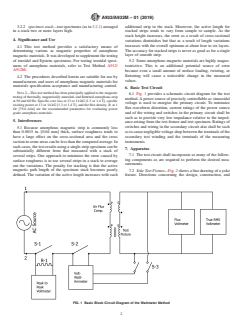
6.1 Fig. 1 provides a schematic circuit diagram for the test
testingofthermally,magneticallyannealed,andflattenedamorphousstrip
method.Apowersourceofpreciselycontrollableacsinusoidal
at 50 and 60 Hz. Specific core loss at 13 or 14 kG [1.3 or 1.4 T], specific
voltage is used to energize the primary circuit. To minimize
exciting power at 13 or 14 kG [1.3 or 1.4 T], and the flux density, B,at1
flux-waveform distortion, current ratings of the power source
Oe [79.6 A/m] are the recommended parameters for evaluating power
grade amorphous materials. and of the wiring and switches in the primary circuit shall be
such as to provide very low impedance relative to the imped-
5. Interferences
ance arising from the test fixture and test specimen. Ratings of
switches and wiring in the secondary circuit also shall be such
5.1 Because amorphous magnetic strip is commonly less
than 0.0015 in. [0.04 mm] thick, surface roughness tends to astocausenegligiblevoltagedropbetweentheterminalsofthe
secondary test winding and the terminals of the measuring
have a large effect on the cross-sectional area and the cross
instruments.
sectioninsomeareascanbelessthanthecomputedaverage.In
suchcases,thetestresultsusingasingle-stripspecimencanbe
7. Apparatus
substantially different from that measured with a stack of
7.1 The test circuit shall incorporate as many of the follow-
several strips. One approach to minimize the error caused by
ing components as are required to perform the desired mea-
surface roughness is to use several strips in a stack to average
surements.
out the variations. The penalty for stacking is that the active
magnetic path length of the specimen stack becomes poorly 7.2 YokeTestFixture—Fig.2showsalinedrawingofayoke
defined. The variation of the active length increases with each fixture. Directions concerning the design, construction, and
FIG. 1 Basic Block Circuit Diagram of the Wattmeter Method
A932/A932M − 01 (2019)
ing voltmeter, with scale readings in average volts times π
.=2/4 so that its indications will be identical with those of a
true rms voltmeter on a pure sinusoidal voltage, shall be
provided for evaluating the peak value of the test flux density.
To produce the estimated precision of test under this test
method, the full-scale meter errors shall not exceed 0.25%
(Note3).Eitherdigitaloranalogfluxvoltmetersarepermitted.
Use of a digital flux voltmeter with high input impedance
(typically, 10 MΩ) is recommended to minimize loading
effects and to reduce instrument loss compensation. If an
analog flux voltmeter is used, its input resistance shall be
greaterthen10000Ω/Voffull-scaleindication.Voltageranges
FIG. 2 Single-Yoke Fixture (Exploded View)
and number of significant digits shall be consistent with the
accuracy specified above. Care shall be taken to avoid errors
caused by temperature and frequency effects in the instrument.
calibration of the fixture are given in 7.2.1, 7.2.2, Annex A1,
Annex A2, and Annex A3. NOTE3—Inaccuraciesinsettingthetestvoltageproduceerrorsapproxi-
mately two times as large in the specific core loss.
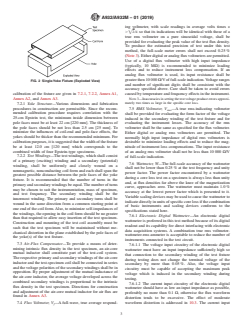
7.2.1 Yoke Structure—Various dimensions and fabrication
procedures in construction are permissible. Since the recom-
7.5 RMS Voltmeter, V —A true rms-indicating voltmeter
rms
mended calibration procedure requires correlation with the
shall be provided for evaluating the form factor of the voltage
25-cm Epstein test, the minimum inside dimension between
induced in the secondary winding of the test fixture and for
pole faces must be at least 22 cm [220 mm]. The thickness of
evaluating the instrument losses. The accuracy of the rms
the pole faces should be not less than 2.5 cm [25 mm]. To
voltmeter shall be the same as specified for the flux voltmeter.
minimize the influences of coil-end and pole-face effects, the
Either digital or analog rms voltmeters are permitted. The
yokes should be thicker than the recommended minimum. For
normally high input impedance of digital rms voltmeters is
calibrationpurposes,itissuggestedthatthewidthofthefixture
desirable to minimize loading effects and to reduce the mag-
be at least 12.0 cm [120 mm] which corresponds to the
nitude of instrument loss compensations. The input resistance
combined width of four Epstein-type specimens.
of an analog rms voltmeter shall not be less than 10000 Ω/V
7.2.2 Test Windings—The test windings, which shall consist
of full-scale indication.
of a primary (exciting) winding and a secondary (potential)
7.6 Wattmeter, W—The full-scale accuracy of the wattmeter
winding, shall be uniformly and closely wound on a
shall not be lower than 0.25% at the test frequency and unity
nonmagnetic, nonconducting coil form and each shall span the
power factor. The power factor encountered by a wattmeter
greatest possible distance between the pole faces of the yoke
during a core loss test on a specimen is always less than unity
fixture. It is recommended that the number of turns in the
and, at flux densities far above the knee of the magnetization
primaryandsecondarywindingsbeequal.Thenumberofturns
curve, approaches zero. The wattmeter must maintain 1.0%
may be chosen to suit the instrumentation, mass of specimen,
accuracy at the lowest power factor which is presented to it.
and test frequency. The secondary winding shall be the
Variablescalingdevicesmaybeusedtocausethewattmeterto
innermost winding. The primary and secondary turns shall be
indicatedirectlyinunitsofspecificcorelossifthecombination
wound in the same direction from a common starting point at
of basic instruments and scaling devices conforms to the
oneendofthecoilform.Also,tominimizeself-impedancesof
specifications stated here.
thewindings,theopeninginthecoilformshouldbenogreater
7.6.1 Electronic Digital Wattmeter—An electronic digital
than that required to allow easy insertion of the test specimen.
wattmeter is preferred in this test method because of its digital
Construction and mounting of the test coil assembly must be
readout and its capability for direct interfacing with electronic
such that the test specimen will be maintained without me-
data acquisition systems. A combination true rms voltmeter-
chanicaldistortionintheplaneestablishedbythepolefacesof
wattmeter-rms ammeter is acceptable to reduce the number of
the yoke(s) of the test fixture.
instruments connected in the test circuit.
7.3 Air-Flux Compensator—To provide a means of deter-
7.6.1.1 The voltage input circuitry of the electronic digital
mining intrinsic flux density in the test specimen, an air-core
wattmeter must have an input impedance sufficiently high so
mutual inductor shall constitute part of the test-coil system.
that connection to the secondary winding of the test fixture
The respective primary and secondary windings of the air-core
during testing does not change the terminal voltage of the
inductorandthetest-specimencoilshallbeconnectedinseries
secondary by more than 0.05%. Also, the voltage input
andthevoltagepolaritiesofthesecondarywindingsshallbein
circuitry must be capable of accepting the maximum peak
opposition. By proper adjustment of the mutual inductance of
voltage which is induced in the secondary winding during
the air-core inductor, the average voltage developed across the
testing.
combined secondary windings is proportional to the intrinsic
7.6.1.2 The current input circuitry of the electronic digital
flux density in the test specimen. Directions for construction
wattmeter should have as low an input impedance as possible,
and adjustment of the air-core mutual inductor for air flux are
preferably no more than 0.1 Ω, otherwise the flux waveform
found in Annex A3.
distortion tends to be excessive. The effect of moderate
7.4 Flux Voltmeter, V—A full-wave, true average respond- waveform distortion is addressed in 10.3. The current input
f
A932/A932M − 01 (2019)
circuitry must be capable of accepting the maximum rms peak value of the voltage drop that results when the exciting
current and the maximum peak current drawn by the primary current flows through a standard resistance of low value
winding of the test transformer when core loss tests are being connected in series with the primary winding of the test
performed. In particular, since the primary current will be very transformer. This peak-to-peak reading voltmeter shall have a
nonsinusoidal (peaked) if core loss tests are performed on a nominalfull-scaleaccuracyofatleast3%atthetestfrequency
specimen at flux densities above the knee of the magnetization and be able to accommodate voltage with a crest factor of 5 or
curve, the crest factor capability of the current input circuitry more.Caremustbeexercisedthatthestandardresistor(usually
should be 5 or more. in the range 0.1 to 1.0 Ω) carrying the exciting current has
7.6.2 Electrodynamometer Wattmeter—Areflecting-typeas- adequate current-carrying capacity and is accurate to at least
tatic electrodynamometer wattmeter is permitted as an alterna- 0.1%. It shall have negligible variation with temperature and
tive to an electronic wattmeter. frequency under the conditions applicable to this test method.
7.6.2.1 The sensitivity of the electrodynamometer wattme- If desired, the value of the resistor may be such that the
ter must be such that the connection of the potential circuit of peak-reading voltmeter indicates directly in terms of peak
the wattmeter, during testing, to the secondary winding of the magnetic field strength, provided that the resistor conforms to
test fixture does not change the terminal voltage of the the limitations stated above.
secondary by more than 0.05%. Also, the resistance of the
7.9 Power Supply—Asourceofsinusoidaltestpoweroflow
potential circuit of the wattmeter must be sufficiently high so
internal impedance and excellent voltage and frequency stabil-
that the inductive reactance of the potential coil of the
ity is required for this test.
wattmeter in combination with the leakage reactance of the
7.9.1 An electronic power source consisting of a low-
secondary circuit of the test fixture does not introduce an
distortion oscillator working into a very linear amplifier of
additional phase angle error in the measurements. Should the
about 75 VA rating is an acceptable source of test power. The
impedance of this combined reactance at the test frequency
line power for the electronic oscillator and amplifier should
exceed1Ωper1000Ωofresistanceinthewattmeter-potential
come from a voltage-regulated source, to ensure voltage
circuit, the potential circuit must be compensated for this
stability within 0.1%, and the output of the system should be
reactance.
monitored with an accurate frequency-indicating device to see
7.6.2.2 The impedance of the current coil of the electrody-
that control of the frequency is maintained to within 0.1% or
namometer wattmeter should not exceed 2.0 Ω. If flux wave-
better. It is permissible to use an amplifier with negative
formdistortiontendstobeexcessive,thisimpedanceshouldbe
feedback to reduce the waveform distortion. A properly de-
notmorethan0.1Ω.Theratedcurrentcarryingcapacityofthe
signed system will maintain the form factor at π.=2/4 until
current coil must be compatible with the maximum rms
the test specimen saturates.
primary current to be encountered during core loss testing.
7.9.2 A suitable nonelectronic power supply may be used.
7.6.3 Waveform Calculator—The waveform calculator used
The voltage for the test circuit may be made adjustable by use
in combination with a digitizing oscilloscope is useful for core
of a flux density regulator or variable adjustable transformer
loss measurements. See Annex A4 for details regarding these
with a tapped transformer between the source and the test
instruments. There are added benefits in that this equipment is
circuit, or by generator field control. The harmonic content of
able to measure, compute, and display the rms, average and
the voltage output from the source under the heaviest test load
peak values for current and flux voltage as well as measure the
should not exceed 1.0%. Voltage stability within 0.1% is
core loss and excitation power demand.
necessaryforprecisework.Thefrequencyofthesourceshould
7.6.3.1 The normally high input impedance of these instru-
be accurately controlled within 0.1% of the nominal value.
ments (approximately 1 MΩ) precludes possible errors as a
result of instrument loading. There is a requirement that the
8. Specimen Preparation
current and flux sensing leads must be connected in the proper
phase relationship.
8.1 The type of test fixture and its dimensions govern the
dimensions of permissible test specimens. The minimum
7.7 RMS Ammeter—A true rms ammeter is required if
length of a specimen shall be no less than the outside
measurementsofexcitingcurrentaretobemade.Thepreferred
dimensionofthedistanceoverthepolefacesofthetestfixture.
methodformeasuringthermscurrentistomeasurethevoltage
The length of the specimen shall be equal in length to the
drop across a low value, noninductive resistor in the primary
specimens used in calibration of the fixture. This length is
circuit using a true rms-responding voltmeter. Electronic watt-
preferably 30 cm [300 mm].Also, the stack height shall be the
meters commonly are also true rms ammeters, but a separate
same as that used in calibration of the fixture. The preferred
instrument may be needed.
stack height is four strips. For maximum accuracy, the speci-
7.8 Devices for Peak-Current Measurement—A means of
men width should be equal to the width of the yoke. As a
determining the peak value of the exciting current is required
minimum, it is recommended that the specimen width be at
if an evaluation of peak permeability is to be made by the
least one half of the yoke width.
peak-current method. The use of an air-core mutual inductor
8.2 The specimen shall have square ends and a length
for this purpose must be avoided because of the error it would
tolerance of 0.1%.
introduceinthistestbecauseofincreasedwaveformdistortion.
7.8.1 The peak-current measurement may be made with a 8.3 The specimen shall be annealed before testing in accor-
voltmeter whose indications are proportional to the peak-to- dance with the appropriate ASTM material specification such
A932/A932M − 01 (2019)
as Specification A901 or as agreed upon by manufacturer and voltmeter deviates from the reading of the flux voltmeter by
purchaser. The threefold purpose of the anneal is to flatten the
more than 1% (or the form factor deviates from π.=2/4 by
specimen, remove the residual stress, and to impart the desired
more than 1%), the value of the specific core loss shall be
magnetic anisotropy. The details of a typical magnetic anneal-
corrected.Theequationsforcorrectionforwaveformdistortion
ing cycle and fixture are given in Annex A5.
are given in 10.3. The test methods for determining the
percentages of eddy-current loss and hysteresis loss are given
9. Procedure
in Annex A6.
9.1 Initial Determinations—Before testing, check length of
9.8 Peak Current—Because the peak current in this mea-
each specimen for conformity within 0.1% of the desired
surement is seldom above 100 mA and is normally less than
length. Discard specimens showing evidence of mechanical
10mA, it is best measured using a peak-reading voltmeter and
damage. Weigh and record the mass of each specimen to an
aprecision0.1or1.0Ωresistor(R1inFig.1).Whenpeakflux
accuracy of 0.1%.
density at a given magnetic field strength is required, open S1
to insert R1 into the primary circuit, close S2 to protect the
9.2 Specimen Placement—Whenplacedintothetestfixture,
wattmeter from the possibility of excessive current, open S3 to
the test specimen must be centered on the longitudinal and
minimize secondary loading and adjust the voltage to the
transverse axes of the test coil. Because of the high stress
power supply such that the peak reading voltmeter indicates
sensitivity of some amorphous materials, any loading force on
that the necessary value of the peak current has been estab-
the test specimen should be avoided.
lished. Observe on the flux voltmeter the value of flux volts
9.3 Demagnetization—The specimen should be demagne-
induced in the secondary winding of the test fixture. The flux
tizedbeforemeasurementsofanymagneticpropertyaremade.
density corresponding to the observed flux volts may be
With the required apparatus connected as shown in Fig. 1 and
computed using Eq 1 or Eq 13. The peak permeability is
with Switches S1 and S2 closed and S3 open, accomplish this
calculatedusingEq10,Eq11,orEq12orelseEq9andEq20.
demagnetizationbyinitiallyapplyingavoltagefromthepower
9.9 RMS Current—To measure the rms current, a true rms
source of the primary circuit that is sufficient to magnetize the
voltmeter is substituted for the peak reading voltmeter as
specimen to a flux density above the knee of its magnetization
described in 9.8.
curve(thisfluxdensitymaybedeterminedfromthereadingof
the flux voltmeter by means of Eq 1 or Eq 13 and then
10. Calculations (Customary Units)
decreasing the voltage slowly and smoothly (or in small steps)
to a very low flux density). After demagnetization, test
10.1 Flux Volts—Calculate the flux volts, E, induced in the
f
promptlyatthedesiredtestpoints,performingthetestsinorder
secondary winding of the test fixture corresponding to the
of increasing flux density values.
desired intrinsic flux density in the test specimen from the
following equation:
9.4 Setting Induction—WithSwitchesS1andS3closed,and
S2open,increasethevoltageofthepowersupplyuntiltheflux
E 5 ~π =2!B N Af 310 (1)
f i 2
voltmeter indicates the value of voltage calculated to give the
where:
desired test flux density in accordance with Eq 1 or Eq 13.
Becausetheactionoftheair-fluxcompensatorcausesavoltage B = maximum intrinsic flux density, kG;
i
A = effectivecross-sectionalareaofthetestspecimen,cm ;
equaltothatwhichwouldbeinducedinthesecondarywinding
N = number of turns in secondary winding; and
by the air flux to be subtracted from that induced by the total
f = frequency, Hz.
flux in the secondary, the flux density calculated from the
voltageindicatedbythefluxvoltmeterwillbetheintrinsicflux
Cross-sectional area of the test specimen, A cm , is deter-
density, B.
mined as follows:
i
9.5 Core Loss—When the voltage indicated by the flux A 5 m/ δl (2)
~ !
voltmeter has been adjusted to the desired value, read the
where:
wattmeter.
m = total mass of specimen, g;
9.6 Specific Core Loss—Obtain the specific core loss of the
l = actual length of specimen, cm; and
specimen using the equations and instructions given in 10.2
δ = standard assumed density of specimen material, g/cm .
and 11.2.
9.7 Secondary RMS Voltage—Read the rms voltmeter with
10.2 Specific Core Loss—To obtain specific core loss in
Switches S1 closed, S2 and S3 open, and the voltage indicated
watts per unit mass of the specimen, power expended in the
by the flux voltmeter adjusted to the desired value. On truly
secondary of the test circuit and included in wattmeter indica-
sinusoidal voltage, both voltmeters will indicate the same
tion must be eliminated before dividing by the active mass of
value, showing that the form factor of the induced voltage is
the specimen (Note 4). The equation for calculating specific
π.=2/4. Determining the flux density from the reading of a
coreloss, P in
...