

ASTM D5388-21
(Test Method)Standard Test Method for Indirect Measurements of Discharge by Step-Backwater Method
General Information
- Abstract
SIGNIFICANCE AND USE
5.1 This test method is particularly useful for determining the discharge when it cannot be measured directly (such as during high flow conditions) by some type of current meter to obtain velocities and with sounding weights to determine the cross section (refer to Test Method D3858). This test method requires only one high-water elevation, unlike the slope-area test method that requires numerous high-water marks to define the fall in the reach. It can be used to determine a stage-discharge relation without data from several high-water events.
5.1.1 The user is encouraged to verify the theoretical stage-discharge relation with direct current-meter measurements when possible.
5.1.2 To develop a rating curve, plot stage versus discharge for several discharges and their computed stages on a rating curve together with direct current-meter measurements.
SCOPE
1.1 This test method covers the computation of discharge of water in open channels or streams using representative cross-sectional characteristics, the water-surface elevation of the upstream-most cross section, and coefficients of channel roughness as input to gradually-varied flow computations.2
1.2 This test method produces an indirect measurement of the discharge for one flow event, usually a specific flood. The computed discharge may be used to define a point on the stage-discharge relation.
1.3 The values stated in inch-pound units are to be regarded as standard. The values given in parentheses are mathematical conversions to SI units that are provided for information only and are not considered standard.
1.4 This standard does not purport to address all of the safety concerns, if any, associated with its use. It is the responsibility of the user of this standard to establish appropriate safety, health, and environmental practices and determine the applicability of regulatory limitations prior to use.
1.5 This international standard was developed in accordance with internationally recognized principles on standardization established in the Decision on Principles for the Development of International Standards, Guides and Recommendations issued by the World Trade Organization Technical Barriers to Trade (TBT) Committee.
- Status
- Published
- Publication Date
- 31-Oct-2021
- Technical Committee
- D19 - Water
- Drafting Committee
- D19.07 - Sediments, Geomorphology, and Open-Channel Flow
Buy Documents
ASTM D5388-21 - Standard Test Method for Indirect Measurements of Discharge by Step-Backwater Method
REDLINE ASTM D5388-21 - Standard Test Method for Indirect Measurements of Discharge by Step-Backwater Method
Overview
ASTM D5388-21, "Standard Test Method for Indirect Measurements of Discharge by Step-Backwater Method," provides a systematic approach for calculating the discharge (flow rate) of water in open channels and streams. This standard is specifically designed for situations when direct measurements cannot be obtained, such as during flood events or high flow conditions. By relying on representative cross-sectional stream characteristics, a single high-water elevation at the upstream section, and channel roughness coefficients, the step-backwater method enables accurate computation of flow using gradually-varied flow principles.
Adhering to this ASTM standard is crucial for hydrologists, civil engineers, regulatory agencies, and water resource professionals aiming to ensure consistent and reliable discharge measurements, especially in challenging field conditions.
Key Topics
- Indirect Measurement of Open Channel Discharge
- Utilizes representative cross sections, channel roughness (Manning's n), and water-surface elevations
- Suited for instances where direct measurement is impractical or unsafe
- Step-Backwater Methodology
- Requires only a single high-water mark at the upstream-most cross section
- Involves surveying channel geometry and computing water-surface profiles between cross sections
- Allows calculation of discharge for one flow event, typically a specific flood
- Stage-Discharge Relationship Development
- Computed discharge can be used to establish points on a stage-discharge (rating) curve
- Recommended to verify computed values with direct current-meter measurements when possible
- Cross Section and Reach Selection
- Advises on choosing channel reaches that are uniform in shape and conveyance between cross sections
- Recommends a minimum of ten cross sections for a smooth backwater curve
- Calibration and Equipment
- Emphasizes regular calibration of surveying instruments for accuracy
- Highlights the need for proper safety measures during fieldwork
- Limitations and Considerations
- Results are subject to spatial and temporal variability in open-channel flow conditions
- Precise determination of roughness coefficients is crucial for accurate calculations
Applications
ASTM D5388-21 is widely used in the following practical applications:
Flood Flow Analysis
Enables estimation of peak discharges during high flow or flood events, which are challenging or unsafe for direct current meter use.Stage-Discharge Curve Development
Supports the establishment or refinement of rating curves at stream gauging stations, especially when multiple high-water data points are not available.Hydraulic and Hydrologic Studies
Useful for river engineering, floodplain mapping, watershed management, infrastructure design (e.g., bridges and culverts), and environmental impact assessments where reliable discharge data are essential.Regulatory Compliance and Design
Assists engineers and agencies in fulfilling water resource regulations and in the design of hydraulic structures where knowledge of maximum potential flows is required.Retrospective Event Analysis
Suitable for reconstructing historical flood events where only limited high-water evidence exists.
Related Standards
ASTM D3858 - Standard Test Method for Open-Channel Flow Measurement of Water by Velocity-Area Method
Provides guidance for direct measurements using current meters and cross-sectional area determination.ASTM D1129 - Terminology Relating to Water
Defines critical terms related to water measurement and hydrology.ASTM D2777 - Practice for Determination of Precision and Bias of Applicable Test Methods
Offers procedures to ensure the reliability and accuracy of water analysis methods.U.S. Geological Survey Water Supply Paper 1849
Reference for roughness characteristics of natural streams, supporting accurate selection of channel roughness coefficients.
Keywords: flood discharge measurement, open channel flow, step-backwater method, stage-discharge relation, stream gauging, ASTM D5388-21, river engineering, roughness coefficient, hydraulic computation, water resource management.
Relations
- Effective Date
- 01-May-2020
- Effective Date
- 15-Jun-2012
- Effective Date
- 01-Mar-2010
- Effective Date
- 01-Oct-2008
- Effective Date
- 15-Jan-2008
- Effective Date
- 01-Sep-2006
- Effective Date
- 01-Sep-2006
- Effective Date
- 15-Aug-2006
- Effective Date
- 15-Feb-2006
- Effective Date
- 01-Mar-2004
- Effective Date
- 01-Mar-2004
- Effective Date
- 10-Aug-2003
- Effective Date
- 10-Aug-2003
- Effective Date
- 10-Jun-2003
- Effective Date
- 10-Mar-2003
Buy Documents
ASTM D5388-21 - Standard Test Method for Indirect Measurements of Discharge by Step-Backwater Method
REDLINE ASTM D5388-21 - Standard Test Method for Indirect Measurements of Discharge by Step-Backwater Method
Get Certified
Connect with accredited certification bodies for this standard

BSMI (Bureau of Standards, Metrology and Inspection)
Taiwan's standards and inspection authority.
Sponsored listings
Frequently Asked Questions
ASTM D5388-21 is a standard published by ASTM International. Its full title is "Standard Test Method for Indirect Measurements of Discharge by Step-Backwater Method". This standard covers: SIGNIFICANCE AND USE 5.1 This test method is particularly useful for determining the discharge when it cannot be measured directly (such as during high flow conditions) by some type of current meter to obtain velocities and with sounding weights to determine the cross section (refer to Test Method D3858). This test method requires only one high-water elevation, unlike the slope-area test method that requires numerous high-water marks to define the fall in the reach. It can be used to determine a stage-discharge relation without data from several high-water events. 5.1.1 The user is encouraged to verify the theoretical stage-discharge relation with direct current-meter measurements when possible. 5.1.2 To develop a rating curve, plot stage versus discharge for several discharges and their computed stages on a rating curve together with direct current-meter measurements. SCOPE 1.1 This test method covers the computation of discharge of water in open channels or streams using representative cross-sectional characteristics, the water-surface elevation of the upstream-most cross section, and coefficients of channel roughness as input to gradually-varied flow computations.2 1.2 This test method produces an indirect measurement of the discharge for one flow event, usually a specific flood. The computed discharge may be used to define a point on the stage-discharge relation. 1.3 The values stated in inch-pound units are to be regarded as standard. The values given in parentheses are mathematical conversions to SI units that are provided for information only and are not considered standard. 1.4 This standard does not purport to address all of the safety concerns, if any, associated with its use. It is the responsibility of the user of this standard to establish appropriate safety, health, and environmental practices and determine the applicability of regulatory limitations prior to use. 1.5 This international standard was developed in accordance with internationally recognized principles on standardization established in the Decision on Principles for the Development of International Standards, Guides and Recommendations issued by the World Trade Organization Technical Barriers to Trade (TBT) Committee.
SIGNIFICANCE AND USE 5.1 This test method is particularly useful for determining the discharge when it cannot be measured directly (such as during high flow conditions) by some type of current meter to obtain velocities and with sounding weights to determine the cross section (refer to Test Method D3858). This test method requires only one high-water elevation, unlike the slope-area test method that requires numerous high-water marks to define the fall in the reach. It can be used to determine a stage-discharge relation without data from several high-water events. 5.1.1 The user is encouraged to verify the theoretical stage-discharge relation with direct current-meter measurements when possible. 5.1.2 To develop a rating curve, plot stage versus discharge for several discharges and their computed stages on a rating curve together with direct current-meter measurements. SCOPE 1.1 This test method covers the computation of discharge of water in open channels or streams using representative cross-sectional characteristics, the water-surface elevation of the upstream-most cross section, and coefficients of channel roughness as input to gradually-varied flow computations.2 1.2 This test method produces an indirect measurement of the discharge for one flow event, usually a specific flood. The computed discharge may be used to define a point on the stage-discharge relation. 1.3 The values stated in inch-pound units are to be regarded as standard. The values given in parentheses are mathematical conversions to SI units that are provided for information only and are not considered standard. 1.4 This standard does not purport to address all of the safety concerns, if any, associated with its use. It is the responsibility of the user of this standard to establish appropriate safety, health, and environmental practices and determine the applicability of regulatory limitations prior to use. 1.5 This international standard was developed in accordance with internationally recognized principles on standardization established in the Decision on Principles for the Development of International Standards, Guides and Recommendations issued by the World Trade Organization Technical Barriers to Trade (TBT) Committee.
ASTM D5388-21 is classified under the following ICS (International Classification for Standards) categories: 17.220.20 - Measurement of electrical and magnetic quantities. The ICS classification helps identify the subject area and facilitates finding related standards.
ASTM D5388-21 has the following relationships with other standards: It is inter standard links to ASTM D1129-13(2020)e2, ASTM D2777-12, ASTM D1129-10, ASTM D3858-95(2008), ASTM D2777-08, ASTM D1129-06a, ASTM D1129-06ae1, ASTM D2777-06, ASTM D1129-06, ASTM D1129-04, ASTM D1129-04e1, ASTM D2777-03, ASTM D1129-03a, ASTM D3858-95(2003), ASTM D1129-03. Understanding these relationships helps ensure you are using the most current and applicable version of the standard.
ASTM D5388-21 is available in PDF format for immediate download after purchase. The document can be added to your cart and obtained through the secure checkout process. Digital delivery ensures instant access to the complete standard document.
Standards Content (Sample)
This international standard was developed in accordance with internationally recognized principles on standardization established in the Decision on Principles for the
Development of International Standards, Guides and Recommendations issued by the World Trade Organization Technical Barriers to Trade (TBT) Committee.
Designation:D5388 −21
Standard Test Method for
Indirect Measurements of Discharge by Step-Backwater
Method
This standard is issued under the fixed designation D5388; the number immediately following the designation indicates the year of
original adoption or, in the case of revision, the year of last revision. A number in parentheses indicates the year of last reapproval. A
superscript epsilon (´) indicates an editorial change since the last revision or reapproval.
1. Scope Applicable Test Methods of Committee D19 on Water
D3858 Test Method for Open-Channel Flow Measurement
1.1 This test method covers the computation of discharge of
of Water by Velocity-Area Method
water in open channels or streams using representative cross-
sectional characteristics, the water-surface elevation of the
3. Terminology
upstream-most cross section, and coefficients of channel
roughness as input to gradually-varied flow computations.
3.1 Definitions:
1.2 This test method produces an indirect measurement of 3.1.1 For definitions of terms used in this standard, refer to
the discharge for one flow event, usually a specific flood. The
Terminology D1129.
computed discharge may be used to define a point on the 3.2 Definitions of Terms Specific to This Standard:
stage-discharge relation.
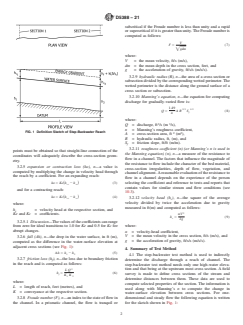
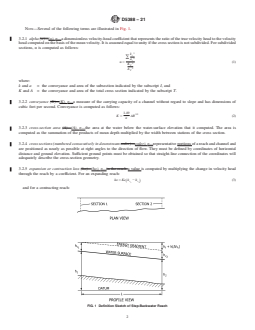
NOTE—Several of the following terms are illustrated in Fig.
1.
1.3 The values stated in inch-pound units are to be regarded
as standard. The values given in parentheses are mathematical 3.2.1 alpha (α), n—a dimensionless velocity-head coeffi-
cient that represents the ratio of the true velocity head to the
conversions to SI units that are provided for information only
and are not considered standard. velocity head computed on the basis of the mean velocity. It is
assumed equal to unity if the cross section is not subdivided.
1.4 This standard does not purport to address all of the
For subdivided sections, α is computed as follows:
safety concerns, if any, associated with its use. It is the
responsibility of the user of this standard to establish appro-
k
i
( 2
priate safety, health, and environmental practices and deter-
a
i
α 5 (1)
mine the applicability of regulatory limitations prior to use.
K
T
1.5 This international standard was developed in accor-
A
T
dance with internationally recognized principles on standard-
where:
ization established in the Decision on Principles for the
k and a = the conveyance and area of the subsection indi-
Development of International Standards, Guides and Recom-
cated by the subscript I, and
mendations issued by the World Trade Organization Technical
K and A = theconveyanceandareaofthetotalcrosssection
Barriers to Trade (TBT) Committee.
indicated by the subscript T.
2. Referenced Documents
3.2.2 conveyance (K), n—ameasureofthecarryingcapacity
2.1 ASTM Standards:
of a channel without regard to slope and has dimensions of
D1129 Terminology Relating to Water
cubic feet per second. Conveyance is computed as follows:
D2777 Practice for Determination of Precision and Bias of
1.49
2/3
K 5 AR (2)
n
This test method is under the jurisdiction of ASTM Committee D19 on Water
3.2.3 cross-section area (A), n—the area at the water below
and is the direct responsibility of Subcommittee D19.07 on Sediments,
the water-surface elevation that it computed. The area is
Geomorphology, and Open-Channel Flow.
computed as the summation of the products of mean depth
Current edition approved Nov. 1, 2021. Published January 2022. Originally
approved in 1993. Last previous edition approved in 2013 as D5388 – 93 (2013). multiplied by the width between stations of the cross section.
DOI: 10.1520/D5388-21.
2 3.2.4 cross sections (numbered consecutively in downstream
Barnes, H. H., Jr., “Roughness Characteristics of Natural Streams,” U.S.
Geological Survey Water Supply Paper 1849, 1967.
order), n—representative portions of a reach and channel and
For referenced ASTM standards, visit the ASTM website, www.astm.org, or
are positioned as nearly as possible at right angles to the
contact ASTM Customer Service at service@astm.org. For Annual Book of ASTM
direction of flow. They must be defined by coordinates of
Standards volume information, refer to the standard’s Document Summary page on
the ASTM website. horizontal distance and ground elevation. Sufficient ground
Copyright © ASTM International, 100 Barr Harbor Drive, PO Box C700, West Conshohocken, PA 19428-2959. United States
D5388−21
subcritical if the Froude number is less than unity and a rapid
or supercritical if it is greater than unity.The Froude number is
computed as follows:
V
F 5 (7)
=gdm
where:
V = the mean velocity, ft/s (m/s),
dm = the mean depth in the cross section, feet, and
g = the acceleration of gravity, ft/s/s (m/s/s).
3.2.9 hydraulic radius (R), n—the area of a cross section or
subsection divided by the corresponding wetted perimeter. The
wetted perimeter is the distance along the ground surface of a
cross section or subsection.
3.2.10 Manning’s equation, n—the equation for computing
discharge for gradually-varied flow is:
1.49
2/3 1/2
Q 5 AR S (8)
f
n
where:
3 3
Q = discharge, ft /s (m /s),
n = Manning’s roughness coefficient,
FIG. 1 Definition Sketch of Step-Backwater Reach 2 2
A = cross-section area, ft (m ),
R = hydraulic radius, ft, (m), and
S = friction slope, ft/ft (m/m).
f
3.2.11 roughness coeffıcient (n) (or Manning’s n is used in
points must be obtained so that straight-line connection of the
the Manning equation) (n), n—a measure of the resistance to
coordinates will adequately describe the cross-section geom-
flow in a channel. The factors that influence the magnitude of
etry.
the resistance to flow include the character of the bed material,
3.2.5 expansion or contraction loss (ho), n—a value is
cross-section irregularities, depth of flow, vegetation, and
computed by multiplying the change in velocity head through
channel alignment.Areasonable evaluation of the resistance to
the reach by a coefficient. For an expanding reach:
flow in a channel depends on the experience of the person
ho 5 Ke h 2 h (3) selecting the coefficient and reference to texts and reports that
~ !
v v
1 2
contain values for similar stream and flow conditions (see
and for a contracting reach:
10.3).
ho 5 Kc h 2 h (4)
~ !
v v
2 1
3.2.12 velocity head (h ), n—the square of the average
v
velocity divided by twice the acceleration due to gravity
where:
measured in ft(m) and computed as follows:
h = velocity head at the respective section, and
v
Ke and Kc = coefficients. αV
h 5 (9)
v
2g
3.2.5.1 Discussion—Thevaluesofthecoefficientscanrange
from zero for ideal transitions to 1.0 for Ke and 0.5 for Kc for where:
abrupt changes.
α = velocity-head coefficient,
V = the mean velocity in the cross section, ft/s (m/s), and
3.2.6 fall (∆h), n—the drop in the water surface, in ft (m),
g = the acceleration of gravity, ft/s/s (m/s/s).
computed as the difference in the water-surface elevation at
adjacent cross sections (see Fig. 1):
4. Summary of Test Method
∆h 5 h 2 h (5)
1 2
4.1 The step-backwater test method is used to indirectly
3.2.7 friction loss (h), n—the loss due to boundary friction
f determine the discharge through a reach of channel. The
in the reach and is computed as follows:
step-backwater test method needs only one high-water eleva-
tion and that being at the upstream most cross section. A field
LQ
h 5 (6)
f
survey is made to define cross sections of the stream and
K K
1 2
determine distances between them. These data are used to
where:
compute selected properties of the section. The information is
L = length of reach, feet (metres), and
used along with Manning’s n to compute the change in
K = conveyance at the respective section.
water-surface elevation between cross sections. For one-
3.2.8 Froude number (F), n—an index to the state of flow in dimensional and steady flow the following equation is written
the channel. In a prismatic channel, the flow is tranquil or for the sketch shown in Fig. 1:
D5388−21
h 5 h 1h 1hf1ho 2 h (10) circuitry, or other advanced surveying instruments may be
1 2 v v
2 1
used. Standard level rods, a telescoping 25-ft (7.62-m) level
where:
rod, rod levels, head levels, steel and metallic tapes, tag lines
h = elevation of the water surface above a common datum
(small wires with markers fixed at known spacings), vividly
at the respective sections,
colored flagging, survey stakes, a camera (preferably stereo)
hf = the loss due to boundary friction in the reach, and
with built-in light meter with color film, and ample note paper
ho = the energy loss due to deceleration or acceleration of
are necessary items.
the flow (in the downstream direction) in an expanding
7.2 Additional equipment that may expedite a survey in-
or contracting reach.
cludes axes, machetes, a boat with oars and motor, hip boots,
5. Significance and Use
waders, rain gear, sounding equipment, and two-way radios.
5.1 This test method is particularly useful for determining
7.3 Safety equipment includes life jackets, first aid kit,
the discharge when it cannot be measured directly (such as
drinking water, and pocket knives.
during high flow conditions) by some type of current meter to
obtain velocities and with sounding weights to determine the
8. Sampling
cross section (refer to Test Method D3858). This test method
8.1 Sampling as defined in Terminology D1129 is not
requires only one high-water elevation, unlike the slope-area
applicable in this test method.
test method that requires numerous high-water marks to define
the fall in the reach. It can be used to determine a stage-
9. Calibration
discharge relation without data from several high-water events.
5.1.1 The user is encouraged to verify the theoretical
9.1 Check the surveying instruments, levels, transits, etc.
stage-discharge relation with direct current-meter measure-
adjustm
...
This document is not an ASTM standard and is intended only to provide the user of an ASTM standard an indication of what changes have been made to the previous version. Because
it may not be technically possible to adequately depict all changes accurately, ASTM recommends that users consult prior editions as appropriate. In all cases only the current version
of the standard as published by ASTM is to be considered the official document.
Designation: D5388 − 93 (Reapproved 2013) D5388 − 21
Standard Test Method for
Indirect Measurements of Discharge by Step-Backwater
Method
This standard is issued under the fixed designation D5388; the number immediately following the designation indicates the year of
original adoption or, in the case of revision, the year of last revision. A number in parentheses indicates the year of last reapproval. A
superscript epsilon (´) indicates an editorial change since the last revision or reapproval.
1. Scope
1.1 This test method covers the computation of discharge of water in open channels or streams using representative cross-sectional
characteristics, the water-surface elevation of the upstream-most cross section, and coefficients of channel roughness as input to
gradually-varied flow computations.
1.2 This test method produces an indirect measurement of the discharge for one flow event, usually a specific flood. The computed
discharge may be used to define a point on the stage-discharge relation.
1.3 The values stated in inch-pound units are to be regarded as the standard. The SI units values given in parentheses are for
information only.mathematical conversions to SI units that are provided for information only and are not considered standard.
1.4 This standard does not purport to address all of the safety concerns, if any, associated with its use. It is the responsibility
of the user of this standard to establish appropriate safety, health, and environmental practices and determine the applicability of
regulatory limitations prior to use.
1.5 This international standard was developed in accordance with internationally recognized principles on standardization
established in the Decision on Principles for the Development of International Standards, Guides and Recommendations issued
by the World Trade Organization Technical Barriers to Trade (TBT) Committee.
2. Referenced Documents
2.1 ASTM Standards:
D1129 Terminology Relating to Water
D2777 Practice for Determination of Precision and Bias of Applicable Test Methods of Committee D19 on Water
D3858 Test Method for Open-Channel Flow Measurement of Water by Velocity-Area Method
3. Terminology
3.1 Definitions:
3.1.1 For definitions of terms used in this test method, standard, refer to Terminology D1129.
3.2 Definitions of Terms Specific to This Standard:
This test method is under the jurisdiction of ASTM Committee D19 on Water and is the direct responsibility of Subcommittee D19.07 on Sediments, Geomorphology,
and Open-Channel Flow.
Current edition approved Jan. 1, 2013Nov. 1, 2021. Published January 2013January 2022. Originally approved in 1993. Last previous edition approved in 20072013 as
D5388 – 93 (2007).(2013). DOI: 10.1520/D5388-93R13.10.1520/D5388-21.
Barnes, H. H., Jr., “Roughness Characteristics of Natural Streams,” U.S. Geological Survey Water Supply Paper 1849, 1967.
For referenced ASTM standards, visit the ASTM website, www.astm.org, or contact ASTM Customer Service at service@astm.org. For Annual Book of ASTM Standards
volume information, refer to the standard’s Document Summary page on the ASTM website.
Copyright © ASTM International, 100 Barr Harbor Drive, PO Box C700, West Conshohocken, PA 19428-2959. United States
D5388 − 21
NOTE—Several of the following terms are illustrated in Fig. 1.
3.2.1 alpha (α)—(α), n—a dimensionless velocity-head coefficient that represents the ratio of the true velocity head to the velocity
head computed on the basis of the mean velocity. It is assumed equal to unity if the cross section is not subdivided. For subdivided
sections, α is computed as follows:
k
i
(
a
i
α5 (1)
K
T
A
T
where:
k and a = the conveyance and area of the subsection indicated by the subscript I, and
K and A = the conveyance and area of the total cross section indicated by the subscript T.
3.2.2 conveyance (K)—(K), n—a measure of the carrying capacity of a channel without regard to slope and has dimensions of
cubic feet per second. Conveyance is computed as follows:
1.49
2/3
K 5 AR (2)
n
3.2.3 cross-section area (A)—(A), n—the area at the water below the water-surface elevation that it computed. The area is
computed as the summation of the products of mean depth multiplied by the width between stations of the cross section.
3.2.4 cross sections (numbered consecutively in downstream order)—order), n—representative portions of a reach and channel and
are positioned as nearly as possible at right angles to the direction of flow. They must be defined by coordinates of horizontal
distance and ground elevation. Sufficient ground points must be obtained so that straight-line connection of the coordinates will
adequately describe the cross-section geometry.
3.2.5 expansion or contraction loss (ho)—(ho), n—in the reach a value is computed by multiplying the change in velocity head
through the reach by a coefficient. For an expanding reach:
ho 5 Ke h 2 h (3)
~ !
v v
1 2
and for a contracting reach:
FIG. 1 Definition Sketch of Step-Backwater Reach
D5388 − 21
ho 5 Kc h 2 h (4)
~ v v !
2 1
where:
h = velocity head at the respective section, and
v
Ke and Kc = coefficients.
3.2.5.1 Discussion—
The values of the coefficients can range from zero for ideal transitions to 1.0 for Ke and 0.5 for Kc for abrupt changes.
3.2.6 fall (Δh)—(Δh), n—the drop in the water surface, in ft (m), computed as the difference in the water-surface elevation at
adjacent cross sections (see Fig. 1):
Δh 5 h 2 h (5)
1 2
3.2.7 friction loss (h )—), n—the loss due to boundary friction in the reach and is computed as follows:
f
L Q
h 5 (6)
f
K K
1 2
where:
L = length of reach, feet (metres), and
K = conveyance at the respective section.
3.2.8 Froude number (F)—(F), n—an index to the state of flow in the channel. In a prismatic channel, the flow is tranquil or
subcritical if the Froude number is less than unity and a rapid or supercritical if it is greater than unity. The Froude number is
computed as follows:
V
F 5 (7)
=
gdm
where:
V = the mean velocity, ft/s (m/s),
dm = the mean depth in the cross section, feet, and
g = the acceleration of gravity, ft/s/s (m/s/s).
3.2.9 hydraulic radius (R)—(R), n—defined as the area of a cross section or subsection divided by the corresponding wetted
perimeter. The wetted perimeter is the distance along the ground surface of a cross section or subsection.
3.2.10 Manning’s equation—equation, n—Manning’sthe equation for computing discharge for gradually-varied flow is:
1.49
2/3 1/2
Q 5 A R S (8)
f
n
where:
3 3
Q = discharge, ft /s (m /s),
n = Manning’s roughness coefficient,
2 2
A = cross-section area, ft (m ),
R = hydraulic radius, ft, (m), and
S = friction slope, ft/ft (m/m).
f
3.2.11 roughness coeffıcient (n)—(n) (or Manning’s n is used in the Manning equation) (n), n—or Manning’s n is used in the
Manning equation. Roughness coefficient or Manning’s n is a measure of the resistance to flow in a channel. The factors that
influence the magnitude of the resistance to flow include the character of the bed material, cross-section irregularities, depth of
flow, vegetation, and channel alignment. A reasonable evaluation of the resistance to flow in a channel depends on the experience
of the person selecting the coefficient and reference to texts and reports that contain values for similar stream and flow conditions
(see 10.3).
D5388 − 21
3.2.12 velocity head (h )—), n—in ft(m), compute velocity head the square of the average velocity divided by twice the
v
acceleration due to gravity measured in ft(m) and computed as follows:
αV
h 5 (9)
v
2g
where:
α = velocity-head coefficient,
V = the mean velocity in the cross section, ft/s (m/s), and
g = the acceleration of gravity, ft/s/s (m/s/s).
4. Summary of Test Method
4.1 The step-backwater test method is used to indirectly determine the discharge through a reach of channel. The step-backwater
test method needs only one high-water elevation and that being at the upstream most cross section. A field survey is made to define
cross sections of the stream and determine distances between them. These data are used to compute selected properties of the
section. The information is used along with Manning’s n to compute the change in water-surface elevation between cross sections.
For one-dimensional and steady flow the following equation is written for the sketch shown in Fig. 1:
h 5 h 1h 1hf1ho 2 h (10)
1 2 v v
2 1
where:
h = elevation of the water surface above a common datum at the respective sections,
hf = the loss due to boundary friction in the reach, and
ho = the energy loss due to deceleration or acceleration of the flow (in the downstream direction) in an expanding or contracting
reach.
5. Significance and Use
5.1 This test method is particularly useful for determining the discharge when it cannot be measured directly (such as during high
flow conditions) by some type of current meter to obtain velocities and with sounding weights to determine the cross section (refer
to Test Method D3858). This test method requires only one high-water elevation, unlike the slope-area test method that requires
numerous high-water marks to define the fall in the reach. It can be used to determine a stage-discharge relation without needing
data from several high-water events.
5.1.1 The user is encouraged to verify the theoretical stage-discharge relation with direct current-meter measurements when
possible.
5.1.2 To develop a rating curve, plot stage versus discharge for several discharges and their computed stages on a rating curve
together with direct current-meter measurements.
6. Interferences
6.1 The cross sections selected should be are typical and representative of the reach half way to each adjacent cross section. If
there are abrupt changes between adjacent cross sections, the results could be suspect. The ratio of the conveyance to the
conveyance at an adjacent cross section should stay is within 0.7 and 1.4.
6.2 Care must be taken in selecting the water-surface elevation for the downstream cross section. It should not be so high that it
would reflect The elevation is too high if it reflects backwater at the upstream cross section or soand t
...