

ASTM A927/A927M-18(2022)
(Test Method)Standard Test Method for Alternating-Current Magnetic Properties of Toroidal Core Specimens Using the Voltmeter-Ammeter-Wattmeter Method
General Information
- Abstract
SIGNIFICANCE AND USE
3.1 This test method is a derivative of Test Method A697/A697M specifically designed for testing of toroidal cores which are not covered in Test Method A697/A697M and for testing at magnetic flux densities above the knee of the magnetization curve.
3.2 Specimen size typically ranges from 1 in. to 1.25 in. [25.4 mm to 31.8 mm] in inside diameter to 1.5 in. [38.1 mm] in outside diameter with weights ranging from 30 g to 60 g. Provided the test equipment is suitably chosen, there is no obvious limit to the overall size of core that can be tested. If basic material properties are desired, then the requirements of 5.1 must be observed.
3.3 The reproducibility and repeatability of this test method are such that this test method is suitable for design, specification acceptance, service evaluation, and research and development.
3.4 When testing under sinusoidal flux conditions at magnetic flux densities approaching saturation, highly peaked magnetizing waveforms will be present, and the test instruments used must have crest factor capabilities of at least 3; otherwise erroneous results will be obtained.
SCOPE
1.1 This test method covers the determination of several ac magnetic properties of either laminated ring or toroidal tape wound cores made from flat rolled product.
1.2 This test method covers test equipment and procedures for determination of specific core loss, specific exciting power, and peak permeability for power and audio frequencies (50 Hz to 20 000 Hz) under sinusoidal flux conditions.
1.3 This test method, because of the use of a feedback-controlled power amplifier, is well suited for determination of ac magnetic properties at magnetic flux densities above the knee of the magnetization curve and is particularly useful for testing of high-saturation iron-cobalt alloys (for example, alloys listed in Specification A801), although use of this test method is not restricted to a particular type of material.
1.4 This test method shall be used in conjunction with Practice A34/A34M and Terminology A340.
1.5 The values stated in either SI units or inch-pound units are to be regarded separately as standard. The values stated in each system may not be exact equivalents; therefore, each system shall be used independently of the other. Combining values from the two systems may result in non-conformance with the standard.
1.6 This standard does not purport to address all of the safety concerns, if any, associated with its use. It is the responsibility of the user of this standard to establish appropriate safety, health, and environmental practices and determine the applicability of regulatory limitations prior to use.
1.7 This international standard was developed in accordance with internationally recognized principles on standardization established in the Decision on Principles for the Development of International Standards, Guides and Recommendations issued by the World Trade Organization Technical Barriers to Trade (TBT) Committee.
- Status
- Published
- Publication Date
- 30-Sep-2022
- Technical Committee
- A06 - Magnetic Properties
- Drafting Committee
- A06.01 - Test Methods
Overview
ASTM A927/A927M-18(2022) is the internationally recognized standard test method published by ASTM International for determining the alternating-current (AC) magnetic properties of toroidal core specimens using the voltmeter-ammeter-wattmeter method. This standard provides the procedures and requirements for evaluating key magnetic properties such as specific core loss, specific exciting power, and peak permeability for both laminated ring and toroidal tape wound cores made from flat rolled product. Covering a wide frequency range from 50 Hz to 20,000 Hz, it is especially suited for testing at magnetic flux densities above the knee of the magnetization curve-a domain critical for high-saturation iron-cobalt alloys and other advanced magnetic materials.
Key Topics
- Magnetic Property Determination: The standard details the measurement of AC magnetic properties, including core loss, exciting power, and permeability, under controlled sinusoidal flux conditions.
- Applicability to Toroidal Cores: Unlike its predecessor, ASTM A697/A697M, this standard specifically addresses toroidal core specimens not covered previously, making it highly relevant for manufacturers and researchers dealing with these geometries.
- Test Frequencies and Materials: Suitable for both power and audio frequency applications (50 Hz–20,000 Hz) and applicable to a broad range of flat rolled magnetic materials, including high-saturation iron-cobalt alloys.
- Equipment Specifications: Guidance on required apparatus, such as signal generators, linear power amplifiers, electronic wattmeters, true RMS voltmeters, and optional accessories like oscilloscopes and peak voltmeters, ensures accurate and reproducible results.
- Reproducibility and Repeatability: The test method is designed to deliver consistent results, making it reliable for design validation, specification compliance, service evaluation, and research and development.
- Dual Unit System: Instructions cover procedures in both SI and inch-pound units, facilitating global adoption and interchangeability.
Applications
ASTM A927/A927M-18(2022) is highly valuable in various sectors:
- Design and Development: Materials engineers and designers use this method to characterize magnetic performance in new materials and core designs, particularly where high flux densities or non-standard geometry toroids are required.
- Quality Assurance and Specification Acceptance: This method provides repeatable testing protocols for internal QA procedures and external supplier qualification.
- Service Evaluation: It supports ongoing evaluation of materials in-service by providing standardized methods for periodic property verification.
- Research: Academic and industrial researchers utilize this standard for advanced studies into core loss mechanisms, magnetic permeability, and material improvements.
Typical users include manufacturers of electrical transformers, inductors, chokes, and magnetic components, as well as materials testing laboratories.
Related Standards
For comprehensive magnetic materials testing and terminology alignment, the following referenced ASTM standards are essential companion documents:
- ASTM A697/A697M - Test Method for Alternating Current Magnetic Properties of Laminated Core Specimens Using Voltmeter-Ammeter-Wattmeter Methods.
- ASTM A801 - Specification for Wrought Iron-Cobalt High Magnetic Saturation Alloys.
- ASTM A34/A34M - Practice for Sampling and Procurement Testing of Magnetic Materials.
- ASTM A340 - Terminology of Symbols and Definitions Relating to Magnetic Testing.
These standards provide foundational guidance on materials, measurement protocols, terminology, and supplemental methods that enhance the accuracy and scope of ASTM A927/A927M-18(2022).
Adherence to ASTM A927/A927M-18(2022) ensures that the determination of AC magnetic properties in toroidal core specimens is consistent, accurate, and internationally accepted, supporting innovation and quality in electrical and electronic applications.
Relations
- Effective Date
- 01-Dec-2023
- Effective Date
- 15-Oct-2019
- Effective Date
- 15-Jun-2019
- Effective Date
- 15-Feb-2019
- Effective Date
- 01-Jun-2018
- Effective Date
- 01-May-2018
- Effective Date
- 15-Oct-2017
- Effective Date
- 01-Jul-2017
- Effective Date
- 01-May-2016
- Effective Date
- 01-May-2016
- Effective Date
- 01-Oct-2015
- Effective Date
- 01-Oct-2014
- Effective Date
- 01-Nov-2013
- Effective Date
- 01-Nov-2012
- Refers
ASTM A340-03a(2011) - Standard Terminology of Symbols and Definitions Relating to Magnetic Testing - Effective Date
- 01-May-2011
Get Certified
Connect with accredited certification bodies for this standard

BSMI (Bureau of Standards, Metrology and Inspection)
Taiwan's standards and inspection authority.
Sponsored listings
Frequently Asked Questions
ASTM A927/A927M-18(2022) is a standard published by ASTM International. Its full title is "Standard Test Method for Alternating-Current Magnetic Properties of Toroidal Core Specimens Using the Voltmeter-Ammeter-Wattmeter Method". This standard covers: SIGNIFICANCE AND USE 3.1 This test method is a derivative of Test Method A697/A697M specifically designed for testing of toroidal cores which are not covered in Test Method A697/A697M and for testing at magnetic flux densities above the knee of the magnetization curve. 3.2 Specimen size typically ranges from 1 in. to 1.25 in. [25.4 mm to 31.8 mm] in inside diameter to 1.5 in. [38.1 mm] in outside diameter with weights ranging from 30 g to 60 g. Provided the test equipment is suitably chosen, there is no obvious limit to the overall size of core that can be tested. If basic material properties are desired, then the requirements of 5.1 must be observed. 3.3 The reproducibility and repeatability of this test method are such that this test method is suitable for design, specification acceptance, service evaluation, and research and development. 3.4 When testing under sinusoidal flux conditions at magnetic flux densities approaching saturation, highly peaked magnetizing waveforms will be present, and the test instruments used must have crest factor capabilities of at least 3; otherwise erroneous results will be obtained. SCOPE 1.1 This test method covers the determination of several ac magnetic properties of either laminated ring or toroidal tape wound cores made from flat rolled product. 1.2 This test method covers test equipment and procedures for determination of specific core loss, specific exciting power, and peak permeability for power and audio frequencies (50 Hz to 20 000 Hz) under sinusoidal flux conditions. 1.3 This test method, because of the use of a feedback-controlled power amplifier, is well suited for determination of ac magnetic properties at magnetic flux densities above the knee of the magnetization curve and is particularly useful for testing of high-saturation iron-cobalt alloys (for example, alloys listed in Specification A801), although use of this test method is not restricted to a particular type of material. 1.4 This test method shall be used in conjunction with Practice A34/A34M and Terminology A340. 1.5 The values stated in either SI units or inch-pound units are to be regarded separately as standard. The values stated in each system may not be exact equivalents; therefore, each system shall be used independently of the other. Combining values from the two systems may result in non-conformance with the standard. 1.6 This standard does not purport to address all of the safety concerns, if any, associated with its use. It is the responsibility of the user of this standard to establish appropriate safety, health, and environmental practices and determine the applicability of regulatory limitations prior to use. 1.7 This international standard was developed in accordance with internationally recognized principles on standardization established in the Decision on Principles for the Development of International Standards, Guides and Recommendations issued by the World Trade Organization Technical Barriers to Trade (TBT) Committee.
SIGNIFICANCE AND USE 3.1 This test method is a derivative of Test Method A697/A697M specifically designed for testing of toroidal cores which are not covered in Test Method A697/A697M and for testing at magnetic flux densities above the knee of the magnetization curve. 3.2 Specimen size typically ranges from 1 in. to 1.25 in. [25.4 mm to 31.8 mm] in inside diameter to 1.5 in. [38.1 mm] in outside diameter with weights ranging from 30 g to 60 g. Provided the test equipment is suitably chosen, there is no obvious limit to the overall size of core that can be tested. If basic material properties are desired, then the requirements of 5.1 must be observed. 3.3 The reproducibility and repeatability of this test method are such that this test method is suitable for design, specification acceptance, service evaluation, and research and development. 3.4 When testing under sinusoidal flux conditions at magnetic flux densities approaching saturation, highly peaked magnetizing waveforms will be present, and the test instruments used must have crest factor capabilities of at least 3; otherwise erroneous results will be obtained. SCOPE 1.1 This test method covers the determination of several ac magnetic properties of either laminated ring or toroidal tape wound cores made from flat rolled product. 1.2 This test method covers test equipment and procedures for determination of specific core loss, specific exciting power, and peak permeability for power and audio frequencies (50 Hz to 20 000 Hz) under sinusoidal flux conditions. 1.3 This test method, because of the use of a feedback-controlled power amplifier, is well suited for determination of ac magnetic properties at magnetic flux densities above the knee of the magnetization curve and is particularly useful for testing of high-saturation iron-cobalt alloys (for example, alloys listed in Specification A801), although use of this test method is not restricted to a particular type of material. 1.4 This test method shall be used in conjunction with Practice A34/A34M and Terminology A340. 1.5 The values stated in either SI units or inch-pound units are to be regarded separately as standard. The values stated in each system may not be exact equivalents; therefore, each system shall be used independently of the other. Combining values from the two systems may result in non-conformance with the standard. 1.6 This standard does not purport to address all of the safety concerns, if any, associated with its use. It is the responsibility of the user of this standard to establish appropriate safety, health, and environmental practices and determine the applicability of regulatory limitations prior to use. 1.7 This international standard was developed in accordance with internationally recognized principles on standardization established in the Decision on Principles for the Development of International Standards, Guides and Recommendations issued by the World Trade Organization Technical Barriers to Trade (TBT) Committee.
ASTM A927/A927M-18(2022) is classified under the following ICS (International Classification for Standards) categories: 17.220.20 - Measurement of electrical and magnetic quantities. The ICS classification helps identify the subject area and facilitates finding related standards.
ASTM A927/A927M-18(2022) has the following relationships with other standards: It is inter standard links to ASTM A340-23a, ASTM A340-19b, ASTM A340-19a, ASTM A340-19, ASTM A340-18, ASTM A697/A697M-13(2018), ASTM A340-17a, ASTM A340-17, ASTM A340-16, ASTM A340-16e1, ASTM A340-15, ASTM A340-14, ASTM A697/A697M-13, ASTM A34/A34M-06(2012), ASTM A340-03a(2011). Understanding these relationships helps ensure you are using the most current and applicable version of the standard.
ASTM A927/A927M-18(2022) is available in PDF format for immediate download after purchase. The document can be added to your cart and obtained through the secure checkout process. Digital delivery ensures instant access to the complete standard document.
Standards Content (Sample)
This international standard was developed in accordance with internationally recognized principles on standardization established in the Decision on Principles for the
Development of International Standards, Guides and Recommendations issued by the World Trade Organization Technical Barriers to Trade (TBT) Committee.
Designation: A927/A927M − 18 (Reapproved 2022)
Standard Test Method for
Alternating-Current Magnetic Properties of Toroidal Core
Specimens Using the Voltmeter-Ammeter-Wattmeter
Method
This standard is issued under the fixed designationA927/A927M; the number immediately following the designation indicates the year
of original adoption or, in the case of revision, the year of last revision.Anumber in parentheses indicates the year of last reapproval.
A superscript epsilon (´) indicates an editorial change since the last revision or reapproval.
1. Scope 2. Referenced Documents
1.1 This test method covers the determination of several ac 2.1 ASTM Standards:
magnetic properties of either laminated ring or toroidal tape A34/A34MPractice for Sampling and Procurement Testing
wound cores made from flat rolled product. of Magnetic Materials
A340Terminology of Symbols and Definitions Relating to
1.2 This test method covers test equipment and procedures
Magnetic Testing
fordeterminationofspecificcoreloss,specificexcitingpower,
A697/A697MTestMethodforAlternatingCurrentMagnetic
and peak permeability for power and audio frequencies (50Hz
Properties of Laminated Core Specimen UsingVoltmeter-
to 20000 Hz) under sinusoidal flux conditions.
Ammeter-Wattmeter Methods
1.3 This test method, because of the use of a feedback-
A801Specification for Wrought Iron-Cobalt High Magnetic
controlled power amplifier, is well suited for determination of
Saturation Alloys (UNS R30005 and K92650)
ac magnetic properties at magnetic flux densities above the
knee of the magnetization curve and is particularly useful for
3. Significance and Use
testing of high-saturation iron-cobalt alloys (for example,
3.1 This test method is a derivative of Test Method A697/
alloys listed in Specification A801), although use of this test
A697M specifically designed for testing of toroidal cores
method is not restricted to a particular type of material.
which are not covered in Test Method A697/A697M and for
1.4 This test method shall be used in conjunction with
testing at magnetic flux densities above the knee of the
Practice A34/A34M and Terminology A340.
magnetization curve.
1.5 The values stated in either SI units or inch-pound units
3.2 Specimen size typically ranges from 1in. to 1.25 in.
are to be regarded separately as standard. The values stated in
[25.4mm to 31.8 mm] in inside diameter to 1.5 in. [38.1 mm]
each system may not be exact equivalents; therefore, each
in outside diameter with weights ranging from 30g to 60 g.
system shall be used independently of the other. Combining
Provided the test equipment is suitably chosen, there is no
values from the two systems may result in non-conformance
obvious limit to the overall size of core that can be tested. If
with the standard.
basic material properties are desired, then the requirements of
1.6 This standard does not purport to address all of the
5.1 must be observed.
safety concerns, if any, associated with its use. It is the
3.3 The reproducibility and repeatability of this test method
responsibility of the user of this standard to establish appro-
are such that this test method is suitable for design, specifica-
priate safety, health, and environmental practices and deter-
tion acceptance, service evaluation, and research and develop-
mine the applicability of regulatory limitations prior to use.
ment.
1.7 This international standard was developed in accor-
3.4 When testing under sinusoidal flux conditions at mag-
dance with internationally recognized principles on standard-
netic flux densities approaching saturation, highly peaked
ization established in the Decision on Principles for the
magnetizing waveforms will be present, and the test instru-
Development of International Standards, Guides and Recom-
ments used must have crest factor capabilities of at least 3;
mendations issued by the World Trade Organization Technical
otherwise erroneous results will be obtained.
Barriers to Trade (TBT) Committee.
This test method is under the jurisdiction ofASTM Committee A06 and is the
direct responsibility of Subcommittee A06.01 on Test Methods. For referenced ASTM standards, visit the ASTM website, www.astm.org, or
Current edition approved Oct. 1, 2022. Published November 2022. Originally contact ASTM Customer Service at service@astm.org. For Annual Book of ASTM
approved in 1994. Last previous edition approved in 2018 as A927/A927M–18. Standards volume information, refer to the standard’s Document Summary page on
DOI: 10.1520/A0927_A0927M-18R22. the ASTM website.
Copyright © ASTM International, 100 Barr Harbor Drive, PO Box C700, West Conshohocken, PA 19428-2959. United States
A927/A927M − 18 (2022)
4. Apparatus current and rms voltage to an accuracy of 60.5% or better;
otherwise, separate instruments meeting this accuracy require-
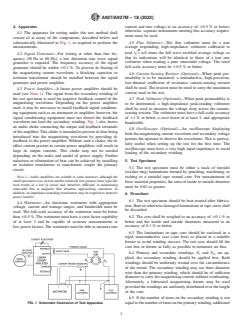
4.1 The apparatus for testing under this test method shall
ment must be used.
consist of as many of the components, described below and
schematically illustrated in Fig. 1, as required to perform the 4.5 Flux Voltmeter—The flux voltmeter must be a true
measurements. average responding, high-impedance voltmeter calibrated to
read =2 π/4 times the full wave rectified average voltage so
4.2 Signal Generator—For testing at other than line fre-
that its indications will be identical to those of a true rms
quency (50Hz or 60 Hz), a low distortion sine wave signal
voltmeter when reading a pure sinusoidal voltage. The rated
generator is required. The frequency accuracy of the signal
full-scale accuracy must be 60.5% or better.
generator should be within 60.1%. To prevent dc biasing of
the magnetizing current waveform, a blocking capacitor or
4.6 Current-Sensing Resistor (Optional)—When peak per-
isolation transformer should be installed between the signal
meability is to be measured, a noninductive, high-precision,
generator and power amplifier.
low-thermal coefficient of resistance current-sensing resistor
shallbeused.Theresistormustberatedtocarrythemaximum
4.3 Power Amplifier—A linear power amplifier should be
current used in the test.
used (see Note 1). The signal from the secondary winding of
the test specimen is used for negative feedback control of the
4.7 Peak Voltmeter (Optional)—When peak permeability is
magnetizing waveform. Depending on the power amplifier
to be determined, a high-impedance peak-reading voltmeter
used, it may be necessary to install feedback signal condition-
shall be used to measure the voltage drop across the current-
ing equipment such as an attenuator or amplifier; however, the
sensing resistor.The voltmeter must have a full-scale accuracy
signal conditioning equipment must not distort the feedback
of 61% or better, a crest factor of at least 3, and appropriate
waveform nor load the secondary winding. Fig. 1 also shows
bandwidth.
an audio choke connecting the output and feedback terminals
4.8 Oscilloscope (Optional)—An oscilloscope displaying
oftheamplifier.Thischokeisintendedtopreventdcbiasbeing
both the magnetizing current waveform and secondary voltage
introduced into the magnetizing waveform by providing dc
permitstheoperatortoobservethewaveforms.Thisisparticu-
feedback to the power amplifier. Without such a choke, the dc
larly useful when setting up the test for the first time. The
offset current present in certain power amplifiers will result in
oscilloscope must have a very high input impedance to avoid
large dc output currents. This choke may not be needed
loading of the secondary winding.
depending on the make and model of power supply. Further
reduction or elimination of bias can be achieved by installing
5. Test Specimen
an isolation transformer to transformer couple the primary
5.1 The test specimen must be either a stack of toroidal
circuit.
(washer ring) laminations formed by punching, machining, or
NOTE 1—Audio amplifiers are suitable in some instances, although the etching or a toroidal tape wound core. For measurement of
smallspecimencrosssectionandtherelativelyfewprimaryturnstypically
basicmaterialproperties,theratioofinsidetooutsidediameter
used results in a low Q circuit and, therefore, difficulty in maintaining
must be 0.82 or greater.
sinusoidal flux at magnetic flux densities approaching saturation. In
addition, an impedance matchingtransformermayberequiredtoimprove
6. Procedure
power transfer.
6.1 The test specimen should be heat treated after fabrica-
4.4 Wattmeter—An electronic wattmeter with appropriate
tion.Bentorotherwisedamagedlaminationsortapecoresshall
voltage, current and wattage ranges, and bandwidth must be
be discarded.
used. The full-scale accuracy of the wattmeter must be better
6.2 The core shall be weighed to an accuracy of 60.1% or
than 60.5%.Thewattmetermusthaveacrestfactorcapability
of at least 3 and be capable of accurate measurements at better and the inside and outside diameters measured to an
accuracy of 0.1% or better.
low-powerfactors.Thewattmetermustbeabletomeasurerms
6.3 The laminations or tape core should be enclosed in a
rigid, nonconductive case (core box) or placed in a suitable
fixture to avoid winding stresses. The test core should fill the
core box or fixture as fully as possible to minimize air flux.
6.4 Primary and secondary windings, N and N , are ap-
1 2
plied; the secondary winding should be applied first. Both
windings should be uniformly wound over the circumference
of the toroid. The secondary winding may use finer diameter
wire than the primary winding, which should be of sufficient
diameter to carry the magnetizing current without overheating.
Al
...