

ASTM G59-23
(Test Method)Standard Test Method for Conducting Potentiodynamic Polarization Resistance Measurements
General Information
- Abstract
SIGNIFICANCE AND USE
3.1 This test method can be utilized to verify the performance of polarization resistance measurement equipment including reference electrodes, electrochemical cells, potentiost- ats, scan generators, and measuring and recording devices. The test method is also useful for training operators in sample preparation and experimental techniques for polarization resistance measurements.
3.2 Polarization resistance can be related to the rate of general corrosion for metals at or near their corrosion potential, Ecorr. Polarization resistance measurements are an accurate and rapid way to measure the general corrosion rate. Real-time corrosion monitoring is a common application. The technique can also be used as a way to rank alloys, inhibitors, and so forth in order of resistance to general corrosion.
3.3 In this test method, a small potential scan, ΔE(t), defined with respect to the corrosion potential (ΔE = E – Ecorr), is applied to a metal sample. The resultant currents are recorded. The polarization resistance, RP, of a corroding electrode is defined from Eq 1 as the slope of a potential versus current density plot at i = 0 (1-4):3
The current density is given by i. The corrosion current density, icorr, is related to the polarization resistance by the Stern-Geary coefficient, B. (3),
The dimension of Rp is ohm-cm2, icorr is muA/cm2, and B is in V. The Stern-Geary coefficient is related to the anodic, ba, and cathodic, bc, Tafel slopes in accordance with Eq 3.
The units of the Tafel slopes are V. The corrosion rate, CR, in mm per year can be determined from Eq 4 in which EW is the equivalent weight of the corroding species in grams and ρ is the density of the corroding material in g/cm3.
Refer to Practice G102 for derivations of the above equations and methods for estimating Tafel slopes.
3.4 The test method may not be appropriate to measure polarization resistance on all materials or in all environments. See 8.2 for a discussi...
SCOPE
1.1 This test method covers an experimental procedure for polarization resistance measurements which can be used for the calibration of equipment and verification of experimental technique. The test method can provide reproducible corrosion potentials and potentiodynamic polarization resistance measurements.
1.2 The values stated in SI units are to be regarded as standard. No other units of measurement are included in this standard.
1.3 This standard does not purport to address all of the safety concerns, if any, associated with its use. It is the responsibility of the user of this standard to establish appropriate safety, health, and environmental practices and determine the applicability of regulatory limitations prior to use.
1.4 This international standard was developed in accordance with internationally recognized principles on standardization established in the Decision on Principles for the Development of International Standards, Guides and Recommendations issued by the World Trade Organization Technical Barriers to Trade (TBT) Committee.
- Status
- Published
- Publication Date
- 31-May-2023
- Technical Committee
- G01 - Corrosion of Metals
- Drafting Committee
- G01.11 - Electrochemical Measurements in Corrosion Testing
Buy Documents

ASTM G59-23 - Standard Test Method for Conducting Potentiodynamic Polarization Resistance Measurements
REDLINE ASTM G59-23 - Standard Test Method for Conducting Potentiodynamic Polarization Resistance Measurements
Overview
ASTM G59-23: Standard Test Method for Conducting Potentiodynamic Polarization Resistance Measurements is a widely recognized international standard developed by ASTM International for evaluating the corrosion resistance of metals. This test method provides a reproducible experimental procedure for measuring polarization resistance, a critical parameter related to the general corrosion rate of metals at or near their corrosion potential (Ecorr). Its usage ensures precise equipment calibration and operator training in polarization resistance measurement and is essential for real-time corrosion monitoring and comparative evaluation of alloys and corrosion inhibitors.
Key Topics
Polarization Resistance Measurement
Measures the resistance of a metal sample to corrosion under a small applied potential scan. Evaluates the electrochemical behavior and general corrosion tendency of metals.Equipment and Calibration
Outlines the verification process for key instruments such as reference electrodes, potentiostats, electrochemical cells, scan generators, and data acquisition devices to ensure accurate and repeatable results.Experimental Technique
Provides detailed steps for specimen preparation, cell setup, solution preparation, and test operation, culminating in the measurement and calculation of polarization resistance (Rp).Significance of Results
The polarization resistance value correlates directly with corrosion rates, supporting rapid assessment and ranking of materials, inhibitors, and protective strategies.Precision and Bias
Includes guidance on repeatability, reproducibility, and potential sources of measurement bias, such as double-layer capacitance and solution resistance.
Applications
The ASTM G59-23 standard has broad applications across industries where metal corrosion is a concern:
Corrosion Rate Determination
Rapid and accurate assessment of general corrosion rates for alloys in various environments, enabling effective material selection and lifespan prediction.Material Selection and Ranking
Comparison and ranking of metals, alloys, and inhibitor effectiveness, supporting informed material engineering decisions for industrial, marine, petrochemical, and infrastructure applications.Quality Control and Equipment Validation
Verification of electrochemical instrument performance for research laboratories, quality control labs, and field inspections.Operator Training
Serves as an excellent foundation for training new personnel in electrochemical testing procedures, enhancing competence and reliability.Real-time Corrosion Monitoring
Supports ongoing monitoring systems where fast, periodic measurement of corrosion potential and rate is essential for maintenance planning and safety assurance.
Related Standards
To ensure comprehensive corrosion testing and result interpretation, ASTM G59-23 should be used in conjunction with the following ASTM standards:
ASTM G3: Practice for Conventions Applicable to Electrochemical Measurements in Corrosion Testing
Establishes conventions for potential and current sign, data presentation, and terminology for consistency in electrochemical test results.ASTM G5: Reference Test Method for Making Potentiodynamic Anodic Polarization Measurements
Provides guidance for conducting potentiodynamic polarization scans beyond those used in G59-23, informing both technical procedures and best practices.ASTM G102: Practice for Calculation of Corrosion Rates and Related Information from Electrochemical Measurements
Details methods for converting polarization resistance and related data into meaningful corrosion rates and for estimating Tafel slopes and coefficients.
Conclusion
ASTM G59-23 is a vital standard for corrosion professionals, providing a robust, reproducible method for potentiodynamic polarization resistance measurements. Utilizing this standard ensures accurate calibration, reliable corrosion monitoring, effective comparison of materials and inhibitors, and valuable operator training. By integrating ASTM G59-23 with other related ASTM electrochemical standards, organizations can achieve high-quality, internationally accepted corrosion assessment and control.
Relations
- Effective Date
- 01-May-2019
- Effective Date
- 15-Dec-2014
- Effective Date
- 01-Nov-2014
- Effective Date
- 01-Dec-2013
- Effective Date
- 01-Feb-2013
- Effective Date
- 01-Feb-2013
- Effective Date
- 01-Feb-2013
- Effective Date
- 15-Nov-2012
- Effective Date
- 15-Nov-2011
- Effective Date
- 01-May-2010
- Effective Date
- 01-May-2010
- Effective Date
- 01-Nov-2004
- Effective Date
- 01-Nov-2004
- Effective Date
- 01-Nov-2004
- Effective Date
- 10-Aug-1999
Buy Documents
ASTM G59-23 - Standard Test Method for Conducting Potentiodynamic Polarization Resistance Measurements
REDLINE ASTM G59-23 - Standard Test Method for Conducting Potentiodynamic Polarization Resistance Measurements
Get Certified
Connect with accredited certification bodies for this standard

BSMI (Bureau of Standards, Metrology and Inspection)
Taiwan's standards and inspection authority.
Sponsored listings
Frequently Asked Questions
ASTM G59-23 is a standard published by ASTM International. Its full title is "Standard Test Method for Conducting Potentiodynamic Polarization Resistance Measurements". This standard covers: SIGNIFICANCE AND USE 3.1 This test method can be utilized to verify the performance of polarization resistance measurement equipment including reference electrodes, electrochemical cells, potentiost- ats, scan generators, and measuring and recording devices. The test method is also useful for training operators in sample preparation and experimental techniques for polarization resistance measurements. 3.2 Polarization resistance can be related to the rate of general corrosion for metals at or near their corrosion potential, Ecorr. Polarization resistance measurements are an accurate and rapid way to measure the general corrosion rate. Real-time corrosion monitoring is a common application. The technique can also be used as a way to rank alloys, inhibitors, and so forth in order of resistance to general corrosion. 3.3 In this test method, a small potential scan, ΔE(t), defined with respect to the corrosion potential (ΔE = E – Ecorr), is applied to a metal sample. The resultant currents are recorded. The polarization resistance, RP, of a corroding electrode is defined from Eq 1 as the slope of a potential versus current density plot at i = 0 (1-4):3 The current density is given by i. The corrosion current density, icorr, is related to the polarization resistance by the Stern-Geary coefficient, B. (3), The dimension of Rp is ohm-cm2, icorr is muA/cm2, and B is in V. The Stern-Geary coefficient is related to the anodic, ba, and cathodic, bc, Tafel slopes in accordance with Eq 3. The units of the Tafel slopes are V. The corrosion rate, CR, in mm per year can be determined from Eq 4 in which EW is the equivalent weight of the corroding species in grams and ρ is the density of the corroding material in g/cm3. Refer to Practice G102 for derivations of the above equations and methods for estimating Tafel slopes. 3.4 The test method may not be appropriate to measure polarization resistance on all materials or in all environments. See 8.2 for a discussi... SCOPE 1.1 This test method covers an experimental procedure for polarization resistance measurements which can be used for the calibration of equipment and verification of experimental technique. The test method can provide reproducible corrosion potentials and potentiodynamic polarization resistance measurements. 1.2 The values stated in SI units are to be regarded as standard. No other units of measurement are included in this standard. 1.3 This standard does not purport to address all of the safety concerns, if any, associated with its use. It is the responsibility of the user of this standard to establish appropriate safety, health, and environmental practices and determine the applicability of regulatory limitations prior to use. 1.4 This international standard was developed in accordance with internationally recognized principles on standardization established in the Decision on Principles for the Development of International Standards, Guides and Recommendations issued by the World Trade Organization Technical Barriers to Trade (TBT) Committee.
SIGNIFICANCE AND USE 3.1 This test method can be utilized to verify the performance of polarization resistance measurement equipment including reference electrodes, electrochemical cells, potentiost- ats, scan generators, and measuring and recording devices. The test method is also useful for training operators in sample preparation and experimental techniques for polarization resistance measurements. 3.2 Polarization resistance can be related to the rate of general corrosion for metals at or near their corrosion potential, Ecorr. Polarization resistance measurements are an accurate and rapid way to measure the general corrosion rate. Real-time corrosion monitoring is a common application. The technique can also be used as a way to rank alloys, inhibitors, and so forth in order of resistance to general corrosion. 3.3 In this test method, a small potential scan, ΔE(t), defined with respect to the corrosion potential (ΔE = E – Ecorr), is applied to a metal sample. The resultant currents are recorded. The polarization resistance, RP, of a corroding electrode is defined from Eq 1 as the slope of a potential versus current density plot at i = 0 (1-4):3 The current density is given by i. The corrosion current density, icorr, is related to the polarization resistance by the Stern-Geary coefficient, B. (3), The dimension of Rp is ohm-cm2, icorr is muA/cm2, and B is in V. The Stern-Geary coefficient is related to the anodic, ba, and cathodic, bc, Tafel slopes in accordance with Eq 3. The units of the Tafel slopes are V. The corrosion rate, CR, in mm per year can be determined from Eq 4 in which EW is the equivalent weight of the corroding species in grams and ρ is the density of the corroding material in g/cm3. Refer to Practice G102 for derivations of the above equations and methods for estimating Tafel slopes. 3.4 The test method may not be appropriate to measure polarization resistance on all materials or in all environments. See 8.2 for a discussi... SCOPE 1.1 This test method covers an experimental procedure for polarization resistance measurements which can be used for the calibration of equipment and verification of experimental technique. The test method can provide reproducible corrosion potentials and potentiodynamic polarization resistance measurements. 1.2 The values stated in SI units are to be regarded as standard. No other units of measurement are included in this standard. 1.3 This standard does not purport to address all of the safety concerns, if any, associated with its use. It is the responsibility of the user of this standard to establish appropriate safety, health, and environmental practices and determine the applicability of regulatory limitations prior to use. 1.4 This international standard was developed in accordance with internationally recognized principles on standardization established in the Decision on Principles for the Development of International Standards, Guides and Recommendations issued by the World Trade Organization Technical Barriers to Trade (TBT) Committee.
ASTM G59-23 is classified under the following ICS (International Classification for Standards) categories: 17.220.20 - Measurement of electrical and magnetic quantities. The ICS classification helps identify the subject area and facilitates finding related standards.
ASTM G59-23 has the following relationships with other standards: It is inter standard links to ASTM G3-14(2019), ASTM G3-14, ASTM G5-14, ASTM G3-13, ASTM G5-13e1, ASTM G5-13, ASTM G5-13e2, ASTM G5-12, ASTM G5-94(2011)e1, ASTM G102-89(2010), ASTM G3-89(2010), ASTM G5-94(2004), ASTM G3-89(2004), ASTM G102-89(2004)e1, ASTM G3-89(1999). Understanding these relationships helps ensure you are using the most current and applicable version of the standard.
ASTM G59-23 is available in PDF format for immediate download after purchase. The document can be added to your cart and obtained through the secure checkout process. Digital delivery ensures instant access to the complete standard document.
Standards Content (Sample)
This international standard was developed in accordance with internationally recognized principles on standardization established in the Decision on Principles for the
Development of International Standards, Guides and Recommendations issued by the World Trade Organization Technical Barriers to Trade (TBT) Committee.
Designation: G59 − 23
Standard Test Method for
Conducting Potentiodynamic Polarization Resistance
Measurements
This standard is issued under the fixed designation G59; the number immediately following the designation indicates the year of original
adoption or, in the case of revision, the year of last revision. A number in parentheses indicates the year of last reapproval. A superscript
epsilon (´) indicates an editorial change since the last revision or reapproval.
1. Scope 3. Significance and Use
3.1 This test method can be utilized to verify the perfor-
1.1 This test method covers an experimental procedure for
mance of polarization resistance measurement equipment in-
polarization resistance measurements which can be used for the
cluding reference electrodes, electrochemical cells, potentiost-
calibration of equipment and verification of experimental
ats, scan generators, and measuring and recording devices. The
technique. The test method can provide reproducible corrosion
test method is also useful for training operators in sample
potentials and potentiodynamic polarization resistance mea-
preparation and experimental techniques for polarization resis-
surements.
tance measurements.
1.2 The values stated in SI units are to be regarded as
3.2 Polarization resistance can be related to the rate of
standard. No other units of measurement are included in this
general corrosion for metals at or near their corrosion potential,
standard.
E . Polarization resistance measurements are an accurate and
corr
1.3 This standard does not purport to address all of the
rapid way to measure the general corrosion rate. Real-time
safety concerns, if any, associated with its use. It is the
corrosion monitoring is a common application. The technique
responsibility of the user of this standard to establish appro-
can also be used as a way to rank alloys, inhibitors, and so forth
priate safety, health, and environmental practices and deter-
in order of resistance to general corrosion.
mine the applicability of regulatory limitations prior to use.
3.3 In this test method, a small potential scan, ΔE(t), defined
1.4 This international standard was developed in accor-
with respect to the corrosion potential (ΔE = E – E ), is
corr
dance with internationally recognized principles on standard-
applied to a metal sample. The resultant currents are recorded.
ization established in the Decision on Principles for the
The polarization resistance, R , of a corroding electrode is
P
Development of International Standards, Guides and Recom-
defined from Eq 1 as the slope of a potential versus current
mendations issued by the World Trade Organization Technical
density plot at i = 0 (1-4):
Barriers to Trade (TBT) Committee.
] ΔE
R 5 (1)
S D
p
] i
i50, dE/dt→0
2. Referenced Documents
2 The current density is given by i. The corrosion current
2.1 ASTM Standards:
density, i , is related to the polarization resistance by the
corr
G3 Practice for Conventions Applicable to Electrochemical
Stern-Geary coefficient, B. (3),
Measurements in Corrosion Testing
B
G5 Reference Test Method for Making Potentiodynamic
i 5 10 (2)
corr
R
Anodic Polarization Measurements
p
G102 Practice for Calculation of Corrosion Rates and Re-
2 2
The dimension of R is ohm-cm , i is muA/cm , and B is
p corr
lated Information from Electrochemical Measurements
in V. The Stern-Geary coefficient is related to the anodic, b ,
a
and cathodic, b , Tafel slopes in accordance with Eq 3.
c
b b
a c
This test method is under the jurisdiction of ASTM Committee G01 on B 5 (3)
2.303~b 1b !
a c
Corrosion of Metals and is the direct responsibility of Subcommittee G01.11 on
Electrochemical Measurements in Corrosion Testing.
The units of the Tafel slopes are V. The corrosion rate, CR,
Current edition approved June 1, 2023. Published June 2023. Originally
in mm per year can be determined from Eq 4 in which EW is
approved in 1978. Last previous edition approved in 2020 as G59 – 97 (2020). DOI:
10.1520/G0059-23.
For referenced ASTM standards, visit the ASTM website, www.astm.org, or
contact ASTM Customer Service at service@astm.org. For Annual Book of ASTM
Standards volume information, refer to the standard’s Document Summary page on The boldface numbers in parentheses refer to the list of references at the end of
the ASTM website. this standard.
Copyright © ASTM International, 100 Barr Harbor Drive, PO Box C700, West Conshohocken, PA 19428-2959. United States
G59 − 23
the equivalent weight of the corroding species in grams and ρ 5.4 If the observed results are different than expected, the
is the density of the corroding material in g/cm . electrochemical equipment may require calibration or servicing
in accordance with the manufacturer’s guidelines.
i EW
corr
CR 5 3.27 × 10 (4)
ρ
6. Experimental Procedure
Refer to Practice G102 for derivations of the above equa-
6.1 The 1.0 N H SO test solution should be prepared from
2 4
tions and methods for estimating Tafel slopes.
American Chemical Society reagent grade acid and distilled
3.4 The test method may not be appropriate to measure
water as described in Test Method G5. The standard test cell
polarization resistance on all materials or in all environments.
requires 900 mL of test solution. The temperature must be
See 8.2 for a discussion of method biases arising from solution
maintained at 30 °C within 1°.
resistance and electrode capacitance.
6.2 The test cell is purged at 150 cm /min with an oxygen-
free gas such as hydrogen, nitrogen, or argon. The purge is
4. Apparatus
started at least 30 min before specimen immersion. The purge
4.1 The apparatus is described in Test Method G5. It
continues throughout the test.
includes a 1 L round bottom flask modified to permit the
6.3 The working electrode should be prepared as detailed in
addition of inert gas, thermometer, and electrodes. This stan-
Test Method G5. The experiment must commence within 1 h of
dard cell or an equivalent cell can be used. An equivalent cell
preparing the electrode. Preparation includes sequential wet
must be constructed of inert materials and be able to reproduce
polishing with 240 grit and 600 grit SiC paper. Determine the
the standard curve in Test Method G5.
surface area of the specimen to the nearest 0.01 cm and
4.2 A potentiostat capable of varying potential at a constant
subtract for the area under the gasket (typically 0.20 cm to
scan rate and measuring the current is needed.
0.25 cm ).
4.3 A method of recording the varying potential and result-
6.4 Immediately prior to immersion the specimen is
ing current is needed.
degreased with a solvent such as acetone and rinsed with
distilled water. The time delay between rinsing and immersion
5. Test of Electrical Equipment
should be minimal.
5.1 Before the polarization resistance measurement is made,
NOTE 2—Samples of the standard AISI Type 430 stainless steel (UNS
the instrument system (potentiostat, X-Y recorder or data
S45000) used in this test method are available to those wishing to evaluate
acquisition system) must be tested to ensure proper function-
their equipment and test procedure from Metal Samples, P.O. Box 8,
ing. For this purpose, connect the potentiostat to a test
Mumford, AL 36268.
electrical circuit (5). While more complex dummy cells are
6.5 Transfer the test specimen to the test cell and position
sometimes needed in electrochemical studies, the simple resis-
the Luggin probe tip 2 mm to 3 mm from the test electrode
tor shown in Fig. 1 is adequate for the present application.
surface. The tip diameter must be no g
...
This document is not an ASTM standard and is intended only to provide the user of an ASTM standard an indication of what changes have been made to the previous version. Because
it may not be technically possible to adequately depict all changes accurately, ASTM recommends that users consult prior editions as appropriate. In all cases only the current version
of the standard as published by ASTM is to be considered the official document.
Designation: G59 − 97 (Reapproved 2020) G59 − 23
Standard Test Method for
Conducting Potentiodynamic Polarization Resistance
Measurements
This standard is issued under the fixed designation G59; the number immediately following the designation indicates the year of original
adoption or, in the case of revision, the year of last revision. A number in parentheses indicates the year of last reapproval. A superscript
epsilon (´) indicates an editorial change since the last revision or reapproval.
1. Scope
1.1 This test method covers an experimental procedure for polarization resistance measurements which can be used for the
calibration of equipment and verification of experimental technique. The test method can provide reproducible corrosion potentials
and potentiodynamic polarization resistance measurements.
1.2 The values stated in SI units are to be regarded as standard. No other units of measurement are included in this standard.
1.3 This standard does not purport to address all of the safety concerns, if any, associated with its use. It is the responsibility
of the user of this standard to establish appropriate safety, health, and environmental practices and determine the applicability of
regulatory limitations prior to use.
1.4 This international standard was developed in accordance with internationally recognized principles on standardization
established in the Decision on Principles for the Development of International Standards, Guides and Recommendations issued
by the World Trade Organization Technical Barriers to Trade (TBT) Committee.
2. Referenced Documents
2.1 ASTM Standards:
G3 Practice for Conventions Applicable to Electrochemical Measurements in Corrosion Testing
G5 Reference Test Method for Making Potentiodynamic Anodic Polarization Measurements
G102 Practice for Calculation of Corrosion Rates and Related Information from Electrochemical Measurements
3. Significance and Use
3.1 This test method can be utilized to verify the performance of polarization resistance measurement equipment including
reference electrodes, electrochemical cells, potentiostats,potentiost-
ats, scan generators, and measuring and recording devices. The test method is also useful for training operators in sample
preparation and experimental techniques for polarization resistance measurements.
3.2 Polarization resistance can be related to the rate of general corrosion for metals at or near their corrosion potential, E .
corr
Polarization resistance measurements are an accurate and rapid way to measure the general corrosion rate. Real time Real-time
corrosion monitoring is a common application. The technique can also be used as a way to rank alloys, inhibitors, and so forth
in order of resistance to general corrosion.
This test method is under the jurisdiction of ASTM Committee G01 on Corrosion of Metals and is the direct responsibility of Subcommittee G01.11 on Electrochemical
Measurements in Corrosion Testing.
Current edition approved Nov. 1, 2020June 1, 2023. Published November 2020June 2023. Originally approved in 1978. Last previous edition approved in 20142020 as
G59G59 – 97 (2020). – 97 (2014). DOI: 10.1520/G0059-97R20.DOI: 10.1520/G0059-23.
For referenced ASTM standards, visit the ASTM website, www.astm.org, or contact ASTM Customer Service at service@astm.org. For Annual Book of ASTM Standards
volume information, refer to the standard’s Document Summary page on the ASTM website.
Copyright © ASTM International, 100 Barr Harbor Drive, PO Box C700, West Conshohocken, PA 19428-2959. United States
G59 − 23
3.3 In this test method, a small potential scan, ΔE(t), defined with respect to the corrosion potential (ΔE = E – E ), is applied
corr
to a metal sample. The resultant currents are recorded. The polarization resistance, R , of a corroding electrode is defined from
P
Eq 1 as the slope of a potential versus current density plot at i = 0 (1-4):
] ΔE
R 5 (1)
S D
p
] i
i50, dE/dt→0
The current density is given by i. The corrosion current density, i , is related to the polarization resistance by the Stern-Geary
corr
coefficient, B.(3),
B
i 5 10 (2)
corr
R
p
2 2
The dimension of R is ohm-cm , i is muA/cm , and B is in V. The Stern-Geary coefficient is related to the anodic, b , and
p corr a
cathodic, b , Tafel slopes as per in accordance with Eq 3.
c
b b
a c
B 5 (3)
2.303~b 1b !
a c
The units of the Tafel slopes are V. The corrosion rate, CR, in mm per year can be determined from Eq 4 in which EW is the
equivalent weight of the corroding species in grams and ρ is the density of the corroding material in g/cm .
i EW
corr
CR 5 3.27 ×10 (4)
ρ
Refer to Practice G102 for derivations of the above equations and methods for estimating Tafel slopes.
3.4 The test method may not be appropriate to measure polarization resistance on all materials or in all environments. See 8.2 for
a discussion of method biases arising from solution resistance and electrode capacitance.
4. Apparatus
4.1 The apparatus is described in Test Method G5. It includes a 1 L 1 L round bottom flask modified to permit the addition of inert
gas, thermometer, and electrodes. This standard cell or an equivalent cell can be used. An equivalent cell must be constructed of
inert materials and be able to reproduce the standard curve in Test Method G5.
4.2 A potentiostat capable of varying potential at a constant scan rate and measuring the current is needed.
4.3 A method of recording the varying potential and resulting current is needed.
5. Test of Electrical Equipment
5.1 Before the polarization resistance measurement is made, the instrument system (potentiostat, X-Y recorder or data acquisition
system) must be tested to ensure proper functioning. For this purpose, connect the potentiostat to a test electrical circuit (5). While
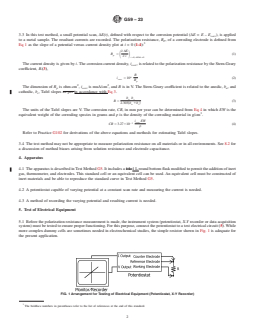
more complex dummy cells are sometimes needed in electrochemical studies, the simple resistor shown in Fig. 1 is adequate for
the present application.
FIG. 1 Arrangement for Testing of Electrical Equipment (Potentiostat, X-Y Recorder)
The boldface numbers in parentheses refer to the list of references at the end of this standard.
G59 − 23
5.2 Use R = 10.0 Ω. Set the applied potential on the potentiostat to E = –30.0 mV and apply the potential. The current should be
3.0 mA by Ohm’s Law, I = E/R.
NOTE 1—When polarization resistance values are measured for systems with different corrosion currents, the value of R should be chosen to cover the
current range of the actual polarization resistance measurement. Expected corrosion currents in the microampere range require R = 11 kΩ to 10 kΩ.
5.3 Record the potentiodynamic polarization curve at a scan rate of 0.6 V/h from ΔE = –30 mV to ΔE = +30 mV and back to ΔE
= –30 mV. The plot should be linear, go through the origin, and have a slope 10 Ω. The curves recorded for the forward and reverse
scans should be identical.
5.4 If the observed results are different than expected, the electrochemical equipment may require calibration or servicing in
accordance with the manufacturer’s guidelines.
6. Experimental Procedure
6.1 The 1.0 N H SO test solution should be prepared from American Chemical Society reagent grade acid and distilled water as
2 4
described in Test Method G5. The standard test cell requires 900 mL of test solution. The temperature must be maintained at 30 °C
within 1°.
6.2 The test cell is purged at 150 cm /min with an oxygen-free gas such as hydrogen, nitrogen, or argon. The purge is started at
least 30 min before specimen immersion. The purge continues throughout the test.
6.3 The working electrode should be prepared
...