

ASTM D7449/D7449M-22a
(Test Method)Standard Test Method for Measuring Relative Complex Permittivity and Relative Magnetic Permeability of Solid Materials at Microwave Frequencies Using Coaxial Air Line
General Information
- Abstract
SIGNIFICANCE AND USE
5.1 Design calculations for radio frequency (RF), microwave, and millimetre-wave components require the knowledge of values of complex permittivity and permeability at operating frequencies. This test method is useful for evaluating small experimental batch or continuous production materials used in electromagnetic applications. Use this method to determine complex permittivity only (in non-magnetic materials), or both complex permittivity and permeability simultaneously.
5.2 Relative complex permittivity (relative complex dielectric constant), , is the proportionality factor that relates the electric field to the electric flux density, and which depends on intrinsic material properties such as molecular polarizability, charge mobility, and so forth:
where:
ε0 = permittivity of free space = electric flux density vector, and = electric field vector.
Note 1: In common usage the word “relative” is frequently dropped. The real part of complex relative permittivity ( ) is often referred to as simply relative permittivity, permittivity, or dielectric constant. The imaginary part of complex relative permittivity ( ) is often referred to as the loss factor. In anisotropic media, permittivity is described by a three dimensional tensor.
Note 2: For the purposes of this test method, the media is considered to be isotropic and, therefore, permittivity is a single complex number at each frequency.
5.3 Relative complex permeability, , is the proportionality factor that relates the magnetic flux density to the magnetic field, and which depends on intrinsic material properties such as magnetic moment, domain magnetization, and so forth:
where:
μ0 = permeability of free space, = magnetic flux density vector, and = magnetic field vector.
Note 3: In common usage the word “relative” is frequently dropped. The real part of complex relative permeability ( ) is often referred to as relative perme...
SCOPE
1.1 This test method covers a procedure for determining relative complex permittivity (relative dielectric constant and loss) and relative magnetic permeability of isotropic, reciprocal (non-gyromagnetic) solid materials. If the material is nonmagnetic, it is acceptable to use this procedure to measure permittivity only.
1.2 This measurement method is valid over a frequency range of approximately 1 GHz to over 20 GHz. These limits are not exact and depend on the size of the specimen, the size of coaxial air line used as a specimen holder, and on the applicable frequency range of the network analyzer used to make measurements. The size of specimen dimension is limited by test frequency, intrinsic specimen electromagnetism properties, and the request of algorithm. For a given air line size, the upper frequency is also limited by the onset of higher order modes that invalidate the dominant-mode transmission line model and the lower frequency is limited by the smallest measurable phase shift through a specimen. Being a non-resonant method, the selection of any number of discrete measurement frequencies in a measurement band would be suitable. The coaxial fixture is preferred over rectangular waveguide fixtures when broadband data are desired with a single sample or when only small sample volumes are available, particularly for lower frequency measurements.
1.3 The values stated in either SI units of in inch-pound units are to be regarded separately as standard. The values stated in each system are not necessarily exact equivalents; therefore each system shall be used independently of the other. Combining values from the two systems is likely to result in non conformance with the standard. The equations shown here assume an e+jωt harmonic time convention.
1.4 This standard does not purport to address all of the safety concerns, if any, associated with its use. It is the responsibility of the user of this standard to ...
- Status
- Published
- Publication Date
- 31-Aug-2022
- Technical Committee
- D09 - Electrical and Electronic Insulating Materials
- Drafting Committee
- D09.12 - Electrical Tests
Buy Documents
ASTM D7449/D7449M-22a - Standard Test Method for Measuring Relative Complex Permittivity and Relative Magnetic Permeability of Solid Materials at Microwave Frequencies Using Coaxial Air Line
REDLINE ASTM D7449/D7449M-22a - Standard Test Method for Measuring Relative Complex Permittivity and Relative Magnetic Permeability of Solid Materials at Microwave Frequencies Using Coaxial Air Line
Overview
ASTM D7449/D7449M-22a is the internationally recognized standard test method for measuring the relative complex permittivity and relative magnetic permeability of isotropic, non-gyromagnetic solid materials at microwave frequencies using a coaxial air line. Developed by ASTM International, this method supports precise dielectric and magnetic property assessment, which is crucial for design calculations in radio frequency (RF), microwave, and millimeter-wave components. The test covers the frequency spectrum from approximately 1 GHz up to over 20 GHz, depending on specimen and equipment variables.
By utilizing this standard, manufacturers and researchers can reliably characterize materials for electromagnetic, microwave, and electrical insulation applications. The method is suitable for both small-batch experimental samples and continuous production materials.
Key Topics
- Relative Complex Permittivity
Measures how a material reacts to an electric field, critical for understanding dielectric constant (real part) and loss factor (imaginary part). - Relative Complex Permeability
Describes the material response to a magnetic field, including both relative permeability and magnetic loss factor. - Coaxial Air Line Measurement
Uses a coaxial fixture and network analyzer setup to evaluate material properties over a broad frequency range, ideal for broadband data acquisition with small or low-volume samples. - Specimen Preparation and Calibration
Precise machining and measurement of specimens are essential. The standard details calibration procedures and error corrections-especially for air gaps-to ensure accuracy and repeatability. - Measurement Algorithms
Applies data reduction methods, including the Nicolson-Ross-Weir (NRW) and iterative calculation procedures, tailored to material characteristics and measurement requirements. - Data Reporting and Quality
Documentation includes operator details, calibration methods, specimen identification, measurement settings, and calculated values across the frequency band.
Applications
- RF and Microwave Component Design
Accurate values of permittivity and permeability are essential for high-frequency circuit and component design, such as antennas, substrates, insulators, and filters. - Material Development and Quality Control
Supports research, production, and batch verification of dielectric and magnetic materials used in communication, radar, and EMI shielding systems. - Industrial and Academic Research
Valuable in universities, industrial R&D, and quality assurance for evaluating new polymeric, ceramic, or composite materials targeted for high-frequency or electromagnetic applications. - Electrical Insulation Testing
Used for verifying the dielectric properties of solid electrical insulation materials in line with industry and safety standards.
Related Standards
- ASTM D150 – Test Methods for AC Loss Characteristics and Permittivity (Dielectric Constant) of Solid Electrical Insulation
A foundational test method for measuring dielectric constant and loss at power frequencies and lower microwave frequencies. - ASTM D1711 – Terminology Relating to Electrical Insulation
Provides standardized definitions, ensuring consistency in technical communication regarding insulation materials. - ASTM D257 – Test Methods for DC Resistance or Conductance of Insulating Materials
Relevant for comprehensive electrical material property assessment.
Keywords: ASTM D7449, complex permittivity, magnetic permeability, coaxial air line, microwave frequency measurement, dielectric constant, loss factor, RF material testing, electromagnetic material properties, network analyzer, electrical insulation standards.
Relations
- Effective Date
- 01-Mar-2024
- Effective Date
- 01-Nov-2015
- Effective Date
- 01-Nov-2014
- Effective Date
- 01-May-2014
- Effective Date
- 01-Nov-2013
- Effective Date
- 01-Aug-2011
- Effective Date
- 01-May-2008
- Effective Date
- 01-Mar-2004
- Effective Date
- 10-Mar-2002
- Effective Date
- 10-Oct-1999
- Effective Date
- 10-Feb-1998
Buy Documents
ASTM D7449/D7449M-22a - Standard Test Method for Measuring Relative Complex Permittivity and Relative Magnetic Permeability of Solid Materials at Microwave Frequencies Using Coaxial Air Line
REDLINE ASTM D7449/D7449M-22a - Standard Test Method for Measuring Relative Complex Permittivity and Relative Magnetic Permeability of Solid Materials at Microwave Frequencies Using Coaxial Air Line
Get Certified
Connect with accredited certification bodies for this standard

BSMI (Bureau of Standards, Metrology and Inspection)
Taiwan's standards and inspection authority.
Sponsored listings
Frequently Asked Questions
ASTM D7449/D7449M-22a is a standard published by ASTM International. Its full title is "Standard Test Method for Measuring Relative Complex Permittivity and Relative Magnetic Permeability of Solid Materials at Microwave Frequencies Using Coaxial Air Line". This standard covers: SIGNIFICANCE AND USE 5.1 Design calculations for radio frequency (RF), microwave, and millimetre-wave components require the knowledge of values of complex permittivity and permeability at operating frequencies. This test method is useful for evaluating small experimental batch or continuous production materials used in electromagnetic applications. Use this method to determine complex permittivity only (in non-magnetic materials), or both complex permittivity and permeability simultaneously. 5.2 Relative complex permittivity (relative complex dielectric constant), , is the proportionality factor that relates the electric field to the electric flux density, and which depends on intrinsic material properties such as molecular polarizability, charge mobility, and so forth: where: ε0 = permittivity of free space = electric flux density vector, and = electric field vector. Note 1: In common usage the word “relative” is frequently dropped. The real part of complex relative permittivity ( ) is often referred to as simply relative permittivity, permittivity, or dielectric constant. The imaginary part of complex relative permittivity ( ) is often referred to as the loss factor. In anisotropic media, permittivity is described by a three dimensional tensor. Note 2: For the purposes of this test method, the media is considered to be isotropic and, therefore, permittivity is a single complex number at each frequency. 5.3 Relative complex permeability, , is the proportionality factor that relates the magnetic flux density to the magnetic field, and which depends on intrinsic material properties such as magnetic moment, domain magnetization, and so forth: where: μ0 = permeability of free space, = magnetic flux density vector, and = magnetic field vector. Note 3: In common usage the word “relative” is frequently dropped. The real part of complex relative permeability ( ) is often referred to as relative perme... SCOPE 1.1 This test method covers a procedure for determining relative complex permittivity (relative dielectric constant and loss) and relative magnetic permeability of isotropic, reciprocal (non-gyromagnetic) solid materials. If the material is nonmagnetic, it is acceptable to use this procedure to measure permittivity only. 1.2 This measurement method is valid over a frequency range of approximately 1 GHz to over 20 GHz. These limits are not exact and depend on the size of the specimen, the size of coaxial air line used as a specimen holder, and on the applicable frequency range of the network analyzer used to make measurements. The size of specimen dimension is limited by test frequency, intrinsic specimen electromagnetism properties, and the request of algorithm. For a given air line size, the upper frequency is also limited by the onset of higher order modes that invalidate the dominant-mode transmission line model and the lower frequency is limited by the smallest measurable phase shift through a specimen. Being a non-resonant method, the selection of any number of discrete measurement frequencies in a measurement band would be suitable. The coaxial fixture is preferred over rectangular waveguide fixtures when broadband data are desired with a single sample or when only small sample volumes are available, particularly for lower frequency measurements. 1.3 The values stated in either SI units of in inch-pound units are to be regarded separately as standard. The values stated in each system are not necessarily exact equivalents; therefore each system shall be used independently of the other. Combining values from the two systems is likely to result in non conformance with the standard. The equations shown here assume an e+jωt harmonic time convention. 1.4 This standard does not purport to address all of the safety concerns, if any, associated with its use. It is the responsibility of the user of this standard to ...
SIGNIFICANCE AND USE 5.1 Design calculations for radio frequency (RF), microwave, and millimetre-wave components require the knowledge of values of complex permittivity and permeability at operating frequencies. This test method is useful for evaluating small experimental batch or continuous production materials used in electromagnetic applications. Use this method to determine complex permittivity only (in non-magnetic materials), or both complex permittivity and permeability simultaneously. 5.2 Relative complex permittivity (relative complex dielectric constant), , is the proportionality factor that relates the electric field to the electric flux density, and which depends on intrinsic material properties such as molecular polarizability, charge mobility, and so forth: where: ε0 = permittivity of free space = electric flux density vector, and = electric field vector. Note 1: In common usage the word “relative” is frequently dropped. The real part of complex relative permittivity ( ) is often referred to as simply relative permittivity, permittivity, or dielectric constant. The imaginary part of complex relative permittivity ( ) is often referred to as the loss factor. In anisotropic media, permittivity is described by a three dimensional tensor. Note 2: For the purposes of this test method, the media is considered to be isotropic and, therefore, permittivity is a single complex number at each frequency. 5.3 Relative complex permeability, , is the proportionality factor that relates the magnetic flux density to the magnetic field, and which depends on intrinsic material properties such as magnetic moment, domain magnetization, and so forth: where: μ0 = permeability of free space, = magnetic flux density vector, and = magnetic field vector. Note 3: In common usage the word “relative” is frequently dropped. The real part of complex relative permeability ( ) is often referred to as relative perme... SCOPE 1.1 This test method covers a procedure for determining relative complex permittivity (relative dielectric constant and loss) and relative magnetic permeability of isotropic, reciprocal (non-gyromagnetic) solid materials. If the material is nonmagnetic, it is acceptable to use this procedure to measure permittivity only. 1.2 This measurement method is valid over a frequency range of approximately 1 GHz to over 20 GHz. These limits are not exact and depend on the size of the specimen, the size of coaxial air line used as a specimen holder, and on the applicable frequency range of the network analyzer used to make measurements. The size of specimen dimension is limited by test frequency, intrinsic specimen electromagnetism properties, and the request of algorithm. For a given air line size, the upper frequency is also limited by the onset of higher order modes that invalidate the dominant-mode transmission line model and the lower frequency is limited by the smallest measurable phase shift through a specimen. Being a non-resonant method, the selection of any number of discrete measurement frequencies in a measurement band would be suitable. The coaxial fixture is preferred over rectangular waveguide fixtures when broadband data are desired with a single sample or when only small sample volumes are available, particularly for lower frequency measurements. 1.3 The values stated in either SI units of in inch-pound units are to be regarded separately as standard. The values stated in each system are not necessarily exact equivalents; therefore each system shall be used independently of the other. Combining values from the two systems is likely to result in non conformance with the standard. The equations shown here assume an e+jωt harmonic time convention. 1.4 This standard does not purport to address all of the safety concerns, if any, associated with its use. It is the responsibility of the user of this standard to ...
ASTM D7449/D7449M-22a is classified under the following ICS (International Classification for Standards) categories: 17.220.20 - Measurement of electrical and magnetic quantities. The ICS classification helps identify the subject area and facilitates finding related standards.
ASTM D7449/D7449M-22a has the following relationships with other standards: It is inter standard links to ASTM D1711-24, ASTM D1711-15, ASTM D1711-14a, ASTM D1711-14, ASTM D1711-13, ASTM D1711-11a, ASTM D1711-08, ASTM D150-98(2004), ASTM D1711-02, ASTM D1711-99, ASTM D150-98. Understanding these relationships helps ensure you are using the most current and applicable version of the standard.
ASTM D7449/D7449M-22a is available in PDF format for immediate download after purchase. The document can be added to your cart and obtained through the secure checkout process. Digital delivery ensures instant access to the complete standard document.
Standards Content (Sample)
This international standard was developed in accordance with internationally recognized principles on standardization established in the Decision on Principles for the
Development of International Standards, Guides and Recommendations issued by the World Trade Organization Technical Barriers to Trade (TBT) Committee.
Designation: D7449/D7449M − 22a
Standard Test Method for
Measuring Relative Complex Permittivity and Relative
Magnetic Permeability of Solid Materials at Microwave
Frequencies Using Coaxial Air Line
This standard is issued under the fixed designation D7449/D7449M; the number immediately following the designation indicates the
year of original adoption or, in the case of revision, the year of last revision. A number in parentheses indicates the year of last
reapproval. A superscript epsilon (´) indicates an editorial change since the last revision or reapproval.
1. Scope* responsibility of the user of this standard to establish appro-
priate safety, health, and environmental practices and deter-
1.1 This test method covers a procedure for determining
mine the applicability of regulatory limitations prior to use.
relative complex permittivity (relative dielectric constant and
1.5 This international standard was developed in accor-
loss)andrelativemagneticpermeabilityofisotropic,reciprocal
dance with internationally recognized principles on standard-
(non-gyromagnetic) solid materials. If the material is
ization established in the Decision on Principles for the
nonmagnetic, it is acceptable to use this procedure to measure
Development of International Standards, Guides and Recom-
permittivity only.
mendations issued by the World Trade Organization Technical
1.2 This measurement method is valid over a frequency
Barriers to Trade (TBT) Committee.
range of approximately 1GHz to over 20GHz. These limits
are not exact and depend on the size of the specimen, the size
2. Referenced Documents
of coaxial air line used as a specimen holder, and on the 2
2.1 ASTM Standards:
applicable frequency range of the network analyzer used to
D150Test Methods forAC Loss Characteristics and Permit-
make measurements. The size of specimen dimension is
tivity (Dielectric Constant) of Solid Electrical Insulation
limited by test frequency, intrinsic specimen electromagnetism
D1711Terminology Relating to Electrical Insulation
properties, and the request of algorithm. For a given air line
size, the upper frequency is also limited by the onset of higher
3. Terminology
order modes that invalidate the dominant-mode transmission
3.1 Fordefinitionsoftermsusedinthistestmethod,referto
line model and the lower frequency is limited by the smallest
Terminology D1711.
measurable phase shift through a specimen. Being a non-
3.2 Definitions of Terms Specific to This Standard:
resonant method, the selection of any number of discrete
3.2.1 A list of symbols specific to this test method is given
measurement frequencies in a measurement band would be
in Annex A1.
suitable. The coaxial fixture is preferred over rectangular
3.2.2 calibration, n—a procedure for connecting character-
waveguide fixtures when broadband data are desired with a
ized standard devices to the test ports of a network analyzer to
single sample or when only small sample volumes are
characterize the measurement system’s systematic errors. The
available, particularly for lower frequency measurements.
effects of the systematic errors are then mathematically re-
1.3 The values stated in either SI units of in inch-pound
moved from the indicated measurements. The calibration also
units are to be regarded separately as standard. The values
establishes the mathematical reference plane for the measure-
stated in each system are not necessarily exact equivalents;
ment test ports.
therefore each system shall be used independently of the other.
3.2.2.1 Discussion—Modern network analyzers have this
Combining values from the two systems is likely to result in
capability built in. There are a variety of calibration kits that
non conformance with the standard.The equations shown here
can be used depending on the type of test port. The models
+jωt
assume an e harmonic time convention.
used to predict the measurement response of the calibration
1.4 This standard does not purport to address all of the
devicesdependsonthetypeofcalibrationkit.Mostcalibration
safety concerns, if any, associated with its use. It is the
kitscomewithmediathatcanbeusedtoloadthedefinitionsof
the calibration devices into the network analyzer. Calibration
This test method is under the jurisdiction of ASTM Committee D09 on
Electrical and Electronic Insulating Materials and is the direct responsibility of
Subcommittee D09.12 on Electrical Tests. For referenced ASTM standards, visit the ASTM website, www.astm.org, or
Current edition approved Sept. 1, 2022. Published October 2022. Originally contact ASTM Customer Service at service@astm.org. For Annual Book of ASTM
approved in 2008. Last previous edition approved in 2022 as D7449/D7449M–22. Standards volume information, refer to the standard’s Document Summary page on
DOI: 10.1520/D7449_D7449M-22A. the ASTM website.
*A Summary of Changes section appears at the end of this standard
Copyright © ASTM International, 100 Barr Harbor Drive, PO Box C700, West Conshohocken, PA 19428-2959. United States
D7449/D7449M − 22a
kitdefinitionsloadedintothenetworkanalyzermustmatchthe determine complex permittivity only (in non-magnetic
devices used to calibrate. Since both transmission and reflec- materials), or both complex permittivity and permeability
tion measurements are used in this standard, a two-port simultaneously.
calibration is required.
5.2 Relative complex permittivity (relative complex dielec-
*
tric constant), ε , is the proportionality factor that relates the
3.2.3 cutoff frequency, n—the lowest frequency at which
r
electric field to the electric flux density, and which depends on
non-evanescent, higher-order mode propagation can occur
intrinsic material properties such as molecular polarizability,
within a coaxial transmission line.
charge mobility, and so forth:
3.2.4 network analyzer, n—a system that measures the
two-porttransmissionandone-portreflectioncharacteristicsof W
D
* ’ ”
ε 5 ε 2 jε 5 (1)
a multiport system in its linear range and at a common input
r r r
W
ε E
and output frequency.
where:
3.2.4.1 Discussion—For the purposes of this standard, this
descriptionincludesonlythosesystemsthathaveasynthesized
ε = permittivity of free space
signal generator, and that measure the complex scattering
parameters (both magnitude and phase) in the forward and
W
= electric flux density vector, and
D
reverse directions of a two-port network (S , S , S , S ).
11 21 12 22
3.2.5 scattering parameter (S-parameter), S ,n—acomplex
ij
number consisting of either the reflection or transmission W
= electric field vector.
E
coefficientofacomponentataspecifiedsetofinputandoutput
NOTE 1—In common usage the word “relative” is frequently dropped.
’
reference planes with an incident signal on only a single port.
The real part of complex relative permittivity (ε ) is often referred to as
r
simply relative permittivity, permittivity, or dielectric constant. The
3.2.5.1 Discussion—As most commonly used, these coeffi-
”
imaginary part of complex relative permittivity (ε ) is often referred to as
r
cients represent the quotient of the complex electric field
the loss factor. In anisotropic media, permittivity is described by a three
strength (or voltage) of a reflected or transmitted wave divided
dimensional tensor.
by that of an incident wave. The subscripts i and j of a typical
NOTE 2—For the purposes of this test method, the media is considered
to be isotropic and, therefore, permittivity is a single complex number at
coefficient S refer to the output and input ports, respectively.
ij
each frequency.
For example, the forward transmission coefficient S is the
*
ratioofthetransmittedwavevoltageatReferencePlane2(Port 5.3 Relativecomplexpermeability, µ ,istheproportionality
r
2)dividedbytheincidentwavevoltagemeasuredatReference factor that relates the magnetic flux density to the magnetic
Plane 1 (Port 1). Similarly, the Port 1 reflection coefficient S field, and which depends on intrinsic material properties such
as magnetic moment, domain magnetization, and so forth:
is the ratio of the Port 1 reflected wave voltage divided by the
Port 1 incident wave voltage at reference plane 1 (Port 1).
W
B
* ’ ”
µ 5 µ 2jµ 5 (2)
3.2.6 transverse electromagneticc (TEM) wave, n—an elec-
r r r
W
µ H
tromagnetic wave in which both the electric and magnetic
fields are everywhere perpendicular to the direction of propa-
where:
gation.
µ = permeability of free space,
3.2.6.1 Discussion—In coaxial transmission lines the domi-
nant wave is TEM.
W
= magnetic flux density vector, and
B
4. Summary of Test Method
4.1 A carefully machined test specimen is placed in a W
= magnetic field vector.
H
coaxial air line and connected to a calibrated network analyzer
NOTE 3—In common usage the word “relative” is frequently dropped.
’
that is used to measure the S-parameters of the transmission The real part of complex relative permeability (µ ) is often referred to as
r
relative permeability or simply permeability. The imaginary part of
line-with-specimen. A specified data-reduction algorithm is
”
complexrelativepermeability(µ )isoftenreferredtoasthemagneticloss
r
then used to calculate permittivity and permeability. If the
factor. In anisotropic media, permeability is described by a three dimen-
material is nonmagnetic, a different algorithm is used to
sional tensor.
calculate permittivity only. Error corrections are then applied
NOTE 4—For the purposes of this test method, the media is considered
to compensate for air gaps between the specimen and the to be isotropic, and therefore permeability is a single complex number at
each frequency.
transmission line conductor surfaces.
5.4 Relativepermittivity((relativedielectricconstant)(SIC)
κ'(ε )) is the real part of the relative complex permittivity. It is
5. Significance and Use
r
also the ratio of the equivalent parallel capacitance, C,ofa
p
5.1 Design calculations for radio frequency (RF),
givenconfigurationofelectrodeswithamaterialasadielectric
microwave, and millimetre-wave components require the
to the capacitance, C , of the same configuration of electrodes
υ
knowledge of values of complex permittivity and permeability
with vacuum (or air for most practical purposes) as the
at operating frequencies. This test method is useful for evalu-
dielectric:
ating small experimental batch or continuous production ma-
κ' 5 C /C (3)
terialsusedinelectromagneticapplications.Usethismethodto p v
D7449/D7449M − 22a
NOTE 5—In common usage the word “relative” is frequently dropped.
are only approximate and therefore this test method is practi-
NOTE 6—Experimentally, vacuum must be replaced by the material at
cally limited to low-to-medium values of permittivity and
all points where it makes a significant change in capacitance. The
permeability.
equivalent circuit of the dielectric is assumed to consist of C,a
p
capacitance in parallel with conductance. (See Fig. 3 of Test Methods
7. Apparatus
D150.)
NOTE 7—C is taken to be C , the equivalent parallel capacitance as
x p 7.1 Experimental Test Fixture—The test fixture includes a
shown in Fig. 3 of Test Methods D150.
specimen holder connected to a network analyzer, as shown in
NOTE 8—The series capacitance is larger than the parallel capacitance
Fig. 1.
by less than 1% for a dissipation factor of 0.1, and by less than 0.1% for
a dissipation factor of 0.03. If a measuring circuit yields results in terms
7.2 Network Analyzer—The network analyzer needs a full
ofseriescomponents,theparallelcapacitancemustbecalculatedfromEq
2-port test set that can measure transmission and reflection-
5 of Test Methods D150 before the corrections and permittivity are
scattering parameters. Use a network analyzer that has a
calculated.
synthesized signal generator in order to ensure good frequency
NOTE 9—The permittivity of dry air at 23°C and standard pressure at
101.3 kPa is 1.000536. Its divergence from unity, κ'−1, is inversely stability and signal purity.
proportional to absolute temperature and directly proportional to atmo-
7.3 Coaxial Air Line Calibration Kit—To define Port 1 and
spheric pressure. The increase in permittivity when the space is saturated
Port2measurementreferenceplanes,calibrationofthecoaxial
with water vapor at 23°C is 0.00025, and varies approximately linearly
with temperature expressed in degrees Celsius, from 10°C to 27°C. For
test fixture is required. A calibration kit consists of well-
partial saturation the increase is proportional to the relative humidity.
characterized standard devices and mathematical models of
thosedevices.Useathrough-reflect-line(TRL),anopen-short-
6. Interferences
load-through (OSLT), or any other calibration kit that yields
6.1 The upper limits of permittivity and permeability that
similar calibration quality to calibrate the coaxial test fixture.
can be measured using this test method are restricted by the
7.4 Specimen Holder:
transmission line and specimen geometries, which can lead to
7.4.1 Because parameters such as specimen holder length
unwanted higher order waveguide modes. In addition, exces-
andcross-sectionaldimensionsareofcriticalimportancetothe
sive electromagnetic attenuation due to a high loss factor
calculation of permittivity and permeability, carefully measure
within the test specimen can prevent determination of permit-
and characterize the physical dimensions of the specimen
tivity and permeability. No specific limits are given in this
holder.
standard, but this test method is practically limited to low-to-
7.4.2 Ifaseparatelengthoftransmissionlineisusedtohold
medium values of permittivity and permeability.
the specimen, ensure that the empty length of line is also in
6.2 The existence of air gaps between the test specimen and place during calibration of the specimen holder.
the transmission line introduces a negative bias into measure- 7.4.3 The theoretical model used for this test method
ments of permittivity and permeability. In this test method, assumes that only the dominant mode of propagation exists
compensation for this bias is required, and to do so requires (TEM).This fundamental mode has no lower cutoff frequency,
knowledge of the air gap sizes. Air gap sizes are estimated so low-frequency measurements are possible.The existence of
from dimensional measurements of the specimen and the higher-order modes restricts the upper measurement frequency
specimen holder. Several different error correction models for a given coaxial air line test fixture.
have been developed, and a frequency independent series 7.4.4 Be sure that the specimen holder dimensions are
capacitor model is described in AnnexA2.Air gap corrections
within proper tolerances for the transmission line size in use.
FIG. 1 Diagram of Experimental Fixture
D7449/D7449M − 22a
For a coaxial transmission line, the diameter of the center transmission lines using filtered, pressurized air (not breath).
conductor, D , and the inside diameter of the outer conductor, Examine specimens for cracks and chips on their edges. Note
D ,arethecriticaldimensions.Propertolerancesfora“7-mm” any damage to specimens.
coax are then:
9.4 Network Analyzer Setup:
9.4.1 Turn on the network analyzer before beginning cali-
7–mm coax center conductor diameter:
bration and measurements. Refer to manufacturer documenta-
D 5 3.04mm60.01mm @0.1197 in.60.0004in.# (4)
1 tion for minimum warm-up period.
9.4.2 Put network analyzer into step frequency mode. Set
7–mm coax outer conductor diameter:
the start frequency and stop frequency as desired. Set the
D 5 7.00 mm60.01mm 0.2756in.60.0004in. (5)
@ #
number of measurement points to the desired value.
Dimensions and tolerances of other standard coaxial trans-
9.4.3 If available, set the network analyzer’s variable inter-
mission lines are in the appropriate manufacturer’s specifica-
mediate frequency (IF) bandwidth to less than 30 Hz, other-
tions.
wise set the network analyzer data-averaging factor to a value
>200.
8. Test Specimen
9.4.4 Perform a two-port test fixture calibration using a
8.1 Make the test specimen long enough to ensure good
coaxial air line calibration kit in accordance with the manu-
alignment inside the holder.Also, make the test specimen long
facturer’s procedures and in accordance with Subsection 7.3.
enough to ensure that the phase shift through the specimen is
much greater than the phase measurement uncertainty of the
10. Procedure
network analyzer at the lowest measurement frequency. If a
10.1 The following procedure applies to all coaxial trans-
specimen is expected to have low loss, sufficient length is also
mission lines.
required to insure accurate determination of the loss factor.
Finally,forhighlossspecimens,thespecimenlengthcannotbe 10.2 Calibration Verification:
so long that high insertion loss prevents material property
10.2.1 Insert a known verification specimen, such as cross-
inversion.
linked polystyrene or polytetrafluoroethylene, into the coaxial
transmission line. Make sure the front surface of the sample is
8.2 Atest specimen that fits into a coaxial transmission line
flushwiththePort1referenceplane.Itispossiblethatadowel
is a toroidal cylinder.Accurately machine the specimen so that
will be required to position the specimen so that it is flush. If
its dimensions minimize the air gap that exists between the
the inversion algorithm to be used is not dependent on the
conductor surfaces and the specimen. In this respect, measure
specimen location, then special care in positioning the speci-
the specimen holder’s dimensions in order to specify the
men is not necessary.
tightest tolerances possible for specimen preparation. Keep
10.2.2 Tighten the coaxial air line connectors with
...
This document is not an ASTM standard and is intended only to provide the user of an ASTM standard an indication of what changes have been made to the previous version. Because
it may not be technically possible to adequately depict all changes accurately, ASTM recommends that users consult prior editions as appropriate. In all cases only the current version
of the standard as published by ASTM is to be considered the official document.
Designation: D7449/D7449M − 22 D7449/D7449M − 22a
Standard Test Method for
Measuring Relative Complex Permittivity and Relative
Magnetic Permeability of Solid Materials at Microwave
Frequencies Using Coaxial Air Line
This standard is issued under the fixed designation D7449/D7449M; the number immediately following the designation indicates the
year of original adoption or, in the case of revision, the year of last revision. A number in parentheses indicates the year of last
reapproval. A superscript epsilon (´) indicates an editorial change since the last revision or reapproval.
1. Scope*
1.1 This test method covers a procedure for determining relative complex permittivity (relative dielectric constant and loss) and
relative magnetic permeability of isotropic, reciprocal (non-gyromagnetic) solid materials. If the material is nonmagnetic, it is
acceptable to use this procedure to measure permittivity only.
1.2 This measurement method is valid over a frequency range of approximately 1 GHz to over 20 GHz. These limits are not exact
and depend on the size of the specimen, the size of coaxial air line used as a specimen holder, and on the applicable frequency
range of the network analyzer used to make measurements. The size of specimen dimension is limited by test frequency, intrinsic
specimen electromagnetism properties, and the request of algorithm. For a given air line size, the upper frequency is also limited
by the onset of higher order modes that invalidate the dominant-mode transmission line model and the lower frequency is limited
by the smallest measurable phase shift through a specimen. Being a non-resonant method, the selection of any number of discrete
measurement frequencies in a measurement band would be suitable. The coaxial fixture is preferred over rectangular waveguide
fixtures when broadband data are desired with a single sample or when only small sample volumes are available, particularly for
lower frequency measurements.
1.3 The values stated in either SI units of in inch-pound units are to be regarded separately as standard. The values stated in each
system are not necessarily exact equivalents; therefore each system shall be used independently of the other. Combining values
+jωt
from the two systems is likely to result in non conformance with the standard. The equations shown here assume an e harmonic
time convention.
1.4 This standard does not purport to address all of the safety concerns, if any, associated with its use. It is the responsibility
of the user of this standard to establish appropriate safety, health, and environmental practices and determine the applicability of
regulatory limitations prior to use.
1.5 This international standard was developed in accordance with internationally recognized principles on standardization
established in the Decision on Principles for the Development of International Standards, Guides and Recommendations issued
by the World Trade Organization Technical Barriers to Trade (TBT) Committee.
2. Referenced Documents
2.1 ASTM Standards:
This test method is under the jurisdiction of ASTM Committee D09 on Electrical and Electronic Insulating Materials and is the direct responsibility of Subcommittee
D09.12 on Electrical Tests.
Current edition approved March 15, 2022Sept. 1, 2022. Published April 2022October 2022. Originally approved in 2008. Last previous edition approved in 20142022 as
D7449/D7449M – 14.D7449/D7449M – 22. DOI: 10.1520/D7449_D7449M-22.10.1520/D7449_D7449M-22A.
For referenced ASTM standards, visit the ASTM website, www.astm.org, or contact ASTM Customer Service at service@astm.org. For Annual Book of ASTM Standards
volume information, refer to the standard’s Document Summary page on the ASTM website.
*A Summary of Changes section appears at the end of this standard
Copyright © ASTM International, 100 Barr Harbor Drive, PO Box C700, West Conshohocken, PA 19428-2959. United States
D7449/D7449M − 22a
D150 Test Methods for AC Loss Characteristics and Permittivity (Dielectric Constant) of Solid Electrical Insulation
D1711 Terminology Relating to Electrical Insulation
3. Terminology
3.1 For definitions of terms used in this test method, refer to Terminology D1711.
3.2 Definitions:
*
3.2.1 relative complex permittivity (relative complex dielectric constant), ε , n—the proportionality factor that relates the electric
r
field to the electric flux density, and which depends on intrinsic material properties such as molecular polarizability, charge
mobility, and so forth:
W
D
* ’ ”
ε 5 ε 2 jε 5 (1)
r r r
W
ε E
where:
ε = permittivity of free space
W
= electric flux density vector, and
D
W
= electric field vector.
E
3.2.1.1 Discussion—
’
In common usage the word “relative” is frequently dropped. The real part of complex relative permittivity (ε ) is often referred to
r
”
as simply relative permittivity, permittivity, or dielectric constant. The imaginary part of complex relative permittivity (ε ) is often
r
referred to as the loss factor. In anisotropic media, permittivity is described by a three dimensional tensor. For the purposes of this
test method, the media is considered to be isotropic, and therefore permittivity is a single complex number at each frequency.
*
3.2.2 relative complex permeability, μ , n—the proportionality factor that relates the magnetic flux density to the magnetic field,
r
and which depends on intrinsic material properties such as magnetic moment, domain magnetization, and so forth:
W
B
* ’ ”
μ 5 μ 2 jμ 5 (2)
r r r
W
μ H
where:
μ = permeability of free space
W
= magnetic flux density vector, and
B
W
= magnetic field vector.
H
3.2.2.1 Discussion—
’
In common usage the word “relative” is frequently dropped. The real part of complex relative permeability (μ ) is often referred
r
”
to as relative permeability or simply permeability. The imaginary part of complex relative permeability (μ ) is often referred to as
r
the magnetic loss factor. In anisotropic media, permeability is described by a three dimensional tensor. For the purposes of this
test method, the media is considered to be isotropic, and therefore permeability is a single complex number at each frequency.
3.2 Definitions of Terms Specific to This Standard:
3.2.1 A list of symbols specific to this test method is given in Annex A1.
D7449/D7449M − 22a
3.2.2 calibration, n—a procedure for connecting characterized standard devices to the test ports of a network analyzer to
characterize the measurement system’s systematic errors. The effects of the systematic errors are then mathematically removed
from the indicated measurements. The calibration also establishes the mathematical reference plane for the measurement test ports.
3.2.2.1 Discussion—
Modern network analyzers have this capability built in. There are a variety of calibration kits that can be used depending on the
type of test port. The models used to predict the measurement response of the calibration devices depends on the type of calibration
kit. Most calibration kits come with media that can be used to load the definitions of the calibration devices into the network
analyzer. Calibration kit definitions loaded into the network analyzer must match the devices used to calibrate. Since both
transmission and reflection measurements are used in this standard, a two-port calibration is required.
3.2.3 cutoff frequency, n—the lowest frequency at which non-evanescent, higher-order mode propagation can occur within a
coaxial transmission line.
3.2.4 network analyzer, n—a system that measures the two-port transmission and one-port reflection characteristics of a multiport
system in its linear range and at a common input and output frequency.
3.2.4.1 Discussion—
For the purposes of this standard, this description includes only those systems that have a synthesized signal generator, and that
measure the complex scattering parameters (both magnitude and phase) in the forward and reverse directions of a two-port network
(S , S , S , S ).
11 21 12 22
3.2.5 scattering parameter (S-parameter), S , n—a complex number consisting of either the reflection or transmission coefficient
ij
of a component at a specified set of input and output reference planes with an incident signal on only a single port.
3.2.5.1 Discussion—
As most commonly used, these coefficients represent the quotient of the complex electric field strength (or voltage) of a reflected
or transmitted wave divided by that of an incident wave. The subscripts i and j of a typical coefficient S refer to the output and
ij
input ports, respectively. For example, the forward transmission coefficient S is the ratio of the transmitted wave voltage at
Reference Plane 2 (Port 2) divided by the incident wave voltage measured at Reference Plane 1 (Port 1). Similarly, the Port 1
reflection coefficient S is the ratio of the Port 1 reflected wave voltage divided by the Port 1 incident wave voltage at reference
plane 1 (Port 1).
3.2.6 transverse electromagneticc (TEM) wave, n—an electromagnetic wave in which both the electric and magnetic fields are
everywhere perpendicular to the direction of propagation.
3.2.6.1 Discussion—
In coaxial transmission lines the dominant wave is TEM.
4. Summary of Test Method
4.1 A carefully machined test specimen is placed in a coaxial air line and connected to a calibrated network analyzer that is used
to measure the S-parameters of the transmission line-with-specimen. A specified data-reduction algorithm is then used to calculate
permittivity and permeability. If the material is nonmagnetic, a different algorithm is used to calculate permittivity only. Error
corrections are then applied to compensate for air gaps between the specimen and the transmission line conductor surfaces.
5. Significance and Use
5.1 Design calculations for radio frequency (RF), microwave, and millimetre-wave components require the knowledge of values
of complex permittivity and permeability at operating frequencies. This test method is useful for evaluating small experimental
batch or continuous production materials used in electromagnetic applications. Use this method to determine complex permittivity
only (in non-magnetic materials), or both complex permittivity and permeability simultaneously.
*
5.2 Relative complex permittivity (relative complex dielectric constant), ε , is the proportionality factor that relates the electric
r
field to the electric flux density, and which depends on intrinsic material properties such as molecular polarizability, charge
mobility, and so forth:
W
D
* ’ ”
ε 5 ε 2 jε 5 (1)
r r r
W
ε E
D7449/D7449M − 22a
where:
ε = permittivity of free space
W
= electric flux density vector, and
D
W
= electric field vector.
E
’
NOTE 1—In common usage the word “relative” is frequently dropped. The real part of complex relative permittivity (ε ) is often referred to as simply
r
”
relative permittivity, permittivity, or dielectric constant. The imaginary part of complex relative permittivity (ε ) is often referred to as the loss factor. In
r
anisotropic media, permittivity is described by a three dimensional tensor.
NOTE 2—For the purposes of this test method, the media is considered to be isotropic and, therefore, permittivity is a single complex number at each
frequency.
*
5.3 Relative complex permeability, μ , is the proportionality factor that relates the magnetic flux density to the magnetic field, and
r
which depends on intrinsic material properties such as magnetic moment, domain magnetization, and so forth:
W
B
* ’ ”
μ 5 μ 2 jμ 5 (2)
r r r
W
μ H
where:
μ = permeability of free space,
W
= magnetic flux density vector, and
B
W
= magnetic field vector.
H
’
NOTE 3—In common usage the word “relative” is frequently dropped. The real part of complex relative permeability (μ ) is often referred to as relative
r
”
permeability or simply permeability. The imaginary part of complex relative permeability (μ ) is often referred to as the magnetic loss factor. In
r
anisotropic media, permeability is described by a three dimensional tensor.
NOTE 4—For the purposes of this test method, the media is considered to be isotropic, and therefore permeability is a single complex number at each
frequency.
5.4 Relative permittivity ((relative dielectric constant) (SIC) κ'(ε )) is the real part of the relative complex permittivity. It is also
r
the ratio of the equivalent parallel capacitance, C , of a given configuration of electrodes with a material as a dielectric to the
p
capacitance, C , of the same configuration of electrodes with vacuum (or air for most practical purposes) as the dielectric:
υ
κ'5 C /C (3)
p v
NOTE 5—In common usage the word “relative” is frequently dropped.
NOTE 6—Experimentally, vacuum must be replaced by the material at all points where it makes a significant change in capacitance. The equivalent circuit
of the dielectric is assumed to consist of C , a capacitance in parallel with conductance. (See Fig. 3 of Test Methods D150.)
p
NOTE 7—C is taken to be C , the equivalent parallel capacitance as shown in Fig. 3 of Test Methods D150.
x p
NOTE 8—The series capacitance is larger than the parallel capacitance by less than 1 % for a dissipation factor of 0.1, and by less than 0.1 % for a
dissipation factor of 0.03. If a measuring circuit yields results in terms of series components, the parallel capacitance must be calculated from Eq 5 of
Test Methods D150 before the corrections and permittivity are calculated.
NOTE 9—The permittivity of dry air at 23 °C and standard pressure at 101.3 kPa is 1.000536. Its divergence from unity, κ' − 1, is inversely proportional
to absolute temperature and directly proportional to atmospheric pressure. The increase in permittivity when the space is saturated with water vapor at
D7449/D7449M − 22a
23 °C is 0.00025, and varies approximately linearly with temperature expressed in degrees Celsius, from 10 °C to 27 °C. For partial saturation the increase
is proportional to the relative humidity.
6. Interferences
6.1 The upper limits of permittivity and permeability that can be measured using this test method are restricted by the transmission
line and specimen geometries, which can lead to unwanted higher order waveguide modes. In addition, excessive electromagnetic
attenuation due to a high loss factor within the test specimen can prevent determination of permittivity and permeability. No
specific limits are given in this standard, but this test method is practically limited to low-to-medium values of permittivity and
permeability.
6.2 The existence of air gaps between the test specimen and the transmission line introduces a negative bias into measurements
of permittivity and permeability. In this test method, compensation for this bias is required, and to do so requires knowledge of
the air gap sizes. Air gap sizes are estimated from dimensional measurements of the specimen and the specimen holder. Several
different error correction models have been developed, and a frequency independent series capacitor model is described in Annex
A2. Air gap corrections are only approximate and therefore this test method is practically limited to low-to-medium values of
permittivity and permeability.
7. Apparatus
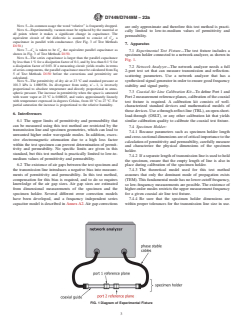
7.1 Experimental Test Fixture—The test fixture includes a specimen holder connected to a network analyzer, as shown in Fig. 1.
7.2 Network Analyzer—The network analyzer needs a full 2-port test set that can measure transmission and reflection-scattering
parameters. Use a network analyzer that has a synthesized signal generator in order to ensure good frequency stability and signal
purity.
7.3 Coaxial Air Line Calibration Kit—To define Port 1 and Port 2 measurement reference planes, calibration of the coaxial test
fixture is required. A calibration kit consists of well-characterized standard devices and mathematical models of those devices. Use
a through-reflect-line (TRL), an open-short-load-through (OSLT), or any other calibration kit that yields similar calibration quality
to calibrate the coaxial test fixture.
7.4 Specimen Holder:
7.4.1 Because parameters such as specimen holder length and cross-sectional dimensions are of critical importance to the
calculation of permittivity and permeability, carefully measure and characterize the physical dimensions of the specimen holder.
7.4.2 If a separate length of transmission line is used to hold the specimen, ensure that the empty length of line is also in place
during calibration of the specimen holder.
FIG. 1 Diagram of Experimental Fixture
D7449/D7449M − 22a
7.4.3 The theoretical model used for this test method assumes that only the dominant mode of propagation exists (TEM). This
fundamental mode has no lower cutoff frequency, so low-frequency measurements are possible. The existence of higher-order
modes restricts the upper measurement frequency for a given coaxial air line test fixture.
7.4.4 Be sure that the specimen holder dimensions are within proper tolerances for the transmission line size in use. For a coaxial
transmission line, the diameter of the center conductor, D , and the inside diameter of the outer conductor, D , are the critical
1 2
dimensions. Proper tolerances for a “7-mm” coax are then:
7–mm coax center conductor diameter:
D 5 3.04 mm60.01 mm @0.1197 in.60.0004 in.# (4)
7–mm coax outer conductor diameter:
D 5 7.00 mm60.01 mm 0.2756 in.60.0004 in. (5)
@ #
Dimensions and tolerances of other standard coaxial transmission lines are in the appropriate manufacturer’s specifications.
8. Test Specimen
8.1 Make the test specimen long enough to ensure good alignment inside the holder. Also, make the test specimen long enough
to ensure that the phase shift through the specimen is much greater than the phase measurement uncertainty of the network analyzer
at the lowest measurement frequency. If a specimen is expected to have low loss, sufficient length is also required to insure accurate
determination of the loss factor. Finally, for high loss specimens, the specimen length cannot be so long that high insertion loss
prevents material property inversion.
8.2 A test specimen that fits into a coaxial transmission line is a toroidal cylinder. Accurately machine the specimen so that its
dimensions minimize the air gap that exists between the conductor surfaces and the specimen. In this respect, measure the
specimen holder’s dimensions in order to specify the tightest tolerances possible for specimen preparation. Keep physical
variations of specimen dimensions as small as is practicable and include specimen dimensions and uncertainties in the report.
9. Preparation of Apparatus
9.1 Inspect Network Analyzer Test Ports—Insure that the recession of both test ports’ center conductor shoulder behind the outer
conductor mating plane meets the minimum specifications. Refer to network analyzer manufacturer’s documentation to provide
connector specificat
...