

ASTM D4935-18
(Test Method)Standard Test Method for Measuring the Electromagnetic Shielding Effectiveness of Planar Materials
General Information
- Abstract
SIGNIFICANCE AND USE
4.1 This test method applies to the measurement of SE of planar materials under normal incidence, far-field, plane-wave conditions (E and H tangential to the surface of the material).
4.2 The uncertainty of the measured SE values is a function of material, mismatches throughout the transmission line path, dynamic range of the measurement system, and the accuracy of the ancillary equipment. An uncertainty analysis is given in Appendix X1 to illustrate the probability of uncertainty achieved by an experienced operator using good equipment. Deviations from the procedure in this test method will increase this uncertainty.
4.3 Approximate near-field values of SE can be calculated for both E or H sources by using measured values of far-field SE. A program can be generated from the source code in Appendix X2 that is suitable for use on a personal computer.
4.4 This test method measures the net SE caused by reflection and absorption. The reflected and absorbed power measurement is accomplished by the addition of a calibrated bidirectional coupler to the input of the holder.
SCOPE
1.1 This test method provides a procedure for measuring the electromagnetic (EM) shielding effectiveness (SE) of a planar material for a plane, far-field EM wave. From the measured data, near-field SE values can be calculated for magnetic (H) sources for electrically thin specimens.2,3 Electric (E) field SE values are also able to be calculated from this same far-field data, but their validity and applicability have not been established.
1.2 The measurement method is valid over a frequency range of 30 MHz to 1.5 GHz. These limits are not exact, but are based on decreasing displacement current as a result of decreased capacitive coupling at lower frequencies and on overmoding (excitation of modes other than the transverse electromagnetic mode (TEM)) at higher frequencies for the size of specimen holder described in this test method. Select any number of discrete frequencies within this range. For electrically thin, isotropic materials with frequency independent electrical properties of conductivity, permittivity, and permeability, measurements will possibly be needed at only a few frequencies as the far-field SE values will be independent of frequency. If the material is not electrically thin or if any of the parameters vary with frequency, make measurements at several frequencies within the band of interest.
1.3 This test method is not applicable to cables or connectors.
1.4 Units—The values stated in SI units are to be regarded as standard. No other units of measurement are included in this standard.
1.5 This standard does not purport to address all of the safety concerns, if any, associated with its use. It is the responsibility of the user of this standard to establish appropriate safety, health, and environmental practices and determine the applicability of regulatory limitations prior to use.
1.6 This international standard was developed in accordance with internationally recognized principles on standardization established in the Decision on Principles for the Development of International Standards, Guides and Recommendations issued by the World Trade Organization Technical Barriers to Trade (TBT) Committee.
- Status
- Published
- Publication Date
- 30-Apr-2018
- Technical Committee
- D09 - Electrical and Electronic Insulating Materials
- Drafting Committee
- D09.12 - Electrical Tests
Buy Documents
ASTM D4935-18 - Standard Test Method for Measuring the Electromagnetic Shielding Effectiveness of Planar Materials
REDLINE ASTM D4935-18 - Standard Test Method for Measuring the Electromagnetic Shielding Effectiveness of Planar Materials
Overview
ASTM D4935-18 is a widely recognized standard test method developed by ASTM International for measuring the electromagnetic shielding effectiveness (SE) of planar materials. This method provides a structured approach for evaluating how materials block or attenuate electromagnetic (EM) energy under controlled laboratory conditions, focusing on normal incidence, far-field, plane-wave exposure. The standard is applicable across a broad frequency range from 30 MHz to 1.5 GHz, making it valuable in a variety of industries concerned with electromagnetic interference (EMI) and protection.
Key Topics
Measurement of Shielding Effectiveness (SE):
- The standard measures the net shielding effectiveness caused by reflection and absorption of EM waves in planar materials.
- SE is calculated as the ratio of power received with and without the shielding material, typically expressed in decibels (dB).
- Measurement considers both far-field and, with suitable calculation, approximate near-field SE values.
Scope and Limitations:
- Applicable only to planar materials, under normal incidence and far-field conditions.
- Not suitable for cables, connectors, or non-planar configurations.
- Valid over frequencies from 30 MHz to 1.5 GHz, with guidance on discrete frequency selection based on material properties.
Specimen Preparation and Testing Requirements:
- Test specimens and reference samples must be identical in thickness, with stringent requirements for uniformity.
- Materials may be homogeneous or inhomogeneous, single or multi-layered, conductive or insulating.
- Strict environmental conditioning and careful specimen handling are emphasized to ensure reliable results.
Equipment and Apparatus:
- Uses a coaxial transmission line specimen holder with 50 Ω characteristic impedance.
- Requires signal generators, receivers (spectrum analyzers or field intensity meters), attenuators, and bidirectional couplers for power measurement.
- Ancillary equipment accuracy and dynamic range are critical for minimizing uncertainty.
Uncertainty and Reliability:
- Uncertainty in SE measurements is influenced by material, system mismatches, measurement dynamic range, and operator expertise.
- The standard includes an analysis of uncertainty and guidance on reducing measurement errors.
Applications
ASTM D4935-18 is essential for industries requiring reliable data on the electromagnetic shielding capabilities of materials, including:
- Electronics and Electrical Enclosures: To select materials for device housings and containers that minimize EMI and ensure compliance with electromagnetic compatibility (EMC) regulations.
- Aerospace and Defense: In the development of materials and structures that require EM shielding to protect sensitive electronics.
- Telecommunications and IT Equipment: For evaluating materials used in server cabinets, racks, and communication device enclosures.
- Automotive: Applied in materials for automotive components that need to resist EMI from wireless systems and sensors.
- Research and Development: Provides a standardized methodology for comparing shielding performance of new or advanced materials.
By adhering to ASTM D4935-18, organizations can ensure that their material selection and product designs meet stringent requirements for electromagnetic compatibility and shielding performance.
Related Standards
- ASTM D1711: Terminology Relating to Electrical Insulation - referenced for definitions within D4935-18.
- IEEE 299: Standard Method for Measuring the Effectiveness of Electromagnetic Shielding Enclosures.
- MIL-STD-285: Attenuation Measurements for Enclosures, Electromagnetic Shielding, for Electronic Test Purposes.
- IEC 61000-5-7: Electromagnetic Compatibility (EMC) - Installation and mitigation guidelines for shielding.
- ASTM E1851: Standard Test Method for Electromagnetic Shielding Effectiveness of Durable Rigid Wall Relocatable Structures.
For companies and professionals involved in EMI compliance, product design, and quality assurance, ASTM D4935-18 serves as a cornerstone document for electromagnetic shielding material evaluation and comparison. Use of this standard supports quality control, product performance assurance, and regulatory compliance in a competitive, technology-driven market.
Relations
- Effective Date
- 01-May-2018
- Effective Date
- 01-Mar-2024
- Effective Date
- 01-Nov-2015
- Effective Date
- 01-Nov-2014
- Effective Date
- 01-May-2014
- Effective Date
- 01-Nov-2013
- Effective Date
- 01-Aug-2011
- Effective Date
- 01-May-2008
- Effective Date
- 10-Mar-2002
- Effective Date
- 10-Oct-1999
- Effective Date
- 01-May-2018
Buy Documents
ASTM D4935-18 - Standard Test Method for Measuring the Electromagnetic Shielding Effectiveness of Planar Materials
REDLINE ASTM D4935-18 - Standard Test Method for Measuring the Electromagnetic Shielding Effectiveness of Planar Materials
Get Certified
Connect with accredited certification bodies for this standard

BSMI (Bureau of Standards, Metrology and Inspection)
Taiwan's standards and inspection authority.
Sponsored listings
Frequently Asked Questions
ASTM D4935-18 is a standard published by ASTM International. Its full title is "Standard Test Method for Measuring the Electromagnetic Shielding Effectiveness of Planar Materials". This standard covers: SIGNIFICANCE AND USE 4.1 This test method applies to the measurement of SE of planar materials under normal incidence, far-field, plane-wave conditions (E and H tangential to the surface of the material). 4.2 The uncertainty of the measured SE values is a function of material, mismatches throughout the transmission line path, dynamic range of the measurement system, and the accuracy of the ancillary equipment. An uncertainty analysis is given in Appendix X1 to illustrate the probability of uncertainty achieved by an experienced operator using good equipment. Deviations from the procedure in this test method will increase this uncertainty. 4.3 Approximate near-field values of SE can be calculated for both E or H sources by using measured values of far-field SE. A program can be generated from the source code in Appendix X2 that is suitable for use on a personal computer. 4.4 This test method measures the net SE caused by reflection and absorption. The reflected and absorbed power measurement is accomplished by the addition of a calibrated bidirectional coupler to the input of the holder. SCOPE 1.1 This test method provides a procedure for measuring the electromagnetic (EM) shielding effectiveness (SE) of a planar material for a plane, far-field EM wave. From the measured data, near-field SE values can be calculated for magnetic (H) sources for electrically thin specimens.2,3 Electric (E) field SE values are also able to be calculated from this same far-field data, but their validity and applicability have not been established. 1.2 The measurement method is valid over a frequency range of 30 MHz to 1.5 GHz. These limits are not exact, but are based on decreasing displacement current as a result of decreased capacitive coupling at lower frequencies and on overmoding (excitation of modes other than the transverse electromagnetic mode (TEM)) at higher frequencies for the size of specimen holder described in this test method. Select any number of discrete frequencies within this range. For electrically thin, isotropic materials with frequency independent electrical properties of conductivity, permittivity, and permeability, measurements will possibly be needed at only a few frequencies as the far-field SE values will be independent of frequency. If the material is not electrically thin or if any of the parameters vary with frequency, make measurements at several frequencies within the band of interest. 1.3 This test method is not applicable to cables or connectors. 1.4 Units—The values stated in SI units are to be regarded as standard. No other units of measurement are included in this standard. 1.5 This standard does not purport to address all of the safety concerns, if any, associated with its use. It is the responsibility of the user of this standard to establish appropriate safety, health, and environmental practices and determine the applicability of regulatory limitations prior to use. 1.6 This international standard was developed in accordance with internationally recognized principles on standardization established in the Decision on Principles for the Development of International Standards, Guides and Recommendations issued by the World Trade Organization Technical Barriers to Trade (TBT) Committee.
SIGNIFICANCE AND USE 4.1 This test method applies to the measurement of SE of planar materials under normal incidence, far-field, plane-wave conditions (E and H tangential to the surface of the material). 4.2 The uncertainty of the measured SE values is a function of material, mismatches throughout the transmission line path, dynamic range of the measurement system, and the accuracy of the ancillary equipment. An uncertainty analysis is given in Appendix X1 to illustrate the probability of uncertainty achieved by an experienced operator using good equipment. Deviations from the procedure in this test method will increase this uncertainty. 4.3 Approximate near-field values of SE can be calculated for both E or H sources by using measured values of far-field SE. A program can be generated from the source code in Appendix X2 that is suitable for use on a personal computer. 4.4 This test method measures the net SE caused by reflection and absorption. The reflected and absorbed power measurement is accomplished by the addition of a calibrated bidirectional coupler to the input of the holder. SCOPE 1.1 This test method provides a procedure for measuring the electromagnetic (EM) shielding effectiveness (SE) of a planar material for a plane, far-field EM wave. From the measured data, near-field SE values can be calculated for magnetic (H) sources for electrically thin specimens.2,3 Electric (E) field SE values are also able to be calculated from this same far-field data, but their validity and applicability have not been established. 1.2 The measurement method is valid over a frequency range of 30 MHz to 1.5 GHz. These limits are not exact, but are based on decreasing displacement current as a result of decreased capacitive coupling at lower frequencies and on overmoding (excitation of modes other than the transverse electromagnetic mode (TEM)) at higher frequencies for the size of specimen holder described in this test method. Select any number of discrete frequencies within this range. For electrically thin, isotropic materials with frequency independent electrical properties of conductivity, permittivity, and permeability, measurements will possibly be needed at only a few frequencies as the far-field SE values will be independent of frequency. If the material is not electrically thin or if any of the parameters vary with frequency, make measurements at several frequencies within the band of interest. 1.3 This test method is not applicable to cables or connectors. 1.4 Units—The values stated in SI units are to be regarded as standard. No other units of measurement are included in this standard. 1.5 This standard does not purport to address all of the safety concerns, if any, associated with its use. It is the responsibility of the user of this standard to establish appropriate safety, health, and environmental practices and determine the applicability of regulatory limitations prior to use. 1.6 This international standard was developed in accordance with internationally recognized principles on standardization established in the Decision on Principles for the Development of International Standards, Guides and Recommendations issued by the World Trade Organization Technical Barriers to Trade (TBT) Committee.
ASTM D4935-18 is classified under the following ICS (International Classification for Standards) categories: 17.220.20 - Measurement of electrical and magnetic quantities. The ICS classification helps identify the subject area and facilitates finding related standards.
ASTM D4935-18 has the following relationships with other standards: It is inter standard links to ASTM D4935-10, ASTM D1711-24, ASTM D1711-15, ASTM D1711-14a, ASTM D1711-14, ASTM D1711-13, ASTM D1711-11a, ASTM D1711-08, ASTM D1711-02, ASTM D1711-99, ASTM B904-00(2021). Understanding these relationships helps ensure you are using the most current and applicable version of the standard.
ASTM D4935-18 is available in PDF format for immediate download after purchase. The document can be added to your cart and obtained through the secure checkout process. Digital delivery ensures instant access to the complete standard document.
Standards Content (Sample)
This international standard was developed in accordance with internationally recognized principles on standardization established in the Decision on Principles for the
Development of International Standards, Guides and Recommendations issued by the World Trade Organization Technical Barriers to Trade (TBT) Committee.
Designation: D4935 − 18
Standard Test Method for
Measuring the Electromagnetic Shielding Effectiveness of
Planar Materials
This standard is issued under the fixed designation D4935; the number immediately following the designation indicates the year of
original adoption or, in the case of revision, the year of last revision.Anumber in parentheses indicates the year of last reapproval.A
superscript epsilon (´) indicates an editorial change since the last revision or reapproval.
1. Scope responsibility of the user of this standard to establish appro-
priate safety, health, and environmental practices and deter-
1.1 Thistestmethodprovidesaprocedureformeasuringthe
mine the applicability of regulatory limitations prior to use.
electromagnetic (EM) shielding effectiveness (SE) of a planar
1.6 This international standard was developed in accor-
material for a plane, far-field EM wave. From the measured
dance with internationally recognized principles on standard-
data, near-field SE values can be calculated for magnetic (H)
2,3 ization established in the Decision on Principles for the
sources for electrically thin specimens. Electric (E) field SE
Development of International Standards, Guides and Recom-
values are also able to be calculated from this same far-field
mendations issued by the World Trade Organization Technical
data, but their validity and applicability have not been estab-
Barriers to Trade (TBT) Committee.
lished.
1.2 The measurement method is valid over a frequency 2. Referenced Documents
rangeof30MHzto1.5GHz.Theselimitsarenotexact,butare
2.1 ASTM Standards:
based on decreasing displacement current as a result of
D1711Terminology Relating to Electrical Insulation
decreased capacitive coupling at lower frequencies and on
overmoding (excitation of modes other than the transverse
3. Terminology
electromagnetic mode (TEM)) at higher frequencies for the
3.1 Definitions—For definitions of terms used in this test
size of specimen holder described in this test method. Select
method, refer to Terminology D1711.
any number of discrete frequencies within this range. For
3.2 Definitions of Terms Specific to This Standard:
electrically thin, isotropic materials with frequency indepen-
3.2.1 dynamic range (DR), n—differencebetweenthemaxi-
dent electrical properties of conductivity, permittivity, and
mum and minimum signals measurable by the system.
permeability, measurements will possibly be needed at only a
3.2.1.1 Discussion—Measurement of materials with good
few frequencies as the far-field SE values will be independent
SE require extra care to avoid contamination of extremely low
of frequency. If the material is not electrically thin or if any of
power or voltage values by unwanted signals from leakage
the parameters vary with frequency, make measurements at
paths.
several frequencies within the band of interest.
3.2.2 electrically thin, adj—thickness of the specimen is
1.3 This test method is not applicable to cables or connec-
much smaller (< ⁄100) than the electrical wavelength within the
tors.
specimen.
1.4 Units—The values stated in SI units are to be regarded
3.2.3 far field, n—that region where vectors E and H are
asstandard.Nootherunitsofmeasurementareincludedinthis
orthogonaltoeachotherandbotharenormaltothedirectionof
standard.
propagation of energy.
1.5 This standard does not purport to address all of the
3.2.4 near field, n—that region where E and H are not
safety concerns, if any, associated with its use. It is the
related by simple rules.
3.2.4.1 Discussion—The transition region between near
This test method is under the jurisdiction of ASTM Committee D09 on
field and far field is not abrupt but is located at the distance
Electrical and Electronic Insulating Materials and is the direct responsibility of
close to λ/2π from a dipole source, where λ is the free-space
Subcommittee D09.12 on Electrical Tests.
wave length of the frequency of the source. It is possible this
Current edition approved May 1, 2018. Published May 2018. Originally
approved in 1989. Last previous edition approved in 2010 as D4935–10. DOI: concept of regions is further blurred by reradiating as a result
10.1520/D4935-18.
Wilson, P. F., and Ma, M. T., “A Study of Techniques for Measuring the
Electromagnetic Shielding Effectiveness of Materials,” NBS Technical Note 1095, For referenced ASTM standards, visit the ASTM website, www.astm.org, or
May 1986. contact ASTM Customer Service at service@astm.org. For Annual Book of ASTM
Adams, J. W., and Vanzura, E. J., “Shielding Effectiveness Measurements of Standards volume information, refer to the standard’s Document Summary page on
Plastics,” NBSIR 85-3035, January 1986. the ASTM website.
Copyright © ASTM International, 100 Barr Harbor Drive, PO Box C700, West Conshohocken, PA 19428-2959. United States
D4935 − 18
of scattering by reflecting materials or objects distant from the 5.2 Specimen Holder—Physical dimensions of a specimen
source. The interior of metallic structures often contains a holder are given in Annex A1. The specimen holder is an
mixture of near-field regions. enlarged, coaxial transmission line with special taper sections
and notched matching grooves to maintain a characteristic
3.2.5 shielding effectiveness (SE), n—ratio of power re-
impedance of 50 Ω throughout the entire length of the holder.
ceived with and without a material present for the same
This impedance is checked in accordance with 7.1, and any
incident power.
variations greater than 60.5 Ω are corrected. There are three
3.2.5.1 Discussion—SE is usually expressed in decibels
important aspects to this design. First, a pair of flanges in the
(dB) by the following equation:
middle of the structure hold the specimen. This allows capaci-
P
tive coupling of energy into insulating materials through
SE 5 10log ~dB! (1)
P
displacement current. Second, a reference specimen of the
where: same thickness and electrical properties as the load specimen
causes the same discontinuity in the transmission line as is
P = received power with the material present, and
caused by the load specimen. Third, nonconductive (nylon)
P = received power without the material present.
screws are used to connect the two sections of the holder
If the receiver readout is in units of voltage, use the
together during tests. This prevents conduction currents from
following equation:
dominatingthedesireddisplacementcurrentsnecessaryforthe
V
1 correct operation of this specimen holder.
SE 5 20log ~dB! (2)
V
5.3 Signal Generator, a source capable of generating a
where: sinusoidal signal over the desired portion of the frequency
range specified in 1.2. A 50-Ω output impedance is needed to
V and V = respective voltage levels with and without a
1 2
minimize reflections caused by mismatches. Precision step
material present.
attenuatorsareusefulinincreasingtheeffectivedynamicrange
According to these equations, SE will have a negative
for SE measurements.
valueiflesspowerisreceivedwiththematerialpresentthan
when it is absent. 5.4 Receiver,adevicewitha50-Ωinputimpedancecapable
of measuring signals over the same frequency range as the
4. Significance and Use signal generator in 5.3. A wide dynamic range is desirable to
achieve a wide dynamic range of measured SE values.
4.1 This test method applies to the measurement of SE of
Typically, either a spectrum analyzer or a field intensity meter
planar materials under normal incidence, far-field, plane-wave
is used.
conditions (E and H tangential to the surface of the material).
5.5 Coaxial Cables and Connectors—These are devices for
4.2 The uncertainty of the measured SE values is a function
connecting power between specific components without caus-
of material, mismatches throughout the transmission line path,
ing interference with other components. These shall all have a
dynamicrangeofthemeasurementsystem,andtheaccuracyof
50-Ω characteristic impedance. Double-shielded cables pro-
the ancillary equipment. An uncertainty analysis is given in
vide lower leakage than single-shielded cables. Type N con-
Appendix X1 to illustrate the probability of uncertainty
nectors provide more reliability and less leakage than BNC
achieved by an experienced operator using good equipment.
connectors. Precision 14-mm connectors give lower mismatch
Deviationsfromtheprocedureinthistestmethodwillincrease
errors and are more reliable under heavy usage than other
this uncertainty.
connectors but are more expensive and are not used on most
4.3 Approximate near-field values of SE can be calculated
generators or receivers.
for both E or H sources by using measured values of far-field
5.6 Attenuators—These devices are used to isolate the
SE. A program can be generated from the source code in
specimen holder from the signal generator and the receiver.
Appendix X2 that is suitable for use on a personal computer.
Their main purpose in this system is for impedance matching.
4.4 This test method measures the net SE caused by
A10-dB, 50-Ω attenuator shall be used on each end of the
reflection and absorption. The reflected and absorbed power
specimenholder.Thematerialundertestusuallycausesalarge
measurement is accomplished by the addition of a calibrated
reflection of energy back into the signal generator, which also
bidirectional coupler to the input of the holder.
cause variations of the incident power by changing the gen-
eratorimpedanceloading.Useofabidirectionalcouplerallows
5. Apparatus
monitoring and correcting any changes in incident power as a
5.1 A basic equipment setup is shown in Fig. 1. result of this loading. Attenuators greater than 10 dB will
excessively decrease the dynamic range of the measurement
system.
6. Test Specimens
6.1 The reference and load specimens shall be of the same
material and thickness. Both are shown in Fig. 2. Dimensions
FIG. 1 General Test Setup are shown in Fig. 3. The load specimen can be larger than the
D4935 − 18
change in attenuator setting, and if the step attenuator itself
doesnotcausealeakagepath,leakageisnegligibleandtheDR
measured above is correct. If the levels do not correspond, the
attenuation shall be increased until a one-to-one correspon-
dence is achieved to determine the DR. Recheck connections
since leakage from a coaxial connector is determined not only
by the quality of the connector, but also by the amount of
torque used in tightening the connector.
7.2.2 If a standard reference specimen such as gold film
depositedonMylar®isavailable,measurementofitsSEvalue
can provide assurance that the entire system is working
properly. A specimen with the surface resistivity of 5 Ω
commonly possess SE = –32 6 3 dB. Use any other known
FIG. 2 Illustration of Reference and Load Specimens
specimen to check setup-to-setup repeatability.
7.2.3 Careful handling of the specimen holder and speci-
mens is important.
outer diameter of the flange on the holder but keeping them to
the dimensions shown in Fig. 3 will expedite handling.
7.3 Preparation of 7.2 shall be in accordance with proce-
dures of Section 8.
6.2 Specimen thickness is a critical dimension. For the best
repeatabilityofSEmeasurements,referencespecimenandload
8. Procedure
specimen shall be identical in thickness. For this test method,
twospecimensareconsideredtohaveidenticalthicknessifthe
8.1 Follow the preparation of apparatus in accordance with
differenceintheaveragethicknessesislessthan25µmandthe
7.2 whenever the measurement system has been reconfigured
thickness variation within and between specimens is less than
or not used for several days.
5% of the average.
8.2 Prepare two specimens in accordance with Section 6.
6.3 It is permissible for the specimen materials to be either
8.3 Determine all frequencies for which SE values are to be
homogeneous or inhomogeneous, single or multiple layered,
measured. The specimen mounting procedure described in 8.4
and conducting or insulating. Measured SE values of inhomo-
requires more time and effort than changing frequency, so it is
geneous materials are dependent on geometry and orientation,
more efficient to record values at all frequencies for the
andresultsarelessrepeatablethanforhomogeneousmaterials.
reference specimen, change to the load specimen, and then
6.4 Before tests, condition test specimens for 48 h at 23 6
record load values at these same frequencies. This procedure
2°C and 50 6 5% relative humidity. Tests shall be performed
can be automated if a computer and ancillary equipment with
immediatelyuponremovalfromtheconditioningenvironment. IEEE-488 bus capability are available.
8.4 The procedure for inserting the specimens is as follows:
7. Preparation of Apparatus
Use a support structure (a large roll of tape or special stand) to
7.1 Performed an initial check of the specimen holder with
supportthespecimenholderinaverticalposition.Removetwo
a time-domain reflectometer or other suitable instrument to
nylonscrews,turntheholderendforend,removetheothertwo
ensure that a characteristic impedance of 50 6 0.5Ω has been
nylonscrews,andcarefullyliftofftheupperhalfoftheholder.
achieved during construction and that this impedance has not
Anindented,softfoampadisusefulforholdingthisupperhalf
been degraded during shipment or handling. A time-domain
of the specimen holder while continuing the installation or
system can give location of a mismatch in addition to its
removal of specimens. Place the two pieces of the reference
magnitude
...
This document is not an ASTM standard and is intended only to provide the user of an ASTM standard an indication of what changes have been made to the previous version. Because
it may not be technically possible to adequately depict all changes accurately, ASTM recommends that users consult prior editions as appropriate. In all cases only the current version
of the standard as published by ASTM is to be considered the official document.
Designation: D4935 − 10 D4935 − 18
Standard Test Method for
Measuring the Electromagnetic Shielding Effectiveness of
Planar Materials
This standard is issued under the fixed designation D4935; the number immediately following the designation indicates the year of
original adoption or, in the case of revision, the year of last revision. A number in parentheses indicates the year of last reapproval. A
superscript epsilon (´) indicates an editorial change since the last revision or reapproval.
1. Scope
1.1 This test method provides a procedure for measuring the electromagnetic (EM) shielding effectiveness (SE) of a planar
material for a plane, far-field EM wave. From the measured data, near-field SE values maycan be calculated for magnetic (H)
2,3
sources for electrically thin specimens. Electric (E) field SE values mayare also able to be calculated from this same far-field
data, but their validity and applicability have not been established.
1.2 The measurement method is valid over a frequency range of 30 MHz to 1.5 GHz. These limits are not exact, but are based
on decreasing displacement current as a result of decreased capacitive coupling at lower frequencies and on overmoding (excitation
of modes other than the transverse electromagnetic mode (TEM)) at higher frequencies for the size of specimen holder described
in this test method. Any Select any number of discrete frequencies may be selected within this range. For electrically thin, isotropic
materials with frequency independent electrical properties of conductivity, permittivity, and permeability, measurements may will
possibly be needed at only a few frequencies as the far-field SE values will be independent of frequency. If the material is not
electrically thin or if any of the parameters vary with frequency, measurements should be made at manymake measurements at
several frequencies within the band of interest.
1.3 This test method is not applicable to cables or connectors.
1.4 Units—The values stated in SI units are to be regarded as standard. No other units of measurement are included in this
standard.
1.5 This standard does not purport to address all of the safety concerns, if any, associated with its use. It is the responsibility
of the user of this standard to establish appropriate safety safety, health, and healthenvironmental practices and determine the
applicability of regulatory limitations prior to use.
1.6 This international standard was developed in accordance with internationally recognized principles on standardization
established in the Decision on Principles for the Development of International Standards, Guides and Recommendations issued
by the World Trade Organization Technical Barriers to Trade (TBT) Committee.
2. Referenced Documents
2.1 ASTM Standards:
D1711 Terminology Relating to Electrical Insulation
3. Terminology
3.1 Definitions—For definitions of terms used in this test method, refer to Terminology D1711.
3.2 Definitions of Terms Specific to This Standard:
3.2.1 dynamic range (DR), n—difference between the maximum and minimum signals measurable by the system.
3.2.1.1 Discussion—
This test method is under the jurisdiction of ASTM Committee D09 on Electrical and Electronic Insulating Materials and is the direct responsibility of Subcommittee
D09.12 on Electrical Tests.
Current edition approved May 1, 2010May 1, 2018. Published June 2010May 2018. Originally approved in 1989. Last previous edition approved in 19992010 as
D 4935–99.D4935 – 10. DOI: 10.1520/D4935–10.10.1520/D4935-18.
Wilson, P. F., and Ma, M. T., “A Study of Techniques for Measuring the Electromagnetic Shielding Effectiveness of Materials,” NBS Technical Note 1095, May 1986.
Adams, J. W., and Vanzura, E. J., “Shielding Effectiveness Measurements of Plastics,” NBSIR 85-3035, January 1986.
For referenced ASTM standards, visit the ASTM website, www.astm.org, or contact ASTM Customer Service at service@astm.org. For Annual Book of ASTM Standards
volume information, refer to the standard’s Document Summary page on the ASTM website.
Copyright © ASTM International, 100 Barr Harbor Drive, PO Box C700, West Conshohocken, PA 19428-2959. United States
D4935 − 18
Measurement of materials with good SE require extra care to avoid contamination of extremely low power or voltage values by
unwanted signals from leakage paths.
3.2.2 electrically thin, adj—thickness of the specimen is much smaller (< ⁄100) than the electrical wavelength within the
specimen.
3.2.3 far field, n—that region where vectors E and H are orthogonal to each other and both are normal to the direction of
propagation of energy.
3.2.4 near field, n—that region where E and H are not related by simple rules.
3.2.4.1 Discussion—
The transition region between near field and far field is not abrupt but is located at the distance close to λ/2π from a dipole source,
where λ is the free-space wave length of the frequency of the source. This It is possible this concept of regions is further blurred
by reradiating as a result of scattering by reflecting materials or objects that may be distant from the source. The interior of metallic
structures often contains a mixture of near-field regions.
3.2.5 shielding effectiveness (SE), n—ratio of power received with and without a material present for the same incident power.
3.2.5.1 Discussion—
SE is usually expressed in decibels (dB) by the following equation:
P
SE 5 10log ~dB! (1)
P
where:
P = received power with the material present, and
P = received power without the material present.
If the receiver readout is in units of voltage, use the following equation:
V
SE 5 20log ~dB! (2)
V
where:
V and V = respective voltage levels with and without a material present.
1 2
According to these equations, SE will have a negative value if less power is received with the material present than when it
is absent.
4. Significance and Use
4.1 This test method applies to the measurement of SE of planar materials under normal incidence, far-field, plane-wave
conditions (E and H tangential to the surface of the material).
4.2 The uncertainty of the measured SE values is a function of material, mismatches throughout the transmission line path,
dynamic range of the measurement system, and the accuracy of the ancillary equipment. An uncertainty analysis is given in
Appendix X1 to illustrate the uncertainty that may be probability of uncertainty achieved by an experienced operator using good
equipment. Deviations from the procedure in this test method will increase this uncertainty.
4.3 Approximate near-field values of SE maycan be calculated for both E or H sources by using measured values of far-field
SE. A program maycan be generated from the source code in Appendix X2 that is suitable for use on a personal computer.
4.4 This test method measures the net SE caused by reflection and absorption. Separate measurement of The reflected and
absorbed power may bemeasurement is accomplished by the addition of a calibrated bidirectional coupler to the input of the holder.
5. Apparatus
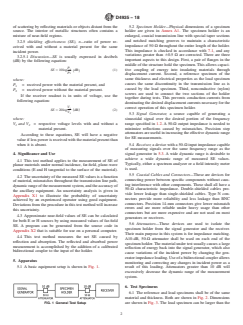
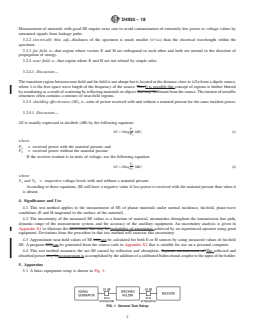
5.1 A basic equipment setup is shown in Fig. 1.
FIG. 1 General Test Setup
D4935 − 18
5.2 Specimen Holder—Physical dimensions of a specimen holder are given in Annex A1. The specimen holder is an enlarged,
coaxial transmission line with special taper sections and notched matching grooves to maintain a characteristic impedance of 50
Ω throughout the entire length of the holder. This impedance is checked in accordance with 7.1, and any variations greater than
60.5 Ω are corrected. There are three important aspects to this design. First, a pair of flanges in the middle of the structure hold
the specimen. This allows capacitive coupling of energy into insulating materials through displacement current. Second, a
reference specimen of the same thickness and electrical properties as the load specimen causes the same discontinuity in the
transmission line as is caused by the load specimen. Third, nonconductive (nylon) screws are used to connect the two sections of
the holder together during tests. This prevents conduction currents from dominating the desired displacement currents necessary
for the correct operation of this specimen holder.
5.3 Signal Generator, a source capable of generating a sinusoidal signal over the desired portion of the frequency range specified
in 1.2. A 50-Ω output impedance is needed to minimize reflections caused by mismatches. Precision step attenuators are useful in
increasing the effective dynamic range for SE measurements.
5.4 Receiver, a device with a 50-Ω input impedance capable of measuring signals over the same frequency range as the signal
generator in 5.3. A wide dynamic range is desirable to achieve a wide dynamic range of measured SE values. Typically, either a
spectrum analyzer or a field intensity meter is used.
5.5 Coaxial Cables and Connectors—These are devices for connecting power between specific components without causing
interference with other components. These shouldshall all have a 50-Ω characteristic impedance. Double-shielded cables provide
lower leakage than single-shielded cables. Type N connectors provide more reliability and less leakage than BNC connectors.
Precision 14-mm connectors give lower mismatch errors and are more reliable under heavy usage than other connectors but are
more expensive and are not used on most generators or receivers.
5.6 Attenuators—These are devices are used to isolate the specimen holder from the signal generator and the receiver. Their
main purpose in this system is for impedance matching. A10-dB, 50-Ω attenuator shouldshall be used on each end of the specimen
holder. The material under test usually causes a large reflection of energy back into the signal generator. This may generator, which
also cause variations of the incident power by changing the generator impedance loading. Use of a bidirectional coupler allows
monitoring and correcting any changes in incident power as a result of this loading. Attenuators greater than 10 dB will excessively
decrease the dynamic range of the measurement system.
6. Test Specimens
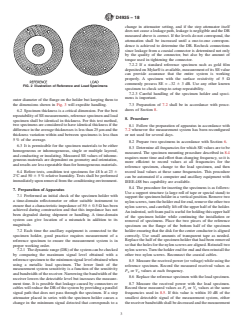
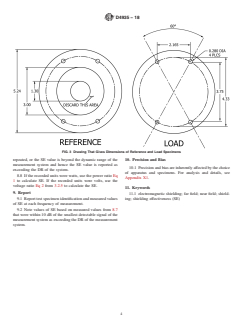
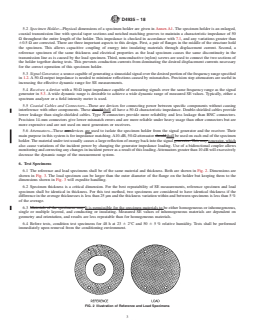
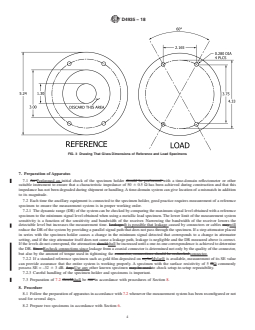
6.1 The reference and load specimens shall be of the same material and thickness. Both are shown in Fig. 2. Dimensions are
shown in Fig. 3. The load specimen can be larger than the outer diameter of the flange on the holder but keeping them to the
dimensions shown in Fig. 3 will expedite handling.
6.2 Specimen thickness is a critical dimension. For the best repeatability of SE measurements, reference specimen and load
specimen shall be identical in thickness. For this test method, two specimens are considered to have identical thickness if the
difference in the average thicknesses is less than 25 μm and the thickness variation within and between specimens is less than 5 %
of the average.
6.3 Materials of the specimens may It is permissible for the specimen materials to be either homogeneous or inhomogeneous,
single or multiple layered, and conducting or insulating. Measured SE values of inhomogeneous materials are dependent on
geometry and orientation, and results are less repeatable than for homogeneous materials.
6.4 Before tests, condition test specimens for 48 h at 23 6 2°C and 50 6 5 % relative humidity. Tests shall be performed
immediately upon removal from the conditioning environment.
FIG. 2 Illustration of Reference and Load Specimens
D4935 − 18
FIG. 3 Drawing That Gives Dimensions of Reference and Load Specimens
7. Preparation of Apparatus
7.1 An Performed an initial check of the specimen holder should be performed with a time-domain reflectometer or other
suitable instrument to ensure that a characteristic impedance of 50 6 0.5 Ω has been achieved during construction and that this
impedance has not been degraded during shipment or handling. A time-domain system can give location of a mismatch in addition
to its magnitude.
7.2 Each time the ancillary equipment is connected to the specimen holder, good practice requires measurement of a reference
specimen to ensure the measurement system is in proper working order.
7.2.1 The dynamic range (DR) of the system can be checked by comparing the maximum signal level obtained with a reference
specimen to the minimum signal level obtained when using a metallic load specimen. The lower limit of the measurement system
sensitivity is a function of the sensitivity and bandwidth of the receiver. Narrowing the bandwidth of the receiver lowers the
detectable level but increases the measurement time. Leakage It is possible that leakage caused by connectors or cables maywill
reduce the DR of the system by providing a parallel signal path that does not pass through the specimen. If a step attenuator placed
in series with the specimen holder causes a change in the minimum signal detected that corresponds to a change in attenuator
setting, and if the step attenuator itself does not cause a leakage path, leakage is negligible and the DR measured above is correct.
If the levels do not correspond, the attenuation shouldshall be increased until a one-to-one correspondence is achieved to determine
the DR. Since Recheck connections since leakage from a coaxial connector is determined not only by the quality of the connector,
but also by the amount of torque used in tightening the connector, connections should be rechecked.connector.
7.2.2 If a standard reference specimen such as gold film deposited on mylarMylar® is available, measurement of its SE value
can provide assurance that the entire system is working properly. A specimen with the surface resistivity of 5 ΩΩ commonly
possess SE = –32 6 3 dB. Any Use any other known specimen may be used to check setup-to-setup repeatability.
7.2.3 Careful handling of the specimen holder and specimens is important.
7.3 Preparation of 7.2 shouldshall
...