

ASTM A698/A698M-20
(Test Method)Standard Test Method for Magnetic Shield Efficiency in Attenuating Alternating Magnetic Fields
General Information
- Abstract
SIGNIFICANCE AND USE
5.1 This test method provides an easy, accurate, and reproducible method for determination of shielding factors (attenuation ratios) in simple alternating magnetic fields.
5.2 Since the sensing or pickup coil is of finite size, the measured shielding factor tends to be the average value for the space enclosed by the coil. Due care is required when interpreting results when the coil is located near an opening in the shield.
5.3 This test method is suitable for design, specification acceptance, service evaluation, quality assurance, and research purposes on magnetic shields.
5.4 Provided geometrically identical shields are compared, this test method is also suitable for evaluation and grading of magnetic shielding materials.
SCOPE
1.1 This test method covers the means for determining the performance quality of a magnetic shield when placed in a magnetic field of alternating polarity.
1.2 This test method provides a means of evaluating and grading magnetic shielding materials to determine their suitability for use in the production of magnetic shields.
1.3 This test method shall be used in conjunction with and shall conform to the requirements of Practice A34/A34M.
1.4 The values stated in either SI units or inch-pound units are to be regarded separately as standard. The values stated in each system may not be exact equivalents; therefore, each system shall be used independently of the other. Combining values from the two systems may result in non-conformance with the standard.
1.5 This standard does not purport to address all of the safety concerns, if any, associated with its use. It is the responsibility of the user of this standard to establish appropriate safety, health, and environmental practices and determine the applicability of regulatory limitations prior to use.
1.6 This international standard was developed in accordance with internationally recognized principles on standardization established in the Decision on Principles for the Development of International Standards, Guides and Recommendations issued by the World Trade Organization Technical Barriers to Trade (TBT) Committee.
- Status
- Published
- Publication Date
- 31-May-2020
- Technical Committee
- A06 - Magnetic Properties
- Drafting Committee
- A06.01 - Test Methods
Buy Documents
ASTM A698/A698M-20 - Standard Test Method for Magnetic Shield Efficiency in Attenuating Alternating Magnetic Fields
REDLINE ASTM A698/A698M-20 - Standard Test Method for Magnetic Shield Efficiency in Attenuating Alternating Magnetic Fields
Overview
ASTM A698/A698M-20 establishes a standardized test method for assessing the efficiency of magnetic shields in attenuating alternating magnetic fields. Developed by ASTM International, this standard details procedures to accurately and reproducibly determine the shielding factor, also known as the attenuation ratio, in alternating magnetic environments. The method is essential for evaluating both the performance of fabricated magnetic shields and the effectiveness of magnetic shielding materials, providing a framework for design, specification acceptance, quality assurance, and research applications.
The test utilizes precise instrumentation-including Helmholtz coils, pickup coils, and electronic voltmeters-to measure the degree to which a shield reduces the strength of an applied magnetic field. It covers procedures suitable for a range of shield sizes and materials, ensuring versatility across industries requiring electromagnetic interference (EMI) mitigation.
Key Topics
- Magnetic Shield Efficiency: Focuses on measuring the attenuation of alternating magnetic fields by various shield types using standardized test setups.
- Attenuation Ratio Calculation: Determines the ratio of magnetic field strength or pickup coil voltage with and without a shield, a direct measure of shielding effectiveness.
- Test Apparatus: Specifies the configuration and use of Helmholtz coils, pickup coils, ammeters, electronic voltmeters, and associated power supply equipment.
- Test Procedures:
- Preparation and demagnetization of shields to ensure reliable results.
- Step-by-step instructions for positioning, rotating, and evaluating shield specimens in test environments.
- Interpretation and Use of Results: Includes guidance for accurate reading, reproducibility, and considerations when shields are near openings or of non-standard geometry.
- Safety and Units: Emphasizes conformance with Practice A34/A34M, use of SI or inch-pound units independently, and adherence to safety and regulatory practices.
Applications
ASTM A698/A698M-20 is widely applicable in areas requiring control of electromagnetic fields and reduction of EMI. Major practical applications include:
- Design of Electronic Enclosures: Validates shield effectiveness in commercial and industrial electronics where protection from external AC magnetic fields is essential.
- Material Evaluation: Assesses and grades shielding materials such as nickel-iron, silicon iron, and amorphous alloys for use in manufacturing magnetic shields.
- Quality Assurance and Specification Compliance: Ensures that magnetic shields meet required performance standards during manufacturing and before installation.
- Research and Development: Supports investigation and innovation in advanced shielding solutions and new magnetic alloys for enhanced attenuation properties.
- Service Evaluation: Verifies ongoing field performance of shields to maintain electromagnetic compatibility and comply with regulatory requirements.
Related Standards
- ASTM A34/A34M: Practice for Sampling and Procurement Testing of Magnetic Materials - required in conjunction with ASTM A698/A698M-20 for material validation.
- ASTM A340: Terminology of Symbols and Definitions Relating to Magnetic Testing - provides definitions essential to understanding test parameters and results.
- Electromagnetic Compatibility Standards: ASTM A698/A698M-20 aligns with broader industry standards by providing rigorous, reproducible test methods for EMI shielding performance assessments.
By following ASTM A698/A698M-20, organizations can ensure their magnetic shields are rigorously tested and compliant with international standards, facilitating reliable protection from alternating magnetic fields in sensitive equipment and critical applications.
Relations
- Effective Date
- 01-Dec-2023
- Effective Date
- 15-Oct-2019
- Effective Date
- 15-Jun-2019
- Effective Date
- 15-Feb-2019
- Effective Date
- 01-Jun-2018
- Effective Date
- 15-Oct-2017
- Effective Date
- 01-Jul-2017
- Effective Date
- 01-May-2016
- Effective Date
- 01-May-2016
- Effective Date
- 01-Oct-2015
- Effective Date
- 01-Oct-2014
- Effective Date
- 01-Nov-2012
- Refers
ASTM A340-03a(2011) - Standard Terminology of Symbols and Definitions Relating to Magnetic Testing - Effective Date
- 01-May-2011
- Refers
ASTM A34/A34M-06 - Standard Practice for Sampling and Procurement Testing of Magnetic Materials - Effective Date
- 01-Nov-2006
- Effective Date
- 10-Jun-2003
Buy Documents
ASTM A698/A698M-20 - Standard Test Method for Magnetic Shield Efficiency in Attenuating Alternating Magnetic Fields
REDLINE ASTM A698/A698M-20 - Standard Test Method for Magnetic Shield Efficiency in Attenuating Alternating Magnetic Fields
Get Certified
Connect with accredited certification bodies for this standard

BSMI (Bureau of Standards, Metrology and Inspection)
Taiwan's standards and inspection authority.
Sponsored listings
Frequently Asked Questions
ASTM A698/A698M-20 is a standard published by ASTM International. Its full title is "Standard Test Method for Magnetic Shield Efficiency in Attenuating Alternating Magnetic Fields". This standard covers: SIGNIFICANCE AND USE 5.1 This test method provides an easy, accurate, and reproducible method for determination of shielding factors (attenuation ratios) in simple alternating magnetic fields. 5.2 Since the sensing or pickup coil is of finite size, the measured shielding factor tends to be the average value for the space enclosed by the coil. Due care is required when interpreting results when the coil is located near an opening in the shield. 5.3 This test method is suitable for design, specification acceptance, service evaluation, quality assurance, and research purposes on magnetic shields. 5.4 Provided geometrically identical shields are compared, this test method is also suitable for evaluation and grading of magnetic shielding materials. SCOPE 1.1 This test method covers the means for determining the performance quality of a magnetic shield when placed in a magnetic field of alternating polarity. 1.2 This test method provides a means of evaluating and grading magnetic shielding materials to determine their suitability for use in the production of magnetic shields. 1.3 This test method shall be used in conjunction with and shall conform to the requirements of Practice A34/A34M. 1.4 The values stated in either SI units or inch-pound units are to be regarded separately as standard. The values stated in each system may not be exact equivalents; therefore, each system shall be used independently of the other. Combining values from the two systems may result in non-conformance with the standard. 1.5 This standard does not purport to address all of the safety concerns, if any, associated with its use. It is the responsibility of the user of this standard to establish appropriate safety, health, and environmental practices and determine the applicability of regulatory limitations prior to use. 1.6 This international standard was developed in accordance with internationally recognized principles on standardization established in the Decision on Principles for the Development of International Standards, Guides and Recommendations issued by the World Trade Organization Technical Barriers to Trade (TBT) Committee.
SIGNIFICANCE AND USE 5.1 This test method provides an easy, accurate, and reproducible method for determination of shielding factors (attenuation ratios) in simple alternating magnetic fields. 5.2 Since the sensing or pickup coil is of finite size, the measured shielding factor tends to be the average value for the space enclosed by the coil. Due care is required when interpreting results when the coil is located near an opening in the shield. 5.3 This test method is suitable for design, specification acceptance, service evaluation, quality assurance, and research purposes on magnetic shields. 5.4 Provided geometrically identical shields are compared, this test method is also suitable for evaluation and grading of magnetic shielding materials. SCOPE 1.1 This test method covers the means for determining the performance quality of a magnetic shield when placed in a magnetic field of alternating polarity. 1.2 This test method provides a means of evaluating and grading magnetic shielding materials to determine their suitability for use in the production of magnetic shields. 1.3 This test method shall be used in conjunction with and shall conform to the requirements of Practice A34/A34M. 1.4 The values stated in either SI units or inch-pound units are to be regarded separately as standard. The values stated in each system may not be exact equivalents; therefore, each system shall be used independently of the other. Combining values from the two systems may result in non-conformance with the standard. 1.5 This standard does not purport to address all of the safety concerns, if any, associated with its use. It is the responsibility of the user of this standard to establish appropriate safety, health, and environmental practices and determine the applicability of regulatory limitations prior to use. 1.6 This international standard was developed in accordance with internationally recognized principles on standardization established in the Decision on Principles for the Development of International Standards, Guides and Recommendations issued by the World Trade Organization Technical Barriers to Trade (TBT) Committee.
ASTM A698/A698M-20 is classified under the following ICS (International Classification for Standards) categories: 17.220.20 - Measurement of electrical and magnetic quantities. The ICS classification helps identify the subject area and facilitates finding related standards.
ASTM A698/A698M-20 has the following relationships with other standards: It is inter standard links to ASTM A340-23a, ASTM A340-19b, ASTM A340-19a, ASTM A340-19, ASTM A340-18, ASTM A340-17a, ASTM A340-17, ASTM A340-16, ASTM A340-16e1, ASTM A340-15, ASTM A340-14, ASTM A34/A34M-06(2012), ASTM A340-03a(2011), ASTM A34/A34M-06, ASTM A340-03a. Understanding these relationships helps ensure you are using the most current and applicable version of the standard.
ASTM A698/A698M-20 is available in PDF format for immediate download after purchase. The document can be added to your cart and obtained through the secure checkout process. Digital delivery ensures instant access to the complete standard document.
Standards Content (Sample)
This international standard was developed in accordance with internationally recognized principles on standardization established in the Decision on Principles for the
Development of International Standards, Guides and Recommendations issued by the World Trade Organization Technical Barriers to Trade (TBT) Committee.
Designation: A698/A698M − 20
Standard Test Method for
Magnetic Shield Efficiency in Attenuating Alternating
Magnetic Fields
This standard is issued under the fixed designationA698/A698M; the number immediately following the designation indicates the year
of original adoption or, in the case of revision, the year of last revision. A number in parentheses indicates the year of last reapproval.
A superscript epsilon (´) indicates an editorial change since the last revision or reapproval.
1. Scope A340 Terminology of Symbols and Definitions Relating to
Magnetic Testing
1.1 This test method covers the means for determining the
performance quality of a magnetic shield when placed in a
3. Terminology
magnetic field of alternating polarity.
3.1 The following symbols and abbreviated definitions ap-
1.2 This test method provides a means of evaluating and
plyonlytothistestmethod(theofficialsymbolsanddefinitions
grading magnetic shielding materials to determine their suit-
are listed in Terminology A340):
ability for use in the production of magnetic shields.
3.2 Definitions of Terms Specific to This Standard:
1.3 This test method shall be used in conjunction with and
3.2.1 attenuation ratio—the ratio of the measured voltage in
shall conform to the requirements of Practice A34/A34M.
thepickupcoilbeforeandaftertheinsertionoftheshieldunder
1.4 The values stated in either SI units or inch-pound units
test, E /E .
1 2
are to be regarded separately as standard. The values stated in
3.3 Abbreviations:
each system may not be exact equivalents; therefore, each
3.3.1 A—ac ammeter (usually root mean square (rms) but
system shall be used independently of the other. Combining
may be peak reading type).
values from the two systems may result in non-conformance
with the standard.
3.3.2 E —voltage in the pickup coil, after establishing the
field of test but before insertion of the shield into the test
1.5 This standard does not purport to address all of the
position.
safety concerns, if any, associated with its use. It is the
responsibility of the user of this standard to establish appro-
3.3.3 E —highest voltage observed in the pickup coil, at the
priate safety, health, and environmental practices and deter-
field of test, while rotating the test shield in the test position.
mine the applicability of regulatory limitations prior to use.
3.3.4 H —magnetic field strength, Oe [A/m].
p
1.6 This international standard was developed in accor-
3.3.5 I —ac magnetizing current, peak amperes.
p
dance with internationally recognized principles on standard-
ization established in the Decision on Principles for the
3.3.6 I—ac magnetizing current, rms amperes.
Development of International Standards, Guides and Recom-
3.3.7 l —length of demagnetizing air coil, cm [m].
c
mendations issued by the World Trade Organization Technical
3.3.8 N—number of turns per coil section (one half of total
Barriers to Trade (TBT) Committee.
Helmholtz coil turns).
2. Referenced Documents 3.3.9 N —number of turns in demagnetizing coil.
2.1 ASTM Standards: 3.3.10 R—mean radius of Helmholtz coil, cm [m].
A34/A34M Practice for Sampling and Procurement Testing
3.3.11 V—electronic voltmeter (average volts 3π/2 =2).
of Magnetic Materials
4. Summary of Test Method
1 4.1 Frequency—Tests under this test method are normally
This test method is under the jurisdiction of ASTM Committee A06 on
MagneticPropertiesandisthedirectresponsibilityofSubcommitteeA06.01onTest conducted at a test frequency of 60 Hz.
Methods.
NOTE 1—Other test frequencies are used by mutual agreement. In
CurrenteditionapprovedJune1,2020.PublishedJuly2020.Originallyapproved
in 1974. Last previous edition approved in 2015 as A698/A698M – 15. DOI: general, as test frequencies are increased, it will be necessary to make
10.1520/A0698_A0698M-20. corresponding changes in pickup or test coils and in the size of the power
For referenced ASTM standards, visit the ASTM website, www.astm.org, or
supply.
contact ASTM Customer Service at service@astm.org. For Annual Book of ASTM
4.2 Magnetic Field Strength—Tests may be conducted at
Standards volume information, refer to the standard’s Document Summary page on
the ASTM website. any desired magnetic field strength. The standard test level for
Copyright © ASTM International, 100 Barr Harbor Drive, PO Box C700, West Conshohocken, PA 19428-2959. United States
A698/A698M − 20
ac magnetic fields is 0.5 or 2.0 peak Oe [39.8 or 159 peakA/m]
and in the presence of the earth’s magnetic field (see 9.2).
4.3 Instrumentation—The instruments described are for use
at 60 Hz. At higher frequencies, electronic voltmeters and
preamplifiers should also be satisfactory. It may be necessary
to change the rms ammeter and power supplies for use at
higher test frequencies. It may also be desirable to reduce the
number of area turns in the pickup coil at these frequencies.
4.4 Field Attenuation—The usable range of attenuation
ratios is determined by the strength of the starting field and the
sensitivity of the available instrumentation. Measurements
shall not be made when signal voltages cannot be clearly
distinguished from amplifier noise or other transient voltages.
5. Significance and Use
5.1 This test method provides an easy, accurate, and repro-
ducible method for determination of shielding factors (attenu-
ation ratios) in simple alternating magnetic fields.
5.2 Since the sensing or pickup coil is of finite size, the
measured shielding factor tends to be the average value for the
FIG. 1 Shield Testing Apparatus
space enclosed by the coil. Due care is required when inter-
preting results when the coil is located near an opening in the
shield.
5.3 This test method is suitable for design, specification
acceptance, service evaluation, quality assurance, and research
purposes on magnetic shields.
5.4 Provided geometrically identical shields are compared,
this test method is also suitable for evaluation and grading of
magnetic shielding materials.
FIG. 2 Diagram of Connections for the Shield Test
6. Apparatus
6.1 Helmholtz Coil:
permits perpendicular positioning in relation to the axis of the
6.1.1 The standard Helmholtz coil shall have an inside
coil and permits 360° rotation. Also the test fixture shall be
diameter of 48 in. [1.22 m]. It shall consist of two identical coil
equipped with a centering adjustment which holds the shield
sections of 48 turns each, wound on separate forms that are
specimen in place at the center of the Helmholtz coil system
rigidly fastened together or as two separate 48-turn coils
during the test.The axis of the test specimen shall be 90° to the
wound on a single cylindrical form. The frame shall be
direction of the field. No magnetic material shall be used in the
constructed of nonmagnetic materials. A satisfactory wire size
construction of the test apparatus, and the use of electrically
is No. 14 varnish-insulated copper wire wound into concen-
conducting materials should also be avoided wherever pos-
trated multi-layer coils of approximately square cross section.
sible.
The two coils shall be mounted to have a common axis with
the spacing between coil centers equal to the coil radius. 6.2 Pickup Coil—The pickup coil shall be wound to have a
The electrical connections between coil sections shall be such value of area turns that is adequate to provide sufficient voltage
that they are connected in series with their fields aiding to form for good instrument scale deflections when the coil is in the
the Helmholtz coil (Figs. 1 and 2). weakest field to be measured. In general, for broad-range
6.1.2 The standard Helmholtz coil will measure shields up requirements,thepickupcoilshouldhaveanareaturnsproduct
to 16 in. [0.40 m] in length and 12 in. [0.30 m] in diameter. If of approximately 50 000-cm turns. For best reproducibility,
larger shields are to be measured, the Helmholtz coil diameter the coil should be covered with a thin nonmagnetic electrically
shall be at least three times the length of the test specimen or conductive foil shield (copper, aluminum, and so forth) which
four times its diameter, or both. By mutual agreement, small should be connected to the system common point or to ground.
specimens may be measured in smaller Helmholtz coils pro- Care must be taken to make sure the edges of this shield
viding the ratio of coil to specimen sizes described above is material are insulated in such a manner as to prevent a shorted
maintained. The framework shall be constructed to allow easy turn effect around the flux linking the coil area. Coil leads to
access for insertion of the shield test specimen.The pickup coil the instrument shall be enclosed in a grounded electrostatic
should be fastened to a support that maintains its position and shield which may also be connected to the foil of the coil
orientation at the center of the Helmholtz coil system. The test shield.The pickup coil should be positioned at the center of the
fixture also requires an adjustable specimen support that Helmholtz coil, equidistant from the two coil sections, and
A698/A698M − 20
oriented so its axis coincides with that of the Helmholtz coil. supply parts must be located as far as practicable from the
Either or both the diameter and length of the pickup coil shall Helmholtz coils and must be energized during all tests.
be equal to or less than one half of the diameter of the shield
6.8 Hall Probes—In certain instances such as when low
test specimen and should be less than one tenth of the
attenuation ratios are present or when very small shields are to
Helmholtz coil radius. The pickup coils listed in Table 1 are
be tested, transverse Hall probes may be used instead of pickup
recommended for use with various size shields.
coils. The active sensing element dimensions must conform to
6.3 Ammeter—A true rms ammeter, having rated full-scale the same size restrictions as pickup coils (see 6.2).
accuracy of at least 1 %, may be used to set the magnetizing
7. Test Specimens
current in the Helmholtz coil. The peak value of magnetizing
current is calculated from the measured value of rms amperes.
7.1 Magnetic shields of any shape may be evaluated for
When desired, the ammeter may be one which reads directly in
attenuation under this test method providing their geometric
peak amperes.
shape is one that can partially surround the pickup coil. Any
size shield may be tested when the requirements specified in
6.4 Electronic Voltmeter—A wide voltage range, average
7.2 and 7.3 are met.
responding type, calibrated π/2 =23 average (sometimes
called rms calibrated), electronic voltmeter having a rated 7.2 The shield shall be large enough to fit around a pickup
full-scale accuracy of at least 1 % shall be used to measure coil of sufficient area turns and must maintain the coil to shield
induced voltage in the pickup coil. This meter shall have a size relati
...
This document is not an ASTM standard and is intended only to provide the user of an ASTM standard an indication of what changes have been made to the previous version. Because
it may not be technically possible to adequately depict all changes accurately, ASTM recommends that users consult prior editions as appropriate. In all cases only the current version
of the standard as published by ASTM is to be considered the official document.
Designation: A698/A698M − 15 A698/A698M − 20
Standard Test Method for
Magnetic Shield Efficiency in Attenuating Alternating
Magnetic Fields
This standard is issued under the fixed designation A698/A698M; the number immediately following the designation indicates the year
of original adoption or, in the case of revision, the year of last revision. A number in parentheses indicates the year of last reapproval.
A superscript epsilon (´) indicates an editorial change since the last revision or reapproval.
1. Scope
1.1 This test method covers the means for determining the performance quality of a magnetic shield when placed in a magnetic
field of alternating polarity.
1.2 This test method provides a means of evaluating and grading magnetic shielding materials to determine their suitability for
use in the production of magnetic shields.
1.3 This test method shall be used in conjunction with and shall conform to the requirements of Practice A34/A34M.
1.4 The values stated in either SI units or inch-pound units are to be regarded separately as standard. The values stated in each
system may not be exact equivalents; therefore, each system shall be used independently of the other. Combining values from the
two systems may result in non-conformance with the standard.
1.5 This standard does not purport to address all of the safety concerns, if any, associated with its use. It is the responsibility
of the user of this standard to establish appropriate safety safety, health, and healthenvironmental practices and determine the
applicability of regulatory limitations prior to use.
1.6 This international standard was developed in accordance with internationally recognized principles on standardization
established in the Decision on Principles for the Development of International Standards, Guides and Recommendations issued
by the World Trade Organization Technical Barriers to Trade (TBT) Committee.
2. Referenced Documents
2.1 ASTM Standards:
A34/A34M Practice for Sampling and Procurement Testing of Magnetic Materials
A340 Terminology of Symbols and Definitions Relating to Magnetic Testing
3. Terminology
3.1 The following symbols and abbreviated definitions apply only to this test method (the official symbols and definitions are
listed in Terminology A340):
3.2 Definitions of Terms Specific to This Standard:
3.2.1 attenuation ratio—the ratio of the measured voltage in the pickup coil before and after the insertion of the shield under
test, E /E .
1 2
3.3 Abbreviations:
3.3.1 A—ac ammeter (usually root mean square (rms) but may be peak reading type).
3.3.2 E —voltage in the pickup coil, after establishing the field of test but before insertion of the shield into the test position.
3.3.3 E —highest voltage observed in the pickup coil, at the field of test, while rotating the test shield in the test position.
3.3.4 H —magnetic field strength, Oe [A/m].
p
3.3.5 I —ac magnetizing current, peak amperes.
p
3.3.6 I—ac magnetizing current, rms amperes.
This test method is under the jurisdiction of ASTM Committee A06 on Magnetic Properties and is the direct responsibility of Subcommittee A06.01 on Test Methods.
Current edition approved April 1, 2015June 1, 2020. Published May 2015July 2020. Originally approved in 1974. Last previous edition approved in 20072015 as
A698/A698MA698/A698M – 15.–07. DOI: 10.1520/A0698_A0698M-15.10.1520/A0698_A0698M-20.
For referenced ASTM standards, visit the ASTM website, www.astm.org, or contact ASTM Customer Service at service@astm.org. For Annual Book of ASTM Standards
volume information, refer to the standard’s Document Summary page on the ASTM website.
Copyright © ASTM International, 100 Barr Harbor Drive, PO Box C700, West Conshohocken, PA 19428-2959. United States
A698/A698M − 20
3.3.7 l —length of demagnetizing air coil, cm [m].
c
3.3.8 N—number of turns per coil section (one half of total Helmholtz coil turns).
3.3.9 N —number of turns in demagnetizing coil.
3.3.10 R—mean radius of Helmholtz coil, cm [m].
3.3.11 V—electronic voltmeter (average volts 3π/2 =2).
4. Summary of Test Method
4.1 Frequency—Tests under this test method are normally conducted at a test frequency of 60 Hz.
NOTE 1—Other test frequencies are used by mutual agreement. In general, as test frequencies are increased, it will be necessary to make corresponding
changes in pickup or test coils and in the size of the power supply.
4.2 Magnetic Field Strength—Tests may be conducted at any desired magnetic field strength. The standard test level for ac
magnetic fields is 0.5 or 2.0 peak Oe [39.8 or 159 peak A/m] and in the presence of the earth’s magnetic field (see 9.2).
4.3 Instrumentation—The instruments described are for use at 60 Hz. At higher frequencies, electronic voltmeters and
preamplifiers should also be satisfactory. It may be necessary to change the rms ammeter and power supplies for use at higher test
frequencies. It may also be desirable to reduce the number of area turns in the pickup coil at these frequencies.
4.4 Field Attenuation—The usable range of attenuation ratios is determined by the strength of the starting field and the
sensitivity of the available instrumentation. Measurements shall not be made when signal voltages cannot be clearly distinguished
from amplifier noise or other transient voltages.
5. Significance and Use
5.1 This test method provides an easy, accurate, and reproducible method for determination of shielding factors (attenuation
ratios) in simple alternating magnetic fields.
5.2 Since the sensing or pickup coil is of finite size, the measured shielding factor tends to be the average value for the space
enclosed by the coil. Due care is required when interpreting results when the coil is located near an opening in the shield.
5.3 This test method is suitable for design, specification acceptance, service evaluation, quality assurance, and research purposes
on magnetic shields.
5.4 Provided geometrically identical shields are compared, this test method is also suitable for evaluation and grading of
magnetic shielding materials.
6. Apparatus
6.1 Helmholtz Coil:
6.1.1 The standard Helmholtz coil shall have an inside diameter of 48 in. [1.22 m]. It shall consist of two identical coil sections
of 48 turns each, wound on separate forms that are rigidly fastened together or as two separate 48-turn coils wound on a single
cylindrical form. The frame shall be constructed of nonmagnetic materials. A satisfactory wire size is No. 14 varnish-insulated
copper wire wound into concentrated multi-layer coils of approximately square cross section. The two coils shall be mounted to
have a common axis with the spacing between coil centers equal to the coil radius. The electrical connections between coil
sections shall be such that they are connected in series with their fields aiding to form the Helmholtz coil (Figs. 1 and 2).
6.1.2 The standard Helmholtz coil will measure shields up to 16 in. [0.40 m] in length and 12 in. [0.30 m] in diameter. If larger
shields are to be measured, the Helmholtz coil diameter shall be at least three times the length of the test specimen or four times
its diameter, or both. By mutual agreement, small specimens may be measured in smaller Helmholtz coils providing the ratio of
coil to specimen sizes described above is maintained. The framework shall be constructed to allow easy access for insertion of the
shield test specimen. The pickup coil should be fastened to a support that maintains its position and orientation at the center of
the Helmholtz coil system. The test fixture also requires an adjustable specimen support that permits perpendicular positioning in
relation to the axis of the coil and permits 360° rotation. Also the test fixture shall be equipped with a centering adjustment which
holds the shield specimen in place at the center of the Helmholtz coil system during the test. The axis of the test specimen shall
be 90° to the direction of the field. No magnetic material shall be used in the construction of the test apparatus, and the use of
electrically conducting materials should also be avoided wherever possible.
6.2 Pickup Coil—The pickup coil shall be wound to have a value of area turns that is adequate to provide sufficient voltage for
good instrument scale deflections when the coil is in the weakest field to be measured. In general, for broad-range requirements,
the pickup coil should have an area turns product of approximately 50 000-cm turns. For best reproducibility, the coil should be
covered with a thin nonmagnetic electrically conductive foil shield (copper, aluminum, and so forth) which should be connected
to the system common point or to ground. Care must be taken to make sure the edges of this shield material are insulated in such
a manner as to prevent a shorted turn effect around the flux linking the coil area. Coil leads to the instrument shall be enclosed
in a grounded electrostatic shield which may also be connected to the foil of the coil shield. The pickup coil should be positioned
A698/A698M − 20
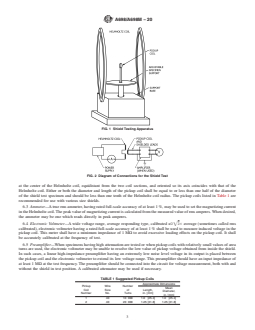
FIG. 1 Shield Testing Apparatus
FIG. 2 Diagram of Connections for the Shield Test
at the center of the Helmholtz coil, equidistant from the two coil sections, and oriented so its axis coincides with that of the
Helmholtz coil. Either or both the diameter and length of the pickup coil shall be equal to or less than one half of the diameter
of the shield test specimen and should be less than one tenth of the Helmholtz coil radius. The pickup coils listed in Table 1 are
recommended for use with various size shields.
6.3 Ammeter—A true rms ammeter, having rated full-scale accuracy of at least 1 %, may be used to set the magnetizing current
in the Helmholtz coil. The peak value of magnetizing current is calculated from the measured value of rms amperes. When desired,
the ammeter may be one which reads directly in peak amperes.
6.4 Electronic Voltmeter—A wide voltage range, average responding type, calibrated π/2 =23 average (sometimes called rms
calibrated), electronic voltmeter having a rated full-scale accuracy of at least 1 % shall be used to measure induced voltage in the
pickup coil. This meter shall have a minimum impedance of 1 MΩ to avoid excessive loading effects on the pickup coil. It shall
be accurately calibrated at the frequency of test.
6.5 Preamplifier—When specimens having high attenuation are tested or when pickup coils with relatively small values of area
turns are used, the electronic voltmeter may be unable to resolve the low value of pickup voltage obtained from inside the shield.
In such cases, a linear high-impedance preamplifier having an extremely low noise level voltage in its output is placed between
the pickup coil and the electronic voltmeter to extend its low voltage range. This preamplifier should have an input impedance of
at least 1 MΩ at the test frequency. The preamplifier should be connected into the circuit for voltage measurement, both with and
without the shield in test position. A calibrated attenuator may be used if necessary.
TABLE 1 Suggested Pickup Coils
Approximate Dime
...