

ASTM A876-17e1
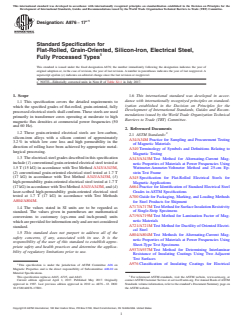
(Specification)Standard Specification for Flat-Rolled, Grain-Oriented, Silicon-Iron, Electrical Steel, Fully Processed Types
General Information
- Abstract
ABSTRACT
This specification covers the detailed requirements for specified grades of flat-rolled, grain-oriented, fully processed low-carbon silicon-iron electrical steels, whose low core loss and high permeability in the direction of rolling have been achieved by appropriate metallurgical processing. These steels are primarily used in transformer cores operating at moderate to high magnetic flux densities at commercial power frequencies. These steels may be acquired in any of four conditions a.) conventional grain-oriented tested at 15 kG (1.5 T), b.) conventional grain-oriented tested at 17 kG (1.7 T), c.) high-permeability grain-oriented tested at 17 kG (1.7 T) and d.) laser-scribed high-permeability grain-oriented tested at 17 kG (1.7 T). These steels can be purchased in a number of combinations of material form and surface type or treatment. This specification explains in detail, the available forms, thicknesses and magnetic performance.
SCOPE
1.1 This specification covers the detailed requirements to which the specified grades of flat-rolled, grain-oriented, fully processed electrical steels shall conform. These steels are used primarily in transformer cores operating at moderate to high magnetic flux densities at commercial power frequencies (50 and 60 Hz).
1.2 These grain-oriented electrical steels are low-carbon, silicon-iron alloys with a silicon content of approximately 3.2 % in which low core loss and high permeability in the direction of rolling have been achieved by appropriate metallurgical processing.
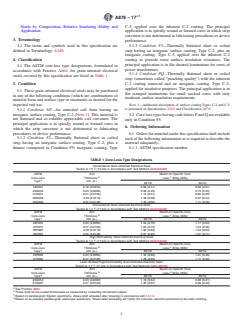
1.3 The electrical-steel grades described in this specification include (1) conventional grain-oriented electrical steel tested at 1.5 T (15 kG) in accordance with Test Method A343/A343M, (2) conventional grain-oriented electrical steel tested at 1.7 T (17 kG) in accordance with Test Method A343/A343M, (3) high-permeability grain-oriented electrical steel tested at 1.7 T (17 kG) in accordance with Test Method A343/A343M, and (4) laser-scribed high-permeability grain-oriented electrical steel tested at 1.7 T (17 kG) in accordance with Test Methods A804/A804M.
1.4 The values stated in SI units are to be regarded as standard. The values given in parentheses are mathematical conversions to customary (cgs-emu and inch-pound) units which are provided for information only and are not considered standard.
1.5 This standard does not purport to address all of the safety concerns, if any, associated with its use. It is the responsibility of the user of this standard to establish appropriate safety and health practices and determine the applicability of regulatory limitations prior to use.
1.6 This international standard was developed in accordance with internationally recognized principles on standardization established in the Decision on Principles for the Development of International Standards, Guides and Recommendations issued by the World Trade Organization Technical Barriers to Trade (TBT) Committee.
- Status
- Published
- Publication Date
- 31-Mar-2017
- Technical Committee
- A06 - Magnetic Properties
- Drafting Committee
- A06.02 - Material Specifications
Overview
ASTM A876-17e1 is the internationally recognized standard specification for flat-rolled, grain-oriented, silicon-iron electrical steel, fully processed types. Issued by ASTM International, this standard sets out the required characteristics for low-carbon, silicon-iron electrical steels, which are engineered to provide low core loss and high permeability in the direction of rolling. The prime use of these steels is in transformer cores, particularly those operating at moderate to high magnetic flux densities at commercial power frequencies (50 and 60 Hz). The specification details the available grades, physical properties, forms, and surface coatings necessary for optimal magnetic performance and fabrication.
Key Topics
- Material Composition: Electrical steels covered by ASTM A876-17e1 are low-carbon, silicon-iron alloys with an approximate silicon content of 3.2%, designed for high electromagnetic efficiency.
- Material Grades: The standard distinguishes between:
- Conventional grain-oriented electrical steel (tested at 1.5 T and 1.7 T)
- High-permeability grain-oriented electrical steel (tested at 1.7 T)
- Laser-scribed high-permeability grain-oriented electrical steel (tested at 1.7 T)
- Material Conditions and Surface Coatings: Steels may be purchased in forms such as annealed coil or thermally flattened sheets, with various inorganic coatings (Type C-2 and C-5) offering different insulation characteristics.
- Core-Loss Types and Magnetic Properties: Guarantees are specified for core loss and permeability, which are critical metrics for transformer performance. Testing is conducted per ASTM methodologies to verify conformance.
- Dimensional Standards and Workmanship: Specific tolerances for thickness, width, length, and flatness are provided, ensuring suitability for robust manufacturing and assembly processes.
- Ordering and Certification: The standard sets clear guidelines for ordering, reporting test data, and certification, supporting traceability and quality assurance.
Applications
ASTM A876-17e1 electrical steels are utilized primarily in:
- Power and Distribution Transformer Cores: Their low core loss and high permeability make these steels ideal for efficient energy transformation and minimal thermal buildup at commercial frequencies.
- Large and Small Magnetic Cores: Used in both stationary and wound core constructions, including flat sheared laminations, wound cores, formed lamination cores, and bonded or welded assemblies.
- Electrical Equipment: Applications extend to reactors, chokes, and industrial magnetic devices where performance at high flux density is required.
By conforming to this standard, manufacturers ensure that their electrical steels offer high efficiency, longevity, and reliability in critical electrical infrastructure.
Related Standards
ASTM A876-17e1 references and aligns with several other key ASTM standards to ensure thorough quality control:
- ASTM A343/A343M: Test Method for Alternating-Current Magnetic Properties of Materials
- ASTM A345: Specification for Flat-Rolled Electrical Steels for Magnetic Applications
- ASTM A664: Practice for Identification of Standard Electrical Steel Grades
- ASTM A700: Guide for Packaging, Marking, and Loading Methods for Steel Products
- ASTM A804/A804M: Test Methods for Magnetic Properties of Sheet-Type Specimens
- ASTM A340, A719/A719M, A721/A721M, A937/A937M: For terminology, lamination factor, ductility, and insulation resistance
These standards collectively establish a framework for material selection, testing, and acceptance, supporting global trade and interoperability in the electrical steel market.
Practical Value
Complying with ASTM A876-17e1 ensures that steel used in transformers and other electrical applications meets rigorous performance and quality demands. This reduces energy losses, improves durability, and supports efficient operation in utility, industrial, and commercial sectors. Manufacturers, suppliers, and end-users benefit from clear specifications, reliable test methods, and the assurance of compliance with international trade requirements and technical barriers as outlined by the World Trade Organization (WTO).
Keywords: ASTM A876, grain-oriented electrical steel, silicon-iron steel, transformer core steel, magnetic properties, low core loss, high permeability, electrical steel standard.
Relations
- Effective Date
- 01-Dec-2023
- Effective Date
- 01-Nov-2019
- Effective Date
- 15-Oct-2019
- Effective Date
- 01-Oct-2019
- Effective Date
- 15-Jun-2019
- Effective Date
- 01-Apr-2019
- Effective Date
- 01-Apr-2019
- Effective Date
- 15-Feb-2019
- Effective Date
- 01-Oct-2018
- Effective Date
- 01-Jun-2018
- Effective Date
- 15-Oct-2017
- Effective Date
- 01-Jul-2017
- Effective Date
- 01-May-2016
- Effective Date
- 01-May-2016
- Effective Date
- 01-Oct-2015
Get Certified
Connect with accredited certification bodies for this standard

Element Materials Technology
Materials testing and product certification.

Inštitut za kovinske materiale in tehnologije
Institute of Metals and Technology. Materials testing, metallurgical analysis, NDT.
Sponsored listings
Frequently Asked Questions
ASTM A876-17e1 is a technical specification published by ASTM International. Its full title is "Standard Specification for Flat-Rolled, Grain-Oriented, Silicon-Iron, Electrical Steel, Fully Processed Types". This standard covers: ABSTRACT This specification covers the detailed requirements for specified grades of flat-rolled, grain-oriented, fully processed low-carbon silicon-iron electrical steels, whose low core loss and high permeability in the direction of rolling have been achieved by appropriate metallurgical processing. These steels are primarily used in transformer cores operating at moderate to high magnetic flux densities at commercial power frequencies. These steels may be acquired in any of four conditions a.) conventional grain-oriented tested at 15 kG (1.5 T), b.) conventional grain-oriented tested at 17 kG (1.7 T), c.) high-permeability grain-oriented tested at 17 kG (1.7 T) and d.) laser-scribed high-permeability grain-oriented tested at 17 kG (1.7 T). These steels can be purchased in a number of combinations of material form and surface type or treatment. This specification explains in detail, the available forms, thicknesses and magnetic performance. SCOPE 1.1 This specification covers the detailed requirements to which the specified grades of flat-rolled, grain-oriented, fully processed electrical steels shall conform. These steels are used primarily in transformer cores operating at moderate to high magnetic flux densities at commercial power frequencies (50 and 60 Hz). 1.2 These grain-oriented electrical steels are low-carbon, silicon-iron alloys with a silicon content of approximately 3.2 % in which low core loss and high permeability in the direction of rolling have been achieved by appropriate metallurgical processing. 1.3 The electrical-steel grades described in this specification include (1) conventional grain-oriented electrical steel tested at 1.5 T (15 kG) in accordance with Test Method A343/A343M, (2) conventional grain-oriented electrical steel tested at 1.7 T (17 kG) in accordance with Test Method A343/A343M, (3) high-permeability grain-oriented electrical steel tested at 1.7 T (17 kG) in accordance with Test Method A343/A343M, and (4) laser-scribed high-permeability grain-oriented electrical steel tested at 1.7 T (17 kG) in accordance with Test Methods A804/A804M. 1.4 The values stated in SI units are to be regarded as standard. The values given in parentheses are mathematical conversions to customary (cgs-emu and inch-pound) units which are provided for information only and are not considered standard. 1.5 This standard does not purport to address all of the safety concerns, if any, associated with its use. It is the responsibility of the user of this standard to establish appropriate safety and health practices and determine the applicability of regulatory limitations prior to use. 1.6 This international standard was developed in accordance with internationally recognized principles on standardization established in the Decision on Principles for the Development of International Standards, Guides and Recommendations issued by the World Trade Organization Technical Barriers to Trade (TBT) Committee.
ABSTRACT This specification covers the detailed requirements for specified grades of flat-rolled, grain-oriented, fully processed low-carbon silicon-iron electrical steels, whose low core loss and high permeability in the direction of rolling have been achieved by appropriate metallurgical processing. These steels are primarily used in transformer cores operating at moderate to high magnetic flux densities at commercial power frequencies. These steels may be acquired in any of four conditions a.) conventional grain-oriented tested at 15 kG (1.5 T), b.) conventional grain-oriented tested at 17 kG (1.7 T), c.) high-permeability grain-oriented tested at 17 kG (1.7 T) and d.) laser-scribed high-permeability grain-oriented tested at 17 kG (1.7 T). These steels can be purchased in a number of combinations of material form and surface type or treatment. This specification explains in detail, the available forms, thicknesses and magnetic performance. SCOPE 1.1 This specification covers the detailed requirements to which the specified grades of flat-rolled, grain-oriented, fully processed electrical steels shall conform. These steels are used primarily in transformer cores operating at moderate to high magnetic flux densities at commercial power frequencies (50 and 60 Hz). 1.2 These grain-oriented electrical steels are low-carbon, silicon-iron alloys with a silicon content of approximately 3.2 % in which low core loss and high permeability in the direction of rolling have been achieved by appropriate metallurgical processing. 1.3 The electrical-steel grades described in this specification include (1) conventional grain-oriented electrical steel tested at 1.5 T (15 kG) in accordance with Test Method A343/A343M, (2) conventional grain-oriented electrical steel tested at 1.7 T (17 kG) in accordance with Test Method A343/A343M, (3) high-permeability grain-oriented electrical steel tested at 1.7 T (17 kG) in accordance with Test Method A343/A343M, and (4) laser-scribed high-permeability grain-oriented electrical steel tested at 1.7 T (17 kG) in accordance with Test Methods A804/A804M. 1.4 The values stated in SI units are to be regarded as standard. The values given in parentheses are mathematical conversions to customary (cgs-emu and inch-pound) units which are provided for information only and are not considered standard. 1.5 This standard does not purport to address all of the safety concerns, if any, associated with its use. It is the responsibility of the user of this standard to establish appropriate safety and health practices and determine the applicability of regulatory limitations prior to use. 1.6 This international standard was developed in accordance with internationally recognized principles on standardization established in the Decision on Principles for the Development of International Standards, Guides and Recommendations issued by the World Trade Organization Technical Barriers to Trade (TBT) Committee.
ASTM A876-17e1 is classified under the following ICS (International Classification for Standards) categories: 77.140.50 - Flat steel products and semi-products. The ICS classification helps identify the subject area and facilitates finding related standards.
ASTM A876-17e1 has the following relationships with other standards: It is inter standard links to ASTM A340-23a, ASTM A700-14(2019), ASTM A340-19b, ASTM A719/A719M-14(2019), ASTM A340-19a, ASTM A343/A343M-14(2019), ASTM A937/A937M-12(2019), ASTM A340-19, ASTM A976-18, ASTM A340-18, ASTM A340-17a, ASTM A340-17, ASTM A340-16e1, ASTM A340-16, ASTM A340-15. Understanding these relationships helps ensure you are using the most current and applicable version of the standard.
ASTM A876-17e1 is available in PDF format for immediate download after purchase. The document can be added to your cart and obtained through the secure checkout process. Digital delivery ensures instant access to the complete standard document.
Standards Content (Sample)
This international standard was developed in accordance with internationally recognized principles on standardization established in the Decision on Principles for the
Development of International Standards, Guides and Recommendations issued by the World Trade Organization Technical Barriers to Trade (TBT) Committee.
´1
Designation:A876 −17
Standard Specification for
Flat-Rolled, Grain-Oriented, Silicon-Iron, Electrical Steel,
Fully Processed Types
This standard is issued under the fixed designation A876; the number immediately following the designation indicates the year of
original adoption or, in the case of revision, the year of last revision.Anumber in parentheses indicates the year of last reapproval.A
superscript epsilon (´) indicates an editorial change since the last revision or reapproval.
ε NOTE—Editorially corrected units in Note B of Table X1.1 in July 2017.
1. Scope 1.6 This international standard was developed in accor-
dance with internationally recognized principles on standard-
1.1 This specification covers the detailed requirements to
ization established in the Decision on Principles for the
which the specified grades of flat-rolled, grain-oriented, fully
Development of International Standards, Guides and Recom-
processed electrical steels shall conform.These steels are used
mendations issued by the World Trade Organization Technical
primarily in transformer cores operating at moderate to high
Barriers to Trade (TBT) Committee.
magnetic flux densities at commercial power frequencies (50
and 60 Hz).
2. Referenced Documents
1.2 These grain-oriented electrical steels are low-carbon,
2.1 ASTM Standards:
silicon-iron alloys with a silicon content of approximately
A34/A34MPractice for Sampling and Procurement Testing
3.2% in which low core loss and high permeability in the
of Magnetic Materials
direction of rolling have been achieved by appropriate metal-
A340Terminology of Symbols and Definitions Relating to
lurgical processing.
Magnetic Testing
1.3 Theelectrical-steelgradesdescribedinthisspecification
A343/A343MTest Method for Alternating-Current Mag-
include(1)conventionalgrain-orientedelectricalsteeltestedat
netic Properties of Materials at Power Frequencies Using
1.5 T (15 kG) in accordance with Test Method A343/A343M,
Wattmeter-Ammeter-Voltmeter Method and 25-cm Ep-
(2) conventional grain-oriented electrical steel tested at 1.7 T
stein Test Frame
(17 kG) in accordance with Test Method A343/A343M,(3)
A345Specification for Flat-Rolled Electrical Steels for
high-permeability grain-oriented electrical steel tested at 1.7 T
Magnetic Applications
(17kG)inaccordancewithTestMethodA343/A343M,and(4)
A664Practice for Identification of Standard Electrical Steel
laser-scribed high-permeability grain-oriented electrical steel
Grades in ASTM Specifications
tested at 1.7 T (17 kG) in accordance with Test Methods
A700Guide for Packaging, Marking, and Loading Methods
A804/A804M.
for Steel Products for Shipment
A717/A717MTestMethodforSurfaceInsulationResistivity
1.4 The values stated in SI units are to be regarded as
of Single-Strip Specimens
standard. The values given in parentheses are mathematical
A719/A719MTest Method for Lamination Factor of Mag-
conversions to customary (cgs-emu and inch-pound) units
netic Materials
whichareprovidedforinformationonlyandarenotconsidered
A721/A721MTest Method for Ductility of Oriented Electri-
standard.
cal Steel
1.5 This standard does not purport to address all of the
A804/A804MTest Methods for Alternating-Current Mag-
safety concerns, if any, associated with its use. It is the
netic Properties of Materials at Power Frequencies Using
responsibility of the user of this standard to establish appro-
Sheet-Type Test Specimens
priate safety and health practices and determine the applica-
A937/A937MTest Method for Determining Interlaminar
bility of regulatory limitations prior to use.
Resistance of Insulating Coatings Using Two Adjacent
Test Surfaces
A976Classification of Insulating Coatings for Electrical
This specification is under the jurisdiction of ASTM Committee A06 on
Magnetic Properties and is the direct responsibility of Subcommittee A06.02 on
Material Specifications.
This specification replaces A665, A725, and A843. For referenced ASTM standards, visit the ASTM website, www.astm.org, or
Current edition approved April 1, 2017. Published May 2017. Originally contactASTM Customer Service at service@astm.org. ForAnnual Book ofASTM
approved in 1987. Last previous edition approved in 2012 as A876–12. DOI: Standards volume information, refer to the standard’s Document Summary page on
10.1520/A0876-17E01. the ASTM website.
Copyright © ASTM International, 100 Barr Harbor Drive, PO Box C700, West Conshohocken, PA 19428-2959. United States
´1
A876−17
Steels by Composition, Relative Insulating Ability and C-5, applied over the inherent C-2 coating. The principal
Application application is in spirally wound or formed cores in which strip
curvatureisnotdetrimentaltofabricatingproceduresordevice
3. Terminology
performance.
5.1.3 Condition F5—Thermally flattened sheet or coiled
3.1 The terms and symbols used in this specification are
strip having an inorganic surface coating, Type C-2, plus an
defined in Terminology A340.
inorganic coating, Type C-5, applied over the inherent C-2
4. Classification
coating to provide extra surface insulation resistance. The
principal application is in flat sheared laminations for cores of
4.1 The ASTM core-loss type designations, formulated in
power transformers.
accordance with Practice A664, for grain-oriented electrical
5.1.4 Condition PQ—Thermally flattened sheet or coiled
steels covered by this specification are listed in Table 1.
strip (sometimes called “punching quality”) with the inherent
C-2 coating removed and an inorganic coating, Type C-5,
5. Condition
applied for insulative purposes. The principal application is in
5.1 These grain-oriented electrical steels may be purchased
flat stamped laminations for small stacked cores with only
in any of the following conditions (which are combinations of
moderate surface insulation requirements.
material form and surface type or treatment) as desired for the
expected end use. NOTE 1—Additional description of surface coating Types C-2 and C-5
is presented in Specification A345 and Classification A976.
5.1.1 Condition NF—An annealed coil form having an
inorganic surface coating, Type C-2 (Note 1). This material is
5.2 Core-losstypeshavingcodelettersPandQareavailable
not flattened and so exhibits appreciable coil curvature. The
only in Condition F5.
principal application is in spirally wound or formed cores in
6. Ordering Information
which the strip curvature is not detrimental to fabricating
procedures or device performance. 6.1 Ordersformaterialunderthisspecificationshallinclude
5.1.2 Condition F2—Thermally flattened sheet or coiled suchofthefollowinginformationasisrequiredtodescribethe
strip having an inorganic surface coating, Type C-2, plus a material adequately:
thinner (compared to Condition F5) inorganic coating, Type 6.1.1 ASTM specification number,
TABLE 1 Core-Loss Type Designations
Conventional Grain-Oriented Electrical Steel
Tested at 1.5 T (15 kG) in Accordance with Test Method A343/A343M
ASTM Aim Maximum Specific Core
B C
Core-Loss Thickness, Loss, W/kg (W/lb)
A
mm (in.)
Type
60 Hz 50 Hz
18G041 0.18 (0.0070) 0.90 (0.41) 0.68 (0.31)
23G045 0.23 (0.0090) 0.99 (0.45) 0.75 (0.34)
27G051 0.27 (0.0106) 1.12 (0.51) 0.85 (0.39)
30G058 0.30 (0.0118) 1.28 (0.58) 0.97 (0.44)
35G066 0.35 (0.0138) 1.46 (0.66) 1.11 (0.50)
Conventional Grain-Oriented Electrical Steel
Tested at 1.7 T (17 kG) in Accordance with Test Method A343/A343M
ASTM Aim Maximum Specific Core
B C
Core-Loss Thickness, Loss, W/kg (W/lb)
A
mm (in.)
Type
60 Hz 50 Hz
23H070 0.23 (0.0090) 1.54 (0.70) 1.17 (0.53)
27H074 0.27 (0.0106) 1.63 (0.74) 1.24 (0.56)
30H083 0.30 (0.0118) 1.83 (0.83) 1.39 (0.63)
35H094 0.35 (0.0138) 2.07 (0.94) 1.57 (0.71)
High-Permeability Grain-Oriented Electrical Steel
Tested at 1.7 T (17 kG) in Accordance with Test Method A343/A343M
ASTM Aim Maximum Specific Core
B C
Core-Loss Thickness, Loss, W/kg (W/lb)
A
mm (in.)
Type
60 Hz 50 Hz
23P060 0.23 (0.0090) 1.32 (0.60) 1.01 (0.46)
27P066 0.27 (0.0106) 1.46 (0.66) 1.11 (0.50)
Laser-Scribed High-Permeability Grain-Oriented Electrical Steel
Tested at 1.7 T (17 kG) in Accordance with Test Methods A804/A804M
ASTM Aim Maximum Specific Core
B D
Core-Loss Thickness, Loss, W/kg (W/lb)
A
mm (in.)
Type 60 Hz 50 Hz
23Q054 0.23 (0.0090) 1.19 (0.54) 0.90 (0.41)
27Q057 0.27 (0.0106) 1.26 (0.57) 0.96 (0.43)
A
See Practice A664.
B
These shall be the overall thicknesses as measured by contacting micrometre caliper.
C
Based on parallel-grain Epstein specimens, stress-relief annealed after shearing in accordance with 14.1.2.
D
Based on as-sheared parallel-grain sheet-type specimens. Stress-relief annealing will nullify the core-loss reduction produced by the laser scribing.
´1
A876−17
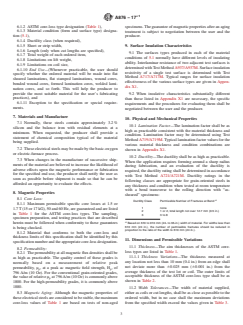
6.1.2 ASTM core-loss type designation (Table 1), specimens.Theguaranteeofmagneticpropertiesafteranaging
6.1.3 Material condition (form and surface type) designa- treatment is subject to negotiation between the user and the
tion (5.1), producer.
6.1.4 Ductility class (when required),
6.1.5 Sheet or strip width,
9. Surface Insulation Characteristics
6.1.6 Length (only when cut lengths are specified),
9.1 The surfaces types produced in each of the material
6.1.7 Total weight of each ordered item,
conditions of 5.1 normally have different levels of insulating
6.1.8 Limitations on lift weight,
ability. Interlaminar resistance of two adjacent test surfaces is
6.1.9 Limitations on coil size,
determinedwithTestMethodA937/A937M.Surfaceinsulation
6.1.10 End Use—(Whenever practicable, the user should
resistivity of a single test surface is determined with Test
specify whether the ordered material will be made into flat
Method A717/A717M. Typical ranges for surface insulation
sheared laminations, flat stamped laminations, wound cores,
effectiveness of the various surface types are given in Appen-
bonded wound cores, formed lamination cores, welded lami-
dix X1.
nation cores, and so forth. This will help the producer to
provide the most suitable material for the user’s fabricating
9.2 When insulative characteristics substantially different
practices), and
than those listed in Appendix X1 are necessary, the specific
6.1.11 Exception to the specification or special require-
requirements and the procedures for evaluating them shall be
ments.
negotiated between the user and the producer.
7. Materials and Manufacture
10. Physical and Mechanical Properties
7.1 Normally, these steels contain approximately 3.2%
10.1 Lamination Factor—The lamination factor shall be as
silicon and the balance iron with residual elements at a
high as practicable consistent with the material thickness and
minimum. When requested, the producer shall provide a
condition. Lamination factor may be determined using Test
statement of chemical composition typical of the material
MethodA719/A719M.Typicallaminationfactorvaluesforthe
being supplied.
various material thickness and condition combinations are
7.2 Theseelectricalsteelsmaybemadebythebasic-oxygen
shown in Appendix X1.
or electric-furnace process.
10.2 Ductility—Theductilityshallbeashighaspracticable.
7.3 When changes in the manufacture of successive ship-
When the application requires forming around a sharp radius
ments of the material are believed to increase the likelihood of
during fabrication, and an evaluation of the ductility is
adverse effects upon the magnetic performance or fabrication
required, the ductility rating shall be determined in accordance
for the specified end use, the producer shall notify the user as
with Test Method A721/A721M. Ductility ratings in the
soon as possible before shipment is made so that he can be
following classes are appropriate for grain-oriented steels in
afforded an opportunity to evaluate the effects.
any thickness and condition when tested at room temperature
with a bend transverse to the rolling direction with “as-
8. Magnetic Properties
sheared” specimens:
8.1 Core Loss:
A
Ductility Class Permissible Number of Fractures at Bend
8.1.1 Maximum permissible specific core losses at 1.5 or
1 none
1.7T(15or17kG),50and60Hz,areguaranteedandarelisted
2 1 or 2, total length not over 12.7 mm (0.5 in.)
in Table 1 for the ASTM core-loss types. The sampling,
3 3 to 8
specimen preparation, and testing practices that are described
A
herein must be followed when conformity to these guarantees
Based on 610 to 910 mm (24- to 36-in.) width
...