

ASTM A867-19
(Specification)Standard Specification for Iron-Silicon Relay Steels
General Information
- Abstract
ABSTRACT
This specification covers wrought iron-silicon (Fe-Si) relay steels that are generally used in the manufacture of electromechanical devices, such as relays and solenoids, requiring higher electrical resistivity, higher permeability, and lower coercivity and residual magnetism than provided by either carbon steels or soft magnetic low-carbon irons. Available forms and conditions are forging billet, hot-rolled product, cold-finished bars, strip, and wire. These steels are not the same as the flat-rolled non-oriented or grain oriented iron-silicon electrical steels covered by ASTM Specifications A 677, A 683 and A 876. The steels covered in this specification have nominal silicon contents of 1.1, 2.3 and 4.0 % Si. Both the 1.1 and 2.3 % Si types are also available in an enhanced machinability composition. Along with chemical composition, steels produced to this specification must meet a specified maximum value of coercive field strength when heat treated according to this specification. Appendices are given containing typical magnetic, physical and mechanical properties and heat treatment.
SCOPE
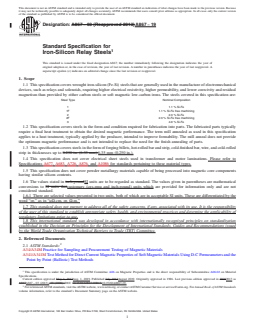
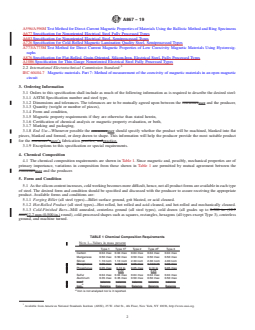
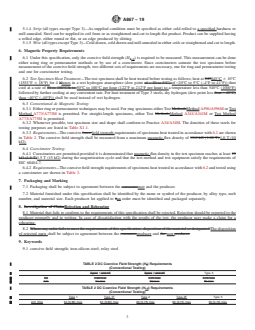
1.1 This specification covers wrought iron-silicon (Fe-Si) steels that are generally used in the manufacture of electromechanical devices, such as relays and solenoids, requiring higher electrical resistivity, higher permeability, and lower coercivity and residual magnetism than provided by either carbon steels or soft magnetic low-carbon irons. The steels covered in this specification are:
Steel Type
Nominal Composition
1
1.1 % Si-Fe
1F
1.1 % Si-Fe free machining
2
2.3 % Si-Fe
2F
2.3 % Si-Fe free machining
3
4.0 % Si-Fe
1.2 This specification covers steels in the form and condition required for fabrication into parts. The fabricated parts typically require a final heat treatment to obtain the desired magnetic performance. The term mill annealed as used in this specification applies to a heat treatment, typically applied by the producer, intended to improve formability. The mill anneal does not provide the optimum magnetic performance and is not intended to replace the need for the finish annealing of parts.
1.3 This specification covers steels in the form of forging billets, hot-rolled bar and strip, cold-finished bar, wire, and cold-rolled strip in thicknesses up to 6.35 mm (0.250 in.).
1.4 This specification does not cover electrical sheet steels used in transformer and motor laminations. Please refer to Specifications A677, A683, A726, A876, and A1086 for standards pertaining to these material types.
1.5 This specification does not cover powder metallurgy materials capable of being processed into magnetic core components having similar silicon contents.
1.6 The values stated in SI units are to be regarded as standard. The values given in parentheses are mathematical conversions to customary (cgs-emu and inch-pound) units which are provided for information only and are not considered standard.
1.6.1 There are selected values presented in two units, both of which are in acceptable SI units. These are differentiated by the word “or,” as in “μΩ-cm, or, Ω-m.”
1.7 This standard does not purport to address all of the safety concerns, if any, associated with its use. It is the responsibility of the user of this standard to establish appropriate safety, health, and environmental practices and determine the applicability of regulatory limitations prior to use.
1.8 This international standard was developed in accordance with internationally recognized principles on standardization established in the Decision on Principles for the Development of International Standards, Guides and Recommendations issued by the World Trade Organization Technical Barriers to Trade (TBT) Committee.
- Status
- Published
- Publication Date
- 31-Jul-2019
- Technical Committee
- A06 - Magnetic Properties
- Drafting Committee
- A06.02 - Material Specifications
Overview
ASTM A867-19: Standard Specification for Iron-Silicon Relay Steels provides comprehensive requirements for wrought iron-silicon (Fe-Si) steels. These materials are primarily used in electromechanical devices, such as relays and solenoids, where enhanced magnetic properties are required. Compared to carbon steels or soft magnetic low-carbon irons, iron-silicon relay steels offer higher electrical resistivity, higher magnetic permeability, and lower coercivity and residual magnetism.
This specification outlines the chemical composition, forms, and conditions of delivery for iron-silicon relay steels, emphasizing their suitability for applications that demand precision magnetic performance. ASTM A867-19 distinguishes these steels from flat-rolled electrical steels used in transformer and motor laminations, which are covered under other ASTM standards.
Key Topics
Material Types and Composition
- Covers five types of Fe-Si steels with nominal silicon contents of 1.1%, 2.3%, and 4.0%
- Types 1 and 2 also available in enhanced machinability grades (1F, 2F)
- Key elements: low carbon, controlled amounts of manganese, phosphorus, sulfur, and aluminum
Product Forms and Conditions
- Supplied as forging billets, hot-rolled bar and strip, cold-finished bar, wire, and cold-rolled strip (up to 6.35 mm thickness)
- Condition options include mill annealed, cold finished, and cut-to-length as needed for fabrication
Magnetic Properties
- Focus on achieving specific maximum coercive field strength when correctly heat treated
- Only coercive field strength is mandatory to measure; different test methods allowed, including ring, permeameter, and coercimeter approaches
Heat Treatment and Fabrication
- Final magnetic performance requires a dedicated, post-fabrication heat treatment
- Mill annealing improves formability but does not substitute for finish annealing necessary for optimal magnetic properties
Packaging and Certification
- Traceability ensured through marking by alloy type, melt number, and size
- Certification of chemical analysis or magnetic property evaluation available as required by the purchaser
Applications
ASTM A867-19 iron-silicon relay steels are ideal for manufacturers and designers of electromechanical components where precise control over magnetic properties is essential. Primary application areas include:
- Relays and solenoids: Enhanced magnetic switch performance due to low residual magnetism and high permeability
- Electromagnetic actuators: Improved efficiency and reliability from higher electrical resistivity
- Sensors and small transformers: Where specific magnetic response and minimal energy loss are critical
Due to their tailored properties, these steels enable device miniaturization, increased efficiency, and improved sensitivity in modern electrical assemblies. The availability of machinability-enhanced variants further aids manufacturing throughput.
Related Standards
ASTM A867-19 defines requirements distinct from several related material standards. Commonly referenced standards for users working with magnetic or electrical steels include:
- ASTM A677: Nonoriented electrical steel, fully processed types
- ASTM A683: Nonoriented electrical steel, semiprocessed types
- ASTM A726: Cold-rolled magnetic lamination quality steel, semiprocessed types
- ASTM A876: Flat-rolled, grain-oriented, silicon-iron, electrical steel
- ASTM A1086: Thin-gauge nonoriented electrical steel, fully processed types
- IEC 60404-7: Coercivity measurement for magnetic materials
Selecting the correct standard ensures that the material’s performance aligns with the intended electromechanical or electronic application.
Keywords: ASTM A867-19, iron-silicon relay steel, Fe-Si steel, electromechanical device material, magnetic steel specification, high permeability steel, coercive field strength, magnetic properties, relay steel applications, ASTM magnetic standards
Relations
- Refers
ASTM A683-16(2023) - Standard Specification for Nonoriented Electrical Steel, Semiprocessed Types - Effective Date
- 01-Dec-2023
- Refers
ASTM A677-16(2023) - Standard Specification for Nonoriented Electrical Steel Fully Processed Types - Effective Date
- 01-Dec-2023
- Effective Date
- 01-Apr-2017
- Effective Date
- 01-Aug-2013
- Effective Date
- 01-Nov-2012
- Effective Date
- 01-Nov-2012
- Effective Date
- 01-Nov-2012
- Effective Date
- 01-Oct-2011
- Effective Date
- 01-Oct-2011
- Effective Date
- 01-Nov-2010
- Refers
ASTM A683-05(2010) - Standard Specification for Nonoriented Electrical Steel, Semiprocessed Types - Effective Date
- 01-Nov-2010
- Effective Date
- 01-Nov-2009
- Effective Date
- 01-May-2009
- Effective Date
- 01-May-2009
- Effective Date
- 01-May-2009
Get Certified
Connect with accredited certification bodies for this standard

Element Materials Technology
Materials testing and product certification.

Inštitut za kovinske materiale in tehnologije
Institute of Metals and Technology. Materials testing, metallurgical analysis, NDT.
Sponsored listings
Frequently Asked Questions
ASTM A867-19 is a technical specification published by ASTM International. Its full title is "Standard Specification for Iron-Silicon Relay Steels". This standard covers: ABSTRACT This specification covers wrought iron-silicon (Fe-Si) relay steels that are generally used in the manufacture of electromechanical devices, such as relays and solenoids, requiring higher electrical resistivity, higher permeability, and lower coercivity and residual magnetism than provided by either carbon steels or soft magnetic low-carbon irons. Available forms and conditions are forging billet, hot-rolled product, cold-finished bars, strip, and wire. These steels are not the same as the flat-rolled non-oriented or grain oriented iron-silicon electrical steels covered by ASTM Specifications A 677, A 683 and A 876. The steels covered in this specification have nominal silicon contents of 1.1, 2.3 and 4.0 % Si. Both the 1.1 and 2.3 % Si types are also available in an enhanced machinability composition. Along with chemical composition, steels produced to this specification must meet a specified maximum value of coercive field strength when heat treated according to this specification. Appendices are given containing typical magnetic, physical and mechanical properties and heat treatment. SCOPE 1.1 This specification covers wrought iron-silicon (Fe-Si) steels that are generally used in the manufacture of electromechanical devices, such as relays and solenoids, requiring higher electrical resistivity, higher permeability, and lower coercivity and residual magnetism than provided by either carbon steels or soft magnetic low-carbon irons. The steels covered in this specification are: Steel Type Nominal Composition 1 1.1 % Si-Fe 1F 1.1 % Si-Fe free machining 2 2.3 % Si-Fe 2F 2.3 % Si-Fe free machining 3 4.0 % Si-Fe 1.2 This specification covers steels in the form and condition required for fabrication into parts. The fabricated parts typically require a final heat treatment to obtain the desired magnetic performance. The term mill annealed as used in this specification applies to a heat treatment, typically applied by the producer, intended to improve formability. The mill anneal does not provide the optimum magnetic performance and is not intended to replace the need for the finish annealing of parts. 1.3 This specification covers steels in the form of forging billets, hot-rolled bar and strip, cold-finished bar, wire, and cold-rolled strip in thicknesses up to 6.35 mm (0.250 in.). 1.4 This specification does not cover electrical sheet steels used in transformer and motor laminations. Please refer to Specifications A677, A683, A726, A876, and A1086 for standards pertaining to these material types. 1.5 This specification does not cover powder metallurgy materials capable of being processed into magnetic core components having similar silicon contents. 1.6 The values stated in SI units are to be regarded as standard. The values given in parentheses are mathematical conversions to customary (cgs-emu and inch-pound) units which are provided for information only and are not considered standard. 1.6.1 There are selected values presented in two units, both of which are in acceptable SI units. These are differentiated by the word “or,” as in “μΩ-cm, or, Ω-m.” 1.7 This standard does not purport to address all of the safety concerns, if any, associated with its use. It is the responsibility of the user of this standard to establish appropriate safety, health, and environmental practices and determine the applicability of regulatory limitations prior to use. 1.8 This international standard was developed in accordance with internationally recognized principles on standardization established in the Decision on Principles for the Development of International Standards, Guides and Recommendations issued by the World Trade Organization Technical Barriers to Trade (TBT) Committee.
ABSTRACT This specification covers wrought iron-silicon (Fe-Si) relay steels that are generally used in the manufacture of electromechanical devices, such as relays and solenoids, requiring higher electrical resistivity, higher permeability, and lower coercivity and residual magnetism than provided by either carbon steels or soft magnetic low-carbon irons. Available forms and conditions are forging billet, hot-rolled product, cold-finished bars, strip, and wire. These steels are not the same as the flat-rolled non-oriented or grain oriented iron-silicon electrical steels covered by ASTM Specifications A 677, A 683 and A 876. The steels covered in this specification have nominal silicon contents of 1.1, 2.3 and 4.0 % Si. Both the 1.1 and 2.3 % Si types are also available in an enhanced machinability composition. Along with chemical composition, steels produced to this specification must meet a specified maximum value of coercive field strength when heat treated according to this specification. Appendices are given containing typical magnetic, physical and mechanical properties and heat treatment. SCOPE 1.1 This specification covers wrought iron-silicon (Fe-Si) steels that are generally used in the manufacture of electromechanical devices, such as relays and solenoids, requiring higher electrical resistivity, higher permeability, and lower coercivity and residual magnetism than provided by either carbon steels or soft magnetic low-carbon irons. The steels covered in this specification are: Steel Type Nominal Composition 1 1.1 % Si-Fe 1F 1.1 % Si-Fe free machining 2 2.3 % Si-Fe 2F 2.3 % Si-Fe free machining 3 4.0 % Si-Fe 1.2 This specification covers steels in the form and condition required for fabrication into parts. The fabricated parts typically require a final heat treatment to obtain the desired magnetic performance. The term mill annealed as used in this specification applies to a heat treatment, typically applied by the producer, intended to improve formability. The mill anneal does not provide the optimum magnetic performance and is not intended to replace the need for the finish annealing of parts. 1.3 This specification covers steels in the form of forging billets, hot-rolled bar and strip, cold-finished bar, wire, and cold-rolled strip in thicknesses up to 6.35 mm (0.250 in.). 1.4 This specification does not cover electrical sheet steels used in transformer and motor laminations. Please refer to Specifications A677, A683, A726, A876, and A1086 for standards pertaining to these material types. 1.5 This specification does not cover powder metallurgy materials capable of being processed into magnetic core components having similar silicon contents. 1.6 The values stated in SI units are to be regarded as standard. The values given in parentheses are mathematical conversions to customary (cgs-emu and inch-pound) units which are provided for information only and are not considered standard. 1.6.1 There are selected values presented in two units, both of which are in acceptable SI units. These are differentiated by the word “or,” as in “μΩ-cm, or, Ω-m.” 1.7 This standard does not purport to address all of the safety concerns, if any, associated with its use. It is the responsibility of the user of this standard to establish appropriate safety, health, and environmental practices and determine the applicability of regulatory limitations prior to use. 1.8 This international standard was developed in accordance with internationally recognized principles on standardization established in the Decision on Principles for the Development of International Standards, Guides and Recommendations issued by the World Trade Organization Technical Barriers to Trade (TBT) Committee.
ASTM A867-19 is classified under the following ICS (International Classification for Standards) categories: 77.140.50 - Flat steel products and semi-products. The ICS classification helps identify the subject area and facilitates finding related standards.
ASTM A867-19 has the following relationships with other standards: It is inter standard links to ASTM A683-16(2023), ASTM A677-16(2023), ASTM A876-17, ASTM A1086-13, ASTM A876-12, ASTM A677-12, ASTM A34/A34M-06(2012), ASTM A341/A341M-00(2011), ASTM A341/A341M-00(2011)e1, ASTM A726-05(2010), ASTM A683-05(2010), ASTM A596/A596M-95(2009)e1, ASTM A876-09e1, ASTM A876-09, ASTM A773/A773M-01(2009). Understanding these relationships helps ensure you are using the most current and applicable version of the standard.
ASTM A867-19 is available in PDF format for immediate download after purchase. The document can be added to your cart and obtained through the secure checkout process. Digital delivery ensures instant access to the complete standard document.
Standards Content (Sample)
This international standard was developed in accordance with internationally recognized principles on standardization established in the Decision on Principles for the
Development of International Standards, Guides and Recommendations issued by the World Trade Organization Technical Barriers to Trade (TBT) Committee.
Designation:A867 −19
Standard Specification for
Iron-Silicon Relay Steels
This standard is issued under the fixed designation A867; the number immediately following the designation indicates the year of
original adoption or, in the case of revision, the year of last revision.Anumber in parentheses indicates the year of last reapproval.A
superscript epsilon (´) indicates an editorial change since the last revision or reapproval.
1. Scope 1.6.1 There are selected values presented in two units, both
of which are in acceptable SI units.These are differentiated by
1.1 This specification covers wrought iron-silicon (Fe-Si)
the word “or,” as in “µΩ-cm, or,Ω-m.”
steels that are generally used in the manufacture of electrome-
1.7 This standard does not purport to address all of the
chanicaldevices,suchasrelaysandsolenoids,requiringhigher
safety concerns, if any, associated with its use. It is the
electrical resistivity, higher permeability, and lower coercivity
responsibility of the user of this standard to establish appro-
and residual magnetism than provided by either carbon steels
priate safety, health, and environmental practices and deter-
or soft magnetic low-carbon irons. The steels covered in this
mine the applicability of regulatory limitations prior to use.
specification are:
1.8 This international standard was developed in accor-
Steel Type Nominal Composition
dance with internationally recognized principles on standard-
1 1.1 % Si-Fe
ization established in the Decision on Principles for the
1F 1.1 % Si-Fe free machining
Development of International Standards, Guides and Recom-
2 2.3 % Si-Fe
2F 2.3 % Si-Fe free machining
mendations issued by the World Trade Organization Technical
3 4.0 % Si-Fe
Barriers to Trade (TBT) Committee.
1.2 This specification covers steels in the form and condi-
tion required for fabrication into parts. The fabricated parts
2. Referenced Documents
typically require a final heat treatment to obtain the desired
2.1 ASTM Standards:
magnetic performance. The term mill annealed as used in this
A34/A34MPractice for Sampling and Procurement Testing
specification applies to a heat treatment, typically applied by
of Magnetic Materials
the producer, intended to improve formability.The mill anneal
A341/A341MTest Method for Direct Current Magnetic
doesnotprovidetheoptimummagneticperformanceandisnot
Properties of Soft Magnetic Materials Using D-C Per-
intended to replace the need for the finish annealing of parts.
meametersandthePointbyPoint(Ballistic)TestMethods
1.3 This specification covers steels in the form of forging
A596/A596MTest Method for Direct-Current Magnetic
billets, hot-rolled bar and strip, cold-finished bar, wire, and
Properties of Materials Using the Ballistic Method and
cold-rolled strip in thicknesses up to 6.35 mm (0.250 in.).
Ring Specimens
A677Specification for Nonoriented Electrical Steel Fully
1.4 This specification does not cover electrical sheet steels
Processed Types
used in transformer and motor laminations. Please refer to
A683Specification for Nonoriented Electrical Steel, Semi-
Specifications A677, A683, A726, A876, and A1086 for
processed Types
standards pertaining to these material types.
A726Specification for Cold-Rolled Magnetic Lamination
1.5 This specification does not cover powder metallurgy
Quality Steel, Semiprocessed Types
materials capable of being processed into magnetic core
A773/A773MTest Method for Direct Current Magnetic
components having similar silicon contents.
Properties of Low Coercivity Magnetic Materials Using
1.6 The values stated in SI units are to be regarded as
Hysteresigraphs
standard. The values given in parentheses are mathematical
A876Specification for Flat-Rolled, Grain-Oriented, Silicon-
conversions to customary (cgs-emu and inch-pound) units
Iron, Electrical Steel, Fully Processed Types
whichareprovidedforinformationonlyandarenotconsidered
A1086Specification for Thin-Gauge Nonoriented Electrical
standard.
Steel Fully Processed Types
This specification is under the jurisdiction of ASTM Committee A06 on
Magnetic Properties and is the direct responsibility of Subcommittee A06.02 on
Material Specifications. For referenced ASTM standards, visit the ASTM website, www.astm.org, or
Current edition approved Aug. 1, 2019. Published August 2019. Originally contact ASTM Customer Service at service@astm.org. For Annual Book of ASTM
approved in 1986. Last previous edition approved in 2013 as A867–03 (2013). Standards volume information, refer to the standard’s Document Summary page on
DOI: 10.1520/A0867-19. the ASTM website.
Copyright © ASTM International, 100 Barr Harbor Drive, PO Box C700, West Conshohocken, PA 19428-2959. United States
A867−19
2.2 International Electrotechnical Commission Standard: 5.1.2 Hot-Rolled Product (all steel types)—Hot rolled, hot
IEC 60404-7 Magnetic materials. Part 7: Method of rolled and acid cleaned, and hot-rolled and mechanically
measurementofthecoercivityofmagneticmaterialsinan cleaned.
open magnetic circuit
5.1.3 Cold-FinishedBars—Millannealed,centerlessground
(all steel types), cold drawn (all grades up to 12.7 mm (0.500
3. Ordering Information
in.) round), cold-processed shapes such as squares, rectangles,
hexagons (all types except Type 3), centerless ground, and
3.1 Orders to this specification shall include as much of the
following information as is required to describe the desired machine turned.
steel: 5.1.4 Strip(alltypesexceptType3)—As-suppliedcondition
3.1.1 ASTM Specification number and steel type, must be specified as either cold rolled to a specified hardness
3.1.2 Dimensions and tolerances. The tolerances are to be
or mill annealed. Steel can be supplied in coil form or as
mutually agreed upon between the user and the producer, straightened and cut to length flat product. Product can be
3.1.3 Quantity (weight or number of pieces),
supplied having a rolled edge, either round or flat, or an edge
3.1.4 Form and condition, produced by slitting.
3.1.5 Magnetic property requirements if they are otherwise
5.1.5 Wire (all types except Type 3)—Cold drawn, cold
than stated herein,
drawn and mill annealed in either coils or straightened and cut
3.1.6 Certification of chemical analysis or magnetic prop-
to length.
erty evaluation, or both,
3.1.7 Marking and packaging,
6. Magnetic Property Requirements
3.1.8 End Use—Whenever possible the user should specify
6.1 Under this specification, only the coercive field strength
whethertheproductwillbemachined,blankedintoflatpieces,
(H ) is required to be measured. This measurement can be
cB
blanked and formed, or deep drawn to shape.This information
done either using ring or permeameter methods or by use of a
willhelptheproducerprovidethemostsuitableproductforthe
coercimeter. Since coercimeters saturate the test specimen
user’s fabrication practice.
before measurement of the coercive field strength, two differ-
3.1.9 Exceptions to this specification or special require-
ent sets of requirements are necessary, one for ring and
ments.
permeameter testing and one for coercimeter testing.
4. Chemical Composition
6.2 Test Specimen Heat Treatment—The test specimen shall
beheattreatedbeforetestingasfollows;heatat845°C 610°C
4.1 The chemical composition requirements are shown in
(1553°F 6 18°F) for 4 hours in a wet hydrogen atmosphere
Table 1. Since magnetic and, possibly, mechanical properties
(dew point of−20°C to 5°C (–4°F to 41°F)) then cool at a rate
are of primary importance, variations in composition from
of 50°C to 100°C per hour (122°F to 212°F per hour) to a
those shown in Table 1 are permitted by mutual agreement
temperature less than 540°C (1000°F) followed by further
between the user and the producer.
cooling at any convenient rate. For heat treatment of Type 3
5. Form and Condition
steels, dry hydrogen (dew point less than−40°C (–40°F)) shall
be used instead of wet hydrogen.
5.1 As the silicon content increases, cold working becomes
more difficult, hence, not all product forms are available in
6.3 Conventional dc Magnetic Testing:
each type of steel. The desired form and condition should be
6.3.1 Either ring or permeameter techn
...
This document is not an ASTM standard and is intended only to provide the user of an ASTM standard an indication of what changes have been made to the previous version. Because
it may not be technically possible to adequately depict all changes accurately, ASTM recommends that users consult prior editions as appropriate. In all cases only the current version
of the standard as published by ASTM is to be considered the official document.
Designation: A867 − 03 (Reapproved 2013) A867 − 19
Standard Specification for
Iron-Silicon Relay Steels
This standard is issued under the fixed designation A867; the number immediately following the designation indicates the year of
original adoption or, in the case of revision, the year of last revision. A number in parentheses indicates the year of last reapproval. A
superscript epsilon (´) indicates an editorial change since the last revision or reapproval.
1. Scope
1.1 This specification covers wrought iron-silicon (Fe-Si) steels that are generally used in the manufacture of electromechanical
devices, such as relays and solenoids, requiring higher electrical resistivity, higher permeability, and lower coercivity and residual
magnetism than provided by either carbon steels or soft magnetic low-carbon irons. The steels covered in this specification are:
Steel Type Nominal Composition
1 1.1 % Si-Fe
1F 1.1 % Si-Fe free machining
2 2.3 % Si-Fe
2F 2.3 % Si-Fe free machining
3 4.0 % Si-Fe
1.2 This specification covers steels in the form and condition required for fabrication into parts. The fabricated parts typically
require a final heat treatment to obtain the desired magnetic performance. The term mill annealed as used in this specification
applies to a heat treatment, typically applied by the producer, intended to improve formability. The mill anneal does not provide
the optimum magnetic performance and is not intended to replace the need for the finish annealing of parts.
1.3 This specification covers steels in the form of forging billets, hot-rolled bar and strip, cold-finished bar, wire, and cold-rolled
strip in thicknesses up to 0.250 in. (6.35 mm).6.35 mm (0.250 in.).
1.4 This specification does not cover electrical sheet steels used in transformer and motor laminations. Please refer to
Specifications A677, A683, A726, A876, and A1086 for standards pertaining to these material types.
1.5 This specification does not cover powder metallurgy materials capable of being processed into magnetic core components
having similar silicon contents.
1.6 The values stated in inch-poundSI units are to be regarded as standard. The values given in parentheses are mathematical
conversions to SI units thatcustomary (cgs-emu and inch-pound) units which are provided for information only and are not
considered standard.
1.6.1 There are selected values presented in two units, both of which are in acceptable SI units. These are differentiated by the
word “or,” as in “μΩ-cm, or, Ω-m.”
1.7 This standard does not purport to address all of the safety concerns, if any, associated with its use. It is the responsibility
of the user of this standard to establish appropriate safety, health, and environmental practices and determine the applicability of
regulatory limitations prior to use.
1.8 This international standard was developed in accordance with internationally recognized principles on standardization
established in the Decision on Principles for the Development of International Standards, Guides and Recommendations issued
by the World Trade Organization Technical Barriers to Trade (TBT) Committee.
2. Referenced Documents
2.1 ASTM Standards:
A34/A34M Practice for Sampling and Procurement Testing of Magnetic Materials
A341/A341M Test Method for Direct Current Magnetic Properties of Soft Magnetic Materials Using D-C Permeameters and the
Point by Point (Ballistic) Test Methods
This specification is under the jurisdiction of ASTM Committee A06 on Magnetic Properties and is the direct responsibility of Subcommittee A06.02 on Material
Specifications.
Current edition approved May 1, 2013Aug. 1, 2019. Published July 2013August 2019. Originally approved in 1986. Last previous edition approved in 20082013 as
A867A867 – 03 (2013).–03 (2008). DOI: 10.1520/A0867-03R13.10.1520/A0867-19.
For referenced ASTM standards, visit the ASTM website, www.astm.org, or contact ASTM Customer Service at service@astm.org. For Annual Book of ASTM Standards
volume information, refer to the standard’s Document Summary page on the ASTM website.
Copyright © ASTM International, 100 Barr Harbor Drive, PO Box C700, West Conshohocken, PA 19428-2959. United States
A867 − 19
A596/A596M Test Method for Direct-Current Magnetic Properties of Materials Using the Ballistic Method and Ring Specimens
A677 Specification for Nonoriented Electrical Steel Fully Processed Types
A683 Specification for Nonoriented Electrical Steel, Semiprocessed Types
A726 Specification for Cold-Rolled Magnetic Lamination Quality Steel, Semiprocessed Types
A773/A773M Test Method for Direct Current Magnetic Properties of Low Coercivity Magnetic Materials Using Hysteresig-
raphs
A876 Specification for Flat-Rolled, Grain-Oriented, Silicon-Iron, Electrical Steel, Fully Processed Types
A1086 Specification for Thin-Gauge Nonoriented Electrical Steel Fully Processed Types
2.2 International Electrotechnical Commission Standard:
IEC 60404-7 Magnetic materials. Part 7: Method of measurement of the coercivity of magnetic materials in an open magnetic
circuit
3. Ordering Information
3.1 Orders to this specification shall include as much of the following information as is required to describe the desired steel:
3.1.1 ASTM Specification number and steel type,
3.1.2 Dimensions and tolerances. The tolerances are to be mutually agreed upon between the consumeruser and the producer,
3.1.3 Quantity (weight or number of pieces),
3.1.4 Form and condition,
3.1.5 Magnetic property requirements if they are otherwise than stated herein,
3.1.6 Certification of chemical analysis or magnetic property evaluation, or both,
3.1.7 Marking and packaging,
3.1.8 End Use—Whenever possible the consumeruser should specify whether the product will be machined, blanked into flat
pieces, blanked and formed, or deep drawn to shape. This information will help the producer provide the most suitable product
for the consumer’suser’s fabrication practice, andpractice.
3.1.9 Exceptions to this specification or special requirements.
4. Chemical Composition
4.1 The chemical composition requirements are shown in Table 1. Since magnetic and, possibly, mechanical properties are of
primary importance, variations in composition from those shown in Table 1 are permitted by mutual agreement between the
consumeruser and the producer.
5. Form and Condition
5.1 As the silicon content increases, cold working becomes more difficult, hence, not all product forms are available in each type
of steel. The desired form and condition should be specified and discussed with the producer to assure receiving the appropriate
product. Available forms and conditions are:
5.1.1 Forging Billet (all steel types)—Billet surface ground, grit blasted, or acid cleaned.
5.1.2 Hot-Rolled Product (all steel types)—Hot rolled, hot rolled and acid cleaned, and hot-rolled and mechanically cleaned.
5.1.3 Cold-Finished Bars—Mill annealed, centerless ground (all steel types), cold drawn (all grades up to 0.500 in. (12.7
mm)12.7 mm (0.500 in.) round), cold-processed shapes such as squares, rectangles, hexagons (all types except Type 3), centerless
ground, and machine turned.
TABLE 1 Chemical Composition Requirements
NOTE 1—Values in mass percent
Type 1 Type 1F Type 2 Type 2F Type 3
Carbon 0.04 max 0.04 max 0.04 max 0.04 max 0.04 max
Manganese 0.50 max 0.50 max 0.50 max 0.50 max 0.50 max
Silicon 1.10 nom 1.10 nom 2.30 nom 2.30 nom 4.00 nom
Phosphorus 0.05 max 0.10/0.22 0.05 max 0.10/0.25 0.05 max
Phosphorus 0.05 max 0.10 to 0.05 max 0.10 to 0.05 max
0.22 0.25
Sulfur 0.04 max 0.04 max 0.04 max 0.04 max 0.04 max
Aluminum 0.35 max 0.35 max 0.50 max 0.50 max 0.50 max
A
Iron balance balance balance balance balance
A
Iron Balance Balance Balance Balance Balance
A
Iron is not analyzed nor is it reported.
Available from American National Standards Institute (ANSI), 25 W. 43rd St., 4th Floor, New York, NY 10036, http://www.ansi.org.
A867 − 19
5.1.4 Strip (all types except Type 3)—As-supplied condition must be specified as either cold rolled to a specified hardness or
mill annealed. Steel can be supplied in coil form or as straightened and cut to length flat product. Product can be supplied having
a rolled edge, either round or flat, or an edge produced by slitting.
5.1.5 Wire (all types except Type 3)—Cold drawn, cold drawn and mill annealed in either coils or straightened and cut to length.
6. Magnetic Property Requirements
6.1 Under this specification, only the coercive field strength (H ) is required to be measured. This measurement can be done
ccB
either using ring or permeameter methods or by use of a coercimeter. Since coercimeters saturate the test specimen before
measurement of the coercive field strength, two different sets of requirements are necessary, one for ring and permeameter testing
and one for coercimeter testing.
6.2 Test Specimen Heat Treatment—The test specimen shall be heat treated before testing as follows; heat at 845845°C 6 10°C
(1553°F 6 18°F) for 4 hhours in a wet hydrogen atmo
...