

ASTM A1086-20
(Specification)Standard Specification for Thin-Gauge Nonoriented Electrical Steel Fully Processed Types
General Information
- Abstract
SCOPE
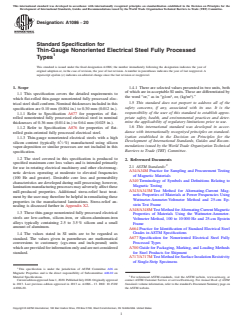
1.1 This specification covers the detailed requirements to which flat-rolled thin-gauge nonoriented fully processed electrical steel shall conform. Nominal thicknesses included in this specification are 0.10 mm (0.004 in.) to 0.30 mm (0.012 in.).
1.1.1 Refer to Specification A677 for properties of flat-rolled nonoriented fully processed electrical steel in nominal thicknesses of 0.36 mm (0.014 in.) to 0.64 mm (0.025 in.).
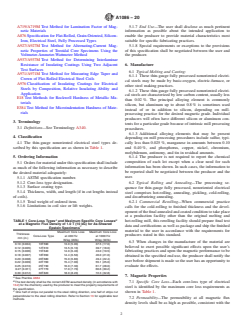
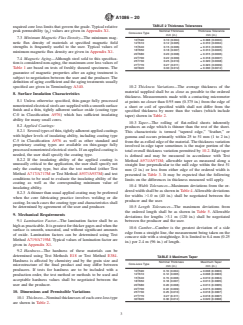
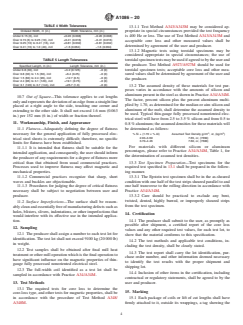
1.1.2 Refer to Specification A876 for properties of flat-rolled grain-oriented fully processed electrical steel.
1.1.3 Thin-gauge nonoriented electrical steels with a high silicon content (typically 61/2 %) manufactured using silicon vapor-deposition or similar processes are not included in this specification.
1.2 The steel covered in this specification is produced to specified maximum core loss values and is intended primarily for use in rotating electrical machinery and other electromagnetic devices operating at moderate to elevated frequencies (100 Hz and greater). Desirable core loss and permeability characteristics are developed during mill processing; however, lamination manufacturing processes may adversely affect these mill-produced properties. Additional stress-relief heat treatment by the user may therefore be helpful in remediating these properties in the manufactured laminations. Stress-relief annealing is discussed further in Appendix X2.
1.3 These thin-gauge nonoriented fully processed electrical steels are low-carbon, silicon-iron, or silicon-aluminum-iron alloys typically containing 2.5 to 3.5 % silicon and a small amount of aluminum.
1.4 The values stated in SI units are to be regarded as standard. The values given in parentheses are mathematical conversions to customary (cgs-emu and inch-pound) units which are provided for information only and are not considered standard.
1.4.1 There are selected values presented in two units, both of which are in acceptable SI units. These are differentiated by the word “or,” as in “g/cm3, or, (kg/m3).”
1.5 This standard does not purport to address all of the safety concerns, if any, associated with its use. It is the responsibility of the user of this standard to establish appropriate safety, health, and environmental practices and determine the applicability of regulatory limitations prior to use.
1.6 This international standard was developed in accordance with internationally recognized principles on standardization established in the Decision on Principles for the Development of International Standards, Guides and Recommendations issued by the World Trade Organization Technical Barriers to Trade (TBT) Committee.
- Status
- Published
- Publication Date
- 31-May-2020
- Technical Committee
- A06 - Magnetic Properties
- Drafting Committee
- A06.02 - Material Specifications
Buy Documents
ASTM A1086-20 - Standard Specification for Thin-Gauge Nonoriented Electrical Steel Fully Processed Types
REDLINE ASTM A1086-20 - Standard Specification for Thin-Gauge Nonoriented Electrical Steel Fully Processed Types
Overview
ASTM A1086-20: Standard Specification for Thin-Gauge Nonoriented Electrical Steel Fully Processed Types covers flat-rolled, thin-gauge, nonoriented electrical steels in thicknesses from 0.10 mm (0.004 in.) to 0.30 mm (0.012 in.). These materials are engineered to meet stringent core loss limits and permeability values, making them suitable for electromagnetic devices and rotating electrical machinery operating at moderate to elevated frequencies starting from 100 Hz.
Typical alloys are low-carbon silicon-iron or silicon-aluminum-iron containing 2.5 to 3.5% silicon, with some aluminum. The standard provides requirements for core loss, thickness tolerances, lamination factors, surface coatings, and mechanical properties. It supports improved energy efficiency and performance in electrical applications, while also noting that certain high-silicon steels and grain-oriented varieties are covered under separate ASTM standards.
Key Topics
- Material Types: Covers nonoriented, fully processed, flat-rolled electrical steels with thicknesses of 0.10-0.30 mm.
- Performance Criteria: Electrical steel must meet defined maximum core loss values and high relative permeability for efficient magnetic performance.
- Core Loss Types: Core loss specifications are defined at 400 Hz and 1000 Hz for standard thicknesses.
- Surface Insulation: Standard finish is a tightly adherent surface oxide providing adequate insulation; higher insulation coatings are available upon request.
- Mechanical Properties: Critical parameters include lamination factor, thickness tolerances, hardness, flatness, camber, and out-of-square tolerances.
- Testing and Certification: Material is tested in accordance with ASTM procedures and provided with certified reports on core loss and other specified values.
Applications
ASTM A1086-20 thin-gauge nonoriented electrical steel is designed for use in:
- Rotating Electrical Machinery: Such as electric motors, generators, and alternators, where minimal core loss and high permeability enhance efficiency.
- Electromagnetic Devices: Including transformers, solenoids, and high-frequency choke coils operating at 100 Hz and above.
- Small Electrical Cores and Laminations: Suited for compact, high-performance devices in industrial, automotive, and consumer applications.
- Specialized Electrical Components: Where precise thickness, insulation, and mechanical uniformity are required.
This specification helps manufacturers achieve improved energy efficiency, reduced heat generation, and consistent product performance in demanding electromagnetic environments.
Related Standards
For broader context and further material options, consider these related ASTM standards:
- ASTM A677: Specification for nonoriented fully processed electrical steel in thicknesses from 0.36 mm (0.014 in.) to 0.64 mm (0.025 in.).
- ASTM A876: Specification for flat-rolled, grain-oriented, silicon-iron electrical steel, fully processed types.
- ASTM A34/A34M: Practice for sampling and procurement testing of magnetic materials.
- ASTM A340: Terminology of symbols and definitions relating to magnetic testing.
- ASTM A343/A343M, A348/A348M, A927/A927M: Test methods for AC magnetic properties.
- ASTM A719/A719M: Test method for lamination factor of magnetic materials.
- ASTM A937/A937M: Method for determining interlaminar resistance of insulating coatings.
- ASTM A976: Classification of insulating coatings for electrical steels.
These standards ensure comprehensive coverage of electrical steel requirements, testing, and classification for engineers and manufacturers committed to quality, consistency, and optimal electromagnetic performance.
Keywords: ASTM A1086-20, thin-gauge electrical steel, nonoriented electrical steel, fully processed electrical steel, core loss, silicon steel, electromagnetic applications, energy efficiency, flat-rolled steel.
Relations
- Effective Date
- 01-Dec-2023
- Refers
ASTM A677-16(2023) - Standard Specification for Nonoriented Electrical Steel Fully Processed Types - Effective Date
- 01-Dec-2023
- Effective Date
- 01-Nov-2019
- Effective Date
- 15-Oct-2019
- Effective Date
- 01-Oct-2019
- Effective Date
- 15-Jun-2019
- Effective Date
- 01-Apr-2019
- Effective Date
- 01-Apr-2019
- Effective Date
- 15-Feb-2019
- Effective Date
- 01-Oct-2018
- Effective Date
- 01-Jul-2018
- Effective Date
- 01-Jun-2018
- Effective Date
- 15-Oct-2017
- Effective Date
- 01-Jul-2017
- Effective Date
- 01-Jul-2017
Buy Documents
ASTM A1086-20 - Standard Specification for Thin-Gauge Nonoriented Electrical Steel Fully Processed Types
REDLINE ASTM A1086-20 - Standard Specification for Thin-Gauge Nonoriented Electrical Steel Fully Processed Types
Get Certified
Connect with accredited certification bodies for this standard

Element Materials Technology
Materials testing and product certification.

Inštitut za kovinske materiale in tehnologije
Institute of Metals and Technology. Materials testing, metallurgical analysis, NDT.
Sponsored listings
Frequently Asked Questions
ASTM A1086-20 is a technical specification published by ASTM International. Its full title is "Standard Specification for Thin-Gauge Nonoriented Electrical Steel Fully Processed Types". This standard covers: SCOPE 1.1 This specification covers the detailed requirements to which flat-rolled thin-gauge nonoriented fully processed electrical steel shall conform. Nominal thicknesses included in this specification are 0.10 mm (0.004 in.) to 0.30 mm (0.012 in.). 1.1.1 Refer to Specification A677 for properties of flat-rolled nonoriented fully processed electrical steel in nominal thicknesses of 0.36 mm (0.014 in.) to 0.64 mm (0.025 in.). 1.1.2 Refer to Specification A876 for properties of flat-rolled grain-oriented fully processed electrical steel. 1.1.3 Thin-gauge nonoriented electrical steels with a high silicon content (typically 61/2 %) manufactured using silicon vapor-deposition or similar processes are not included in this specification. 1.2 The steel covered in this specification is produced to specified maximum core loss values and is intended primarily for use in rotating electrical machinery and other electromagnetic devices operating at moderate to elevated frequencies (100 Hz and greater). Desirable core loss and permeability characteristics are developed during mill processing; however, lamination manufacturing processes may adversely affect these mill-produced properties. Additional stress-relief heat treatment by the user may therefore be helpful in remediating these properties in the manufactured laminations. Stress-relief annealing is discussed further in Appendix X2. 1.3 These thin-gauge nonoriented fully processed electrical steels are low-carbon, silicon-iron, or silicon-aluminum-iron alloys typically containing 2.5 to 3.5 % silicon and a small amount of aluminum. 1.4 The values stated in SI units are to be regarded as standard. The values given in parentheses are mathematical conversions to customary (cgs-emu and inch-pound) units which are provided for information only and are not considered standard. 1.4.1 There are selected values presented in two units, both of which are in acceptable SI units. These are differentiated by the word “or,” as in “g/cm3, or, (kg/m3).” 1.5 This standard does not purport to address all of the safety concerns, if any, associated with its use. It is the responsibility of the user of this standard to establish appropriate safety, health, and environmental practices and determine the applicability of regulatory limitations prior to use. 1.6 This international standard was developed in accordance with internationally recognized principles on standardization established in the Decision on Principles for the Development of International Standards, Guides and Recommendations issued by the World Trade Organization Technical Barriers to Trade (TBT) Committee.
SCOPE 1.1 This specification covers the detailed requirements to which flat-rolled thin-gauge nonoriented fully processed electrical steel shall conform. Nominal thicknesses included in this specification are 0.10 mm (0.004 in.) to 0.30 mm (0.012 in.). 1.1.1 Refer to Specification A677 for properties of flat-rolled nonoriented fully processed electrical steel in nominal thicknesses of 0.36 mm (0.014 in.) to 0.64 mm (0.025 in.). 1.1.2 Refer to Specification A876 for properties of flat-rolled grain-oriented fully processed electrical steel. 1.1.3 Thin-gauge nonoriented electrical steels with a high silicon content (typically 61/2 %) manufactured using silicon vapor-deposition or similar processes are not included in this specification. 1.2 The steel covered in this specification is produced to specified maximum core loss values and is intended primarily for use in rotating electrical machinery and other electromagnetic devices operating at moderate to elevated frequencies (100 Hz and greater). Desirable core loss and permeability characteristics are developed during mill processing; however, lamination manufacturing processes may adversely affect these mill-produced properties. Additional stress-relief heat treatment by the user may therefore be helpful in remediating these properties in the manufactured laminations. Stress-relief annealing is discussed further in Appendix X2. 1.3 These thin-gauge nonoriented fully processed electrical steels are low-carbon, silicon-iron, or silicon-aluminum-iron alloys typically containing 2.5 to 3.5 % silicon and a small amount of aluminum. 1.4 The values stated in SI units are to be regarded as standard. The values given in parentheses are mathematical conversions to customary (cgs-emu and inch-pound) units which are provided for information only and are not considered standard. 1.4.1 There are selected values presented in two units, both of which are in acceptable SI units. These are differentiated by the word “or,” as in “g/cm3, or, (kg/m3).” 1.5 This standard does not purport to address all of the safety concerns, if any, associated with its use. It is the responsibility of the user of this standard to establish appropriate safety, health, and environmental practices and determine the applicability of regulatory limitations prior to use. 1.6 This international standard was developed in accordance with internationally recognized principles on standardization established in the Decision on Principles for the Development of International Standards, Guides and Recommendations issued by the World Trade Organization Technical Barriers to Trade (TBT) Committee.
ASTM A1086-20 is classified under the following ICS (International Classification for Standards) categories: 77.140.50 - Flat steel products and semi-products. The ICS classification helps identify the subject area and facilitates finding related standards.
ASTM A1086-20 has the following relationships with other standards: It is inter standard links to ASTM A340-23a, ASTM A677-16(2023), ASTM A700-14(2019), ASTM A340-19b, ASTM A719/A719M-14(2019), ASTM A340-19a, ASTM A937/A937M-12(2019), ASTM A343/A343M-14(2019), ASTM A340-19, ASTM A976-18, ASTM E18-18, ASTM A340-18, ASTM A340-17a, ASTM A340-17, ASTM E18-17. Understanding these relationships helps ensure you are using the most current and applicable version of the standard.
ASTM A1086-20 is available in PDF format for immediate download after purchase. The document can be added to your cart and obtained through the secure checkout process. Digital delivery ensures instant access to the complete standard document.
Standards Content (Sample)
This international standard was developed in accordance with internationally recognized principles on standardization established in the Decision on Principles for the
Development of International Standards, Guides and Recommendations issued by the World Trade Organization Technical Barriers to Trade (TBT) Committee.
Designation:A1086 −20
Standard Specification for
Thin-Gauge Nonoriented Electrical Steel Fully Processed
Types
This standard is issued under the fixed designation A1086; the number immediately following the designation indicates the year of
original adoption or, in the case of revision, the year of last revision. A number in parentheses indicates the year of last reapproval. A
superscript epsilon (´) indicates an editorial change since the last revision or reapproval.
1. Scope 1.4.1 There are selected values presented in two units, both
of which are in acceptable SI units. These are differentiated by
1.1 This specification covers the detailed requirements to
3 3
the word “or,” as in “g/cm , or, (kg/m ).”
which flat-rolled thin-gauge nonoriented fully processed elec-
1.5 This standard does not purport to address all of the
trical steel shall conform. Nominal thicknesses included in this
safety concerns, if any, associated with its use. It is the
specification are 0.10 mm (0.004 in.) to 0.30 mm (0.012 in.).
responsibility of the user of this standard to establish appro-
1.1.1 Refer to Specification A677 for properties of flat-
priate safety, health, and environmental practices and deter-
rolled nonoriented fully processed electrical steel in nominal
mine the applicability of regulatory limitations prior to use.
thicknesses of 0.36 mm (0.014 in.) to 0.64 mm (0.025 in.).
1.6 This international standard was developed in accor-
1.1.2 Refer to Specification A876 for properties of flat-
dance with internationally recognized principles on standard-
rolled grain-oriented fully processed electrical steel.
ization established in the Decision on Principles for the
1.1.3 Thin-gauge nonoriented electrical steels with a high
1 Development of International Standards, Guides and Recom-
silicon content (typically 6 ⁄2 %) manufactured using silicon
mendations issued by the World Trade Organization Technical
vapor-deposition or similar processes are not included in this
Barriers to Trade (TBT) Committee.
specification.
1.2 The steel covered in this specification is produced to
2. Referenced Documents
specified maximum core loss values and is intended primarily
2.1 ASTM Standards:
for use in rotating electrical machinery and other electromag-
A34/A34M Practice for Sampling and Procurement Testing
netic devices operating at moderate to elevated frequencies
of Magnetic Materials
(100 Hz and greater). Desirable core loss and permeability
A340 Terminology of Symbols and Definitions Relating to
characteristics are developed during mill processing; however,
Magnetic Testing
lamination manufacturing processes may adversely affect these
A343/A343M Test Method for Alternating-Current Mag-
mill-produced properties. Additional stress-relief heat treat-
netic Properties of Materials at Power Frequencies Using
ment by the user may therefore be helpful in remediating these
Wattmeter-Ammeter-Voltmeter Method and 25-cm Ep-
properties in the manufactured laminations. Stress-relief an-
stein Test Frame
nealing is discussed further in Appendix X2.
A348/A348M TestMethodforAlternatingCurrentMagnetic
1.3 These thin-gauge nonoriented fully processed electrical
Properties of Materials Using the Wattmeter-Ammeter-
steels are low-carbon, silicon-iron, or silicon-aluminum-iron
Voltmeter Method, 100 to 10 000 Hz and 25-cm Epstein
alloys typically containing 2.5 to 3.5 % silicon and a small
Frame
amount of aluminum.
A664 Practice for Identification of Standard Electrical Steel
Grades in ASTM Specifications
1.4 The values stated in SI units are to be regarded as
A677 Specification for Nonoriented Electrical Steel Fully
standard. The values given in parentheses are mathematical
Processed Types
conversions to customary (cgs-emu and inch-pound) units
A700 Guide for Packaging, Marking, and Loading Methods
whichareprovidedforinformationonlyandarenotconsidered
for Steel Products for Shipment
standard.
A717/A717M TestMethodforSurfaceInsulationResistivity
of Single-Strip Specimens
This specification is under the jurisdiction of ASTM Committee A06 on
Magnetic Properties and is the direct responsibility of Subcommittee A06.02 on
Material Specifications. For referenced ASTM standards, visit the ASTM website, www.astm.org, or
CurrenteditionapprovedJune1,2020.PublishedJuly2020.Originallyapproved contact ASTM Customer Service at service@astm.org. For Annual Book of ASTM
in 2013. Last previous edition approved in 2013 as A1086 – 13. DOI: 10.1520/ Standards volume information, refer to the standard’s Document Summary page on
A1086-20. the ASTM website.
Copyright © ASTM International, 100 Barr Harbor Drive, PO Box C700, West Conshohocken, PA 19428-2959. United States
A1086−20
A719/A719M Test Method for Lamination Factor of Mag- 5.1.7 End Use—The user shall disclose as much pertinent
netic Materials information as possible about the intended application to
A876 Specification for Flat-Rolled, Grain-Oriented, Silicon- enable the producer to provide material characteristics most
Iron, Electrical Steel, Fully Processed Types suitable for specific fabricating practices.
A927/A927M Test Method for Alternating-Current Mag- 5.1.8 Special requirements or exceptions to the provisions
netic Properties of Toroidal Core Specimens Using the of this specification shall be negotiated between the user and
Voltmeter-Ammeter-Wattmeter Method the producer.
A937/A937M Test Method for Determining Interlaminar
Resistance of Insulating Coatings Using Two Adjacent
6. Manufacture
Test Surfaces
6.1 Typical Melting and Casting:
A971/A971M Test Method for Measuring Edge Taper and
6.1.1 These thin-gauge fully processed nonoriented electri-
Crown of Flat-Rolled Electrical Steel Coils
cal steels may be made by basic-oxygen, electric-furnace, or
A976 Classification of Insulating Coatings for Electrical
other steel making practices.
Steels by Composition, Relative Insulating Ability and
6.1.2 These thin-gauge fully processed nonoriented electri-
Application
cal steels are characterized by low carbon content, usually less
E18 Test Methods for Rockwell Hardness of Metallic Ma-
than 0.02 %. The principal alloying element is commonly
terials
silicon, but aluminum up to about 0.8 % is sometimes used
E384 Test Method for Microindentation Hardness of Mate-
instead of or in addition to silicon, depending on mill-
rials
processing practice for the desired magnetic grade. Individual
producers will often have different silicon or aluminum con-
3. Terminology
tents for a particular grade because of intrinsic mill processing
3.1 Definitions—See Terminology A340.
procedures.
6.1.3 Additional alloying elements that may be present
4. Classification
depending on mill processing procedures include sulfur, typi-
cally less than 0.025 %, manganese in amounts between 0.10
4.1 The thin-gauge nonoriented electrical steel types de-
scribed by this specification are as shown in Table 1. and 0.40 %, and phosphorus, copper, nickel, chromium,
molybdenum, antimony, and tin in residual amounts.
5. Ordering Information
6.1.4 The producer is not required to report the chemical
composition of each lot except when a clear need for such
5.1 Orders for material under this specification shall include
information has been shown. In such cases, the information to
as much of the following information as necessary to describe
be reported shall be negotiated between the producer and the
the desired material adequately:
user.
5.1.1 ASTM specification number.
5.1.2 Core-loss type designation.
6.2 Typical Rolling and Annealing—The processing se-
5.1.3 Surface coating type.
quence for thin-gauge fully processed, nonoriented electrical
5.1.4 Thickness, width, and length (if in cut lengths instead
steel comprises hot-rolling, annealing, pickling, cold-rolling,
of coils).
and decarburizing annealing.
5.1.5 Total weight of ordered item.
6.2.1 Commercial Rerolling—When commercial practice
5.1.6 Limitations in coil size or lift weights.
calls for the cold-rolling to finished thickness and the devel-
opment of the final annealed and coated condition to take place
at a production facility other than the original melting and
A B
TABLE 1 Core-Loss Types and Maximum Specific Core Losses hot-rolling mill, this rerolling facility should prepare final test
at a Magnetic Flux Density of 1.0 T (10 kG) for As-Sheared
data and certifications as well as package and ship the finished
C
Epstein Specimens
material to the user in accordance with the requirements for
Maximum Core Loss Maximum Core Loss
Thickness
producers stated in this standard.
Core-Loss Type at 400 Hz at 1000 Hz
mm (in.)
W/kg (W/lb) W/kg (W/lb)
6.3 When changes in the manufacture of the material are
0.10 (0.004) 10T590 13.0 (5.90) 37.5 (17.0)
believed to exert possible significant effects upon the user’s
0.12 (0.005) 12T610 13.5 (6.10) 39.7 (18.0)
0.15 (0.006) 15T640 14.0 (6.40) 43.0 (19.5) fabricating practices and upon the magnetic performance to be
0.18 (0.007) 18T650 14.4 (6.50) 46.0 (21.0)
obtained in the specified end use, the producer shall notify the
0.20 (0.008) 20T680 15.0 (6.80) 49.4 (22.4)
user before shipment is made so the user has an opportunity to
0.22 (0.009) 22T700 15.4 (7.00) 55.1 (25.0)
0.25 (0.010) 25T730 16.0 (7.30) 61.7 (28.0) evaluate the effects.
0.27 (0.011) 27T770 17.0 (7.70) 66.6 (30.2)
0.30 (0.012) 30T820 18.0 (8.20) 72.3 (32.8)
7. Magnetic Properties
A
See Practice A664
B
ThetestdensityshallbethecorrectASTMassumeddensity(inaccordancewith
7.1 Specific Core Loss—Each core-loss type of electrical
13.2)forthechemistryusedbytheproducertomeetthepropertyrequirementsof
steel is identified by the maximum core loss requirements as
the specification.
C
shown in Table 1.
One half of strips cut parallel to the steel rolling direction, one half of strips cut
perpendicular to the steel rolling direction. Refer to Section 13 for applicable test
7.2 Permeability—The permeability at all magnetic flux
methods.
density levels shall be as high as possible, consistent with the
A1086−20
TABLE 2 Thickness Tolerances
required core loss limits that govern the grade. Typical relative
peak permeability (µ ) values are given in Appendix X1. Nominal Thickness Thickness Tolerance
p
Core-Loss Type
mm (in.) mm (in.)
7.3 Minimum Magnetic Flux Density—The minimum mag-
10T590 0.10 (0.004) ± 0.008 (0.0003)
netic flux density of materials at specified magnetic field
12T610 0.12 (0.005) ± 0.010 (0.0004)
15T640 0.15 (0.006) ± 0.013 (0.0005)
strengths is frequently useful to the user. Typical values of
18T650 0.18 (0.007) ± 0.013 (0.0005)
minimum magnetic flux density are given in Appendix X1.
20T680 0.20 (0.008) ± 0.015 (0.0006)
22T700 0.22 (0.009) ± 0.018 (0.0007)
7.4 Magnetic Aging—Although steel sold to this specifica-
25T730 0.25 (0.010) ± 0.020 (0.0008)
tion is considered non-aging, the maximum core loss values of
27T770 0.27 (0.011) ± 0.023 (0.0009)
Table 1 are based on tests of freshly sheared specimens. The 30T820 0.30 (0.012) ± 0.030 (0.0012)
guarantee of magnetic properties after an aging treatment is
subject to negotiation between the user and the producer. The
definition of aging coefficient and the aging treatments usually
specified are given in Terminology A340. 10.2 Thickness Variations—The average thickness of the
material supplied shall be as close as possible to the ordered
8. Surface Insulation Characteristics
thickness. Measurements made with a contacting micrometer
8.1 Unless otherwise specified, thin-gauge fully processed
at points no closer than 0.95 mm (0.375 in.) from the edge of
nonorientedelectricalsteelsaresuppliedwithasmoothsurface
a sheet or coil of specified width shall not differ from the
finish and a thin, tightly adherent surface oxide (coating type
specified thickness by more than the values (which include
C-0 in Classification A976) which has sufficient insulating
taper) shown in Table 2.
ability for many small cores.
10.3 Taper—The rolling of flat-rolled sheets inherently
8.2 Applied Coatings:
produces an edge which is thinner than the rest of the sheet.
8.2.1 Several types of thin, tightly adherent applied coatings
This characteristic is termed “tapered edge,” “feather,” or
with higher levels of insulating ability, including coating type
gamma and occurs primarily within 25 to 51 mm (1 to 2 in.)
C-5 in Classification A976 as well as other standard and
from the as-rolled edge of the material.The thickness variation
proprietary coating types are available on thin-gauge fully
involved in edge taper sometimes is the major portion of the
processed nonoriented electrical steels. If an applied coating is
total overall thickness variation permitted by 10.2. Edge taper
needed, the user shall specify the coating type.
is defined and may be measured in accordance with Test
8.2.2 If the insulating ability of the applied coating is
Method A971/A971M; allowable taper as measured along a
unusually critical to the application, the user shall specify not
straight line perpendicular to the mill edge within the first 51
only the coating type, but also the test method (either Test
mm (2 in.) or less from either edge of the ordered width is
Method A717/A717M or Test Method A937/A937M) and test
presented in Table 3. It may be expected that the following
conditions to be used to evaluate the insulating ability of the
limits on the differences in thickness measured will apply.
coating as well as the corresponding minimum value of
10.4 Width Tolerances—Maximum deviations from the or-
insulating ability.
dered width shall be as shown in Table 4.Allowable deviations
8.2.3 Athinner than usual applied coating may be preferred
for widths ˃1.0 m (40 in.) shall be negotiated between the
when the core fabricating practice involves welding or die
producer and the user.
casting. In such cases the coating type and characteristics shall
10.5 Length Tolerances—The maximum deviations from
be determined by agreement of the user and producer.
the ordered length shall be as shown in Table 5. Allowable
9. Mechanical Requirements
deviations for lengths ˃3.1 m (120 in.) shall be negotiated
9.1 Lamination Factor—The lamination factor shall be as
between the producer and the user.
highaspracticable.Itisgreatestforthickergagesandwhenthe
10.6 Camber—Camber is the greatest deviation of a side
surface is smooth, uncoated, and without significant amounts
edge from a straight line, the measurement being taken on the
of oxide. Lamination factors can be determined using Test
concave side with a straightedge. It is limited to 6.
...
This document is not an ASTM standard and is intended only to provide the user of an ASTM standard an indication of what changes have been made to the previous version. Because
it may not be technically possible to adequately depict all changes accurately, ASTM recommends that users consult prior editions as appropriate. In all cases only the current version
of the standard as published by ASTM is to be considered the official document.
Designation: A1086 − 13 A1086 − 20
Standard Specification for
Thin-Gauge Nonoriented Electrical Steel Fully Processed
Types
This standard is issued under the fixed designation A1086; the number immediately following the designation indicates the year of
original adoption or, in the case of revision, the year of last revision. A number in parentheses indicates the year of last reapproval. A
superscript epsilon (´) indicates an editorial change since the last revision or reapproval.
1. Scope
1.1 This specification covers the detailed requirements to which flat-rolled thin-gauge nonoriented fully processed electrical
steel shall conform. Nominal thicknesses included in this specification are 0.004 in. (0.10 mm) to 0.012 in. (0.30 mm).0.10 mm
(0.004 in.) to 0.30 mm (0.012 in.).
1.1.1 Refer to Specification A677 for properties of flat-rolled nonoriented fully processed electrical steel in nominal thicknesses
of 0.014 in. (0.36 mm) to 0.025 in. (0.64 mm).0.36 mm (0.014 in.) to 0.64 mm (0.025 in.).
1.1.2 Refer to Specification A876 for properties of flat-rolled grain-oriented fully processed electrical steel.
1.1.3 Thin-gauge nonoriented electrical steels with a high silicon content (typically 6½ %)6 ⁄2 %) manufactured using silicon
vapor-deposition or similar processes are not included in this specification.
1.2 The steel covered in this specification is produced to specified maximum core loss values and is intended primarily for use
in rotating electrical machinery and other electromagnetic devices operating at moderate to elevated frequencies (100 Hz and
greater). Desirable core loss and permeability characteristics are developed during mill processing; however, lamination
manufacturing processes may adversely affect these mill-produced properties. Additional stress-relief heat treatment by the user
may therefore be helpful in remediating these properties in the manufactured laminations. Stress-relief annealing is discussed
further in Appendix X2.
1.3 These thin-gauge nonoriented fully processed electrical steels are low-carbon, silicon-iron, or silicon-aluminum-iron alloys
typically containing 2.5 to 3.5 % silicon and a small amount of aluminum.
1.4 The values stated in customary (cgs-emu and inch-pound) SI units are to be regarded as standard. The values given in
parentheses are mathematical conversions to SI customary (cgs-emu and inch-pound) units which are provided for information
only and are not considered standard.
1.4.1 There are selected values presented in two units, both of which are in acceptable SI units. These are differentiated by the
3 3
word “or,” as in “g/cm , or, (kg/m ).”
1.5 This standard does not purport to address all of the safety concerns, if any, associated with its use. It is the responsibility
of the user of this standard to establish appropriate safety safety, health, and healthenvironmental practices and determine the
applicability of regulatory limitations prior to use.
1.6 This international standard was developed in accordance with internationally recognized principles on standardization
established in the Decision on Principles for the Development of International Standards, Guides and Recommendations issued
by the World Trade Organization Technical Barriers to Trade (TBT) Committee.
2. Referenced Documents
2.1 ASTM Standards:
A34/A34M Practice for Sampling and Procurement Testing of Magnetic Materials
A340 Terminology of Symbols and Definitions Relating to Magnetic Testing
A343/A343M Test Method for Alternating-Current Magnetic Properties of Materials at Power Frequencies Using Wattmeter-
Ammeter-Voltmeter Method and 25-cm Epstein Test Frame
This specification is under the jurisdiction of ASTM Committee A06 on Magnetic Properties and is the direct responsibility of Subcommittee A06.02 on Material
Specifications.
Current edition approved Aug. 1, 2013June 1, 2020. Published August 2013July 2020. Originally approved in 2013. Last previous edition approved in 2013 as A1086 – 13.
DOI: 10.1520/A1086–13.10.1520/A1086-20.
For referenced ASTM standards, visit the ASTM website, www.astm.org, or contact ASTM Customer Service at service@astm.org. For Annual Book of ASTM Standards
volume information, refer to the standard’s Document Summary page on the ASTM website.
Copyright © ASTM International, 100 Barr Harbor Drive, PO Box C700, West Conshohocken, PA 19428-2959. United States
A1086 − 20
A348/A348M Test Method for Alternating Current Magnetic Properties of Materials Using the Wattmeter-Ammeter-Voltmeter
Method, 100 to 10 000 Hz and 25-cm Epstein Frame
A664 Practice for Identification of Standard Electrical Steel Grades in ASTM Specifications
A677 Specification for Nonoriented Electrical Steel Fully Processed Types
A700 Guide for Packaging, Marking, and Loading Methods for Steel Products for Shipment
A717/A717M Test Method for Surface Insulation Resistivity of Single-Strip Specimens
A719/A719M Test Method for Lamination Factor of Magnetic Materials
A876 Specification for Flat-Rolled, Grain-Oriented, Silicon-Iron, Electrical Steel, Fully Processed Types
A927/A927M Test Method for Alternating-Current Magnetic Properties of Toroidal Core Specimens Using the Voltmeter-
Ammeter-Wattmeter Method
A937/A937M Test Method for Determining Interlaminar Resistance of Insulating Coatings Using Two Adjacent Test Surfaces
A971/A971M Test Method for Measuring Edge Taper and Crown of Flat-Rolled Electrical Steel Coils
A976 Classification of Insulating Coatings for Electrical Steels by Composition, Relative Insulating Ability and Application
E18 Test Methods for Rockwell Hardness of Metallic Materials
E384 Test Method for Microindentation Hardness of Materials
3. Terminology
3.1 Definitions—See Terminology A340.
4. Classification
4.1 The thin-gauge nonoriented electrical steel types described by this specification are as shown in Table 1.
5. Ordering Information
5.1 Orders for material under this specification shall include as much of the following information as necessary to describe the
desired material adequately:
5.1.1 ASTM specification number.
5.1.2 Core-loss type designation.
A B
TABLE 1 Core-Loss Types and Maximum Specific Core Losses
at a Magnetic Flux Density of 10 kG (1.0 T) for As-Sheared
C
Epstein Specimens
Maximum Core Loss Maximum Core Loss
Thickness
Core-Loss Type at 400 Hz at 1000 Hz
in. (mm)
W/lb (W/kg) W/lb (W/kg)
0.004 (0.10) 10T590 5.90 (13.0) 12.0 (26.4)
0.005 (0.12) 12T610 6.10 (13.5) 15.3 (33.7)
0.006 (0.15) 15T640 6.40 (14.0) 17.4 (38.3)
0.007 (0.18) 18T650 6.50 (14.4) 19.5 (43.0)
0.008 (0.20) 20T680 6.80 (15.0) 22.4 (49.4)
0.009 (0.22) 22T700 7.00 (15.4) 25.0 (55.1)
0.010 (0.25) 25T730 7.30 (16.0) 28.0 (61.7)
0.011 (0.27) 27T770 7.70 (17.0) 30.2 (66.6)
0.012 (0.30) 30T820 8.20 (18.0) 32.8 (72.3)
A B
TABLE 1 Core-Loss Types and Maximum Specific Core Losses
at a Magnetic Flux Density of 1.0 T (10 kG) for As-Sheared
C
Epstein Specimens
Maximum Core Loss Maximum Core Loss
Thickness
Core-Loss Type at 400 Hz at 1000 Hz
mm (in.)
W/kg (W/lb) W/kg (W/lb)
0.10 (0.004) 10T590 13.0 (5.90) 37.5 (17.0)
0.12 (0.005) 12T610 13.5 (6.10) 39.7 (18.0)
0.15 (0.006) 15T640 14.0 (6.40) 43.0 (19.5)
0.18 (0.007) 18T650 14.4 (6.50) 46.0 (21.0)
0.20 (0.008) 20T680 15.0 (6.80) 49.4 (22.4)
0.22 (0.009) 22T700 15.4 (7.00) 55.1 (25.0)
0.25 (0.010) 25T730 16.0 (7.30) 61.7 (28.0)
0.27 (0.011) 27T770 17.0 (7.70) 66.6 (30.2)
0.30 (0.012) 30T820 18.0 (8.20) 72.3 (32.8)
A
See Practice A664
B
The test density shall be the correct ASTM assumed density (in accordance with
13.2) for the chemistry used by the producer to meet the property requirements of
the specification.
C
One half of strips cut parallel to the steel rolling direction, one half of strips cut
perpendicular to the steel rolling direction. Refer to Section 13 for applicable test
methods.
A1086 − 20
5.1.3 Surface coating type.
5.1.4 Thickness, width, and length (if in cut lengths instead of coils).
5.1.5 Total weight of ordered item.
5.1.6 Limitations in coil size or lift weights.
5.1.7 End Use—The user shall disclose as much pertinent information as possible about the intended application to enable the
producer to provide material characteristics most suitable for specific fabricating practices.
5.1.8 Special requirements or exceptions to the provisions of this specification shall be negotiated between the user and the
producer.
6. Manufacture
6.1 Typical Melting and Casting:
6.1.1 These thin-gauge fully processed nonoriented electrical steels may be made by basic-oxygen, electric-furnace, or other
steel making practices.
6.1.2 These thin-gauge fully processed nonoriented electrical steels are characterized by low carbon content, usually less than
0.02 %. The principal alloying element is commonly silicon, but aluminum up to about 0.8 % is sometimes used instead of or in
addition to silicon, depending on mill-processing practice for the desired magnetic grade. Individual producers will often have
different silicon or aluminum contents for a particular grade because of intrinsic mill processing procedures.
6.1.3 Additional alloying elements that may be present depending on mill processing procedures include sulfur, typically less
than 0.025 %, manganese in amounts between 0.10 and 0.40 %, and phosphorus, copper, nickel, chromium, molybdenum,
antimony, and tin in residual amounts.
6.1.4 The producer is not required to report the chemical composition of each lot except when a clear need for such information
has been shown. In such cases, the information to be reported shall be negotiated between the producer and the user.
6.2 Typical Rolling and Annealing—The processing sequence for thin-gauge fully processed, nonoriented electrical steel
comprises hot-rolling, annealing, pickling, cold-rolling, and decarburizing annealing.
6.2.1 Commercial Rerolling—When commercial practice calls for the cold-rolling to finished thickness and the development of
the final annealed and coated condition to take place at a production facility other than the original melting and hot-rolling mill,
this rerolling facility should prepare final test data and certifications as well as package and ship the finished material to the user
in accordance with the requirements for producers stated in this standard.
6.3 When changes in the manufacture of the material are believed to exert possible significant effects upon the user’s fabricating
practices and upon the magnetic performance to be obtained in the specified end use, the producer shall notify the user before
shipment is made so the user has an opportunity to evaluate the effects.
7. Magnetic Properties
7.1 Specific Core Loss—Each core-loss type of electrical steel is identified by the maximum core loss requirements as shown
in Table 1.
7.2 Permeability—The permeability at all magnetic flux density levels shall be as high as possible, consistent with the required
core loss limits that govern the grade. Typical relative peak permeability (μ ) values are given in Appendix X1.
p
7.3 Minimum Magnetic Flux Density—The minimum magnetic flux density of materials at specified magnetic field strengths is
frequently useful to the user. Typical values of minimum magnetic flux density are given in Appendix X1.
7.4 Magnetic Aging—Although steel sold to this specification is considered non-aging, the maximum core loss values of Table
1 are based on tests of freshly sheared specimens. The guarantee of magnetic properties after an aging treatment is subject to
negotiation between the user and the producer. The definition of aging coefficient and the aging treatments usually specified are
given in Terminology A340.
8. Surface Insulation Characteristics
8.1 Unless otherwise specified, thin-gauge fully processed nonoriented electrical steels are supplied with a smooth surface finish
and a thin, tightly adherent surface oxide (coating type C-0 in Classification A976) which has sufficient insulating ability for many
small cores.
8.2 Applied Coatings:
8.2.1 Several types of thin, tightly adherent applied coatings with higher levels of insulating ability, including coating type C-5
in Classification A976 as well as other standard and proprietary coating types are available on thin-gauge fully processed
nonoriented electrical steels. If an applied coating is needed, the user shall specify the coating type.
8.2.2 If the insulating ability of the applied coating is unusually critical to the application, the user shall specify not only the
coating type, but also the test method (either Test Method A717/A717M or Test Method A937/A937M) and test conditions to be
used to evaluate the insulating ability of the coating as well as the corresponding minimum value of insulating ability.
8.2.3 A thinner than usual applied coating may be preferred when the core fabricating practice involves welding or die casting.
In such cases the coating type and characteristics shall be determined by agreement of the user and producer.
A1086 − 20
9. Mechanical Requirements
9.1 Lamination Factor—The lamination factor shall be as high as practicable. It is greatest for thicker gages and when the
surface is smooth, uncoated, and without significant amounts of oxide. Lamination factors can be determined using Test Method
A719/A719M. Typical values of lamination factor are given in Appendix X1.
9.2 Hardness—The hardness of these materials can be determined using Test Methods E18 or Test Method E384. Hardness is
affected by chemistry and by the grain size and microstructure of the final product and may differ between producers. If tests for
hardness are to be included with a production order, the test method or methods to be used and acceptable hardness values shall
be negotiated between the user and the producer.
10. Dimensions and Permissible Variations
10.1 Thickness—Nominal thicknesses of each core-loss type are shown in Table 2.
10.2 Thickness Variations—The average thickness of the material supplied shall be as close as possible to the ordered thickness.
Measurements made with a contacting micrometer at points no closer than 0.375 in. (0.95 mm)0.95 mm (0.375 in.) from the edge
of a sheet or coil of specified width shall not differ from the specified thickness by more than the values (which include taper)
shown in Table 2.
10.3 Taper—The rolling of flat-rolled sheets inherently produces an edge which is thinner than the rest of the sheet. This
characteristic is termed “tapered edge,” “feather,” or gamma and occurs primarily within 1 to 2 in. (25 to 51 mm)25 to 51 mm (1
to 2 in.) from the as-rolled edge of the material. The thickness variation involved in edge taper sometimes is the major portion of
the total overall thickness variation permitted by 10.2. Edge taper is defined and may be measured in accordance with Test Method
A971/A971M; allowable taper as measured along a straight line perpendicular to the mill edge within the first 2 in. (51 mm)51
mm (2 in.) or less from either edge of the ordered width is presented in Table 3. It may be expected that the following limits on
the differences in thickness measured will apply.
TABLE 2 Thickness Tolerances
Nominal Thickness Thickness Tolerance
Core-Loss Type
in. (mm) in. (mm)
10T590 0.004 (0.10) ± 0.0003 (0.008)
12T610 0.005 (0.12) ± 0.0004 (0.010)
15T640 0.006 (0.15) ± 0.0005 (0.013)
18T650 0.007 (0.18) ± 0.0005 (0.013)
20T680 0.008 (0.20) ± 0.0006 (0.015)
22T700 0.009 (0.22) ± 0.0007 (0.018)
25T730 0.010 (0.25) ± 0.0008 (0.020)
27T770 0.011 (0.27) ± 0.0009 (0.023)
30T820 0.012 (0.30) ± 0.0012 (0.030)
TABLE 3 Maximum Taper
Nominal Thickness Maximum Taper
Core-Loss Type
in. (mm) in. (mm)
10T590 0.004 (0.10) 0.0003 (0.008)
12T610 0.005 (0.12) 0.0003 (0.008)
15T640 0.006 (0.15) 0.0004 (0.010)
18T650 0.007 (0.18) 0.0005 (0.013)
20T680 0.008 (0.20) 0.0005 (0.013)
22T700 0.009 (0.22) 0.0006 (0.015)
25T730 0.010 (0.25) 0.0007 (0.018)
27T770 0.011 (0.27) 0.0007 (0.018)
30T820 0.012 (0.30) 0.0008 (0.02)
10.4 Width Tolerances—Maximum deviations from the ordered width shall be as shown in Table 4. Allowable deviations for
widths ˃40 in. (1.0 m)˃1.0 m (40 in.) shall be negotiated between the producer and the user.
TABLE 2 Thickness Tolerances
Nominal Thickness Thickness Tolerance
Core-Loss Type
mm (in.) mm (in.)
10T590 0.10 (0.004) ± 0.008 (0.0003)
12T610 0.12 (0.005) ± 0.010 (0.0004)
15T640 0.15 (0.006) ± 0.013 (0.0005)
18T650 0.18 (0.007) ± 0.013 (0.0005)
20T680 0.20 (0.008) ± 0.015 (0.0006)
22T700 0.22 (0.009) ± 0.018 (0.0007)
25T730 0.25 (0.010) ± 0.020 (0.0008)
27T770 0.27 (0.011) ± 0.0
...