

ASTM A1126-23
(Specification)Standard Specification for Magnetic Pure Iron
General Information
- Abstract
SCOPE
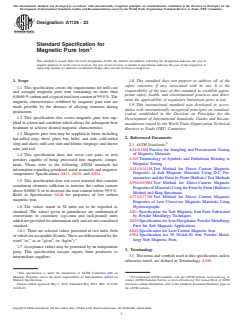
1.1 This specification covers the requirements for mill-cast and wrought magnetic pure iron containing no more than 0.0060 % carbon and a typical total iron content of 99.9 %. The magnetic characteristics exhibited by magnetic pure iron are made possible by the absence of alloying elements during production.
1.2 This specification also covers magnetic pure iron supplied in a form and condition which allows for subsequent heat treatment to achieve desired magnetic characteristics.
1.3 Magnetic pure iron may be supplied in forms including hot-rolled strip, sheet, plate, bar, billet, and slab; cold-rolled strip and sheet; mill-cast slab and bloom; forgings; and drawn wire and rod.
1.4 This specification does not cover cast parts or iron powders capable of being processed into magnetic components. Please refer to the following ASTM standards for information regarding powdered metal materials and magnetic components: Specifications A811, A839, and A904.
1.5 This specification does not cover material that contains constituent elements sufficient to increase the carbon content above 0.0060 % or to decrease the iron content below 99.9 %. Refer to Specification A848 for properties of low carbon magnetic iron.
1.6 The values stated in SI units are to be regarded as standard. The values given in parentheses are mathematical conversions to customary (cgs-emu and inch-pound) units which are provided for information only and are not considered standard.
1.6.1 There are selected values presented in two units, both of which are acceptable SI units. These are differentiated by the word “or,” as in “g/cm3, or, (kg/m3).”
1.7 Acceptance values may be generated by an independent party. This specification accepts reports from producers or intermediate suppliers.
1.8 This standard does not purport to address all of the safety concerns, if any, associated with its use. It is the responsibility of the user of this standard to establish appropriate safety, health, and environmental practices and determine the applicability of regulatory limitations prior to use.
1.9 This international standard was developed in accordance with internationally recognized principles on standardization established in the Decision on Principles for the Development of International Standards, Guides and Recommendations issued by the World Trade Organization Technical Barriers to Trade (TBT) Committee.
- Status
- Published
- Publication Date
- 30-Apr-2023
- Technical Committee
- A06 - Magnetic Properties
- Drafting Committee
- A06.02 - Material Specifications

Overview
ASTM A1126-23: Standard Specification for Magnetic Pure Iron provides comprehensive requirements for mill-cast and wrought magnetic pure iron intended for high-purity magnetic applications. This standard defines magnetic pure iron as having no more than 0.0060% carbon and typically 99.9% iron, ensuring optimal magnetic properties due to minimal alloying elements. The specification covers various forms of magnetic pure iron, such as hot-rolled and cold-rolled strip, sheet, plate, bar, billet, slab, forgings, and drawn wire and rod. ASTM A1126-23 specifies the conditions in which the material can be supplied to accommodate subsequent heat treatments for tailored magnetic performance, making it essential for industries that demand precise magnetic characteristics.
Key Topics
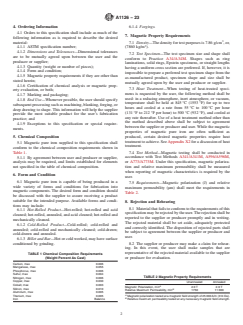
- Material Purity and Composition: Strict limits on carbon, manganese, phosphorus, sulfur, nitrogen, copper, cobalt, silicon, aluminum, and titanium are established, supporting the 99.9% minimum iron content required for high magnetic permeability.
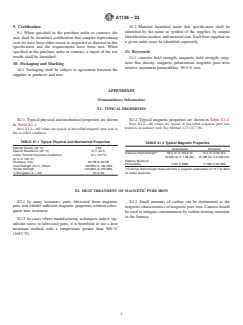
- Magnetic Characteristics: Focuses on properties such as magnetic polarization and relative maximum permeability. Achieving exceptional magnetic performance relies on both chemical purity and appropriate processing.
- Product Forms and Conditions:
- Hot-rolled and cold-rolled products
- Mill-cast slab and bloom
- Forgings, bar, billet, and drawn wire/rod
- Options for annealed or unannealed conditions
- Heat Treatment: The standard describes protocols for post-manufacture heat treatment, emphasizing the importance of atmosphere (reducing/inert/vacuum) and controlled temperature schedules to optimize magnetic properties.
- Testing and Certification: Magnetic testing is conducted according to referenced ASTM test methods, and chemical analysis or magnetic property certification can be supplied upon request.
Applications
Magnetic pure iron to ASTM A1126-23 is utilized in a wide spectrum of industries and applications where high magnetic permeability, low coercive field strength, and minimal losses are essential:
- Electrical and Electronic Devices: Used in transformer cores, solenoids, relays, and magnetic shielding components due to its excellent soft magnetic properties.
- Automotive and Aerospace: Forms critical parts in sensors, actuators, and electromagnetic devices requiring consistent, high-purity soft magnetic material.
- Manufacturing and Fabrication: Supplied in multiple forms to facilitate machining, forging, drawing, or deep drawing, making it versatile for custom components.
- Research and Development: Serves as a standard reference material in magnetic studies and testing environments.
Users benefit from specifying the intended end-use and processing requirements to ensure the supplied product matches the application's functional and fabrication needs.
Related Standards
For materials and applications outside the scope of magnetic pure iron as defined by ASTM A1126-23, the following ASTM standards are relevant:
- ASTM A811: Specification for Soft Magnetic Iron Parts Fabricated by Powder Metallurgy Techniques
- ASTM A839: Specification for Iron-Phosphorus Powder Metallurgy Parts for Soft Magnetic Applications
- ASTM A848: Specification for Low-Carbon Magnetic Iron
- ASTM A904: Specification for 50 Nickel-50 Iron Powder Metallurgy Soft Magnetic Parts
Additional referenced standards support testing, terminology, and property evaluation, including:
- ASTM A34/A34M: Practice for Sampling and Procurement Testing of Magnetic Materials
- ASTM A340: Terminology of Symbols and Definitions Relating to Magnetic Testing
- ASTM A341/A341M, A596/A596M, A773/A773M: Test Methods for evaluating the magnetic properties of soft magnetic materials
Practical Value
Complying with ASTM A1126-23 ensures access to magnetic pure iron optimized for high-performance applications, enabling manufacturers and end-users to specify, order, and utilize material with confidence in its purity, consistency, and functional suitability. The standard's detailed guidance on properties, forms, and processing supports quality assurance and reliable product performance in demanding technical environments.
Relations
- Effective Date
- 01-Dec-2023
- Effective Date
- 15-Oct-2019
- Effective Date
- 15-Jun-2019
- Effective Date
- 15-Feb-2019
- Effective Date
- 01-Jun-2018
- Effective Date
- 15-Oct-2017
- Effective Date
- 01-Jul-2017
- Effective Date
- 01-May-2016
- Effective Date
- 01-May-2016
- Effective Date
- 01-Oct-2015
- Effective Date
- 01-Oct-2014
- Refers
ASTM A904-14 - Standard Specification for 50 Nickel-50 Iron Powder Metallurgy Soft Magnetic Parts - Effective Date
- 01-May-2014
- Effective Date
- 01-Nov-2012
- Effective Date
- 01-Oct-2011
- Effective Date
- 01-Oct-2011
Get Certified
Connect with accredited certification bodies for this standard

Element Materials Technology
Materials testing and product certification.

Inštitut za kovinske materiale in tehnologije
Institute of Metals and Technology. Materials testing, metallurgical analysis, NDT.
Sponsored listings
Frequently Asked Questions
ASTM A1126-23 is a technical specification published by ASTM International. Its full title is "Standard Specification for Magnetic Pure Iron". This standard covers: SCOPE 1.1 This specification covers the requirements for mill-cast and wrought magnetic pure iron containing no more than 0.0060 % carbon and a typical total iron content of 99.9 %. The magnetic characteristics exhibited by magnetic pure iron are made possible by the absence of alloying elements during production. 1.2 This specification also covers magnetic pure iron supplied in a form and condition which allows for subsequent heat treatment to achieve desired magnetic characteristics. 1.3 Magnetic pure iron may be supplied in forms including hot-rolled strip, sheet, plate, bar, billet, and slab; cold-rolled strip and sheet; mill-cast slab and bloom; forgings; and drawn wire and rod. 1.4 This specification does not cover cast parts or iron powders capable of being processed into magnetic components. Please refer to the following ASTM standards for information regarding powdered metal materials and magnetic components: Specifications A811, A839, and A904. 1.5 This specification does not cover material that contains constituent elements sufficient to increase the carbon content above 0.0060 % or to decrease the iron content below 99.9 %. Refer to Specification A848 for properties of low carbon magnetic iron. 1.6 The values stated in SI units are to be regarded as standard. The values given in parentheses are mathematical conversions to customary (cgs-emu and inch-pound) units which are provided for information only and are not considered standard. 1.6.1 There are selected values presented in two units, both of which are acceptable SI units. These are differentiated by the word “or,” as in “g/cm3, or, (kg/m3).” 1.7 Acceptance values may be generated by an independent party. This specification accepts reports from producers or intermediate suppliers. 1.8 This standard does not purport to address all of the safety concerns, if any, associated with its use. It is the responsibility of the user of this standard to establish appropriate safety, health, and environmental practices and determine the applicability of regulatory limitations prior to use. 1.9 This international standard was developed in accordance with internationally recognized principles on standardization established in the Decision on Principles for the Development of International Standards, Guides and Recommendations issued by the World Trade Organization Technical Barriers to Trade (TBT) Committee.
SCOPE 1.1 This specification covers the requirements for mill-cast and wrought magnetic pure iron containing no more than 0.0060 % carbon and a typical total iron content of 99.9 %. The magnetic characteristics exhibited by magnetic pure iron are made possible by the absence of alloying elements during production. 1.2 This specification also covers magnetic pure iron supplied in a form and condition which allows for subsequent heat treatment to achieve desired magnetic characteristics. 1.3 Magnetic pure iron may be supplied in forms including hot-rolled strip, sheet, plate, bar, billet, and slab; cold-rolled strip and sheet; mill-cast slab and bloom; forgings; and drawn wire and rod. 1.4 This specification does not cover cast parts or iron powders capable of being processed into magnetic components. Please refer to the following ASTM standards for information regarding powdered metal materials and magnetic components: Specifications A811, A839, and A904. 1.5 This specification does not cover material that contains constituent elements sufficient to increase the carbon content above 0.0060 % or to decrease the iron content below 99.9 %. Refer to Specification A848 for properties of low carbon magnetic iron. 1.6 The values stated in SI units are to be regarded as standard. The values given in parentheses are mathematical conversions to customary (cgs-emu and inch-pound) units which are provided for information only and are not considered standard. 1.6.1 There are selected values presented in two units, both of which are acceptable SI units. These are differentiated by the word “or,” as in “g/cm3, or, (kg/m3).” 1.7 Acceptance values may be generated by an independent party. This specification accepts reports from producers or intermediate suppliers. 1.8 This standard does not purport to address all of the safety concerns, if any, associated with its use. It is the responsibility of the user of this standard to establish appropriate safety, health, and environmental practices and determine the applicability of regulatory limitations prior to use. 1.9 This international standard was developed in accordance with internationally recognized principles on standardization established in the Decision on Principles for the Development of International Standards, Guides and Recommendations issued by the World Trade Organization Technical Barriers to Trade (TBT) Committee.
ASTM A1126-23 is classified under the following ICS (International Classification for Standards) categories: 77.140.40 - Steels with special magnetic properties. The ICS classification helps identify the subject area and facilitates finding related standards.
ASTM A1126-23 has the following relationships with other standards: It is inter standard links to ASTM A340-23a, ASTM A340-19b, ASTM A340-19a, ASTM A340-19, ASTM A340-18, ASTM A340-17a, ASTM A340-17, ASTM A340-16e1, ASTM A340-16, ASTM A340-15, ASTM A340-14, ASTM A904-14, ASTM A34/A34M-06(2012), ASTM A341/A341M-00(2011)e1, ASTM A341/A341M-00(2011). Understanding these relationships helps ensure you are using the most current and applicable version of the standard.
ASTM A1126-23 is available in PDF format for immediate download after purchase. The document can be added to your cart and obtained through the secure checkout process. Digital delivery ensures instant access to the complete standard document.
Standards Content (Sample)
This international standard was developed in accordance with internationally recognized principles on standardization established in the Decision on Principles for the
Development of International Standards, Guides and Recommendations issued by the World Trade Organization Technical Barriers to Trade (TBT) Committee.
Designation: A1126 − 23
Standard Specification for
Magnetic Pure Iron
This standard is issued under the fixed designation A1126; the number immediately following the designation indicates the year of
original adoption or, in the case of revision, the year of last revision. A number in parentheses indicates the year of last reapproval. A
superscript epsilon (´) indicates an editorial change since the last revision or reapproval.
1. Scope 1.8 This standard does not purport to address all of the
safety concerns, if any, associated with its use. It is the
1.1 This specification covers the requirements for mill-cast
responsibility of the user of this standard to establish appro-
and wrought magnetic pure iron containing no more than
priate safety, health, and environmental practices and deter-
0.0060 % carbon and a typical total iron content of 99.9 %. The
mine the applicability of regulatory limitations prior to use.
magnetic characteristics exhibited by magnetic pure iron are
1.9 This international standard was developed in accor-
made possible by the absence of alloying elements during
dance with internationally recognized principles on standard-
production.
ization established in the Decision on Principles for the
1.2 This specification also covers magnetic pure iron sup-
Development of International Standards, Guides and Recom-
plied in a form and condition which allows for subsequent heat
mendations issued by the World Trade Organization Technical
treatment to achieve desired magnetic characteristics.
Barriers to Trade (TBT) Committee.
1.3 Magnetic pure iron may be supplied in forms including
2. Referenced Documents
hot-rolled strip, sheet, plate, bar, billet, and slab; cold-rolled
strip and sheet; mill-cast slab and bloom; forgings; and drawn
2.1 ASTM Standards:
wire and rod.
A34/A34M Practice for Sampling and Procurement Testing
of Magnetic Materials
1.4 This specification does not cover cast parts or iron
A340 Terminology of Symbols and Definitions Relating to
powders capable of being processed into magnetic compo-
Magnetic Testing
nents. Please refer to the following ASTM standards for
A341/A341M Test Method for Direct Current Magnetic
information regarding powdered metal materials and magnetic
Properties of Soft Magnetic Materials Using D-C Per-
components: Specifications A811, A839, and A904.
meameters and the Point by Point (Ballistic) Test Methods
1.5 This specification does not cover material that contains
A596/A596M Test Method for Direct-Current Magnetic
constituent elements sufficient to increase the carbon content
Properties of Materials Using the Point by Point (Ballistic)
above 0.0060 % or to decrease the iron content below 99.9 %.
Method and Ring Specimens
Refer to Specification A848 for properties of low carbon
A773/A773M Test Method for Direct Current Magnetic
magnetic iron.
Properties of Low Coercivity Magnetic Materials Using
1.6 The values stated in SI units are to be regarded as Hysteresigraphs
standard. The values given in parentheses are mathematical A811 Specification for Soft Magnetic Iron Parts Fabricated
conversions to customary (cgs-emu and inch-pound) units by Powder Metallurgy Techniques
which are provided for information only and are not considered A839 Specification for Iron-Phosphorus Powder Metallurgy
standard. Parts for Soft Magnetic Applications
1.6.1 There are selected values presented in two units, both A848 Specification for Low-Carbon Magnetic Iron
A904 Specification for 50 Nickel-50 Iron Powder Metal-
of which are acceptable SI units. These are differentiated by the
3 3
word “or,” as in “g/cm , or, (kg/m ).” lurgy Soft Magnetic Parts
1.7 Acceptance values may be generated by an independent
3. Terminology
party. This specification accepts reports from producers or
3.1 The terms and symbols used in this specification, unless
intermediate suppliers.
otherwise noted, are defined in Terminology A340.
This specification is under the jurisdiction of ASTM Committee A06 on
Magnetic Properties and is the direct responsibility of Subcommittee A06.02 on For referenced ASTM standards, visit the ASTM website, www.astm.org, or
Material Specifications. contact ASTM Customer Service at service@astm.org. For Annual Book of ASTM
Current edition approved May 1, 2023. Published May 2023. DOI: 10.1520/ Standards volume information, refer to the standard’s Document Summary page on
A1126-23. the ASTM website.
Copyright © ASTM International, 100 Barr Harbor Drive, PO Box C700, West Conshohocken, PA 19428-2959. United States
A1126 − 23
4. Ordering Information 6.1.4 Forgings.
4.1 Orders to this specification shall include as much of the
7. Magnetic Property Requirements
following information as is required to describe the desired
material: 7.1 Density—The density for test purposes is 7.86 g/cm , or,
4.1.1 ASTM specification number; (7860 kg/m ).
4.1.2 Dimensions and Tolerances—Dimensional tolerances
7.2 Test Specimen—The test specimen size and shape shall
are to be mutually agreed upon between the user and the
conform to Practice A34/A34M. Shapes such as ring
producer or supplier;
laminations, solid rings, Epstein specimens, or straight lengths
4.1.3 Quantity (weight or number of pieces);
having a uniform cross section are preferred. If, however, it is
4.1.4 Form and condition;
impossible to prepare a preferred test specimen shape from the
4.1.5 Magnetic property requirements if they are other than
as-manufactured product, specimen shape and size shall be
stated herein;
mutually agreed upon by the user and producer or supplier.
4.1.6 Certification of chemical analysis or magnetic prop-
7.3 Heat Treatment—When testing of heat-treated speci-
erty evaluation, or both;
mens is requested by the user, the following method shall be
4.1.7 Marking and packaging;
used: in a reducing atmosphere, inert atmosphere, or vacuum,
4.1.8 End Use—Whenever possible, the user should specify
temperature shall be held at 845 °C (1553 °F) for up to two
subsequent processing such as machining, blanking, forging, or
hours and cooled at a rate from 55 °C to 100 °C per hour
deep drawing to shape. This information will help the supplier
(131 °F to 212 °F per hour) to 500 °C (932 °F), and cooled at
provide the most suitable product for the user’s fabrication
any rate thereafter. Use of a heat treatment method other than
practice; and
the method described above shall be subject to agreement
4.1.9 Exceptions to this specification or special require-
between the supplier or producer and user. While the magnetic
ments.
properties of magnetic pure iron are often sufficient as
5. Chemical Composition produced, certain desired magnetic properties require heat
treatment to achieve. See Appendix X2 for a discussion of heat
5.1 Magnetic pure iron supplied to this specification shall
treatment.
conform to the chemical composition requirements shown in
Table 1. 7.4 Test Method—Magnetic testing shall be conducted in
5.1.1 By agreement between user and producer or supplier, accordance with Test Methods A341/A341M, A596/A596M,
analysis may be required, and limits established for elements or A773/A773M. Under this specification, magnetic polariza-
not specified in the table of chemical composition. tion and relative maximum permeability shall be measured
when reporting of magnetic characteristics is required by the
6. Form and Condition
user.
6.1 Magnetic pure iron is capable o
...