

ASTM A804/A804M-04(2021)
(Test Method)Standard Test Methods for Alternating-Current Magnetic Properties of Materials at Power Frequencies Using Sheet-Type Test Specimens
General Information
- Abstract
SIGNIFICANCE AND USE
4.1 Materials Evaluation—These test methods were developed to supplement the testing of Epstein specimens for applications involving the use of flat, sheared laminations where the testing of Epstein specimens in either the as-sheared or stress-relief-annealed condition fails to provide the most satisfactory method of predicting magnetic performance in the application. As a principal example, the test methods have been found particularly applicable to the control and evaluation of the magnetic properties of thermally flattened, grain-oriented electrical steel (Condition F5, Specification A876) used as lamination stock for cores of power transformers. Inasmuch as the test methods can only be reliably used to determine unidirectional magnetic properties, the test methods have limited applicability to the testing of fully processed nonoriented electrical steels as normally practiced (Specification A677).
4.2 Specification Acceptance—The reproducibility of test results and the accuracy relative to the 25-cm [250-mm] Epstein method of test are considered such as to render the test methods suitable for materials specification testing.
4.3 Interpretation of Test Results—Because of specimen size, considerable variation in magnetic properties may be present within a single specimen or between specimens that may be combined for testing purposes. Also, variations may exist in test values that are combined to represent a test lot of material. Test results reported will therefore, in general, represent averages of magnetic quality and in certain applications, particularly those involving narrow widths of laminations, deviations in magnetic performance from those expected from reported data may occur at times. Additionally, application of test data to the design or evaluation of a particular magnetic device must recognize the influence of magnetic circuitry upon performance and the possible deterioration in magnetic properties arising from construction of the device.
4.4 ...
SCOPE
1.1 These test methods cover the determination of specific core loss and peak permeability of single layers of sheet-type specimens tested with normal excitation at a frequency of 50 or 60 Hz.
Note 1: These test methods have been applied only at the commercial power frequencies, 50 and 60 Hz, but with proper instrumentation and application of the principles of testing and calibration embodied in the test methods, they are believed to be adaptable to testing at frequencies ranging from 25 to 400 Hz.
1.2 These test methods use calibration procedures that provide correlation with the 25-cm [250-mm] Epstein test.
1.3 The range of test magnetic flux densities is governed by the properties of the test specimen and by the available instruments and other equipment components. Normally, nonoriented electrical steels can be tested over a range from 8 to 16 kG [0.8 to 1.6 T] for core loss. For oriented electrical steels, the normal range extends to 18 kG [1.8 T]. Maximum magnetic flux densities in peak permeability testing are limited principally by heating of the magnetizing winding and tests are limited normally to a maximum ac magnetic field strength of about 150 Oe [12 000 A/m].
1.4 These test methods cover two alternative procedures as follows:
Test Method 1—Sections 6 – 12
Test Method 2—Sections 13 – 19
1.4.1 Test Method 1 uses a test fixture having (1) two windings that encircle the test specimen, and (2) a ferromagnetic yoke structure that serves as the flux return path and has low core loss and low magnetic reluctance.
1.4.2 Test Method 2 uses a test fixture having (1) two windings that encircle the test specimen, (2) a third winding located inside the other two windings and immediately adjacent to one surface of the test specimen, and (3) a ferromagnetic yoke structure which serves as the flux-return path and has low magnetic reluctance.
1.5 The values and equations stated in customary (cgs-emu a...
- Status
- Published
- Publication Date
- 31-Jan-2021
- Technical Committee
- A06 - Magnetic Properties
- Drafting Committee
- A06.01 - Test Methods
Overview
ASTM A804/A804M-04(2021) provides standardized test methods for determining the alternating-current (AC) magnetic properties of materials at power frequencies using sheet-type test specimens. Developed by ASTM International, this standard plays a crucial role in assessing the specific core loss and peak permeability of electrical steels, particularly for materials used in transformer core laminations and other magnetic devices. These test methods supplement traditional Epstein frame testing, offering a reliable alternative for evaluating flat, sheared laminations and thermally flattened, grain-oriented electrical steels.
Key Topics
- Specific Core Loss Measurement: Defines procedures for assessing core loss in electrical steels at frequencies of 50 or 60 Hz, adaptable for frequencies between 25 and 400 Hz with the appropriate equipment.
- Peak Permeability Testing: Details how to determine the maximum permeability of sheet-type specimens, essential for quality control in transformer lamination materials.
- Test Methods:
- Method 1: Utilizes a two-winding yoke fixture with a ferromagnetic flux-return path.
- Method 2: Adds a third winding adjacent to the specimen for enhanced measurement capabilities.
- Calibration and Correlation: Ensures test results are correlated with the recognized 25-cm Epstein frame method for consistent, standardized magnetic property evaluation.
- Form-Factor Corrections: Addresses necessary corrections for waveform deviations when measuring eddy-current losses.
- Lot Sampling and Data Interpretation: Deals with variability in specimen properties and provides guidelines for averaging results to represent material lots accurately.
Applications
ASTM A804/A804M-04(2021) is widely applied in industries requiring precise control over the magnetic properties of electrical steels:
- Power Transformer Core Manufacturing: Used to evaluate and control the magnetic losses and permeability of flat, grain-oriented laminations, ensuring high efficiency and reliability.
- Quality Control for Electrical Steels: Supports manufacturers and purchasers in specifying and verifying magnetic properties for materials such as nonoriented and grain-oriented silicon steels.
- Materials Research and Development: Offers a robust methodology for developing new steel grades or optimizing lamination processing to minimize core losses at operational frequencies.
- Specification Compliance: Enables material acceptance testing in line with industry specifications by offering repeatable and comparable results to established standards.
By providing reliable test data, these methods influence material selection and device design, contributing to improved performance and energy efficiency in electrical applications.
Related Standards
Utilizing ASTM A804/A804M-04(2021) often involves references to other key ASTM standards to ensure comprehensive materials evaluation:
- ASTM A34/A34M – Practice for Sampling and Procurement Testing of Magnetic Materials
- ASTM A340 – Terminology of Symbols and Definitions Relating to Magnetic Testing
- ASTM A343/A343M – Test Method for Alternating-Current Magnetic Properties Using Epstein Frame
- ASTM A677 – Specification for Nonoriented Electrical Steel, Fully Processed Types
- ASTM A683 – Specification for Nonoriented Electrical Steel, Semi-processed Types
- ASTM A876 – Specification for Flat-Rolled, Grain-Oriented, Silicon-Iron, Electrical Steel, Fully Processed Types
Practical Value
- Supplementary Evaluation: Bridges the gap where Epstein frame methods are insufficient, particularly for flat, thermally processed laminations.
- Industry Relevance: Critical for manufacturers, quality engineers, and research labs focused on electrical steel performance at commercial power frequencies.
- Adaptability: With proper calibration, the methods can be applied over a range of frequencies, aiding in the development of materials for varied AC applications.
In summary, ASTM A804/A804M-04(2021) ensures accurate, reliable assessment of the AC magnetic properties of materials, supporting material selection and conforming to global industry requirements. This standard is essential for anyone involved in the production, specification, or application of electrical steels in power equipment.
Relations
- Refers
ASTM A683-16(2023) - Standard Specification for Nonoriented Electrical Steel, Semiprocessed Types - Effective Date
- 01-Dec-2023
- Refers
ASTM A677-16(2023) - Standard Specification for Nonoriented Electrical Steel Fully Processed Types - Effective Date
- 01-Dec-2023
- Effective Date
- 01-Dec-2023
- Effective Date
- 15-Oct-2019
- Effective Date
- 15-Jun-2019
- Effective Date
- 01-Apr-2019
- Effective Date
- 15-Feb-2019
- Effective Date
- 01-Jun-2018
- Effective Date
- 15-Oct-2017
- Effective Date
- 01-Jul-2017
- Effective Date
- 01-Apr-2017
- Effective Date
- 01-May-2016
- Effective Date
- 01-May-2016
- Effective Date
- 01-Oct-2015
- Effective Date
- 01-Oct-2014
Get Certified
Connect with accredited certification bodies for this standard

Element Materials Technology
Materials testing and product certification.

Inštitut za kovinske materiale in tehnologije
Institute of Metals and Technology. Materials testing, metallurgical analysis, NDT.
Sponsored listings
Frequently Asked Questions
ASTM A804/A804M-04(2021) is a standard published by ASTM International. Its full title is "Standard Test Methods for Alternating-Current Magnetic Properties of Materials at Power Frequencies Using Sheet-Type Test Specimens". This standard covers: SIGNIFICANCE AND USE 4.1 Materials Evaluation—These test methods were developed to supplement the testing of Epstein specimens for applications involving the use of flat, sheared laminations where the testing of Epstein specimens in either the as-sheared or stress-relief-annealed condition fails to provide the most satisfactory method of predicting magnetic performance in the application. As a principal example, the test methods have been found particularly applicable to the control and evaluation of the magnetic properties of thermally flattened, grain-oriented electrical steel (Condition F5, Specification A876) used as lamination stock for cores of power transformers. Inasmuch as the test methods can only be reliably used to determine unidirectional magnetic properties, the test methods have limited applicability to the testing of fully processed nonoriented electrical steels as normally practiced (Specification A677). 4.2 Specification Acceptance—The reproducibility of test results and the accuracy relative to the 25-cm [250-mm] Epstein method of test are considered such as to render the test methods suitable for materials specification testing. 4.3 Interpretation of Test Results—Because of specimen size, considerable variation in magnetic properties may be present within a single specimen or between specimens that may be combined for testing purposes. Also, variations may exist in test values that are combined to represent a test lot of material. Test results reported will therefore, in general, represent averages of magnetic quality and in certain applications, particularly those involving narrow widths of laminations, deviations in magnetic performance from those expected from reported data may occur at times. Additionally, application of test data to the design or evaluation of a particular magnetic device must recognize the influence of magnetic circuitry upon performance and the possible deterioration in magnetic properties arising from construction of the device. 4.4 ... SCOPE 1.1 These test methods cover the determination of specific core loss and peak permeability of single layers of sheet-type specimens tested with normal excitation at a frequency of 50 or 60 Hz. Note 1: These test methods have been applied only at the commercial power frequencies, 50 and 60 Hz, but with proper instrumentation and application of the principles of testing and calibration embodied in the test methods, they are believed to be adaptable to testing at frequencies ranging from 25 to 400 Hz. 1.2 These test methods use calibration procedures that provide correlation with the 25-cm [250-mm] Epstein test. 1.3 The range of test magnetic flux densities is governed by the properties of the test specimen and by the available instruments and other equipment components. Normally, nonoriented electrical steels can be tested over a range from 8 to 16 kG [0.8 to 1.6 T] for core loss. For oriented electrical steels, the normal range extends to 18 kG [1.8 T]. Maximum magnetic flux densities in peak permeability testing are limited principally by heating of the magnetizing winding and tests are limited normally to a maximum ac magnetic field strength of about 150 Oe [12 000 A/m]. 1.4 These test methods cover two alternative procedures as follows: Test Method 1—Sections 6 – 12 Test Method 2—Sections 13 – 19 1.4.1 Test Method 1 uses a test fixture having (1) two windings that encircle the test specimen, and (2) a ferromagnetic yoke structure that serves as the flux return path and has low core loss and low magnetic reluctance. 1.4.2 Test Method 2 uses a test fixture having (1) two windings that encircle the test specimen, (2) a third winding located inside the other two windings and immediately adjacent to one surface of the test specimen, and (3) a ferromagnetic yoke structure which serves as the flux-return path and has low magnetic reluctance. 1.5 The values and equations stated in customary (cgs-emu a...
SIGNIFICANCE AND USE 4.1 Materials Evaluation—These test methods were developed to supplement the testing of Epstein specimens for applications involving the use of flat, sheared laminations where the testing of Epstein specimens in either the as-sheared or stress-relief-annealed condition fails to provide the most satisfactory method of predicting magnetic performance in the application. As a principal example, the test methods have been found particularly applicable to the control and evaluation of the magnetic properties of thermally flattened, grain-oriented electrical steel (Condition F5, Specification A876) used as lamination stock for cores of power transformers. Inasmuch as the test methods can only be reliably used to determine unidirectional magnetic properties, the test methods have limited applicability to the testing of fully processed nonoriented electrical steels as normally practiced (Specification A677). 4.2 Specification Acceptance—The reproducibility of test results and the accuracy relative to the 25-cm [250-mm] Epstein method of test are considered such as to render the test methods suitable for materials specification testing. 4.3 Interpretation of Test Results—Because of specimen size, considerable variation in magnetic properties may be present within a single specimen or between specimens that may be combined for testing purposes. Also, variations may exist in test values that are combined to represent a test lot of material. Test results reported will therefore, in general, represent averages of magnetic quality and in certain applications, particularly those involving narrow widths of laminations, deviations in magnetic performance from those expected from reported data may occur at times. Additionally, application of test data to the design or evaluation of a particular magnetic device must recognize the influence of magnetic circuitry upon performance and the possible deterioration in magnetic properties arising from construction of the device. 4.4 ... SCOPE 1.1 These test methods cover the determination of specific core loss and peak permeability of single layers of sheet-type specimens tested with normal excitation at a frequency of 50 or 60 Hz. Note 1: These test methods have been applied only at the commercial power frequencies, 50 and 60 Hz, but with proper instrumentation and application of the principles of testing and calibration embodied in the test methods, they are believed to be adaptable to testing at frequencies ranging from 25 to 400 Hz. 1.2 These test methods use calibration procedures that provide correlation with the 25-cm [250-mm] Epstein test. 1.3 The range of test magnetic flux densities is governed by the properties of the test specimen and by the available instruments and other equipment components. Normally, nonoriented electrical steels can be tested over a range from 8 to 16 kG [0.8 to 1.6 T] for core loss. For oriented electrical steels, the normal range extends to 18 kG [1.8 T]. Maximum magnetic flux densities in peak permeability testing are limited principally by heating of the magnetizing winding and tests are limited normally to a maximum ac magnetic field strength of about 150 Oe [12 000 A/m]. 1.4 These test methods cover two alternative procedures as follows: Test Method 1—Sections 6 – 12 Test Method 2—Sections 13 – 19 1.4.1 Test Method 1 uses a test fixture having (1) two windings that encircle the test specimen, and (2) a ferromagnetic yoke structure that serves as the flux return path and has low core loss and low magnetic reluctance. 1.4.2 Test Method 2 uses a test fixture having (1) two windings that encircle the test specimen, (2) a third winding located inside the other two windings and immediately adjacent to one surface of the test specimen, and (3) a ferromagnetic yoke structure which serves as the flux-return path and has low magnetic reluctance. 1.5 The values and equations stated in customary (cgs-emu a...
ASTM A804/A804M-04(2021) is classified under the following ICS (International Classification for Standards) categories: 77.140.40 - Steels with special magnetic properties. The ICS classification helps identify the subject area and facilitates finding related standards.
ASTM A804/A804M-04(2021) has the following relationships with other standards: It is inter standard links to ASTM A683-16(2023), ASTM A677-16(2023), ASTM A340-23a, ASTM A340-19b, ASTM A340-19a, ASTM A343/A343M-14(2019), ASTM A340-19, ASTM A340-18, ASTM A340-17a, ASTM A340-17, ASTM A876-17, ASTM A340-16e1, ASTM A340-16, ASTM A340-15, ASTM A340-14. Understanding these relationships helps ensure you are using the most current and applicable version of the standard.
ASTM A804/A804M-04(2021) is available in PDF format for immediate download after purchase. The document can be added to your cart and obtained through the secure checkout process. Digital delivery ensures instant access to the complete standard document.
Standards Content (Sample)
This international standard was developed in accordance with internationally recognized principles on standardization established in the Decision on Principles for the
Development of International Standards, Guides and Recommendations issued by the World Trade Organization Technical Barriers to Trade (TBT) Committee.
Designation: A804/A804M − 04 (Reapproved 2021)
Standard Test Methods for
Alternating-Current Magnetic Properties of Materials at
Power Frequencies Using Sheet-Type Test Specimens
This standard is issued under the fixed designationA804/A804M; the number immediately following the designation indicates the year
of original adoption or, in the case of revision, the year of last revision.Anumber in parentheses indicates the year of last reapproval.
A superscript epsilon (´) indicates an editorial change since the last revision or reapproval.
1. Scope netic yoke structure which serves as the flux-return path and
has low magnetic reluctance.
1.1 These test methods cover the determination of specific
1.5 The values and equations stated in customary (cgs-emu
core loss and peak permeability of single layers of sheet-type
and inch-pound) units or SI units are to be regarded separately
specimenstestedwithnormalexcitationatafrequencyof50or
as standard. Within this standard, SI units are shown in
60 Hz.
brackets except for the sections concerning calculations where
NOTE 1—These test methods have been applied only at the commercial
there are separate sections for the respective unit systems. The
power frequencies, 50 and 60 Hz, but with proper instrumentation and
values stated in each system may not be exact equivalents;
applicationoftheprinciplesoftestingandcalibrationembodiedinthetest
therefore,eachsystemshallbeusedindependentlyoftheother.
methods, they are believed to be adaptable to testing at frequencies
ranging from 25 to 400 Hz.
Combiningvaluesfromthetwosystemsmayresultinnoncon-
formance with this standard.
1.2 These test methods use calibration procedures that
provide correlation with the 25-cm [250-mm] Epstein test. 1.6 This standard does not purport to address all of the
safety concerns, if any, associated with its use. It is the
1.3 The range of test magnetic flux densities is governed by
responsibility of the user of this standard to establish appro-
the properties of the test specimen and by the available
priate safety, health, and environmental practices and deter-
instruments and other equipment components. Normally, non-
mine the applicability of regulatory limitations prior to use.
orientedelectricalsteelscanbetestedoverarangefrom8to16
1.7 This international standard was developed in accor-
kG[0.8to1.6T]forcoreloss.Fororientedelectricalsteels,the
dance with internationally recognized principles on standard-
normal range extends to 18 kG [1.8 T]. Maximum magnetic
ization established in the Decision on Principles for the
flux densities in peak permeability testing are limited princi-
Development of International Standards, Guides and Recom-
pally by heating of the magnetizing winding and tests are
mendations issued by the World Trade Organization Technical
limited normally to a maximum ac magnetic field strength of
Barriers to Trade (TBT) Committee.
about 150 Oe [12000 A/m].
1.4 These test methods cover two alternative procedures as 2. Referenced Documents
follows:
2.1 ASTM Standards:
Test Method 1—Sections6–12
A34/A34MPractice for Sampling and Procurement Testing
Test Method 2—Sections13–19
of Magnetic Materials
1.4.1 Test Method 1 uses a test fixture having (1) two
A340Terminology of Symbols and Definitions Relating to
windings that encircle the test specimen, and (2) a ferromag-
Magnetic Testing
netic yoke structure that serves as the flux return path and has
A343/A343MTest Method for Alternating-Current Mag-
low core loss and low magnetic reluctance.
netic Properties of Materials at Power Frequencies Using
1.4.2 Test Method 2 uses a test fixture having (1) two
Wattmeter-Ammeter-Voltmeter Method and 25-cm Ep-
windings that encircle the test specimen, (2) a third winding
stein Test Frame
located inside the other two windings and immediately adja-
A677Specification for Nonoriented Electrical Steel Fully
cent to one surface of the test specimen, and (3) a ferromag-
Processed Types
A683Specification for Nonoriented Electrical Steel, Semi-
processed Types
These test methods are under the jurisdiction of ASTM Committee A06 on
Magnetic Properties and are the direct responsibility of Subcommittee A06.01 on
Test Methods. For referenced ASTM standards, visit the ASTM website, www.astm.org, or
Current edition approved Feb. 1, 2021. Published February 2021. Originally contact ASTM Customer Service at service@astm.org. For Annual Book of ASTM
approved in 1982. Last previous edition approved in 2015 as A804/A804M–04 Standards volume information, refer to the standard’s Document Summary page on
(2015). DOI: 10.1520/A0804_A0804M-04R21. the ASTM website.
Copyright © ASTM International, 100 Barr Harbor Drive, PO Box C700, West Conshohocken, PA 19428-2959. United States
A804/A804M − 04 (2021)
A876Specification for Flat-Rolled, Grain-Oriented, Silicon- exist in test values that are combined to represent a test lot of
Iron, Electrical Steel, Fully Processed Types material. Test results reported will therefore, in general, repre-
sent averages of magnetic quality and in certain applications,
3. Terminology
particularly those involving narrow widths of laminations,
deviations in magnetic performance from those expected from
3.1 Definitions:
reported data may occur at times. Additionally, application of
3.1.1 General—The definitions of terms, symbols, and con-
test data to the design or evaluation of a particular magnetic
version factors relating to magnetic testing found in Terminol-
devicemustrecognizetheinfluenceofmagneticcircuitryupon
ogy A340 are used in these test methods.
performance and the possible deterioration in magnetic prop-
3.2 Definitions of Terms Specific to This Standard:
erties arising from construction of the device.
3.2.1 sheet specimen—a rectangular specimen comprised of
4.4 RecommendedStandardTests—Thesetestmethodshave
a single piece of material or paralleled multiple strips of
been principally applied to the magnetic testing of thermally
material arranged in a single layer.
flattened, grain-oriented electrical steels at 50 and 60 Hz.
4. Significance and Use Specific core loss at 15 or 17 kG [1.5 or 1.7 T] and peak
permeability (if required) at 10 Oe [796 A/m] are the recom-
4.1 Materials Evaluation—These test methods were devel-
mended parameters for evaluating this class of material.
oped to supplement the testing of Epstein specimens for
applications involving the use of flat, sheared laminations
5. Sampling
where the testing of Epstein specimens in either the as-sheared
5.1 LotSizeandSampling—Unlessotherwiseestablishedby
or stress-relief-annealed condition fails to provide the most
mutualagreementbetweenthemanufacturerandthepurchaser,
satisfactory method of predicting magnetic performance in the
determination of a lot size and the sampling of a lot to obtain
application.Asaprincipalexample,thetestmethodshavebeen
sheets for specimen preparation shall follow the recommenda-
found particularly applicable to the control and evaluation of
tions of Practice A34/A34M, Sections 5 and 6.
the magnetic properties of thermally flattened, grain-oriented
electrical steel (Condition F5, Specification A876) used as
METHOD 1 TWO-WINDING YOKE-FIXTURE TEST
lamination stock for cores of power transformers. Inasmuch as
METHOD
the test methods can only be reliably used to determine
unidirectional magnetic properties, the test methods have
6. Basic Test Circuit
limited applicability to the testing of fully processed nonori-
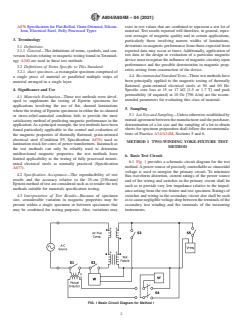
6.1 Fig. 1 provides a schematic circuit diagram for the test
ented electrical steels as normally practiced (Specification
method.Apowersourceofpreciselycontrollableacsinusoidal
A677).
voltage is used to energize the primary circuit. To minimize
4.2 Specification Acceptance—The reproducibility of test
flux-waveform distortion, current ratings of the power source
results and the accuracy relative to the 25-cm [250-mm]
and of the wiring and switches in the primary circuit shall be
Epsteinmethodoftestareconsideredsuchastorenderthetest
such as to provide very low impedance relative to the imped-
methods suitable for materials specification testing.
ance arising from the test fixture and test specimen. Ratings of
4.3 Interpretation of Test Results—Because of specimen switches and wiring in the secondary circuit also shall be such
size, considerable variation in magnetic properties may be astocausenegligiblevoltagedropbetweentheterminalsofthe
present within a single specimen or between specimens that secondary test winding and the terminals of the measuring
may be combined for testing purposes. Also, variations may instruments.
FIG. 1 Basic Circuit Diagram for Method 1
A804/A804M − 04 (2021)
7. Apparatus
7.1 The test circuit shall incorporate as many of the follow-
ing components as are required to perform the desired mea-
surements.
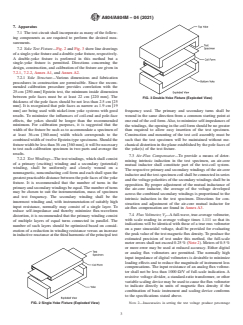
7.2 Yoke Test Fixture—Fig. 2 and Fig. 3 show line drawings
ofasingle-yokefixtureandadouble-yokefixture,respectively.
A double-yoke fixture is preferred in this method but a
single-yoke fixture is permitted. Directions concerning the
design, construction, and calibration of the fixture are given in
7.2.1, 7.2.2, Annex A1, and Annex A2.
7.2.1 Yoke Structure—Various dimensions and fabrication
procedures in construction are permissible. Since the recom-
mended calibration procedure provides correlation with the
25-cm [250-mm] Epstein test, the minimum inside dimension
between pole faces must be at least 22 cm [220 mm]. The
FIG. 3 Double-Yoke Fixture (Exploded View)
thickness of the pole faces should be not less than 2.5 cm [25
mm]. It is recognized that pole faces as narrow as 1.9 cm [19
mm] are being used with nickel-iron yoke systems with good
frequency used. The primary and secondary turns shall be
results. To minimize the influences of coil-end and pole-face wound in the same direction from a common starting point at
effects, the yokes should be longer than the recommended
one end of the coil form.Also, to minimize self-impedances of
minimum. For calibration purposes, it is suggested that the thewindings,theopeninginthecoilformshouldbenogreater
width of the fixture be such as to accommodate a specimen of
than required to allow easy insertion of the test specimen.
at least 36-cm [360-mm] width which corresponds to the Construction and mounting of the test coil assembly must be
combined width of twelve Epstein-type specimens. Should the such that the test specimen will be maintained without me-
fixturewidthbelessthan36cm[360mm],itwillbenecessary chanical distortion in the plane established by the pole faces of
to test each calibration specimen in two parts and average the the yoke(s) of the test fixture.
results.
7.3 Air-Flux Compensator—To provide a means of deter-
7.2.2 Test Windings—The test windings, which shall consist
mining intrinsic induction in the test specimen, an air-core
of a primary (exciting) winding and a secondary (potential)
mutual inductor shall constitute part of the test-coil system.
winding, shall be uniformly and closely wound on a
The respective primary and secondary windings of the air-core
nonmagnetic, nonconducting coil form and each shall span the
inductorandthetest-specimencoilshallbeconnectedinseries
greatestpracticabledistancebetweenthepolefacesoftheyoke
andthevoltagepolaritiesofthesecondarywindingsshallbein
fixture. It is recommended that the number of turns in the
opposition. By proper adjustment of the mutual inductance of
primaryandsecondarywindingsbeequal.Thenumberofturns
the air-core inductor, the average of the voltage developed
may be chosen to suit the instrumentation, mass of specimen
across the combined secondary windings is proportional to the
and test frequency. The secondary winding shall be the
intrinsic induction in the test specimen. Directions for con-
innermost winding and, with instrumentation of suitably high
struction and adjustment of the air-core mutual inductor for
input resistance, normally may consist of a single layer. To
air-flux compensation are found in Annex A3.
reduce self-impedance and thereby minimize flux-waveform
7.4 Flux Voltmeter, V—Afull-wave,true-averagevoltmeter,
f
distortion, it is recommended that the primary winding consist
with scale reading in average voltage times 1.111 so that its
of multiple layers of equal turns connected in parallel. The
indications will be identical with those of a true rms voltmeter
number of such layers should be optimized based on consid-
on a pure sinusoidal voltage, shall be provided for evaluating
eration of a reduction in winding resistance versus an increase
thepeakvalueofthetestmagneticfluxdensity.Toproducethe
ininductivereactanceatthethirdharmonicoftheprincipaltest
estimated precision of test under this method, the full-scale
metererrorsshallnotexceed0.25%(Note2).Metersof0.5%
or more error may be used at reduced accuracy. Either digital
or analog flux voltmeters are permitted. The normally high
input impedance of digital voltmeters is desirable to minimize
loading effects and to reduce the magnitude of instrument loss
compensations. The input resistance of an analog flux voltme-
ter shall not be less than 1000 Ω/V of full-scale indication. A
resistive voltage divider, a standard-ratio transformer, or other
variablescalingdevicemaybeusedtocausethefluxvoltmeter
to indicate directly in units of magnetic flux density if the
combination of basic instrument and scaling device conforms
to the specifications stated above.
FIG. 2 Single-Yoke Fixture (Exploded View) NOTE 2—Inaccuracies in setting the test voltage produce percentage
A804/A804M − 04 (2021)
errors approximately two times as large in the specific core loss. Care
maximum rms primary current to be encountered during
should also be taken to avoid errors caused by temperature and frequency
core-loss testing. Preferably the current-carrying capacity
effects in the instrument.
should be at least 10 rms amperes.
7.4.1 If used with a mutual inductor as a peak ammeter at
7.6.2 Electronic Digital Wattmeter—Electronic digital watt-
magnetic flux densities well above the knee of the magnetiza-
meters have been developed that have proven satisfactory for
tion curve, the flux voltmeter must be capable of accurately
use under the provisions of this test method. Usage of a
measuringtheextremelynonsinusoidal(peaked)voltagethatis
suitable electronic digital wattmeter is permitted as an alterna-
induced in the secondary winding of the mutual inductor.
tive to an electrodynamometer wattmeter in this test method.
Additionally, if so used, an analog flux voltmeter should have
An electronic digital wattmeter oftentimes is preferred in this
an input resistance of 5000 to 10000 Ω/V of full-scale
test method because of its digital readout and its capability for
indication.
direct interfacing with electronic data acquisition systems.
7.6.2.1 The voltage input circuitry of the electronic digital
7.5 RMS Voltmeter, V —A true rms-indicating voltmeter
rms
wattmeter must have an input impedance sufficiently high that
shall be provided for evaluating the form factor of the voltage
connection of the circuitry, during testing, to the secondary
induced in the secondary winding of the test fixture and for
windingofthetestfixturedoesnotchangetheterminalvoltage
evaluating the instrument losses. The accuracy of the rms
of the secondary by more than 0.05%. Also the voltage input
voltmeter shall be the same as that specified for the flux
circuitry must be capable of accepting the maximum peak
voltmeter. Either digital or analog rms voltmeters are permit-
voltagethatisinducedinthesecondarywindingduringtesting.
ted.Thenormallyhighinputimpedanceofdigitalvoltmetersis
desirable to minimize loading effects and to reduce the mag- 7.6.2.2 The current input circuitry of the electronic digital
nitude of instrument loss compensations. The input resistance wattmeter must have an input impedance of no more than 1 Ω.
of an analog rms voltmeter shall not be less than 500 Ω/V of Preferably the input impedance should be no more than 0.1 Ω
full-scale indication.
ifthefluxwaveformdistortionotherwisetendstobeexcessive.
Also the current input circuitry must be capable of accepting
7.6 Wattmeter, W—The full-scale accuracy of the wattmeter
the maximum rms current and the maximum peak current
must be better than 60.25% at the frequency of test and at
drawnbytheprimarywindingofthetestfixturewhencoreloss
unity power factor. The power factor encountered by a watt-
tests are being performed. In particular, since the primary
meter during a core loss test on a specimen is always less than
current will be very nonsinusoidal (peaked) if core-loss tests
unity and, at magnetic flux densities far above the knee of the
are performed on a specimen at magnetic flux densities above
magnetization curve, approaches zero. The wattmeter must
the knee of the magnetization curve, the crest factor capability
maintainadequateaccuracy(betterthan 61%ofreading)even
of the current input circuitry should be three or more.
at the most severe (lowest) power factor that is presented to it.
Variablescalingdevicesmaybeusedtocausethewattmeterto
7.7 Devices for Peak-Current Measurement—A means of
indicatedirectlyinunitsofspecificcorelossifthecombination
determining the peak value of the exciting current is required
of basic instrument and scaling devices conforms to the
if an evaluation of peak permeability is to be made by the
specifications stated here. peak-current method.
7.6.1 Electrodynamometer Wattmeter—A reflecting-type
7.7.1 An air-core mutual inductor and a flux voltmeter
dynamometer is recommended among this class of
comprise the apparatus most frequently used to measure peak
instruments, but, if the specimen mass is sufficiently large, a
exciting current. Use of this apparatus is based on the same
direct-indicating electrodynamometer wattmeter of the highest
theoretical considerations that indicate the use of a flux
availablesensitivityandlowestpower-factorcapabilitymaybe
voltmeter on the secondary of the test fixture to measure the
used.
peakmagneticfluxdensity;namely,thatwhenafluxvoltmeter
7.6.1.1 The sensitivity of the electrodynamometer wattme-
is connected to a test coil, the flux voltmeter indications are
ter must be such that the connection of the potential circuit of proportionaltothepeakvalueofthefluxlinkingthecoil.Inthe
the wattmeter, during testing, to the secondary winding of the
case of an air-core mutual inductor, the peak value of flux (and
test fixture does not change the terminal voltage of the hence the indications of the flux voltmeter connected to its
secondary by more than 0.05%. Also, the resistance of the
secondarywinding)willbeproportionaltothepeakvalueofits
potential circuit of the wattmeter must be sufficiently high that primary current.Amutual inductor used for this purpose must
the inductive reactance of the potential coil of the wattmeter in
have reasonably low primary impedance so that its insertion
combination with the leakage reactance of the secondary willnotmateriallyaffecttheprimarycircuitconditionsandyet
circuit of the test fixture does not result in appreciable defect
must have sufficiently high mutual inductance to provide a
angleerrorsinthemeasurements.Shouldtheimpedanceofthis satisfactorily high voltage to the flux voltmeter for primary
combined reactance at the test frequency exceed 1 Ω per 1000
currents corresponding to the desired range in peak magnetic
Ω of resistance in the wattmeter-potential circuit, the potential field strength. The mutual inductor secondary impedance
circuit must be compensated for this reactance.
should be low if any significant secondary current is drawn by
7.6.1.2 The impedance of the current coil of the electrody- a low impedance flux voltmeter. The addition of the flux
namometerwattmetershouldnotexceed1 Ω.Iffluxwaveform voltmeter should not change the mutual inductor secondary
distortion otherwise tends to be excessive, this impedance terminal voltage by more than 0.25%. It is important that the
should be not more than 0.1 Ω. The rated current-carrying mutual inductor be located in the test equipment in such a
capacity of the current coil must be compatible with the position that its windings will not be linked by ac leakage flux
A804/A804M − 04 (2021)
from other apparatus. Care should be taken to avoid locating it 8.2 The specimens shall be sheared as rectangular as prac-
so close to any magnetic material or any conducting material ticable to a length tolerance not exceeding 60.1%. Excessive
that its calibration and linearity might be affected. Directions burrandmechanicaldistortionaretobeavoidedintheshearing
for construction and calibration of the mutual inductor for operation. For tests of grain-oriented electrical steel parallel to
peak-current measurement are given in Annex A4. the direction of rolling, the angular deviation of the specimen
7.7.2 Peak-to-Peak Ammeter—Even at commercial power length axis from the rolling direction shall not exceed 1.0°.
frequencies, there can be appreciable error in the measurement
8.3 Where it is desirable to minimize the effects of slitting
of peak exciting current if winding capacitances and induc-
or shearing strains on the magnetic properties of an as-sheared
tances and flux voltmeter errors begin to become important at
test specimen, minimum width shall not be less than 100 mm.
some of the high-harmonic frequencies occasioned by the
8.4 Unlessotherwiseagreeduponbetweentheproducerand
extremely nonsinusoidal character of the voltage waveform
the user, it is recommended that sufficient specimens be
induced in the secondary of the mutual inductor by the
prepared so as to represent substantially the entire width of the
nonsinusoidal exciting-current waveform. In such cases, the
sheet samples taken from a test lot. If such samples are of less
peak-current measurement may be made with a voltmeter
than optimum width (see 8.1), the samples should be of
whoseindicationsareproportionaltothepeak-to-peakvalueof
sufficient length that consecutive specimens may be prepared
the voltage drop across a low value of standard resistance
for testing in a paralleled, single-layer configuration.
connectedinserieswiththeprimarywindingofthetestfixture.
This peak-to-peak-reading voltmeter should have a nominal
9. Procedure
full-scale accuracy of better than 63% at the test frequency
9.1 Initial Determinations—Before testing, check length of
and be able to accommodate voltages with a crest factor of up
each specimen for conformity within 60.1% of the desired
to approximately 5. Care must be exercised that the standard
length. Discard specimens showing evidence of mechanical
resistor (usually in the range from 0.1 to 1.0 Ω) carrying the
abuse. Weigh and record the mass of each specimen to an
exciting current has adequate current-carrying capacity and is
accuracy of 60.1%.
accurate to at least 0.1% in value. It must have negligible
temperature and frequency dependence under the conditions
9.2 Specimen Loading—When loaded into the test fixture,
applying in this method. If desired, the value of the resistor
the test specimen must be centered on the longitudinal and
may be such that the peak-reading voltmeter indicates directly
transverse axes of the test coil. When using a single-yoke
in terms of peak magnetic field strength provided that the
fixture, sufficient pressure from nonmagnetic weights shall be
resistorconformstothelimitationsstatedpreviously.Normally
used to bring the specimen into close contact with the pole
this resistor will replace the mutual inductor in the circuit of
faces of the yoke.
Fig. 1 and the shorting switch, S , is used to remove this extra
9.3 Demagnetization—The specimen should be demagne-
resistance from the primary circuit when not in use.
tizedbeforemeasurementsofanymagneticpropertyaremade.
7.8 Power Supply—Aprecisely controllable source of sinu-
With the required apparatus connected as shown in Fig. 1 and
soidal test voltage with sufficient current and voltage
withswitchesS andS closed,S closedtothetestfixtureside,
1 2 4
capability, low internal impedance, and excellent stability is
and S and S open, accomplish this demagnetization by
3 5
mandatory. Voltage amplitude and frequency stability should
initially applying a voltage from the power source to the
be maintained within 60.1%. Electronic power sources using
primarycircuitthatissufficienttomagnetizethespecimentoa
negative feedback from the secondary winding of the test
magnetic flux density above the knee of its magnetization
fixture to reduce flux waveform distortion have been found to
curve (magnetic flux density may be determined from the
perform quite satisfactorily in this test method.
reading of the flux voltmeter by means of the equation of 10.1
or the equation of 11.1) and then decrease the voltage slowly
8. Specimen Preparation and smoothly (or in small steps) to a very low magnetic flux
density. After this demagnetization, test promptly for the
8.1 The type of test fixture and its dimensions govern the
desired test points. When multiple test points are required,
dimensions of permissible test specimens. The minimum
perform the test in order of increasing magnetic flux density
length of a specimen shall be no less than the outside
values.
dimensionofthedistancebetweenpolefacesofthetestfixture.
With a double-yoke fixture, the amount of projection of the 9.4 SettingMagneticFluxDensity—WithswitchesS andS
1 3
specimen beyond the pole faces is not critical but should be no closed, S closed to the test fixture side, and S and S open,
4 2 5
longer than necessary for convenient loading and unloading of increase the voltage of the power supply until the flux
the specimen. For a single-yoke fixture, the length of the voltmeter indicates the value of voltage calculated to give the
specimen must equal the length of the specimens used in desired test magnetic flux density in accordance with the
calibration of the fixture. This length preferably is the mini- equation of 10.1 or the equation of 11.1. Because the action of
mumpermissiblelength.Formaximumaccuracy,thespecimen the air-flux compensator causes a voltage equal to that which
width should, as nearly as practicable, be the maximum that would be induced in the secondary winding by the air flux to
can be accommodated by the opening of the test coil. As a be subtracted from that induced by the total flux in the
minimum, it is recommended that the specimen width be at secondary, the magnetic flux density calculated from the
least one half of the maximum width that can be accommo- voltage indicated by the flux voltmeter will be the intrinsic
dated by the test coil. induction, B. In most cases, the values of intrinsic induction,
i
A804/A804M − 04 (2021)
B, are not sufficiently different from the corresponding values being tested if the correction is reasonably small. The equa-
i
ofnormalinduction, B,torequirethatanydistinctionbemade. tions involved in determining this correction are given in 10.3
and 11.3.
Where Γ H is no longer insignificantly small compared to B,
m p i
as at very high magnetic flux densities, determine the value of
9.8 Peak Current:
B by adding to B either the measured value of Γ H or a
i m p 9.8.1 Mutual Inductor—When peak permeability at a given
nominal value known to be reasonably typical of the class of
peak magnetic field strength is required, open S to insert the
material being tested.
primary of the mutual inductor, close S to protect the
wattmeter from the possibility of excessive current, open S
9.5 Core Loss—When the voltage indicated by the flux
and S to minimize secondary loading, and close S toward the
5 4
voltmeter has been adjusted to the desired value, read the
mutual-inductor side. Then adjust the voltage of the power
wattmeter. Some users, particularly those having wattmeters
supply such that the flux voltmeter indicates that the necessary
compensated for their own losses (or burden), will desire to
value of the peak exciting current (calculated using the
open switch S before reading the wattmeter to eliminate the
equations of 10.4.1 and 10.5 or the equations of 11.4 and 11.5)
flux voltmeter burden from the wattmeter indication. Others
has been established. At this point, throw S towards the
willlikelychoosetohave S and S closedwhenmeasuringthe
4 5
test-fixture side and observe on the flux voltmeter the value of
losses, so that all instruments may be read at the same time. In
flux volts induced in the secondary winding of the test fixture.
the latter case, the combined resistance load of the flux
The magnetic flux density corresponding to the observed flux
voltmeter,rmsvoltmeter,andpotentialcircuitofthewattmeter
volts may be computed using the equation of 10.1 or the
will constitute the total instrument burden on the wattmeter.
equation of 11.1. The equation for determining peak perme-
Exercise care so that the combined current drain of the
ability is given in 10.6 and in 11.6.
instrumentsdoesnotcauseanappreciablylargevoltagedropin
9.8.2 Peak-Reading Voltmeter—If the peak-reading voltme-
the secondary circuit impedance of the test fixture. In such a
terandstandardresistorareusedinsteadofthemutualinductor
case, the true magnetic flux density in the specimen may be
and flux voltmeter for determining peak current, follow the
appreciably higher than is apparent from the voltage measured
same procedure as in 9.8.1 except use S only on the test-
at the secondary terminals of the test fixture. In any event,
fixturesideandadjustthevoltageofthepowersupplysuchthat
power as a result of any current drain in the secondary circuit
thepeak-readingvoltmeterindicatesthatthenecessaryvalueof
at the time of reading the wattmeter must be known so it can
the peak exciting current (calculated using the equations of
be subtracted from the wattmeter indication to obtain the net
10.4.2 and 10.5 or the equations of 11.4 and 11.5) has been
watts caused by core loss.
established.The equation for determining peak permeability is
given in 10.6 and in 11.6.
9.6 Specific Core Loss—Obtain the specific core loss of the
specimen in watts per unit mass at a specified frequency by
10. Calculations (Customary Units)
dividing the net watts by that portion of the mass of the
10.1 Flux Voltage—Calculate the flux voltage, E in volts,
specimen constituting the active magnetic flux path in the
f
induced in the secondary winding of the test fixture corre-
specimen. Equations and instructions for computing the active
sponding to the desired intrinsic test induction in the test
mass of the specimen and the specific core loss are given in
specimen from the equation as follows:
10.2 and 11.2.
E 5 =2π B AN f 310 (1)
9.7 Secondary RMS Voltage—Read the rms voltmeter with
f i 2
the switch S closed to the test fixture side, switch S closed,
4 5
where:
and the voltage indicated by the flux voltmeter adjusted to the
B = maximum intrinsic induction, G;
i
desiredvalue.Ontrulysinusoidalvoltage,bothvoltmeterswill 2
A = effectivecross-sectionalareaofthetestspecimen,cm ;
indicate the same value, showing that the form factor of the
N = number of turns in secondary winding; and
induced voltage is 1.111. When the voltmeters give different
f = frequency, Hz.
readings,theratioofthermsvaluetothevalueindicatedbythe
Cross-sectional area, A in square centimetres, of the test
flux voltmeter reveals the amount by which the form factor of
specimen is determined as follows:
the induced voltage deviates from the desired value of 1.111.
A 5 m/ℓδ (2)
Determining the magnetic flux density from the reading of a
flux voltmeter assures that the correct value of peak magnetic
where:
flux density is achieved in the specimen and, hence, that the
m = total mass of specimen, g;
hysteresis component of the core loss is correct even if the
ℓ = actual length of specimen, cm; and
waveform is not strictly sinusoidal. However, the eddy-current
δ = standardassumeddensityofspecimenmaterial,g/cm .
component of the core loss (caused by current resulting from a
NOTE 3—Information on standard assumed densities for commonly
nonsinusoidal voltage induced in the cross section of the strip) used magnetic materials can be found in Practice A34/A34M, Section 10
on density.
will be in error depending on the deviation of the induced
voltage from the desired sinusoidal wave shape. This error in
10.2 Specific Core Loss—To obtain specific core loss in
theeddy-currentcomponentoflosscanbereadilycorrectedby watts per unit mass of the specimen, power expended in the
calculationsbasedontheobservedformfactorandtheapproxi-
secondary of the test circuit and included in the wattmeter
mate percentage of eddy-current loss for the grade of material indication must be eliminated prior to dividing by the active
A804/A804M − 04 (2021)
loss for form-factor error can be found in Test Method A343/A343M,
mass of the specimen. The equation for calculating specific
Section 8.3 and Note 4.
core loss, P (B;f) in watts per pound, for a specified magnetic
c
flux density, B, and frequency, f, is as follows:
10.4 Peak Current:
10.4.1 The peak exciting current, I in amperes, may be
P 5453.6 N P /N 2 E /R /m (3)
~ ! p
c~B;f! 1 c 2 1
computed from measurements made using the mutual inductor
where:
as follows:
P = core loss indicated by the wattmeter, W;
c
=2
E = rms value of secondary voltage, V;
I 5 E /f L (7)
p fm m
2π
R = parallel resistance of wattmeter potential circuit and
all other loads connected to the secondary circuit, Ω;
where:
N = number of turns in primary winding;
E = flux volts induced in secondary winding of mutual
m
N = number of turns in secondary winding; and
inductor;
m = active mass of specimen, g.
f = frequency, Hz; and
Theactivemass, m ingrams,ofthespecimenisdetermined
L = mutualinductanceofmutualinductorasdeterminedby
m
as follows:
the calibration procedures of Annex A4,H.
m 5 ℓ m/ℓ (4)
1 1
10.4.2 The peak exciting current, I in amperes, may be
p
computedfrommeasurementsmadeusingthestandardresistor
where:
and peak-reading voltmeter as follows:
ℓ = effective core-loss path length as determined by the
calibration procedures of Annex A2, cm; I 5 E /2 R (8)
p p2p 1
m = total mass of specimen, g; and
where:
ℓ = actual length of specimen, cm.
E = peak-to-peak voltage indicated by peak reading
p-p
10.3 Form Factor Correction—When the percent error in
voltmeter, V and
form factor exceeds 61.0%, the specific core loss shall be
R = resistance of standard resistor, Ω.
corrected to determine the value that would be obtained under
10.5 Peak Magnetic Field Strength—The peak magnetic
sinusoidal-flux test conditions (Note 4). The percent error in
field strength, H in oersteds, may be calculated as follows:
form factor is given by the equation as follows: p
H 50.4π N I /ℓ (9)
% errorin ff 5 ~100E/E ! 2100 (5) p 1 p 2
f
where:
Corrected specific core loss is obtained from the equation:
N = number of turns in primary winding of test fixture;
Corrected P 5100 observed P / h1Ke (6)
~ ! ~ !
c B;f c B;f
~ ! ~ !
I = peak exciting current, A; and
p
where: ℓ = effective peak magnetic field strength path length as
determinedbycalibrationproceduresofAnnexA2,cm.
observed P = specific core loss calculated in 10.2;
c(B;f)
h = percent hysteresis loss at magnetic flux
10.6 Peak Permeability—To obtain correspondence with dc
density, B, and frequency, f;
determinations, H valuesforcalculatingpeakpermeabilityare
p
e = percent eddy loss at magnetic flux
customarilydeterminedonlyatmagneticfluxdensitiesthatare
density, B, and frequency, f; and
sufficiently above the knee of the magnetization curve that the
K = (E/E) .
f
core-loss component of exciting current has negligible influ-
Obviously, h=100− e if residual losses are considered
ence on the peak value of exciting current. Relative peak
negligible.When the form-factor error is small, the values of h
permeability, µ , is determined as follows:
p
and e are not critical. The values of e commonly used for
Relative µ 5 B /Γ H (10)
p i m p
electrical steels are given in Table 1. Test conditions resulting
in a form-factor error in excess of 10% are to be avoided where:
because even the corrected core loss is apt to be in error by an
B = intrinsic induction, G;
i
excessive amount.
H = peak magnetic field strength, Oe; and
p
Γ = 1 G/Oe.
m
NOTE4—Adiscussionofassumptionsunderlyingthecorrectionofcore
TABLE 1 Assumed Percent Eddy-Current Loss Applicable at 50 or 60 Hz
A
Assumed Percent Eddy-Current Loss, for Strip Thicknesses in in. (mm)
Material Specimen
0.007 0.009 0.011 0.012 0.014 0.019 0.025
[0.18] [0.23] [0.27] [0.30] [0.35] [0.47] [0.64]
B
Nonoriented silicon steel parallel . . . . 25 35 45
C
Oriented silicon steel parallel 35 45 50 50 55 . .
A
Values were obtained by the frequency separation method in which the frequencies were not less than 25 Hz and not greater than 120 Hz.
B
These eddy-current percentages were developed for and are appropriate for use with nonoriented silicon steels as described in Specifications A677 and A683 where
(%SI + 1.7 × %AI) is in the range 1.40 to 3.70.
C
These eddy-current percentages were developed for and are appropriate for use with oriented silicon steels as described in Specifications A876.
A804/A804M − 04 (2021)
NOTE5—Forconvenienceincalculationofpeakpermeability,thevalue
The active mass, m in kilograms, of the specimen is
of B (intrinsic induction) is used instead of B (normal induction) under
i
determined as follows:
most circumstances of testing. This entails no loss of accuracy until H
p
m 5 ℓ m/ℓ (15)
becomes appreciable in magnitude relative to B. If greater accuracy is
1 1
i
required, B (equal to B + H ) should be used in place of B in the
i p i
where:
permeability equation of 10.6.
ℓ = effective core-loss path length as determined by the
10.7 Averaging of Test Data—If the reporting of data for a
calibration procedures of Annex A2,m;
testlotrequiresaveragingofdataontestspecimensofdifferent
m = total mass of specimen, kg; and
widths and if the data vary substantially in value, weighted
ℓ = actual length of specimen, m.
averaging of the test values shall be used. Weighted averaging
11.3 Form-Factor Correction—See 10.3.
is achieved as follows:
Weightedaverage 5 W X 1W X 1… / W 1W 1… (11) 11.4 Peak Current—See 10.4.
~ ! ~ !
1 1 2 2 1 2
11.5 Peak Magnetic Field Strength—The peak magnetic
where:
field strength, H in amperes per metre, may be calculated as
p
W = width of an individual test specimen and
follows:
X = test value for an individual specimen.
H 5 N I /ℓ (16)
p 1 p 2
11. Calculation (SI Units)
where:
11.1 Flux Voltage—Calculate the flux voltage, E in volts,
f
N = number of turns in primary winding of test fixture;
induced in the secondary winding of the test fixture corre-
I = peak exciting current, A; and
p
sponding to the desired intrinsic test induction in the test
ℓ = effective peak magnetic field strength path length as
specimen as follows:
determinedbycalibrationproceduresofAnnexA2,m.
E 5 =2π B AN f (12)
f i 2
11.6 Peak Permeability—To obtain correspondence with dc
where:
determinations, H valuesforcalculatingpeakpermeabilityare
p
B = maximum intrinsic flux density, T;
i
customarilydeterminedonlyatmagneticfluxdensitiesthatare
A = effective cross-sectional area of the test specimen, m ;
sufficiently above the knee of the magnetization curve that the
core-loss component of exciting current has negligible influ-
N = number of turns in secondary winding; and
ence on the peak value of exciting current. Relative peak
f = frequency, Hz.
permeability, µ , is determined as follows:
p
Cross-sectionalarea,Ainsquaremetres,ofthetestspecimen
Relative µ 5 B /Γ H (17)
p i m p
is determined as follows:
where:
A 5 m/ℓδ (13)
B = intrinsic induction, T;
i
where:
H = peak magnetic field strength, A/m; and
p
−7
m = total mass of specimen, kg;
Γ =4π×10 H/m.
m
ℓ = actual length of specimen, m; and
NOTE7—Forconvenienceincalculationofpeakpermeability,thevalue
of B (intrinsic induction) is used instead of B (normal induction) under
δ = standard assumed density of specimen material, kg/
i
most circumstances of testing.This entails no loss of accuracy until Γ H
m p
m .
becomes appreciable in magnitude relative to B. If greater accuracy is
i
NOTE 6—Information on standard assumed densities for commonly
required, B (equal to B + Γ H ) should be used in place of B in the
i m p i
used magnetic materials can be found in Practice A34/A34M, Section 10
permeability equation of 11.6.
on density.
11.7 Averaging of Test Data—See 10.7.
11.2 Specific Core Loss—To obtain specific core loss in
watts per unit mass of the specimen, power expended in the
12. Precision
secondary of the test circuit and included in wattmeter indica-
12.1 For the recommended standard specific core loss tests
tion must be eliminated before dividing by the active mass of
(see 4.4), the precision is estimated to be 62.0%.
the specimen. The equation for calculating specific core loss,
P in watts per kilogram, for a specified magnetic flux
c(B;f)
12.2 For the recommended standard peak permeability tests
density, B, and frequency, f, is as follows:
(see 4.4), the precision is estimated to be 61.0%.
P 5 N P /N 2 E /R /m (14)
~ !
c~B;f! 1 c 2 1
METHOD 2 THREE-WINDING YOKE-FIXTURE
where: TEST METHOD
P = core loss indicated by the wattmeter, W;
c
13. Basic Test Circuit
E = rms volts for the secondary circuit;
R = parallelresistanceofwattmeterpotentialcircuitandall
13.1 Fig. 4 provides a block diagram for the test method.A
other loads connected to the secondary circuit, Ω;
power source of precisely controllable ac sinusoidal voltage is
N = number of turns in primary winding;
used to energize the primary circuit. To minimize flux wave-
N = number of turns in secondary winding; and
form distortion in the primary circuit, current ratings of the
m = active mass of specimen, kg.
power source and of the wiring and switches in the primary
A804/A804M − 04 (2021)
tion procedure provides correlation with the 25-cm [250-mm]
Epstein test, the minimum inside dimension between the pole
faces must be at least 22 cm [220 mm]. The thickness of the
pole faces should not be less than 2.5 cm [25 mm]. For
calibrationpurposes,itissuggestedthatthewidthofthefixture
be such as to accommodate a specimen of at least 36-cm
[360-mm] width that corresponds to the combined width of
twelve Epstein-type strips. Should the fixture width be less
than 36 cm [360 mm], it will be necessary to test each
calibration specimen in two parts and average the results.
14.2.2 The test windings shall consist of a primary (excit-
ing) winding, a secondary (potential) winding, and a flat
air-flux search winding (hereafter called the H-coil). The axis
of each winding is to be parallel to the length of the test
specimen.Thenumberofturnsineachwindingmaybechosen
to best suit the intended test conditions. The primary and
secondary windings shall be wound on a common
nonmagnetic, nonconducting coil form that encircles the test
specimen and the H-coil. The primary and secondary turns
shall be wound in the same direction on the coil form. The
secondary winding is to be inside the primary winding. The
length of the secondary winding shall not be greater than the
distance over which uniform flux density is achieved in the
specimen. The primary winding shall span the greatest practi-
cable distance between the pole faces of the yoke fixture. To
FIG. 4 Apparatus
reduce self-impedance and thereby minimize flux waveform
distortion, the primary winding may consist of multiple layers
circuit shall be such as to provide very low impedance relative
ofequalturnsconnectedinparallel.Thenumberofsuchlayers
to the impedance arising from the test fixture and test speci-
should be optimized based on consideration of a reduction in
men.
winding resistance versus an increase in inductive reactance at
the third harmonic of the principal test frequency used. To
14. Apparatus
minimize self-impedances of the windings, the opening in the
14.1 The test circuit shall incorporate as many of the
coilformfortheprimaryandsecondarywindingsshouldbeno
following components as are required to perform the desired
greaterthanrequiredtoallowinstallationoftheH-coilandalso
measurements.
permit easy insertion of the largest test specimen. The H-coil
14.2 Yoke-Test Fixture—Measurements of core loss and
shall be uniformly and closely wound on a solid nonmagnetic,
permeability may be made basically by a method capable
...