

ASTM E396-17
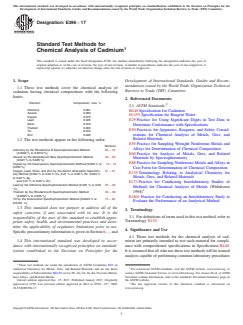
(Test Method)Standard Test Methods for Chemical Analysis of Cadmium
General Information
- Abstract
SIGNIFICANCE AND USE
4.1 These test methods for the chemical analysis of cadmium are primarily intended to test such material for compliance with compositional specifications in Specification B440. It is assumed that all who use these test methods will be trained analysts capable of performing common laboratory procedures skillfully and safely. It is expected that work will be performed in a properly equipped laboratory.
SCOPE
1.1 These test methods cover the chemical analysis of cadmium having chemical compositions with the following limits:
Element
Composition, max, %
Antimony
0.001
Arsenic
0.003
Copper
0.015
Lead
0.025
Silver
0.010
Thallium
0.003
Tin
0.010
Zinc
0.035
1.2 The test methods appear in the following order:
Sections
Antimony by the Rhodamine B Spectrophotometric Method
[0.0002 % to 0.0010 %]
62 – 72
Arsenic by the Molybdenum Blue Spectrophotometric Method
[0.001 % to 0.005 %]
40 – 50
Copper by the Neocuproine Spectrophotometric Method [0.002 % to 0.030 %]
10 – 19
Copper, Lead, Silver, and Zinc by the Atomic Absorption Spectrometry Method [0.004 % to 0.02 % Cu, 0.01 % to 0.05 % Pb, 0.004 % to 0.02 % Ag,
and 0.01 % to 0.05 % Zn]
51 – 61
Lead by the Dithizone Spectrophotometric Method [0.001 % to 0.05 %]
20 – 29
Thallium by the Rhodamine B Spectrophotometric Method
[0.0003 % to 0.005 %]
30 – 39
Tin by the 8-Quinolinol Spectrophotometric Method [0.0025 % to 0.0150 %]
73 – 82
1.3 This standard does not purport to address all of the safety concerns, if any, associated with its use. It is the responsibility of the user of this standard to establish appropriate safety, health, and environmental practices and determine the applicability of regulatory limitations prior to use. Specific precautionary information is given in Section 6, , , and .
1.4 This international standard was developed in accordance with internationally recognized principles on standardization established in the Decision on Principles for the Development of International Standards, Guides and Recommendations issued by the World Trade Organization Technical Barriers to Trade (TBT) Committee.
- Status
- Published
- Publication Date
- 14-Dec-2017
- Technical Committee
- E01 - Analytical Chemistry for Metals, Ores, and Related Materials
Overview
ASTM E396-17 is the standard test method established by ASTM International for the chemical analysis of cadmium. This standard provides validated laboratory procedures for determining the composition of cadmium and its impurities, ensuring compliance with established specifications such as ASTM B440. The standard focuses on accurate quantification of trace elements in cadmium using various spectrophotometric and atomic absorption techniques, guiding laboratories worldwide in maintaining product quality and uniformity.
Key Topics
The standard addresses the following key aspects of chemical analysis of cadmium:
- Scope of Analysis: Quantifies traces of antimony, arsenic, copper, lead, silver, thallium, tin, and zinc in cadmium samples, covering maximum permissible levels for each impurity.
- Test Methods: Details step-by-step analytical methods, including:
- Spectrophotometric methods using Rhodamine B, Neocuproine, Dithizone, 8-Quinolinol, and Molybdenum Blue
- Atomic Absorption Spectrometry (AAS) for simultaneous analysis of copper, lead, silver, and zinc
- Laboratory Requirements: Specifies the need for skilled analysts, appropriate equipment, and safe laboratory practices.
- Sampling and Rounding: Provides guidance on representative sampling for wrought and cast cadmium products and the standardized rounding of results.
- Quality and Precision: Discusses precision and bias, interlaboratory repeatability, and encourages use of certified reference materials when available.
Applications
The ASTM E396-17 standard serves multiple industries and stakeholders that require reliable chemical analysis of cadmium, including:
- Primary and Secondary Metals Producers: Confirming that cadmium meets industry and regulatory purity standards, especially for high-purity applications.
- Quality Assurance Laboratories: Ensuring compliance with compositional specifications for incoming materials, intermediates, and final products.
- Manufacturers of Batteries, Alloys, and Coatings: Verifying the elemental composition to meet safety, durability, and functionality requirements.
- Regulatory Bodies and Inspectors: Assessing conformance with international and local regulations on hazardous element content.
- Academic and Research Institutions: Utilizing standardized methods for investigating cadmium materials and their properties.
The methods support quality control throughout the supply chain, from smelting and refining to end-use product manufacturing, helping to prevent product failures and environmental contamination.
Related Standards
ASTM E396-17 cites and aligns with several other pertinent ASTM standards:
- ASTM B440: Specification for cadmium, which outlines permissible impurity limits and product requirements.
- ASTM E29: Practice for rounding off numerical test results.
- ASTM D1193: Specification for reagent water purity, crucial for minimizing interference in trace analysis.
- ASTM E50/E60: Guidance on safe laboratory practices and spectrophotometric procedures in metals analysis.
- ASTM E55/E88: Procedures for sampling wrought and cast nonferrous metals for composition determination.
- ASTM E135: Terminology for analytical chemistry in metals.
- ASTM E1601: Interlaboratory study practices for evaluating analytical methods.
Practical Value
Implementing ASTM E396-17 ensures accurate, repeatable, and internationally recognized chemical analysis of cadmium, which is vital for maintaining product quality, regulatory compliance, and safety in applications where cadmium purity is critical. By adhering to this standard, laboratories can confidently report results and support manufacturers, regulators, and end-users in risk mitigation and quality assurance.
Keywords: ASTM E396-17, chemical analysis of cadmium, cadmium impurities, spectrophotometric analysis, trace metals, ASTM standards, cadmium quality control, laboratory testing, compositional specifications, metals analysis.
Relations
- Effective Date
- 15-Dec-2017
- Effective Date
- 01-Jan-2020
- Effective Date
- 01-Nov-2019
- Effective Date
- 15-May-2019
- Effective Date
- 01-Sep-2017
- Effective Date
- 01-Sep-2017
- Effective Date
- 01-Aug-2016
- Effective Date
- 15-May-2016
- Effective Date
- 01-Jul-2015
- Effective Date
- 15-May-2015
- Effective Date
- 15-Aug-2014
- Effective Date
- 01-Apr-2014
- Effective Date
- 15-Feb-2014
- Effective Date
- 01-Dec-2013
- Effective Date
- 15-Dec-2012
Get Certified
Connect with accredited certification bodies for this standard

ECOCERT
Organic and sustainability certification.

Element Materials Technology
Materials testing and product certification.

Eurofins Food Testing Global
Global leader in food, environment, and pharmaceutical product testing.
Sponsored listings
Frequently Asked Questions
ASTM E396-17 is a standard published by ASTM International. Its full title is "Standard Test Methods for Chemical Analysis of Cadmium". This standard covers: SIGNIFICANCE AND USE 4.1 These test methods for the chemical analysis of cadmium are primarily intended to test such material for compliance with compositional specifications in Specification B440. It is assumed that all who use these test methods will be trained analysts capable of performing common laboratory procedures skillfully and safely. It is expected that work will be performed in a properly equipped laboratory. SCOPE 1.1 These test methods cover the chemical analysis of cadmium having chemical compositions with the following limits: Element Composition, max, % Antimony 0.001 Arsenic 0.003 Copper 0.015 Lead 0.025 Silver 0.010 Thallium 0.003 Tin 0.010 Zinc 0.035 1.2 The test methods appear in the following order: Sections Antimony by the Rhodamine B Spectrophotometric Method [0.0002 % to 0.0010 %] 62 – 72 Arsenic by the Molybdenum Blue Spectrophotometric Method [0.001 % to 0.005 %] 40 – 50 Copper by the Neocuproine Spectrophotometric Method [0.002 % to 0.030 %] 10 – 19 Copper, Lead, Silver, and Zinc by the Atomic Absorption Spectrometry Method [0.004 % to 0.02 % Cu, 0.01 % to 0.05 % Pb, 0.004 % to 0.02 % Ag, and 0.01 % to 0.05 % Zn] 51 – 61 Lead by the Dithizone Spectrophotometric Method [0.001 % to 0.05 %] 20 – 29 Thallium by the Rhodamine B Spectrophotometric Method [0.0003 % to 0.005 %] 30 – 39 Tin by the 8-Quinolinol Spectrophotometric Method [0.0025 % to 0.0150 %] 73 – 82 1.3 This standard does not purport to address all of the safety concerns, if any, associated with its use. It is the responsibility of the user of this standard to establish appropriate safety, health, and environmental practices and determine the applicability of regulatory limitations prior to use. Specific precautionary information is given in Section 6, , , and . 1.4 This international standard was developed in accordance with internationally recognized principles on standardization established in the Decision on Principles for the Development of International Standards, Guides and Recommendations issued by the World Trade Organization Technical Barriers to Trade (TBT) Committee.
SIGNIFICANCE AND USE 4.1 These test methods for the chemical analysis of cadmium are primarily intended to test such material for compliance with compositional specifications in Specification B440. It is assumed that all who use these test methods will be trained analysts capable of performing common laboratory procedures skillfully and safely. It is expected that work will be performed in a properly equipped laboratory. SCOPE 1.1 These test methods cover the chemical analysis of cadmium having chemical compositions with the following limits: Element Composition, max, % Antimony 0.001 Arsenic 0.003 Copper 0.015 Lead 0.025 Silver 0.010 Thallium 0.003 Tin 0.010 Zinc 0.035 1.2 The test methods appear in the following order: Sections Antimony by the Rhodamine B Spectrophotometric Method [0.0002 % to 0.0010 %] 62 – 72 Arsenic by the Molybdenum Blue Spectrophotometric Method [0.001 % to 0.005 %] 40 – 50 Copper by the Neocuproine Spectrophotometric Method [0.002 % to 0.030 %] 10 – 19 Copper, Lead, Silver, and Zinc by the Atomic Absorption Spectrometry Method [0.004 % to 0.02 % Cu, 0.01 % to 0.05 % Pb, 0.004 % to 0.02 % Ag, and 0.01 % to 0.05 % Zn] 51 – 61 Lead by the Dithizone Spectrophotometric Method [0.001 % to 0.05 %] 20 – 29 Thallium by the Rhodamine B Spectrophotometric Method [0.0003 % to 0.005 %] 30 – 39 Tin by the 8-Quinolinol Spectrophotometric Method [0.0025 % to 0.0150 %] 73 – 82 1.3 This standard does not purport to address all of the safety concerns, if any, associated with its use. It is the responsibility of the user of this standard to establish appropriate safety, health, and environmental practices and determine the applicability of regulatory limitations prior to use. Specific precautionary information is given in Section 6, , , and . 1.4 This international standard was developed in accordance with internationally recognized principles on standardization established in the Decision on Principles for the Development of International Standards, Guides and Recommendations issued by the World Trade Organization Technical Barriers to Trade (TBT) Committee.
ASTM E396-17 is classified under the following ICS (International Classification for Standards) categories: 71.040.40 - Chemical analysis; 77.040.30 - Chemical analysis of metals. The ICS classification helps identify the subject area and facilitates finding related standards.
ASTM E396-17 has the following relationships with other standards: It is inter standard links to ASTM E396-12e1, ASTM E135-20, ASTM E1601-19, ASTM E135-19, ASTM E50-17, ASTM E88-11(2017), ASTM E50-11(2016), ASTM E135-16, ASTM E135-15a, ASTM E135-15, ASTM E135-14b, ASTM E135-14a, ASTM E135-14, ASTM E135-13a, ASTM E1601-12. Understanding these relationships helps ensure you are using the most current and applicable version of the standard.
ASTM E396-17 is available in PDF format for immediate download after purchase. The document can be added to your cart and obtained through the secure checkout process. Digital delivery ensures instant access to the complete standard document.
Standards Content (Sample)
This international standard was developed in accordance with internationally recognized principles on standardization established in the Decision on Principles for the
Development of International Standards, Guides and Recommendations issued by the World Trade Organization Technical Barriers to Trade (TBT) Committee.
Designation: E396 − 17
Standard Test Methods for
Chemical Analysis of Cadmium
This standard is issued under the fixed designation E396; the number immediately following the designation indicates the year of
original adoption or, in the case of revision, the year of last revision. A number in parentheses indicates the year of last reapproval. A
superscript epsilon (´) indicates an editorial change since the last revision or reapproval.
1. Scope Development of International Standards, Guides and Recom-
mendations issued by the World Trade Organization Technical
1.1 These test methods cover the chemical analysis of
Barriers to Trade (TBT) Committee.
cadmium having chemical compositions with the following
limits:
2. Referenced Documents
Element Composition, max, %
2.1 ASTM Standards:
Antimony 0.001
B440 Specification for Cadmium
Arsenic 0.003
D1193 Specification for Reagent Water
Copper 0.015
E29 Practice for Using Significant Digits in Test Data to
Lead 0.025
Silver 0.010
Determine Conformance with Specifications
Thallium 0.003
E50 Practices for Apparatus, Reagents, and Safety Consid-
Tin 0.010
Zinc 0.035 erations for Chemical Analysis of Metals, Ores, and
Related Materials
1.2 The test methods appear in the following order:
E55 Practice for Sampling Wrought Nonferrous Metals and
Sections
Alloys for Determination of Chemical Composition
Antimony by the Rhodamine B Spectrophotometric Method 62–72
[0.0002 % to 0.0010 %]
E60 Practice for Analysis of Metals, Ores, and Related
Arsenic by the Molybdenum Blue Spectrophotometric Method 40–50
Materials by Spectrophotometry
[0.001 % to 0.005 %]
E88 Practice for Sampling Nonferrous Metals and Alloys in
Copper by the Neocuproine Spectrophotometric Method [0.002 % to 10–19
0.030 %]
Cast Form for Determination of Chemical Composition
Copper, Lead, Silver, and Zinc by the Atomic Absorption Spectrom- 51–61
E135 Terminology Relating to Analytical Chemistry for
etry Method [0.004 % to 0.02 % Cu, 0.01 % to 0.05 % Pb, 0.004 %
Metals, Ores, and Related Materials
to 0.02 % Ag,
and 0.01 % to 0.05 % Zn]
E173 Practice for Conducting Interlaboratory Studies of
Lead by the Dithizone Spectrophotometric Method [0.001 % to 0.05 20–29
Methods for Chemical Analysis of Metals (Withdrawn
%]
1998)
Thallium by the Rhodamine B Spectrophotometric Method 30–39
[0.0003 % to 0.005 %]
E1601 Practice for Conducting an Interlaboratory Study to
Tin by the 8-Quinolinol Spectrophotometric Method [0.0025 % to 73–82
Evaluate the Performance of an Analytical Method
0.0150 %]
1.3 This standard does not purport to address all of the
3. Terminology
safety concerns, if any, associated with its use. It is the
3.1 For definitions of terms used in this test method, refer to
responsibility of the user of this standard to establish appro-
Terminology E135.
priate safety, health, and environmental practices and deter-
mine the applicability of regulatory limitations prior to use.
4. Significance and Use
Specific precautionary information is given in Section 6,,,and
. 4.1 These test methods for the chemical analysis of cad-
1.4 This international standard was developed in accor-
mium are primarily intended to test such material for compli-
dance with internationally recognized principles on standard- ance with compositional specifications in Specification B440.
ization established in the Decision on Principles for the
Itisassumedthatallwhousethesetestmethodswillbetrained
analysts capable of performing common laboratory procedures
These test methods are under the jurisdiction of ASTM Committee E01 on
Analytical Chemistry for Metals, Ores, and Related Materials and are the direct For referenced ASTM standards, visit the ASTM website, www.astm.org, or
responsibility of Subcommittee E01.05 on Cu, Pb, Zn, Cd, Sn, Be, Precious Metals, contact ASTM Customer Service at service@astm.org. For Annual Book of ASTM
their Alloys, and Related Metals. Standards volume information, refer to the standard’s Document Summary page on
Current edition approved Dec. 15, 2017. Published January 2017. Originally the ASTM website.
ɛ1 3
approved in 1970. Last previous edition approved in 2012 as E396 – 12 . DOI: The last approved version of this historical standard is referenced on
10.1520/E0396-17. www.astm.org.
Copyright © ASTM International, 100 Barr Harbor Drive, PO Box C700, West Conshohocken, PA 19428-2959. United States
E396 − 17
skillfully and safely. It is expected that work will be performed COPPER BY THE NEOCUPROINE
in a properly equipped laboratory. SPECTROPHOTOMETRIC METHOD
5. Apparatus, Reagents, and Spectrophotometric Practice
10. Scope
5.1 Apparatus and reagents required for each determination
10.1 This test method covers the determination of copper
are listed in separate sections preceding the procedure. The
content from 0.002 % to 0.030 %.
apparatus,standardsolutions,andreagentsshallconformtothe
requirements prescribed in Practices E50. Spectrophotometers
11. Summary of Test Method
shall conform to the requirements prescribed in Practice E60.
11.1 Copper is separated as cuprous copper from other
5.2 Spectrophotometric practice prescribed in these meth-
metals by extraction of the copper-neocuproine complex with
ods shall conform to Practice E60.
chloroform. Spectrophotometric absorbance measurement is
made at 455 nm.
5.3 Reagents—
5.3.1 Purity of Water—Unless otherwise indicated, refer-
12. Concentration Range
ences to water shall be understood to mean reagent water
conformingtoTypeIIofSpecificationD1193.TypeIIIorType 12.1 The recommended concentration range is from 0.01
IV may be used if they effect no measurable change in the
mg to 0.15 mg of copper for each 25 mL of solution, using a
blank or sample. 1-cm cell.
5.3.2 Purity of Reagents—Reagent grade chemicals shall be
NOTE1—Thistestmethodhasbeenwrittenforcellshavinga1-cmlight
used in all tests. Unless otherwise indicated, it is intended that
path. Cells having other dimensions may be used, provided suitable
all reagents conform to the specifications of the Committee on
adjustments can be made in the amounts of sample and reagents used.
Analytical Reagents of the American Chemical Society where
such specifications are available. Other grades may be used, 13. Stability of Color
provided it is first ascertained that the reagent is of sufficiently
13.1 The color develops within 5 min and the extracted
high purity to permit its use without lessening the accuracy of
complex is stable. However, because of the volatile nature of
the determination.
the solvent, it is advisable to take spectrophotometric readings
promptly.
6. Safety Hazards
6.1 For precautions to be observed in the use of certain
14. Interferences
reagents in these test methods, refer to Practices E50.
14.1 The elements ordinarily present do not interfere if their
contents are under the maximum limits shown in 1.1.
7. Sampling
7.1 Wrought products shall be sampled in accordance with
15. Reagents
Practice E55. Cast products shall be sampled in accordance
15.1 Chloroform (CHCl ).
with Practice E88. However, these test methods do not super-
sede any sampling requirements specified in a specific ASTM 15.2 Copper, Standard Solution (1 mL = 0.01 mg Cu)—
material specification. Dissolve 0.1000 g of copper (purity: 99.9 % min) in 10 mL of
HNO (1 + 1). Add 25 mL of water, heat to boiling, and boil
8. Rounding Calculated Values
gently for 2 min to eliminate oxides of nitrogen. Cool, transfer
to a 100-mL volumetric flask, dilute to volume, and mix.
8.1 Rounding of test results obtained using this test method
Transfer 5.00 mL to a 500-mL volumetric flask. Add 1 mL of
shall be performed in accordance with Practice E29, Rounding
HNO (1 + 1), dilute to volume, and mix.
Method, unless an alternative rounding method is specified by
the customer or applicable material specification.
15.3 Hydroxylamine Hydrochloride Solution (100 g/L)—
Dissolve 5.0 g of hydroxylamine hydrochloride (NH OH·HCl)
9. Interlaboratory Studies
in 50 mL of water. Prepare fresh as needed.
9.1 These test methods have been evaluated in accordance
15.4 Metacresol Purple Indicator Solution (1 g/L)—
with Practices E173, unless otherwise noted in the precision
Dissolve 0.100 g of metacresol purple together with 1 pellet of
section.
NaOH in about 10 mLof water by warming. Dilute to 100 mL,
9.2 Practice E173 has been replaced by Practice E1601.The
and mix.
reproducibility index, R , of Practice E173 corresponds to the
15.5 Neocuproine Solution (1 g/L)—Dissolve 0.10 g of
reproducibility index, R, of Practice E1601. The repeatability
neocuproine (2,9-dimethyl-1,10-phenanthroline hemihydrate)
index, R , of Practice E173, corresponds to the repeatability
in 100 mL of either methanol or 95 % ethanol.
index, r, of Practice E1601.
15.6 Sodium Citrate Solution (300 g/L)—Dissolve 300 g of
sodium citrate dihydrate in water, dilute to 1 L, and mix.
Reagent Chemicals, American Chemical Society Specifications, American
Chemical Society, Washington, DC. For suggestions on the testing of reagents not
16. Preparation of Calibration Curve
listed by the American Chemical Society, see the United States Pharmacopeia and
National Formulary, U.S. Pharmacopeial Convention, Inc. (USPC), Rockville, MD 16.1 Calibration Solution:
E396 − 17
16.1.1 Using pipets, transfer (2, 5, 10, 15, and 20) mL of 18. Calculation
copper solution (1 mL = 0.01 mg Cu) to five 150-mL beakers,
18.1 Convertthenetspectrophotometricabsorbancereading
and dilute to about 40 mL.
of the test solution to milligrams of copper by means of the
16.1.2 Add 2 drops of metacresol purple indicator solution,
calibration curve. Calculate the percentage of copper as fol-
and then add HNO (1 + 1) dropwise to the red color change of
lows:
the indicator. Proceed as directed in 16.3.
Copper,% 5 A/ B 310 (1)
~ !
16.2 Reference Solution—Add 40 mLof water to a 150- mL
where:
beaker. Proceed as directed in 16.1.2.
A = copper found in the 25 mL of final test solution, mg,
16.3 Color Development:
and
16.3.1 Add10mLofNH OH·HClsolution,andstir.Add10
B = sample represented in 25 mL of final test solution, g.
mL of sodium citrate solution, and stir. Add NH OH to the
purple color of the indicator (pH about 8.5). Add 5.0 mL of
19. Precision and Bias
neocuproine solution, stir, and allow to stand for 5 min.
19.1 Precision—Eightlaboratoriescooperatedintestingthis
NOTE 2—The precipitate that may form upon addition of sodium citrate
test method and obtained the data summarized in Table 1.
solution will redissolve when the pH is raised to 8.5 with NH OH.
19.2 Bias—No certified reference materials suitable for
16.3.2 Transfer to a 125-mLseparatory funnel marked at 80
testingthistestmethodwereavailablewhentheinterlaboratory
mL, and dilute to the mark with water.Add 25.0 mLof CHCl .
testing program was conducted. The user of this test method is
Shake vigorously for 45 s, and allow the layers to separate.
encouraged to employ accepted reference materials, if
Draw off and discard about 1 mL of the CHCl layer to rinse
available, to determine the accuracy of this test method as
the stem of the separatory funnel.
applied in a specific laboratory.
16.4 Spectrophotometry:
LEAD BY THE DITHIZONE
16.4.1 Multiple-Cell Spectrophotometer—Measure the cell
SPECTROPHOTOMETRIC METHOD
correction using absorption cells with a 1-cm light path and a
light band centered at 455 nm. Using the test cell, take the
20. Scope
spectrophotometric absorbance readings of the calibration
20.1 This test method covers the determination of lead in
solutions.
content from 0.001 % to 0.05 %.
16.4.1.1 Avoid transfer of water to the absorption cell in the
following manner: Insert a loose plug of sterilized absorbent
21. Summary of Test Method
cotton into the stem of each separatory funnel. Just prior to
21.1 Lead dithizonate is extracted with chloroform from a
filling the absorption cell with the solution in the separatory
buffered cyanide solution at a pH of 8.5. The excess dithizone
funnel, discard about 1 mL of the CHCl layer through the
in the chloroform is then removed by extraction with an
cotton plug and immediately transfer a suitable portion of the
ammoniacal sulfite solution. Spectrophotometric absorbance
CHCl layer into the dry absorption cell.
measurement is made at 515 nm.
16.4.2 Single-Cell Spectrophotometer—Transfer a suitable
portion of the reference solution to an absorption cell with a
22. Concentration Range
1-cm light path and adjust the spectrophotometer to the initial
22.1 The recommended concentration range is from 0.005
setting, using a light band centered at 455 nm (Note 1). While
mg to 0.050 mg of lead for each 25 mL of solution, using a
maintaining this adjustment, take the spectrophotometric ab-
1-cm cell (Note 1).
sorbance readings of the calibration solutions.
16.5 Calibration Curve—Plot the net spectrophotometric
23. Stability of Color
absorbance readings of the calibration solutions against milli-
23.1 The color is stable for at least2hif protected from
grams of copper per 25 mL of solution.
direct sunlight; however, because of the volatile nature of the
solvent, it is advisable to take spectrophotometric readings
17. Procedure
promptly.
17.1 Test Solution—Transfer a 0.5-g sample, weighed to the
24. Interferences
nearest 1 mg, to a 150-mLbeaker.Add 5 mLof HNO (1 + 1).
When dissolution is complete, add 20 mL of water and boil
24.1 The elements ordinarily present in cadmium do not
gently to eliminate oxides of nitrogen. Cool, dilute to about 40
interfere if their contents are under the maximum limits shown
mL, and add 2 drops of metacresol purple indicator solution.
in 1.1.
Proceed as directed in 17.3.
17.2 Reference Solution—Carry a reagent blank through the
TABLE 1 Statistical Information
entireprocedureusingthesameamountofallreagentswiththe
Copper Found, Repeatability Reproducibility
Specimen
sample omitted, for use as the reference solution.
% (R , E173) (R , E173)
1 2
1 0.0074 0.003 0.0013
17.3 Color Development—Proceed as directed in 16.3.
2 0.0173 0.0018 0.0031
17.4 Spectrophotometry—Proceed as directed in 16.4.
E396 − 17
25. Reagents dithizone solution until the color of the dithizone remains
unchanged. Discard all extracts.
25.1 Ascorbic Acid (C H O ).
6 8 6
26.3.2 Add2mLofsodiumtartratesolution,about20mgof
25.2 Bromine Water, saturated.
ascorbic acid, and 2 drops of thioglycolic acid solution
25.3 Chloroform (CHCl ). (1 + 99).Add NH OH (1 + 1), while mixing, until the solution
turns yellow. Add 20 mL of KCN solution (Warning—see )
25.4 Dithizone Solution (0.01 g/L in CHCl )—Dissolve 0.05
and mix. Add 10 mL of acetic acid (1 + 4), and mix.
g of dithizone (diphenylthiocarbazone) in a freshly opened
700-g bottle of CHCl . Mix several times over a period of
NOTE 3—The indicator color should be purple and the pH approxi-
mately 8.5. Some lots of KCN may give a pH lower than 8.0 or higher
severalhours.Storeinacool,darkplace.Justbeforeuse,dilute
than 9.0. Should this occur, use NH OH (1 + 1) or acetic acid (1 + 4) to
50 mL of this solution to 500 mL with CHCl in a dry
adjust the pH to 8.5 6 0.5.
borosilicate bottle or flask, and mix.
26.3.3 Diluteto60mLwithwater,add15.0mLofdithizone
25.5 Lead, Standard Solution (1 mL = 0.005 mg Pb)—
solution, and shake vigorously for 1 min. Allow the layers to
Dissolve 0.1000 g of lead (purity: 99.9 % min) in 20 mL of
separate for 1 min. Transfer the lower layer to another 125-mL
HNO (1 + 1), and boil gently to eliminate oxides of nitrogen.
separatory funnel (set No. 2) containing 50 mL of the sodium
Cool, transfer to a 200-mL volumetric flask, dilute to volume,
sulfite wash solution. Add an additional 10.0 mL of dithizone
andmix.Transfer5.00mLtoa500-mLvolumetricflask,dilute
solution to the original separatory funnel (set No. 1) and shake
to volume, and mix. Prepare the final solution fresh as needed.
for 1 min.Again allow the layers to separate for 1 min and add
25.6 Metacresol Purple Indicator Solution (1 g/L)—Proceed
this second portion to the No. 2 separatory funnel.
as directed in 15.4.
26.3.4 Shake the combined organic layers in the No. 2
funnel for 1 min and allow the layers to separate for 1 min.
25.7 Potassium Cyanide Solution (200 g/L)—Dissolve 200
Drawoffanddiscardafewmillilitresofthelowerlayertorinse
g of potassium cyanide (KCN) (low in lead and sulfide)
out the stem of the funnel.
(Warning —See ) in water, and dilute to 1 L. Bring to a boil
and boil for 2 min. Cool, and store in a polyethylene bottle.
26.4 Spectrophotometry:
26.4.1 Multiple-Cell Spectrophotometer—Measure the cell
25.8 Sodium Sulfite Wash Solution—Dissolve1gof sodium
correction using absorption cells with a 1-cm light path and a
sulfite (Na SO ) in about 300 mL of water in a 1-L volumetric
2 3
light band centered at 515 nm. Using the test cell, take the
flask.Add 20 mLof the KCN solution and 475 mLof NH OH
spectrophotometric absorbance readings of the calibration
(1 + 1) which has been prepared from a freshly opened bottle.
solutions.
Dilute to volume, and mix. Store in a polyethylene bottle.
26.4.2 Single-Cell Spectrophotometer—Transfer a suitable
(Warning—The preparation, storage, and use of KCN solu-
portion of the reference solution to an absorption cell with a
tions require care and attention.Avoid inhalation of fumes and
1-cm light path and adjust the spectrophotometer to the initial
exposure of the skin to the chemical and its solutions. Do not
setting, using a light band centered at 515 nm. While main-
allow solutions containing cyanide to come in contact with
taining this adjustment, take the spectrophotometric absor-
stronglyacidicsolutions.Workinawell-ventilatedhood.Refer
bance readings of the calibration solutions.
to Section 8 of Practices E50.)
26.5 Calibration Curve—Plot the net spectrophotometric
25.9 Sodium Tartrate Solution (250 g/L)—Dissolve 50 g of
absorbance readings of the calibration solutions against milli-
sodium tartrate dihydrate in water, and dilute to 200 mL.
grams of lead per 25 mL of solution.
25.10 Thioglycolic Acid Solution (1 + 99)—Dilute 1.0 mL
of thioglycolic acid (mercaptoacetic acid) to 100 mL with
27. Procedure
water. Refrigerate both the concentrated and diluted acid
solutions.Donotuseconcentratedacidthatismorethan1year 27.1 Test Solution—Transfer a 5-g sample, weighed to the
old, nor diluted acid that has stood for more than 1 week. nearest 10 mg, to a 125-mL beaker. Add 25 mL of HNO
(1 + 1). When dissolution is complete, add several drops of
26. Preparation of Calibration Curve HCl and 1 mL of saturated bromine water. Boil gently to
eliminatetheoxidesofnitrogenandtoremoveexcessbromine.
26.1 Calibration Solutions—Using pipets, transfer (1, 2, 3,
Cool, transfer to a 100-mL volumetric flask, dilute to volume,
5, and 10)-mLvolumes of lead solution (1 mL = 0.005 mg Pb)
and mix. Using a pipet, transfer a 2-mL to 10-mL portion
to 125-mLseparatory funnels (set No. 1). Dilute to 15 mLwith
(containing between 0.005 mg and 0.050 mg of Pb) to a
water and add 1 drop of metacresol purple indicator solution
125-mLseparatoryfunnel.Diluteto15mLwithwater,andadd
(Note 3).
1 drop of metacresol purple indicator solution. Proceed as
26.2 Reference Solution—Transfer 15 mL of water to a
directed in 27.3.
125-mLseparatory funnel (one of set No. 1), and add 1 drop of
27.2 Reference Solution—Carry a reagent blank through the
metacresol purple indicator solution.
entire procedure using the same amount of all reagents, with
26.3 Color Development:
the sample omitted for use as the reference solution.
26.3.1 Add NH OH (1 + 1) dropwise, with swirling, until
27.3 Color Development—Proceed as directed in 26.3.
the indicator color begins to change from red to yellow.Add 2
drops of HNO . Extract with successive 10-mL portions of 27.4 Spectrophotometry—Proceed as directed in 26.4.
E396 − 17
28. Calculation 35. Reagents
28.1 Convertthenetspectrophotometricabsorbancereading
35.1 Cadmium Bromide Solution (1 mL = 0.05 g Cd)—
of the test solution to milligrams of lead by means of the
Dissolve5.0gofcadmiummetal(thallium,max0.001 %)with
calibration curve. Calculate the percentage of lead as follows:
35 mL of the HBr-Br mixture. Warm, if necessary, to effect
dissolution. Evaporate just to dryness but do not bake; dissolve
Lead,% 5 A/ B 310 (2)
~ !
in water, and cool. Transfer to a 100-mL volumetric flask,
where:
dilute to volume, and mix.
A = lead in the 25 mL of final test solution, mg, and
35.2 Hydrobromic Acid-Bromine Mixture—
B = sample represented in 25 mL of final test solution, g.
(Warning —Add 50 mL of bromine to 950 mL of HBr and
mix. (Handle liquid bromine with care. The vapors are poison-
29. Precision and Bias
ous and the liquid causes severe burns.))
29.1 Precision—Eightlaboratoriescooperatedintestingthis
test method and obtained the data summarized in Table 2. 35.3 Isopropyl Ether—(Warning —Isopropyl ether that has
been improperly stored or that has been stored for many years
29.2 Bias—No certified reference materials suitable for
may contain peroxides. Small amounts of peroxide can cause
testingthistestmethodwereavailablewhentheinterlaboratory
violent explosions when the ether is distilled; larger amounts
testing program was conducted. The user of this test method is
can be detonated by ordinary handling of the liquid.)
encouraged to employ accepted reference materials, if
available, to determine the accuracy of this test method as
35.4 Rhodamine B Solution (0.1 g/L)—Dissolve 0.10 g of
applied in a specific laboratory.
rhodamine B in water. Add 40 mL of HCl, and dilute to 1 L.
35.5 Sulfatoceric Acid Solution (2 g/L)—Dissolve 0.2 g of
THALLIUM BY THE RHODAMINE B
sulfatoceric acid (ceric sulfate) (H Ce(SO ) ), in 50 mL of
SPECTROPHOTOMETRIC METHOD 4 4 4
water and 4 mL of H SO (1 + 1). Dilute to 100 mL.
2 4
30. Scope
35.6 Thallium Standard Solution (1 mL = 0.005 mg Tl)—
30.1 This test method covers the determination of thallium
Remove the surface oxide from a piece of thallium metal
from 0.0003 % to 0.005 %. Higher and lower amounts can be
(purity: 99.9 % min). Dissolve 0.100 g in 10 mL of H SO
2 4
determined by varying the sample size or the dilution within
(1 + 1). Transfer to a 200-mL volumetric flask, dilute to
reasonable limits. However, the calibration solutions used to
volume, and mix. Transfer 5.00 mL to a 500-mL volumetric
establish the calibration curve must contain about the same
flask containing 250 mL of water. Add 25 mL of H SO
2 4
amount of cadmium as the test solution.
(1 + 1), cool, dilute to volume, and mix.
31. Summary of Test Method
36. Preparation of Calibration Curve
31.1 The bromothallate (III) ion is extracted from a 1-M
36.1 Calibration Solutions—Using pipets, transfer (1, 2, 3,
hydrobromic acid solution with isopropyl ether and the red
and5)mLofthalliumsolution(1mL = 0.005mgTl)to100-ml
rhodamine B complex of thallium is then formed. Spectropho-
beakers. Add 10.0 mL of cadmium bromide solution, 5 mL of
tometric absorbance measurement is made at 540 nm.
HBr-Br mixture, and sufficient water to bring the volume of
32. Concentration Range each solution to about 20 mL. Boil gently to eliminate excess
bromine. Cool the solution (Note 4). Proceed as directed in
32.1 The recommended concentration range is from 0.002
36.3.
mg to 0.025 mg of thallium for each 25 mL of solution using
a 1-cm cell (Note 1).
NOTE 4—The solution should be colorless or at most faintly yellow and
the volume should be not less than 8 mL.
33. Stability of Color
36.2 Reference Solution—Transfer 10 mL of cadmium bro-
33.1 The color develops immediately and is stable.
mide solution, 5 mLof HBr-Br mixture, and 5 mLof water to
However, transfers of the organic layer should be carried out
a 100-mL beaker. Boil gently to eliminate excess bromine
quickly and the spectrophotometric absorbance measurements
(Note 4). Cool the solution.
made in stoppered cells to minimize evaporation of the
36.3 Color Development—Transfer the solution to a
isopropyl ether.
125-mL separatory funnel, add 1.0 mL of sulfatoceric acid
34. Interferences solution, and dilute to approximately 30 mL. Mix thoroughly,
and allow to stand 10 min. Add 25.0 mL of isopropyl ether.
34.1 The elements normally present do not interfere if their
Shakefor60sandthenallowthelayerstoseparatecompletely.
contents are under the maximum limits shown in 1.1.
Drain off and discard the aqueous (lower) layer.Add 20 mLof
rhodamine B solution and shake for 30 s. Allow the layers to
TABLE 2 Statistical Information
separate and again discard the aqueous (lower) layer.
Lead Found, Repeatability Reproducibility
Specimen
% (R , E173) (R , E173)
1 2 36.4 Spectrophotometry:
1 0.0066 0.0009 0.0020
36.4.1 Multiple-Cell Spectrophotometer—Measure the cell
2 0.0236 0.0025 0.0053
correction using absorption cells with a 1-cm light path and a
E396 − 17
lightbandcenteredat540nm(Note1).Usingthetestcell,take ARSENIC BY THE MOLYBDENUM BLUE
the spectrophotometric absorbance readings of the calibration SPECTROPHOTOMETRIC METHOD
solutions.
40. Scope
36.4.1.1 Eliminate water droplets in the organic solvent by
drawing the isopropyl ether layer into a clean, dry test tube
40.1 This test method covers the determination of arsenic
before transferring to the absorption cell.
content from 0.001 % to 0.005 %. Higher and lower contents
36.4.2 Single-Cell Spectrophotometer—Transfer a suitable
can be determined by varying the sample size within reason-
portion of the reference solution to an absorption cell with a
able limits.
1-cm light path and adjust the spectrophotometer to the initial
41. Summary of Test Method
setting, using a light band centered at 540 nm (Note 1). While
maintaining this adjustment, take the spectrophotometric ab-
41.1 Arsenic is reduced to As (III) with stannous chloride
sorbance readings of the calibration solutions.
and potassium iodide, and extracted into benzene. The arsenic
36.5 Calibration Curve—Plot the net spectrophotometric is stripped from the organic layer and oxidized to As (V) with
potassium permanganate. The heteropoly acid is formed with
absorbance readings of the calibration solutions against milli-
grams of thallium per 25 mL of solution. molybdate and extracted into methyl isobutyl ketone. Excess
molybdate is removed with H SO solution. The yellow
2 4
37. Procedure
molybdoarsenate is reduced with stannous chloride. Spectro-
photometric absorbance measurement of the blue complex is
37.1 Test Solution—Transfer a 0.5-g sample, weighed to the
made at 725 nm.
nearest 1 mg, to a 100-mL beaker. Add 6 mL of HBr-Br
mixture, and heat gently to dissolve the sample.Add 15 mL of
42. Concentration Range
water, and boil (Note 4). Cool the solution. Proceed as directed
42.1 The recommended concentration range is from 10 µg
in 37.3.
to 80 µg of arsenic per 25 mLof solution using a 1-cm cell (see
37.2 Reference Solution—Carry a reagent blank through the
Note 1).
entireprocedureusingthesameamountofallreagentswiththe
sample omitted for use as the reference solution.
43. Stability of Color
37.3 Color Development—Proceed as directed in 36.3.
43.1 The color develops immediately and is stable for at
37.4 Spectrophotometry—Proceed as directed in 36.4.
least 1 h.
38. Calculation 44. Interferences
38.1 Convertthenetspectrophotometricabsorbancereading 44.1 The elements ordinarily present do not interfere if their
contents are under the maximum limits shown in 1.1. More
of the test solution to milligrams of thallium by the means of
the calibration curve. Calculate the percentage of thallium as than 20 µg of germanium in the final sample solution will
follows: interfere. A procedure is given for eliminating this possible
interference.
Thallium,% 5 A/~B 310! (3)
where: 45. Apparatus
A = thallium in 25 mL of final test solution, mg, and
45.1 Glassware, borosilicate, having low arsenic content
B = sample represented in 25 mL of final test solution, g.
should be used. Before use, clean all glassware with HNO or
cleaning solution and rinse with water. Do not use soaps or
39. Precision and Bias
detergents because they may contain phosphates or silicates.
39.1 Precision—Nine laboratories cooperated in testing this
46. Reagents
test method and obtained the data summarized in Table 3.
46.1 Ammonium Molybdate Solution (25 g/L)—Dissolve 25
39.2 Bias—No certified reference materials suitable for
g of ammonium molybdate tetrahydrate [(NH ) Mo O
testingthistestmethodwereavailablewhentheinterlaboratory
4 6 7 24
4H O] in about 900 mLof water.Add 70 mLof H SO (1 + 1).
testing program was conducted. The user of this test method is 2 2 4
Dilute to 1L, and mix. Store in a polyethylene bottle.
encouraged to employ accepted reference materials, if
available, to determine the accuracy of this test method as
46.2 Ammonium Oxalate Solution(Saturated)—Add10gof
applied in a specific laboratory.
ammonium oxalate monohydrate to 100 mL of water.
46.3 Arsenic, Standard Solution (1 mL = 50 µg As)—Weigh
0.0661 g of arsenic trioxide (As O ) and transfer to a polyeth-
2 3
TABLE 3 Statistical Information
ylene beaker.Add 1 pellet of NaOH and 10 mLof water. Swirl
Thallium Found, Repeatability Reproducibility
to dissolve. Transfer to a glass beaker and dilute to about 90
Specimen
% (R , E173) (R , E173)
1 2
mL. Add 2 mL of H SO . Heat to boiling and add KMnO
2 4 4
1 0.0011 0.0001 0.0002
solution dropwise until a precipitate or a pink color persists.
2 0.0030 0.0006 0.0007
Cool the solution for 15 min.Add ammonium oxalate solution
dropwise, with stirring, until a clear, colorless solution is
E396 − 17
obtained. Transfer to a 1-L volumetric flask, add 60 mL of wash solution. Shake for 5 s. Allow the layers to separate for
H SO (1 + 1), and cool. Dilute to volume, and mix. Store in a 15 min, and discard the aqueous phase. Allow the benzene
2 4
polyethylene bottle. layer to stand for 5 min and discard any aqueous solution that
separates. Add 25 mL of water and shake for 1 min. After 15
46.4 Benzene (C H ).
6 6
min, transfer the aqueous layer to a 150-mL beaker.
46.5 Carbon Tetrachloride (CCl ).
47.3.3 Add 1 mL of H SO (1 + 1) and 4 drops of KMnO
2 4 4
solution. Mix and heat for about 15 min (surface temperature
46.6 Methanol.
of hot plate 150 °C). Cool to room temperature and add 1 drop
46.7 Methylene Isobutyl Ketone.
of ammonium oxalate solution. Swirl and allow to stand for 5
46.8 Potassium Iodide Solution (100 g/L)—Dissolve 10 g of
min. Repeat the addition of ammonium oxalate solution until a
potassium iodide (KI) in water, and dilute to 100 mL. Prepare
clear, colorless solution is obtained. Transfer the solution to a
fresh as needed.
125-mL separatory funnel. Rinse the beaker with two 25-mL
portions of ammonium molybdate solution, add the rinsings to
46.9 Potassium Permanganate Solution (10 g/L)—Dissolve
the funnel, and mix. Using a pipet, add 20 mLof MlBK. Shake
1gofpotassiumpermanganate(KMnO )inwateranddiluteto
for1min.Allowthephasestoseparateanddiscardtheaqueous
100 mL.
phase. Add 50 mL of H SO (1 + 9) washing the stopper and
2 4
46.10 Stannous Chloride Solution A (50 g/L)—Dissolve 5 g
the ground glass with the acid. Shake for 30 s.Allow the layers
of stannous chloride dihydrate (SnCl ·2H O) in 10 mL HCl,
2 2
toseparateanddiscardtheaqueouslayer.Repeattheextraction
and dilute to 100 mL with water. Prepare just before use.
with a second 50-mL portion of H SO (1 + 9). Allow the
2 4
46.11 Stannous Chloride Solution B (1 g/L)—Transfer 2.0
layers to separate and discard the aqueous layer.Allow to stand
mL of stannous chloride Solution A (50 g/L) to a 100-mL
for 10 min. Drain off and discard the last few drops of the
volumetric flask. Add 20 mL of HCl, dilute to volume, and
aqueous phase. Add 10 mL of SnCl Solution B and shake for
mix. Do not use a solution that has stood more than 24 h.
30 s. Allow the layers to separate for 10 min and discard the
a
...
This document is not an ASTM standard and is intended only to provide the user of an ASTM standard an indication of what changes have been made to the previous version. Because
it may not be technically possible to adequately depict all changes accurately, ASTM recommends that users consult prior editions as appropriate. In all cases only the current version
of the standard as published by ASTM is to be considered the official document.
´1
Designation: E396 − 12 E396 − 17
Standard Test Methods for
Chemical Analysis of Cadmium
This standard is issued under the fixed designation E396; the number immediately following the designation indicates the year of
original adoption or, in the case of revision, the year of last revision. A number in parentheses indicates the year of last reapproval. A
superscript epsilon (´) indicates an editorial change since the last revision or reapproval.
ε NOTE—Editorial corrections were made throughout in August 2012.
1. Scope
1.1 These test methods cover the chemical analysis of cadmium having chemical compositions with the following limits:
Element Composition, max, %
Antimony 0.001
Arsenic 0.003
Copper 0.015
Lead 0.025
Silver 0.010
Thallium 0.003
Tin 0.010
Zinc 0.035
1.2 The test methods appear in the following order:
Sections
Antimony by the Rhodamine B Spectrophotometric Method 62 – 72
[0.0002 % to 0.0010 %]
Arsenic by the Molybdenum Blue Spectrophotometric Method 40 – 50
[0.001 % to 0.005 %]
Copper by the Neocuproine Spectrophotometric Method [0.002 % to 10 – 19
0.030 %]
Copper, Lead, Silver, and Zinc by the Atomic Absorption Spectrom- 51 – 61
etry Method [0.004 % to 0.02 % Cu, 0.01 % to 0.05 % Pb, 0.004 %
to 0.02 % Ag,
and 0.01 % to 0.05 % Zn]
Lead by the Dithizone Spectrophotometric Method [0.001 % to 20 – 29
0.05 %]
Lead by the Dithizone Spectrophotometric Method [0.001 % to 0.05 20 – 29
%]
Thallium by the Rhodamine B Spectrophotometric Method 30 – 39
[0.0003 % to 0.005%]
Thallium by the Rhodamine B Spectrophotometric Method 30 – 39
[0.0003 % to 0.005 %]
Tin by the 8-Quinolinol Spectrophotometric Method [0.0025 % to 73 – 82
0.0150 %]
1.3 This standard does not purport to address all of the safety concerns, if any, associated with its use. It is the responsibility
of the user of this standard to establish appropriate safety safety, health, and healthenvironmental practices and determine the
applicability of regulatory limitations prior to use. Specific precautionary information is given in Section 6, , , and .
1.4 This international standard was developed in accordance with internationally recognized principles on standardization
established in the Decision on Principles for the Development of International Standards, Guides and Recommendations issued
by the World Trade Organization Technical Barriers to Trade (TBT) Committee.
2. Referenced Documents
2.1 ASTM Standards:
B440 Specification for Cadmium
These test methods are under the jurisdiction of ASTM Committee E01 on Analytical Chemistry for Metals, Ores, and Related Materials and are the direct responsibility
of Subcommittee E01.05 on Cu, Pb, Zn, Cd, Sn, Be, Precious Metals, their Alloys, and Related Metals.
Current edition approved Jan. 27, 2012Dec. 15, 2017. Published February 2012January 2017. Originally approved in 1970. Last previous edition approved in 20112012
ɛ1
as E396 – 05E396 – 12 (2011). DOI: 10.1520/E0396-12.10.1520/E0396-17.
For referenced ASTM standards, visit the ASTM website, www.astm.org, or contact ASTM Customer Service at service@astm.org. For Annual Book of ASTM Standards
volume information, refer to the standard’s Document Summary page on the ASTM website.
Copyright © ASTM International, 100 Barr Harbor Drive, PO Box C700, West Conshohocken, PA 19428-2959. United States
E396 − 17
D1193 Specification for Reagent Water
E29 Practice for Using Significant Digits in Test Data to Determine Conformance with Specifications
E50 Practices for Apparatus, Reagents, and Safety Considerations for Chemical Analysis of Metals, Ores, and Related Materials
E55 Practice for Sampling Wrought Nonferrous Metals and Alloys for Determination of Chemical Composition
E60 Practice for Analysis of Metals, Ores, and Related Materials by Spectrophotometry
E88 Practice for Sampling Nonferrous Metals and Alloys in Cast Form for Determination of Chemical Composition
E135 Terminology Relating to Analytical Chemistry for Metals, Ores, and Related Materials
E173 Practice for Conducting Interlaboratory Studies of Methods for Chemical Analysis of Metals (Withdrawn 1998)
E1601 Practice for Conducting an Interlaboratory Study to Evaluate the Performance of an Analytical Method
3. Terminology
3.1 For definitions of terms used in this test method, refer to Terminology E135.
4. Significance and Use
4.1 These test methods for the chemical analysis of cadmium are primarily intended to test such material for compliance with
compositional specifications in Specification B440. It is assumed that all who use these test methods will be trained analysts
capable of performing common laboratory procedures skillfully and safely. It is expected that work will be performed in a properly
equipped laboratory.
5. Apparatus, Reagents, and Spectrophotometric Practice
5.1 Apparatus and reagents required for each determination are listed in separate sections preceding the procedure. The
apparatus, standard solutions, and reagents shall conform to the requirements prescribed in Practices E50. Spectrophotometers shall
conform to the requirements prescribed in Practice E60.
5.2 Spectrophotometric practice prescribed in these methods shall conform to Practice E60.
5.3 Reagents—
5.3.1 Purity of Water—Unless otherwise indicated, references to water shall be understood to mean reagent water conforming
to Type II of Specification D1193. Type III or Type IV may be used if they effect no measurable change in the blank or sample.
5.3.2 Purity of Reagents—Reagent grade chemicals shall be used in all tests. Unless otherwise indicated, it is intended that all
reagents conform to the specifications of the Committee on Analytical Reagents of the American Chemical Society where such
specifications are available. Other grades may be used, provided it is first ascertained that the reagent is of sufficiently high purity
to permit its use without lessening the accuracy of the determination.
6. Safety Hazards
6.1 For precautions to be observed in the use of certain reagents in these test methods, refer to Practices E50.
7. Sampling
7.1 Wrought products shall be sampled in accordance with Practice E55. Cast products shall be sampled in accordance with
Practice E88. However, these test methods do not supersede any sampling requirements specified in a specific ASTM material
specification.
8. Rounding Calculated Values
8.1 Calculated values shall be rounded to the desired numberRounding of test results obtained using this test method shall be
performed in accordance with Practice E29of places as directed in Practice, Rounding Method, unless an alternative E29.rounding
method is specified by the customer or applicable material specification.
9. Interlaboratory Studies
9.1 These test methods have been evaluated in accordance with Practices E173, unless otherwise noted in the precision section.
9.2 Practice E173 has been replaced by Practice E1601. The reproducibility index, R , of Practice E173 corresponds to the
reproducibility index, R, of Practice E1601. The repeatability index, R , of Practice E173, corresponds to the repeatability index,
r, of Practice E1601.
COPPER BY THE NEOCUPROINE SPECTROPHOTOMETRIC METHOD
10. Scope
10.1 This test method covers the determination of copper content from 0.002 % to 0.030 %.
The last approved version of this historical standard is referenced on www.astm.org.
Reagent Chemicals, American Chemical Society Specifications, American Chemical Society, Washington, DC. For suggestions on the testing of reagents not listed by
the American Chemical Society, see the United States Pharmacopeia and National Formulary, U.S. Pharmacopeial Convention, Inc. (USPC), Rockville, MD
E396 − 17
10. Scope
10.1 This test method covers the determination of copper content from 0.002 % to 0.030 %.
11. Summary of Test Method
11.1 Copper is separated as cuprous copper from other metals by extraction of the copper-neocuproine complex with
chloroform. Spectrophotometric absorbance measurement is made at approximately 455 nm.
12. Concentration Range
12.1 The recommended concentration range is from 0.01 mg to 0.15 mg of copper for each 25 mL of solution, using a 1-cm
cell.
NOTE 1—This test method has been written for cells having a 1-cm light path. Cells having other dimensions may be used, provided suitable
adjustments can be made in the amounts of sample and reagents used.
13. Stability of Color
13.1 The color develops within 5 min and the extracted complex is stable. However, because of the volatile nature of the solvent,
it is advisable to take spectrophotometric readings promptly.
14. Interferences
14.1 The elements ordinarily present do not interfere if their contents are under the maximum limits shown in 1.1.
15. Reagents
15.1 Chloroform (CHCl ).
15.2 Copper, Standard Solution (1 mL = 0.01 mg Cu)—Dissolve 0.1000 g of copper (purity: 99.9 % min) in 10 mL of HNO
(1 + 1). Add 25 mL of water, heat to boiling, and boil gently for 2 min to eliminate oxides of nitrogen. Cool, transfer to a 100-mL
volumetric flask, dilute to volume, and mix. Transfer 5.00 mL to a 500-mL volumetric flask. Add 1 mL of HNO (1 + 1), dilute
to volume, and mix.
15.3 Hydroxylamine Hydrochloride Solution (100 g/L)—Dissolve 5.0 g of hydroxylamine hydrochloride
(NH OH · HCl)OH·HCl) in 50 mL of water. Prepare fresh as needed.
15.4 Metacresol Purple Indicator Solution (1 g/L)—Dissolve 0.100 g of metacresol purple together with 1 pellet of sodium
hydroxide (NaOH) NaOH in about 10 mL of water by warming. Dilute to 100 mL, and mix.
15.5 Neocuproine Solution (1 g/L)—Dissolve 0.10 g of neocuproine (2,9-dimethyl-1,10-phenanthroline hemihydrate) in 100 mL
of either methanol or 95 % ethanol.
15.6 Sodium Citrate Solution (300 g/L)—Dissolve 300 g of sodium citrate dihydrate in water, dilute to 1 L, and mix.
15.7 Purity of Water—Unless otherwise indicated, reference to water shall be understood to mean reagent water as defined by
Type II of Specification D1193. Other Types may be used if they effect no measurable change in the reference solution or sample.
16. Preparation of Calibration Curve
16.1 Calibration Solution:
16.1.1 Using pipets, transfer (2, 5, 10, 15, and 20) mL of copper solution (1 mL = 0.01 mg Cu) to five 150-mL beakers, and
dilute to about 40 mL.
16.1.2 Add 2 drops of metacresol purple indicator solution, and then add HNO (1 + 1) dropwise to the red color change of the
indicator. Proceed as directed in 16.3.
16.2 Reference Solution—Add 40 mL of water to a 150- mL beaker. Proceed as directed in 16.1.2.
16.3 Color Development:
16.3.1 Add 10 mL of NH OH · HCl OH·HCl solution, and stir. Add 10 mL of sodium citrate solution, and stir. Add NH OH
2 4
to the purple color of the indicator (pH about 8.5). Add 5.0 mL of neocuproine solution, stir, and allow to stand for 5 min.
NOTE 2—The precipitate that may form upon addition of sodium citrate solution will redissolve when the pH is raised to 8.5 with NH OH.
16.3.2 Transfer to a 125-mL separatory funnel marked at 80 mL, and dilute to the mark with water. Add 25.0 mL of CHCl .
Shake vigorously for 45 s, and allow the layers to separate. Draw off and discard about 1 mL of the CHCl layer to rinse the stem
of the separatory funnel.
16.4 Spectrophotometry:
16.4.1 Multiple-Cell Spectrophotometer—Measure the cell correction using absorption cells with a 1-cm light path and a light
band centered at approximately 455 nm (nm. Note 3). Using the test cell, take the spectrophotometric absorbance readings of the
calibration solutions.
E396 − 17
NOTE 3—Avoid transfer of water to the absorption cell in the following manner. Insert a loose plug of sterilized absorbent cotton into the stem of each
separatory funnel. Just prior to filling the absorption cell with the solution in the separatory funnel, discard about 1 mL of the CHCl layer through the
cotton plug and immediately transfer a suitable portion of the CHCl layer into the dry absorption cell.
16.4.1.1 Avoid transfer of water to the absorption cell in the following manner: Insert a loose plug of sterilized absorbent cotton
into the stem of each separatory funnel. Just prior to filling the absorption cell with the solution in the separatory funnel, discard
about 1 mL of the CHCl layer through the cotton plug and immediately transfer a suitable portion of the CHCl layer into the
3 3
dry absorption cell.
16.4.2 Single-Cell Spectrophotometer—Transfer a suitable portion of the reference solution to an absorption cell with a 1-cm
light path and adjust the spectrophotometer to the initial setting, using a light band centered at approximately 455 nm (Note 1).
While maintaining this adjustment, take the spectrophotometric absorbance readings of the calibration solutions.
16.5 Calibration Curve—Plot the net spectrophotometric absorbance readings of the calibration solutions against milligrams of
copper per 25 mL of solution.
17. Procedure
17.1 Test Solution—Transfer a 0.5-g sample, weighed to the nearest 1 mg, to a 150-mL beaker. Add 5 mL of HNO (1 + 1).
When dissolution is complete, add 20 mL of water and boil gently to eliminate oxides of nitrogen. Cool, dilute to about 40 mL,
and add 2 drops of metacresol purple indicator solution. Proceed as directed in 17.3.
17.2 Reference Solution—Carry a reagent blank through the entire procedure using the same amount of all reagents with the
sample omitted, for use as the reference solution.
17.3 Color Development—Proceed as directed in 16.3.
17.4 Spectrophotometry—Proceed as directed in 16.4.
18. Calculation
18.1 Convert the net spectrophotometric absorbance reading of the test solution to milligrams of copper by means of the
calibration curve. Calculate the percentage of copper as follows:
Copper,%5 A/ B 310 (1)
~ !
where:
A = copper found in the 25 mL of final test solution, mg, and
B = sample represented in 25 mL of final test solution, g.
19. Precision and Bias
19.1 Precision—Eight laboratories cooperated in testing this test method and obtained the data summarized in Table 1.
19.2 Accuracy—Bias—No certified reference materials suitable for testing this test method were available when the
interlaboratory testing program was conducted. The user of this test method is encouraged to employ accepted reference materials,
if available, to determine the accuracy of this test method as applied in a specific laboratory.
19.3 E173 has been replaced by Practice E1601. The reproducibility Index R corresponds to the Reproducibility Index R of
Practice E1601. Likewise the Repeatability Index R corresponds to the Repeatability Index r of Practice E1601.
LEAD BY THE DITHIZONE SPECTROPHOTOMETRIC METHOD
20. Scope
20.1 This test method covers the determination of lead in content from 0.001 % to 0.05 %.
20. Scope
20.1 This test method covers the determination of lead in content from 0.001 % to 0.05 %.
21. Summary of Test Method
21.1 Lead dithizonate is extracted with chloroform from a buffered cyanide solution at a pH of 8.5. The excess dithizone in the
chloroform is then removed by extraction with an ammoniacal sulfite solution. spectrophotometric Spectrophotometric absorbance
measurement is made at approximately 515 nm.
TABLE 1 Statistical Information
Copper Found, Repeatability Reproducibility
Specimen
% (R , E173) (R , E173)
1 2
1 0.0074 0.003 0.0013
2 0.0173 0.0018 0.0031
E396 − 17
22. Concentration Range
22.1 The recommended concentration range is from 0.005 mg to 0.050 mg of lead for each 25 mL of solution, using a 1-cm
cell (Note 1).
23. Stability of Color
23.1 The color is stable for at least 2 h if protected from direct sunlight; however, because of the volatile nature of the solvent,
it is advisable to take spectrophotometric readings promptly.
24. Interferences
24.1 The elements ordinarily present in cadmium do not interfere if their contents are under the maximum limits shown in 1.1.
25. Reagents
25.1 Ascorbic Acid.Acid (C H O ).
6 8 6
25.2 Bromine Water, (saturated.Saturated).
25.3 Chloroform (CHCl ).
25.4 Dithizone Solution (0.01 g/L ofin CHCl )—Dissolve 0.05 g of dithizone (diphenylthiocarbazone) in a freshly opened 700-g
bottle of CHCl . Mix several times over a period of several hours. Store in a cool, dark place. Just before use, dilute 50 mL of
this solution to 500 mL with CHCl in a dry borosilicate bottle or flask, and mix.
25.5 Lead, Standard Solution (1 mL = 0.005 mg Pb)—Dissolve 0.1000 g of lead (purity: 99.9 % min) in 20 mL of HNO (1 + 1),
and boil gently to eliminate oxides of nitrogen. Cool, transfer to a 200-mL volumetric flask, dilute to volume, and mix. Transfer
5.00 mL to a 500-mL volumetric flask, dilute to volume, and mix. Prepare the final solution fresh as needed.
25.6 Metacresol Purple Indicator Solution (1 g/L)—Proceed as directed in 15.4.
25.7 Potassium Cyanide Solution (200 g/L)—Dissolve 200 g of potassium cyanide (KCN) (low in lead and sulfide) (Warning
—See ) in water, and dilute to 1 L. Bring to a boil and boil for 2 min. Cool, and store in a polyethylene bottle.
25.8 Sodium Sulfite Wash Solution—Dissolve 1 g of sodium sulfite (Na SO ) in about 300 mL of water in a 1-L volumetric flask.
2 3
Add 20 mL of the KCN solution and 475 mL of NH OH (1 + 1) which has been prepared from a freshly opened bottle. Dilute to
volume, and mix. Store in a polyethylene bottle. (Warning—The preparation, storage, and use of KCN solutions require care and
attention. Avoid inhalation of fumes and exposure of the skin to the chemical and its solutions. Do not allow solutions containing
cyanide to come in contact with strongly acidic solutions. Work in a well-ventilated hood. Refer to Section 8 of Practices E50.)
25.9 Sodium Tartrate Solution (250 g/L)—Dissolve 50 g of sodium tartrate dihydrate in water, and dilute to 200 mL.
25.10 Thioglycolic Acid Solution (1 + 99)—Dilute 1.0 mL of thioglycolic acid (mercaptoacetic acid) to 100 mL with water.
Refrigerate both the concentrated and diluted acid solutions. Do not use concentrated acid that is more than 1 year old, nor diluted
acid that has stood for more than 1 week.
25.11 Purity of Water—Unless otherwise indicated, reference to water shall be understood to mean reagent water as defined by
Type II of Specification D1193. Other Types may be used if they effect no measurable change in the reference solution or sample.
26. Preparation of Calibration Curve
26.1 Calibration Solutions—Using pipets, transfer (1, 2, 3, 5, and 10)-mL volumes of lead solution (1 mL = 0.005 mg Pb) to
125-mL separatory funnels (set No. 1). Dilute to 15 mL with water and add 1 drop of metacresol purple indicator solution.solution
(Note 3).
26.2 Reference Solution—Transfer 15 mL of water to a 125-mL separatory funnel (one of set No. 1), and add 1 drop of
metacresol purple indicator solution.
26.3 Color Development:
26.3.1 Add NH OH (1 + 1) dropwise, with swirling, until the indicator color begins to change from red to yellow. Add 2 drops
of HNO . Extract with successive 10-mL portions of dithizone solution until the color of the dithizone remains unchanged. Discard
all extracts.
26.3.2 Add 2 mL of sodium tartrate solution, about 20 mg of ascorbic acid, and 2 drops of thioglycolic acid solution (1 + 99).
Add NH OH (1 + 1), while mixing, until the solution turns yellow. Add 20 mL of KCN solution (Warning—see ) and mix. Add
10 mL of acetic acid (1 + 4), and mix.
NOTE 3—The indicator color should be purple and the pH approximately 8.5. Some lots of KCN may give a pH lower than 8.0 or higher than 9.0.
Should this occur, use NH OH (1 + 1) or acetic acid (1 + 4) to adjust the pH to 8.5 6 0.5.
26.3.3 Dilute to 60 mL with water, add 15.0 mL of dithizone solution, and shake vigorously for 1 min. Allow the layers to
separate for 1 min. Transfer the lower layer to another 125-mL separatory funnel (set No. 2) containing 50 mL of the sodium sulfite
E396 − 17
wash solution. Add an additional 10.0 mL of dithizone solution to the original separatory funnel (set No. 1) and shake for 1 min.
Again allow the layers to separate for 1 min and add this second portion to the No. 2 separatory funnel.
26.3.4 Shake the combined organic layers in the No. 2 funnel for 1 min and allow the layers to separate for 1 min. Draw off
and discard a few millilitres of the lower layer to rinse out the stem of the funnel.
26.4 Spectrophotometry:
26.4.1 Multiple-Cell Spectrophotometer—Measure the cell correction using absorption cells with a 1-cm light path and a light
band centered at approximately 515 nm. Using the test cell, take the spectrophotometric absorbance readings of the calibration
solutions.
26.4.2 Single-Cell Spectrophotometer—Transfer a suitable portion of the reference solution to an absorption cell with a 1-cm
light path and adjust the spectrophotometer to the initial setting, using a light band centered at approximately 515 nm. While
maintaining this adjustment, take the spectrophotometric absorbance readings of the calibration solutions.
26.5 Calibration Curve—Plot the net spectrophotometric absorbance readings of the calibration solutions against milligrams of
lead per 25 mL of solution.
27. Procedure
27.1 Test Solution—Transfer a 5-g sample, weighed to the nearest 10 mg, to a 125-mL beaker. Add 25 mL of HNO (1 + 1).
When dissolution is complete, add several drops of HCl and 1 mL of saturated bromine water. Boil gently to eliminate the oxides
of nitrogen and to remove excess bromine. Cool, transfer to a 100-mL volumetric flask, dilute to volume, and mix. Using a pipet,
transfer a 2-mL to 10-mL portion (containing between 0.005 mg and 0.050 mg of Pb) to a 125-mL separatory funnel. Dilute to
15 mL with water, and add 1 drop of metacresol purple indicator solution. Proceed as directed in 27.3.
27.2 Reference Solution—Carry a reagent blank through the entire procedure using the same amount of all reagents, with the
sample omitted for use as the reference solution.
27.3 Color Development—Proceed as directed in 26.3.
27.4 Spectrophotometry—Proceed as directed in 26.4.
28. Calculation
28.1 Convert the net spectrophotometric absorbance reading of the test solution to milligrams of lead by means of the calibration
curve. Calculate the percentage of lead as follows:
Lead,%5 A/~B 310! (2)
where:
A = lead in the 25 mL of final test solution, mg, and
B = sample represented in 25 mL of final test solution, g.
29. Precision and Bias
29.1 Precision—Eight laboratories cooperated in testing this test method and obtained the data summarized in Table 2.
29.2 Accuracy—Bias—No certified reference materials suitable for testing this test method were available when the
interlaboratory testing program was conducted. The user of this test method is encouraged to employ accepted reference materials,
if available, to determine the accuracy of this test method as applied in a specific laboratory.
29.3 E173 has been replaced by Practice E1601. The reproducibility Index R corresponds to the Reproducibility Index R of
Practice E1601. Likewise the Repeatability Index R corresponds to the Repeatability Index r of Practice E1601.
THALLIUM BY THE RHODAMINE B
SPECTROPHOTOMETRIC METHOD
30. Scope
30.1 This test method covers the determination of thallium in concentrations from 0.0003 % to 0.005 %. Higher and lower
amounts can be determined by varying the sample size or the dilution within reasonable limits. However, the standard solutions
used to establish the calibration curve must contain about the same amount of cadmium as the test solution.
TABLE 2 Statistical Information
Lead Found, Repeatability Reproducibility
Specimen
% (R , E173) (R , E173)
1 2
1 0.0066 0.0009 0.0020
2 0.0236 0.0025 0.0053
E396 − 17
30. Scope
30.1 This test method covers the determination of thallium from 0.0003 % to 0.005 %. Higher and lower amounts can be
determined by varying the sample size or the dilution within reasonable limits. However, the calibration solutions used to establish
the calibration curve must contain about the same amount of cadmium as the test solution.
31. Summary of Test Method
31.1 The bromothallate (III) ion is extracted from a 1-M hydrobromic acid solution with isopropyl ether and the red rhodamine
B complex of thallium is then formed. spectrophotometric Spectrophotometric absorbance measurement is made at approximately
540 nm.
32. Concentration Range
32.1 The recommended concentration range is from 0.002 mg to 0.025 mg of thallium for each 25 mL of solution using a 1-cm
cell (Note 1).
33. Stability of Color
33.1 The color develops immediately and is stable. However, transfers of the organic layer should be carried out quickly and
the spectrophotometric absorbance measurements made in stoppered cells to minimize evaporation of the isopropyl ether.
34. Interferences
34.1 The elements normally present do not interfere if their contents are under the maximum limits shown in 1.1.
35. Reagents
35.1 Cadmium Bromide Solution (1 mL = 0.05 g Cd)—Dissolve 5.0 g of cadmium metal (thallium, max 0.001 %) with 35 mL
of the HBr-Br mixture. Warm, if necessary, to effect dissolution. Evaporate just to dryness but do not bake; dissolve in water, and
cool. Transfer to a 100-mL volumetric flask, dilute to volume, and mix.
35.2 Hydrobromic Acid-Bromine Mixture—
(Warning —Add 50 mL of bromine to 950 mL of HBr and mix. (Handle liquid bromine with care. The vapors are poisonous and
the liquid causes severe burns.))
35.3 Isopropyl Ether—(Warning —Isopropyl ether that has been improperly stored or that has been stored for many years may
contain peroxides. Small amounts of peroxide can cause violent explosions when the ether is distilled; larger amounts can be
detonated by ordinary handling of the liquid.)
35.4 Rhodamine B Solution (0.1 g/L)—Dissolve 0.10 g of rhodamine B in water. Add 40 mL of HCl, and dilute to 1 L.
35.5 Sulfatoceric Acid Solution (2 g/L)—Dissolve 0.2 g of sulfatoceric acid (ceric sulfate) (H Ce(SO ) ), in 50 mL of water and
4 4 4
4 mL of H SO (1 + 1). Dilute to 100 mL.
2 4
35.6 Thallium Standard Solution (1 mL = 0.005 mg Tl)—Remove the surface oxide from a piece of thallium metal (purity:
99.9 % min). Dissolve 0.100 g in 10 mL of H SO (1 + 1). Transfer to a 200-mL volumetric flask, dilute to volume, and mix.
2 4
Transfer 5.00 mL to a 500-mL volumetric flask containing 250 mL of water. Add 25 mL of H SO (1 + 1), cool, dilute to volume,
2 4
and mix.
35.7 Purity of Water—Unless otherwise indicated, reference to water shall be understood to mean reagent water as defined by
Type II of Specification D1193. Other Types may be used if they effect no measurable change in the reference solution or sample.
36. Preparation of Calibration Curve
36.1 Calibration Solutions—Using pipets, transfer 1,(1, 2, 3, and 55) mL of thallium solution (1 mL = 0.005 mg Tl) to 100-ml
beakers. Add 10.0 mL of cadmium bromide solution, 5 mL of HBr-Br mixture, and sufficient water to bring the volume of each
solution to about 20 mL. Boil gently to eliminate excess bromine. Cool the solution (Note 54). Proceed as directed in 36.3.
NOTE 4—The solution should be colorless or at most faintly yellow and the volume should be not less than 8 mL.
36.2 Reference Solution—Transfer 10 mL of cadmium bromide solution, 5 mL of HBr-Br mixture, and 5 mL of water to a
100-mL beaker. Boil gently to eliminate excess bromine (Note 54). Cool the solution.
36.3 Color Development—Transfer the solution to a 125-mL separatory funnel, add 1.0 mL of sulfatoceric acid solution, and
dilute to approximately 30 mL. Mix thoroughly, and allow to stand 10 min. Add 25.0 mL of isopropyl ether. Shake for 60 s and
then allow the layers to separate completely. Drain off and discard the aqueous (lower) layer. Add 20 mL of rhodamine B solution
and shake for 30 s. Allow the layers to separate and again discard the aqueous (lower) layer.
36.4 Spectrophotometry:
E396 − 17
36.4.1 Multiple-Cell Spectrophotometer—Measure the cell correction using absorption cells with a 1-cm light path and a light
band centered at approximately 540 nm (Note 1). Using the test cell, take the spectrophotometric absorbance readings of the
calibration solutions.
NOTE 6—Eliminate water droplets in the organic solvent by drawing the isopropyl ether layer into a clean, dry test tube before transferring to the
absorption cell.
36.4.1.1 Eliminate water droplets in the organic solvent by drawing the isopropyl ether layer into a clean, dry test tube before
transferring to the absorption cell.
36.4.2 Single-Cell Spectrophotometer—Transfer a suitable portion of the reference solution to an absorption cell with a 1-cm
light path and adjust the spectrophotometer to the initial setting, using a light band centered at approximately 540 nm (Note 1).
While maintaining this adjustment, take the spectrophotometric absorbance readings of the calibration solutions.
36.5 Calibration Curve—Plot the net spectrophotometric absorbance readings of the calibration solutions against milligrams of
thallium per 25 mL of solution.
37. Procedure
37.1 Test Solution—Transfer a 0.5-g sample, weighed to the nearest 1 mg, to a 100-mL beaker. Add 6 mL of HBr-Br mixture,
and heat gently to dissolve the sample. Add 15 mL of water, and boil (Note 54). Cool the solution. Proceed as directed in 37.3.
37.2 Reference Solution—Carry a reagent blank through the entire procedure using the same amount of all reagents with the
sample omitted for use as the reference solution.
37.3 Color Development—Proceed as directed in 36.3.
37.4 Spectrophotometry—Proceed as directed in 36.4.
38. Calculation
38.1 Convert the net spectrophotometric absorbance reading of the test solution to milligrams of thallium by the means of the
calibration curve. Calculate the percentage of thallium as follows:
Thallium,%5 A/~B 310! (3)
where:
A = thallium in 25 mL of final test solution, mg, and
B = sample represented in 25 mL of final test solution, g.
39. Precision and Bias
39.1 Precision—Nine laboratories cooperated in testing this test method and obtained the data summarized in Table 3.
39.2 Accuracy—Bias—No certified reference materials suitable for testing this test method were available when the
interlaboratory testing program was conducted. The user of this test method is encouraged to employ accepted reference materials,
if available, to determine the accuracy of this test method as applied in a specific laboratory.
39.3 E173 has been replaced by Practice E1601. The reproducibility Index R corresponds to the Reproducibility Index R of
Practice E1601. Likewise the Repeatability Index R corresponds to the Repeatability Index r of Practice E1601.
TABLE 3 Statistical Information
Thallium Found, Repeatability Reproducibility
Specimen
% (R , E173) (R , E173)
1 2
1 0.0011 0.0001 0.0002
2 0.0030 0.0006 0.0007
ARSENIC BY THE MOLYBDENUM BLUE
SPECTROPHOTOMETRIC METHOD
40. Scope
40.1 This test method covers the determination of arsenic content from 0.001 % to 0.005 %. Higher and lower contents can be
determined by varying the sample size within reasonable limits.
40. Scope
40.1 This test method covers the determination of arsenic content from 0.001 % to 0.005 %. Higher and lower contents can be
determined by varying the sample size within reasonable limits.
E396 − 17
41. Summary of Test Method
41.1 Arsenic is reduced to As (III) with stannous chloride and potassium iodide, and extracted into benzene. The arsenic is
stripped from the organic layer and oxidized to As (V) with potassium permanganate. The heteropoly acid is formed with
molybdate and extracted into methyl isobutyl ketone. Excess molybdate is removed with sulfuricH SO acid solution. The yellow
2 4
molybdoarsenate is reduced with stannous chloride. spectrophotometric Spectrophotometric absorbance measurement of the blue
complex is made at approximately 725 nm.
42. Concentration Range
42.1 The recommended concentration range is from 10 μg to 80 μg of arsenic per 25 mL of solution using a 1-cm cell (see Note
1).
43. Stability of Color
43.1 The color develops immediately and is stable for at least 1 h.
44. Interferences
44.1 The elements ordinarily present do not interfere if their contents are under the maximum limits shown in 1.1. More than
20 μg of germanium in the final sample solution will interfere. A procedure is given for eliminating this possible interference.
45. Apparatus
45.1 Glassware, borosilicate, having low arsenic content should be used. Before use, clean all glassware with HNO or cleaning
solution and rinse with water. Do not use soaps or detergents because they may contain phosphates or silicates.
46. Reagents
46.1 Ammonium Molybdate Solution (25 g/L)—Dissolve 25 g of ammonium molybdate tetrahydrate (NH)[(NH ) Mo O · 4
4 6 7 2244
H4H O)O] in about 900 mL of water. Add 70 mL of H SO (1 + 1). Dilute to 1L, and mix. Store in a polyethylene bottle.
2 2 4
46.2 Ammonium Oxalate Solution (Saturated)—Add 10 g of ammonium oxalate monohydrate to 100 mL of water.
46.3 Arsenic, Standard Solution (1 mL = 50 μg As)—Weigh 0.0661 g of arsenic trioxide (As O ) and transfer to a polyethylene
2 3
beaker. Add 1 pellet of NaOH and 10 mL of water. Swirl to dissolve. Transfer to a glass beaker and dilute to about 90 mL. Add
2 mL of H SO . Heat to boiling and add KMnO solution dropwise until a precipitate or a pink color persists. Cool the solution
2 4 4
for 15 min. Add ammonium oxalate solution dropwise, with stirring, until a clear, colorless solution is obtained. Transfer to a 1-L
volumetric flask, add 60 mL of H SO (1 + 1), and cool. Dilute to volume, and mix. Store in a polyethylene bottle.
2 4
46.4 Benzene.Benzene (C H ).
6 6
46.5 Carbon Tetrachloride (CCl ).
46.6 Methanol.
46.7 Methylene Isobutyl Ketone.
46.8 Potassium Iodide Solution (100 g/L)—Dissolve 10 g of potassium iodide (KI) in water, and dilute to 100 mL. Prepare fresh
as needed.
46.9 Potassium Permanganate Solution (10 g/L)—Dissolve 1 g of potassium permanganate (KMnO ) in water and dilute to 100
mL.
46.10 Stannous Chloride Solution A (50 g/L)—Dissolve 5 g of stannous chloride dihydrate (SnCl · 2H O) in 10 mL HCl, and
2 2
dilute to 100 mL with water. Prepare just before use.
46.11 Stannous Chloride Solution B (1 g/L)—Transfer 2.0 mL of stannous chloride Solution A (50 g/L) to a 100-mL volumetric
flask. Add 20 mL of HCl, dilute to volume, and mix. Do not use a solution that has stood more than 24 h.
46.12 Sulfuric-Hydrochloric Acid Wash Solution—Add 160 mL of H SO (1 + 1) to 90 mL of water, and cool. Add 750 mL of
2 4
HCl, and mix.
46.12 Purity of Water—Unless otherwise indicated, reference to water shall be understood to mean reagent water as defined by
Type II of Specification D1193. Other Types may be used if they effect no measurable change in the reference solution or sample.
47. Preparation of Calibration Curve
47.1 Calibration Solution—Using pipets, transfer 1,(1, 2, 3, 5, and 1010) mL of arsenic solution (1 mL = 50 μg As) to 100-mL
volumetric flasks. Add 10 mL of HNO , dilute to volume, and mix. Using a pipet, transfer 20 mL of each solution to 150-mL
beakers. Proceed as directed in 47.3.1.
E396 − 17
47.2 Reference Solution—Add 10 mL of HNO to a 100-mL volumetric flask. Dilute to volume, and mix. Using a pipet, transfer
20 mL to a 150-mL beaker. Proceed as directed in 47.3.1.
47.3 Color Development:
47.3.1 Add 4 mL of H SO . Evaporate the solution to sulfurSO trioxide fumes (surface temperature of hot plate 250°C) 250
2 4 3
°C) and heat for 5 min to 10 min. Cool. Add 5 mL of ammonium oxalate solution, again evaporate to sulfurSO trioxide fumes
and heat for at least 5 min. Cool. Add 15 mL of water and boil for 3 min.
NOTE 7—If more than 20 μg of germanium is present, it is removed at this time. Transfer the solution to a 125-mL separatory funnel. Add 20 mL of
HCl, 1 drop of H O (10 %), and mix. Add 25 mL of carbon tetrachloride (CCl ) and shake for 1 min. Discard the CCl layer. Continue as directed in
2 2 4 4
47.3.2 but add 10 mL of water instead of 10 mL of HCl.
47.3.1.1 If more than 20 μg of germanium is present, it is removed at this time. Transfer the solution to a 125-mL separatory
funnel. Add 20 mL of HCl, 1 drop of H O (10 %), and mix. Add 25 mL of CCl and shake for 1 min. Discard the CCl layer.
2 2 4 4
Continue as directed in 47.3.2 but add 10 mL of water instead of 10 mL of HCl.
47.3.2 Add 10 mL of HCl, 1 mL of KI solution, and 2 mL of SnCl Solution A. Mix and allow to stand for 15 min. Transfer
the solution to a 125-mL separatory funnel and add 50 mL of HCl in three portions using the HCl to rinse the beaker. Add 20 mL
of benzene and shake for 1 min. Drain the aqueous phase into a 125-mL separatory funnel and extract with a second 20-mL portion
of benzene. Discard the aqueous solution and combine the benzene extracts. To the organic solution, add 4 drops of SnCl Solution
A and 25 mL of H SO -HCl acid wash solution. Shake for 5 s. Allow the layers to separate for 15 min, and discard the aqueous
2 4
phase. Allow the benzene layer to stand for 5 min and discard any aqueous solution that separates. Add 25 mL of water and shake
for 1 min. After 15 min, transfer the aqueous layer to a 150-mL beaker.
47.3.3 Add 1 mL of H SO (1 + 1) and 4 drops of KMnO solution. Mix and heat for about 15 min (surface temperature of hot
2 4 4
plate 150°C). 150 °C). Cool to room temperature and add 1 drop of ammonium oxalate solution. Swirl and allow to stand for 5
min. Repeat the addition of ammonium oxalate solution until a clear, colorless solution is obtained. Transfer the solution to a
125-mL separatory funnel. Rinse the beaker with two 25-mL portions of ammonium molybdate solution, add the rinsings to the
funnel, and mix. Using a pipet, add 20 mL of methyl isobutyl ketone. MlBK. Shake for 1 min. Allow the phases to separate and
discard the aqueous phase. Add 50 mL of H SO (1 + 9) washing the stopper and the ground glass with the acid. Shake for 30 s.
2 4
Allow the layers to separate and discard the aqueous layer. Repeat the extraction with a second 50-mL portion of H SO (1 + 9).
2 4
Allow the layers to separate and discard the aqueous layer. Allow to stand for 10 min. Drain off and discard the last few drops of
the aqueous phase. Add 10 mL of SnCl Solution B and shake for 30 s. Allow the layers to separate for 10 min and discard the
aqueous phase. Using a pipet, add 5 mL of methanol, and mix. Flush a small portion of the organic solution through the stopcock
and stem of the separatory funnel. Dry the stem with a cotton swab.
47.4 Spectrophotometry:
47.4.1 Multiple-Cell Spectrophotometer—Measure the cell correction using absorption cells with a 1-cm light path and a light
band centered at approximately 725 nm. Using the test cell, take the spectrophotometric absorbance readings of the calibration
solutions.
47.4.2 Single-Cell Spectrophotometer—Transfer a suitable portion of the reference solution to an absorption cell with a 1-cm
light path and adjust the photometerspectrophotometer to the initial setting, using a light band centered at approximately 725 nm.
While maintaining this adjustment, take the spectrophotometric absorbance readings of the calibration solutions.
47.5 Calibration Curve—Plot the net spectrophotometric readings of the calibration solutions against micrograms of arsenic per
25 mL of solution.
48. Procedure
48.1 Test Solution:
48.1.1 Transfer a 5.0-g or 10.0-g sample, weighed to the nearest 5 mg, to a 250-mL beaker. Add 35 mL of HNO (1 + 1) and
cover. When dissolution is complete, add 20 mL of water and several boiling chips. Boil for 15 min, and cool. Transfer to a 100-mL
volumetric flask, dilute to volume, and mix. Using a pipet, transfer a portion of the solution containing about 50 μg of arsenic to
a 150-mL beaker.
48.2 Reference Solution—Add 4 mL of HNO to a 150-mL beaker and proceed as directed in 47.3.
48.3 Color Development—Proceed as directed in 47.3.
48.4 Spectrophotometry—Take the spectrophotometric absorbance readings of the test solution as directed in 47.4.
49. Calculation
49.1 Convert the net spectrophotometric absorbance readings of the test solution to micrograms of arsenic by means of the
calibration curve. Calculate the percentage of arsenic as follows:
Arsenic,%5 A/ B 310 000 (4)
~ !
E396 − 17
where:
A = arsenic found in 25 mL of the final test solution, μg and
B = sample in 25 mL of the final test solution, g.
50. Precision and Bias
50.1 Precision—Eight laboratories cooperated in testing this test method and obtained the data summarized in Table 4.
50.2 Accuracy—Bias—No certified reference materials suitable for testing this test method were available when the
interlaboratory testing program was conducted. The user of this test method is encouraged to employ accepted reference materials,
if available, to determine the accuracy of this test method as applied in a specific laboratory.
50.3 E173 has been replaced by Practice E1601. The Reproducibility Index R , corresponds to the Reproducibility Index R of
Practice E1601. Likewise the Repeatability Index R , corresponds to the Repeatability Index r of Practice E1601.
TABLE 4 Statistical Information
Repeatability Reproducibility
Specimen Arsenic Found,
(R , E173) (R , E173)
1 2
D60 0.0012 0.0002 0.0003
D61 0.0052 0.0010 0.0010
COPPER, LEAD, SILVER, AND ZINC BY THE ATOMIC
ABSORPTION SPECTROMETRY METHOD
51. Scope
51.1 This test method covers the determination of copper in contents from 0.004 % to 0.02 %; lead in contents from 0.01 % to
0.05 %; silver in contents from 0.004 % to 0.02 %; and zinc in contents from 0.01 % to 0.05 %.
51. Scope
51.1 This test method covers the determination of copper in contents from 0.004 % to 0.02 %; lead in contents from 0.01 % to
0.05 %; silver in contents from 0.004 % to 0.02 %; and zinc in contents from 0.01 % to 0.05 %.
52. Summary of Test Method
52.1 A nitricHNO acid solution of the sample is aspirated into the flame of the atomic absorption apparatus.spectrometer. The
absorption of the resonance line energy from the spectrum of each element is measured and compared with that of calibration
solutions of the same element.
53. Concentration Range
53.1 The concentration range of each element in the test solutions must be determined experimentally because the optimum
range will depend upon the individual instrument. Higher or lower concentration ranges may be required for different instruments
and with different radiation sources. Determine the appropriate concentration ranges of the elements as described in 53.1.1 –
53.1.5.
53.1.1 Prepare a dilute standardcalibration solution (see Table 5 for suggested initial concentrations).
53.1.2 Prepare the instrument for use as directed in 59.1.1 – 59.1.4. Measure the instrument response of the “zero,” the lowest,
and the two highest calibration solutions. Apply the minimum sensitivity (55.1.1) and curve linearity (55.1.2) tests.
53.1.3 If the instrument meets or surpasses the minimum sensitivity and curve linearity criteria, the initial concentration range
chosen is suitable for use, and the sample size should be selected to bring the anticipated concentration of the unknown element
within that range. If both criteria are met, proceed as described in 53.1.5. If either fails, proceed to 53.1.4.
TABLE 5 Preparation of Typical Calibration Solutions
Dilute
Equivalent
StandardCalibration Concentration Cadmium
WeightMass
Solution, Range of the Solution,
of Cadmium,
(5 mL to 25 Element, μg/mL mL/100 mL
g
mL)
Copper 1.0 to 5.0 25.0 2.50
Lead 1.0 to 5.0 10.0 1.00
Silver 0.5 to 2.5 10.0 1.00
Zinc 0.2 to 1.0 2.00 0.200
E396 − 17
53.1.4 If the minimum sensitivity is not achieved, prepare another dilute standardcalibration solution to provide a higher
concentration range and repeat 53.1.2 and 53.1.3. If the calibration curve does not meet the linearity criterion, prepare another
dilute standardcalibration solution to provide a lower concentration range and repeat 53.1.2 and 53.1.3. If a concentration range
cannot be found for which both criteria can be met, the performance of the apparatusspectrometer must be improved before this
test method may be employed.
53.1.5 Apply the stabi
...