

ASTM E50-17
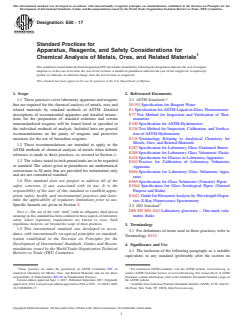
(Practice)Standard Practices for Apparatus, Reagents, and Safety Considerations for Chemical Analysis of Metals, Ores, and Related Materials
General Information
- Abstract
SIGNIFICANCE AND USE
4.1 The inclusion of the following paragraph, or a suitable equivalent, in any standard (preferably after the section on Scope) is due notification that the apparatus and reagents required in that standard are subject to the recommendations set forth in these practices.
“Apparatus and Reagents—Apparatus and reagents required for each determination are listed in separate sections preceding the procedure. Apparatus, standard solutions, and certain other reagents shall conform to the requirements prescribed in ASTM Practices E50, for Apparatus, Reagents, and Safety Considerations for Chemical Analysis of Metals, Ores, and Related Materials.”
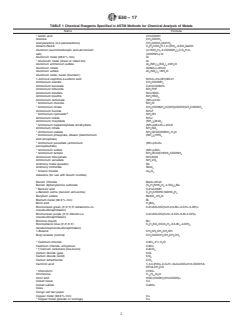
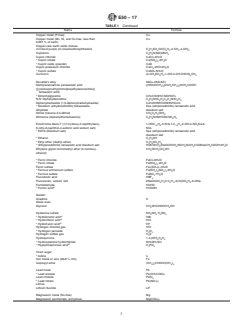
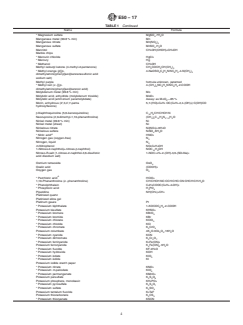
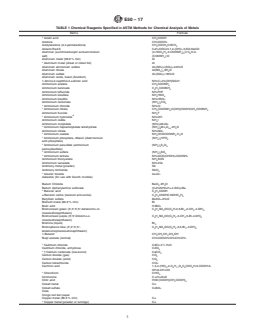
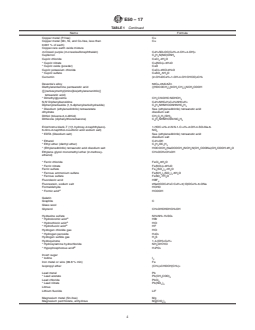
TABLE 1 Chemical Reagents Specified in ASTM Methods for Chemical Analysis of Metals
Name
Formula
* Acetic acid
CH3COOH
Acetone
CH3COCH3
Acetylacetone (2,4-pentanedione)
CH3COCH2COCH3
Alizarin-Red-S
C6H4COC6H-1,2-(OH)2-3-SO3NaCO
Aluminon (aurintricarboxylic acid-ammonium salt)
(4-HOC6H3-3-COONH4)2C:C6H-3-(COONH4):O
Aluminum metal (99.9 % min)
Al
* Aluminum metal (sheet or rolled foil)
Al
Aluminum ammonium sulfate
Al2(NH4)2(SO4)4·24H2O
Aluminum nitrate
Al(NO3)3·9H2O
Aluminum sulfate
Al2(SO4)3·18H2O
Aluminum oxide, fused (Alundum)
1-Amino-2-naphthol-4-sulfonic acid
NH2C10H5(OH)SO3H
Ammonium acetate
CH3COONH4
Ammonium benzoate
C6H5COONH4
Ammonium bifluoride
NH4FHF
Ammonium bisulfate
NH4HSO4
Ammonium bisulfite
NH4HSO3
Ammonium carbonate
(NH4)2CO3
* Ammonium chloride
NH4Cl
* Ammonium citrate
CH2(COONH4)C(OH)(COOH)CH2COONH4
Ammonium fluoride
NH4F
* Ammonium hydroxideA
NH4OH
Ammonium iodide
NH4I
Ammonium molybdate
(NH4)2MoO4
* Ammonium heptamolybdate tetrahydrate
(NH4)6Mo7O24·4H2O
Ammonium nitrate
NH4NO3
* Ammonium oxalate
NH4OCOCOONH4·H2O
* Ammonium phosphate, dibasic (diammonium acid phosphate)
(NH4)2HPO4
* Ammo...
SCOPE
1.1 These practices cover laboratory apparatus and reagents that are required for the chemical analysis of metals, ores and related materials by standard methods of ASTM. Detailed descriptions of recommended apparatus and detailed instructions for the preparation of standard solutions and certain nonstandardized reagents will be found listed or specified in the individual methods of analysis. Included here are general recommendations on the purity of reagents and protective measures for the use of hazardous reagents.
1.2 These recommendations are intended to apply to the ASTM methods of chemical analysis of metals when definite reference is made to these practices, as covered in Section 4.
1.3 The values stated in inch-pound units are to be regarded as standard. The values given in parentheses are mathematical conversions to SI units that are provided for information only and are not considered standard.
1.4 This standard does not purport to address all of the safety concerns, if any, associated with its use. It is the responsibility of the user of this standard to establish appropriate safety, health, and environmental practices and determine the applicability of regulatory limitations prior to use. Specific hazards are given in Section 8.
Note 1: The use of the verb “shall” (with its obligatory third person meaning) in this standard has been confined to those aspects of laboratory safety where regulatory requirements are known to exist. Such regulations, however, are beyond the scope of these practices.
1.5 This international standard was developed in accordance with internationally recognized principles on standardization established in the Decision on Principles for the Development of International Standards, Guides and Recommendations issued by the World Trade Organization Technical Barriers to Trade (TBT) Committee.
- Status
- Published
- Publication Date
- 31-Aug-2017
- Technical Committee
- E01 - Analytical Chemistry for Metals, Ores, and Related Materials
- Drafting Committee
- E01.20 - Fundamental Practices
Buy Documents
ASTM E50-17 - Standard Practices for Apparatus, Reagents, and Safety Considerations for Chemical Analysis of Metals, Ores, and Related Materials
REDLINE ASTM E50-17 - Standard Practices for Apparatus, Reagents, and Safety Considerations for Chemical Analysis of Metals, Ores, and Related Materials
Overview
ASTM E50-17 - Standard Practices for Apparatus, Reagents, and Safety Considerations for Chemical Analysis of Metals, Ores, and Related Materials provides essential guidelines for laboratories performing chemical analysis on metals, ores, and related materials. Developed by ASTM International, this standard specifies best practices for selecting and maintaining laboratory apparatus, preparing and qualifying reagents, and establishing safety procedures. The practices covered ensure accurate, reproducible results while safeguarding personnel and facilities.
This standard is applicable when referenced by ASTM analytical methods and is recognized for its harmonization with international standardization principles, supporting laboratories aiming for global compliance and best practice.
Key Topics
Laboratory Apparatus
Recommends the use of borosilicate glassware or properly calibrated plastic labware, with tolerances and physical properties outlined for critical instruments like burets, flasks, pipets, and more. It emphasizes regular calibration and equipment verification according to ASTM and international specifications.Chemical Reagents and Solutions
Provides a comprehensive list of chemical reagents commonly used in the analysis of metals and ores, including criteria for reagent purity and preparation instructions for standard and nonstandard solutions. It cites adherence to American Chemical Society (ACS) specifications where available, and encourages validation of reagent suitability through blanks and quality checks.Water Quality
Specifies the use of reagent-grade water (Type I or II, ASTM D1193) for the preparation of solutions and cleaning of apparatus, ensuring sample integrity and measurement accuracy.Safety and Risk Management
Offers robust guidance on laboratory safety plans, hazard identification, use of personal protective equipment (PPE), emergency equipment, and safe handling of hazardous reagents. Compliance with local, state, and federal regulations is emphasized, along with the need for ongoing personnel training and effective safety protocols.
Applications
The ASTM E50-17 standard is vital for:
Laboratory Managers and Analysts
Ensuring laboratory operations meet standardized criteria for apparatus and reagent selection, preparation, and use, directly contributing to the reliability and accuracy of results in chemical analysis.Quality Assurance Programs
Integrating ASTM E50-17 facilitates compliance with quality management systems in analytical laboratories, supporting traceability, calibration, and proper documentation of materials and procedures.Regulatory and Method Compliance
Laboratories adhering to standard methods that reference ASTM E50 are prepared for audits and can demonstrate compliance with internationally recognized safety and technical requirements.Industrial Sectors
Widely used in mining, metallurgy, environmental testing, and manufacturing where trace elemental analysis is crucial for process control, product certification, or environmental compliance.
Related Standards
- ASTM D1193 - Specification for Reagent Water
- ASTM E1, E77 - Thermometer standards for laboratory use
- ASTM E287, E288, E438, E542, E694, E969, E1044 - Standards for volumetric glassware and calibration
- ASTM E135 - Terminology relating to analytical chemistry for metals and ores
- ASTM E1621 - Guide for elemental analysis by X-ray fluorescence spectrometry
- DIN EN ISO 1042 - Laboratory glassware - One-mark volumetric flasks
Practical Value
By following ASTM E50-17, laboratories ensure that their chemical analysis of metals and ores is conducted with rigor, reliability, and safety. The clear specifications for apparatus, reagents, and protective measures reduce the risk of analytical errors and workplace incidents, helping organizations demonstrate due diligence and technical excellence in routine and regulatory-driven testing environments.
Keywords: ASTM E50-17, chemical analysis, metals analysis, laboratory apparatus, chemical reagents, laboratory safety, ASTM standards, analytical chemistry, ore analysis, quality assurance.
Relations
- Effective Date
- 01-Sep-2017
- Effective Date
- 01-Feb-2024
- Effective Date
- 01-Feb-2024
- Refers
ASTM E1044-96(2024) - Standard Specification for Glass Serological Pipets (General Purpose and Kahn) - Effective Date
- 01-Feb-2024
- Effective Date
- 01-Jan-2020
- Effective Date
- 01-Jul-2019
- Effective Date
- 01-Jul-2019
- Effective Date
- 15-May-2019
- Effective Date
- 01-May-2019
- Effective Date
- 01-May-2019
- Effective Date
- 01-Jan-2018
- Refers
ASTM E1044-96(2018) - Standard Specification for Glass Serological Pipets (General Purpose and Kahn) - Effective Date
- 01-Jan-2018
- Effective Date
- 01-Jan-2018
- Effective Date
- 01-Nov-2017
- Effective Date
- 15-May-2016
Buy Documents
ASTM E50-17 - Standard Practices for Apparatus, Reagents, and Safety Considerations for Chemical Analysis of Metals, Ores, and Related Materials
REDLINE ASTM E50-17 - Standard Practices for Apparatus, Reagents, and Safety Considerations for Chemical Analysis of Metals, Ores, and Related Materials
Get Certified
Connect with accredited certification bodies for this standard

Element Materials Technology
Materials testing and product certification.

Inštitut za kovinske materiale in tehnologije
Institute of Metals and Technology. Materials testing, metallurgical analysis, NDT.
Sponsored listings
Frequently Asked Questions
ASTM E50-17 is a standard published by ASTM International. Its full title is "Standard Practices for Apparatus, Reagents, and Safety Considerations for Chemical Analysis of Metals, Ores, and Related Materials". This standard covers: SIGNIFICANCE AND USE 4.1 The inclusion of the following paragraph, or a suitable equivalent, in any standard (preferably after the section on Scope) is due notification that the apparatus and reagents required in that standard are subject to the recommendations set forth in these practices. “Apparatus and Reagents—Apparatus and reagents required for each determination are listed in separate sections preceding the procedure. Apparatus, standard solutions, and certain other reagents shall conform to the requirements prescribed in ASTM Practices E50, for Apparatus, Reagents, and Safety Considerations for Chemical Analysis of Metals, Ores, and Related Materials.” TABLE 1 Chemical Reagents Specified in ASTM Methods for Chemical Analysis of Metals Name Formula * Acetic acid CH3COOH Acetone CH3COCH3 Acetylacetone (2,4-pentanedione) CH3COCH2COCH3 Alizarin-Red-S C6H4COC6H-1,2-(OH)2-3-SO3NaCO Aluminon (aurintricarboxylic acid-ammonium salt) (4-HOC6H3-3-COONH4)2C:C6H-3-(COONH4):O Aluminum metal (99.9 % min) Al * Aluminum metal (sheet or rolled foil) Al Aluminum ammonium sulfate Al2(NH4)2(SO4)4·24H2O Aluminum nitrate Al(NO3)3·9H2O Aluminum sulfate Al2(SO4)3·18H2O Aluminum oxide, fused (Alundum) 1-Amino-2-naphthol-4-sulfonic acid NH2C10H5(OH)SO3H Ammonium acetate CH3COONH4 Ammonium benzoate C6H5COONH4 Ammonium bifluoride NH4FHF Ammonium bisulfate NH4HSO4 Ammonium bisulfite NH4HSO3 Ammonium carbonate (NH4)2CO3 * Ammonium chloride NH4Cl * Ammonium citrate CH2(COONH4)C(OH)(COOH)CH2COONH4 Ammonium fluoride NH4F * Ammonium hydroxideA NH4OH Ammonium iodide NH4I Ammonium molybdate (NH4)2MoO4 * Ammonium heptamolybdate tetrahydrate (NH4)6Mo7O24·4H2O Ammonium nitrate NH4NO3 * Ammonium oxalate NH4OCOCOONH4·H2O * Ammonium phosphate, dibasic (diammonium acid phosphate) (NH4)2HPO4 * Ammo... SCOPE 1.1 These practices cover laboratory apparatus and reagents that are required for the chemical analysis of metals, ores and related materials by standard methods of ASTM. Detailed descriptions of recommended apparatus and detailed instructions for the preparation of standard solutions and certain nonstandardized reagents will be found listed or specified in the individual methods of analysis. Included here are general recommendations on the purity of reagents and protective measures for the use of hazardous reagents. 1.2 These recommendations are intended to apply to the ASTM methods of chemical analysis of metals when definite reference is made to these practices, as covered in Section 4. 1.3 The values stated in inch-pound units are to be regarded as standard. The values given in parentheses are mathematical conversions to SI units that are provided for information only and are not considered standard. 1.4 This standard does not purport to address all of the safety concerns, if any, associated with its use. It is the responsibility of the user of this standard to establish appropriate safety, health, and environmental practices and determine the applicability of regulatory limitations prior to use. Specific hazards are given in Section 8. Note 1: The use of the verb “shall” (with its obligatory third person meaning) in this standard has been confined to those aspects of laboratory safety where regulatory requirements are known to exist. Such regulations, however, are beyond the scope of these practices. 1.5 This international standard was developed in accordance with internationally recognized principles on standardization established in the Decision on Principles for the Development of International Standards, Guides and Recommendations issued by the World Trade Organization Technical Barriers to Trade (TBT) Committee.
SIGNIFICANCE AND USE 4.1 The inclusion of the following paragraph, or a suitable equivalent, in any standard (preferably after the section on Scope) is due notification that the apparatus and reagents required in that standard are subject to the recommendations set forth in these practices. “Apparatus and Reagents—Apparatus and reagents required for each determination are listed in separate sections preceding the procedure. Apparatus, standard solutions, and certain other reagents shall conform to the requirements prescribed in ASTM Practices E50, for Apparatus, Reagents, and Safety Considerations for Chemical Analysis of Metals, Ores, and Related Materials.” TABLE 1 Chemical Reagents Specified in ASTM Methods for Chemical Analysis of Metals Name Formula * Acetic acid CH3COOH Acetone CH3COCH3 Acetylacetone (2,4-pentanedione) CH3COCH2COCH3 Alizarin-Red-S C6H4COC6H-1,2-(OH)2-3-SO3NaCO Aluminon (aurintricarboxylic acid-ammonium salt) (4-HOC6H3-3-COONH4)2C:C6H-3-(COONH4):O Aluminum metal (99.9 % min) Al * Aluminum metal (sheet or rolled foil) Al Aluminum ammonium sulfate Al2(NH4)2(SO4)4·24H2O Aluminum nitrate Al(NO3)3·9H2O Aluminum sulfate Al2(SO4)3·18H2O Aluminum oxide, fused (Alundum) 1-Amino-2-naphthol-4-sulfonic acid NH2C10H5(OH)SO3H Ammonium acetate CH3COONH4 Ammonium benzoate C6H5COONH4 Ammonium bifluoride NH4FHF Ammonium bisulfate NH4HSO4 Ammonium bisulfite NH4HSO3 Ammonium carbonate (NH4)2CO3 * Ammonium chloride NH4Cl * Ammonium citrate CH2(COONH4)C(OH)(COOH)CH2COONH4 Ammonium fluoride NH4F * Ammonium hydroxideA NH4OH Ammonium iodide NH4I Ammonium molybdate (NH4)2MoO4 * Ammonium heptamolybdate tetrahydrate (NH4)6Mo7O24·4H2O Ammonium nitrate NH4NO3 * Ammonium oxalate NH4OCOCOONH4·H2O * Ammonium phosphate, dibasic (diammonium acid phosphate) (NH4)2HPO4 * Ammo... SCOPE 1.1 These practices cover laboratory apparatus and reagents that are required for the chemical analysis of metals, ores and related materials by standard methods of ASTM. Detailed descriptions of recommended apparatus and detailed instructions for the preparation of standard solutions and certain nonstandardized reagents will be found listed or specified in the individual methods of analysis. Included here are general recommendations on the purity of reagents and protective measures for the use of hazardous reagents. 1.2 These recommendations are intended to apply to the ASTM methods of chemical analysis of metals when definite reference is made to these practices, as covered in Section 4. 1.3 The values stated in inch-pound units are to be regarded as standard. The values given in parentheses are mathematical conversions to SI units that are provided for information only and are not considered standard. 1.4 This standard does not purport to address all of the safety concerns, if any, associated with its use. It is the responsibility of the user of this standard to establish appropriate safety, health, and environmental practices and determine the applicability of regulatory limitations prior to use. Specific hazards are given in Section 8. Note 1: The use of the verb “shall” (with its obligatory third person meaning) in this standard has been confined to those aspects of laboratory safety where regulatory requirements are known to exist. Such regulations, however, are beyond the scope of these practices. 1.5 This international standard was developed in accordance with internationally recognized principles on standardization established in the Decision on Principles for the Development of International Standards, Guides and Recommendations issued by the World Trade Organization Technical Barriers to Trade (TBT) Committee.
ASTM E50-17 is classified under the following ICS (International Classification for Standards) categories: 77.040.30 - Chemical analysis of metals. The ICS classification helps identify the subject area and facilitates finding related standards.
ASTM E50-17 has the following relationships with other standards: It is inter standard links to ASTM E50-11(2016), ASTM E694-18(2024), ASTM E438-92(2024), ASTM E1044-96(2024), ASTM E135-20, ASTM E287-02(2019), ASTM E969-02(2019), ASTM E135-19, ASTM E126-19, ASTM E100-19, ASTM E694-18, ASTM E1044-96(2018), ASTM E438-92(2018), ASTM E288-10(2017), ASTM E135-16. Understanding these relationships helps ensure you are using the most current and applicable version of the standard.
ASTM E50-17 is available in PDF format for immediate download after purchase. The document can be added to your cart and obtained through the secure checkout process. Digital delivery ensures instant access to the complete standard document.
Standards Content (Sample)
This international standard was developed in accordance with internationally recognized principles on standardization established in the Decision on Principles for the
Development of International Standards, Guides and Recommendations issued by the World Trade Organization Technical Barriers to Trade (TBT) Committee.
Designation:E50 −17
Standard Practices for
Apparatus, Reagents, and Safety Considerations for
Chemical Analysis of Metals, Ores, and Related Materials
This standard is issued under the fixed designation E50; the number immediately following the designation indicates the year of original
adoption or, in the case of revision, the year of last revision.Anumber in parentheses indicates the year of last reapproval.Asuperscript
epsilon (´) indicates an editorial change since the last revision or reapproval.
This standard has been approved for use by agencies of the U.S. Department of Defense.
1. Scope 2. Referenced Documents
1.1 These practices cover laboratory apparatus and reagents 2.1 ASTM Standards:
that are required for the chemical analysis of metals, ores and D1193 Specification for Reagent Water
related materials by standard methods of ASTM. Detailed E1 Specification for ASTM Liquid-in-Glass Thermometers
descriptions of recommended apparatus and detailed instruc- E77 Test Method for Inspection and Verification of Ther-
tions for the preparation of standard solutions and certain mometers
nonstandardized reagents will be found listed or specified in E100 Specification for ASTM Hydrometers
the individual methods of analysis. Included here are general E126 Test Method for Inspection, Calibration, and Verifica-
recommendations on the purity of reagents and protective tion of ASTM Hydrometers
measures for the use of hazardous reagents. E135 Terminology Relating to Analytical Chemistry for
Metals, Ores, and Related Materials
1.2 These recommendations are intended to apply to the
E287 Specification for Laboratory Glass Graduated Burets
ASTM methods of chemical analysis of metals when definite
E288 Specification for Laboratory Glass Volumetric Flasks
reference is made to these practices, as covered in Section 4.
E438 Specification for Glasses in Laboratory Apparatus
1.3 The values stated in inch-pound units are to be regarded
E542 Practice for Calibration of Laboratory Volumetric
as standard. The values given in parentheses are mathematical
Apparatus
conversions to SI units that are provided for information only
E694 Specification for Laboratory Glass Volumetric Appa-
and are not considered standard.
ratus
1.4 This standard does not purport to address all of the
E969 Specification for Glass Volumetric (Transfer) Pipets
safety concerns, if any, associated with its use. It is the
E1044 Specification for Glass Serological Pipets (General
responsibility of the user of this standard to establish appro- Purpose and Kahn)
priate safety, health, and environmental practices and deter-
E1621 Guide for ElementalAnalysis by Wavelength Disper-
mine the applicability of regulatory limitations prior to use. sive X-Ray Fluorescence Spectrometry
Specific hazards are given in Section 8.
2.2 ISO Standard
DIN EN ISO 1042 Laboratory glassware -- One-mark volu-
NOTE 1—The use of the verb “shall” (with its obligatory third person
meaning) in this standard has been confined to those aspects of laboratory metric flasks
safety where regulatory requirements are known to exist. Such
regulations, however, are beyond the scope of these practices.
3. Terminology
1.5 This international standard was developed in accor-
3.1 For definitions of terms used in these practices, refer to
dance with internationally recognized principles on standard-
Terminology E135.
ization established in the Decision on Principles for the
Development of International Standards, Guides and Recom-
4. Significance and Use
mendations issued by the World Trade Organization Technical
4.1 The inclusion of the following paragraph, or a suitable
Barriers to Trade (TBT) Committee.
equivalent, in any standard (preferably after the section on
1 2
These practices are under the jurisdiction of ASTM Committee E01 on For referenced ASTM standards, visit the ASTM website, www.astm.org, or
Analytical Chemistry for Metals, Ores, and Related Materials and are the direct contact ASTM Customer Service at service@astm.org. For Annual Book of ASTM
responsibility of Subcommittee E01.20 on Fundamental Practices. Standards volume information, refer to the standard’s Document Summary page on
Current edition approved Sept. 1, 2017. Published September 2017. Originally the ASTM website.
approved in 1943. Last previous edition approved in 2016 as E50 – 11 (2016). DOI: Available fromAmerican National Standards Institute (ANSI), 25 W. 43rd St.,
10.1520/E0050-17. 4th Floor, New York, NY 10036, http://www.ansi.org.
Copyright © ASTM International, 100 Barr Harbor Drive, PO Box C700, West Conshohocken, PA 19428-2959. United States
E50−17
TABLE 1 Chemical Reagents Specified in ASTM Methods for Chemical Analysis of Metals
Name Formula
* Acetic acid CH COOH
Acetone CH COCH
3 3
Acetylacetone (2,4-pentanedione) CH COCH COCH
3 2 3
Alizarin-Red-S C H COC H-1,2-(OH) -3-SO NaCO
6 4 6 2 3
Aluminon (aurintricarboxylic acid-ammonium (4-HOC H -3-COONH ) C:C H-3-
6 3 4 2 6
salt) (COONH ):O
Aluminum metal (99.9 % min) Al
* Aluminum metal (sheet or rolled foil) Al
Aluminum ammonium sulfate Al (NH ) (SO ) ·24H O
2 4 2 4 4 2
Aluminum nitrate Al(NO ) ·9H O
3 3 2
Aluminum sulfate Al (SO ) ·18H O
2 4 3 2
Aluminum oxide, fused (Alundum)
1-Amino-2-naphthol-4-sulfonic acid NH C H (OH)SO H
2 10 5 3
Ammonium acetate CH COONH
3 4
Ammonium benzoate C H COONH
6 5 4
Ammonium bifluoride NH FHF
Ammonium bisulfate NH HSO
4 4
Ammonium bisulfite NH HSO
4 3
Ammonium carbonate (NH ) CO
4 2 3
* Ammonium chloride NH Cl
* Ammonium citrate CH (COONH )C(OH)(COOH)CH COONH
2 4 2 4
Ammonium fluoride NH F
A
* Ammonium hydroxide NH OH
Ammonium iodide NH I
Ammonium molybdate (NH ) MoO
4 2 4
* Ammonium heptamolybdate tetrahydrate (NH ) Mo O ·4H O
4 6 7 24 2
Ammonium nitrate NH NO
4 3
* Ammonium oxalate NH OCOCOONH ·H O
4 4 2
* Ammonium phosphate, dibasic (diammonium (NH ) HPO
4 2 4
acid phosphate)
* Ammonium persulfate (ammonium (NH ) S O
4 2 2 8
peroxydisulfate)
* Ammonium sulfate (NH ) SO
4 2 4
* Ammonium tartrate NH OCO(CHOH) COONH
4 2 4
Ammonium thiocyanate NH SCN
Ammonium vanadate NH VO
4 3
Antimony metal (powder) Sb
Antimony trichloride SbCl
* Arsenic trioxide As O
2 3
Asbestos (for use with Gooch crucible)
Barium Chloride BaCl ·2H O
2 2
Barium diphenylamine sulfonate (C H NHC H -4-SO ) Ba
6 5 6 4 3 2
* Benzoic acid C H COOH
6 5
α-Benzoin oxime (benzoin anti-oxime) C H CHOHC:NOHC H
6 5 6 5
Beryllium sulfate BeSO ·4H O
4 2
Bismuth metal (99.9 % min) Bi
Boric acid H BO
3 3
Bromocresol green (3',39,5',59-tetrabromo-m- C H SO OC(C H-3,5-Br -2-CH -4-OH)
6 4 2 6 2 3 2
cresolsulfonephthalein)
Bromocresol purple (5',59-Dibromo-o- C H SO OC(C H -3-CH -5-Br-4-OH)
6 4 2 6 2 3 2
cresolsulfonephthalein)
Bromine (liquid) Br
Bromophenol blue (3',39,5',59- C H SO OC(C H -3,5-Br -4-OH)
6 4 2 6 2 2 2
tetrabromophenolsulfonephthalein)
1-Butanol CH CH CH CH OH
3 2 2 2
Butyl acetate (normal) CH COOCH CH CH CH
3 2 2 2 3
* Cadmium chloride CdCl ·2 ⁄2 H O
2 2
Cadmium chloride, anhydrous CdCl
* † Calcium carbonate (low-boron) CaCO
Carbon dioxide (gas) CO
Carbon dioxide (solid) CO
Carbon tetrachloride CCl
Carminic acid 1,3,4-(HO) -2-C H O C COC H-5-COOH-6-
3 6 11 6 6 6
OH-8-CH CO
* Chloroform CHCl
Cinchonine C H N O
19 22 2
Citric acid HOC(COOH)(CH COOH)
2 2
Cobalt metal Co
Cobalt sulfate CoSO
Coke
Congo red test paper
Copper metal (99.9 % min) Cu
* Copper metal (powder or turnings) Cu
E50−17
TABLE1 Continued
Name Formula
Copper metal (P-free) Cu
Copper metal (Mn, Ni, and Co-free, less than Cu
0.001 % of each)
Copper-rare earth oxide mixture
m-Cresol purple (m-cresolsulfonephthalein) C H SO OC(C H -2-CH -4-OH)
6 4 2 6 3 3 2
Cupferron C H N(NO)ONH
6 5 4
Cupric chloride CuCl ·2H O
2 2
* Cupric nitrate Cu(NO ) ·3H O
3 2 2
* Cupric oxide (powder) CuO
Cupric potassium chloride CuCl ·2KCl·2H O
2 2
* Cupric sulfate CuSO ·5H O
4 2
Curcumin (2-CH OC H -1-OH-4-CH:CHCO) CH
3 6 3 2 2
Devarda’s alloy 50Cu-45Al-5Zn
Diethylenetriamine pentaacetic acid ((HOCOCH ) NCH CH ) NCH COOH
2 2 2 2 2 2
([[(carboxymethyl)imino]bis(ethylenenenitrilo)]
tetraacetic acid)
* Dimethylglyoxime CH C:NOHC:NOHCH
3 3
N,N' Diphenylbenzidine C H NHC H C H NHC H
6 5 6 4 6 4 6 5
Diphenylcarbazide (1,5-diphenylcarbohydrazide) C H NHNHCONHNHC H
6 5 6 5
* Disodium (ethylenedinitrilo) tetraacetate See (ethylenedinitrilo) tetraacetic acid
dihydrate disodium salt
Dithiol (toluene-3,4-dithiol) CH C H (SH)
3 6 3 2
Dithizone (diphenylthiocarbazone) C H NHNHCSN:NC H
6 5 6 5
Eriochrome black-T (1(1-hydroxy-2-naphthylazo)- 1-HOC H -2-N:N-1-C H -2-OH-4-SO Na-6-
10 6 10 4 3
6-nitro-2-naphthol-4-sulfonic acid sodium salt) NO
* EDTA (Disodium salt) See (ethylenedinitrilo) tetraacetic acid
disodium salt
* Ethanol C H OH
2 5
* Ethyl ether (diethyl ether) C H OC H
2 5 2 5
* (Ethylenedinitrilo) tetraacetic acid disodium salt HOCOCH (NaOCOCH )NCH N(CH COONa)CH COOH·2H O
2 2 2 2 2 2
Ethylene glycol monomethyl ether (2-methoxy- CH OCH CH OH
3 2 2
ethanol)
* Ferric chloride FeCl ·6H O
3 2
* Ferric nitrate Fe(NO ) ·9H O
3 3 2
Ferric sulfate Fe (SO ) ·nH O
2 4 3 2
* Ferrous ammonium sulfate Fe(NH ) (SO ) ·6H O
4 2 4 2 2
* Ferrous sulfate FeSO ·7H O
4 2
Fluoroboric acid HBF
Fluorescein, sodium salt 2NaOCOC H C:C H -3(:O)OC H -6-ONa
6 4 6 3 6 3
Formaldehyde HCHO
A
* Formic acid HCOOH
Gelatin
Graphite C
Glass wool
Glycerol CH OHCHOHCH OH
2 2
Hydrazine sulfate NH NH ·H SO
2 2 2 4
A
* Hydrobromic acid HBr
A
* Hydrochloric acid HCl
A
* Hydrofluoric acid HF
Hydrogen chloride gas HCl
* Hydrogen peroxide H O
2 2
Hydrogen sulfide gas H S
Hydroquinone 1,4-(OH) C H
2 6 4
* Hydroxylamine hydrochloride NH OH·HCl
B
* Hypophosphorous acid H PO
3 2
Invert sugar
* Iodine I
Iron metal or wire (99.8 % min) Fe
Isopropyl ether (CH ) CHOCH(CH )
3 2 3 2
Lead metal Pb
* Lead acetate Pb(CH COO)
3 2
Lead chloride PbCl
* Lead nitrate Pb(NO )
3 2
Litmus
Lithium fluoride LiF
Magnesium metal (Sn-free) Mg
Magnesium perchlorate, anhydrous Mg(ClO )
4 2
E50−17
TABLE1 Continued
Name Formula
* Magnesium sulfate MgSO ·7H O
4 2
Manganese metal (99.8 % min) Mn
Manganous nitrate Mn(NO )
3 2
Manganous sulfate MnSO ·H O
4 2
Mannitol CH OH(CHOH) CH OH
2 4 2
Marble chips
* Mercuric chloride HgCl
* Mercury Hg
* Methanol CH OH
Methyl isobutyl ketone (4-methyl-2-pentanone) CH COCH CH(CH )
3 2 3 2
* Methyl orange (p[[p- 4-NaOSO C H N:NC H -4-N(CH )
2 6 4 6 4 3 2
dimethylamino)phenyl]azo]benzenesulfonic acid
sodium salt)
Methyl purple formula unknown, patented
* Methyl red (o -[[(p- 4-(CH ) NC H N:NC H -2-COOH
3 2 6 4 6 4
dimethylamino)phenyl]azo]benzoic acid)
Molybdenum metal (99.8 % min) Mo
Molybdic acid, anhydride (molybdenum trioxide) MoO
Molybdic acid (ammonium paramolybdate) Assay: as MoO —85 %
Morin, anhydrous (2',3,4',7-penta 5,7-(HO) C H OC(C H -2,4-(OH) ):C(OH)CO
2 6 2 6 3 2
hydroxyflavone)
β-Naphthoquinoline (5,6-benzoquinoline) C H CH:CHCH:N
10 6
Neocuproine (2,9-dimethyl-1,10-phenanthroline) (CH ) C H N · H O
3 2 12 6 2 12 2
Nickel metal (99.8 % min) Ni
Nickel metal (sheet) Ni
Nickelous nitrate Ni(NO ) ·6H O
3 2 2
Nickelous sulfate NiSO ·6H O
4 2
A
* Nitric acid HNO
Nitrogen gas (oxygen-free) N
Nitrogen, liquid N
m-Nitrophenol NO C H OH
2 6 4
1-Nitroso-2-naphthol(α-nitroso-β-naphthol) NOC H OH
10 6
Nitroso-R-salt (1-nitroso-2-naphthol-3,6-disulfonic 1-NOC H -2-(OH)-3,6-(SO Na)
10 4 3 2
acid disodium salt)
Osmium tetraoxide OsO
Oxalic acid (COOH)
Oxygen gas O
A
* Perchloric acid HClO
1,10-Phenanthroline (o -phenanthroline) CH:CHCH:NC:CCH:CHC:CN:CHCH:CH·H O
* Phenolphthalein C H COOC(C H -4-OH)
6 4 6 4 2
* Phosphoric acid H PO
3 4
Piperidine NH(CH ) CH
2 4 2
Platinized quartz
Platinized silica gel
Platinum gauze Pt
* Potassium biphthalate 1-KOCOC H -2-COOH
6 4
Potassium bisulfate KHSO
* Potassium bromate KBrO
* Potassium bromide KBr
* Potassium chlorate KClO
* Potassium chloride KCl
* Potassium chromate K CrO
2 4
Potassium columbate 4K O·3Cb O ·16H O
2 2 5 2
* Potassium cyanide KCN
* Potassium dichromate K Cr O
2 2 7
* Potassium ferricyanide K Fe(CN)
3 6
Potassium ferrocyanide K Fe(CN) ·3H O
4 6 2
* Potassium fluoride KF·2H O
* Potassium hydroxide KOH
* Potassium iodate KIO
* Potassium iodide KI
Potassium iodide starch paper
* Potassium nitrate KNO
* Potassium m-periodate KIO
* Potassium permanganate KMnO
Potassium persulfate K S O
2 2 8
Potassium phosphate, monobasic KH PO
2 4
* Potassium pyrosulfate K S O
2 2 7
* Potassium sulfate K SO
2 4
Potassium tantalum fluoride K TaF
Potassium thiocarbonate K CS
2 3
* Potassium thiocyanate KSCN
E50−17
TABLE1 Continued
Name Formula
Pyrogallic acid (pyrogallol) C H -1,3-(OH)
6 3 3
Quinine sulfate (C H N O ) ·H SO ·2H O
20 24 2 2 2 2 4 2
8-Quinolinol (8-hydroxyquinoline) HOC H N:CHCH:CH
6 3
Sebacic acid HOCO(CH ) COOH
2 8
Selenium (powder) Se
Silicon dioxide (silica) SiO
* Silver nitrate AgNO
Soda-lime
Soda-mica mineral (CO absorbent)
Sodium acetate CH COONa
Sodium arsenite NaAsO
Sodium azide NaN
* Sodium bicarbonate NaHCO
* Sodium bismuthate NaBiO
Sodium bisulfate see sodium hydrogen sulfate
* Sodium bisulfate, fused see sodium hydrogen sulfate, fused
Sodium bisulfite NaHSO
* Sodium borate Na B O ·10H O
2 4 7 2
* Sodium carbonate, anhydrous Na CO
2 3
Sodium chlorate NaClO
Sodium chloride NaCl
Sodium citrate HOC(COONa)(CH COONa) ·2H O
2 2 2
Sodium cyanide NaCN
Sodium diethyldithiocarbamate (C H ) NCSSNa·3H O
2 5 2 2
Sodium dimethylglyoximate CH C(:NONa)C(:NONa)CH ·8H O
3 3 2
Sodium diphenylamine sulfonate C H NHC H -4-SO Na
6 5 6 4 3
Sodium dithionite (hydrosulfite) Na S O
2 2 4
* Sodium fluoride NaF
Sodium hydrogen sulfate NaHSO
Sodium hydrogen sulfate, fused A mixture of Na S O and NaHSO
2 2 7 4
* Sodium hydroxide NaOH
Sodium hypophosphite NaH PO ·H O
2 2 2
Sodium molybdate Na MoO ·2H O
2 4 2
Sodium nitrate NaNO
Sodium nitrite NaNO
Sodium oxalate NaOCOCOONa
Sodium perchlorate NaClO
Sodium peroxide Na O
2 2
Sodium phosphate, dibasic, anhydrous Na HPO
2 4
Sodium pyrophosphate Na P O ·10H O
4 2 7 2
Sodium pyrosulfate Na S O
2 2 7
Sodium sulfate, anhydrous Na SO
2 4
Sodium sulfide Na S·9H O
2 2
Sodium sulfite Na SO ·7H O
2 3 2
Sodium sulfite, anhydrous Na SO
2 3
Sodium thiocyanate NaSCN
* Sodium thiosulfate Na S O ·5H O
2 2 3 2
* Sodium tungstate Na WO ·2H O
2 4 2
* Stannous chloride SnCl ·2H O
2 2
* Starch (C H O )
6 10 5 x
Succinic acid HOCOCH CH COOH
2 2
Sulfamic acid NH SO H
2 3
Sulfatoceric acid (ceric sulfate) H Ce(SO )
4 4 4
5-Sulfosalicylic acid 2-HOC H -1-COOH-5-SO H·2H O
6 3 3 2
Sulfur dioxide gas SO
A
* Sulfuric acid H SO
2 4
A
* Sulfurous acid H SO
2 3
Talc
* Tartaric acid HOCO(CHOH) COOH
Test lead Pb
Tetrapropylammonium hydroxide (CH CH CH ) NOH
3 2 2 4
Thioglycollic acid (mercaptoacetic acid) CH SHCOOH
Thiourea NH CSNH
2 2
Tin metal (99.9 %min) Sn
Titanium dioxide TiO
Titanium metal (low Sn) Ti
Triethanolamine (2,2',29-nitrilotriethanol) (CH OHCH ) N
2 2 3
Uranium oxide U O
3 8
* Uranyl nitrate UO (NO ) ·6H O
2 3 2 2
Urea NH CONH
2 2
E50−17
TABLE1 Continued
Name Formula
Zinc (99.9 % min) Zn
Zinc metal (S-free) Zn
Zinc oxide ZnO
Zinc sulfate ZnSO ·7H O
4 2
Zirconium oxide ZrO
Zirconium metal Zr
Zirconyl chloride ZrOCl ·8H O
2 2
A
* Reagent on which ACS specifications exist.
† ACS specification exists but does not cover all requirements.
For concentration of laboratory reagent, see Table 2.
B
Contains at least 50 % H PO .
3 2
Scope) is due notification that the apparatus and reagents accuracyofthedetermination.Inadditiontothis,itisdesirable
required in that standard are subject to the recommendations in many cases for the analyst to ensure the accuracy of his
set forth in these practices. results by running blanks or checking against a comparable
sample of known composition.
“Apparatus and Reagents—Apparatus and reagents required for each
determination are listed in separate sections preceding the procedure.
Apparatus, standard solutions, and certain other reagents shall conform to
6. Reagents
the requirements prescribed in ASTM Practices E50, for Apparatus,
Reagents, and Safety Considerations for Chemical Analysis of Metals, 6.1 Concentrated Acids, Ammonium Hydroxide, and Hydro-
Ores, and Related Materials.”
gen Peroxide—When acids, ammonium hydroxide, and hydro-
4.2 It is assumed that the users of these practices will be gen peroxide are specified by name or chemical formula only,
trained analysts capable of performing common laboratory it is understood that concentrated reagents of the specific
proceduresskillfullyandsafely.Itisexpectedthatworkwillbe gravities or concentrations shown in Table 2 are intended. The
performed in a properly-equipped laboratory. specific gravities or concentrations of all other concentrated
acids are stated wherever they are specified.
5. Purity of Water and Reagents
6.2 Diluted Acids and Ammonium Hydroxide—
5.1 Purity of Water—Unless otherwise indicated, references
Concentrations of diluted acids and ammonium hydroxide,
towatershallbeunderstoodtomeanreagentwaterconforming
except when standardized, are specified as a ratio stating the
to Type I or II of Specification D1193. Type III or IV may be
number of volumes of the concentrated reagent to be diluted
used if they effect no measurable change in the blank or
with a given number of volumes of water, as in the following
sample.
example: HCl (5 + 95) means 5 volumes of concentrated HCl
(sp gr 1.19) diluted with 95 volumes of water.
5.2 Reagents—Unless otherwise indicated, it is intended
thatallreagentsconformtothespecificationsoftheCommittee
6.3 Standard Solutions—Concentrations of standard solu-
on Analytical Reagents of the American Chemical Society
tions are stated as molarities or normalities, expressed deci-
when such specifications are available. Other grades may be
mally; or the equivalent of 1 mLof solution in terms of grams,
used, provided it is first ascertained that the reagent is of
milligrams, or micrograms of a given element expressed as “1
sufficiently high purity to permit its use without lessening the
mL = x.xx—g, mg, or µg of.”
6.4 Nonstandard Solutions—Composition of nonstandard
solutions prepared by dissolving a given mass of the solid
Reagent Chemicals, American Chemical Society Specifications, American
Chemical Society, Washington, DC, www.chemistry.org . For suggestions on the reagent in a solvent are specified in grams of the salt as
testing of reagents not listed by the American Chemical Society, see the United
weighed per litre of solution, and it is understood that water is
States Pharmacopeiaand 4.2 National Formulary,U.S.PharmacopeialConvention,
the solvent unless otherwise specified. For example, to prepare
Inc. (USPC), Rockville, MD, www.usp.org.
TABLE 2 Composition of Acids, Ammonium Hydroxide, and Hydrogen Peroxide
Specific
Reagent, Mass Fraction, %
Name Formula Gravity,
Nominal Min Max
Approximate
Acetic acid CH COOH 1.05 . 99.5 .
Formic acid HCOOH 1.20 . 88.0 .
Hydrobromic acid HBr 1.49 48 47.0 49.0
Hydrochloric acid HCl 1.19 . 35.0 38.0
Hydrofluoric acid HF 1.15 . 48.0 51.0
Nitric acid HNO 1.42 . 69.0 71.0
Perchloric acid HClO 1.67 . 70.0 72.0
Phosphoric acid H PO 1.69 . 85.0 .
3 4
Sulfuric acid H SO 1.84 . 95.0 98.0
2 4
Sulfurous acid H SO 1.03 . 6.0(SO ) .
2 3 2
Ammonium hydroxide NH OH 0.90 . 27.0(NH ) 30.0 (NH )
4 3 3
Hydrogen peroxide H O 1.10 30 28.0 .
2 2
E50−17
barium chloride solution (100 g/L) dissolve 100 g of barium plastics. The two basic modes of interaction that can cause
chloride (BaCl ·2H O) in water and dilute to 1 L. In the case these changes are described in 7.2.3.1 – 7.2.3.4.
2 2
ofcertain reagents, thecompositionmaybespecifiedasamass
7.2.3.1 Chemical—The analytical reagents can react with
fraction percent. For example, H O (3 %) means a solution
2 2 the polymer chain by oxidation, by attack on functional groups
containing3gofH O per 100 g of solution. Other nonstan-
2 2 in or on the polymer molecule, or by depolymerization with a
dard solutions may be specified by name only and the
resultant deterioration in physical properties.
designation of the composition of such solutions will be
7.2.3.2 Physical—Absorption of solvents in the plastic can
governed by the instructions for their preparation.
result in softening, swelling, and permeation of the solvent
5,6 through the plastic. No room temperature solvents are known
7. Laboratory Ware (1,2)
for the polyolefins, however, they are best not used to store
7.1 Glassware—Unless otherwise stated all analytical meth-
reagents. Reagents such as NH ,Br ,H S, and nitrogen oxides
3 2 2
ods are conducted in borosilicate glassware.
may be absorbed from reagent solutions by the plastic and
7.1.1 Tolerances—All glass apparatus and vessels used in
becomeasourceoferrorbysubsequentreleasewhenthevessel
analytical work must be carefully selected and calibrated to
is used for a different analysis.Atmospheric contaminants may
meet the particular requirements for each operation. Standard
diffuse through the plastic and spoil contained reagents or
volumetric flasks, burets, and pipets must be of Class A or B
samples. Other polymer types may dissolve in some solvents.
within the tolerances established by the National Institute of
Plastic labware may crack from interaction of a “stress
Standards and Technology and ASTM.
cracking agent” (present, possibly in the solution to be ana-
7.1.2 Types—Glasses are available which include colored
lyzed) with molded-in stresses. This is, however, a long-time
glass for the protection of solutions affected by light, alkali-
phenomenon and is normally not a factor in analytical work
resistant glass, and high-silica glass having exceptional resis-
because contact times usually are limited and the labware is
tance to thermal shock. Standard-taper, interchangeable,
washed regularly.
ground-glass joints are very useful in analytical work.
7.2.3.3 Some plastics may contain small amounts of metals
7.2 Plastic Labware:
used as catalysts during manufacture. Such metals may dis-
7.2.1 Tolerances—All plastic apparatus and vessels used in
solve in the analytical reagent system and cause interference,
analytical work should be procured to meet the particular
particularly when small amounts of metals are to be deter-
requirements for each operation. Standard volumetric flasks,
mined.
burets, and pipets must be of precision grade within the
7.2.3.4 A general indication of the effect of individual
tolerancesestablishedinDINENISO1042forthecorrespond-
reagents can often be obtained from manufacturers’ publica-
ing types of plastic labware (see 7.2.4).
tions. It is important, of course, to consider that exposure time,
7.2.2 Physical Properties—There are a number of physical
temperature, amount, and other reagents in the system may
properties which influence the usefulness of plastic labware
alter the effects of a given reagent on a given plastic. Because
(Table 3).
of these factors, the plastic labware must be thoroughly tested
7.2.3 Compatibility—Many reagents can affect the strength,
under the conditions of the method. The type of plastic
flexibility, surface appearance, color, dimensions, or weight of
labware (see footnote B of Table 3) will be found specified in
the method as well as any special precautions for its use.
7.2.4 Precautions—Most plastic labware must not be used
with strong oxidants at elevated temperatures; or exposed to
The boldface numbers in parentheses refer to the list of references at the end of
these practices.
For further information the following ASTM Standards may be consulted:
Volumetric Labware: Specifications E287, E288, and E438; Practice E542; and
From the publications of the Nalgene Labware, www.nalgenelabware.com.
Specifications E694, E969, and E1044. Thermometers: Specification E1 and Test
Method E77. Hydrometers: Specification E100 and Test Method E126.
A
TABLE 3 Physical Properties of Plastic Labware
Brittleness
B
Plastic Temperature Limit,° C Specific Gravity Water Absorption, % Flexibility Transparency
Temperature,° C
CPE 80 0.92 −100 <0.01 excellent translucent
LPE 120 0.95 −196 <0.01 rigid translucent
PA 130 0.90 −40 <0.02 slight translucent
PP 135 0.90 0 <0.02 rigid translucent
PMP 175 0.83 −20 <0.01 rigid clear
FEP 205 2.15 −270 <0.01 excellent translucent
TFE 315 2.2 −265 <0.01 excellent translucent
PC 135 1.20 −135 0.35 rigid clear
SA 95 1.07 −25 0.23 rigid clear
ETFE 180 1.70 −100 0.1 moderate translucent
A
From the publications of the Nalgene Labware Div., Nalge Sybron Corp.
B
CPE, conventional (low density) polyethylene; LPE, linear (high density) polyethylene; PA, polyallomer (ethylene
...
This document is not an ASTM standard and is intended only to provide the user of an ASTM standard an indication of what changes have been made to the previous version. Because
it may not be technically possible to adequately depict all changes accurately, ASTM recommends that users consult prior editions as appropriate. In all cases only the current version
of the standard as published by ASTM is to be considered the official document.
Designation: E50 − 11 (Reapproved 2016) E50 − 17
Standard Practices for
Apparatus, Reagents, and Safety Considerations for
Chemical Analysis of Metals, Ores, and Related Materials
This standard is issued under the fixed designation E50; the number immediately following the designation indicates the year of original
adoption or, in the case of revision, the year of last revision. A number in parentheses indicates the year of last reapproval. A superscript
epsilon (´) indicates an editorial change since the last revision or reapproval.
This standard has been approved for use by agencies of the U.S. Department of Defense.
1. Scope
1.1 These practices cover laboratory apparatus and reagents that are required for the chemical analysis of metals, ores and
related materials by standard methods of ASTM. Detailed descriptions of recommended apparatus and detailed instructions for the
preparation of standard solutions and certain nonstandardized reagents will be found listed or specified in the individual methods
of analysis. Included here are general recommendations on the purity of reagents and protective measures for the use of hazardous
reagents.
1.2 These recommendations are intended to apply to the ASTM methods of chemical analysis of metals when definite reference
is made to these practices, as covered in Section 4.
1.3 The values stated in inch-pound units are to be regarded as standard. The values given in parentheses are mathematical
conversions to SI units that are provided for information only and are not considered standard.
1.4 This standard does not purport to address all of the safety concerns, if any, associated with its use. It is the responsibility
of whoever uses the user of this standard to consult and establish appropriate safety safety, health, and healthenvironmental
practices and determine the applicability of regulatory limitations prior to use. Specific hazards are given in Section 8.
NOTE 1—The use of the verb “shall” (with its obligatory third person meaning) in this standard has been confined to those aspects of laboratory safety
where regulatory requirements are known to exist. Such regulations, however, are beyond the scope of these practices.
1.5 This international standard was developed in accordance with internationally recognized principles on standardization
established in the Decision on Principles for the Development of International Standards, Guides and Recommendations issued
by the World Trade Organization Technical Barriers to Trade (TBT) Committee.
2. Referenced Documents
2.1 ASTM Standards:
D1193 Specification for Reagent Water
E1 Specification for ASTM Liquid-in-Glass Thermometers
E77 Test Method for Inspection and Verification of Thermometers
E100 Specification for ASTM Hydrometers
E126 Test Method for Inspection, Calibration, and Verification of ASTM Hydrometers
E135 Terminology Relating to Analytical Chemistry for Metals, Ores, and Related Materials
E287 Specification for Laboratory Glass Graduated Burets
E288 Specification for Laboratory Glass Volumetric Flasks
E438 Specification for Glasses in Laboratory Apparatus
E542 Practice for Calibration of Laboratory Volumetric Apparatus
E694 Specification for Laboratory Glass Volumetric Apparatus
E969 Specification for Glass Volumetric (Transfer) Pipets
E1044 Specification for Glass Serological Pipets (General Purpose and Kahn)
These practices are under the jurisdiction of ASTM Committee E01 on Analytical Chemistry for Metals, Ores, and Related Materials and are the direct responsibility
of Subcommittee E01.20 on Fundamental Practices.
Current edition approved Aug. 1, 2016Sept. 1, 2017. Published August 2016September 2017. Originally approved in 1943. Last previous edition approved in 20112016
as E50E50 – 11 (2016).–11. DOI: 10.1520/E0050-16.10.1520/E0050-17.
For referenced ASTM standards, visit the ASTM website, www.astm.org, or contact ASTM Customer Service at service@astm.org. For Annual Book of ASTM Standards
volume information, refer to the standard’s Document Summary page on the ASTM website.
Copyright © ASTM International, 100 Barr Harbor Drive, PO Box C700, West Conshohocken, PA 19428-2959. United States
E50 − 17
E1621 Guide for Elemental Analysis by Wavelength Dispersive X-Ray Fluorescence Spectrometry
2.2 ISO Standard
DIN EN ISO 1042 Laboratory glassware -- One-mark volumetric flasks
3. Terminology
3.1 For definitions of terms used in these practices, refer to Terminology E135E135.
4. Significance and Use
4.1 The inclusion of the following paragraph, or a suitable equivalent, in any standard (preferably after the section on Scope)
is due notification that the apparatus and reagents required in that standard are subject to the recommendations set forth in these
practices.
“Apparatus and Reagents—Apparatus and reagents required for each
determination are listed in separate sections preceding the procedure.
Apparatus, standard solutions, and certain other reagents shall conform to
the requirements prescribed in ASTM Practices E50, for Apparatus,
Reagents, and Safety Considerations for Chemical Analysis of Metals,
Ores, and Related Materials.”
4.2 It is assumed that the users of these practices will be trained analysts capable of performing common laboratory procedures
skillfully and safely. It is expected that work will be performed in a properly-equipped laboratory.
5. Purity of Water and Reagents
5.1 Purity of Water—Unless otherwise indicated, references to water shall be understood to mean reagent water conforming to
Type I or II of Specification D1193. Type III or IV may be used if they effect no measurable change in the blank or sample.
5.2 Reagents—Unless otherwise indicated, it is intended that all reagents conform to the specifications of the Committee on
Analytical Reagents of the American Chemical Society when such specifications are available. Other grades may be used,
provided it is first ascertained that the reagent is of sufficiently high purity to permit its use without lessening the accuracy of the
determination. In addition to this, it is desirable in many cases for the analyst to ensure the accuracy of his results by running blanks
or checking against a comparable sample of known composition.
6. Reagents
6.1 Concentrated Acids, Ammonium Hydroxide, and Hydrogen Peroxide—When acids, ammonium hydroxide, and hydrogen
peroxide are specified by name or chemical formula only, it is understood that concentrated reagents of the specific gravities or
concentrations shown in Table 2 are intended. The specific gravities or concentrations of all other concentrated acids are stated
wherever they are specified.
6.2 Diluted Acids and Ammonium Hydroxide—Concentrations of diluted acids and ammonium hydroxide, except when
standardized, are specified as a ratio stating the number of volumes of the concentrated reagent to be diluted with a given number
of volumes of water, as in the following example: HCl (5 + 95) means 5 volumes of concentrated HCl (sp gr 1.19) diluted with
95 volumes of water.
6.3 Standard Solutions—Concentrations of standard solutions are stated as molarities or normalities, expressed decimally; or the
equivalent of 1 mL of solution in terms of grams, milligrams, or micrograms of a given element expressed as “1 mL = x.xx—g,
mg, or μg of.”
6.4 Nonstandard Solutions—Composition of nonstandard solutions prepared by dissolving a given mass of the solid reagent in
a solvent are specified in grams of the salt as weighed per litre of solution, and it is understood that water is the solvent unless
otherwise specified. For example, to prepare barium chloride solution (100 g/L) dissolve 100 g of barium chloride (BaCl ·2H O)
2 2
in water and dilute to 1 L. In the case of certain reagents, the composition may be specified as a mass fraction percent. For example,
H O (3 %) means a solution containing 3 g of H O per 100 g of solution. Other nonstandard solutions may be specified by name
2 2 2 2
only and the designation of the composition of such solutions will be governed by the instructions for their preparation.
5,6
7. Laboratory Ware (1,2)
7.1 Glassware—Unless otherwise stated all analytical methods are conducted in borosilicate glassware.
Available from American National Standards Institute (ANSI), 25 W. 43rd St., 4th Floor, New York, NY 10036, http://www.ansi.org.
Reagent Chemicals, American Chemical Society Specifications, American Chemical Society, Washington, DC, www.chemistry.org . For suggestions on the testing of
reagents not listed by the American Chemical Society, see the United States Pharmacopeia and 4.2 National Formulary, U.S. Pharmacopeial Convention, Inc. (USPC),
Rockville, MD, www.usp.org.
The boldface numbers in parentheses refer to the list of references at the end of these practices.
For further information the following ASTM Standards may be consulted: Volumetric Labware: Specifications E287, E288, and E438; Practice E542; and Specifications
E694, E969, and E1044. Thermometers: Specification E1 and Test Method E77. Hydrometers: Specification E100 and Test Method E126.
E50 − 17
TABLE 1 Chemical Reagents Specified in ASTM Methods for Chemical Analysis of Metals
Name Formula
* Acetic acid CH COOH
Acetone CH COCH
3 3
Acetylacetone (2,4-pentanedione) CH COCH COCH
3 2 3
Alizarin-Red-S C H COC H-1,2-(OH) -3-SO NaCO
6 4 6 2 3
Aluminon (aurintricarboxylic acid-ammonium (4-HOC H -3-COONH ) C:C H-3-
6 3 4 2 6
salt) (COONH ):O
Aluminum metal (99.9 % min) Al
* Aluminum metal (sheet or rolled foil) Al
Aluminum ammonium sulfate Al (NH ) (SO ) ·24H O
2 4 2 4 4 2
Aluminum nitrate Al(NO ) ·9H O
3 3 2
Aluminum sulfate Al (SO ) ·18H O
2 4 3 2
Aluminum oxide, fused (Alundum)
1-Amino-2-naphthol-4-sulfonic acid NH C H (OH)SO H
2 10 5 3
Ammonium acetate CH COONH
3 4
Ammonium benzoate C H COONH
6 5 4
Ammonium bifluoride NH FHF
Ammonium bisulfate NH HSO
4 4
Ammonium bisulfite NH HSO
4 3
Ammonium carbonate (NH ) CO
4 2 3
* Ammonium chloride NH Cl
* Ammonium citrate CH (COONH )C(OH)(COOH)CH COONH
2 4 2 4
Ammonium fluoride NH F
A
* Ammonium hydroxide NH OH
Ammonium iodide NH I
Ammonium molybdate (NH ) MoO
4 2 4
* Ammonium heptamolybdate tetrahydrate (NH ) Mo O ·4H O
4 6 7 24 2
Ammonium nitrate NH NO
4 3
* Ammonium oxalate NH OCOCOONH ·H O
4 4 2
* Ammonium phosphate, dibasic (diammonium (NH ) HPO
4 2 4
acid phosphate)
* Ammonium persulfate (ammonium (NH ) S O
4 2 2 8
peroxydisulfate)
* Ammonium sulfate (NH ) SO
4 2 4
* Ammonium tartrate NH OCO(CHOH) COONH
4 2 4
Ammonium thiocyanate NH SCN
Ammonium vanadate NH VO
4 3
Antimony metal (powder) Sb
Antimony trichloride SbCl
* Arsenic trioxide As O
2 3
Asbestos (for use with Gooch crucible)
Barium Chloride BaCl ·2H O
2 2
Barium diphenylamine sulfonate (C H NHC H -4-SO ) Ba
6 5 6 4 3 2
* Benzoic acid C H COOH
6 5
α-Benzoin oxime (benzoin anti-oxime) C H CHOHC:NOHC H
6 5 6 5
Beryllium sulfate BeSO ·4H O
4 2
Bismuth metal (99.9 % min) Bi
Boric acid H BO
3 3
Bromocresol green (3',39,5',59-tetrabromo-m- C H SO OC(C H-3,5-Br -2-CH -4-OH)
6 4 2 6 2 3 2
cresolsulfonephthalein)
Bromocresol purple (5',59-Dibromo-o- C H SO OC(C H -3-CH -5-Br-4-OH)
6 4 2 6 2 3 2
cresolsulfonephthalein)
Bromine (liquid) Br
Bromophenol blue (3',39,5',59- C H SO OC(C H -3,5-Br -4-OH)
6 4 2 6 2 2 2
tetrabromophenolsulfonephthalein)
1-Butanol CH CH CH CH OH
3 2 2 2
Butyl acetate (normal) CH COOCH CH CH CH
3 2 2 2 3
* Cadmium chloride CdCl ·2 ⁄2 H O
2 2
Cadmium chloride, anhydrous CdCl
* † Calcium carbonate (low-boron) CaCO
Carbon dioxide (gas) CO
Carbon dioxide (solid) CO
Carbon tetrachloride CCl
Carminic acid 1,3,4-(HO) -2-C H O C COC H-5-COOH-6-
3 6 11 6 6 6
OH-8-CH CO
* Chloroform CHCl
Cinchonine C H N O
19 22 2
Citric acid HOC(COOH)(CH COOH)
2 2
Cobalt metal Co
Cobalt sulfate CoSO
Coke
Congo red test paper
Copper metal (99.9 % min) Cu
* Copper metal (powder or turnings) Cu
E50 − 17
TABLE 1 Continued
Name Formula
Copper metal (P-free) Cu
Copper metal (Mn, Ni, and Co-free, less than Cu
0.001 % of each)
Copper-rare earth oxide mixture
m-Cresol purple (m-cresolsulfonephthalein) C H SO OC(C H -2-CH -4-OH)
6 4 2 6 3 3 2
Cupferron C H N(NO)ONH
6 5 4
Cupric chloride CuCl ·2H O
2 2
* Cupric nitrate Cu(NO ) ·3H O
3 2 2
* Cupric oxide (powder) CuO
Cupric potassium chloride CuCl ·2KCl·2H O
2 2
* Cupric sulfate CuSO ·5H O
4 2
Curcumin (2-CH OC H -1-OH-4-CH:CHCO) CH
3 6 3 2 2
Devarda’s alloy 50Cu-45Al-5Zn
Diethylenetriamine pentaacetic acid ((HOCOCH ) NCH CH ) NCH COOH
2 2 2 2 2 2
([[(carboxymethyl)imino]bis(ethylenenenitrilo)]
tetraacetic acid)
* Dimethylglyoxime CH C:NOHC:NOHCH
3 3
N,N' Diphenylbenzidine C H NHC H C H NHC H
6 5 6 4 6 4 6 5
Diphenylcarbazide (1,5-diphenylcarbohydrazide) C H NHNHCONHNHC H
6 5 6 5
* Disodium (ethylenedinitrilo) tetraacetate See (ethylenedinitrilo) tetraacetic acid
dihydrate disodium salt
Dithiol (toluene-3,4-dithiol) CH C H (SH)
3 6 3 2
Dithizone (diphenylthiocarbazone) C H NHNHCSN:NC H
6 5 6 5
Eriochrome black-T (1(1-hydroxy-2-naphthylazo)- 1-HOC H -2-N:N-1-C H -2-OH-4-SO Na-6-
10 6 10 4 3
6-nitro-2-naphthol-4-sulfonic acid sodium salt) NO
* EDTA (Disodium salt) See (ethylenedinitrilo) tetraacetic acid
disodium salt
* Ethanol C H OH
2 5
* Ethyl ether (diethyl ether) C H OC H
2 5 2 5
* (Ethylenedinitrilo) tetraacetic acid disodium salt HOCOCH (NaOCOCH )NCH N(CH COONa)CH COOH·2H O
2 2 2 2 2 2
Ethylene glycol monomethyl ether (2-methoxy- CH OCH CH OH
3 2 2
ethanol)
* Ferric chloride FeCl ·6H O
3 2
* Ferric nitrate Fe(NO ) ·9H O
3 3 2
Ferric sulfate Fe (SO ) ·nH O
2 4 3 2
* Ferrous ammonium sulfate Fe(NH ) (SO ) ·6H O
4 2 4 2 2
* Ferrous sulfate FeSO ·7H O
4 2
Fluoroboric acid HBF
Fluorescein, sodium salt 2NaOCOC H C:C H -3(:O)OC H -6-ONa
6 4 6 3 6 3
Formaldehyde HCHO
A
* Formic acid HCOOH
Gelatin
Graphite C
Glass wool
Glycerol CH OHCHOHCH OH
2 2
Hydrazine sulfate NH NH ·H SO
2 2 2 4
A
* Hydrobromic acid HBr
A
* Hydrochloric acid HCl
A
* Hydrofluoric acid HF
Hydrogen chloride gas HCl
* Hydrogen peroxide H O
2 2
Hydrogen sulfide gas H S
Hydroquinone 1,4-(OH) C H
2 6 4
* Hydroxylamine hydrochloride NH OH·HCl
B
* Hypophosphorous acid H PO
3 2
Invert sugar
* Iodine I
Iron metal or wire (99.8 % min) Fe
Isopropyl ether (CH ) CHOCH(CH )
3 2 3 2
Lead metal Pb
* Lead acetate Pb(CH COO)
3 2
Lead chloride PbCl
* Lead nitrate Pb(NO )
3 2
Litmus
Lithium fluoride LiF
Magnesium metal (Sn-free) Mg
Magnesium perchlorate, anhydrous Mg(ClO )
4 2
E50 − 17
TABLE 1 Continued
Name Formula
* Magnesium sulfate MgSO ·7H O
4 2
Manganese metal (99.8 % min) Mn
Manganous nitrate Mn(NO )
3 2
Manganous sulfate MnSO ·H O
4 2
Mannitol CH OH(CHOH) CH OH
2 4 2
Marble chips
* Mercuric chloride HgCl
* Mercury Hg
* Methanol CH OH
Methyl isobutyl ketone (4-methyl-2-pentanone) CH COCH CH(CH )
3 2 3 2
* Methyl orange (p[[p- 4-NaOSO C H N:NC H -4-N(CH )
2 6 4 6 4 3 2
dimethylamino)phenyl]azo]benzenesulfonic acid
sodium salt)
Methyl purple formula unknown, patented
* Methyl red (o -[[(p- 4-(CH ) NC H N:NC H -2-COOH
3 2 6 4 6 4
dimethylamino)phenyl]azo]benzoic acid)
Molybdenum metal (99.8 % min) Mo
Molybdic acid, anhydride (molybdenum trioxide) MoO
Molybdic acid (ammonium paramolybdate) Assay: as MoO —85 %
Morin, anhydrous (2',3,4',7-penta 5,7-(HO) C H OC(C H -2,4-(OH) ):C(OH)CO
2 6 2 6 3 2
hydroxyflavone)
β-Naphthoquinoline (5,6-benzoquinoline) C H CH:CHCH:N
10 6
Neocuproine (2,9-dimethyl-1,10-phenanthroline) (CH ) C H N · H O
3 2 12 6 2 12 2
Nickel metal (99.8 % min) Ni
Nickel metal (sheet) Ni
Nickelous nitrate Ni(NO ) ·6H O
3 2 2
Nickelous sulfate NiSO ·6H O
4 2
A
* Nitric acid HNO
Nitrogen gas (oxygen-free) N
Nitrogen, liquid N
m-Nitrophenol NO C H OH
2 6 4
1-Nitroso-2-naphthol(α-nitroso-β-naphthol) NOC H OH
10 6
Nitroso-R-salt (1-nitroso-2-naphthol-3,6-disulfonic 1-NOC H -2-(OH)-3,6-(SO Na)
10 4 3 2
acid disodium salt)
Osmium tetraoxide OsO
Oxalic acid (COOH)
Oxygen gas O
A
* Perchloric acid HClO
1,10-Phenanthroline (o -phenanthroline) CH:CHCH:NC:CCH:CHC:CN:CHCH:CH·H O
* Phenolphthalein C H COOC(C H -4-OH)
6 4 6 4 2
* Phosphoric acid H PO
3 4
Piperidine NH(CH ) CH
2 4 2
Platinized quartz
Platinized silica gel
Platinum gauze Pt
* Potassium biphthalate 1-KOCOC H -2-COOH
6 4
Potassium bisulfate KHSO
* Potassium bromate KBrO
* Potassium bromide KBr
* Potassium chlorate KClO
* Potassium chloride KCl
* Potassium chromate K CrO
2 4
Potassium columbate 4K O·3Cb O ·16H O
2 2 5 2
* Potassium cyanide KCN
* Potassium dichromate K Cr O
2 2 7
* Potassium ferricyanide K Fe(CN)
3 6
Potassium ferrocyanide K Fe(CN) ·3H O
4 6 2
* Potassium fluoride KF·2H O
* Potassium hydroxide KOH
* Potassium iodate KIO
* Potassium iodide KI
Potassium iodide starch paper
* Potassium nitrate KNO
* Potassium m-periodate KIO
* Potassium permanganate KMnO
Potassium persulfate K S O
2 2 8
Potassium phosphate, monobasic KH PO
2 4
* Potassium pyrosulfate K S O
2 2 7
* Potassium sulfate K SO
2 4
Potassium tantalum fluoride K TaF
Potassium thiocarbonate K CS
2 3
* Potassium thiocyanate KSCN
E50 − 17
TABLE 1 Continued
Name Formula
Pyrogallic acid (pyrogallol) C H -1,3-(OH)
6 3 3
Quinine sulfate (C H N O ) ·H SO ·2H O
20 24 2 2 2 2 4 2
8-Quinolinol (8-hydroxyquinoline) HOC H N:CHCH:CH
6 3
Sebacic acid HOCO(CH ) COOH
2 8
Selenium (powder) Se
Silicon dioxide (silica) SiO
* Silver nitrate AgNO
Soda-lime
Soda-mica mineral (CO absorbent)
Sodium acetate CH COONa
Sodium arsenite NaAsO
Sodium azide NaN
* Sodium bicarbonate NaHCO
* Sodium bismuthate NaBiO
Sodium bisulfate see sodium hydrogen sulfate
* Sodium bisulfate, fused see sodium hydrogen sulfate, fused
Sodium bisulfite NaHSO
* Sodium borate Na B O ·10H O
2 4 7 2
* Sodium carbonate, anhydrous Na CO
2 3
Sodium chlorate NaClO
Sodium chloride NaCl
Sodium citrate HOC(COONa)(CH COONa) ·2H O
2 2 2
Sodium cyanide NaCN
Sodium diethyldithiocarbamate (C H ) NCSSNa·3H O
2 5 2 2
Sodium dimethylglyoximate CH C(:NONa)C(:NONa)CH ·8H O
3 3 2
Sodium diphenylamine sulfonate C H NHC H -4-SO Na
6 5 6 4 3
Sodium dithionite (hydrosulfite) Na S O
2 2 4
* Sodium fluoride NaF
Sodium hydrogen sulfate NaHSO
Sodium hydrogen sulfate, fused A mixture of Na S O and NaHSO
2 2 7 4
* Sodium hydroxide NaOH
Sodium hypophosphite NaH PO ·H O
2 2 2
Sodium molybdate Na MoO ·2H O
2 4 2
Sodium nitrate NaNO
Sodium nitrite NaNO
Sodium oxalate NaOCOCOONa
Sodium perchlorate NaClO
Sodium peroxide Na O
2 2
Sodium phosphate, dibasic, anhydrous Na HPO
2 4
Sodium pyrophosphate Na P O ·10H O
4 2 7 2
Sodium pyrosulfate Na S O
2 2 7
Sodium sulfate, anhydrous Na SO
2 4
Sodium sulfide Na S·9H O
2 2
Sodium sulfite Na SO ·7H O
2 3 2
Sodium sulfite, anhydrous Na SO
2 3
Sodium thiocyanate NaSCN
* Sodium thiosulfate Na S O ·5H O
2 2 3 2
* Sodium tungstate Na WO ·2H O
2 4 2
* Stannous chloride SnCl ·2H O
2 2
* Starch (C H O )
6 10 5 x
Succinic acid HOCOCH CH COOH
2 2
Sulfamic acid NH SO H
2 3
Sulfatoceric acid (ceric sulfate) H Ce(SO )
4 4 4
5-Sulfosalicylic acid 2-HOC H -1-COOH-5-SO H·2H O
6 3 3 2
Sulfur dioxide gas SO
A
* Sulfuric acid H SO
2 4
A
* Sulfurous acid H SO
2 3
Talc
* Tartaric acid HOCO(CHOH) COOH
Test lead Pb
Tetrapropylammonium hydroxide (CH CH CH ) NOH
3 2 2 4
Thioglycollic acid (mercaptoacetic acid) CH SHCOOH
Thiourea NH CSNH
2 2
Tin metal (99.9 %min) Sn
Titanium dioxide TiO
Titanium metal (low Sn) Ti
Triethanolamine (2,2',29-nitrilotriethanol) (CH OHCH ) N
2 2 3
Uranium oxide U O
3 8
* Uranyl nitrate UO (NO ) ·6H O
2 3 2 2
Urea NH CONH
2 2
E50 − 17
TABLE 1 Continued
Name Formula
Zinc (99.9 % min) Zn
Zinc metal (S-free) Zn
Zinc oxide ZnO
Zinc sulfate ZnSO ·7H O
4 2
Zirconium oxide ZrO
Zirconium metal Zr
Zirconyl chloride ZrOCl ·8H O
2 2
A
* Reagent on which ACS specifications exist.
† ACS specification exists but does not cover all requirements.
For concentration of laboratory reagent, see Table 2.
B
Contains at least 50 % H PO .
3 2
TABLE 2 Composition of Acids, Ammonium Hydroxide, and Hydrogen Peroxide
Specific
Reagent, Mass Fraction, %
Name Formula Gravity,
Nominal Min Max
Approximate
Acetic acid CH COOH 1.05 . 99.5 .
Formic acid HCOOH 1.20 . 88.0 .
Hydrobromic acid HBr 1.49 48 47.0 49.0
Hydrochloric acid HCl 1.19 . 35.0 38.0
Hydrofluoric acid HF 1.15 . 48.0 51.0
Nitric acid HNO 1.42 . 69.0 71.0
Perchloric acid HClO 1.67 . 70.0 72.0
Phosphoric acid H PO 1.69 . 85.0 .
3 4
Sulfuric acid H SO 1.84 . 95.0 98.0
2 4
Sulfurous acid H SO 1.03 . 6.0(SO ) .
2 3 2
Ammonium hydroxide NH OH 0.90 . 27.0(NH ) 30.0 (NH )
4 3 3
Hydrogen peroxide H O 1.10 30 28.0 .
2 2
7.1.1 Tolerances—All glass apparatus and vessels used in analytical work must be carefully selected and calibrated to meet the
particular requirements for each operation. Standard volumetric flasks, burets, and pipets must be of Class A or B within the
tolerances established by the National Institute of Standards and Technology and ASTM.
7.1.2 Types—Glasses are available which include colored glass for the protection of solutions affected by light, alkali-resistant
glass, and high-silica glass having exceptional resistance to thermal shock. Standard-taper, interchangeable, ground-glass joints are
very useful in analytical work.
7.2 Plastic Labware:
7.2.1 Tolerances—All plastic apparatus and vessels used in analytical work mustshould be calibratedprocured to meet the
particular requirements for each operation. Standard volumetric flasks, burets, and pipets must be of precision grade within the
tolerances established by the National Institute of Standards and Technology in DIN EN ISO 1042 for the corresponding types of
plastic labware (see 7.2.4).
7.2.2 Physical Properties—There are a number of physical properties which influence the usefulness of plastic labware (Table
3).
7.2.3 Compatibility—Many reagents can affect the strength, flexibility, surface appearance, color, dimensions, or weight of
plastics. The two basic modes of interaction that can cause these changes are described in 7.2.3.1 – 7.2.3.4.
A
TABLE 3 Physical Properties of Plastic Labware
Brittleness
B
Plastic Temperature Limit,° C Specific Gravity Water Absorption, % Flexibility Transparency
Temperature,° C
CPE 80 0.92 −100 <0.01 excellent translucent
LPE 120 0.95 −196 <0.01 rigid translucent
PA 130 0.90 −40 <0.02 slight translucent
PP 135 0.90 0 <0.02 rigid translucent
PMP 175 0.83 −20 <0.01 rigid clear
FEP 205 2.15 −270 <0.01 excellent translucent
TFE 315 2.2 −265 <0.01 excellent translucent
PC 135 1.20 −135 0.35 rigid clear
SA 95 1.07 −25 0.23 rigid clear
ETFE 180 1.70 −100 0.1 moderate translucent
A
From the publications of the Nalgene Labware Div., Nalge Sybron Corp.
B
CPE, conventional (low density) polyethylene; LPE, linear (high density) polyethylene; PA, polyallomer (ethylene propylene copolymer); PP, polypropylene; PMP,
polymethylpentene; FEP, fluorinated ethylene propylene; TFE, fluorinated ethylene; PC, polycarbonate; SA, styrene-acrylonitrile; ETFE, ethylene-tetrafluoroethylene
copolymer.
E50 − 17
A
TABLE 4 Stoichiometrical Equivalents for Standard Solutions
Equivalent of 1.0000 mL of 1.0000 N Solution
Standard
Reagent Contained Equivalent in Terms of Element
Solution
in Solution, g or Compound Named, g
As O 0.04946 0.03746 As
2 3
0.52840 H Ce(SO )
4 4 4
0.03161 KMnO
H Ce(SO ) 0.52840 0.04946 As O
4 4 4 2 3
0.05585 Fe
0.06700 Na C O
2 2 4
Fe(NH ) (SO ) ·6H O 0.39214 0.52840 H Ce(SO )
4 2 4 2 2 4 4 4
0.01733 Cr
0.03161 KMnO
I 0.12690 0.03746 As
0.06088 Sb
0.05935 Sn
KBrO 0.02783 0.03746 As
0.06088 Sb
KCN 0.13024 0.02936 Ni
K Cr O 0.04903 0.01733 Cr
2 2 7
0.05585 Fe
K Fe(CN) ·3H O 0.14080 0.03269 Zn
4 6 2
KIO 0.03567 0.03746 As
0.24818 Na S O ·5H O
2 2 3 2
0.01603 S
0.05935 Sn
KMnO 0.03161 0.04946 As O
4 2 3
0.02004 Ca
0.04645 Cb
0.01733 Cr
0.05585 Fe
0.01099 Mn
0.03198 Mo
0.06700 Na C O
2 2 4
0.05094 V
AgNO 0.16987 0.03646 HCl
0.13024 KCN
0.02936 Ni
NaAsO 0.06496 0.01099 Mn
B
NaOH 0.04000 (0.0107) Al
0.03646 HCl
0.20423 KHC H O
8 4 4
0.001347 P
Na S O ·5H O 0.24818 0.06354 Cu
2 2 3 2
0.12690 I
0.03567 KIO
0.00304 Mg
0.01974 Se
A 12
These equivalents are based on the 1965 Table of Relative Atomic Weights of the International Commission on Atomic Weights based on Atomic Mass of C = 12.
B
This equivalent is empirical; the theoretical equivalent is 0.01079.
7.2.3.1 Chemical—The analytical reagents can react with the polymer chain by oxidation, by attack on functional groups in or
on the polymer molecule, or by depolymerization with a resultant deterioration in physical properties.
7.2.3.2 Physical—Absorption of solvents in the plastic can result in softening, swelling, and permeation of the solvent through
the plastic. No room temperature solvents are known for the polyolefins, however, they are best not used to store reagents
...