

ASTM E100-19
(Specification)Standard Specification for ASTM Hydrometers
General Information
- Abstract
ABSTRACT
This specification covers glass hydrometers of various scale graduation systems, as required by the ASTM test methods in which they are used. Hydrometers shall be of the constant-mass, variable-displacement type. Hydrometers shall be made of glass, except for the scale, ballasting material, and the thermometric liquid of thermohydrometers. Material used for ballast shall be secured to the lower part of the body, and no loose material of any sort may be inside a hydrometer. The stem shall be uniform in cross section, with no perceptible irregularities. The preferred shapes for the bodies of hydrometers are presented. Graduation lines and inscriptions shall be in a permanent black marking material, such as India ink. All hydrometers shall be graduated to read correctly where the plane of the level liquid surface intersects the stem. The thermometer shall be of the mercury-in-glass type, unless otherwise specified. Hydrometers shall be inspected, tested, and standardized in accordance with the requirements prescribed.
SCOPE
1.1 This specification covers glass hydrometers of various scale graduation systems, as required by the ASTM Test Methods in which they are used.
1.2 This standard does not purport to address all of the safety concerns, if any, associated with its use. It is the responsibility of the user of this standard to establish appropriate safety, health, and environmental practices and determine the applicability of regulatory limitations prior to use.
1.3 This international standard was developed in accordance with internationally recognized principles on standardization established in the Decision on Principles for the Development of International Standards, Guides and Recommendations issued by the World Trade Organization Technical Barriers to Trade (TBT) Committee.
- Status
- Published
- Publication Date
- 30-Apr-2019
- Technical Committee
- E20 - Temperature Measurement
- Drafting Committee
- E20.05 - Liquid-in-Glass Thermometers and Hydrometers
Overview
ASTM E100-19: Standard Specification for ASTM Hydrometers defines requirements and specifications for glass hydrometers of various scale graduation systems. These hydrometers are essential laboratory instruments used for measuring the density, relative density (specific gravity), or API gravity of liquids based on their ability to float at a certain level within the liquid. Commonly employed in fields such as petroleum, chemical, and environmental testing, ASTM hydrometers standardized under this specification ensure accuracy, repeatability, and compatibility with related ASTM test methods.
This international standard covers glass hydrometers constructed with constant-mass, variable-displacement principles. It specifies materials, dimensional tolerances, graduation markings, calibration, and packaging, ensuring these instruments deliver consistent measurements as required by the ASTM test methods in which they are referenced.
Key Topics
- Hydrometer Construction: Hydrometers must be made of glass except for permissible materials in the scale, ballast, and, where applicable, the thermometric liquid. Preferred hydrometer body shapes, stem uniformity, surface smoothness, and chemical resistance are outlined.
- Graduation and Markings: All hydrometers must feature clear, permanent, black graduation lines, typically applied with India ink. Graduations are standardized to read where the plane of the liquid surface meets the stem, ensuring reliable and repeatable measurements.
- Ballast Requirements: The ballast, essential for proper floating behavior, is secured to the lower body and must be immobile inside the hydrometer. Approved ballast retention methods and minimum temperature ratings for sealing materials are prescribed.
- Calibration and Inspection: Manufacturers must calibrate hydrometers to meet strict error tolerances. Initial and periodic calibration and inspection are recommended to sustain performance, referencing ASTM E126 for hydrometers and E77 for integral thermometers.
- Thermohydrometers: Special provisions exist for hydrometers integrated with thermometers, ensuring temperature measurements are accurate and scales are distinguishable. Mercury-in-glass thermometers are typical unless otherwise specified, with safety and regulatory guidance due to mercury hazards.
- Labeling and Traceability: Each instrument is labeled with ASTM number, range, serial number, and manufacturer’s name or trademark, ensuring traceability.
Applications
ASTM E100-19 hydrometers are widely used across multiple industries for:
- Petroleum and Petrochemical Testing: Essential in determining API gravity, relative density, and pounds per gallon for crude oils and petroleum products, supporting ASTM D287 and similar test methods.
- Chemical Manufacturing: Used for routine quality control of liquid products where precise density or specific gravity determination is vital.
- Environmental Laboratories: Employed in soil analysis (e.g., sedimentation rate, soil particle size determination) and water quality monitoring.
- Pharmaceuticals and Food Processing: Applied where liquid concentrations must be verified by density.
- Academic and Research Laboratories: Supports educational experiments and scientific studies involving fluid properties.
Related Standards
For accurate selection and correct use of ASTM hydrometers, the following related standards should be consulted:
- ASTM D287 - Test Method for API Gravity of Crude Petroleum and Petroleum Products (Hydrometer Method)
- ASTM E1 - Specification for ASTM Liquid-in-Glass Thermometers
- ASTM E77 - Test Method for Inspection and Verification of Thermometers
- ASTM E126 - Test Method for Inspection, Calibration, and Verification of ASTM Hydrometers
- ASTM E344 - Terminology Relating to Thermometry and Hydrometry
- ASTM E2251 - Specification for Liquid-in-Glass ASTM Thermometers with Low-Hazard Precision Liquids
- ISO 1768:1975 - Glass Hydrometers - Conventional Value for the Thermal Cubic Expansion Coefficient
By adhering to ASTM E100-19, laboratories and manufacturers ensure hydrometer accuracy, instrument quality, and compatibility with global test methods for liquid density and specific gravity measurement.
Relations
- Effective Date
- 01-May-2019
- Effective Date
- 01-Dec-2023
- Effective Date
- 01-Sep-2019
- Effective Date
- 01-May-2019
- Effective Date
- 01-May-2019
- Effective Date
- 01-Apr-2018
- Effective Date
- 01-Nov-2016
- Effective Date
- 01-May-2014
- Effective Date
- 01-Nov-2013
- Effective Date
- 01-May-2013
- Effective Date
- 01-May-2013
- Effective Date
- 01-May-2013
- Effective Date
- 15-Nov-2012
- Effective Date
- 01-Nov-2012
- Effective Date
- 01-Nov-2012
Get Certified
Connect with accredited certification bodies for this standard

BSMI (Bureau of Standards, Metrology and Inspection)
Taiwan's standards and inspection authority.
Sponsored listings
Frequently Asked Questions
ASTM E100-19 is a technical specification published by ASTM International. Its full title is "Standard Specification for ASTM Hydrometers". This standard covers: ABSTRACT This specification covers glass hydrometers of various scale graduation systems, as required by the ASTM test methods in which they are used. Hydrometers shall be of the constant-mass, variable-displacement type. Hydrometers shall be made of glass, except for the scale, ballasting material, and the thermometric liquid of thermohydrometers. Material used for ballast shall be secured to the lower part of the body, and no loose material of any sort may be inside a hydrometer. The stem shall be uniform in cross section, with no perceptible irregularities. The preferred shapes for the bodies of hydrometers are presented. Graduation lines and inscriptions shall be in a permanent black marking material, such as India ink. All hydrometers shall be graduated to read correctly where the plane of the level liquid surface intersects the stem. The thermometer shall be of the mercury-in-glass type, unless otherwise specified. Hydrometers shall be inspected, tested, and standardized in accordance with the requirements prescribed. SCOPE 1.1 This specification covers glass hydrometers of various scale graduation systems, as required by the ASTM Test Methods in which they are used. 1.2 This standard does not purport to address all of the safety concerns, if any, associated with its use. It is the responsibility of the user of this standard to establish appropriate safety, health, and environmental practices and determine the applicability of regulatory limitations prior to use. 1.3 This international standard was developed in accordance with internationally recognized principles on standardization established in the Decision on Principles for the Development of International Standards, Guides and Recommendations issued by the World Trade Organization Technical Barriers to Trade (TBT) Committee.
ABSTRACT This specification covers glass hydrometers of various scale graduation systems, as required by the ASTM test methods in which they are used. Hydrometers shall be of the constant-mass, variable-displacement type. Hydrometers shall be made of glass, except for the scale, ballasting material, and the thermometric liquid of thermohydrometers. Material used for ballast shall be secured to the lower part of the body, and no loose material of any sort may be inside a hydrometer. The stem shall be uniform in cross section, with no perceptible irregularities. The preferred shapes for the bodies of hydrometers are presented. Graduation lines and inscriptions shall be in a permanent black marking material, such as India ink. All hydrometers shall be graduated to read correctly where the plane of the level liquid surface intersects the stem. The thermometer shall be of the mercury-in-glass type, unless otherwise specified. Hydrometers shall be inspected, tested, and standardized in accordance with the requirements prescribed. SCOPE 1.1 This specification covers glass hydrometers of various scale graduation systems, as required by the ASTM Test Methods in which they are used. 1.2 This standard does not purport to address all of the safety concerns, if any, associated with its use. It is the responsibility of the user of this standard to establish appropriate safety, health, and environmental practices and determine the applicability of regulatory limitations prior to use. 1.3 This international standard was developed in accordance with internationally recognized principles on standardization established in the Decision on Principles for the Development of International Standards, Guides and Recommendations issued by the World Trade Organization Technical Barriers to Trade (TBT) Committee.
ASTM E100-19 is classified under the following ICS (International Classification for Standards) categories: 17.060 - Measurement of volume, mass, density, viscosity. The ICS classification helps identify the subject area and facilitates finding related standards.
ASTM E100-19 has the following relationships with other standards: It is inter standard links to ASTM E100-17, ASTM E344-23, ASTM E344-19, ASTM E126-19, ASTM E2877-12(2019), ASTM E344-18, ASTM E344-16, ASTM E77-14, ASTM E126-13a, ASTM E1-13, ASTM E344-13, ASTM E126-13, ASTM E126-12, ASTM E2877-12e1, ASTM E2877-12. Understanding these relationships helps ensure you are using the most current and applicable version of the standard.
ASTM E100-19 is available in PDF format for immediate download after purchase. The document can be added to your cart and obtained through the secure checkout process. Digital delivery ensures instant access to the complete standard document.
Standards Content (Sample)
This international standard was developed in accordance with internationally recognized principles on standardization established in the Decision on Principles for the
Development of International Standards, Guides and Recommendations issued by the World Trade Organization Technical Barriers to Trade (TBT) Committee.
Designation:E100 −19
Standard Specification for
ASTM Hydrometers
This standard is issued under the fixed designation E100; the number immediately following the designation indicates the year of
original adoption or, in the case of revision, the year of last revision.Anumber in parentheses indicates the year of last reapproval.A
superscript epsilon (´) indicates an editorial change since the last revision or reapproval.
This standard has been approved for use by agencies of the U.S. Department of Defense.
1. Scope 2.2 Other Standards:
ISO 1768:1975Glass Hydrometers—Conventional Value
1.1 This specification covers glass hydrometers of various
for the Thermal Cubic Expansion Coefficient (for Use in
scale graduation systems, as required by the ASTM Test
the Preparation of Measurement Tables for Liquids)
Methods in which they are used.
1.2 This standard does not purport to address all of the
3. Terminology
safety concerns, if any, associated with its use. It is the
3.1 Definitions—ThedefinitionsgiveninTerminologyE344
responsibility of the user of this standard to establish appro-
apply.
priate safety, health, and environmental practices and deter-
mine the applicability of regulatory limitations prior to use.
3.2 Definitions of Terms Specific to This Standard:
1.3 This international standard was developed in accor-
3.2.1 ledger paper, n—a paper characterized by strength,
dance with internationally recognized principles on standard-
high tearing resistance, eraseability, water resistance, ink
ization established in the Decision on Principles for the
receptivity, uniformity of surface, and smoothness.
Development of International Standards, Guides and Recom-
3.2.1.1 Discussion—Originally,ledgerpaperwasusedespe-
mendations issued by the World Trade Organization Technical
cially for pen and ink records. Most ledger papers are surface
Barriers to Trade (TBT) Committee.
sized, frequently subjected to appreciable wear, and shall have
a high degree of permanence and durability.
2. Referenced Documents
3.2.2 length of the scale, n—length of the nominal range in
2.1 ASTM Standards:
thestem,notincludinggraduationsextendingaboveandbelow
D3290SpecificationforBondandLedgerPapersforPerma-
the nominal limits.
nent Records (Withdrawn 2010)
3.2.3 relative density (formerly specific gravity), n—ratio of
E1Specification for ASTM Liquid-in-Glass Thermometers
the mass of a given volume of material at a stated temperature
E77Test Method for Inspection and Verification of Ther-
tothemassofanequalvolumeofgas-freedistilledwateratthe
mometers
same or different temperature. Both reference temperatures
E126Test Method for Inspection, Calibration, and Verifica-
shall be explicitly stated.
tion of ASTM Hydrometers
3.2.3.1 Discussion—Common reference temperatures in-
E344Terminology Relating to Thermometry and Hydrom-
clude 60°F⁄60°F, 20°C⁄20°C, 20°C⁄4°C. The historic term
etry
specific gravity may still be found.
E2251Specification for Liquid-in-Glass ASTM Thermom-
3.2.3.2 Discussion—The reference temperatures for ASTM
eters with Low-Hazard Precision Liquids
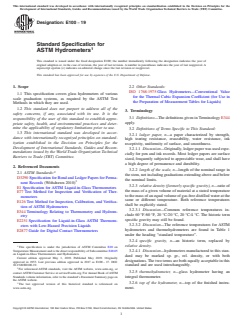
hydrometers and thermohydrometers are found in Table 1
E2877Guide for Digital Contact Thermometers
under the heading “standard temperature”.
3.2.4 specific gravity, n—an historic term, replaced by
1 relative density.
This specification is under the jurisdiction of ASTM Committee E20 on
Temperature Measurement and is the direct responsibility of Subcommittee E20.05
3.2.4.1 Discussion—hydrometers manufactured to this stan-
on Liquid-in-Glass Thermometers and Hydrometers.
dard may be marked sp. gr., rel. density, or with both
Current edition approved May 1, 2019. Published May 2019. Originally
designations.Thetwotermsarebothequallyacceptableinthis
approved in 1953. Last previous edition approved in 2017 as E100–17. DOI:
10.1520/E0100-19. standard and are used interchangeably.
For referenced ASTM standards, visit the ASTM website, www.astm.org, or
3.2.5 thermohydrometer, n—glass hydrometer having an
contactASTM Customer Service at service@astm.org. ForAnnual Book ofASTM
Standards volume information, refer to the standard’s Document Summary page on integral thermometer.
the ASTM website.
3.2.6 top of the hydrometer, n—top of the finished instru-
The last approved version of this historical standard is referenced on
www.astm.org. ment.
Copyright © ASTM International, 100 Barr Harbor Drive, PO Box C700, West Conshohocken, PA 19428-2959. United States
E100−19
3.2.7 total length, n—overall length of the finished instru- 6. Body
ment.
6.1 The preferred shapes for the bodies of hydrometers are
shown in Figs. 1 and 2.
4. Specifications
7. Ballast
4.1 Individual hydrometers shall conform to the detailed
specifications in Table 1 and to the general requirements
7.1 Material used for ballast shall be secured to the lower
specified in Sections5–15.
part of the body, and no loose material of any sort may be
4.2 Hydrometers shall be subjected to the initial calibration inside a hydrometer. When cement is used to hold the ballast
securely in place, this cement shall not soften below 105°C
criteria found in Section 14, the inspection criteria found in
Section16,andthecalibrationandverificationcriteriafoundin (221°F).
Section 17.
7.2 A solid material, such a shot, may be placed in a small
4.3 Hydrometers manufactured to previous revisions of this bulbbelowthemainbulbofthehydrometerandthenmeltedor
specification shall retain the same ASTM status as those secured by cement.
meeting current specifications.
7.3 If steel shot is used and sealed with wax, the wax shall
4.4 At the time of purchase, scale errors shall be within the not soften below 105°C (221°F).
maximum scale error found in Table 1.
7.4 Mercury shall not be used as ballast material in plain
form hydrometers.
NOTE 1—Caution—Users should be aware that both temperature and
density indications of thermohydrometers may change with rough
handling, shock, exposure to aggressive liquids, and thermal cycling,
8. Stem
among other factors. Consequently, test results and performance obtained
at the time of manufacture may not necessarily apply throughout an
8.1 The stem shall be uniform in cross section, with no
extended period of use. Periodic calibration or verification of these
perceptible irregularities. It shall extend at least 15 mm above
instruments, in accordance with procedures set forth inTest Method E126
the top graduation and remain cylindrical for at least 3 mm
(for the hydrometer), or Test Method E77 (for the integral thermometer),
below the lowest graduation.
is recommended
9. Scale
5. Type
9.1 The material for the scale is not specified. However, if
5.1 Hydrometers shall be of the constant-mass, variable-
paper is used, it shall only be ledger paper, meeting the
displacementtype.Hydrometersshallbemadeofglass,except
specifications in Specification D3290. The scale may be
for the scale, ballast, and the thermometric liquid of thermo-
anchored by a design which prevents it from moving;
hydrometers.
otherwise, it shall be fixed in place with cement that will not
5.2 The outer surface of the stem and body shall be
soften below 105°C (221°F) and will not deteriorate with
symmetrical about the vertical axis. There shall be no uneven
time. The paper shall show no evidence of scorching or
or unnecessary thickening of the walls, and no abrupt changes
charring when received or after use at 105°C (221°F). The
or constrictions that would hinder thorough cleaning or tend to
scale shall be straight and without twist.
trap air bubbles when the instrument is immersed.
5.3 The hydrometer shall always float with its axis vertical 10. Markings
in liquids for which it is intended.
10.1 Graduation lines and inscriptions shall be in a perma-
5.4 The hydrometer shall be thoroughly dry on the inside nent black marking material, such as India ink.
when sealed. The top of the stem shall be neatly rounded
10.2 All graduation lines shall be straight, fine lines not
without unnecessary thickening.
exceeding one fifth of the graduation interval in thickness, and
in no case more than 0.2 mm. The lines shall be perpendicular
5.5 The glass shall be smooth, transparent, and free of
bubbles, cracks, strain patterns, or other imperfections that to the vertical axis of the hydrometer. The lengths of main
divisionlines,subdivisionlines,andintermediatelines,ifused,
might interfere with the use of the hydrometer. The glass shall
adequately resist the reaction of chemical agents to which shall be so chosen as to facilitate readings. The shortest lines
shall be at least 2 mm long.
hydrometers may be exposed and shall have suitable thermal
properties to permit its use over the range of temperatures to
10.3 All numbers on API hydrometers shall be complete.
which it may be subjected. In general, glasses suitable for
The numbers for the 0.050 graduation lines on relative density
constructing the bulbs of thermometers are satisfactory for
(specific gravity) and density hydrometers shall include the
hydrometers.
values for the first three decimal places, for example: 0.750,
0.900, 1.100; the other numbered lines may be abbreviated.
5.6 These hydrometers and thermohydrometers shall be
fabricated from soda-lime glass tubing having a thermal
10.4 Relative density (specific gravity) hydrometers may be
-6
cubical expansion coefficient of (25 62)×10 per ºC.
marked sp. gr., rel. density, or with both designations.The two
terms are both acceptable in this standard and are used
NOTE 2—The value of the thermal cubical expansion coefficient given
above is consistent with the conventional value given in ISO 1768:1975. interchangeably.
E100−19
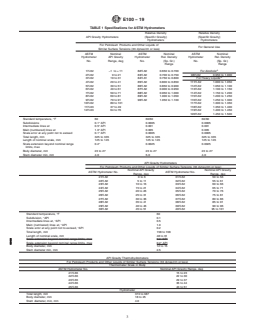
TABLE 1 Specifications for ASTM Hydrometers
Relative Density Relative Density
API Gravity Hydrometers (Specific Gravity) (Specific Gravity)
Hydrometers Hydrometers
For Petroleum Products and Other Liquids of
For General Use
Similar Surface Tensions (33 dynes/cm or less)
ASTM Nominal ASTM Nominal ASTM Nominal
Hydrometer API Gravity Hydrometer Rel. Density Hydrometer Rel. Density
No. Range, deg No. (Sp. Gr.) No. (Sp. Gr.)
Range Range
A
1H-62 −1 to + 11 82H-62 0.650 to 0.700 For Alcohols
2H-62 9 to 21 83H-62 0.700 to 0.750 98H-62 0.950 to 1.000
A
3H-62 19 to 31 84H-61 0.750 to 0.800 For Heavy Liquids
4H-62 29 to 41 85H-62 0.800 to 0.850 111H-62 1.000 to 1.050
5H-62 39 to 51 86H-62 0.850 to 0.900 112H-62 1.050 to 1.100
6H-62 49 to 61 87H-62 0.900 to 0.950 113H-62 1.100 to 1.150
7H-62 59 to 71 88H-62 0.950 to 1.000 114H-62 1.150 to 1.200
8H-62 69 to 81 89H-62 1.000 to 1.050 115H-62 1.200 to 1.250
9H-62 79 to 91 90H-62 1.050 to 1.100 116H-62 1.250 to 1.300
10H-62 89 to 101 117H-62 1.300 to 1.350
11H-03 37 to 49 118H-62 1.350 to 1.400
12H-03 64 to 76 119H-62 1.400 to 1.450
120H-62 1.450 to 1.500
Standard temperature, °F 60 60/60 60/60
Subdivisions 0.1° API 0.0005 0.0005
Intermediate lines at 0.5° API 0.001 0.001
Main (numbered) lines at 1.0° API 0.005 0.005
Scale error at any point not to exceed 0.1° API 0.0005 0.0005
Total length, mm 325 to 335 325 to 335 325 to 335
Length of nominal scale, mm 125 to 145 125 to 145 125 to 145
Scale extension beyond nominal range 0.2° 0.0025 0.0025
limits, max
Body diameter, mm 23 to 27 23 to 27 23 to 27
Stem diameter min, mm 4.0 5.0 4.0
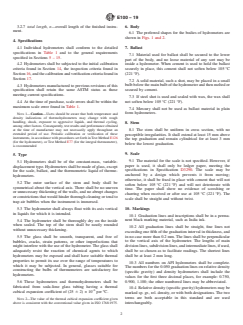
API Gravity Hydrometers
For Petroleum Products and Other Liquids of Similar Surface Tensions (33 dynes/cm or less)
Nominal API Gravity Nominal API Gravity
ASTM Hydrometer No. ASTM Hydrometer No.
Range, deg Range, deg
21H-62 0 to 6 31H-62 50 to 56
22H-62 5 to 11 32H-62 55 to 61
23H-62 10 to 16 33H-62 60 to 66
24H-62 15 to 21 34H-62 65 to 71
25H-62 20 to 26 35H-62 70 to 76
26H-62 25 to 31 36H-62 75 to 81
27H-62 30 to 36 37H-62 80 to 86
28H-62 35 to 41 38H-62 85 to 91
29H-62 40 to 46 39H-62 90 to 96
30H-62 45 to 51 40H-62 95 to 101
Standard temperature, °F 60
Subdivision, °API 0.1
Intermediate lines at, °API 0.5
Main (numbered) lines at, °API 1.0
Scale error at any point not to exceed, °API 0.2
Total length, mm 158 to 168
Length of nominal scale, mm 48 to 61
Scale extension beyond nominal range limits, max 0.2° API
Body diameter, mm 12 to 15
Stem diameter min, mm 2.5
API Gravity Thermohydrometers
For Petroleum Products and Other Liquids of Similar Surface Tensions (33 dynes/cm or less)
Thermometer Scale in Body
ASTM Hydrometer No. Nominal API Gravity Range, deg
41H-66 15 to 23
42H-66 22 to 30
43H-66 29 to 37
44H-66 36 to 44
45H-66 43 to 51
Hydrometer
Total length, mm 374 to 387
Body diameter, mm 18 to 25
Stem diameter, min, mm 4.0
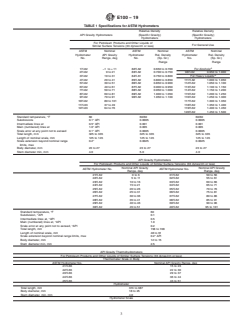
Hydrometer Scale
E100−19
Standard temperature, °F 60
Subdivisions, °API 0.1
Intermediate lines at,°API 0.5
Main (numbered) lines at, °API 1.0
Scale error at any point not to exceed, °API 0.1
Length of nominal scale, mm 125 to 145
Thermometer Scale
B
Range, °F 0 to 150 Designation L
30 to 180 Designation M
60 to 220 Designation H
Immersion total
Subdivisions, °F 2
Intermediate lines at, °F 10
Main (numbered) lines at, °F 20
Scale error at any point not to exceed, °F 1
Scale length, mm 80 to 110
API Gravity Thermohydrometers
For Petroleum Products and Other Liquids of Similar Surface Tensions (33 dynes/cm or less)
Thermometer Scale in Body Thermometer Scale in Stem
Nominal API Gravity Nominal API Gravity
ASTM Hydrometer No. ASTM Hydrometer No.
Range, deg Range, deg
51H-62 –1 to + 11 71H-62 –1 to + 11
52H-62 9 to 21 72H-62 9 to 21
53H-62 19 to 31 73H-62 19 to 31
54H-62 29 to 41 74H-62 29 to 41
55H-62 39 to 51
56H-62 49 to 61
57H-62 59 to 71
58H-62 69 to 81
59H-62 79 to 91
60H-62 89 to 101
Hydrometer
Total length, mm 374 to 387 374 to 387
Body diameter, mm 18 to 25 23 to 27
Stem diameter, min, mm 4.0 6.0
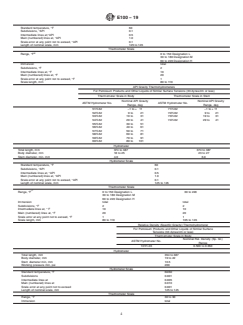
Hydrometer Scale
Standard temperature, °F 60
Subdivisions, °API 0.1
Intermediate lines at, °API 0.5
Main (numbered) lines at, °API 1.0
Scale error at any point not to exceed, °API 0.1
Length of nominal scale, mm 125 to 145
Thermometer Scale
C
Range, °F 0 to 150 Designation L 30 to 220
30 to 180 Designation M
60 to 220 Designation H
Immersion total total
Subdivisions, °F 2 2
Intermediate lines at, ° F 10 10
Main (numbered) lines at, °F 20 20
Scale error at any point not to exceed, °F 1 1
Scale length, mm 80 to 110 105 to 145
Relative Density (Specific Gravity) Thermohydrometer
For Petroleum Products and Other Liquids of Similar Surface
Tensions (33 dynes/cm or less)
Thermometer Scale in Body
Nominal Rel. Density (Sp. Gr.)
ASTM Hydrometer No.
Range
101H-03 0.500 to 0.650
Hydrometer
Total length, mm 354 to 387
Body diameter, mm 19 to 22
Stem diameter min, mm 10.5
Working pressure min, psi 200
Hydrometer Scale
Standard temperature, °F 60/60
Subdivisions 0.001
Intermediate lines at 0.005
Main (numbered) lines at 0.010
Scale error at any point not to exceed 0.001
Length of nominal scale, mm 125 to 145
Thermometer Scale
Range, °F 30 to 90
Immersion total
E100−19
Subdivisions, °F 1
Intermediate lines at, °F 5
Main (numbered) lines at, °F 10
Scale error at any point not to exceed, °F 0.5
Scale length, mm 50 to 70
Relative Density (Specific Gravity) Hydrometers
For Petroleum Products and Other Liquids of Similar
For General Use
Surface Tensions (33 dynes/cm or less)
Nominal Nominal
ASTM ASTM
Rel. Density Rel. Density
Hydrometer No. Hydrometer No.
(Sp. Gr.) Range (Sp. Gr.) Range
102H-62 0.650 to 0.700 125H-62 1.000 to 1.050
103H-62 0.700 to 0.750 126H-62 1.050 to 1.100
104H-62 0.750 to 0.800 127H-62 1.100 to 1.150
105H-62 0.800 to 0.850 128H-62 1.150 to 1.200
106H-62 0.850 to 0.900 129H-62 1.200 to 1.250
107H-62 0.900 to 0.950 130H-62 1.2
...
This document is not an ASTM standard and is intended only to provide the user of an ASTM standard an indication of what changes have been made to the previous version. Because
it may not be technically possible to adequately depict all changes accurately, ASTM recommends that users consult prior editions as appropriate. In all cases only the current version
of the standard as published by ASTM is to be considered the official document.
Designation: E100 − 17 E100 − 19
Standard Specification for
ASTM Hydrometers
This standard is issued under the fixed designation E100; the number immediately following the designation indicates the year of
original adoption or, in the case of revision, the year of last revision. A number in parentheses indicates the year of last reapproval. A
superscript epsilon (´) indicates an editorial change since the last revision or reapproval.
This standard has been approved for use by agencies of the U.S. Department of Defense.
1. Scope
1.1 This specification covers glass hydrometers of various scale graduation systems, as required by the ASTM Test Methods in
which they are used.
1.2 This standard does not purport to address all of the safety concerns, if any, associated with its use. It is the responsibility
of the user of this standard to establish appropriate safety safety, health, and healthenvironmental practices and determine the
applicability of regulatory limitations prior to use.
1.3 This international standard was developed in accordance with internationally recognized principles on standardization
established in the Decision on Principles for the Development of International Standards, Guides and Recommendations issued
by the World Trade Organization Technical Barriers to Trade (TBT) Committee.
2. Referenced Documents
2.1 ASTM Standards:
D287 Test Method for API Gravity of Crude Petroleum and Petroleum Products (Hydrometer Method)
D3290 Specification for Bond and Ledger Papers for Permanent Records (Withdrawn 2010)
E1 Specification for ASTM Liquid-in-Glass Thermometers
E77 Test Method for Inspection and Verification of Thermometers
E126 Test Method for Inspection, Calibration, and Verification of ASTM Hydrometers
E344 Terminology Relating to Thermometry and Hydrometry
E2251 Specification for Liquid-in-Glass ASTM Thermometers with Low-Hazard Precision Liquids
E2877 Guide for Digital Contact Thermometers
2.2 Other Standards:
ISO 1768:1975 Glass Hydrometers—Conventional Value for the Thermal Cubic Expansion Coefficient (for Use in the
Preparation of Measurement Tables for Liquids)
3. Terminology
3.1 Definitions—The definitions given in Terminology E344 apply.
3.2 Definitions of Terms Specific to This Standard:
3.2.1 ledger paper, n—a paper characterized by strength, high tearing resistance, eraseability, water resistance, ink receptivity,
uniformity of surface, and smoothness.
3.2.1.1 Discussion—
Originally, ledger paper was used especially for pen and ink records. Most ledger papers are surface sized, frequently subjected
to appreciable wear, and shall have a high degree of permanence and durability.
This specification is under the jurisdiction of ASTM Committee E20 on Temperature Measurement and is the direct responsibility of Subcommittee E20.05 on
Liquid-in-Glass Thermometers and Hydrometers.
Current edition approved May 1, 2017May 1, 2019. Published May 2017May 2019. Originally approved in 1953. Last previous edition approved in 20152017 as
E100 – 15a.E100 – 17. DOI: 10.1520/E0100-17.10.1520/E0100-19.
For referenced ASTM standards, visit the ASTM website, www.astm.org, or contact ASTM Customer Service at service@astm.org. For Annual Book of ASTM Standards
volume information, refer to the standard’s Document Summary page on the ASTM website.
The last approved version of this historical standard is referenced on www.astm.org.
Copyright © ASTM International, 100 Barr Harbor Drive, PO Box C700, West Conshohocken, PA 19428-2959. United States
E100 − 19
3.2.2 length of the scale, n—length of the nominal range in the stem, not including graduations extending above and below the
nominal limits.
3.2.3 relative density (formerly specific gravity), n—ratio of the mass of a given volume of material at a stated temperature to
the mass of an equal volume of gas-free distilled water at the same or different temperature. Both reference temperatures shall be
explicitly stated.
3.2.3.1 Discussion—
Common reference temperatures include 60°F/60°F,60 °F 20°C/20°C,⁄60 °F, 20 °C 20°C/4°C.⁄20 °C, 20 °C ⁄4 °C. The historic
term specific gravity may still be found.
3.2.3.2 Discussion—
The reference temperatures for ASTM hydrometers and thermohydrometers are found in Table 1 under the heading “standard
temperature”.
3.2.4 specific gravity, n—an historic term, replaced by relative density.
3.2.4.1 Discussion—
hydrometers manufactured to this standard may be marked sp. gr., rel. density, or with both designations. The two terms are both
equally acceptable in this standard and are used interchangeably.
3.2.5 thermohydrometer, n—glass hydrometer having an integral thermometer.
3.2.6 top of the hydrometer, n—top of the finished instrument.
3.2.7 total length, n—overall length of the finished instrument.
4. Specifications
4.1 Individual hydrometers shall conform to the detailed specifications in Table 1 and to the general requirements specified in
Sections 5 – 15.
4.2 Hydrometers shall be subjected to the initial calibration criteria found in Section 14, the inspection criteria found in Section
16, and the calibration and verification criteria found in Section 17.
4.3 Hydrometers manufactured to previous revisions of this specification shall retain the same ASTM status as those meeting
current specifications.
4.4 At the time of purchase, scale errors shall be within the maximum scale error found in Table 1.
NOTE 1—Caution—Users should be aware that both temperature and density indications of thermohydrometers may change with rough handling,
shock, exposure to aggressive liquids, and thermal cycling, among other factors. Consequently, test results and performance obtained at the time of
manufacture may not necessarily apply throughout an extended period of use. Periodic calibration or verification of these instruments, in accordance with
procedures set forth in Test Method E126 (for the hydrometer), or Test Method E77 (for the integral thermometer), is recommended
5. Type
5.1 Hydrometers shall be of the constant-mass, variable-displacement type. Hydrometers shall be made of glass, except for the
scale, ballast, and the thermometric liquid of thermohydrometers.
5.2 The outer surface of the stem and body shall be symmetrical about the vertical axis. There shall be no uneven or unnecessary
thickening of the walls, and no abrupt changes or constrictions that would hinder thorough cleaning or tend to trap air bubbles when
the instrument is immersed.
5.3 The hydrometer shall always float with its axis vertical in liquids for which it is intended.
5.4 The hydrometer shall be thoroughly dry on the inside when sealed. The top of the stem shall be neatly rounded without
unnecessary thickening.
5.5 The glass shall be smooth, transparent, and free of bubbles, cracks, strain patterns, or other imperfections that might interfere
with the use of the hydrometer. The glass shall adequately resist the reaction of chemical agents to which hydrometers may be
exposed and shall have suitable thermal properties to permit its use over the range of temperatures to which it may be subjected.
In general, glasses suitable for constructing the bulbs of thermometers are satisfactory for hydrometers.
5.6 These hydrometers and thermohydrometers shall be fabricated from soda-lime glass tubing having a thermal cubical
-6
expansion coefficient of (25 +/-6 2) x× 10 per ºC.
E100 − 19
TABLE 1 Specifications for ASTM Hydrometers
Relative Density Relative Density
API Gravity Hydrometers (Specific Gravity) (Specific Gravity)
Hydrometers Hydrometers
For Petroleum Products and Other Liquids of
For General Use
Similar Surface Tensions (33 dynes/cm or less)
ASTM Nominal ASTM Nominal ASTM Nominal
Hydrometer API Gravity Hydrometer Rel. Density Hydrometer Rel. Density
No. Range, deg No. (Sp. Gr.) No. (Sp. Gr.)
Range Range
A
1H-62 −1 to + 11 82H-62 0.650 to 0.700 For Alcohols
2H-62 9 to 21 83H-62 0.700 to 0.750 98H-62 0.950 to 1.000
A
3H-62 19 to 31 84H-61 0.750 to 0.800 For Heavy Liquids
4H-62 29 to 41 85H-62 0.800 to 0.850 111H-62 1.000 to 1.050
5H-62 39 to 51 86H-62 0.850 to 0.900 112H-62 1.050 to 1.100
6H-62 49 to 61 87H-62 0.900 to 0.950 113H-62 1.100 to 1.150
7H-62 59 to 71 88H-62 0.950 to 1.000 114H-62 1.150 to 1.200
8H-62 69 to 81 89H-62 1.000 to 1.050 115H-62 1.200 to 1.250
9H-62 79 to 91 90H-62 1.050 to 1.100 116H-62 1.250 to 1.300
10H-62 89 to 101 117H-62 1.300 to 1.350
11H-03 37 to 49 118H-62 1.350 to 1.400
12H-03 64 to 76 119H-62 1.400 to 1.450
120H-62 1.450 to 1.500
Standard temperature, °F 60 60/60 60/60
Subdivisions 0.1° API 0.0005 0.0005
Intermediate lines at 0.5° API 0.001 0.001
Main (numbered) lines at 1.0° API 0.005 0.005
Scale error at any point not to exceed 0.1° API 0.0005 0.0005
Total length, mm 325 to 335 325 to 335 325 to 335
Length of nominal scale, mm 125 to 145 125 to 145 125 to 145
Scale extension beyond nominal range 0.2° 0.0025 0.0025
limits, max
Body diameter, mm 23 to 27 23 to 27 23 to 27
Stem diameter min, mm 4.0 5.0 4.0
API Gravity Hydrometers
For Petroleum Products and Other Liquids of Similar Surface Tensions (33 dynes/cm or less)
Nominal API Gravity Nominal API Gravity
ASTM Hydrometer No. ASTM Hydrometer No.
Range, deg Range, deg
21H-62 0 to 6 31H-62 50 to 56
22H-62 5 to 11 32H-62 55 to 61
23H-62 10 to 16 33H-62 60 to 66
24H-62 15 to 21 34H-62 65 to 71
25H-62 20 to 26 35H-62 70 to 76
26H-62 25 to 31 36H-62 75 to 81
27H-62 30 to 36 37H-62 80 to 86
28H-62 35 to 41 38H-62 85 to 91
29H-62 40 to 46 39H-62 90 to 96
30H-62 45 to 51 40H-62 95 to 101
Standard temperature, °F 60
Subdivision, °API 0.1
Intermediate lines at, °API 0.5
Main (numbered) lines at, °API 1.0
Scale error at any point not to exceed, °API 0.2
Total length, mm 158 to 168
Length of nominal scale, mm 48 to 61
Scale extension beyond nominal range limits, max 0.2 °API
Scale extension beyond nominal range limits, max 0.2° API
Body diameter, mm 12 to 15
Stem diameter min, mm 2.5
API Gravity Thermohydrometers
For Petroleum Products and Other Liquids of Similar Surface Tensions (33 dynes/cm or less)
Thermometer Scale in Body
ASTM Hydrometer No. Nominal API Gravity Range, deg
41H-66 15 to 23
42H-66 22 to 30
43H-66 29 to 37
44H-66 36 to 44
45H-66 43 to 51
Hydrometer
Total length, mm 374 to 387
Body diameter, mm 18 to 25
Stem diameter, min, mm 4.0
E100 − 19
Hydrometer Scale
Standard temperature, °F 60
Subdivisions, ° API 0.1
Subdivisions, °API 0.1
Intermediate lines at,° API 0.5
Intermediate lines at,°API 0.5
Main (numbered) lines at, ° API 1.0
Main (numbered) lines at, °API 1.0
Scale error at any point not to exceed,° API 0.1
Scale error at any point not to exceed, °API 0.1
Length of nominal scale, mm 125 to 145
Thermometer Scale
B
Range, °F 0 to 150 Designation L
30 to 180 Designation M
60 to 220 Designation H
Immersion total
Subdivisions, °F 2
Intermediate lines at,° F 10
Intermediate lines at, °F 10
Main (numbered) lines at, °F 20
Scale error at any point not to exceed,° F 1
Scale error at any point not to exceed, °F 1
Scale length, mm 80 to 110
API Gravity Thermohydrometers
For Petroleum Products and Other Liquids of Similar Surface Tensions (33 dynes/cm or less)
Thermometer Scale in Body Thermometer Scale in Stem
Nominal API Gravity Nominal API Gravity
ASTM Hydrometer No. ASTM Hydrometer No.
Range, deg Range, deg
51H-62 –1 to + 11 71H-62 –1 to + 11
52H-62 9 to 21 72H-62 9 to 21
53H-62 19 to 31 73H-62 19 to 31
54H-62 29 to 41 74H-62 29 to 41
55H-62 39 to 51
56H-62 49 to 61
57H-62 59 to 71
58H-62 69 to 81
59H-62 79 to 91
60H-62 89 to 101
Hydrometer
Total length, mm 374 to 387 374 to 387
Body diameter, mm 18 to 25 23 to 27
Stem diameter, min, mm 4.0 6.0
Hydrometer Scale
Standard temperature, °F 60
Subdivisions, °API 0.1
Intermediate lines at, °API 0.5
Main (numbered) lines at, °API 1.0
Scale error at any point not to exceed, °API 0.1
Length of nominal scale, mm 125 to 145
Thermometer Scale
C
Range, °F 0 to 150 Designation L 30 to 220
30 to 180 Designation M
60 to 220 Designation H
Immersion total total
Subdivisions, °F 2 2
Intermediate lines at,° F 10 10
Intermediate lines at, ° F 10 10
Main (numbered) lines at, °F 20 20
Scale error at any point not to exceed, °F 1 1
Scale length, mm 80 to 110 105 to 145
Relative Density (Specific Gravity) Thermohydrometer
For Petroleum Products and Other Liquids of Similar Surface
Tensions (33 dynes/cm or less)
Thermometer Scale in Body
Nominal Rel. Density (Sp. Gr.)
ASTM Hydrometer No.
Range
101H-03 0.500 to 0.650
Hydrometer
Total length, mm 354 to 387
Body diameter, mm 19 to 22
Stem diameter min, mm 10.5
Working pressure min, psi 200
Hydrometer Scale
Standard temperature, °F 60/60
E100 − 19
Subdivisions 0.001
Intermediate lines at 0.005
Main (numbered) lines at 0.010
Scale error at any point not to exceed 0.001
Length of nominal scale, mm 125 to 145
Thermometer Scale
Range, °F 30 to 90
Immersion total
Subdivisions, °F 1
Intermediate lines at, °F 5
Main (numbered) lines at, °F 10
Scale error at any point not to exceed, °F 0.5
Scale length, mm 50 to 70
Relative Density (Specific Gravity) Hydrometers
For Petroleum Products and Other Liquids of Similar
For General Use
Surface Tensions (33 dynes/cm or less)
Nominal Nominal
ASTM ASTM
Rel. Density Rel. Density
Hydrometer No. Hydrometer No.
(Sp. Gr.) Range (Sp. Gr.) Range
102H-62 0.650 to 0.700 125H-62 1.000 to 1.050
103H-62 0.700 to 0.750 126H-62 1.050 to 1.100
104H-62 0.750 to 0.800 127H-62 1.100 to 1.150
105H-62 0.800 to 0.850 128H-62 1.150 to 1.200
106H-62 0.850 to 0.900 129H-62 1.200 to 1.250
107H-62 0.900 to 0.950 130H-62 1.250 to 1.300
108H-62 0.950 to 1.000 131H-62 1.300 to 1.350
132H-62 1.350 to 1.400
133H-62 1.400 to 1.450
134H-62 1.450 to 1.500
135H-62 1.500 to 1.550
136H-62 1.550 to 1.600
137H-62 1.600 to 1.650
138H-62 1.650 to 1.700
139H-62 1.700 to 1.750
140H-62 1.750 to 1.800
141H-62 1.800 to 1.850
Standard temperature, °F 60/60
Subdivisions 0.001
Intermediate lines at 0.005
Main (numbered) lines at 0.010
Scale error at any point not to exceed 0.001
Total length, mm 250 to 270
Length of nominal scale, mm 70 to 85
Scale extension beyond nominal 0.005
range limits, max
Body diameter, mm 20 to 24
Stem diameter min, mm 4.0
Soil Hydrometers (55 dynes/cm or less)
Nominal
ASTM Hydrometer
Rel. Density ASTM Hydrometer No. Nominal Range
No.
(Sp. Gr.) Range
0.995 to 1.038
151H-05 152H-05 –5 to + 60 g/L
sp gr
Standard temperature, °F 68/68 68/68
Divisions 0.001 sp gr 1 g/L
Intermediate lines at 0.005 sp gr 5 g/L
Main (numbered) lines at 0.010 sp gr 10 g/L
Scale error at any point not to exceed 0.001 sp gr 1 g/L
Length of nominal scale See Fig. 2 See Fig. 2
Total length, mm 278 to 282 278 to 282
Body diameter See Fig. 2 See Fig. 2
Stem diameter See Fig. 2 See Fig. 2
Pounds Per Gallon Hydrometers
For Petroleum Products and Other Liquids of Similar Surface Tensions (33 dynes/cm or less)
Nominal Range,
ASTM Number
lb/gal
293H-68 5.83 to 6.24
294H-68 6.24 to 6.66
295H-68 6.66 to 7.08
296H-68 7.08 to 7.50
297H-68 7.50 to 7.91
298H-68 7.91 to 8.33
Standard temperature, °F 60°F
Standard temperature, °F 60 °F
E100 − 19
Subdivisions 0.005
Intermediate lines at 0.01
Main (numbered) lines at 0.05
Scale error at any point not to exceed 0.005
Total length, mm 325 to 335
Length of nominal scale, mm 125 to 145
Scale extension beyond nominal range limits 0.025
Body diameter, mm 23 to 27
Stem diameter min, mm 5.0
Thermohydrometers
ASTM Hydrometer No. API°
255H-03 37 to 49
258H-03 64 to 76
Hydrometer
Total length, mm 385 to 405
Body diameter, mm 18 to 25
Nominal stem diameter, mm >4
Hydrometer Scale
Standard temperature, °F 60
Subdivisions, API 0.1
Intermediate lines at, API 0.5
Main (numbered) lines at, API 1
Scale error at any point not to exceed, API 0.1
Length of nominal scale, mm 125 to 145
Thermometer Scale
Range, °F 0 to 100°
Immersion total
Subdivisions, °F 0.5
Short intermediate lines at, °F 1
Long intermediate lines at, °F 5
Main (numbered) lines at, °F 10
Scale e
...