

ASTM E287-02(2019)
(Specification)Standard Specification for Laboratory Glass Graduated Burets
General Information
- Abstract
ABSTRACT
This specification covers requirements for glass burets of precision and general-purpose grades suitable for laboratory use. Burets are classified as: class A - precision grade buret, and class B - general purpose burets. Burets shall be calibrated to deliver the intended volume at 20°C. No after-drainage period is allowed. Self-zeroing burets shall have an ungraduated, tapered, interior extension that terminates with an overflow orifice. Burets may be equipped with a filling tube. All burets shall have permanently attached stopcocks. The stopcock's handle shall be located to the right. Stopcock plugs shall be provided with a retaining device.
SCOPE
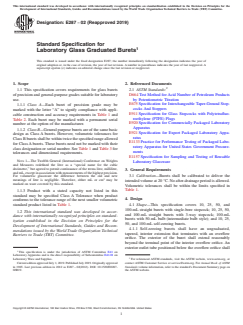
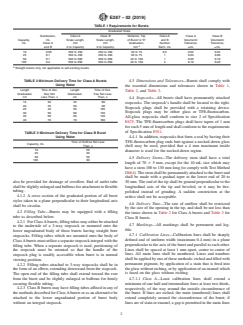
1.1 This specification covers requirements for glass burets of precision and general-purpose grades suitable for laboratory use.
1.1.1 Class A—Each buret of precision grade may be marked with the letter “A” to signify compliance with applicable construction and accuracy requirements in Table 1 and Table 2. Each buret may be marked with a permanent serial number at the option of the manufacturer.
1.1.2 Class B—General purpose burets are of the same basic design as Class A burets. However, volumetric tolerances for Class B burets shall be within twice the specified range allowed for Class A burets. These burets need not be marked with their class designation or serial number. See Table 1 and Table 3 for tolerances and dimensional requirements.
Note 1: The Twelfth General (International) Conference on Weights and Measures redefined the litre as a “special name for the cubic decimetre,” but agreed to permit continuance of the terms litre, millilitre, and mL, except in association with measurements of the highest precision. For volumetric glassware the difference between the old and new meanings of litre is negligible. Therefore, either mL or cm3 may be marked on ware covered by this standard.
1.1.3 Product with a stated capacity not listed in this standard may be specified Class A Tolerance when product conforms to the tolerance range of the next smaller volumetric standard product listed in Table 1.
1.2 This international standard was developed in accordance with internationally recognized principles on standardization established in the Decision on Principles for the Development of International Standards, Guides and Recommendations issued by the World Trade Organization Technical Barriers to Trade (TBT) Committee.
- Status
- Published
- Publication Date
- 30-Jun-2019
- Technical Committee
- E41 - Laboratory Apparatus
- Drafting Committee
- E41.01 - Laboratory Ware and Supplies


Overview
ASTM E287-02(2019): Standard Specification for Laboratory Glass Graduated Burets establishes requirements for precision and general-purpose glass burets used in laboratory environments. This international standard, developed by ASTM International, provides detailed specifications for construction, calibration, and performance of glass graduated burets. The goal is to ensure consistent accuracy and reliability for laboratory measurements involving liquid dispensing.
Burets manufactured under this standard are categorized as:
- Class A: Precision grade, with stricter volumetric tolerances for high-accuracy work.
- Class B: General-purpose grade, maintaining the same basic design but with doubled allowable tolerances compared to Class A.
Compliance with this standard supports laboratories in maintaining quality control, meeting regulatory requirements, and assuring data consistency across analytical processes.
Key Topics
Calibration and Delivery Accuracy
- Burets must be calibrated to deliver specified volumes at 20°C, with no after-drainage period.
- Class A burets offer higher accuracy, while Class B burets are acceptable for less critical applications.
Design and Construction
- Includes straight and self-zeroing burets in various capacities (10, 25, 50, 100 mL).
- All burets must have permanently attached stopcocks with handles positioned to the right; stopcock plugs require a retaining device.
- Optional features include filling tubes and overflow orifices for self-zeroing burets.
Graduation and Markings
- Permanent, legible calibration lines and numbers are mandatory.
- Calibration lines must meet specific extension requirements around the buret circumference for each class.
- Markings must include manufacturer, temperature of calibration (20°C), and delivery indicator (e.g., “TD” or “Delivers”).
Materials and Compatibility
- Glass is the specified material for burets, with options for glass or polytetrafluoroethylene (PTFE) stopcock plugs.
Tolerances and Dimensions
- Standardized volumetric tolerances and dimensional requirements ensure interchangeability and reliable performance.
International Recognition
- Developed in accordance with internationally recognized standards principles, making it suitable for global laboratory use.
Applications
ASTM E287-02(2019) standardized glass burets are essential in:
- Analytical Chemistry: Highly accurate volumetric titrations and analyses in research and quality control labs.
- Educational Laboratories: Reliable tools for student experiments in chemistry and biology.
- Pharmaceutical and Petrochemical Testing: Precise liquid dispensing in regulatory and product testing environments.
- Environmental Analysis: Performing accurate measurements for water and soil testing.
- General Laboratory Use: Any setting requiring reproducible liquid measurements where traceability and consistent results are critical.
Adherence to this standard ensures that laboratory burets provide precise, repeatable results, fostering comparability and trust in data across various fields.
Related Standards
Laboratories frequently use ASTM E287-02(2019) in conjunction with other ASTM standards and related guidelines, including:
- ASTM E675: Specification for Interchangeable Taper-Ground Stopcocks and Stoppers
- ASTM E911: Specification for Glass Stopcocks with PTFE Plugs
- ASTM E920: Specification for Commercially Packaged Laboratory Apparatus
- ASTM E921: Specification for Export Packaged Laboratory Apparatus
- ASTM E1157: Specification for Sampling and Testing of Reusable Laboratory Glassware
These related standards provide further requirements and guidance for laboratory glassware quality, packaging, and performance.
Keywords: ASTM E287, laboratory burets, glass graduated burets, precision burets, Class A burets, Class B burets, laboratory standard, volumetric measurement, analytical chemistry, laboratory glassware standards.
Relations
- Effective Date
- 01-Jul-2019
- Effective Date
- 01-Jul-2019
- Refers
ASTM E675-02(2019) - Standard Specification for Interchangeable Taper-Ground Stopcocks And Stoppers - Effective Date
- 01-Jan-2019
- Effective Date
- 01-May-2017
- Effective Date
- 01-Nov-2013
- Refers
ASTM E675-02(2012) - Standard Specification for Interchangeable Taper-Ground Stopcocks And Stoppers - Effective Date
- 01-Nov-2012
- Effective Date
- 01-Dec-2011
- Effective Date
- 01-Dec-2011
- Effective Date
- 15-May-2011
- Effective Date
- 01-Sep-2010
- Effective Date
- 15-May-2010
- Effective Date
- 01-Nov-2009
- Effective Date
- 01-Mar-2009
- Effective Date
- 01-Nov-2008
- Refers
ASTM E675-02(2007) - Standard Specification for Interchangeable Taper-Ground Stopcocks And Stoppers - Effective Date
- 01-Nov-2007
Get Certified
Connect with accredited certification bodies for this standard

ECOCERT
Organic and sustainability certification.

Eurofins Food Testing Global
Global leader in food, environment, and pharmaceutical product testing.

Intertek Bangladesh
Intertek certification and testing services in Bangladesh.
Sponsored listings
Frequently Asked Questions
ASTM E287-02(2019) is a technical specification published by ASTM International. Its full title is "Standard Specification for Laboratory Glass Graduated Burets". This standard covers: ABSTRACT This specification covers requirements for glass burets of precision and general-purpose grades suitable for laboratory use. Burets are classified as: class A - precision grade buret, and class B - general purpose burets. Burets shall be calibrated to deliver the intended volume at 20°C. No after-drainage period is allowed. Self-zeroing burets shall have an ungraduated, tapered, interior extension that terminates with an overflow orifice. Burets may be equipped with a filling tube. All burets shall have permanently attached stopcocks. The stopcock's handle shall be located to the right. Stopcock plugs shall be provided with a retaining device. SCOPE 1.1 This specification covers requirements for glass burets of precision and general-purpose grades suitable for laboratory use. 1.1.1 Class A—Each buret of precision grade may be marked with the letter “A” to signify compliance with applicable construction and accuracy requirements in Table 1 and Table 2. Each buret may be marked with a permanent serial number at the option of the manufacturer. 1.1.2 Class B—General purpose burets are of the same basic design as Class A burets. However, volumetric tolerances for Class B burets shall be within twice the specified range allowed for Class A burets. These burets need not be marked with their class designation or serial number. See Table 1 and Table 3 for tolerances and dimensional requirements. Note 1: The Twelfth General (International) Conference on Weights and Measures redefined the litre as a “special name for the cubic decimetre,” but agreed to permit continuance of the terms litre, millilitre, and mL, except in association with measurements of the highest precision. For volumetric glassware the difference between the old and new meanings of litre is negligible. Therefore, either mL or cm3 may be marked on ware covered by this standard. 1.1.3 Product with a stated capacity not listed in this standard may be specified Class A Tolerance when product conforms to the tolerance range of the next smaller volumetric standard product listed in Table 1. 1.2 This international standard was developed in accordance with internationally recognized principles on standardization established in the Decision on Principles for the Development of International Standards, Guides and Recommendations issued by the World Trade Organization Technical Barriers to Trade (TBT) Committee.
ABSTRACT This specification covers requirements for glass burets of precision and general-purpose grades suitable for laboratory use. Burets are classified as: class A - precision grade buret, and class B - general purpose burets. Burets shall be calibrated to deliver the intended volume at 20°C. No after-drainage period is allowed. Self-zeroing burets shall have an ungraduated, tapered, interior extension that terminates with an overflow orifice. Burets may be equipped with a filling tube. All burets shall have permanently attached stopcocks. The stopcock's handle shall be located to the right. Stopcock plugs shall be provided with a retaining device. SCOPE 1.1 This specification covers requirements for glass burets of precision and general-purpose grades suitable for laboratory use. 1.1.1 Class A—Each buret of precision grade may be marked with the letter “A” to signify compliance with applicable construction and accuracy requirements in Table 1 and Table 2. Each buret may be marked with a permanent serial number at the option of the manufacturer. 1.1.2 Class B—General purpose burets are of the same basic design as Class A burets. However, volumetric tolerances for Class B burets shall be within twice the specified range allowed for Class A burets. These burets need not be marked with their class designation or serial number. See Table 1 and Table 3 for tolerances and dimensional requirements. Note 1: The Twelfth General (International) Conference on Weights and Measures redefined the litre as a “special name for the cubic decimetre,” but agreed to permit continuance of the terms litre, millilitre, and mL, except in association with measurements of the highest precision. For volumetric glassware the difference between the old and new meanings of litre is negligible. Therefore, either mL or cm3 may be marked on ware covered by this standard. 1.1.3 Product with a stated capacity not listed in this standard may be specified Class A Tolerance when product conforms to the tolerance range of the next smaller volumetric standard product listed in Table 1. 1.2 This international standard was developed in accordance with internationally recognized principles on standardization established in the Decision on Principles for the Development of International Standards, Guides and Recommendations issued by the World Trade Organization Technical Barriers to Trade (TBT) Committee.
ASTM E287-02(2019) is classified under the following ICS (International Classification for Standards) categories: 71.040.20 - Laboratory ware and related apparatus. The ICS classification helps identify the subject area and facilitates finding related standards.
ASTM E287-02(2019) has the following relationships with other standards: It is inter standard links to ASTM E287-02(2012), ASTM E920-97(2019), ASTM E675-02(2019), ASTM D664-11a(2017), ASTM E920-97(2013), ASTM E675-02(2012), ASTM E1157-87(2011), ASTM E1157-87(2018)e1, ASTM D664-11, ASTM E1133-86(2010), ASTM E921-97(2010), ASTM E911-98(2009), ASTM D664-09, ASTM E920-97(2008), ASTM E675-02(2007). Understanding these relationships helps ensure you are using the most current and applicable version of the standard.
ASTM E287-02(2019) is available in PDF format for immediate download after purchase. The document can be added to your cart and obtained through the secure checkout process. Digital delivery ensures instant access to the complete standard document.
Standards Content (Sample)
This international standard was developed in accordance with internationally recognized principles on standardization established in the Decision on Principles for the
Development of International Standards, Guides and Recommendations issued by the World Trade Organization Technical Barriers to Trade (TBT) Committee.
Designation:E287 −02 (Reapproved 2019)
Standard Specification for
Laboratory Glass Graduated Burets
This standard is issued under the fixed designation E287; the number immediately following the designation indicates the year of
original adoption or, in the case of revision, the year of last revision. A number in parentheses indicates the year of last reapproval. A
superscript epsilon (´) indicates an editorial change since the last revision or reapproval.
1. Scope 2. Referenced Documents
2.1 ASTM Standards:
1.1 This specification covers requirements for glass burets
D664 Test Method for Acid Number of Petroleum Products
of precision and general-purpose grades suitable for laboratory
by Potentiometric Titration
use.
E675 Specification for Interchangeable Taper-Ground Stop-
1.1.1 Class A—Each buret of precision grade may be
cocks And Stoppers
marked with the letter “A” to signify compliance with appli-
E911 Specification for Glass Stopcocks with Polytetrafluo-
cable construction and accuracy requirements in Table 1 and
roethylene (PTFE) Plugs
Table 2. Each buret may be marked with a permanent serial
E920 Specification for Commercially Packaged Laboratory
number at the option of the manufacturer.
Apparatus
1.1.2 Class B—Generalpurposeburetsareofthesamebasic
E921 Specification for Export Packaged Laboratory Appa-
design as Class A burets. However, volumetric tolerances for
ratus
ClassBburetsshallbewithintwicethespecifiedrangeallowed
E1133 Practice for Performance Testing of Packaged Labo-
for ClassAburets. These burets need not be marked with their
ratory Apparatus for United States Government Procure-
class designation or serial number. See Table 1 and Table 3 for
ments
tolerances and dimensional requirements.
E1157 Specification for Sampling and Testing of Reusable
NOTE 1—The Twelfth General (International) Conference on Weights
Laboratory Glassware
and Measures redefined the litre as a “special name for the cubic
decimetre,” but agreed to permit continuance of the terms litre, millilitre,
3. General Requirements
and mL, except in association with measurements of the highest precision.
For volumetric glassware the difference between the old and new 3.1 Calibration—Burets shall be calibrated to deliver the
meanings of litre is negligible. Therefore, either mL or cm may be
intended volume at 20 °C. No after-drainage period is allowed.
marked on ware covered by this standard.
Volumetric tolerances shall be within the limits specified in
Table 1.
1.1.3 Product with a stated capacity not listed in this
standard may be specified Class A Tolerance when product
4. Design
conforms to the tolerance range of the next smaller volumetric
standard product listed in Table 1. 4.1 Shape—This specification covers 10, 25, 50, and
100-mL straight burets with single-bore stopcock; 10, 25, 50,
1.2 This international standard was developed in accor-
and 100-mL straight burets with 3-way stopcock; 100-mL
dance with internationally recognized principles on standard-
burets with 50-mL bulb (intermediate bulb style); and 10, 25,
ization established in the Decision on Principles for the
50, and 100-mL self-zeroing burets.
Development of International Standards, Guides and Recom-
4.1.1 Self-zeroing burets shall have an ungraduated,
mendations issued by the World Trade Organization Technical
tapered, interior extension that terminates with an overflow
Barriers to Trade (TBT) Committee.
orifice. The exterior of the buret shall extend reasonably
beyond the terminal point of the interior overflow orifice. An
exterior outlet tube positioned below the overflow orifice shall
This specification is under the jurisdiction of ASTM Committee E41 on
Laboratory Apparatus and is the direct responsibility of Subcommittee E41.01 on
Laboratory Ware and Supplies. For referenced ASTM standards, visit the ASTM website, www.astm.org, or
Current edition approved July 1, 2019. Published July 2019. Originally approved contact ASTM Customer Service at service@astm.org. For Annual Book of ASTM
in 1965. Last previous edition in 2012 as E287 – 02(2012). DOI: 10.1520/E0287- Standards volume information, refer to the standard’s Document Summary page on
02R19. the ASTM website.
Copyright © ASTM International, 100 Barr Harbor Drive, PO Box C700, West Conshohocken, PA 19428-2959. United States
E287−02 (2019)
TABLE 1 Requirements for Burets
Graduated Scale
Subdivision, Class A Class B Distance, Top Class A Class A Class B
Capacity, mL Scale Length, Scale Length, of Buret to “0” and B Volumetric Volumetric
mL Class A mm mm Graduation, Number Tolerance, Tolerance,
A
and B 0 to Capacity 0 to Capacity mm Each, mL ±mL ±mL
10 0.05 350 to 450 250 to 450 30 to 75 0.5 0.02 0.04
25 0.1 350 to 450 250 to 450 30 to 75 1 0.03 0.06
50 0.1 500 to 600 500 to 600 40 to 100 1 0.05 0.10
100 0.2 550 to 650 550 to 650 40 to 100 2 0.10 0.20
A
Straight burets only, not applicable to self-zeroing burets.
TABLE 2 Minimum Delivery Time for Class A Burets
4.3 Dimensions and Tolerances—Burets shall comply with
Using Water
the essential dimensions and tolerances shown in Table 1,
Length Time of Out- Length Time of Out-
Table 2, and Table 3.
Graduated, flow Not Graduated, flow Not Less
cm Less Than, s cm Than, s
4.4 Stopcocks—All burets shall have permanently attached
15 30 45 80
stopcocks. The stopcock’s handle shall be located to the right.
20 35 50 90
Stopcock plugs shall be provided with a retaining device.
25 40 55 105
Stopcock plugs may be either glass or TFE-fluorocarbon.
30 50 60 120
35 60 65 140
All-glass stopcocks shall conform to size 2 of Specification
40 70 70 160
E675. The TFE-fluorocarbon plugs shall have tapers of 1 mm
for each 5 mm of length and shall conform to the requirements
of Specification E911.
TABLE 3 Minimum Delivery Time for Class B
...