

SIST EN ISO 17652-3:2003
(Main)Welding - Test for shop primers in relation to welding and allied processes - Part 3: Thermal cutting (ISO 17652-3:2003)
General Information
- Abstract
ISO 17652-3:2003 specifies a test method for determination of a shop primers influence on the maximum speed usable for thermal cutting.
- Status
- Published
- Publication Date
- 30-Nov-2003
- Technical Committee
- VAR - Welding
- Current Stage
- 6060 - National Implementation/Publication (Adopted Project)
- Start Date
- 01-Dec-2003
- Due Date
- 01-Dec-2003
- Completion Date
- 01-Dec-2003

Overview
SIST EN ISO 17652-3:2003 is a European and international standard specifying a test method for evaluating the influence of shop primers on the maximum cutting speed achievable during thermal cutting processes. This standard is part of the broader ISO 17652 series which addresses shop primers in relation to welding and allied processes, focusing here specifically on thermal cutting. It provides a methodological framework to assess how coatings applied in steel fabrication shops affect thermal cutting efficiency, quality, and safety.
Developed by CEN in collaboration with ISO technical committees on welding, this standard ensures harmonized testing procedures across Europe and beyond, promoting consistent quality assurance for steel structural components with shop primers.
Key Topics
Scope and Purpose
The standard defines procedures to determine how shop primers impact the maximum speed for thermal cutting without compromising cut quality. It targets conventional oxygen-fuel cutting but allows for optional laser and plasma cutting tests.Test Specimen Preparation
Test plates are made from grade S275 hot rolled steel, typically sized 1000mm x 1000mm with 10 mm thickness.- One sample is blasted to SA 2½ cleanliness and left uncoated.
- Other samples are coated with shop primer applied per supplier guidelines, ensuring uniform thickness.
- One sample remains uncoated as a control.
Cutting Process and Parameters
- Mechanized thermal cutting with acetylene or propane fuel gases, optimized gas pressures, and nozzle conditions to minimize tip soiling.
- Cutting speeds are tested across multiple zones at incremental steps around an estimated maximum speed to evaluate quality standards defined by EN ISO 9013.
- Cooling between cuts and nozzle condition monitoring ensure consistency.
Acceptance Criteria
Cut surfaces must meet specified quality levels, generally acceptable in most zones except the highest speed zone, confirming limits on cutting speed.
The reduction factor R is calculated comparing max cutting speeds with and without shop primer, quantifying primer impact.Test Reporting
Test reports document all relevant data including shop primer type, dry film thickness, cutting equipment details, cutting speeds, reduction factor, and acceptance criteria applied.
Applications
SIST EN ISO 17652-3:2003 is vital for industries and professionals involved in:
Steel Fabrication and Structural Engineering
Ensuring that surface treatments applied before welding or cutting do not impair quality or productivity of thermal cutting operations.Quality Control in Manufacturing
Assessing and certifying shop primers to guarantee they meet performance requirements related to cutting speed and cut surface quality.Welding and Allied Processes Optimization
Selecting suitable primers to balance corrosion protection and fabrication efficiency, especially in automated or mechanized cutting environments.Safety and Environmental Compliance
Supporting proper procedures that respect health, safety, and environmental regulations during thermal cutting with coated steels.
By applying the standard, manufacturers can reliably predict and control production parameters, reduce downtime, prevent cutting nozzle damage, and optimize cutting speeds-all critical for cost-effective and high-quality steel processing.
Related Standards
SIST EN ISO 17652-3:2003 is part of the ISO 17652 series, closely linked with:
- EN ISO 17652-1:2003: General requirements for testing shop primers related to welding and allied processes.
- EN ISO 17652-2:2003: Specific tests concerning welding properties of shop primers.
- EN ISO 17652-4:2003: Assessment of fumes and gases emission during welding with shop primers.
Additionally, it references key standards for substrate preparation, technical delivery conditions, and cutting quality like:
- EN 10025 (Hot rolled products of structural steel)
- EN ISO 2808 (Paints and varnishes – Film thickness determination)
- EN ISO 8501-1 (Surface cleanliness before painting)
- EN ISO 9013 (Classification and quality tolerances for thermal cuts)
Together, these standards ensure comprehensive quality management across surface treatment, thermal cutting, and welding processes in steel fabrication.
By adhering to SIST EN ISO 17652-3:2003, industries enhance precision and efficiency in thermal cutting operations involving shop primers-key to maintaining structural integrity, reducing fabrication costs, and ensuring compliance with international welding and fabrication standards.
Relations
- Effective Date
- 28-Jan-2026
- Effective Date
- 28-Jan-2026
- Refers
SIST EN ISO 2808:2019 - Paints and varnishes - Determination of film thickness (ISO 2808:2019) - Effective Date
- 28-Jan-2026
- Effective Date
- 28-Jan-2026
- Effective Date
- 28-Jan-2026
- Effective Date
- 28-Jan-2026
- Effective Date
- 28-Jan-2026
Get Certified
Connect with accredited certification bodies for this standard

DVS-ZERT GmbH
German welding certification society.
CARES (UK Certification Authority for Reinforcing Steels)
UK certification for reinforcing steels and construction.
EWF/IIW (European/International Welding Federation)
International welding personnel certification.
Sponsored listings
Frequently Asked Questions
SIST EN ISO 17652-3:2003 is a standard published by the Slovenian Institute for Standardization (SIST). Its full title is "Welding - Test for shop primers in relation to welding and allied processes - Part 3: Thermal cutting (ISO 17652-3:2003)". This standard covers: ISO 17652-3:2003 specifies a test method for determination of a shop primers influence on the maximum speed usable for thermal cutting.
ISO 17652-3:2003 specifies a test method for determination of a shop primers influence on the maximum speed usable for thermal cutting.
SIST EN ISO 17652-3:2003 is classified under the following ICS (International Classification for Standards) categories: 25.160.10 - Welding processes. The ICS classification helps identify the subject area and facilitates finding related standards.
SIST EN ISO 17652-3:2003 has the following relationships with other standards: It is inter standard links to SIST EN 10238:2009, SIST EN ISO 17652-1:2003, SIST EN ISO 2808:2019, SIST EN ISO 9013:2017, SIST EN ISO 8501-1:2002, SIST EN 1090-2:2018, SIST EN 1090-2:2018+A1:2024. Understanding these relationships helps ensure you are using the most current and applicable version of the standard.
SIST EN ISO 17652-3:2003 is available in PDF format for immediate download after purchase. The document can be added to your cart and obtained through the secure checkout process. Digital delivery ensures instant access to the complete standard document.
Standards Content (Sample)
SLOVENSKI STANDARD
01-december-2003
Varjenje - Preskus osnovnih premazov v zvezi z varjenjem in sorodnimi postopki -
3. del: Toplotno rezanje (ISO 17652-3:2003)
Welding - Test for shop primers in relation to welding and allied processes - Part 3:
Thermal cutting (ISO 17652-3:2003)
Schweißen - Prüfung von Fertigungsbeschichtungen für das Schweißen und für
verwandte Prozesse - Teil 3: Thermisches Schneiden (ISO 17652-3:2003)
Soudage - Essai sur peintures primaires en relation avec le soudage et les techniques
connexes - Partie 3: Coupage thermique (ISO 17652-3:2003)
Ta slovenski standard je istoveten z: EN ISO 17652-3:2003
ICS:
25.160.10 Varilni postopki in varjenje Welding processes
2003-01.Slovenski inštitut za standardizacijo. Razmnoževanje celote ali delov tega standarda ni dovoljeno.
EUROPEAN STANDARD
EN ISO 17652-3
NORME EUROPÉENNE
EUROPÄISCHE NORM
May 2003
ICS 25.160.10
English version
Welding - Test for shop primers in relation to welding and allied
processes - Part 3: Thermal cutting (ISO 17652-3:2003)
Soudage - Essai sur peintures primaires en relation avec le Schweißen - Prüfung von Fertigungsbeschichtungen für
soudage et les techniques connexes - Partie 3: Coupage das Schweißen und für verwandte Prozesse - Teil 3:
thermique (ISO 17652-3:2003) Thermisches Schneiden (ISO 17652-3:2003)
This European Standard was approved by CEN on 12 December 2002.
CEN members are bound to comply with the CEN/CENELEC Internal Regulations which stipulate the conditions for giving this European
Standard the status of a national standard without any alteration. Up-to-date lists and bibliographical references concerning such national
standards may be obtained on application to the Management Centre or to any CEN member.
This European Standard exists in three official versions (English, French, German). A version in any other language made by translation
under the responsibility of a CEN member into its own language and notified to the Management Centre has the same status as the official
versions.
CEN members are the national standards bodies of Austria, Belgium, Czech Republic, Denmark, Finland, France, Germany, Greece,
Hungary, Iceland, Ireland, Italy, Luxembourg, Malta, Netherlands, Norway, Portugal, Slovakia, Spain, Sweden, Switzerland and United
Kingdom.
EUROPEAN COMMITTEE FOR STANDARDIZATION
COMITÉ EUROPÉEN DE NORMALISATION
EUROPÄISCHES KOMITEE FÜR NORMUNG
Management Centre: rue de Stassart, 36 B-1050 Brussels
© 2003 CEN All rights of exploitation in any form and by any means reserved Ref. No. EN ISO 17652-3:2003 E
worldwide for CEN national Members.
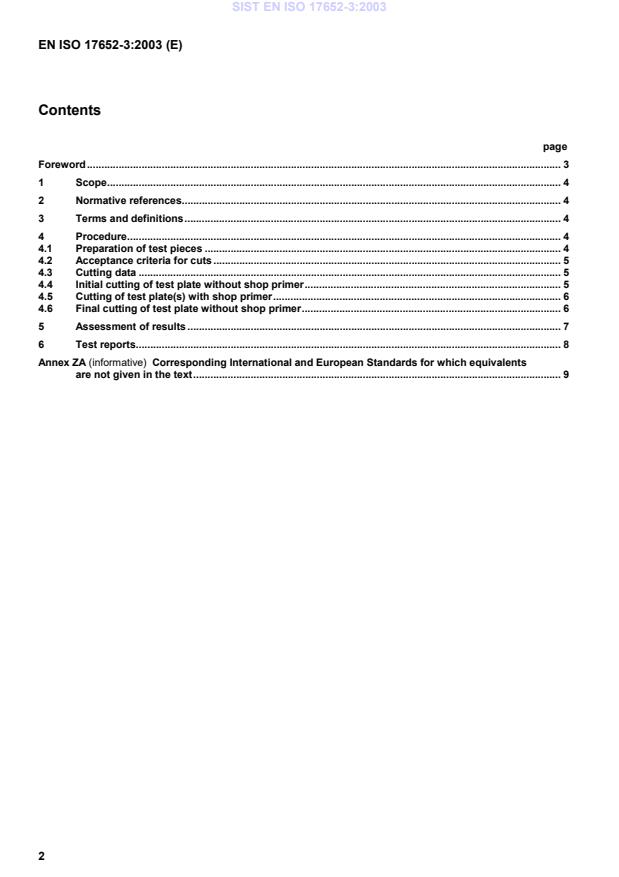
Contents
page
Foreword. 3
1 Scope. 4
2 Normative references. 4
3 Terms and definitions. 4
4 Procedure. 4
4.1 Preparation of test pieces . 4
4.2 Acceptance criteria for cuts . 5
4.3 Cutting data . 5
4.4 Initial cutting of test plate without shop primer. 5
4.5 Cutting of test plate(s) with shop primer. 6
4.6 Final cutting of test plate without shop primer. 6
5 Assessment of results . 7
6 Test reports. 8
Annex ZA (informative) Corresponding International and European Standards for which equivalents
are not given in the text. 9
Foreword
This document (EN ISO 17652-3:2003) has been prepared by Technical Committee CEN/TC 121 "Welding", the
secretariat of which is held by DS, in collaboration with Technical Committee ISO/TC 44 “Welding and allied
processes”.
This European Standard shall be given the status of a national standard, either by publication of an identical text or
by endorsement, at the latest by November 2003 and conflicting national standards shall be withdrawn at the latest
by November 2003.
EN ISO 17652 consists of the following parts, under the general title: Welding – Test for shop primers in relation to
welding and allied processes:
- Part 1: General requirements
- Part 2: Welding properties of shop primers
- Part 3: Thermal cutting
- Part 4: Emission of fumes and gases
Annex ZA is informative.
According to the CEN/CENELEC Internal Regulations, the national standards organizations of the following
countries are bound to implement this European Standard: Austria, Belgium, Czech Republic, Denmark, Finland,
France, Germany, Greece, Hungary, Iceland, Ireland, Italy, Luxembourg, Malta, Netherlands, Norway, Portugal,
Slovakia, Spain, Sweden, Switzerland and the United Kingdom.
1 Scope
This part of this European Standard specifies a test method for determination of a shop primers influence on the
maximum speed usable for thermal cutting.
For precaution for protection of health, safety and environment during testing, see EN ISO 17652-1.
2 Normative references
This European Standard incorporates by dated or undated reference, provisions from other publications. These
normative references are cited at the appropriate places in the text, and the publications are listed hereafter. For
dated references, subsequent amendments to or revisions of any of these publications apply to this European
Standard only when incorporated in it by amendment or revision. For undated references the latest edition of the
publication referred to applies (including amendments).
EN 10025, Hot rolled products of non-alloy structural steels Technical delivery conditions.
EN 10238, Automatically blast-cleaned and automatically prefabricated primed structural steel products.
EN ISO 2808, Paints and varnishes - Determination of film thickness (ISO 2808:1997).
EN ISO 8501-1:1988, Preparation of steel substrates before application of paints and related products - Visual
assessment of surface cleanliness - Part 1: Rust grades and preparation grades of uncoated steel substrates and of
steel substrates after overall removal of previous coatings (ISO 8501-1:1988).
EN ISO 9013, Thermal cutting - Classification of thermal cuts - Geometrical product specification and quality
tolerances (ISO 9013:2002).
EN ISO 17652-1:2003, Welding - Test for shop primers in relation to welding and allied processes - Part 1: General
requirements (ISO 17652-
...