

oSIST prEN 17093:2026
(Main)Domestic appliances used for drinking water treatment not connected to water supply - Jug water filter systems - Safety and performance requirements, labeling and information to be supplied
- Abstract
This European Standard describes the specifications and test methods for gravity fed devices for conditioning of drinking water that are not connected to the mains water distribution system in buildings, known as jug water filter systems. It also gives instructions for the user manuals, so that the jug water filter system can be used and maintained properly. Jug water filter systems are intended to modify the properties of drinking water only, and are not designed to make non-potable water safe for drinking. The scope of this document does not extend to combination systems that require an electrical power supply such as water heaters and water coolers systems.
NOTE 1 Although jug water filter systems are covered by the widely harmonized food legislation (EU Regulations 178/2002 and 1935/2004), existing national regulations concerning the use and or the characteristics of these products remain in force
NOTE 2 This standard provides no information as to whether the product is used without restriction in any of the Member States of the EU or EFTA.
- Status
- Not Published
- Public Enquiry End Date
- 24-Nov-2026
- Technical Committee
- I13 - Imaginarni 13
- Current Stage
- 4020 - Public enquire (PE) (Adopted Project)
- Start Date
- 05-Oct-2026
- Due Date
- 22-Feb-2027
- Completion Date
- 26-Nov-2026

oSIST prEN 17093:2026 is a draft European Standard from CEN for jug water filter systems used to condition drinking water without connection to the mains water supply. It specifies safety and performance requirements, labeling, marking, user information and test methods for freestanding gravity-fed jug filters intended for drinking water treatment.
The standard is aimed at manufacturers, test laboratories, and anyone who places jug water filter systems or replacement cartridges on the market. It helps readers judge whether a product is suitable for claims about chemical reduction, microbiological behavior, and product identification.
What does oSIST prEN 17093:2026 specify?
oSIST prEN 17093:2026 specifies the requirements for jug water filter systems that treat drinking water by gravity flow through a cartridge. It covers product design, constituent materials, chemical and microbiological safety, performance claims, test methods, user instructions, and labeling.
The scope is limited to devices that modify drinking water properties only. oSIST prEN 17093:2026 does not cover systems that require electrical power, such as water heaters or water coolers, and it does not treat non-potable water as safe for drinking. The document also notes that food-law obligations and existing national rules still apply.
The document is organized into nine clauses and a set of annexes that support the test methods and claims.
| Annex | What it covers |
|---|---|
| Annex A | Preparation of stock solutions |
| Annex B | Preparation of challenge water |
| Annex C | Example filtration and sampling schedule for chemical tests |
| Annex D | Example microbiological test procedure |
| Annex E | Scale reduction by boiling test |
| Annex F | Synopsis of test procedures and analytical methods |
| Annex G | Example test report forms |
| Annex H | Substance-specific reduction claims |
| Annex I | Hardness conversion table |
| Annex J | Seal verification test |
What are the key requirements of oSIST prEN 17093:2026?
oSIST prEN 17093:2026 requires the jug water filter system to be assessed as a complete unit, with claims limited to the parameters actually covered by the standard. In practice, this means a manufacturer cannot mix and match results from separate parts or make broad reduction claims without testing the full product configuration.
Design, materials and packaging
Clause 4 requires the wetted materials to comply with food-contact rules, and the active media to meet the relevant water-extractable chemical requirements for the cited media standards. This matters because the cartridge is in direct contact with inlet water and filtrate, so material quality affects both safety and test results.
Clause 5.2 requires cartridges to be protected against mechanical damage and packed hygienically. That is important for storage and shipping, because contamination or damage before first use can invalidate the product’s performance.
Chemical and microbiological safety
Clause 5.3 addresses silver-treated cartridges and ties the permitted silver release to the test method in Clause 7. Clause 5.4 requires new cartridges to be microbiologically safe on delivery and also requires a colonisation challenge, so the system must not support bacterial growth during normal use.
For microbiology, the standard uses Escherichia coli (E.coli) as the indicator organism. The practical point is that manufacturers and laboratories must show both that a new cartridge is clean enough for use and that the system does not promote microbial growth over the declared use period.
Performance claims
Clause 6.2 covers the main performance claims for metals, scale, nitrate, free chlorine, organoleptic improvement, PFAS and THMs. The standard links each claim to a named challenge water and a test method, so the reader can see exactly which parameter is being demonstrated.
The key chemical claim areas are:
- reduction of metal contents, including aluminium, copper, lead and nickel
- reduction of scale, nitrate and free chlorine
- improvement of organoleptic characteristics, with Geosmin and 2,4,6-TCP as one option and free chlorine as the alternative option
- reduction of PFAS-4, namely PFOA, PFOS, PFNA and PFHxS
- reduction of THMs, using chloroform as the representative compound
Clause 6.1 also sets an important rule for additional claims: any other substance reduction claim tested under the standard must achieve at least the stated minimum reduction level in that clause. That keeps extra marketing claims aligned with a measurable test result.
Test regime and alternative systems
Clause 7 requires two identical units to be tested in parallel, with a third unit used if one of the first two fails. The tests are run under specified use conditions, and the filtration regime is based on the manufacturer’s declared nominal capacity and maximum usage time. In practice, this means the test lab must simulate realistic use, including periods of stagnation and repeated daily operation.
Annex J is important for replacement cartridges used in alternative jug systems. Compliance can be extended to another jug only if the cartridge was tested in a reference system, the seal is verified, and the contact time is not reduced below the stated threshold. This matters for cartridge suppliers, because fit and flow behavior affect whether a cartridge can be reused in another housing.
Instructions, marking and traceability
Clauses 8 and 9 require user instructions, change-out guidance, storage and hygiene advice, and clear packaging information. The packaging must identify the manufacturer, the standard reference, the claimed determinants, the batch code and the total cartridge capacity.
The labeling also has to identify which cartridge was tested with which jug water filter system. That traceability is important when a cartridge and jug are sold separately, because the performance claim belongs to the tested combination, not to any random pairing.
What terms does oSIST prEN 17093:2026 define?
- active medium - the material that changes the water by physical or chemical action.
- cartridge - the replaceable or rechargeable part that contains the active medium.
- challenge water - water spiked with chemicals or inoculated with bacteria for testing.
- filtrate - the water that has passed through the active medium.
- jug - the receptacle that collects the filtrate.
- jug water filter system - the freestanding water filter device not connected to a water supply system.
- maximum usage time - the manufacturer-declared period during which hygienic conditions are maintained if the product is used correctly.
- nominal capacity (NC) - the stated volume of treated water up to which cartridge performance is guaranteed.
Who uses oSIST prEN 17093:2026?
oSIST prEN 17093:2026 is used by manufacturers of jug water filter systems and replacement cartridges, test laboratories, quality and regulatory teams, and conformity assessment bodies. Buyers and product managers use it to check whether a claimed filter performance has been tested in the right system and under the right conditions.
It is also relevant to people responsible for labeling, instructions for use, packaging, and batch traceability. In practice, the document helps them decide what must be declared on the pack, what must appear in the manual, and which claims need test evidence.
What changed in oSIST prEN 17093:2026 from the previous edition?
oSIST prEN 17093:2026 will supersede EN 17093:2018. The foreword states two significant technical additions compared with the previous edition:
- addition of reduction of PFAS as a chemical requirement
- addition of free chlorine reduction as a chemical requirement
Which standards are used with oSIST prEN 17093:2026?
The document relies on several test and material standards. The main ones are:
- EN ISO 3696 - laboratory water quality for preparing solutions
- EN 12903, EN 12904, EN 12905, EN 12906, EN 12907, EN 12909, EN 12910, EN 12911, EN 12912, EN 12913, EN 12914, EN 12915-1, EN 13752, EN 13753, EN 13754, EN 14368, EN 14369 - requirements for the active media used in the cartridge
- EN 17892 - PFAS analysis in drinking water
- EN 26777, EN ISO 7393-2, EN ISO 9308-1, EN ISO 9963-1, EN ISO 10301, EN ISO 10304-1, EN ISO 10523, EN ISO 11885, EN ISO 13395, EN ISO 17294-2, ISO 6059, ISO 7890-3 - analytical methods for nitrate, free chlorine, microbiology, alkalinity, chloroform, pH, metals, and hardness-related testing
- EN 12673 - 2,4,6-trichlorophenol measurement
What does the oSIST prEN 17093:2026 document contain?
The document contains the test framework for chemical and microbiological performance, including how to prepare stock solutions and challenge waters, how to run filtration and sampling cycles, and how to report results. Annexes A and B give the preparation routes for the test waters, while Annex F links each claim to the analytical method used to measure it.
It also contains a separate kettle-based scale reduction test in Annex E, microbiological challenge procedures in Clause 7 and Annex D, and seal verification methods in Annex J for using a cartridge in an alternative jug system. Annex H explains how substance-specific reduction claims are handled, and Annex G provides example report layouts for documenting test outcomes.
Relations
- Effective Date
- 18-Feb-2026
Get Certified
Connect with accredited certification bodies for this standard

CIS Institut d.o.o.
Personal Protective Equipment (PPE) certification body. Notified Body NB-2890 for EU Regulation 2016/425 PPE.

Kiwa BDA Testing
Building and construction product certification.
Kmetijski inštitut Slovenije
Agricultural Institute of Slovenia. Soil testing, plant health, agricultural product analysis.
Sponsored listings
Frequently Asked Questions
oSIST prEN 17093:2026 is a draft published by the Slovenian Institute for Standardization (SIST). Its full title is "Domestic appliances used for drinking water treatment not connected to water supply - Jug water filter systems - Safety and performance requirements, labeling and information to be supplied". This standard covers: This European Standard describes the specifications and test methods for gravity fed devices for conditioning of drinking water that are not connected to the mains water distribution system in buildings, known as jug water filter systems. It also gives instructions for the user manuals, so that the jug water filter system can be used and maintained properly. Jug water filter systems are intended to modify the properties of drinking water only, and are not designed to make non-potable water safe for drinking. The scope of this document does not extend to combination systems that require an electrical power supply such as water heaters and water coolers systems. NOTE 1 Although jug water filter systems are covered by the widely harmonized food legislation (EU Regulations 178/2002 and 1935/2004), existing national regulations concerning the use and or the characteristics of these products remain in force NOTE 2 This standard provides no information as to whether the product is used without restriction in any of the Member States of the EU or EFTA.
This European Standard describes the specifications and test methods for gravity fed devices for conditioning of drinking water that are not connected to the mains water distribution system in buildings, known as jug water filter systems. It also gives instructions for the user manuals, so that the jug water filter system can be used and maintained properly. Jug water filter systems are intended to modify the properties of drinking water only, and are not designed to make non-potable water safe for drinking. The scope of this document does not extend to combination systems that require an electrical power supply such as water heaters and water coolers systems. NOTE 1 Although jug water filter systems are covered by the widely harmonized food legislation (EU Regulations 178/2002 and 1935/2004), existing national regulations concerning the use and or the characteristics of these products remain in force NOTE 2 This standard provides no information as to whether the product is used without restriction in any of the Member States of the EU or EFTA.
oSIST prEN 17093:2026 is classified under the following ICS (International Classification for Standards) categories: 13.060.20 - Drinking water; 97.040.99 - Other kitchen equipment. The ICS classification helps identify the subject area and facilitates finding related standards.
oSIST prEN 17093:2026 has the following relationships with other standards: It is inter standard links to SIST EN 17093:2018. Understanding these relationships helps ensure you are using the most current and applicable version of the standard.
oSIST prEN 17093:2026 is available in PDF format for immediate download after purchase. The document can be added to your cart and obtained through the secure checkout process. Digital delivery ensures instant access to the complete standard document.
Standards Content (Sample)
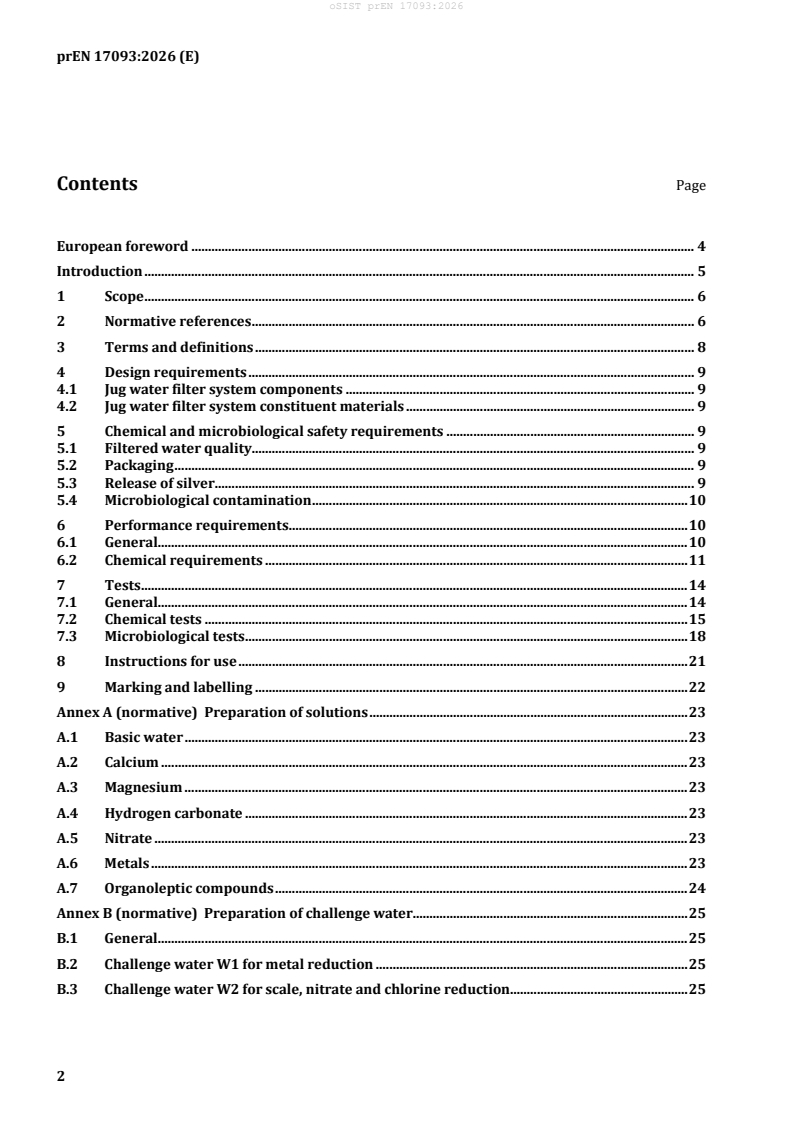
Contents
- Introduction
- 1 Scope
- 2 Normative references
- 3 Terms and definitions
- 3.1 active medium
- 3.2 cartridge
- 3.3 cartridge replacement indicator
- 3.4 challenge water
- 3.5 filtrate
- 3.6 flow rate
- 3.7 hopper
- 3.8 jug
- 3.9 jug water filter system
- 3.10 maximum usage time
- 3.11 nominal capacity
- 4 Design requirements
- 4.1 Jug water filter system components
- 4.2 Jug water filter system constituent materials
- 5 Chemical and microbiological safety requirements
- 5.1 Filtered water quality
- 5.2 Packaging
- 5.3 Release of silver
- 5.4 Microbiological contamination
- 6 Performance requirements
- 6.1 General
- 6.2 Chemical requirements
- 7 Tests
- 7.1 General
- 7.2 Chemical tests
- 7.3 Microbiological tests
- 8 Instructions for use
- 9 Marking and labelling
- Annex A
- Annex B
- Annex C
- 6 Two-day break from filtration
- 13 Two-day break from filtration
- 20 Two-day break from filtration
- Annex D
- 2 Filtration of 6 l of tap water
- 3 Filtration of 6 l of tap water
- 4 Filtration of 6 l of tap water
- 5 Filtration of 6 l of tap water
- 2 Filtration of 3 l of tap water Sample MB1: overnight Determination of
- 3 Filtration of 3 l of tap water Sample MD1: mixed sample of Determination of
- 4 Filtration of 3 l of tap water Sample ME1: mixed sample of Determination of
- 5 No filtration
- Annex E
- Annex F
- Annex E (for boiling test)
- Annex G
- Annex H
- Annex I
- Annex J
- Bibliography
Introduction
Jug water filter systems are used for the conditioning of drinking water with the objective of optimizing drinking water for specific applications.
oSIST prEN 17093:2026 prEN 17093:2026 (E)
1 Scope
This document describes the specifications and test methods for gravity fed devices for conditioning of drinking water that are not connected to the mains water distribution system in buildings, known as jug water filter systems. It also gives instructions for the user manuals, so that the jug water filter system can be used and maintained properly. Jug water filter systems are intended to modify the properties of drinking water only and are not designed to make non-potable water safe for drinking. The scope of this document does not extend to combination systems that require an electrical power supply such as water heaters and water coolers systems.
NOTE Although jug water filter systems are covered by the widely harmonized food legislation (EU Regulations 178/2002 and 1935/2004), existing national regulations concerning the use and or the characteristics of these products remain in force.
2 Normative references
The following documents are referred to in the text in such a way that some or all of their content constitutes requirements of this document. For dated references, only the edition cited applies. For undated references, the latest edition of the referenced document (including any amendments) applies. EN 12673, Water quality - Gas chromatographic determination of some selected chlorophenols in water EN 12903, Products used for the treatment of water intended for human consumption - Powdered activated carbon EN 12904, Products used for treatment of water intended for human consumption - Silica sand and silica gravel EN 12905, Products used for treatment of water intended for human consumption - Expanded aluminosilicate EN 12906, Products used for treatment of water intended for human consumption - Pumice EN 12907, Products used for treatment of water intended for human consumption - Pyrolyzed coal material EN 12909, Products used for treatment of water intended for human consumption - Anthracite EN 12910, Products used for treatment of water intended for human consumption - Garnet EN 12911, Products used for treatment of water intended for human consumption - Manganese greensand EN 12912, Products used for treatment of water intended for human consumption - Barite EN 12913, Products used for treatment of water intended for human consumption - Powdered diatomaceous earth EN 12914, Products used for treatment of water intended for human consumption - Powdered perlite EN 12915-1, Products used for the treatment of water intended for human consumption - Granular activated carbon - Part 1: Virgin granular activated carbon EN 13752, Products used for treatment of water intended for human consumption - Manganese dioxide
oSIST prEN 17093:2026 prEN 17093:2026 (E) EN 13753, Products used for treatment of water intended for human consumption - Granular activated alumina EN 13754, Products used for treatment of water intended for human consumption - Bentonite EN 14368, Products used for treatment of water intended for human consumption - Manganese dioxide coated limestone EN 14369, Products used for treatment of water intended for human consumption - Iron-coated granular activated alumina EN 17892, Water quality - Determination of selected per- and polyfluoroalkyl substances in drinking water - Method using liquid chromatography/tandem-mass spectrometry (LC-MS/MS) EN 26777, Water quality - Determination of nitrite - Molecular absorption spectrometric method (ISO 6777) EN ISO 3696, Water for analytical laboratory use - Specification and test methods (ISO 3696) EN ISO 7393-2, Water quality - Determination of free chlorine and total chlorine - Part 2: Colorimetric method using N,N-dialkyl-1,4-phenylenediamine, for routine control purposes (ISO 7393-2) EN ISO 9308-1, Water quality - Enumeration of Escherichia coli and coliform bacteria - Part 1: Membrane filtration method for waters with low bacterial background flora (ISO 9308-1) EN ISO 9963-1, Water quality - Determination of alkalinity - Part 1: Determination of total and composite alkalinity (ISO 9963-1) EN ISO 10301, Water quality - Determination of highly volatile halogenated hydrocarbons - Gaschromatographic methods (ISO 10301) EN ISO 10304-1, Water quality - Determination of dissolved anions by liquid chromatography of ions - Part 1: Determination of bromide, chloride, fluoride, nitrate, nitrite, phosphate and sulfate (ISO 10304-1) EN ISO 10523, Water quality - Determination of pH (ISO 10523) EN ISO 13395, Water quality - Determination of nitrite nitrogen and nitrate nitrogen and the sum of both by flow analysis (CFA and FIA) and spectrometric detection (ISO 13395) EN ISO 11885, Water quality - Determination of selected elements by inductively coupled plasma optical emission spectrometry (ICP-OES) (ISO 11885) EN ISO 17294-2, Water quality - Application of inductively coupled plasma mass spectrometry (ICP-MS) - Part 2: Determination of selected elements including uranium isotopes (ISO 17294-2) ISO 6059, Water quality — Determination of the sum of calcium and magnesium — EDTA titrimetric method ISO 7890-3, Water quality — Determination of nitrate — Part 3: Spectrometric method using sulfosalicylic acid
oSIST prEN 17093:2026 prEN 17093:2026 (E)
3 Terms and definitions
For the purposes of this document, the following terms and definitions apply. ISO and IEC maintain terminology databases for use in standardization at the following addresses:
- ISO Online browsing platform: available at https://www.iso.org/obp/
- IEC Electropedia: available at https://www.electropedia.org/
3.1 active medium
active material that significantly changes the composition of the water by physical or chemical processes
3.2 cartridge
replaceable or rechargeable component, which contains the active medium through which the water passes in order to be treated
3.3 cartridge replacement indicator
device indicating the need to replace a cartridge
3.4 challenge water
water spiked with chemicals or inoculated with bacteria, used for carrying out the tests
3.5 filtrate
water that has passed through the filter active medium
3.6 flow rate
time taken for one litre of water to pass through the cartridge
3.7 hopper
separate, removable or non-removable chamber that contains the water before it passes through the active medium
3.8 jug
receptacle that collects the filtrate
3.9 jug water filter system
freestanding water filter device, not connected to a water supply system
3.10 maximum usage time
time in weeks specified by the manufacturer up to which hygienic conditions of the filter are maintained subject to correct operation in accordance with manufacturer’s instructions
oSIST prEN 17093:2026 prEN 17093:2026 (E)
3.11 nominal capacity
(NC) volume in litres of treated water stated by the manufacturer, up to which cartridge performances are guaranteed
4 Design requirements
4.1 Jug water filter system components
The jug water filter system can comprise some or all of the following components:
a) jug; b) hopper; c) cartridge; d) cartridge replacement indicator; e) lid.
NOTE The components of a jug water filter system can vary and might include parts other than those listed. However, this list is representative of most jug water filter systems currently available.
4.2 Jug water filter system constituent materials
All materials used in the jug water filter system coming into contact with inlet water and filtrate shall meet the regulations for materials in contact with food [11] [12]. The active media shall comply with the requirements relating to the water extractable chemical parameters in EN 12903, EN 12904, EN 12905, EN 12906, EN 12907, EN 12909, EN 12910, EN 12911, EN 12912, EN 12913, EN 12914, EN 12915-1, EN 13752, EN 13753, EN 13754, EN 14368, and EN 14369 as appropriate.
For the use of an ion exchange resin, ResAP (2004) 3 [14] shall be considered.
5 Chemical and microbiological safety requirements
5.1 Filtered water quality
For compliance with this European Standard, instructions on the filtered water quality can be found in the European drinking water Directive 2020/2184/EU, Annex 1, Part A and B and any subsequent amendments [1] or appropriate food legislation.
5.2 Packaging
Filter cartridges shall be adequately protected from mechanical damage during shipment and storage. They shall also be individually, hygienically packed to prevent contamination during shipment and storage.
5.3 Release of silver
There is no European regulated limit governing the amount of silver in drinking water. Taking into consideration the information provided in the WHO Guidelines [15], if the cartridge is treated with silver, the average silver concentration when tested in accordance with 7.2.5.3 shall not exceed 80 µg/l.
oSIST prEN 17093:2026 prEN 17093:2026 (E) When testing for silver leachate in a new cartridge, an initial volume of water specified shall be discarded before commencement of use and before testing is carried out.
5.4 Microbiological contamination
5.4.1 Condition on the new cartridge
The new cartridge as delivered to the consumer shall not contain numbers or concentrations of microorganisms constituting a potential danger to the health of the user. When tested in accordance with 7.3.2 sterile filtered challenge water after filtration by a new jug water filter system, shall comply with the microbiological requirements. More instructions can be found in the Drinking Water Directive 2020/2184/EC, Annex 1, Part A [1], as applicable to tap water.
5.4.2 Potential for colonisation of the jug water filter system
During normal use, the jug water filter system shall not promote microbiological growth, therefore, a microbiological challenge test according to 7.3.3 shall be carried out. When tested in accordance with 7.3.3, the sum of the Colony Forming Units (CFU) counts of E.coli for day 2 to day 4 shall not exceed twice the CFU counts of the challenge water, for each of the two challenge weeks.
6 Performance requirements
6.1 General
6.1.1 Compliance with this standard may only be claimed if the jug water filter system has been tested as a complete unit.
The jug water filter system shall only be assessed against the performance claims relevant to the parameters present in the standard.
At least one parameter shall be identified in those performance claims based on the nominal capacity in litres.
If more than one performance parameter is declared for the jug water filter system, the performance parameter with the lowest capacity (in litres) defines the maximum capacity declared. All claims made to this standard shall be clearly separated from other claims or information.
6.1.2 Any additional substance reduction claims (see Annex H) not specifically mentioned in this
standard but tested according to the procedures specified in Clause 7 shall have a reduction rate of at least 90 %.
6.1.3 If a filter cartridge, which has been confirmed to comply with this standard in a specific jug water filter system, is to be used in an alternative system (hopper and jug), compliance of the alternative system can be assumed if:
a) the cartridge has been tested in the jug water filter system with the highest water level above the cartridge (the reference system), and b) a seal verification confirms that the cartridge fits into the alternative jug water filter system(s) with the same seal tightness as in the reference system (see Annex J); c) the contact time for the cartridge is not less than 90 % of that for the originally tested system.
oSIST prEN 17093:2026 prEN 17093:2026 (E)
6.2 Chemical requirements
6.2.1 Reduction of metal contents
When tested according to 7.2.5.2, the average of all of the daily composite filtered water samples from each jug water filter system shall meet the minimum average percentage reduction of the concentration of all of the challenge water according to Table 1 the metal parameters tested. Table 1 — Metal reduction requirements Parameter Concentration unit challenge water Minimum average a Concentration Ci for water W1 (Annex B) percentage reduction +40 Aluminium µg/l Al 60
−20 Copper mg/l Cu +0,6 80
−03, Lead µg/l Pb +20 90
−10 +16 Nickel µg/l Ni 75
−10 a The concentration of aluminium in the challenge water W1 is equal to the parametric value laid down in the Drinking Water Directive; the concentrations of copper, lead and nickel are greater than the corresponding parametric values laid down in the Drinking Water Directive and represent the transient values that may be found in the water at the consumers’ tap after a long stagnation time inside premises and establishments.
6.2.2 Reduction of scale, free chlorine and nitrate contents
When chlorine reduction and nitrate reduction are tested according to 7.2.5.3 or the average of all the daily composite filtered water samples for the respective parameter for each jug water filter system shall meet the minimum average percentage reduction of the concentration of the challenge water according to Table 2.
The scale reduction shall be tested by boiling test in accordance with Annex E, the total limescale deposits from each kettle using filtered water shall be at least 80 % less than total limescale removed from the kettle supplied with untreated water.
oSIST prEN 17093:2026 prEN 17093:2026 (E) Table 2 — Chemical reduction requirements Parameter Concentration unit challenge water Minimum Average Concentration Ci percentage for water W2 (Annex B) reduction b +40 Scale reduction mg/l 30
−20 (Carbonate hardness reduction) b +40 Scale reduction (Boiling mg/l 80
−20 test)
+10 Nitrate mg/l NO 50 a
−5 Free chlorine mg/l Cl +0,2 80
−01, a The concentration of nitrate in the challenge water W1 is equal to the parametric value laid down in the Drinking Water Directive.
b It shall be stated which scale reduction test was used to confirm the performance according to carbonate hardness reduction, boiling test or both whichever is applicable. c In the case of nitrate, to check that no excessive nitrite formation has occurred, the analysis of filtrate samples shall include both nitrate and nitrite, and the following condition shall be met:
CC
NO NO
3 2 +≤ 1 50 3 where C is the concentration in mg/l
6.2.3 Improvement of organoleptic characteristics
When organoleptic reduction is tested according to 7.2.5.4, the daily average of all the filtered water samples for the respective parameter for each jug water filter shall meet the minimum average percentage reduction according to Table 3 or according to Table 4. Separate claims for odour and flavour reduction are not permitted. There are two options for organoleptic testing. Either Geosmin and TCP reduction (6.2.3.1) together or free chlorine reduction (6.2.3.2).
Both Geosmin and 2,4,6-TCP shall be tested together for compliance with this standard. Table 3 — Organoleptic characteristics reduction test by Geosmin and TCP reduction Parameter Concentration unit challenge water Minimum average Concentration Ci percentage reduction for water W3 (Annex B) a 2,4,6-TCP µg/l 2,4,6-TCP 5 (+1/-0,5) 50 b Geosmin µg/l Geosmin 0,05 (+0,01/-0,005) 50 a 2,4,6-trichlorophenol.
b 2,6-dimethylbicyclo[4;4;0]decan-1-ol Free chlorine reduction can be used as an alternative parameter for organoleptic improvement.
oSIST prEN 17093:2026 prEN 17093:2026 (E) Table 4 — Organoleptic characteristics reduction test by free chlorine reduction Parameter Concentration unit challenge water Minimum Average Concentration Ci percentage for water W2 (Annex B) reduction Free chlorine mg/l Cl +0,2 80
−01,
6.2.4 Reduction of PFAS
6.2.4.1 General
Representatives of the PFAS substance class have been included as new chemical parameters in the European Drinking Water Directive (EC) 2020/2184 (Annex I Part B). Considering that PFAS reduction is an evolving topic and that in the future more substances would be needed to be tested for manufacturer’s claims, other PFAS substances than those indicated below should be tested according to Annex H and in consideration with standards or scientific studies available published.
This standard is based on a total limit value of 20 ng/l for PFAS-4, which is adopted by some national and European authorities.
The following representatives of this substance class “PFAS-4” should therefore be tested for reduction performance:
- Perfluorooctanoic acid (PFOA)
- Perfluorooctane sulfonic acid (PFOS)
- Perfluorononanoic acid (PFNA)
- Perfluorohexane sulfonic acid (PFHxS) 6.2.4.2 Determination of the concentration of PFAS-4 in Challenge Water W3 The tests for substance reduction shall be carried out using test water that contains ten times the value stipulated (Table 5).
In this case, it would mean a 10 times concentration of the limit value setting, i.e. 20 ng/l of PFAS-4. Table 5 − PFAS concentration Parameter for Water W3 concentration in challenge Average minimum reduction in (Annex B) water W3 [ng/L] % +10 PFOA 90
−10 +10 PFOS 90
−10 +10 PFNA 90
−10 +10 PFHxS 90
−10 In accordance to these limit values the PFAS-4 concentration of the challenge water is therefore 200 ng/l ± 20 %.
This means, for each single PFAS of PFAS-4 a concentration of 50 ng/l ± 20 % is applicable.
oSIST prEN 17093:2026 prEN 17093:2026 (E) During the test in accordance with 6.2.4, the average value of all daily filter samples from each jug water filter system shall correspond to the reduction of the individual PFAS concentration in accordance with Table 5.
6.2.4.3 PFAS removal performance test
PFAS removal performance test shall be done as follows:
Challenge Water Preparation: Challenge water W3 is prepared in accordance with Annex B. A stock solution containing all of the above PFAS is prepared for PFAS spiking. In order to obtain reproducible results, it shall be ensured that the target concentration of PFAS in the test water remains constant over time (if necessary, methanol shall be used as a solubilizer. This shall be noted in the test report). The test water is freshly spiked with the selected PFAS on a daily basis to minimize the sorption of PFAS on the walls of the storage vessel. The analysis of PFAS in the filtrate shall be performed according to the procedure described in EN 17892.
Water Sampling Water: Sampling shall be carried out according to 7.2.5.3.
6.2.5 THMs reduction
Trihalomethanes (THMs) are by-products of disinfection of drinking water by chlorine. Chloroform is the predominant THM and is used as a surrogate for testing THMs reductions. When tested according to 7.2.5.4, the average of all of the daily composite filtered water samples for each jug water filter shall meet the minimum average percentage reduction of the concentration of the challenge water according to Table 6.
Table 6 — THMs reduction requirements Parameter Concentration unit challenge water Minimum average b Concentration Ci percentage reduction for water W3 (Annex B) a Chloroform µg/l CHCl +20 90
−10 a Used as a representative of all THMs.
b The concentration of chloroform in the challenge water W1 is equal to the parametric value of total THMs laid down in the Drinking Water Directive.
7 Tests
7.1 General
The jug water filter system shall be commissioned and maintained in accordance with the conditions specified for use throughout the test.
Two identical jug water filter systems shall be tested in parallel. If one of the two does not give the required results, a third jug water filter system shall be tested. If the test with the third jug water filter system gives required results, the test is successful.
The test procedure shall be carried out at room temperature of 22 °C ± 3 °C.
...