

SIST EN 2:1995
(Main)Classification of fires
General Information
- Abstract
The present document classifies in four categories the different kinds of fires which can be defined in terms of the nature of the fuel. Such a classification is particulary useful in the context of fire fighting by means of an extinguisher.
- Status
- Published
- Publication Date
- 30-Nov-1995
- Technical Committee
- POZ - Požarna varnost
- Current Stage
- 6060 - National Implementation/Publication (Adopted Project)
- Start Date
- 01-Dec-1995
- Due Date
- 01-Dec-1995
- Completion Date
- 01-Dec-1995
- Ref Project
EN 2:1992 - Classification of fires

Overview
SIST EN 2:1995 is a crucial European standard published by CEN that provides a clear and practical classification system for different types of fires. This document categorizes fires into four main classes based on the nature of the fuel involved. The classification is designed to support effective fire fighting and prevention strategies, especially when selecting the appropriate fire extinguishing methods and equipment.
Understanding the classification of fires under SIST EN 2:1995 helps safety professionals, fire fighters, and facility managers to quickly identify fire types and implement the most effective response measures. This standard serves as a foundational guideline in fire safety and emergency preparedness across various industries and settings.
Key Topics
Fire Classification System
SIST EN 2:1995 defines four categories of fires, each related to the fuel source:- Class A: Fires involving solid materials such as wood, paper, or textiles
- Class B: Fires involving flammable liquids like petrol, oils, or solvents
- Class C: Fires involving gases such as propane, butane, or natural gas
- Class D: Fires involving combustible metals such as magnesium, sodium, or aluminium
Fuel Nature and Fire Behavior
The standard emphasizes the importance of understanding fuel characteristics to determine how fires develop and propagate, which is critical for effective extinguishing.Extinguishing Methods Alignment
EN 2 promotes compatibility between fire classification and the selection of extinguishers, making it easier to choose the right extinguisher for the fire type. For example, water extinguishers are effective on Class A fires but inappropriate for Class B or D fires.
Applications
Fire Fighting Operations
This classification guides emergency responders in choosing the correct firefighting techniques and equipment, preventing ineffective or hazardous interventions.Fire Extinguisher Design & Labeling
Manufacturers use EN 2 categories to design and label extinguishers clearly, ensuring easy identification and proper use by end-users.Workplace Safety Planning
Facilities develop fire safety plans and training programs based on this classification, improving risk assessment and emergency preparedness.Training and Education
Fire safety training leverages the classification to teach personnel about different fire hazards and appropriate response strategies.Insurance and Compliance
Compliance with EN 2 supports insurance policies and legal regulations related to fire safety standards in commercial and industrial environments.
Related Standards
EN 3 - Portable Fire Extinguishers
Specifies requirements for fire extinguishers that correspond to the fire classes outlined in EN 2.ISO 11602 - Fire Fighting Equipment
Provides additional guidance on firefighting equipment design and performance.EN 54 - Fire Detection and Alarm Systems
Complementary standards addressing fire detection and alarm systems for comprehensive fire safety.National and Regional Fire Safety Regulations
EN 2 often aligns with or supports various local fire safety codes and legislation in European countries and beyond.
By adhering to SIST EN 2:1995 fire classification, professionals ensure accurate identification of fire types and enhance the safety and efficiency of firefighting efforts. This standard remains essential for industries seeking to maintain robust fire prevention and response systems.
Relations
- Effective Date
- 29-Jul-2026
- Effective Date
- 10-Feb-2026
- Effective Date
- 28-Jan-2026
- Referred By
SIST EN ISO 28881:2022 - Machine tools - Safety - Electrical discharge machines (ISO 28881:2022) - Effective Date
- 28-Jan-2026
- Effective Date
- 28-Jan-2026
- Effective Date
- 28-Jan-2026
- Effective Date
- 28-Jan-2026
- Effective Date
- 28-Jan-2026
- Effective Date
- 28-Jan-2026
- Effective Date
- 28-Jan-2026
- Effective Date
- 28-Jan-2026
- Effective Date
- 28-Jan-2026
- Referred By
SIST EN 13000:2010 - Cranes - Mobile cranes - Effective Date
- 28-Jan-2026
- Effective Date
- 28-Jan-2026
- Effective Date
- 28-Jan-2026
Get Certified
Connect with accredited certification bodies for this standard

CIS Institut d.o.o.
Personal Protective Equipment (PPE) certification body. Notified Body NB-2890 for EU Regulation 2016/425 PPE.

Kiwa BDA Testing
Building and construction product certification.
Kmetijski inštitut Slovenije
Agricultural Institute of Slovenia. Soil testing, plant health, agricultural product analysis.
Sponsored listings
Frequently Asked Questions
SIST EN 2:1995 is a standard published by the Slovenian Institute for Standardization (SIST). Its full title is "Classification of fires". This standard covers: The present document classifies in four categories the different kinds of fires which can be defined in terms of the nature of the fuel. Such a classification is particulary useful in the context of fire fighting by means of an extinguisher.
The present document classifies in four categories the different kinds of fires which can be defined in terms of the nature of the fuel. Such a classification is particulary useful in the context of fire fighting by means of an extinguisher.
SIST EN 2:1995 is classified under the following ICS (International Classification for Standards) categories: 13.220.01 - Protection against fire in general. The ICS classification helps identify the subject area and facilitates finding related standards.
SIST EN 2:1995 has the following relationships with other standards: It is inter standard links to SIST EN 45545-6:2025+A1:2026, SIST-TS CEN/TS 45545-6:2009, SIST EN 3-7:2004+A1:2008, SIST EN ISO 28881:2022, SIST EN 12416-1:2001+A2:2007, SIST EN 17932:2024, SIST EN 13814:2005, SIST EN 45545-6:2013, SIST EN 15746-2:2010+A1:2012, SIST EN 15276-1:2019, SIST EN 14033-3:2010+A1:2012, SIST EN 15955-2:2025, SIST EN 13000:2010, SIST EN 13000:2010+A1:2014, SIST EN 16856:2020. Understanding these relationships helps ensure you are using the most current and applicable version of the standard.
SIST EN 2:1995 is associated with the following European legislation: EU Directives/Regulations: 2005-01-2964, 2008/68/EC. When a standard is cited in the Official Journal of the European Union, products manufactured in conformity with it benefit from a presumption of conformity with the essential requirements of the corresponding EU directive or regulation.
SIST EN 2:1995 is available in PDF format for immediate download after purchase. The document can be added to your cart and obtained through the secure checkout process. Digital delivery ensures instant access to the complete standard document.
Standards Content (Sample)
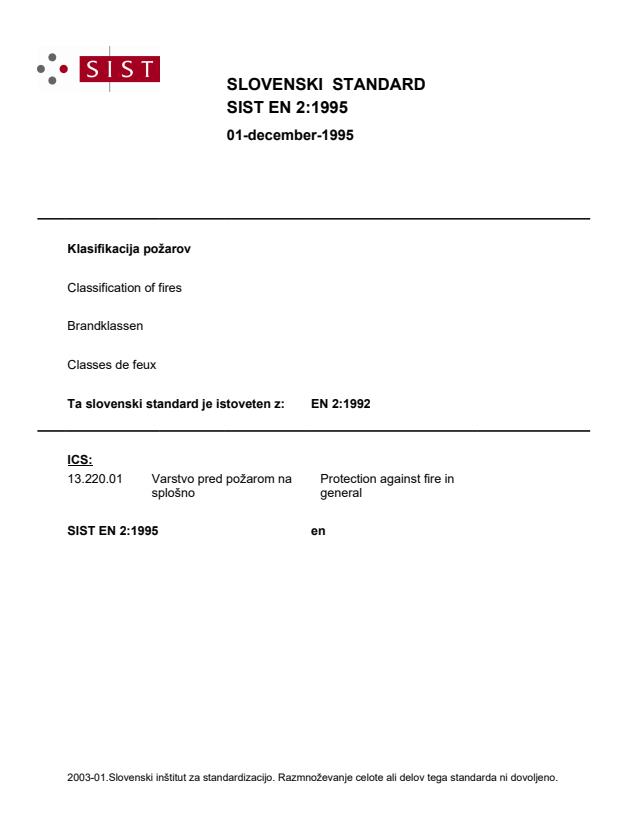
2003-01.Slovenski inštitut za standardizacijo. Razmnoževanje celote ali delov tega standarda ni dovoljeno.Klasifikacija požarovBrandklassenClasses de feuxClassification of fires13.220.01Varstvo pred požarom na splošno
...