

SIST-TP CEN/TR 17524:2020
(Main)Fire safety engineering in Europe - Review of national requirements and application
General Information
- Abstract
This document gives an overview of the evolution of regulations and application of Fire Safety Engineering (FSE) in Europe. Based on work performed in 2001-2002, a full update of information has been done. A global survey based on questionnaires defined in 2001, the evolution and possible perspectives of the FSE practices within two perimeters are presented:
- The first perimeter is the same perimeter analysed in 2001 corresponding to the European Union defined in 2001 extended to European countries with European Union agreement (Switzerland, Norwegian and Iceland).
- The second perimeter is the European Union perimeter of 2016 extended to European countries with European Union agreement (Switzerland, Norwegian and Iceland).
Conclusions and initiatives of the 2001 proposals were analysed 15 years after, with and without the extension of European Union. New initiatives have since been proposed.
In addition, the state-of-the-art of Fire Safety Engineering is updated.
- Status
- Published
- Public Enquiry End Date
- 19-Jun-2020
- Publication Date
- 07-Sep-2020
- Technical Committee
- POZ - Požarna varnost
- Current Stage
- 6060 - National Implementation/Publication (Adopted Project)
- Start Date
- 26-Aug-2020
- Due Date
- 31-Oct-2020
- Completion Date
- 08-Sep-2020



Overview
SIST-TP CEN/TR 17524:2020 - Fire safety engineering in Europe: Review of national requirements and application - is a CEN Technical Report updating the Benefeu programme (2001–2002) and providing a continent-wide survey and state-of-the-art review of Fire Safety Engineering (FSE). The report compares two perimeters (EU in 2001 plus Switzerland/Norway/Iceland, and EU in 2016 plus the same countries), updates regulatory evolution, examines national practices, and reviews initiatives for a harmonized, performance-based approach to fire safety across Europe.
Key topics and technical focus
- Regulatory evolution and national requirements: Detailed survey of fire regulations, enforcement practices, societal goals and functional/performance requirements across EU member states (2001 and 2016 perimeters).
- Performance-based codes and model framework: Analysis of moving from prescriptive to performance-based regulation and proposals for a harmonized framework and model code to reduce trade barriers.
- State-of-the-art FSE: Review of tools, methods, and knowledge gaps; emphasis on need for operational, unambiguous standards and representation of “real world” fire scenarios.
- Standardization and coordination: Calls for coordination between CEN and ISO activities (notably ISO TC 92 SC4) and for targeted mandates to support FSE standard development.
- Education, training and professional recognition: Recommendations for common core curricula, professional recognition, and codes of ethics to develop the FSE profession in Europe.
- Initiatives and cost–benefit analysis: Benefeu conclusions include estimated EU-wide savings (approx. €0.3B–€1B) if FSE is fully implemented, with implementation costs estimated as marginal (~€28M).
Practical applications - who uses this standard
This Technical Report is valuable to:
- Regulators and policy makers assessing national fire safety legislation and considering performance-based approaches.
- Fire safety engineers and consultants applying FSE methods, justifying product performance, and using harmonized assessment frameworks.
- Standards developers (CEN/TC 127, ISO TC 92 SC4) planning mandates, pre-standardization and harmonized tests.
- Educators and professional bodies designing curricula, certification schemes and continuing professional development.
- Manufacturers, building owners and approval authorities needing evidence-based routes for alternative approvals and derogations from prescriptive requirements.
Related standards and initiatives
- CEN/TC 127 (Fire safety in buildings) - WG8 FSE pre-standardization work
- ISO TC 92 SC4 - relevant international standardization on fire safety
- Benefeu programme outputs (2001–2002) and follow-up initiatives referenced in CEN/TR 17524:2020
This report is especially useful for those implementing or transitioning to performance-based fire safety regulations, harmonizing national requirements, and developing the professional and technical infrastructure for FSE across Europe. Keywords: Fire Safety Engineering, FSE, CEN/TR 17524:2020, performance-based codes, Benefeu, European fire regulations, standardization, ISO TC 92.
Get Certified
Connect with accredited certification bodies for this standard

CIS Institut d.o.o.
Personal Protective Equipment (PPE) certification body. Notified Body NB-2890 for EU Regulation 2016/425 PPE.

Kiwa BDA Testing
Building and construction product certification.
Kmetijski inštitut Slovenije
Agricultural Institute of Slovenia. Soil testing, plant health, agricultural product analysis.
Sponsored listings
Frequently Asked Questions
SIST-TP CEN/TR 17524:2020 is a technical report published by the Slovenian Institute for Standardization (SIST). Its full title is "Fire safety engineering in Europe - Review of national requirements and application". This standard covers: This document gives an overview of the evolution of regulations and application of Fire Safety Engineering (FSE) in Europe. Based on work performed in 2001-2002, a full update of information has been done. A global survey based on questionnaires defined in 2001, the evolution and possible perspectives of the FSE practices within two perimeters are presented: - The first perimeter is the same perimeter analysed in 2001 corresponding to the European Union defined in 2001 extended to European countries with European Union agreement (Switzerland, Norwegian and Iceland). - The second perimeter is the European Union perimeter of 2016 extended to European countries with European Union agreement (Switzerland, Norwegian and Iceland). Conclusions and initiatives of the 2001 proposals were analysed 15 years after, with and without the extension of European Union. New initiatives have since been proposed. In addition, the state-of-the-art of Fire Safety Engineering is updated.
This document gives an overview of the evolution of regulations and application of Fire Safety Engineering (FSE) in Europe. Based on work performed in 2001-2002, a full update of information has been done. A global survey based on questionnaires defined in 2001, the evolution and possible perspectives of the FSE practices within two perimeters are presented: - The first perimeter is the same perimeter analysed in 2001 corresponding to the European Union defined in 2001 extended to European countries with European Union agreement (Switzerland, Norwegian and Iceland). - The second perimeter is the European Union perimeter of 2016 extended to European countries with European Union agreement (Switzerland, Norwegian and Iceland). Conclusions and initiatives of the 2001 proposals were analysed 15 years after, with and without the extension of European Union. New initiatives have since been proposed. In addition, the state-of-the-art of Fire Safety Engineering is updated.
SIST-TP CEN/TR 17524:2020 is classified under the following ICS (International Classification for Standards) categories: 13.220.01 - Protection against fire in general. The ICS classification helps identify the subject area and facilitates finding related standards.
SIST-TP CEN/TR 17524:2020 is available in PDF format for immediate download after purchase. The document can be added to your cart and obtained through the secure checkout process. Digital delivery ensures instant access to the complete standard document.
Standards Content (Sample)
SLOVENSKI STANDARD
01-oktober-2020
Požarno inženirstvo v Evropi - Pregled nacionalnih zahtev in uporaba
Fire safety engineering in Europe - Review of national requirements and application
Brandschutzingenieurwesen in Europa - Anforderungen und Anwendung
L’Ingénierie de sécurité incendie en Europe - Revue des exigences nationales et
application
Ta slovenski standard je istoveten z: CEN/TR 17524:2020
ICS:
13.220.01 Varstvo pred požarom na Protection against fire in
splošno general
2003-01.Slovenski inštitut za standardizacijo. Razmnoževanje celote ali delov tega standarda ni dovoljeno.
CEN/TR 17524
TECHNICAL REPORT
RAPPORT TECHNIQUE
August 2020
TECHNISCHER BERICHT
ICS 13.220.01
English Version
Fire safety engineering in Europe - Review of national
requirements and application
L'Ingénierie de sécurité incendie en Europe - Revue Brandschutzingenieurwesen in Europa - Übersicht der
des exigences nationales et application nationalen Anforderungen und Anwendung
This Technical Report was approved by CEN on 10 August 2020. It has been drawn up by the Technical Committee CEN/TC 127.
CEN members are the national standards bodies of Austria, Belgium, Bulgaria, Croatia, Cyprus, Czech Republic, Denmark, Estonia,
Finland, France, Germany, Greece, Hungary, Iceland, Ireland, Italy, Latvia, Lithuania, Luxembourg, Malta, Netherlands, Norway,
Poland, Portugal, Republic of North Macedonia, Romania, Serbia, Slovakia, Slovenia, Spain, Sweden, Switzerland, Turkey and
United Kingdom.
EUROPEAN COMMITTEE FOR STANDARDIZATION
COMITÉ EUROPÉEN DE NORMALISATION
EUROPÄISCHES KOMITEE FÜR NORMUNG
CEN-CENELEC Management Centre: Rue de la Science 23, B-1040 Brussels
© 2020 CEN All rights of exploitation in any form and by any means reserved Ref. No. CEN/TR 17524:2020 E
worldwide for CEN national Members.
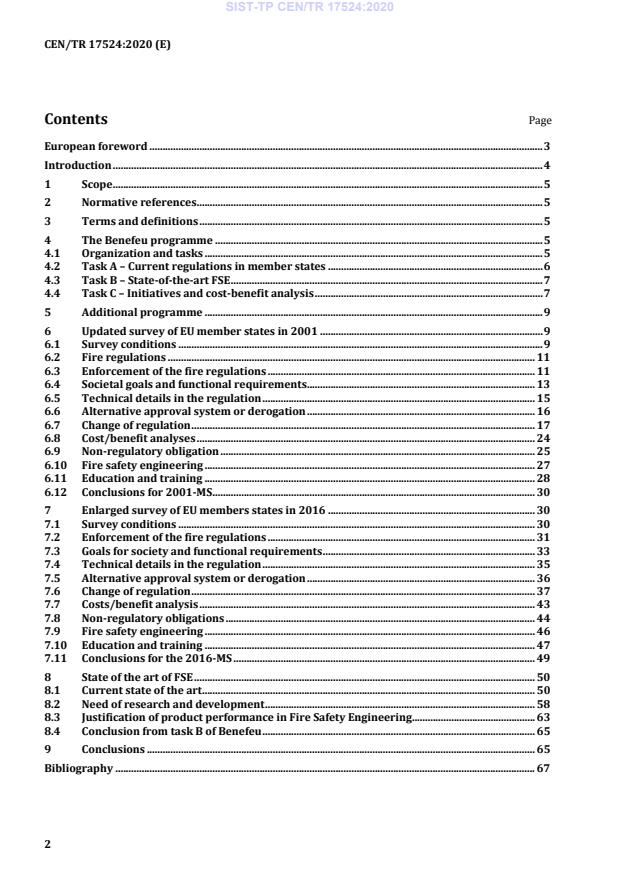
Contents Page
European foreword . 3
Introduction . 4
1 Scope . 5
2 Normative references . 5
3 Terms and definitions . 5
4 The Benefeu programme . 5
4.1 Organization and tasks . 5
4.2 Task A – Current regulations in member states . 6
4.3 Task B – State-of-the-art FSE . 7
4.4 Task C – Initiatives and cost-benefit analysis . 7
5 Additional programme . 9
6 Updated survey of EU member states in 2001 . 9
6.1 Survey conditions . 9
6.2 Fire regulations . 11
6.3 Enforcement of the fire regulations . 11
6.4 Societal goals and functional requirements . 13
6.5 Technical details in the regulation . 15
6.6 Alternative approval system or derogation . 16
6.7 Change of regulation . 17
6.8 Cost/benefit analyses . 24
6.9 Non-regulatory obligation . 25
6.10 Fire safety engineering . 27
6.11 Education and training . 28
6.12 Conclusions for 2001-MS . 30
7 Enlarged survey of EU members states in 2016 . 30
7.1 Survey conditions . 30
7.2 Enforcement of the fire regulations . 31
7.3 Goals for society and functional requirements . 33
7.4 Technical details in the regulation . 35
7.5 Alternative approval system or derogation . 36
7.6 Change of regulation . 37
7.7 Costs/benefit analysis . 43
7.8 Non-regulatory obligations . 44
7.9 Fire safety engineering . 46
7.10 Education and training . 47
7.11 Conclusions for the 2016-MS . 49
8 State of the art of FSE . 50
8.1 Current state of the art . 50
8.2 Need of research and development . 58
8.3 Justification of product performance in Fire Safety Engineering . 63
8.4 Conclusion from task B of Benefeu . 65
9 Conclusions . 65
Bibliography . 67
European foreword
This document (CEN/TR 17524:2020) has been prepared by Technical Committee CEN/TC 127 “Fire
safety in buildings”, the secretariat of which is held by BSI.
Attention is drawn to the possibility that some of the elements of this document may be the subject of
patent rights. CEN shall not be held responsible for identifying any or all such patent rights.
Introduction
On 1 May 2001, the Benefeu project started with a consortium managed by Warrington Fire Research
(UK) composed of CTICM (activity transferred to Efectis France), DIFT, IST, RUG and TNO (activity
transferred to Efectis Nederland).
The programme was financed by the European Commission (EC contract EDT/01/503480).
With a duration of one year, the programme aimed to identify the potential benefit of Fire Safety
Engineering in the European Union.
The CEN TC127 WG8 dedicated to Fire Safety Engineering identified a need of updating the work
performed within the BENEFU programme as a benefit for European standardization work and European
member states.
1 Scope
This document gives an overview of the evolution of regulations and application of Fire Safety
Engineering (FSE) in Europe. Based on work performed in 2001-2002, a full update of information has
been done. A global survey based on questionnaires defined in 2001, the evolution and possible
perspectives of the FSE practices within two perimeters are presented:
The first perimeter is the same perimeter analysed in 2001 corresponding to the European Union
defined in 2001 extended to European countries with European Union agreement (Switzerland,
Norwegian and Iceland).
The second perimeter is the European Union perimeter of 2016 extended to European countries with
European Union agreement (Switzerland, Norwegian and Iceland).
Conclusions and initiatives of the 2001 proposals were analysed 15 years after, with and without the
extension of European Union. New initiatives have since been proposed.
In addition, the state-of-the-art of Fire Safety Engineering is updated.
2 Normative references
There are no normative references in this document.
3 Terms and definitions
For the purposes of this document, no terms and definitions are listed in this document.
ISO and IEC maintain terminological databases for use in standardization at the following addresses:
IEC Electropedia: available at http://www.electropedia.org/
ISO Online browsing platform: available at https://www.iso.org/obp
4 The Benefeu programme
4.1 Organization and tasks
On 1 May 2001, the Benefeu project started with a consortium managed by Warrington Fire Research
(UK) composed of CTICM (activity transferred to Efectis France), DIFT, IST, RUG and TNO (activity
transferred to Efectis Nederland).
The programme was financed by the European Commission (EC contract EDT/01/503480).
With a duration of one year, the programme aimed to identify the potential benefit of Fire Safety
Engineering in the European Union.
To satisfy this aim, this programme was organized in three key tasks:
Task A – Current regulations in member states;
Task B – State of the art in FSE;
Task C – Possible initiatives and cost benefit analysis.
The final report [1] dated 19 July 2002 was presented to the European Commission.
4.2 Task A – Current regulations in member states
In order to collect information from the 15 member states of the European Union plus three countries
that signed conventions (Switzerland, Norway and Iceland), a questionnaire [2] was prepared and
produced by the consortium.
It was sent to the regulators of the member states and to FSE users with responses collected by the
Consortium.
A global overview of the European Union situation from these 18 countries was drawn. The main topics
were:
fire regulation;
enforcement of regulations;
societal goals;
functional/performance requirements;
technical details in regulations;
alternative approval system or derogation;
changes to regulation;
no regulatory obligation;
cost-benefit analysis;
fire safety engineering;
education and training in FSE; and
other points.
In addition, fire experts or regulators from non-European countries (New Zealand, Australia, USA, Brazil,
Singapore, Canada, Japan, and Hong Kong) completed the questionnaire.
The consortium concludes that “the distribution of the answers is generally very similar to the
distribution in Europe, but the following main differences are noticed:
Within fire safety regulations, the goal of business and social activity protection is covered by 30 %
of the non-European countries, instead of about 10 % in Europe.
Concerning the type of requirements, most of the non-European countries have prescriptive or
deemed to satisfy requirements, but not both as is observed in Europe.
Concerning the knowledge of fire safety engineering use in the different subsystems, contrary to
Europe where most of the countries consider that SS2 (66 %), SS3 (90 %) and SS4 (70 %) need little
work or are mature, 50 % of non-European countries consider that they need much work.
4.3 Task B – State-of-the-art FSE
The state of art of FSE was a worldwide overview including development, standardization and
regulations.
The main conclusion from this state-of-the-art review performed in 2001-2002 was:
need for performance-based code coordination to avoid barriers to services in Europe;
huge progress on implementation tools was made from 1990, nevertheless “operational and
unambiguous standards” are needed to have a common way to assess the safety level;
need for coordination of standardization and pre-standardization between the various committees;
evolution of standard tests to represent the “real world” scenario; and
development of training and education to satisfy the future needs of Fire Safety Engineers in Europe,
with a need to mobilise global awareness to support the process.
Next a list of research needs, input data and standardization were attributed to the different technical
and scientific topics, describing the level of knowledge.
4.4 Task C – Initiatives and cost-benefit analysis
From the previous tasks A and B, the consortium listed five main initiatives:
To create a network of fire regulators to steer concerted action towards the transition from
prescriptive codes to performance-based codes, allowing the application of fire safety engineering
techniques. This steering should coordinate work from the four following initiatives, verify the
implementation of that work and maintain the relationship with the European Commission and CEN.
To create a harmonized framework within which performance-based codes can function and create
a model code. The framework objectives are to define the new EU policy for Fire Safety, introduce the
common use of FSEs, share between member states a common view of the development of
performance-based codes with regulatory convergence and so avoid the creation of new trade
barriers within the EU. The framework could be based on the following scheme (see Figure 1):
Figure 1 — Framework example
A ten-year plan was identified to reach a common framework (two years), a model code (one year)
and national performance-based codes (five years).
To set up an advisory committee on research, which will list and prioritise the most urgent and
important research needs in support of performance-based regulations. To promote the
allocation of sufficient research funds to this subject, use should be made of the European
Research Framework programmes. This initiative for FSE was compared to the Reaction to Fire
research programme that led to new standardization and European harmonization from 1988 to
2000. A new ten-year plan was proposed to include the development of research in
standardization (identification two years, execution six years, introduction in standardization
two years)
To develop a mandate for standardization, building on existing knowledge and the results of the
identified, targeted research. This initiative promotes the use of ISO TC 92 SC4 standardization
work to avoid duplication of work and identifies the need for standard tests to create extended
application data for the performance of construction products to use in FSE calculations. To
perform that work, the initiative identifies a need for a mandate for FSE development in CEN. A
timing of three years was given to identify standardization requirements and publish specific
mandates.
To undertake all necessary action to define the professional education needs and the conditions
for professional recognition. The objectives were the production of structured education and a
structure for professional recognition. Practitioners and enforcers should be included in the
process. A code of ethics should be part of the structure. A timeframe of about ten years was
anticipated to yield the first educated Fire Safety Engineers (four-year programme) based on a
common core curriculum, and thus to reach a full organization of the profession.
From all these initiatives, the consortium presented its cost-benefit analysis for the implementation of
FSE in Europe. They concluded:
“Under the condition that fire safety engineering is fully implemented in the EU area, this would
correspond to a saving in the order of €0,3 B to €1 B on an EU scale. Compared to these savings, the costs,
necessary to introduce and maintain fire safety engineering in the EU (i.e. costs for research, education
and standardisation) are marginal” (estimated to €28 M).
5 Additional programme
CEN TC127 WG8 was created in 2014 with the aim of pre-standardisation and standardisation of Fire
Safety Engineering. At the time, no mandate had been published for these topics.
The transfer from the CEN TC127 TG1 to CEN TC127 WG8 demonstrated the wish of the European
Commission to highlight Fire Safety Engineering in Europe.
Several programmes for pre-standardization have already been identified by CEN TC127 WG8, including
a performance-based framework, recognition of the profession, identification of needs, strong
relationship with the ISO TC 92 SC4, review of conferences and international exercises, identification of
national trends and feedback from some countries.
Thus the work made by the Benefeu Consortium and the initiatives promoted by it were a strong basis
for CEN TC127 WG8. Nevertheless, 15 years later (2001-2016), an update of the situation was necessary.
Therefore the tasks performed within the Benefeu programme were updated with a revision of the
questionnaire initially completed in 2001. This is presented in Clause 6 for the results of the revision of
the questionnaire in the context of EU in 2001: the update concerns the European countries assessed in
2001. The analysis will identify the work performed in the past 15 years in these European countries.
Since 2001 the European Union has been enlarged from 15 to 28. Thus the questionnaire has also been
completed by the new member states in the European Union. Clause 7 will analyse the situation across
the 28 countries of the European Union in 2016 (some countries did not respond, so the number of
countries was reduced to 22).
Clause 8 will identify the state of the art of Fire Safety Engineering in 2016 compared to the state of the
art in 2001. It includes examples from the SFPE Performance-Based Conference in 2016 that are
representative of the application of FSE in performance-based codes in many countries.
6 Updated survey of EU member states in 2001
6.1 Survey conditions
All the questionnaires filled in 2001 were available as original Excel files. Then the questionnaires were:
Given to the participants to WG8 in order that they update the content of the questionnaire filled by
the regulators of their country in 2001. Members of the WG8 were free to contact any person to help
complete the questionnaire
Sent to TC127 members or regulators to the other countries that are not represented by a member in
the WG8.
Then, an updated version was returned to the convenor of WG8 and listed in the WG8 documents.
The members mentioned sometimes that they disagree with some answers given in 2001, indicating that
the answers may include some subjectivity.
In 2001, the questionnaire included the regulators’ position and the practitioners’ position. In this
updated version, a single view is taken into account, considering that only “changes” are indicated.
A large percentage of the eighteen 2001-member states (given as 2001-MS in the following clauses)
completed the updated questionnaire:
16 countries updated their questionnaire:
France;
Luxembourg;
Germany;
UK;
Sweden;
Norway
Finland;
Switzerland;
Austria;
Spain;
Italy;
Denmark;
Ireland;
Portugal;
Greece; and
Netherlands.
Only two questionnaires were not updated, despite several contacts with experts in those countries.
In the analysis it was assumed that no changes occurred in these countries in the past 15 years:
Iceland; and
Belgium.
From the different updated questionnaires, the analysis focussed on the changes. If no change was
recorded, or very few changes (for example if only one country made changes), the report will not present
it.
The reader should refer to the Benefeu final report [1] to find the analysis made in 2001.
6.2 Fire regulations
The date of the main fire regulations in the countries is mentioned. A date later than 2001 shows that a
change of the regulation has been made. Figure 2 indicates the number of countries mentioning a date
later than 2001, so introducing a change in regulations since 2001.
Where countries updated their regulations but without fundamental changes, the initial date is
mentioned, as in France, with the 1980 decree.
It appears that 11 countries of the 18 substantively changed their regulations since 2001. These national
initiatives indicate possible regular adaptation of the regulations to the latest knowledge, to the
innovative construction and systems, field experience and data from fires.
Fire regulation - Is there a new regulation since 2001?
Key
1 Yes
2 No
3 No answer
Figure 2 — Change of regulation
6.3 Enforcement of the fire regulations
The enforcement of the regulations was already in place in 2001 by all countries at the planning stage.
Nevertheless, it is noticed that controls have been strengthened by some countries during construction
and use. Figure 3 shows that three new countries (Denmark, Portugal and Norway) have introduced
controls during construction and two countries have introduced controls during the use of the building
(Italy and Denmark). Thus a very limited number of countries have no controls during the construction
phase (Italy) or during use (UK, Finland and Austria).
This indicates the current mandatory controls to ensure the application of the regulations. None of the
countries has reduced its level of controls.
Enforcement of the regulation - At what stage is enforcement used? (answer yes)
Key
1 Planning
2 Building
3 Use
Yes-answer in 2001
Difference of yes-answer between 2001-2016
Figure 3 — Enforcement of the regulation – Stages
The type of supporting documents (plans, tests, calculations, expert judgement) or supporting
assessment (third-party) required by the regulation was already strong in many countries in 2001, but
has been reinforced 15 years later in some countries (Italy and Greece) by introducing in the regulations
requirements for calculations, expert judgement and third-party assessment (see Figure 4).
Enforcement of regulation: what information is provided by the owner/user of the building for
acceptance by the enforcement authority (answer Yes)?
Key
1 Plans
2 Test results
3 Calculation
4 Expert judgement
5 Third-party approval
Figure 4 — Enforcement of the regulation – Documentation
6.4 Societal goals and functional requirements
While the main regulatory goals (safety of occupants, firefighters and neighbours) are unchanged in all
countries, other possible goals were not covered in the 2001 report. Few changes in the regulatory goals
were recorded since 2001. Denmark has focussed the goals of its regulation by excluding property and
structure protection as a regulatory goal. Finland has extended its regulatory goals to include protection
of business, heritage and social activity (see Figure 5).
Descriptions of the conditions to achieve these goals have been reinforced in the regulations by a better
description of the functional requirements (see Figure 6).
Goals for society: Which of these goals for your society are covered in this regulation (answer yes)?
Key
1 Occupants
2 Emergency services
3 Neighbours
4 Structure
5 Contents
6 Neighbouring property
7 Air protection
8 Water protection
9 Ground protection
Yes-answer in 2001
Difference of yes-answer between 2001-2016
Figure 5 — Societal goals in fire regulation
Functional/performance requirements: Are the goals identified in the previous section, expressed in
functional/performance terms (answer yes)?
Key
1 Occupants
2 Emergency services
3 Neighbours
4 Structure
5 Contents
6 Neighbouring property
7 Air protection
8 Water protection
9 Ground protection
10 Business
11 Social activity
12 Heritage
Yes-answer in 2001
Difference of yes-answer between 2001-2016
Figure 6 — Functional requirements in fire regulation
6.5 Technical details in the regulation
Figure 7 shows that the regulations have evolved to include more technical details in the regulations. In
2001, less than half of the countries included technical details in the five fire safety-based subsystems.
Now at least half of them have included in their regulations the technical details for fire prevention and
protection. However, technical details for firefighter intervention remain low, although they have
increased by 40%.
This may indicate that there remains a lack of technical knowledge that limits the introduction of these
details in the regulations.
Technical detail in regulation: What is the nature and level of technical details in your regulation:
regarding the entire building – are there performance-based requirements for FSE (answer yes)?
Key
1 SS1 – fire initiation and development
2 SS2 – Smoke propagation
3 SS3 – Compartmentation and stability
4 SS4 – Detection, activation and suppression
5 SS5 – Fire service intervention
Yes-answer in 2001
Difference of yes-answer between 2001-2016
Figure 7 — Performance based requirements at subsystem level
6.6 Alternative approval system or derogation
The application of prescriptive regulations requires flexibility to justify architectural/innovative
solutions that do not comply with the regulations.
Where the regulations do not always include guidance on how to address such issues, the authorities
must assume responsibilities without a framework.
In 2001, most of the countries (17 of 18) approved designs based on calculations, only 14 accepted ad-
hoc tests and 15 expert judgements (see Figure 7). 15 years later, the use of calculations is now accepted
by Portugal completing the list of countries. Greece has introduced expert judgement as a tool for
justifying an alternative or a derogation.
Figure 8 shows that the system of control remains strongly delegated to the local regulatory body
(including local fire brigades), Nevertheless, due to centralisation, different countries have increased the
supervisory role for of regional or national bodies compared to local authorities. The term “fire expert”
refers to an independent, for-profit organisation. The use of fire experts is increasing but remains a minor
use for regulatory control. Fire laboratories are not recognized for these tasks and that position has not
changed since, perhaps because many of them are only dedicated to testing, without enough knowledge
of construction.
Alternative approval system or derogation: Does your regulation permit alternative means of
compliance or have a system of derogation (answer yes)?
Key
1 Calculation (on what basis)
2 Ad-hoc tests (on what basis)
3 Expert judgement (on what basis)
4 Fire expert (who are the authorities)
5 Official laboratory (who are the authorities)
6 Local regulatory body (who are the authorities)
7 Regional regulatory body (who are the authorities)
8 National regulatory body (who are the authorities)
Yes-answer in 2001
Difference of yes-answer between 2001-2016
Figure 8 — Alternative approval system or derogations
6.7 Change of regulation
We observed in Figure 2 that many countries have changed their regulations during these past 15 years.
Fewer of 2001-MS still wish to introduce functional or performance-based requirements (Figure 9). Even
if their number is decreasing (-2 for functional, -3 for performance), that is because a number of countries
have already introduced a new regulation between 2001 and 2015 to address their wish given in 2001.
The following have changed their wish for change:
Functional regulation:
New wishes from Switzerland;
No more wishes due to previous changes: Denmark, Sweden and Finland.
Performance-based regulation:
No more wishes due to previous changes: Denmark, Sweden and Finland.
This means that some countries wanted to introduce functional or performance-based requirements but
have not succeeded, and they hold these objectives for the near future (Greece, Spain), while some
countries have achieved this target (Germany and Austria).
The process to effect change remains more or less the same: changes shall be made through laws or
decrees. Standards remain only as tools.
Changes in the safety level are no longer a target, meaning that flexibility is the main purpose for
introducing substantial changes in regulations.
Key
1 Law (need of full introduction of FSE)
2 Decree (need of full introduction of FSE)
3 Standards (need of full introduction of FSE)
4 Increase/decrease of life safety level (are there any plans for regulatory changes)
5 Introduction of functional; performance-based aspects (are there any plans for regulatory change)
6 Full introduction of functional; performance-based approach allowing use of FSE (are there any plans for
regulatory change)
Yes-answer in 2001
Difference of yes-answer between 2001-2016
Figure 9 — Changes of regulation
Among the five initiatives given by the Benefeu consortium in 2002, one was focussed on Research and
Development over the next ten years, i.e. from 2002-2012. Clause 8 of this report provides a synthetic
upgrade of the state-of-the-art of Fire Safety Engineering, showing that since 2001 the practice has
increased but research has been limited, contrary to the initiative of the consortium.
In order to understand the evolution of knowledge concerning the five subsystems SS1 to SS5, the update
of the qualification of the needs is given from the questionnaires.
Figures 10 to 14 give the update of the assessment of the maturity of each sub system:
SS1 – Fire initiation and development: only one country considered SS1 to be mature in 2001, four
were convinced in 2016. Of the 11 countries that in 2001 considered much work was needed, four no
longer see the need. Indeed, little research has been performed onSS1 since 2001, but standardisation
(in ISO TC 92) and guidelines have been produced. Testing devices such as a cone are more widely
used today and FSE practice in SS1 is steadily increasing. Nevertheless, knowledge of the relationship
between reaction to fire testing standards and real-world scenarios remains limited and has not been
investigated much during the past 15 years.
SS2 – Smoke development: Only two countries in 2015 compared to six in 2001 consider much work
is needed for SS2. Indeed, numerical models are regularly applied for SS2 and phenomena are known.
A lack of input data from SS1 limits the application of SS2.
SS3 – Compartmentation and stability: all the countries consider in 2015 that SS3 is either mature or
needs little work to become mature. Of course, it remains unequal for the different structural
materials. Extensive research on steel was made in the 90s, while the behaviour of concrete was
addressed for FSE by the Eurocode a few years later. There is a lack of knowledge about timber
structures. In addition, the relationship for compartmentation between a testing standard and the
real world is not available.
SS4 – Detection, activation and suppression: more than 70 % of the 2001-MS countries consider there
is a good level of knowledge of SS4 with little work to be done for it to become mature. The view of
SS4 has not really changed in 15 years. The systems are known to be included in FSE applications,
updated statistics would provide input data for probabilistic analyses using the SS4 measures.
SS5 – Fire service intervention: more than 60 % of the 2001-MS considered in 2001 and still today
that a lot of work and research is needed to introduce the criteria for firefighters in FSE. No research
has been performed since 2001. Nevertheless, learning from large fires gives the community feedback
on the risks and difficulties associated with fire service intervention.
What areas of FSE do you consider most mature and reliable so as to form the basis of the regulatory
compliance?
Key
1 Much work
2 Little work
3 Mature
4 No answer
Yes-answer in 2001
Difference of yes-answer between 2001-2016
Figure 10 — Situation of knowledge on SS1 “Fire initiation and development”
What areas of FSE do you consider most mature and reliable so as to form the basis of the regulatory
compliance?
Key
1 Much work
2 Little work
3 Mature
4 No answer
Yes-answer in 2001
Difference of yes-answer between 2001-2016
Figure 11 — Situation of knowledge on SS2 “Smoke propagation”
What areas of FSE do you consider most mature and reliable so as to form the basis of the regulatory
compliance?
Key
1 Much work
2 Little work
3 Mature
4 No answer
Yes-answer in 2001
Difference of yes-answer between 2001-2016
Figure 12 — Situation of knowledge on SS3 “Compartmentation and stability”
What areas of FSE do you consider most mature and reliable so as to form the basis of the regulatory
compliance?
Key
1 Much work
2 Little work
3 Mature
4 No answer
Yes-answer in 2001
Difference of yes-answer between 2001-2016
Figure 13 — Situation of knowledge on SS4 “Detection, activation and suppression”
What areas of FSE do you consider most mature and reliable so as to form the basis of the regulatory
compliance?
Key
1 Much work
2 Little work
3 Mature
4 No answer
Yes-answer in 2001
Difference of yes-answer between 2001-2016
Figure 14 — Situation of knowledge on SS5 “Fire service intervention”
6.8 Cost/benefit analyses
There are still insufficient data to perform cost/benefit analyses in FSE applications. (see Figure 15). The
remark concerning the need for updated statistics for the development of SS4 “Detection, activation and
suppression” and SS5 “Fire service intervention” expressed in the previous clause also applies to the lack
of information for a cost/benefit analysis. We note that a WG at ISO TC 92 level has been created to
standardise statistics at an international level. A first standard on definitions has been published
(ISO/TR 17555:2014 [7]).
Is it possible for you to identify any possible sources of information on the cost benefit to your country
of the introduction of FSE into your national fire safety strategy?
Key
1 Yes
2 No
3 No answer
Yes-answer in 2001
Difference of yes-answer between 2001-2016
Figure 15 — Cost-benefit analysis
6.9 Non-regulatory obligation
The large development of regulations and standardization at European level has not satisfied the needs
identified during the initial survey by the 2001-MS. But non-regulatory obligations show an increase (see
Figure 16). This may be because performance-based regulations and European regulations caused
countries to require the application of guidelines that are not within the regulations. Figure 17 shows an
increase in the third-party certification of products.
For the topics covered by the regulation, are there any other non-regulatory obligations in your
country?
Key
1 Yes
2 No
3 No answer
Yes-answer in 2001
Difference of yes-answer between 2001-2016
Figure 16 — Non-regulatory obligation
For the topics covered by the regulation, are there any other non-regulatory obligations in your
country? What types?
Key
1 De facto requirements e.g. insurance, custom and practice
2 Technical approval of products
3 Third-party certification of product
4 Certification scheme for insurers
Yes-answer in 2001
Difference of yes-answer between 2001-2016
Figure17 — Type of non-regulatory requirements
6.10 Fire safety engineering
The wishes of the 2001-MS with regard to their participation in European Commission initiatives to
develop Fire Safety Engineering have been generalised. All the 2001-MS confirm their willingness to
participate in any EC initiatives in the area of Fire Safety Engineering. This is a clear signal to the European
Commission. See Figure 18.
Are you willing to participate in any EC initiatives in the area of FSE?
Key
1 Yes
2 No
3 Maybe
4 No answer
Yes-answer in 2001
Difference of yes-answer between 2001-2016
Figure 18 — FSE initiatives in EC
6.11 Education and training
Educational support for professional development has been significantly increased in the past 15 years
in the 2001-MS. While regulators and practitioners are involved, the main growth is for the enforcers,
which confirms the need for control tools. All topics (SS1 to SS5) show an increase in training options.
See Figure 19.
In 2001, one of the five main recommendations of the Benefeu consortium was the development of FSE
courses and a programme with a European framework. Although the European Commission has not taken
action in this area during the past 15 years, education has been reinforced (see Figure 20) with an
increased number of programmes in FSE area in 2001-MS. Fifteen countries of eighteen have a masters
dedicated to Fire Safety Engineering. The circulation of students in Europe is increasing the number of
Fire Safety Engineers in European countries.
An analysis of the needs of the construction market for fire safety engineers has not been made. Any such
analysis should take into account the domain of application. A smoke propagation assessment does not
need the same background as one for structural fire behaviour.
Is there educational support available to professionals in the fire safety area?
Key
1 SS1 – Fire initiation & development – To regulators
2 SS1 – Fire initiation & development – To enforcers
3 SS1 – Fire initiation & development – To practitioners
4 SS2 – Fire initiation & development – To regulators
5 SS2 – Fire initiation & development – To enforcers
6 SS2 – Fire initiation & development – To practitioners
7 SS3 – Fire initiation & development – To regulators
8 SS3 – Fire initiation & development – To enforcers
9 SS3 – Fire initiation & development – To practitioners
10 SS4 – Fire initiation & development – To regulators
11 SS4 – Fire initiation & development – To enforcers
12 SS4 – Fire initiation & development – To practitioners
13 SS1 – Fire initiation & development – To regulators
14 SS5 – Fire initiation & development – To enforcers
15 SS5 – Fire initiation & development – To practitioners
Yes-answer in 2001
Difference of yes-answer between 2001-2016
Figure 19 — Courses for professionals
What are the available sources of education and training which incorporate FSE in your country?
Key
1 Bachelor level
2 Masters level
3 Continuous professional development
Yes-answer in 2001
Difference of yes-answer between 2001-2016
Figure 20 — Education
6.12 Conclusions for 2001-MS
Even if many countries have changed their regulations during the past 15 years, and even if the FSE
practice has increased in the 2001-MS, the situation for FSE has not fundamentally changed. Each has
made a single step to assist the use of FSE with some modifications either in regulations and their
enforcement, or in education.
A final point is the major development of the FSE field: Educational support for professionals has
significantly increased over the past 15 years in 2001-MS. This means that the number of FSE
practitioners should increase and FSE activity should be increasing. An analysis of the market should be
done to understand the short-term needs of the Fire Safety Engineering community.
7 Enlarged survey of EU members states in 2016
7.1 Survey conditions
From 2001, the European Union has been enlarged with 13 new countries
...