

SIST EN 2:1995/A1:2005
(Amendment)Classification of fires
General Information
- Abstract
Changed from revision to amendment further to reception of document at Production (NT/030327).
- Status
- Published
- Publication Date
- 31-Jan-2005
- Technical Committee
- POZ - Požarna varnost
- Current Stage
- 6060 - National Implementation/Publication (Adopted Project)
- Start Date
- 01-Feb-2005
- Due Date
- 01-Feb-2005
- Completion Date
- 01-Feb-2005
- Ref Project
EN 2:1992/A1:2004 - Classification of fires

Overview
EN 2:1992/A1:2004 is a CEN amendment to the European standard EN 2:1992 that defines the classification of fires. Approved in August 2004 and adopted by CEN national members, this amendment formally adds a new fire class to the EN 2 system: Class F - fires involving cooking media (vegetable or animal oils and fats) in cooking appliances. The document was prepared by CEN/TC 070 “Manual means of fire fighting equipment” and is part of the protection-against-fire (ICS 13.220.01) family of standards.
Key topics and requirements
- Definition and designation of classes of fires: EN 2:1992/A1:2004 updates the established EN 2 classification framework by introducing a clear definition for Class F fires (cooking oil and fat fires in cooking appliances).
- Amendment status and implementation: CEN members are required to adopt the amendment into their national standards (publication or endorsement) and withdraw conflicting national standards by the specified deadline (April 2005).
- Standardization governance: The amendment follows CEN/CENELEC internal regulations and is available in English, French and German; translations by national bodies are permitted and hold equivalent status when notified to the CEN secretariat.
- Scope note: The document’s procedural scope reflects its conversion from a revision to an amendment (reference NT/030327), indicating a targeted change to the existing classification rather than a full revision.
Applications
EN 2:1992/A1:2004 has practical value across multiple fire-safety and compliance activities:
- Fire extinguisher selection and labeling - manufacturers and suppliers use fire class definitions to specify which extinguishers and suppression agents are suitable for particular fire risks, including frying and deep-fat cooking appliances.
- Kitchen and catering safety - catering businesses, commercial kitchens and equipment designers rely on the Class F designation to assess hazards and implement appropriate suppression and training.
- Risk assessment and emergency planning - fire safety professionals and consultants use the standardized classes to classify fire hazards consistently in audits and procedures.
- Regulatory compliance and procurement - authorities and buyers reference the EN 2 classification when setting requirements for firefighting equipment and building safety measures across EU member states.
Related standards
- EN 2:1992 (original) - the base classification standard to which A1 is an amendment.
- For implementation details, consult national standards bodies or the CEN Central Secretariat for up-to-date bibliographic references and national transpositions.
Keywords: EN 2:1992/A1:2004, classification of fires, Class F, cooking oil fires, CEN standard, fire safety standards, manual firefighting equipment, fire extinguisher selection.
Relations
- Effective Date
- 29-Jul-2026
- Effective Date
- 09-Feb-2026
- Effective Date
- 09-Feb-2026
- Effective Date
- 28-Jan-2026
- Effective Date
- 28-Jan-2026
- Effective Date
- 28-Jan-2026
- Effective Date
- 22-Dec-2008
Get Certified
Connect with accredited certification bodies for this standard

CIS Institut d.o.o.
Personal Protective Equipment (PPE) certification body. Notified Body NB-2890 for EU Regulation 2016/425 PPE.

Kiwa BDA Testing
Building and construction product certification.
Kmetijski inštitut Slovenije
Agricultural Institute of Slovenia. Soil testing, plant health, agricultural product analysis.
Sponsored listings
Frequently Asked Questions
SIST EN 2:1995/A1:2005 is a amendment published by the Slovenian Institute for Standardization (SIST). Its full title is "Classification of fires". This standard covers: Changed from revision to amendment further to reception of document at Production (NT/030327).
Changed from revision to amendment further to reception of document at Production (NT/030327).
SIST EN 2:1995/A1:2005 is classified under the following ICS (International Classification for Standards) categories: 13.220.01 - Protection against fire in general. The ICS classification helps identify the subject area and facilitates finding related standards.
SIST EN 2:1995/A1:2005 has the following relationships with other standards: It is inter standard links to SIST EN 45545-6:2025+A1:2026, SIST EN 62282-3-201:2014, SIST EN IEC 62282-4-102:2023, SIST EN 1679-1:2000+A1:2011, SIST EN 15955-2:2025, SIST EN 45545-6:2025, SIST EN 2:1995. Understanding these relationships helps ensure you are using the most current and applicable version of the standard.
SIST EN 2:1995/A1:2005 is associated with the following European legislation: EU Directives/Regulations: 2005-01-2964, 2008/68/EC. When a standard is cited in the Official Journal of the European Union, products manufactured in conformity with it benefit from a presumption of conformity with the essential requirements of the corresponding EU directive or regulation.
SIST EN 2:1995/A1:2005 is available in PDF format for immediate download after purchase. The document can be added to your cart and obtained through the secure checkout process. Digital delivery ensures instant access to the complete standard document.
Standards Content (Sample)
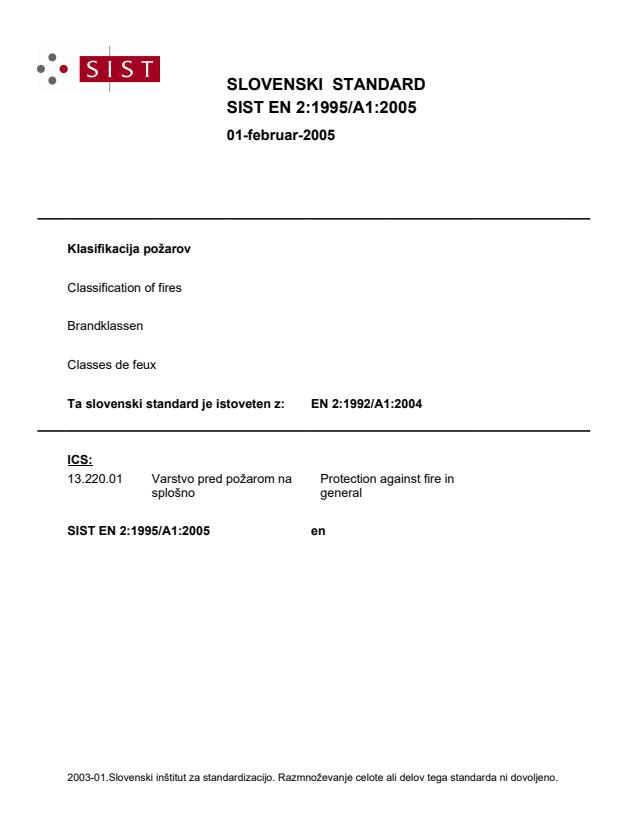
SLOVENSKI STANDARD
01-februar-2005
Klasifikacija požarov
Classification of fires
Brandklassen
Classes de feux
Ta slovenski standard je istoveten z: EN 2:1992/A1:2004
ICS:
13.220.01 Varstvo pred požarom na Protection against fire in
splošno general
2003-01.Slovenski inštitut za standardizacijo. Razmnoževanje celote ali delov tega standarda ni dovoljeno.
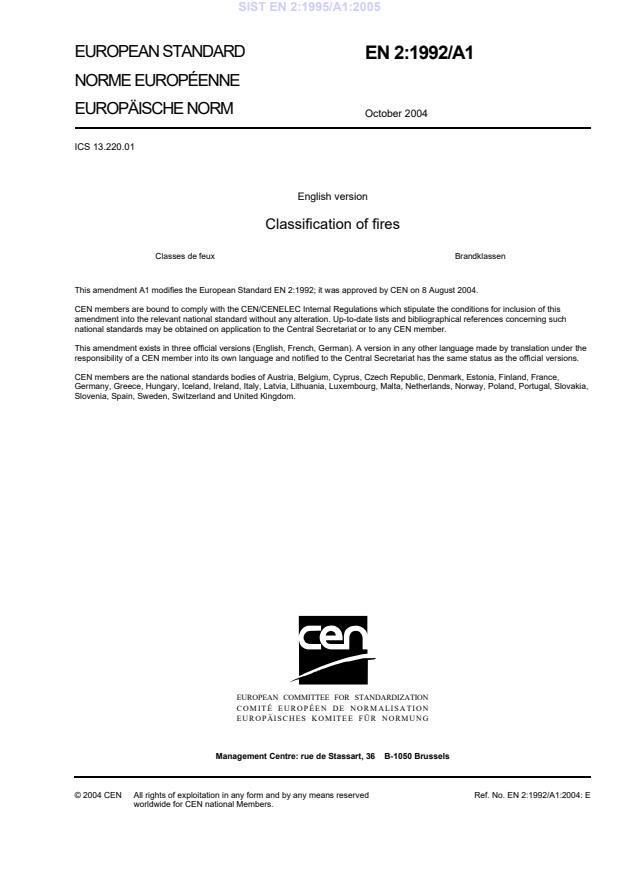
EUROPEAN STANDARD
EN 2:1992/A1
NORME EUROPÉENNE
EUROPÄISCHE NORM
October 2004
ICS 13.220.01
English version
Classification of fires
Classes de feux Brandklassen
This amendment A1 modifies the European Standard EN 2:1992; it was approved by CEN on 8 August 2004.
CEN members are bound to comply with the CEN/CENELEC Internal Regulations which stipulate the conditions for inclusion of this
amendment into the relevant national standard without any alteration. Up-to-date lists and bibliographical references concerning such
national standards may be obtained on application to the Central Secretariat or to any CEN member.
This amendment exists in three official versions (English, French, German). A version in any other language made by translation under the
responsibility of a CEN member into its own language and notified to the Central Secretariat has the same status as the official versions.
CEN members are the national standards bodies of Austria, Belgium, Cyprus, Czech Republic, Denmark, Estonia, Finland, France,
Germany, Greece, Hungary, Iceland, Ireland, Italy, Latvia, Lithuania, Luxembourg, Malta, Netherlands, Norway, Poland, Portugal, Slovakia,
Sloven
...