

SIST EN 17932:2024
(Main)Natural gas vehicles - Requirements for liquefied natural gas vehicle (LNGV) workshops and the management of liquefied natural gas (LNG) vehicles
General Information
- Abstract
This document provides requirements for operation of vehicles that use liquefied natural gas (LNG) as a fuel for propulsion, covering various aspects of LNGV workshops including activities, risk management, planning, personnel, layout, systems and operations. It provides requirements regarding the management of LNGV including use, parking, fuelling for commissioning, inspection, installation, repair and maintenance, disposal, transportation and documentation.
This document is applicable to the management of LNG vehicles.
- Status
- Published
- Public Enquiry End Date
- 02-Apr-2023
- Publication Date
- 11-Nov-2024
- Technical Committee
- DPL - Gas supply
- Current Stage
- 6060 - National Implementation/Publication (Adopted Project)
- Start Date
- 11-Sep-2024
- Due Date
- 16-Nov-2024
- Completion Date
- 12-Nov-2024

Overview
EN 17932:2024 - published by CEN - sets minimum European requirements for the safe operation and management of vehicles using liquefied natural gas (LNG) and for the design and operation of LNGV workshops. The standard covers operational procedures, workshop planning, personnel qualifications, equipment and systems, and lifecycle management of LNG vehicles (use, fuelling, inspection, repair, transport, disposal and documentation). EN 17932:2024 was approved by CEN in May 2024 and is intended as a practical safety and management reference for LNG vehicle stakeholders.
Key topics and technical requirements
EN 17932:2024 is structured to address both workshop and vehicle management needs. Key technical topics include:
- LNGV workshop activities: accepted workshop operations and service tasks specific to LNG vehicles.
- Risk management: requirements for risk context, assessment, treatment, monitoring and documentation following ISO risk principles.
- Workshop planning and layout: designated work areas, hazardous-area classification, access restrictions, emergency access/escape and emergency planning.
- Personnel and qualifications: training, competency and authorized qualification bodies for LNGV mechanics and technicians.
- Workshop systems: specification-level requirements for gas detection systems, personal gas monitors, ventilation, fire protection (including fire walls), air compressors, heat/lighting and measurement systems.
- Operations and documentation: written procedures, record keeping, gas leak reporting and vehicle isolation procedures.
- Annexes addressing management: normative annexes on LNG vehicle management, LNG tank handling and inspection, and informative annexes on gas characteristics and workshop tools.
Practical applications and users
EN 17932:2024 is directly applicable to the management of LNG vehicles and to the planning and safe operation of LNGV workshops. Typical users include:
- LNGV workshop designers and owners
- Workshop staff, technicians and fleet maintenance teams
- Original equipment manufacturers (OEMs) and system suppliers
- Fleet owners/operators of LNG trucks and buses
- Dealers, local authorities and emergency planners
Use cases:
- Developing workshop layout and emergency response plans
- Defining training and qualification programs for LNGV technicians
- Specifying gas detection, ventilation and fire protection measures
- Standardizing inspection, fuelling and transport procedures for LNG vehicles
Related standards
EN 17932:2024 references and aligns with several standards for gas safety, measurement and risk including:
- EN 2 (Classification of fires)
- EN 50402 (Gas detection functional safety)
- EN 60079-10-1 and EN 60079-29-2 (explosive atmospheres and gas detectors)
- EN ISO 10012 (measurement management)
- ISO 31000 (risk management)
EN 17932:2024 is a practical, safety-focused resource for anyone responsible for LNG vehicle operations, maintenance infrastructure and regulatory compliance.
Relations
- Effective Date
- 25-Aug-2026
- Effective Date
- 25-Feb-2026
- Effective Date
- 09-Feb-2026
- Effective Date
- 09-Feb-2026
- Effective Date
- 09-Feb-2026
- Effective Date
- 28-Jan-2026
- Effective Date
- 28-Jan-2026
- Effective Date
- 28-Jan-2026
Get Certified
Connect with accredited certification bodies for this standard

TÜV Rheinland
TÜV Rheinland is a leading international provider of technical services.

TÜV SÜD
TÜV SÜD is a trusted partner of choice for safety, security and sustainability solutions.

BSI Group
BSI (British Standards Institution) is the business standards company that helps organizations make excellence a habit.
Sponsored listings
Frequently Asked Questions
SIST EN 17932:2024 is a standard published by the Slovenian Institute for Standardization (SIST). Its full title is "Natural gas vehicles - Requirements for liquefied natural gas vehicle (LNGV) workshops and the management of liquefied natural gas (LNG) vehicles". This standard covers: This document provides requirements for operation of vehicles that use liquefied natural gas (LNG) as a fuel for propulsion, covering various aspects of LNGV workshops including activities, risk management, planning, personnel, layout, systems and operations. It provides requirements regarding the management of LNGV including use, parking, fuelling for commissioning, inspection, installation, repair and maintenance, disposal, transportation and documentation. This document is applicable to the management of LNG vehicles.
This document provides requirements for operation of vehicles that use liquefied natural gas (LNG) as a fuel for propulsion, covering various aspects of LNGV workshops including activities, risk management, planning, personnel, layout, systems and operations. It provides requirements regarding the management of LNGV including use, parking, fuelling for commissioning, inspection, installation, repair and maintenance, disposal, transportation and documentation. This document is applicable to the management of LNG vehicles.
SIST EN 17932:2024 is classified under the following ICS (International Classification for Standards) categories: 43.020 - Road vehicles in general; 43.180 - Diagnostic, maintenance and test equipment; 75.060 - Natural gas; 75.200 - Petroleum products and natural gas handling equipment. The ICS classification helps identify the subject area and facilitates finding related standards.
SIST EN 17932:2024 has the following relationships with other standards: It is inter standard links to SIST ISO 31000:2018, SIST EN ISO 10012:2026, SIST EN IEC 60079-10-1:2021, SIST EN 60079-29-2:2015, SIST EN 50402:2017, SIST EN 927-7:2020, SIST EN 2:1995, SIST EN ISO 10012:2003. Understanding these relationships helps ensure you are using the most current and applicable version of the standard.
SIST EN 17932:2024 is available in PDF format for immediate download after purchase. The document can be added to your cart and obtained through the secure checkout process. Digital delivery ensures instant access to the complete standard document.
Standards Content (Sample)
SLOVENSKI STANDARD
01-december-2024
Vozila na zemeljski plin - Zahteve za delavnice in upravljanje z vozili na
utekočinjeni zemeljski plin (LNG)
Natural gas vehicles - Requirements for liquefied natural gas vehicle (LNGV) workshops
and the management of liquefied natural gas (LNG) vehicles
Erdgasfahrzeuge - Anforderungen an Werkstätten und das Management von mit LNG
betriebenen Fahrzeugen
Exploitation de véhicules fonctionnant au gaz naturel - Exigences relatives aux ateliers
pour véhicules GNL et à la gestion des véhicules fonctionnant au gaz naturel liquéfié
(GNL)
Ta slovenski standard je istoveten z: EN 17932:2024
ICS:
43.180 Diagnostična, vdrževalna in Diagnostic, maintenance and
preskusna oprema test equipment
75.060 Zemeljski plin Natural gas
2003-01.Slovenski inštitut za standardizacijo. Razmnoževanje celote ali delov tega standarda ni dovoljeno.
EN 17932
EUROPEAN STANDARD
NORME EUROPÉENNE
June 2024
EUROPÄISCHE NORM
ICS 43.020; 43.180; 75.200
English Version
Natural gas vehicles - Requirements for liquefied natural
gas vehicle (LNGV) workshops and the management of
liquefied natural gas (LNG) vehicles
Exploitation de véhicules fonctionnant au gaz naturel - Erdgasfahrzeuge - Anforderungen an Werkstätten und
Exigences relatives aux ateliers pour véhicules gaz das Management von mit LNG betriebenen Fahrzeugen
naturel liquéfié (VGNL) et à la gestion des véhicules
fonctionnant au gaz naturel liquéfié (GNL)
This European Standard was approved by CEN on 19 May 2024.
CEN members are bound to comply with the CEN/CENELEC Internal Regulations which stipulate the conditions for giving this
European Standard the status of a national standard without any alteration. Up-to-date lists and bibliographical references
concerning such national standards may be obtained on application to the CEN-CENELEC Management Centre or to any CEN
member.
This European Standard exists in three official versions (English, French, German). A version in any other language made by
translation under the responsibility of a CEN member into its own language and notified to the CEN-CENELEC Management
Centre has the same status as the official versions.
CEN members are the national standards bodies of Austria, Belgium, Bulgaria, Croatia, Cyprus, Czech Republic, Denmark, Estonia,
Finland, France, Germany, Greece, Hungary, Iceland, Ireland, Italy, Latvia, Lithuania, Luxembourg, Malta, Netherlands, Norway,
Poland, Portugal, Republic of North Macedonia, Romania, Serbia, Slovakia, Slovenia, Spain, Sweden, Switzerland, Türkiye and
United Kingdom.
EUROPEAN COMMITTEE FOR STANDARDIZATION
COMITÉ EUROPÉEN DE NORMALISATION
EUROPÄISCHES KOMITEE FÜR NORMUNG
CEN-CENELEC Management Centre: Rue de la Science 23, B-1040 Brussels
© 2024 CEN All rights of exploitation in any form and by any means reserved Ref. No. EN 17932:2024 E
worldwide for CEN national Members.
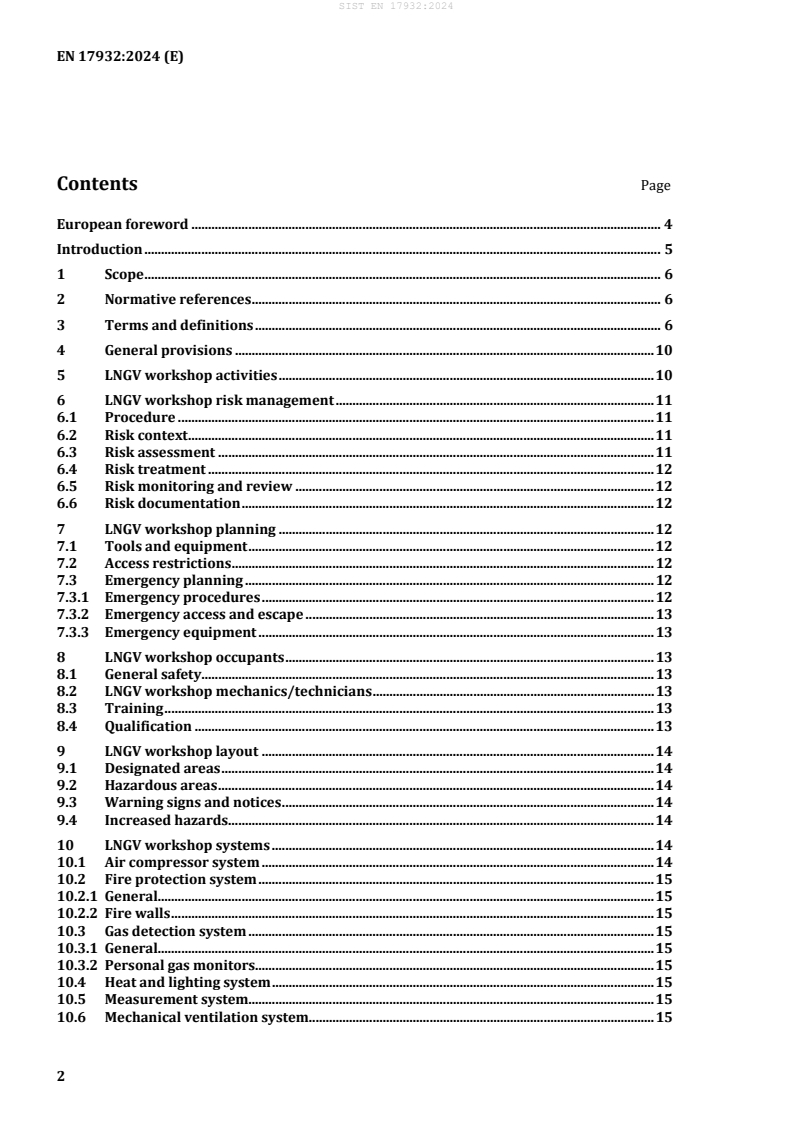
Contents Page
European foreword . 4
Introduction . 5
1 Scope . 6
2 Normative references . 6
3 Terms and definitions . 6
4 General provisions . 10
5 LNGV workshop activities . 10
6 LNGV workshop risk management . 11
6.1 Procedure . 11
6.2 Risk context . 11
6.3 Risk assessment . 11
6.4 Risk treatment . 12
6.5 Risk monitoring and review . 12
6.6 Risk documentation . 12
7 LNGV workshop planning . 12
7.1 Tools and equipment . 12
7.2 Access restrictions . 12
7.3 Emergency planning . 12
7.3.1 Emergency procedures . 12
7.3.2 Emergency access and escape . 13
7.3.3 Emergency equipment . 13
8 LNGV workshop occupants . 13
8.1 General safety . 13
8.2 LNGV workshop mechanics/technicians . 13
8.3 Training . 13
8.4 Qualification . 13
9 LNGV workshop layout . 14
9.1 Designated areas . 14
9.2 Hazardous areas . 14
9.3 Warning signs and notices . 14
9.4 Increased hazards . 14
10 LNGV workshop systems . 14
10.1 Air compressor system . 14
10.2 Fire protection system . 15
10.2.1 General. 15
10.2.2 Fire walls . 15
10.3 Gas detection system . 15
10.3.1 General. 15
10.3.2 Personal gas monitors. 15
10.4 Heat and lighting system . 15
10.5 Measurement system. 15
10.6 Mechanical ventilation system . 15
11 LNGV workshop operations . 16
11.1 Documentation . 16
11.1.1 Written procedures . 16
11.1.2 Record keeping . 16
11.2 Gas leak management . 16
11.2.1 Reporting of gas leak . 16
11.2.2 Handling LNGV with gas leaks . 16
11.2.3 Isolation of a vehicle tank . 16
Annex A (normative) Management of LNGV . 17
A.1 Use of LNGVs . 17
A.2 Refuelling of LNGV . 17
A.3 Parking of LNGVs . 18
A.4 Daily check of LNGV . 18
A.5 Inspection of LNGV . 18
A.6 Repair and maintenance of LNGV . 18
A.7 Disposal of LNGVs . 21
A.8 Transportation of LNGVs . 21
A.9 Documentation of LNGVs . 21
Annex B (normative) Management of LNG tanks . 22
B.1 Use of tanks . 22
B.2 Handling of tanks . 22
B.3 Inspection of tanks . 22
B.4 Storage of tanks . 23
B.5 Depressurization of LNG system . 23
B.6 Draining of tanks . 24
B.7 Mounting of tanks . 24
B.8 Disposal of tank . 24
Annex C (informative) Natural gas characteristics . 25
C.1 Information in manual . 25
C.2 Composition of natural gas . 25
C.3 Handling, cold contact burns . 26
C.4 Exposure to gas . 26
C.5 Fire precautions and protection . 27
Annex D (informative) LNGV workshop tools and equipment . 28
D.1 Complementary tools . 28
D.2 Measurement tools . 28
D.3 LNG retrofit system specific tools . 29
Bibliography . 30
European foreword
This document (EN 17932:2024) has been prepared by Technical Committee CEN/TC 326 “Natural gas
vehicles - Fuelling and operation”, the secretariat of which is held by TSE.
This European Standard shall be given the status of a national standard, either by publication of an
identical text or by endorsement, at the latest by December 2024, and conflicting national standards shall
be withdrawn at the latest by December 2024.
Attention is drawn to the possibility that some of the elements of this document may be the subject of
patent rights. CEN shall not be held responsible for identifying any or all such patent rights.
Any feedback and questions on this document should be directed to the users’ national standards body.
A complete listing of these bodies can be found on the CEN website.
According to the CEN-CENELEC Internal Regulations, the national standards organisations of the
following countries are bound to implement this European Standard: Austria, Belgium, Bulgaria, Croatia,
Cyprus, Czech Republic, Denmark, Estonia, Finland, France, Germany, Greece, Hungary, Iceland, Ireland,
Italy, Latvia, Lithuania, Luxembourg, Malta, Netherlands, Norway, Poland, Portugal, Republic of North
Macedonia, Romania, Serbia, Slovakia, Slovenia, Spain, Sweden, Switzerland, Türkiye and the United
Kingdom.
Introduction
This document provides minimum requirements for professionals on how to safely operate vehicles that
use liquefied natural gas (LNG) as a fuel for propulsion. This document also covers associated
requirements for LNGV workshops. In addition, the scope of the document addresses the LNGV owner
and user and other parties dealing with LNGVs.
This document addresses LNGV workshops and the management of liquefied natural gas (LNG) vehicles.
This document can be a useful reference for:
— LNGV workshop architects;
— LNGV workshop owners;
— LNGV workshop staff;
— OEMs;
— system manufacturers;
— LNG trucks owners and users;
— LNG trucks dealers;
— local authorities.
1 Scope
This document provides requirements for operation of vehicles that use liquefied natural gas (LNG) as a
fuel for propulsion, covering various aspects of LNGV workshops including activities, risk management,
planning, personnel, layout, systems and operations. It provides requirements regarding the
management of LNGV including use, parking, fuelling for commissioning, inspection, installation, repair
and maintenance, disposal, transportation and documentation.
This document is applicable to the management of LNG vehicles.
2 Normative references
The following documents are referred to in the text in such a way that some or all of their content
constitutes requirements of this document. For dated references, only the edition cited applies. For
undated references, the latest edition of the referenced document (including any amendments) applies.
EN 2, Classification of fires
EN 50402, Electrical apparatus for the detection and measurement of combustible or toxic gases or vapours
or of oxygen — Requirements on the functional safety of gas detection systems
EN 60079-10-1, Explosive atmospheres — Part 10-1: Classification of areas — Explosive gas atmospheres
(IEC 60079-10-1)
EN 60079-29-2, Explosive atmospheres — Part 29-2: Gas detectors — Selection, installation, use and
maintenance of detectors for flammable gases and oxygen (IEC 60079-29-2)
EN ISO 10012, Measurement management systems — Requirements for measurement processes and
measuring equipment (ISO 10012)
ISO 31000, Risk management — Guidelines
3 Terms and definitions
For the purposes of this document, the following terms and definitions apply.
ISO and IEC maintain terminology databases for use in standardization at the following addresses:
— IEC Electropedia: available at https://www.electropedia.org/
— ISO Online browsing platform: available at https://www.iso.org/obp
3.1
authorized qualification body
body, independent of the LNGV workshop, authorized by the certification body to prepare and administer
qualification examinations
[SOURCE: EN ISO 9712:2012, 3.1]
3.2
LNG system
assembly of components (tank(s), valves, flexible fuel lines, etc.) and connecting parts (rigid fuel lines,
pipes fitting, etc.) fitted on motor vehicles using LNG in their propulsion system
3.3
competent body
person or corporate body, defined by the national or relevant authority, which by combination of
appropriate qualification, training, experience and resources is able to make objective judgments on a
subject
[SOURCE: ISO 10691:2004, 3.2]
3.4
liquefied natural gas
LNG
natural gas that has been liquefied, after processing, for storage or transportation purposes used as a
transport fuel
[SOURCE: EN ISO 16924:2018]
3.5
vehicle tank
cryogenic tank mounted on a vehicle for the storage of LNG as a fuel for that vehicle
[SOURCE: EN ISO 16924:2018]
3.6
examining body
organization that has been appointed to verify compliance with the applicable standard
Note 1 to entry: In certain cases, an external independent examining body can be required.
[SOURCE: ISO/TR 25901-1:2016, 2.5.30]
3.7
gas-free
less than 10 % of the lower flammable limit of natural gas in air (less than 0,5 % in air)
3.8
hazardous area
area in which an explosive gas atmosphere is present, or can be expected to be present, in quantities such
as that special precautions for the construction, installation and use of equipment are required
Note 1 to entry: The interior of many items of process equipment is commonly considered as a hazardous area
even though a flammable atmosphere might not normally be present to account for the possibility of air entering
the equipment. Where specific controls such as inerting are used, the interior of process equipment might not need
to be classified as a hazardous area.
[SOURCE: EN 60079-10-1:2015, 3.3.1]
3.9
ignition source
source of energy sufficient to ignite a flammable atmosphere
Note 1 to entry: Ignition sources include naked flames, exposed incandescent material, sparks, electric welding
arcs, and electrical or mechanical equipment not approved for use in hazardous locations.
3.10
incident
unplanned event or occurrence that has been assessed as having an actual or potentially adverse effect
Note 1 to entry: An incident can be classified as a ‘major incident’ or ‘minor incident’. A major incident has effect
on the LNGV’s integrity or structural support (vehicle chassis) whereas a minor incident doesn’t. An example of a
major incident is damage to the bonnet/wing, which is designed to crumple to absorb the impact rather than
continue to transfer the momentum to the car’s passengers; a damaged hood can imply a damage on vehicle chassis.
An example of a minor incident is damage to a door panel that can be minor when limited to the skin (outer panel).
[SOURCE: ISO 28007-1:2015, 3.21, modified – ‘event’ has been replaced with ‘unplanned event or
occurrence’ and Note 1 to entry has been added.]
3.11
inspection
process of measuring, examining, testing, gauging or otherwise comparing the product with the
applicable requirements
[SOURCE: ISO 11961:2018, 3.1.19]
3.12
learning outcome
what a person is expected to know, understand or be able to do at the end of a training programme, course
or module
[SOURCE: ISO/IEC TS 17027:2014, 2.57]
3.13
lower flammable limit
LFL
concentration of flammable gas or vapour in air, below which an explosive gas atmosphere does not form
[SOURCE: EN 60079-10-1:2015, 3.6.12]
3.14
natural gas
complex gaseous mixture of hydrocarbons, primarily methane, but generally includes ethane, propane
and higher hydrocarbons, and some non-combustible gases such as nitrogen and carbon dioxide
Note 1 to entry: Natural gas can also contain components or contaminants such as mercaptan, sulphur
compounds and/or other chemical species.
Note 2 to entry: Annex C provides characteristics of natural gas.
[SOURCE: EN 16723-2:2017, 3.12, modified – Note 2 to entry has been added.]
3.15
liquefied natural gas vehicle
LNGV
road vehicle powered by liquefied natural gas
3.16
LNGV owner
legal entity responsible for the procedures and activities on LNGV
3.17
LNGV workshop
dedicated servicing facility, repair and maintenance where work on LNGV is carried out
3.18
purging
displacing natural gas with a dry inert gas
3.19
qualification
formal outcome of an assessment and validation process which is obtained when a competent body
determines that an individual has achieved learning outcomes to given standards
[SOURCE: CEN Guide 14:2010, B.2]
3.20
qualified person
individual subjected to qualification process which has passed the qualification
3.21
remote-controlled service valve
device that allows or interrupts the LNG supply from the vehicle tank
3.22
requirement
need or expectation that is stated, generally implied or obligatory
[SOURCE: ISO 9000:2015, 3.6.4, modified — Notes 1 to 6 to entry have been deleted.]
3.23
service pit
hole in the ground providing standing access to the underside of a vehicle
3.24
service valve
valve for fluid off-take which is manually operated to provide a leak-tight seal
3.26
system manufacturer
company which can assume technical responsibility for the manufacturing or retrofitting of LNG system
and can demonstrate that it possesses the features required and the necessary means to provide quality
assessment and conformity of production of the LNG system
3.27
technical manager
qualified person which takes responsibility for decisions relating to installation, maintenance and repair
of an LNGV system
3.28
vehicle manufacturer
person or body responsible to the approval authority for all aspects of the type approval or authorization
process and for ensuring conformity of production of the vehicle
Note 1 to entry: It is not essential that the person or body be directly involved in all stages of the construction
of the vehicle, system, component or separate technical unit which is the subject of the approval process.
Note 2 to entry: Vehicle manufacturer can also mean vehicle importer where the manufacturer is not
represented in the European Union.
[SOURCE: EN ISO 18542-1:2012, 3.1.17, modified – Note 2 to entry has been added.]
3.29
ventilation
movement of air and its replacement with fresh air, due to the effect of wind, temperature gradients, or
artificial means (for example fans or extractors)
[SOURCE: EN ISO 16923:2018, 3.54]
3.30
venting
controlled release of natural gas to atmosphere
[SOURCE: EN ISO 16923:2018, 3.55]
3.31
draining
emptying liquid phase from the LNG tank
3.32
depressurizing
reducing internal pressure to ambient pressure
3.33
hold time
time before a tank starts venting
4 General provisions
The management of LNGVs shall be done in accordance with Annex A. The requirements in Annex A are
also intended to apply to the user of the LNGV, whether he is the owner, operator or dealer responsible
for the sale or maintenance of the vehicle.
5 LNGV workshop activities
LNGV workshops shall be designed to accommodate one or more of the following activities:
a) LNGV system inspection;
b) LNGV system installation;
c) LNGV system repair;
d) LNGV system maintenance;
e) LNGV system requalification;
f) LNGV system disposal;
g) other non-gas activities.
6 LNGV workshop risk management
6.1 Procedure
Risks in relation to the LNGV workshop, and of any LNGV that are handled by it, shall be managed
according to the principles outlined in ISO 31000.
6.2 Risk context
Risks in relation to the LNGV workshop, and of any LNGV that are handled by it, shall be addressed in
respect of the various key stakeholders and their respective views, including:
a) health and safety organizations;
b) examining bodies;
c) local authority;
d) fire and emergency response providers;
e) environmental agencies;
f) system manufacturers;
g) vehicle manufacturers;
h) LNGV workshop owners;
i) LNGV workshop personnel;
j) LNGV workshop neighbours;
k) LNGV users;
l) the general public.
6.3 Risk assessment
Risks in relation to the LNGV workshop, and of any LNGVs that are handled by it, shall be assessed using
appropriate techniques. The risk assessment shall as a minimum include the following aspects of the
LNGV workshop:
a) organization;
b) layout;
c) systems;
d) operations.
NOTE EN IEC 31010 provides general guidance on selection and application of systematic techniques for risk
assessment.
6.4 Risk treatment
All identified risks in relation to the LNGV workshop. and of any LNGVs that are handled by it, shall be
treated in a manner which minimizes their impact to an acceptable level for all foreseeable hazards
including, but not limited to:
a) fire and explosion;
b) cold burns;
c) pressure;
d) asphyxiation;
e) electrocution.
6.5 Risk monitoring and review
All identified risks in relation to the LNGV workshop, and of any LNGV that are handled by it, shall be
monitored and reviewed. Risk monitoring and review shall be done on a periodic basis, but can be done
on an ad hoc basis as well.
6.6 Risk documentation
All identified risks in relation to the LNGV workshop, and of any LNGVs that are handled by it, shall be
comprehensively documented in a manner that clearly describes how they are managed.
NOTE Documented information can include hazardous area classification drawings, mitigation strategies, fire
escape routes.
7 LNGV workshop planning
7.1 Tools and equipment
The LNGV workshop shall have all the tools and equipment necessary to operate on LNGV in accordance
with the vehicle and/or system manufacturer’s requirements. Tools and equipment shall be suitably
managed by a qualified person. Management of tools and equipment shall include procurement, periodic
inspection, calibration, upgrading and replacement.
A non-exhaustive list of recommended tools and equipment is provided in Annex D.
7.2 Access restrictions
The LNGV workshop shall implement measures in order to prevent unauthorized persons from accessing
areas of the site, which could pose a risk to safety.
7.3 Emergency planning
7.3.1 Emergency procedures
The LNGV workshop shall have emergency procedures to respond to at least the following events:
a) a suspected or detected leak in gaseous or liquid phase of natural gas or other flammable substances;
b) a fire (conforming to the provisions of the local fire prevention authority);
c) an accident or injury to personnel during activities on the LNG system.
7.3.2 Emergency access and escape
The LNGV workshop shall make provisions for emergency access and escape, taking into account the
requirements for access by emergency response providers (e.g. ambulance, fire brigade) and for
emergency access, escape and evacuation.
7.3.3 Emergency equipment
The LNGV workshop shall be adequately furnished with appropriate equipment for dealing with
emergency situations, such as fire protection systems (see 10.2) and first-aid kits.
8 LNGV workshop occupants
8.1 General safety
The LNGV workshop owner shall provide safety instructions to all persons accessing the LNGV workshop
premises, including mechanics/technicians, administration staff and visitors.
LNGV workshop occupants shall wear adequate personal protective equipment (PPE), where necessary.
8.2 LNGV workshop mechanics/technicians
The LNGV workshop owner shall ensure that LNGV workshop mechanics/technicians are:
a) trained according to the requirements of 8.3;
b) qualified to perform the specific tasks assigned to them according to the written procedures as
defined in 11.1.1;
c) provided with the necessary tools and equipment.
8.3 Training
The training of LNGV workshop mechanics/technicians shall cover at least the following aspects:
a) hazards and associated risks in relation to the LNGV workshop and in the handling of LNGV,
including:
— properties of natural gas and LNG;
— LNGV fuel system;
— release/escape of natural gas in gas or liquid phase;
b) the theory and practice of dealing with emergency situations, for example:
— use of hand-held fire extinguishers;
— evacuation of the LNGV workshop.
8.4 Qualification
LNGV workshop personnel shall demonstrate that they are qualified for the tasks assigned to them.
NOTE 1 Qualification can be demonstrated by an authorized qualification body.
NOTE 2 ISO 23684 and DIS 24671, will provide requirements for the competence of technical personnel dealing
with LNGVs as well as training, qualification and certificatio
...