

oSIST prEN 13852-1:2021
(Main)Cranes - Offshore cranes - Part 1: General-purpose offshore cranes
General Information
- Abstract
This document applies to general purpose offshore cranes including their supporting pedestals and structures.
This document is applicable to general purpose offshore cranes, whose structures are made of steel.
This document provides requirements for all significant hazards, hazardous situations and events relevant to general purpose offshore cranes, for lifting of goods and lifting of persons, when used as intended and under the conditions foreseen by the risk assessment (see Clause 4).
This document is applicable to general purpose offshore cranes, which are manufactured after the date of approval by CEN of this document.
This document is not applicable for:
a) transportation, assembly, disabling, scrapping, installation or erecting of the crane;
b) any item attached to the hook, such as loads, non-fixed load lifting attachments, lifting accessories, baskets, carriers and containers;
c) lifting operations in ambient temperatures below - 20 °C;
d) lifting operations in ambient temperatures above 45 °C;
e) accidental loads as result of collisions, earthquakes, explosions, etc., which are not covered by exceptional loads defined in Table B.7 ;
f) floating cranes (covered by EN13852-2), light offshore cranes (covered by FprEN13852-3) and 2D/3D motion compensated cranes;
g) subsea lifting operations;
h) lifting operations involving more than one crane;
i) emergency rescue operations (except training).
- Status
- Not Published
- Public Enquiry End Date
- 23-Jun-2021
- Technical Committee
- DTN - Lift and transport appliances
- Current Stage
- 4020 - Public enquire (PE) (Adopted Project)
- Start Date
- 14-Apr-2021
- Due Date
- 01-Sep-2021
- Completion Date
- 19-Jul-2021



Overview
oSIST prEN 13852-1:2021 – Cranes – Offshore Cranes – Part 1: General-purpose Offshore Cranes is a draft European standard developed by SIST and CEN/TC 147. This standard specifies the design, safety, and operational requirements for general-purpose offshore cranes constructed primarily from steel. These cranes are typically used for lifting goods and, where appropriate, lifting personnel on offshore structures. The standard outlines protective measures, hazard management, and functional requirements to enhance safety and reliability in offshore environments.
This document is applicable to new general-purpose offshore cranes manufactured after its approval and covers all significant risks and hazardous situations relevant to the operation of such cranes under normal conditions as identified by appropriate risk assessments.
Key Topics
The standard addresses a comprehensive range of technical and safety aspects, including:
- Design & Structural Requirements
- Materials selection for offshore conditions
- Strength, stability, and fatigue considerations
- Load combinations and failure mode analysis
- Control and Automation Systems
- Control system design and safety functions
- Start/stop, motion limitation, and prevention of unintended operations
- Remote and automated operation options
- Mechanical and Electrical Equipment
- Requirements for bearings, brakes, wire ropes, and load-holding devices
- Fluid power systems (hydraulic and pneumatic)
- Electrical safety, ingress protection, and electromagnetic compatibility
- Safety Measures and Safeguarding
- Overload protection, motion limiters, and emergency stop systems
- Fire prevention, dropped object protection, and hazardous area compliance
- Ergonomics and User Interface
- Access, lighting, noise and vibration reduction
- Communication systems and data recorders
- Testing, Verification, and Documentation
- Load and function testing procedures
- Inspection, maintenance and periodic checks
- Marking and provision of operational information
Note: The standard specifically excludes certain operations, such as crane installation, floating cranes, subsea lifting, and operations at extreme temperatures or under extraordinary loads not defined within the scope.
Applications
oSIST prEN 13852-1:2021 applies to a variety of offshore industry applications, particularly where safety and reliability are critical. Key uses include:
- Offshore Oil and Gas Platforms: Ensuring safe and efficient handling of materials, equipment, and personnel.
- Wind Farm Installation and Maintenance: Supporting logistics for offshore renewable energy projects.
- General Cargo Handling on Offshore Structures: Facilitating the transfer of supplies and equipment between vessels and platforms.
- Personnel Lifting: Where cranes are equipped and certified to safely move personnel between locations on or near offshore structures.
- Engineering and Construction Projects: Meeting the rigorous requirements for project cranes operating in challenging marine environments.
Related Standards
For a comprehensive approach to offshore crane safety and performance, the following related standards should be considered:
- EN 13852-2 – Offshore Cranes – Floating Cranes
- FprEN 13852-3 – Offshore Cranes – Light Offshore Cranes
- EN ISO 12100 – General Principles for Design – Risk Assessment and Risk Reduction
- EN 60204-32 – Safety of Machinery – Electrical Equipment of Machines – Requirements for Hoisting Machines
By adhering to oSIST prEN 13852-1:2021, manufacturers, operators, and engineers can ensure compliance with the latest European requirements for offshore crane safety, supporting effective risk management and the safe operation of cranes in harsh offshore environments.
Relations
- Effective Date
- 18-Jan-2023
- Effective Date
- 24-Jan-2018
Get Certified
Connect with accredited certification bodies for this standard

DNV
DNV is an independent assurance and risk management provider.

Lloyd's Register
Lloyd's Register is a global professional services organisation specialising in engineering and technology.

FSC International
Forest Stewardship Council certification.
Sponsored listings
Frequently Asked Questions
oSIST prEN 13852-1:2021 is a draft published by the Slovenian Institute for Standardization (SIST). Its full title is "Cranes - Offshore cranes - Part 1: General-purpose offshore cranes". This standard covers: This document applies to general purpose offshore cranes including their supporting pedestals and structures. This document is applicable to general purpose offshore cranes, whose structures are made of steel. This document provides requirements for all significant hazards, hazardous situations and events relevant to general purpose offshore cranes, for lifting of goods and lifting of persons, when used as intended and under the conditions foreseen by the risk assessment (see Clause 4). This document is applicable to general purpose offshore cranes, which are manufactured after the date of approval by CEN of this document. This document is not applicable for: a) transportation, assembly, disabling, scrapping, installation or erecting of the crane; b) any item attached to the hook, such as loads, non-fixed load lifting attachments, lifting accessories, baskets, carriers and containers; c) lifting operations in ambient temperatures below - 20 °C; d) lifting operations in ambient temperatures above 45 °C; e) accidental loads as result of collisions, earthquakes, explosions, etc., which are not covered by exceptional loads defined in Table B.7 ; f) floating cranes (covered by EN13852-2), light offshore cranes (covered by FprEN13852-3) and 2D/3D motion compensated cranes; g) subsea lifting operations; h) lifting operations involving more than one crane; i) emergency rescue operations (except training).
This document applies to general purpose offshore cranes including their supporting pedestals and structures. This document is applicable to general purpose offshore cranes, whose structures are made of steel. This document provides requirements for all significant hazards, hazardous situations and events relevant to general purpose offshore cranes, for lifting of goods and lifting of persons, when used as intended and under the conditions foreseen by the risk assessment (see Clause 4). This document is applicable to general purpose offshore cranes, which are manufactured after the date of approval by CEN of this document. This document is not applicable for: a) transportation, assembly, disabling, scrapping, installation or erecting of the crane; b) any item attached to the hook, such as loads, non-fixed load lifting attachments, lifting accessories, baskets, carriers and containers; c) lifting operations in ambient temperatures below - 20 °C; d) lifting operations in ambient temperatures above 45 °C; e) accidental loads as result of collisions, earthquakes, explosions, etc., which are not covered by exceptional loads defined in Table B.7 ; f) floating cranes (covered by EN13852-2), light offshore cranes (covered by FprEN13852-3) and 2D/3D motion compensated cranes; g) subsea lifting operations; h) lifting operations involving more than one crane; i) emergency rescue operations (except training).
oSIST prEN 13852-1:2021 is classified under the following ICS (International Classification for Standards) categories: 47.020.40 - Lifting and cargo handling equipment; 53.020.20 - Cranes. The ICS classification helps identify the subject area and facilitates finding related standards.
oSIST prEN 13852-1:2021 has the following relationships with other standards: It is inter standard links to SIST EN 13852-1:2013, SIST EN 13852-1:2013. Understanding these relationships helps ensure you are using the most current and applicable version of the standard.
oSIST prEN 13852-1:2021 is associated with the following European legislation: EU Directives/Regulations: 2006/42/EC, 2014/34/EU; Standardization Mandates: M/396, M/BC/CEN/92/46. When a standard is cited in the Official Journal of the European Union, products manufactured in conformity with it benefit from a presumption of conformity with the essential requirements of the corresponding EU directive or regulation.
oSIST prEN 13852-1:2021 is available in PDF format for immediate download after purchase. The document can be added to your cart and obtained through the secure checkout process. Digital delivery ensures instant access to the complete standard document.
Standards Content (Sample)
SLOVENSKI STANDARD
01-junij-2021
Žerjavi - Žerjavi na plavajočih objektih - 1. del: Žerjavi na plavajočih objektih za
splošno uporabo
Cranes - Offshore cranes - Part 1: General-purpose offshore cranes
Krane - Offshore-Krane - Teil 1: Offshore-Krane für allgemeine Verwendung
Appareils de levage à charge suspendue - Grues off-shore - Partie 1 : Grues off-shore
pour usage général
Ta slovenski standard je istoveten z: prEN 13852-1
ICS:
47.020.40 Dvigalna oprema in oprema Lifting and cargo handling
za pretovor equipment
53.020.20 Dvigala Cranes
2003-01.Slovenski inštitut za standardizacijo. Razmnoževanje celote ali delov tega standarda ni dovoljeno.
DRAFT
EUROPEAN STANDARD
NORME EUROPÉENNE
EUROPÄISCHE NORM
April 2021
ICS 47.020.40; 53.020.20 Will supersede EN 13852-1:2013
English Version
Cranes - Offshore cranes - Part 1: General-purpose
offshore cranes
Appareils de levage à charge suspendue - Grues off- Krane - Offshore-Krane - Teil 1: Offshore-Krane für
shore - Partie 1 : Grues off-shore pour usage général allgemeine Verwendung
This draft European Standard is submitted to CEN members for enquiry. It has been drawn up by the Technical Committee
CEN/TC 147.
If this draft becomes a European Standard, CEN members are bound to comply with the CEN/CENELEC Internal Regulations
which stipulate the conditions for giving this European Standard the status of a national standard without any alteration.
This draft European Standard was established by CEN in three official versions (English, French, German). A version in any other
language made by translation under the responsibility of a CEN member into its own language and notified to the CEN-CENELEC
Management Centre has the same status as the official versions.
CEN members are the national standards bodies of Austria, Belgium, Bulgaria, Croatia, Cyprus, Czech Republic, Denmark, Estonia,
Finland, France, Germany, Greece, Hungary, Iceland, Ireland, Italy, Latvia, Lithuania, Luxembourg, Malta, Netherlands, Norway,
Poland, Portugal, Republic of North Macedonia, Romania, Serbia, Slovakia, Slovenia, Spain, Sweden, Switzerland, Turkey and
United Kingdom.
Recipients of this draft are invited to submit, with their comments, notification of any relevant patent rights of which they are
aware and to provide supporting documentation.
Warning : This document is not a European Standard. It is distributed for review and comments. It is subject to change without
notice and shall not be referred to as a European Standard.
EUROPEAN COMMITTEE FOR STANDARDIZATION
COMITÉ EUROPÉEN DE NORMALISATION
EUROPÄISCHES KOMITEE FÜR NORMUNG
CEN-CENELEC Management Centre: Rue de la Science 23, B-1040 Brussels
© 2021 CEN All rights of exploitation in any form and by any means reserved Ref. No. prEN 13852-1:2021 E
worldwide for CEN national Members.
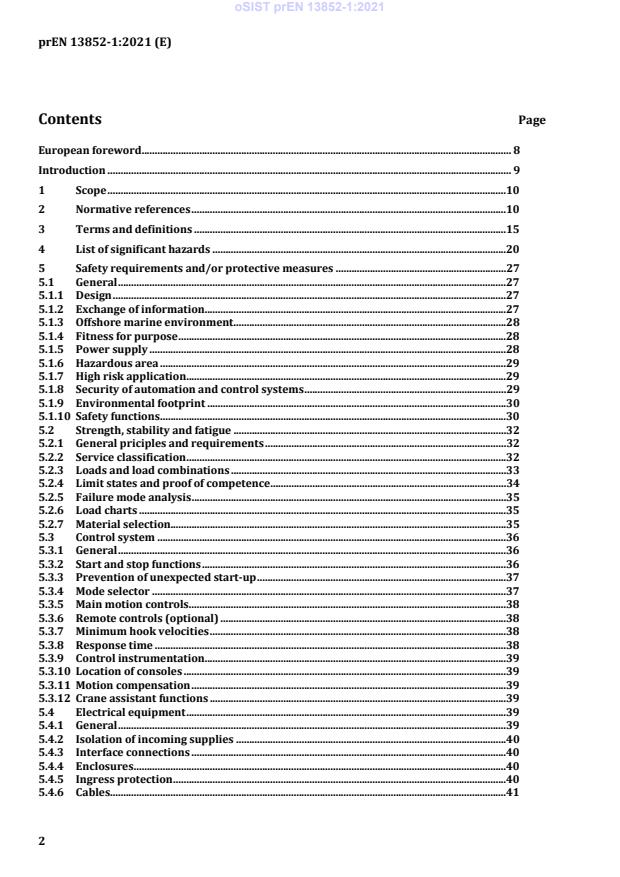
Contents Page
European foreword . 8
Introduction . 9
1 Scope .10
2 Normative references .10
3 Terms and definitions .15
4 List of significant hazards .20
5 Safety requirements and/or protective measures .27
5.1 General .27
5.1.1 Design .27
5.1.2 Exchange of information.27
5.1.3 Offshore marine environment .28
5.1.4 Fitness for purpose .28
5.1.5 Power supply .28
5.1.6 Hazardous area .29
5.1.7 High risk application .29
5.1.8 Security of automation and control systems .29
5.1.9 Environmental footprint .30
5.1.10 Safety functions .30
5.2 Strength, stability and fatigue .32
5.2.1 General priciples and requirements .32
5.2.2 Service classification .32
5.2.3 Loads and load combinations .33
5.2.4 Limit states and proof of competence .34
5.2.5 Failure mode analysis .35
5.2.6 Load charts .35
5.2.7 Material selection.35
5.3 Control system .36
5.3.1 General .36
5.3.2 Start and stop functions .36
5.3.3 Prevention of unexpected start-up .37
5.3.4 Mode selector .37
5.3.5 Main motion controls .38
5.3.6 Remote controls (optional) .38
5.3.7 Minimum hook velocities .38
5.3.8 Response time .38
5.3.9 Control instrumentation.39
5.3.10 Location of consoles .39
5.3.11 Motion compensation .39
5.3.12 Crane assistant functions .39
5.4 Electrical equipment .39
5.4.1 General .39
5.4.2 Isolation of incoming supplies .40
5.4.3 Interface connections .40
5.4.4 Enclosures .40
5.4.5 Ingress protection .40
5.4.6 Cables.41
5.4.7 Protective earthing . 41
5.4.8 Protection by automatic disconnection of supply . 41
5.4.9 Protection against electric shock by direct contact . 41
5.4.10 Hazardous areas . 41
5.4.11 Electromagnetic compatibility . 41
5.5 Mechanical equipment . 41
5.5.1 General . 41
5.5.2 Bearings . 42
5.5.3 Couplings, splines and gears . 42
5.5.4 Brakes . 42
5.5.5 Hoist and luffing wire rope drives . 42
5.5.6 Drums for wire ropes . 42
5.5.7 Wire ropes . 43
5.5.8 Wire rope terminations . 43
5.5.9 Wire rope sheaves . 43
5.5.10 Wear protectors . 44
5.5.11 Slewing drives . 44
5.5.12 Travelling drives . 44
5.5.13 Telescopic drives . 44
5.5.14 Folding and cylinder luffing drives . 44
5.5.15 Fixed load lifting attachments . 45
5.5.16 Bolt assemblies . 46
5.5.17 Double means of securing . 46
5.6 Fluid power systems . 46
5.6.1 General . 46
5.6.2 Hydraulic systems . 46
5.6.3 Hydraulic reservoirs . 46
5.6.4 Hydraulic cylinders . 47
5.6.5 Load holding devices . 47
5.6.6 Accumulators . 47
5.6.7 Hoses, tubes and fittings . 47
5.6.8 Sink rate for boom systems . 48
5.6.9 Pneumatic systems. 48
5.7 Safeguarding . 48
5.7.1 General . 48
5.7.2 External acoustic warning device . 48
5.7.3 Control system indicator. 48
5.7.4 Wind indicator . 48
5.7.5 Hoist drum motion indicator . 49
5.7.6 Rated capacity indicator (RCI) . 49
5.7.7 Motion limiters . 49
5.7.8 Rated capacity limiter (RCL) . 50
5.7.9 Slack wire rope detection . 50
5.7.10 Boom backstop . 50
5.7.11 Motion detection system (MDS) . 50
5.7.12 Automatic Overload Protection System (AOPS) . 51
5.7.13 Manual Overload Protection System (MOPS) . 54
5.7.14 Lateral boom protection system (LBPS) . 55
5.7.15 Emergency operation system (EOS). 55
5.7.16 Emergency load lowering (ELL) . 57
5.7.17 Emergency stop . 57
5.7.18 Fire prevention and fire protection . 57
5.8 Installation interface . 58
5.8.1 General .58
5.8.2 Pedestal and pedestal adaptor .58
5.8.3 Boom rest .58
5.8.4 Access .58
5.8.5 Laydown areas and blind zones .58
5.8.6 Crane restriction charts .58
5.8.7 Dropped object protection .59
5.8.8 Lighting .59
5.8.9 Power connections .59
5.8.10 Uninterrupted Power Supply (UPS) .59
5.8.11 Signal and communication connections .59
5.8.12 Ignition source control .59
5.8.13 Emergency shut down (ESD) .60
5.9 User interface .60
5.9.1 General .60
5.9.2 Ergonomy .60
5.9.3 Access and escape .60
5.9.4 Control station .60
5.9.5 Remote console .63
5.9.6 Communications .63
5.9.7 Machinery and drive rooms .63
5.9.8 Enclosed spaces .63
5.9.9 Lighting .64
5.9.10 Noise reduction at source by design .64
5.9.11 Noise reduction by information .64
5.9.12 Vibrations .64
5.9.13 Guards and falling hazards .65
5.9.14 Edges, angles and surfaces .65
5.9.15 Hot surfaces .65
5.9.16 Hazardous substances .66
5.9.17 Arrangements for stowing and maintenance .66
5.9.18 Component and equipment identification .66
5.9.19 Dropped objects .67
5.9.20 Warnings .67
5.9.21 Data recorder .67
5.9.22 Software access .68
5.10 Fabrication .68
5.10.1 General .68
5.10.2 Component traceability .69
5.10.3 Quality assurance .69
5.10.4 Material certification .69
5.10.5 Welding .69
5.10.6 Bolted connections .69
5.10.7 Corrosion protection.69
5.11 Lifting of persons .70
5.11.1 General .70
5.11.2 Rated capacity .70
5.11.3 Control system .70
5.11.4 Mode selector for lifting of persons .70
5.11.5 Back-up brake .71
5.11.6 Back-up motion limiters .71
5.11.7 Cylinders.71
5.11.8 Reeving systems for luffing .71
6 Verification of the safety requirements and/or protective measures . 72
6.1 General . 72
6.1.1 Verification . 72
6.1.2 Documentation . 72
6.1.3 Verification methods . 72
6.2 Testing . 77
6.2.1 General . 77
6.2.2 Function test . 77
6.2.3 Load test . 77
6.2.4 Load test points . 78
6.2.5 Noise emission tests . 78
6.2.6 Test acceptance criteria . 80
7 Information for use . 80
7.1 General . 80
7.1.1 Provisions of an instruction for use . 80
7.1.2 Installation . 80
7.1.3 Additional information . 81
7.2 Operation . 81
7.2.1 General . 81
7.2.2 Checks before starting operation . 82
7.2.3 Checks during operation . 83
7.2.4 Crane out of service . 83
7.2.5 Lifting of persons (if part of the intended use) . 83
7.3 Maintenance . 85
7.3.1 General . 85
7.3.2 Inspections . 85
7.3.3 Enhanced inspection and maintenance . 86
7.4 Marking . 86
7.4.1 Manufacturer’s plate . 86
7.4.2 Rated capacity information . 86
7.4.3 Components . 86
Annex A (informative) Selection of a suitable set of crane standards for a given
application . 87
Annex B (normative) Determination of factors . 89
B.1 Calculation of the dynamic factor Φ by the simplified method . 89
2n
B.2 Motion response analysis . 91
B.3 Offlead and sidelead . 91
B.4 Hook velocity . 92
B.4.1 Hoisting velocity . 92
B.4.2 Horizontal hook velocity . 92
B.5 Load combinations . 93
Annex C (normative) Environmental influences . 98
C.1 General . 98
C.2 Atmosphere . 98
C.3 Temperature . 98
C.4 Wind . 99
C.4.1 Wind velocities .99
C.5 Installation motions .99
C.5.1 Inclination .99
C.5.2 Accelerations .99
C.5.3 Mean accelerations . 100
C.5.4 Ice and snow loads . 100
Annex D (normative) Failure mode analysis . 102
D.1 General . 102
D.2 Failure mode charts . 102
Annex E (normative) Control station information . 103
E.1 General . 103
E.2 Primary information for control station . 103
E.3 Remote control (on-board lift) . 104
E.4 Additional information for control station . 105
Annex F (normative) Requirements for brakes . 106
Annex G (normative) Ranking of means of safeguarding . 108
Annex H (normative) Safety functions and required performance levels . 109
H.1 Required performance levels . 109
Annex I (informative) Typical general-purpose offshore cranes and terminology . 111
Annex J (normative) Excursion envelopes . 115
Annex K (normative) Noise test code (deleted) . 116
Annex L (normative) Equipment for use in a hazardous area . 117
L.1 General . 117
L.2 Avoidance or reduction of ignition sources. 117
L.3 Electrical equipment . 117
L.4 Non-electrical equipment . 117
L.5 Electrostatic discharge . 118
Annex M (informative) Offshore crane data sheet . 119
Annex N (informative) Crane assistant functions . 127
N.1 General . 127
N.2 Levels of automation . 127
N.3 Examples of crane assisting functions . 127
N.3.1 Deck motion detection . 127
N.3.2 Hook position detection . 127
N.3.3 Lift-off and landing assistant . 128
N.3.4 Anti-swing assistant . 128
N.3.5 People detection . 128
N.3.6 Handsfree slinging . 128
N.3.7 Collision preventer . 128
N.3.8 Remote/automated inspection, test and diagnostics . 128
Annex ZA (informative) Relationship between this European Standard and the essential
requirements of Directive 2006/42/EC aimed to be covered . 129
Annex ZB (informative) Relationship between this European Standard and the Essential
requirements of EU Directive 2014/34/EU . 133
Bibliography . 138
European foreword
This document (prEN 13852-1:2021) has been prepared by Technical Committee CEN/TC 147 “Cranes -
Safety”, the secretariat of which is held by BSI.
This document is currently submitted to the CEN Enquiry.
This document supersedes EN 13852-1:2013.
This document has been prepared under a mandate given to CEN by the European Commission and the
European Free Trade Association, and supports essential requirements of EU Directive(s).
For relationship with EU Directive(s), see informative Annex ZA or ZB, which are integral parts of this
document.
This document is one part of EN 13852. The parts are the following ones:
— Part 1: General-purpose offshore cranes (the present document);
— Part 2: Floating cranes;
— Part 3: Light offshore cranes.
This document is a full revision of EN 13852-1:2013.
Introduction
This document is a type C standard as defined in EN ISO 12100:2010.
This document has been prepared to provide one means for general purpose offshore cranes to conform
to the essential health and safety requirements of the Machinery Directive.
The machinery concerned and the extent to which hazards, hazardous situations and hazardous events
are covered are indicated in the scope of this document (see Clause 1).
When provisions of this type C standard are different from those which are stated in type A or B
standards, the provisions of this type C standard take precedence over the provisions of the other
standards, for machines that have been designed and built according to the provisions of this type C
standard.
1 Scope
This document applies to general purpose offshore cranes including their supporting pedestals and
structures.
This document is applicable to general purpose offshore cranes, whose structures are made of steel.
This document provides requirements for all significant hazards, hazardous situations and events
relevant to general purpose offshore cranes, for lifting of goods and lifting of persons, when used as
intended and under the conditions foreseen by the risk assessment (see Clause 4).
This document is applicable to general purpose offshore cranes, which are manufactured after the date
of approval by CEN of this document.
This document is not applicable for:
a) transportation, assembly, disabling, scrapping, installation or erecting of the crane;
b) any item attached to the hook, such as loads, non-fixed load lifting attachments, lifting accessories,
baskets, carriers and containers;
c) lifting operations in ambient temperatures below - 20 °C;
d) lifting operations in ambient temperatures above 45 °C;
e) accidental loads as result of collisions, earthquakes, explosions, etc., which are not covered by
exceptional loads defined in Table B.7;
f) floating cranes (covered by EN 13852-2), light offshore cranes (covered by FprEN 13852-3) and
2D/3D motion compensated cranes;
g) subsea lifting operations;
h) lifting operations involving more than one crane;
i) emergency rescue operations (except training).
2 Normative references
The following documents are referred to in the text in such a way that some or all of their content
constitutes requirements of this document. For undated references in the body text, the corresponding
dated references in this chapter applies.
EN 614-1:2006+A1:2009, Safety of machinery — Ergonomic design principles — Part 1: Terminology and
general principles
EN 614-2:2000+A1:2008, Safety of machinery — Ergonomic design principles — Part 2: Interactions
between the design of machinery and work tasks
EN 795:2012, Personal fall protection equipment — Anchor devices
EN 842:1996+A1:2008, Safety of machinery — Visual danger signals — General requirements, design and
testing
EN 894-1:1997+A1:2008, Safety of machinery — Ergonomics requirements for the design of displays and
control actuators — Part 1: General principles for human interactions with displays and control actuators
EN 894-2:1997+A1:2008, Safety of machinery — Ergonomics requirements for the design of displays and
control actuators — Part 2: Displays
EN 894-3:2000+A1:2008, Safety of machinery — Ergonomics requirements for the design of displays and
control actuators — Part 3: Control actuators
EN 1127-1:2019, Explosive atmospheres — Explosion prevention and protection — Part 1: Basic concepts
and methodology
EN 1837:1999+A1:2009, Safety of machinery — Inte
...