


SIST EN 16454:2015
(Main)Intelligent transport systems - ESafety - ECall end to end conformance testing
Intelligent transport systems - ESafety - ECall end to end conformance testing
This European Standard defines the key actors in the eCall chain of service
provision as:
1) In-Vehicle System (IVS)/vehicle,
2) Mobile network Operator (MNO),
3) Public safety assistance point [provider](PSAP), in some circumstances may also
involve:
4) Third Party Service Provider (TPSP), and to provide conformance tests for actor
groups 1) - 4).
NOTE Conformance tests are not appropriate nor required for vehicle occupants,
although they are the recipient of the service. The Scope covers conformance
testing (and approval) of new engineering developments, products and systems,
and does not imply testing associated with individual installations in vehicles or
locations.
Intelligente Transportsysteme - ESicherheit - Ende Konformitätstests Ende
Systèmes de transport intelligents - eSécurité - Essais de conformité du système « eCall » de bout en bout
La présente Spécification technique définit les principaux acteurs dans la chaîne de fourniture du service eCall comme étant :
1) Système embarqué (IVS) / véhicule,
2) Opérateur de réseau mobile (MNO),
3) Point d´accès aux services de sécurité publique [fournisseur] (PSAP),
dans certaines circonstances, ils peuvent également inclure :
4) Fournisseur de service tiers (TPSP),
et la réalisation des essais de conformité pour les groupes d’acteurs 1) – 4).
NOTE Les essais de conformité ne conviennent pas et ne sont pas requis pour les occupants des véhicules, bien que ces derniers soient les bénéficiaires du service.
Le domaine d’application couvre les essais de conformité (et l’homologation) des nouveaux développements techniques, produits et systèmes et n’implique par les essais associés aux installations individuelles dans les véhicules ou sur les sites.
Inteligentni transportni sistemi - e-Varnost - Preskušanje skladnosti e-klica v zvezi pošiljatelj-prejemnik
Ta evropski standard določa ključne udeležence v verigi izvedbe storitev e-klica, kot so: 1) sistem v vozilu (IVS)/vozilo, 2) operater mobilnega omrežja (MNO), 3) center za pomoč [ponudnik](PSAP), v nekaterih okoliščinah lahko vključuje tudi: 4) ponudnika storitev tretje strani (TPSP), in zagotavlja preskuse skladnosti za skupine udeležencev 1) - 4). OPOMBA Preskusi skladnosti niso primerni in zahtevani za potnike v vozilu, čeprav so prejemniki storitve. Področje uporabe zajema preskuse skladnosti (in potrditev) novih inženirskih dosežkov, izdelkov in sistemov ter ne zahteva preskusov, povezanih s posameznimi vgradnjami v vozila ali na lokacije.
General Information
- Status
- Withdrawn
- Public Enquiry End Date
- 29-Nov-2014
- Publication Date
- 22-Oct-2015
- Withdrawal Date
- 19-Dec-2023
- Technical Committee
- ITC - Information technology
- Current Stage
- 9900 - Withdrawal (Adopted Project)
- Start Date
- 19-Dec-2023
- Due Date
- 11-Jan-2024
- Completion Date
- 20-Dec-2023
Relations
- Effective Date
- 01-Dec-2015
- Replaced By
SIST EN 16454:2024 - Intelligent transport systems - ESafety - ECall end to end conformance testing - Effective Date
- 01-Feb-2024



Frequently Asked Questions
SIST EN 16454:2015 is a standard published by the Slovenian Institute for Standardization (SIST). Its full title is "Intelligent transport systems - ESafety - ECall end to end conformance testing". This standard covers: This European Standard defines the key actors in the eCall chain of service provision as: 1) In-Vehicle System (IVS)/vehicle, 2) Mobile network Operator (MNO), 3) Public safety assistance point [provider](PSAP), in some circumstances may also involve: 4) Third Party Service Provider (TPSP), and to provide conformance tests for actor groups 1) - 4). NOTE Conformance tests are not appropriate nor required for vehicle occupants, although they are the recipient of the service. The Scope covers conformance testing (and approval) of new engineering developments, products and systems, and does not imply testing associated with individual installations in vehicles or locations.
This European Standard defines the key actors in the eCall chain of service provision as: 1) In-Vehicle System (IVS)/vehicle, 2) Mobile network Operator (MNO), 3) Public safety assistance point [provider](PSAP), in some circumstances may also involve: 4) Third Party Service Provider (TPSP), and to provide conformance tests for actor groups 1) - 4). NOTE Conformance tests are not appropriate nor required for vehicle occupants, although they are the recipient of the service. The Scope covers conformance testing (and approval) of new engineering developments, products and systems, and does not imply testing associated with individual installations in vehicles or locations.
SIST EN 16454:2015 is classified under the following ICS (International Classification for Standards) categories: 13.200 - Accident and disaster control; 35.240.60 - IT applications in transport; 43.040.15 - Car informatics. On board computer systems. The ICS classification helps identify the subject area and facilitates finding related standards.
SIST EN 16454:2015 has the following relationships with other standards: It is inter standard links to SIST-TS CEN/TS 16454:2013, SIST EN 16454:2024. Understanding these relationships helps ensure you are using the most current and applicable version of the standard.
SIST EN 16454:2015 is available in PDF format for immediate download after purchase. The document can be added to your cart and obtained through the secure checkout process. Digital delivery ensures instant access to the complete standard document.
Standards Content (Sample)
2003-01.Slovenski inštitut za standardizacijo. Razmnoževanje celote ali delov tega standarda ni dovoljeno.Inteligentni transportni sistemi - e-Varnost - Preskušanje skladnosti e-klica v zvezi pošiljatelj-prejemnikIntelligente Transportsysteme - ESicherheit - Ende Konformitätstests EndeSystèmes de transport intelligents - eSécurité - Essais de conformité du système « eCall » de bout en boutIntelligent transport systems - ESafety - ECall end to end conformance testing43.040.15Car informatics. On board computer systems35.240.60Uporabniške rešitve IT v transportu in trgoviniIT applications in transport and trade13.200NDWDVWURIAccident and disaster controlICS:Ta slovenski standard je istoveten z:EN 16454:2015SIST EN 16454:2015en,fr,de01-december-2015SIST EN 16454:2015SLOVENSKI
STANDARD
EUROPEAN STANDARD NORME EUROPÉENNE EUROPÄISCHE NORM
EN 16454
September
t r s w English Version
Intelligent transport systems æ ESafety æ ECall end to end conformance testing Systèmes de transport intelligents æ eSécurité æ Essais de conformité du système
6 eCall
6 de bout en bout
Intelligente Verkehrssysteme æ ESicherheit æ Vollständige Konformitätsprüfungen für eCall This European Standard was approved by CEN on
s y July
t r s wä
egulations which stipulate the conditions for giving this European Standard the status of a national standard without any alterationä Upætoædate lists and bibliographical references concerning such national standards may be obtained on application to the CENæCENELEC Management Centre or to any CEN memberä
translation under the responsibility of a CEN member into its own language and notified to the CENæCENELEC Management Centre has the same status as the official versionsä
CEN members are the national standards bodies of Austriaá Belgiumá Bulgariaá Croatiaá Cyprusá Czech Republicá Denmarká Estoniaá Finlandá Former Yugoslav Republic of Macedoniaá Franceá Germanyá Greeceá Hungaryá Icelandá Irelandá Italyá Latviaá Lithuaniaá Luxembourgá Maltaá Netherlandsá Norwayá Polandá Portugalá Romaniaá Slovakiaá Sloveniaá Spainá Swedená Switzerlandá Turkey andUnited Kingdomä
EUROPEAN COMMITTEE FOR STANDARDIZATION COMITÉ EUROPÉEN DE NORMALISATION EUROPÄISCHES KOMITEE FÜR NORMUNG
CEN-CENELEC Management Centre:
Avenue Marnix 17,
B-1000 Brussels
t r s w CEN All rights of exploitation in any form and by any means reserved worldwide for CEN national Membersä Refä Noä EN
s x v w vã t r s w ESIST EN 16454:2015
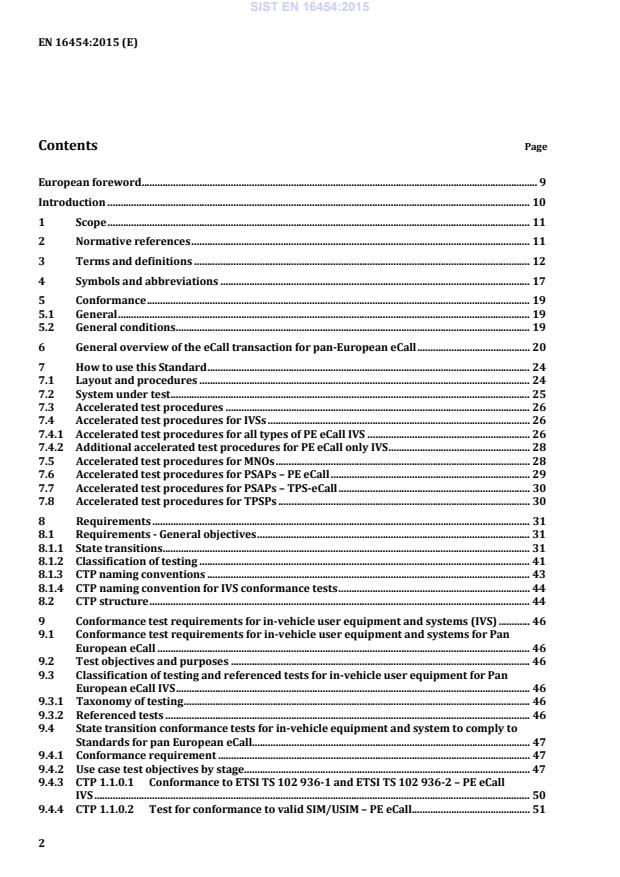
Conformance to ETSI TS 102 936-1 and ETSI TS 102 936-2 – PE eCall IVS . 50 9.4.4 CTP 1.1.0.2
Test for conformance to valid SIM/USIM – PE eCall . 51 SIST EN 16454:2015
Automatic eCall triggering does not occur when ignition OFF – PE eCall IVS . 52 9.4.6 CTP 1.1.1.1
Power on and self test – PE eCall IVS . 53 9.4.7 CTP 1.1.2.1
eCall automatically activated – PE eCall IVS . 54 9.4.8 CTP 1.1.2.2
Automatically triggered eCall in progress was not disconnected upon a new eCall trigger – PE eCall IVS. 55 9.4.9 CTP 1.1.2.3
Post-side-crash performance of automatic trigger - IVS . 56 9.4.10 CTP 1.1.2.4
Post-frontal-crash performance of automatic trigger - IVS . 57 9.4.11 CTP 1.1.2.5
Performance of automatic trigger – different crash types - IVS. 58 9.4.12 CTP 1.1.3.1
eCall manually activated – PE eCall IVS . 59 9.4.13 CTP 1.1.3.2
Manually triggered eCall in progress was not disconnected upon a new eCall trigger – PE eCall IVS . 60 9.4.14 CTP 1.1.4.1
Test eCall activated – PE eCall IVS . 61 9.4.15 CTP 1.1.5.1
Network registration – PE eCall IVS . 62 9.4.16 CTP 1.1.5.2
Manual termination of eCall by vehicle occupants not allowed (automatically triggered eCall) – PE eCall IVS . 63 9.4.17 CTP 1.1.5.3
Manual termination of eCall by vehicle occupants not allowed (manually triggered eCall) – PE eCall IVS . 64 9.4.18 CTP 1.1.5.4
Automatically triggered eCall in progress was not disconnected when ignition is switched to OFF – PE eCall IVS . 65 9.4.19 CTP 1.1.5.5
Manually triggered eCall in progress was not disconnected when ignition is switched to OFF – PE eCall IVS . 66 9.4.20 CTP 1.1.5.6
Priority over conflicting communication – PE eCall IVS . 67 9.4.21 CTP 1.1.5.7
Network registration is re-tried when network registration attempt was not successful – PE eCall IVS . 68 9.4.22 CTP 1.1.6.1
Mute IVS and vehicle audio – PE eCall IVS . 68 9.4.23 CTP 1.1.7.1
Set-up TS12 call with eCall identifier (flag) set to ‘automatic’ – PE eCall IVS . 69 9.4.24 CTP 1.1.8.1
Set-up TS12 call with eCall identifier (flag) set to ‘manual’ – PE eCall IVS . 70 9.4.25 CTP 1.1.9.1
Set-up TS11 call to test number – PE eCall IVS . 71 9.4.26 CTP 1.1.10.1
eCall is attempted when no networks are available (limited service condition) – PE eCall IVS. 72 9.4.27 CTP 1.1.10.2
Re-dial attempt completed within 2 minutes after eCall is dropped – PE eCall IVS . 73 9.4.28 CTP 1.1.10.3
Duration of eCall Initiation signal – PE eCall IVS . 74 9.4.29 CTP 1.1.11.1
Send MSD with indicator set to ‘Automatically Initiated eCall’ (AleC) – PE eCall IVS . 75 9.4.30 CTP 1.1.12.1
Send MSD with indicator set to ‘Manually Initiated eCall’ (MleC) – PE eCall IVS . 76 9.4.31 CTP 1.1.13.1
Send MSD with indicator set to ‘Test Call’ – PE eCall IVS . 77 9.4.32 CTP 1.1.14.1
Verify MSD transfer – PE eCall IVS . 78 9.4.33 CTP 1.1.14.2
Un-mute IVS audio when AL-ACK received – PE eCall IVS . 79 9.4.34 CTP 1.1.15.1
Establish voice link to PSAP – PE eCall IVS . 80 9.4.35 CTP 1.1.15.2
MSD transfer request while eCall conversation in progress – PE eCall IVS . 81 9.4.36 CTP 1.1.15.3
eCall continuation when SEND MSD request not received (T5 expired) – PE eCall IVS . 83 9.4.37 CTP 1.1.15.4
Call continuation when AL-ACK not received (T6 expired) – PE eCall IVS . 84 9.4.38 CTP 1.1.15.5
MSD is transferred continuously until T7 expires and IVS reconnects loudspeaker and microphone on its expiry – PE eCall IVS . 85 9.4.39 CTP 1.1.16.1
Clear down call automatically – PE eCall IVS . 86 9.4.40 CTP 1.1.16.2
IVS clears down the eCall upon T2 expiry – PE eCall IVS . 88 9.4.41 CTP 1.1.16.3
IVS registers recent eCalls – PE eCall IVS . 89 SIST EN 16454:2015
Call-back allowed and able to be answered by IVS – PE eCall IVS . 90 9.4.43 CTP 1.1.17.2
Call-back answered by IVS in the event of abnormal termination – PE eCall IVS . 91 9.4.44 CTP 1.1.17.3
MSD transfer occurs upon PSAP request during call-back – PE eCall IVS . 92 9.4.45 CTP
sä sä s yä v
Remain registered for
· s hr – PE eCall IVS . 93 9.5 State transition test scripts for in-vehicle equipment and system to comply to Standards for pan European eCall – additional tests for eCall only systems . 94 9.5.1 General . 94 9.5.2 CTP 1.1.1.2
IVS does not perform registration after power-up – PE eCall only IVS . 95 9.5.3 CTP 1.1.1.3
IVS periodically scans and maintains a list of available PLMNs – PE eCall only . 95 9.5.4 CTP1.1.10.4
Verify that PLMN registration procedure is executed upon initiating an eCall
– PE eCall only IVS. 96 9.5.5 CTP
sä sä s yä w
Remain registered for
· s hr
¶ s t hr
– PE eCall only IVS. 97 9.6 State transition conformance test requirements for in-vehicle user equipment for eCall TPS-IVS via a third party service provider . 98 9.6.1 General . 98 9.6.2 Test objectives and purposes . 98 9.6.3 Taxonomy of testing and referenced tests . 98 9.6.4 Taxonomy of testing . 98 9.7 Use case conformance tests for in-vehicle equipment and system to comply to Standards for third party service provider eCall . 98 9.7.1 Conformance requirement . 98 9.7.2 Use case test objectives by stage . 99 9.8 State transition test scripts for TPS in-vehicle equipment and system to comply to Standards for third party services supported eCall . 101 9.8.1 General . 101 9.8.2 CTP 1.2.0
Pre operation - TPS-IVS . 102 9.8.3 CTP 1.2.1
Power on self test - TPS-IVS . 104 9.8.4 CTP 1.2.2
Automatically activate eCall - TPS-IVS . 105 9.8.5 CTP 1.2.3
Manually activate eCall - TPS-IVS . 113 9.8.6 CTP 1.2.4
Stop conflicting communication – TPS-IVS . 117 9.8.7 CTP 1.2.5
Establish voice link to TPSP - TPS-IVS . 118 9.8.8 CTP 1.2.6
Send IVS dataset to TPSP - TPS-IVS . 123 9.8.9 CTP 1.2.7
Establish voice link between PSAP and occupants - TPS-IVS . 129 9.8.10 CTP 1.2.8
Cleardown call - TPS-IVS . 130 9.8.11 CTP 1.2.9
Allow call-cack into vehicle - TPS-IVS . 131 10 Conformance tests for mobile network operators . 136 10.1 Test objectives and purposes . 136 10.1.1 General . 136 10.1.2 Default assumptions . 136 10.2 Taxonomy of testing and referenced tests . 136 10.3 Use case conformance tests for mobile network operator systems to comply to Standards for pan European eCall. 136 10.3.1 Conformance requirement . 136 10.3.2 Use case test objectives by stage . 136 10.4 State transition test scripts for mobile network operators to demonstrate compliance with Pan European eCall Standards . 138 10.4.1 General . 138 10.4.2 CTP 2.0.1
Keep SIMs/USIMs alive even though not in regular operation – MNO . 139 10.4.3 CTP 2.0.2
MNO supports general eCall relevant requirements . 140 10.4.4 CTP 2.0.3
Decommission SIM/USIM - MNO . 141 10.4.5 CTP 2.0.4
Support eCall Flag – MNO . 142 SIST EN 16454:2015
Accept registration – Home network – MNO . 142 10.4.7 CTP 2.1.2
Accept registration – Roaming –MNO . 143 10.4.8 CTP 2.2.1.1
Receive TS12 voice call (automatically initiated) – MNO . 144 10.4.9 CTP 2.2.1.2
Route call to ‘most appropriate’ PSAP – MNO . 145 10.4.10 CTP 2.2.1.3
Provide TS12 data/caller ID – MNO . 146 10.4.11 CTP 2.2.2.1
Receive TS12 voice call (manual initiated) – MNO . 147 10.4.12 CTP 2.2.3.1
Test for receiving test eCall (TS11). 147 10.4.13 CTP 2.2.3.2
Route call to non-emergency number – MNO . 147 10.4.14 CTP 2.2.3.3
Provide TS11 data – MNO . 148 10.4.15 CTP 2.3.1
Call in progress–MNO . 148 10.4.16 CTP 2.4.1
Call cleardown – MNO . 149 10.4.17 CTP 2.5.1
Support call-back – MNO . 150 10.4.18 CTP 2.6.1
Maintain registration for 1-12 hours – MNO . 150 10.4.19 CTP 2.7.1
Maintain call records - MNO . 150 10.5 Use case conformance tests for mobile network operator systems to comply to Standards for TPS-eCall . 151 10.5.1 Conformance requirement . 151 10.5.2 Use case test objectives by stage . 151 10.6 State transition test scripts for mobile network operators to demonstrate compliance with TPS-eCall Standards . 151 10.6.1 CTP 2.11.1 MNO supports general TPS-eCall relevant requirements . 151 10.6.2 CTP 2.11.2
Support call-back – MNO . 151 11 Conformance tests for PSAP systems . 152 11.1 Test objectives and purposes . 152 11.2 Taxonomy of testing and referenced tests . 152 11.2.1 Taxonomy of testing . 152 11.2.2 Referenced tests . 152 11.3 Use case conformance tests for PSAP systems to comply to Standards for pan European eCall . 152 11.3.1 Conformance requirement . 152 11.3.2 Use case test objectives by stage . 152 11.4 State transition conformance tests for PSAPs – PE eCall . 153 11.4.1 General . 153 11.4.2 CTP 3.1.0.1
Provide MNOs with appropriate routing data
–
Member State/ PSAP PE eCall . 155 11.4.3 CTP 3.1.0.2
Maintain map geo-information – PSAP PE eCall . 156 11.4.4 CTP 3.1.1.1
Receive automatically initiated eCall –
PSAP PE eCall . 157 11.4.5 CTP 3.1.1.2
Receive manually initiated eCall –
PSAP PE eCall . 158 11.4.6 CTP 3.1.2
Receive TS12 data- Caller ID & location
–
PSAP PE eCall . 159 11.4.7 CTP 3.1.3.1
Recognise eCall and route to in-band modem –
PSAP PE eCall . 160 11.4.8 CTP 3.1.3.2
PSAP equipment failure
–
PSAP PE eCall . 161 11.4.9 CTP 3.1.3.3
PSAP modem failure before link layer ACK is sent
–
PSAP PE eCall . 162 11.4.10 CTP 3.1.4
eCall received at in-band modem –
PSAP PE eCall . 163 11.4.11 CTP 3.1.5.1
Validate initiation signal –
PSAP PE eCall . 164 11.4.12 CTP 3.1.5.2
Route to operator after T4 expiration –
PSAP PE eCall . 165 11.4.13 CTP 3.1.6
Request MSD
–
PSAP PE eCall . 166 11.4.14 CTP 3.1.7.1
Receive MSD
–
PSAP PE eCall . 167 11.4.15 CTP 3.1.7.2
Verify status bit in AL-ACK upon positive ACK–
PSAP PE eCall . 168 11.4.16 CTP 3.1.7.3
Verify MSD transfer upon T8 expiration –
PSAP PE eCall . 169 11.4.17 CTP 3.1.7.4
Verify transfer of corrupted MSD –
PSAP PE eCall . 170 11.4.18 CTP 3.1.7.5
Verify PSAP behaviour when MSD format check fails–
PSAP PE eCall . 171 11.4.19 CTP 3.1.8
ACK
–
PSAP PE eCall . 171 11.4.20 CTP 3.1.9
Route voice and MSD to operator
–
PSAP PE eCall . 172 SIST EN 16454:2015
Display TS12 data and MSD to operator
–
PSAP PE eCall . 173 11.4.22 CTP 3.1.11
Decode VIN
–
PSAP PE eCall . 174 11.4.23 CTP 3.1.12
Talk to vehicle occupants
–
PSAP PE eCall . 175 11.4.24 CTP 3.1.13
Request new MSD before call cleardown
–
PSAP PE eCall . 176 11.4.25 CTP 3.1.14.1
Call cleardown
–
PSAP PE eCall . 177 11.4.26 CTP 3.1.14.2
Verify status bit in AL-ACK upon cleardown -
PSAP –PE eCall . 178 11.4.27 CTP 3.1.15
Call-back to vehicle
–
PSAP PE eCall . 179 11.4.28 CTP 3.1.16
Request new MSD after call cleardown
–
PSAP PE eCall . 180 11.5 State transition conformance tests for PSAPs – TPS-eCall . 181 11.5.1 General . 181 11.5.2 CTP 3.2.0.1 TPSP – PSAP agreement – PSAP TPS eCall . 182 11.5.3 CTP 3.2.0.2
Provide areas of responsibility and contact numbers to approved TPSPs –PSAP TPS-eCall . 183 11.5.4 CTP 3.2.0.3
Agreement on necessary language support – PSAP TPS eCall . 185 11.5.5 CTP 3.2.0.4
Agree electronic data connection and provide details to approved TPSPs
– PSAP TPS eCall . 186 11.5.6 186 11.5.7 CTP 3.2.0.5
Provide PSAP data addresses and security access to approved TPSPs
– PSAP TPS eCall . 188 11.5.8 CTP 3.2.1
Receive eCall notification from TPSP (not TS12)
–PSAP TPS eCall . 189 11.5.9 CTP 3.2.2
Route call to operator – PSAP TPS eCall . 190 11.5.10 CTP 3.2.3
Connection, TSD transmission, display relevant information to PSAP operator –PSAP TPS-eCall . 191 11.5.11 CTP 3.2.4
PSAP Operator: Talk with TPSP operator and receive relevant information – PSAP TPS eCall . 193 11.5.12 CTP 3.2.5
Talk to vehicle occupants – PSAP TPS-eCall . 194 11.5.13 CTP 3.2.6
Request new TSD before call cleardown
–PSAP TPS-eCall . 195 11.5.14 CTP 3.2.7
Inform TPSP that call can be ended – PSAP TPS eCall . 196 11.5.15 CTP 3.2.8
Call cleardown with TPSP
–PSAP TPS-eCall . 197 11.5.16 CTP 3.2.9
Call-back to TPSP – PSAP TPS-eCall . 198 11.5.17 CTP 3.2.10
Call-back to vehicle – PSAP TPS eCall . 199 11.5.18 CTP 3.2.11
Call cleardown with vehicle – PSAP TPS eCall . 200 12 State transition conformance tests for TPS-eCall. 201 12.1 Related specifications and conformance requirements . 201 12.2 TPSP general tests (applicable to both TPS-eCall responder and TPS-eCall notifier) . 201 12.2.1 General . 201 12.2.2 CTP 4.0.1
Agree service level agreement and/or Standard ways of working with PSAPs – TPSP . 203 12.2.3 CTP 4.0.2
Receive PSAP areas of responsibility and contact numbers – TPSP . 204 12.2.4 CTP 4.0.3
Agree necessary language support – TPSP . 205 12.2.5 CTP 4.0.4
Agree electronic data connection details with PSAPs – TPSP . 207 12.2.6 CTP 4.0.5
Evidence quality procedures – TPSP . 208 12.2.7 CTP 4.0.6
Verify automatic call distribution (ACD) system – TPSP . 210 12.2.8 CTP 4.0.7
Check link from MNO – TPSP . 211 12.2.9 CTP 4.0.8
Deal with transmission failures – TPSP . 211 12.2.10 CTP 4.0.9
Update GIS – TPSP . 212 12.2.11 CTP 4.0.10
Protection of privacy – TPSP . 213 12.3 TPS-eCall responder tests – TPS-R . 214 12.3.1 General . 214 12.3.2 CTP 4.1.1
Receive TPS-eCall from vehicle – TPS-R . 215 12.3.3 CTP 4.1.2
Process incoming call – TPS-R . 218 12.3.4 CTP 4.1.3
Talk with vehicle occupants and receive relevant information – TPS-R . 220 12.3.5 CTP 4.1.4
Trigger PSAP notification – TPS-R . 223 12.3.6 CTP 4.1.5
Make voice connection between vehicle and PSAP if required – TPS-R . 223 SIST EN 16454:2015
Confirmation received from PSAP that call with vehicle can be ended – TPS-R . 224 12.3.8 CTP 4.1.7
Call cleardown with vehicle – TPS-R . 225 12.3.9 CTP 4.1.8
Call-back to vehicle – TPS-R . 226 12.4 TPS-eCall notifier tests – TPS-N . 227 12.4.1 General . 227 12.4.2 CTP 4.2.1
Emergency situation likely to require assistance – TPS-N . 228 12.4.3 CTP 4.2.2
Establish contact with PSAP – TPS-N . 228 12.4.4 CTP 4.2.3
Talk with PSAP operator and notify relevant information – TPS-N . 233 12.4.5 CTP 4.2.4
Establish voice link between PSAP and vehicle occupants if required by PSAP – TPS-N . 235 12.4.6 CTP 4.2.5
Respond to electronic data update request – TPS-N . 237 12.4.7 CTP 4.2.6
PSAP informs that call can be ended – TPS-N . 237 12.4.8 CTP 4.2.7
Call cleardown to PSAP – TPS-N . 237 12.4.9 CTP 4.2.9
Call-back from PSAP – TPS-N . 238 13 Marking, labelling and packaging . 238 14 Declaration of patents and intellectual property . 238 Annex A (normative)
Proforma conformance test report for Pan European eCall in-vehicle system (IVS) . 239 A.1 A.1 Conformance test report. 239 A.2 A.1.1 System under test: . . 239 A.2.1 A.1.2 System under test identification . 239 A.2.2 A.1.3 Testing environment . 240 A.2.3 A1.4 Limits and reservation . 240 A.2.4 A.1.5 Comments . 240 A.3 A.2 SUT conformance status . 241 A.4 A.3 Static conformance summary . 241 A.5 A.4 Dynamic conformance summary . 241 A.6 A.5 Static conformance review report. 242 A.7 A.6 Test campaign report . 243 A.7.1 A.7 Observations . 244 Annex B (normative)
ProForma conformance test report for Third Party Service Provider In-Vehicle System (TPS-IVS) . 245 B.1 B.1 Conformance test report. 245 B.2 B.1.1 System under test: . . 245 B.2.1 B.1.2 System under test identification . 245 B.2.2 B.1.3 Testing environment . 246 B.2.3 B.1.4 Limits and reservation . 246 B.2.4 B.1.5 Comments . 246 B.3 B.2 SUT conformance status . 247 B.4 B.3 Static conformance summary . 247 B.5 B.4 Dynamic conformance summary . 247 B.6 B.5 Static conformance review report. 248 B.7 B.6 Test campaign report . 249 B.7.1 B.7 Observations . 249 Annex C (normative)
ProForma conformance test report for mobile network operator (MNO) . 250 C.1 C.1 Conformance test report . 250 C.2 C.1.1 System under test: . . 250 C.2.1 C.1.2 System under test identification . 250 C.2.2 C.1.3 Testing environment . 251 C.2.3 C.1.4 Limits and reservation . 251 SIST EN 16454:2015
ProForma conformance test report for public service answering point (PSAP) . 255 D.1 D.1 Conformance test report . 255 D.2 D.1.1 System under test: . .
...
Questions, Comments and Discussion
Ask us and Technical Secretary will try to provide an answer. You can facilitate discussion about the standard in here.
Loading comments...