

SIST EN 16454:2024
(Main)Intelligent transport systems - ESafety - ECall end to end conformance testing
General Information
- Abstract
This European Standard defines the key actors in the eCall chain of service provision as:
1) In-Vehicle System (IVS)/vehicle,
2) Mobile network Operator (MNO),
3) Public safety assistance point [provider](PSAP),
in some circumstances may also involve:
4) Third Party Service Provider (TPSP),
and to provide conformance tests for actor groups 1) - 4).
NOTE Conformance tests are not appropriate nor required for vehicle occupants, although they are the recipient of the service.
This European Standard covers conformance testing (and approval) of new engineering developments, products and systems, and does not imply testing associated with individual installations in vehicles or locations.
- Status
- Published
- Public Enquiry End Date
- 14-Jul-2022
- Publication Date
- 10-Jan-2024
- Technical Committee
- ITC - Information technology
- Current Stage
- 6060 - National Implementation/Publication (Adopted Project)
- Start Date
- 19-Dec-2023
- Due Date
- 23-Feb-2024
- Completion Date
- 11-Jan-2024

Overview
SIST EN 16454:2024 – Intelligent Transport Systems - ESafety - eCall End to End Conformance Testing is a European Standard that specifies the conformance testing requirements for actors involved in the delivery of the eCall service. The eCall (emergency call) system is a critical part of intelligent transport systems, designed to provide rapid assistance to motorists involved in a collision anywhere in the European Union.
This standard, published by the Slovenian Institute for Standardization (SIST) and harmonized as EN 16454:2023, supersedes previous versions and sets out comprehensive test methods to ensure interoperability, reliability, and performance across the end-to-end eCall service chain. The key actors defined within the scope of this standard are the In-Vehicle System (IVS), Mobile Network Operator (MNO), Public Safety Answering Point (PSAP), and, in certain scenarios, Third Party Service Providers (TPSP).
Key Topics
- End-to-End Conformance Testing: Provides thorough procedures to verify that all essential eCall system actors comply with functional and operational requirements.
- Defined Actor Groups:
- In-Vehicle System (IVS)/Vehicle: Hardware and software installed in vehicles to generate and handle eCalls.
- Mobile Network Operator (MNO): Telecom providers responsible for transmitting eCall data and calls.
- Public Safety Answering Point (PSAP): Emergency call centers responsible for receiving and responding to eCalls.
- Third Party Service Providers (TPSP): Entities involved in eCall routing or management under specific arrangements.
- Test Categories: Includes automated and manual test scripts for new developments, products, and systems. The standard clarifies that these tests do not apply to individual vehicle installations but to the system level.
- Interoperability and Reliability: Ensures seamless communication and data exchange, regardless of make or model, supporting pan-European eCall functionality.
- Requirements Coverage: Addresses operational scenarios, interface compatibility, system behavior, and proper operation under emergency conditions.
Applications
Implementing SIST EN 16454:2024 delivers significant practical benefits in the field of intelligent transport systems and eSafety, including:
- Automotive Manufacturers: Apply the standard to test and validate that in-vehicle eCall systems meet European requirements for safety and interoperability.
- Telecommunication Providers: Use conformance testing procedures to ensure that mobile networks handle and route eCall signals effectively and reliably.
- Emergency Response Centers (PSAPs): Verify that public safety assistance points can correctly receive, process, and act on eCall data, improving emergency response efficiency.
- Third Party Service Providers: Ensure compliance when offering additional routing or support services in the eCall chain.
- Certification Bodies and Laboratories: Use the detailed test cases as a basis for conformity assessment and certification activities within Europe.
- Regulatory Compliance: Enables organizations to demonstrate compliance with legal and regulatory requirements for automotive safety and emergency communications.
Related Standards
For comprehensive implementation and integration, SIST EN 16454:2024 should be used with consideration of the following related standards:
- ETSI TS 102 936-1 & ETSI TS 102 936-2: Cover the pan-European eCall operational and testing requirements for IVS and mobile networks.
- EN 15722: Defines the minimum set of data (MSD) transmitted by the in-vehicle system to the PSAP.
- ISO 21217, ISO 21218, ISO 24102: Series addressing ITS communications architecture and related protocols.
- EN 16072: Specifies the eCall operating requirements and processes for emergency call handling.
- National Regulations: As eCall is a regulated EU requirement, national adaptations may also reference or require conformance to SIST EN 16454 in local legislation.
- Other ITS Standards: Related to broader intelligent transport services and automotive informatics.
By adhering to SIST EN 16454:2024, stakeholders in the automotive and telecommunication sectors can be confident in delivering robust, interoperable, and effective eCall-enabled safety systems across Europe.
Relations
- Replaces
SIST EN 16454:2015 - Intelligent transport systems - ESafety - ECall end to end conformance testing - Effective Date
- 01-Feb-2024
- Effective Date
- 28-Jan-2026
- Effective Date
- 28-Jan-2026
- Effective Date
- 28-Jan-2026
- Effective Date
- 28-Jan-2026
- Effective Date
- 28-Jan-2026
- Effective Date
- 28-Jan-2026
- Effective Date
- 28-Jan-2026
- Effective Date
- 28-Jan-2026
- Effective Date
- 28-Jan-2026
- Referred By
SIST-TS CEN/TS 17312:2019 - Intelligent transport systems - eSafety - eCall via satellite - Effective Date
- 28-Jan-2026
- Effective Date
- 28-Jan-2026
- Effective Date
- 28-Jan-2026
- Effective Date
- 28-Jan-2026
- Effective Date
- 28-Jan-2026
Get Certified
Connect with accredited certification bodies for this standard

BSI Group
BSI (British Standards Institution) is the business standards company that helps organizations make excellence a habit.

TÜV Rheinland
TÜV Rheinland is a leading international provider of technical services.

TÜV SÜD
TÜV SÜD is a trusted partner of choice for safety, security and sustainability solutions.
Sponsored listings
Frequently Asked Questions
SIST EN 16454:2024 is a standard published by the Slovenian Institute for Standardization (SIST). Its full title is "Intelligent transport systems - ESafety - ECall end to end conformance testing". This standard covers: This European Standard defines the key actors in the eCall chain of service provision as: 1) In-Vehicle System (IVS)/vehicle, 2) Mobile network Operator (MNO), 3) Public safety assistance point [provider](PSAP), in some circumstances may also involve: 4) Third Party Service Provider (TPSP), and to provide conformance tests for actor groups 1) - 4). NOTE Conformance tests are not appropriate nor required for vehicle occupants, although they are the recipient of the service. This European Standard covers conformance testing (and approval) of new engineering developments, products and systems, and does not imply testing associated with individual installations in vehicles or locations.
This European Standard defines the key actors in the eCall chain of service provision as: 1) In-Vehicle System (IVS)/vehicle, 2) Mobile network Operator (MNO), 3) Public safety assistance point [provider](PSAP), in some circumstances may also involve: 4) Third Party Service Provider (TPSP), and to provide conformance tests for actor groups 1) - 4). NOTE Conformance tests are not appropriate nor required for vehicle occupants, although they are the recipient of the service. This European Standard covers conformance testing (and approval) of new engineering developments, products and systems, and does not imply testing associated with individual installations in vehicles or locations.
SIST EN 16454:2024 is classified under the following ICS (International Classification for Standards) categories: 13.200 - Accident and disaster control; 35.240.60 - IT applications in transport; 43.040.15 - Car informatics. On board computer systems. The ICS classification helps identify the subject area and facilitates finding related standards.
SIST EN 16454:2024 has the following relationships with other standards: It is inter standard links to SIST EN 16454:2015, SIST EN 16062:2023, SIST EN 16072:2023, SIST EN 15722:2020, SIST EN 16102:2012, SIST-TS CEN/TS 17184:2023, SIST-TS CEN/TS 17249-2:2019, SIST-TS CEN/TS 17249-5:2022, SIST-TP CEN/TR 17249-1:2018, SIST-TS CEN/TS 17249-3:2019, SIST-TS CEN/TS 17312:2019, SIST-TS CEN/TS 17184:2018, SIST-TS CEN/TS 17395:2020, SIST-TS CEN/TS 17249-5:2019, SIST-TS CEN/TS 17313:2019. Understanding these relationships helps ensure you are using the most current and applicable version of the standard.
SIST EN 16454:2024 is associated with the following European legislation: Standardization Mandates: M/XXX. When a standard is cited in the Official Journal of the European Union, products manufactured in conformity with it benefit from a presumption of conformity with the essential requirements of the corresponding EU directive or regulation.
SIST EN 16454:2024 is available in PDF format for immediate download after purchase. The document can be added to your cart and obtained through the secure checkout process. Digital delivery ensures instant access to the complete standard document.
Standards Content (Sample)
SLOVENSKI STANDARD
01-februar-2024
Nadomešča:
SIST EN 16454:2015
Inteligentni transportni sistemi - e-Varnost - Preskušanje skladnosti e-klica v zvezi
pošiljatelj-prejemnik
Intelligent transport systems - ESafety - ECall end to end conformance testing
Intelligente Verkehrssysteme - eSicherheit - Vollständige Konformitätsprüfungen für
eCall
Systèmes de transport intelligents - eSécurité - Essais de conformité du système « eCall
» de bout en bout
Ta slovenski standard je istoveten z: EN 16454:2023
ICS:
13.200 Preprečevanje nesreč in Accident and disaster control
katastrof
35.240.60 Uporabniške rešitve IT v IT applications in transport
prometu
43.040.15 Avtomobilska informatika. Car informatics. On board
Vgrajeni računalniški sistemi computer systems
2003-01.Slovenski inštitut za standardizacijo. Razmnoževanje celote ali delov tega standarda ni dovoljeno.
EN 16454
EUROPEAN STANDARD
NORME EUROPÉENNE
September 2023
EUROPÄISCHE NORM
ICS 35.240.60 Supersedes EN 16454:2015
English Version
Intelligent transport systems - ESafety - ECall end to end
conformance testing
Systèmes de transport intelligents - eSécurité - Essais Intelligente Verkehrssysteme - eSicherheit -
de conformité du système " eCall " de bout en bout Vollständige Konformitätsprüfungen für eCall
This European Standard was approved by CEN on 9 July 2023.
CEN members are bound to comply with the CEN/CENELEC Internal Regulations which stipulate the conditions for giving this
European Standard the status of a national standard without any alteration. Up-to-date lists and bibliographical references
concerning such national standards may be obtained on application to the CEN-CENELEC Management Centre or to any CEN
member.
This European Standard exists in three official versions (English, French, German). A version in any other language made by
translation under the responsibility of a CEN member into its own language and notified to the CEN-CENELEC Management
Centre has the same status as the official versions.
CEN members are the national standards bodies of Austria, Belgium, Bulgaria, Croatia, Cyprus, Czech Republic, Denmark, Estonia,
Finland, France, Germany, Greece, Hungary, Iceland, Ireland, Italy, Latvia, Lithuania, Luxembourg, Malta, Netherlands, Norway,
Poland, Portugal, Republic of North Macedonia, Romania, Serbia, Slovakia, Slovenia, Spain, Sweden, Switzerland, Türkiye and
United Kingdom.
EUROPEAN COMMITTEE FOR STANDARDIZATION
COMITÉ EUROPÉEN DE NORMALISATION
EUROPÄISCHES KOMITEE FÜR NORMUNG
CEN-CENELEC Management Centre: Rue de la Science 23, B-1040 Brussels
© 2023 CEN All rights of exploitation in any form and by any means reserved Ref. No. EN 16454:2023 E
worldwide for CEN national Members.
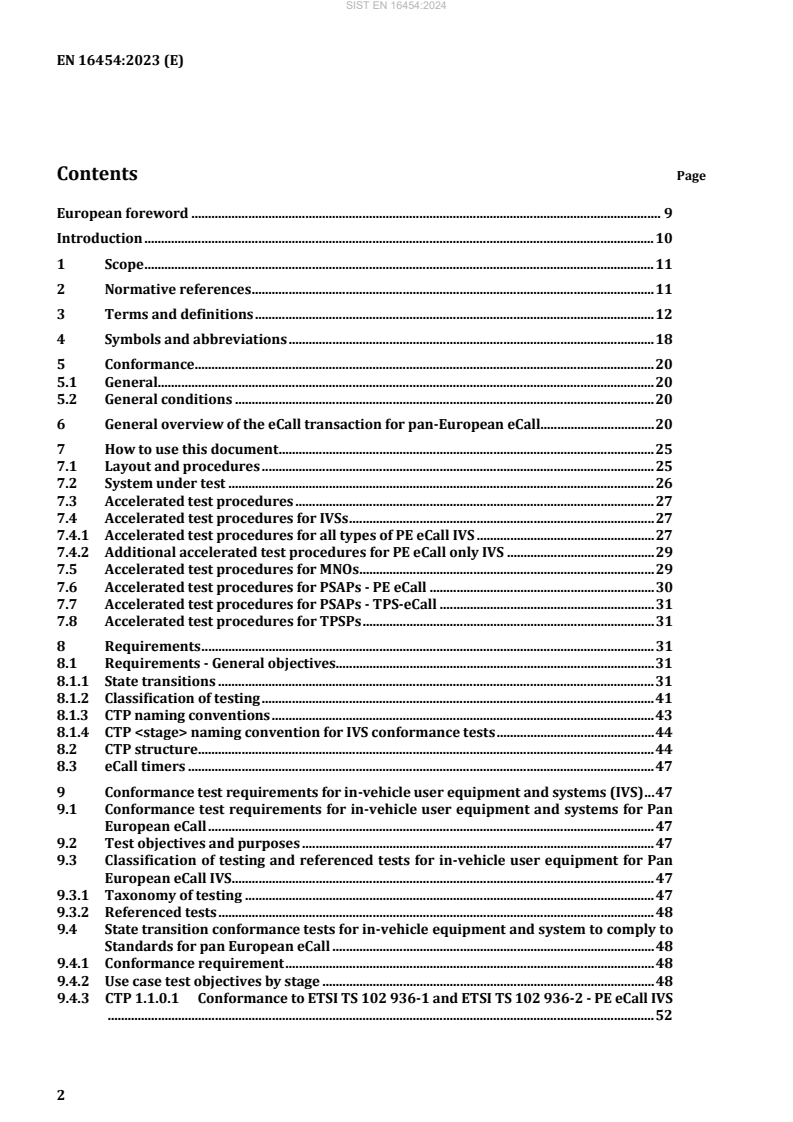
Contents Page
European foreword . 9
Introduction . 10
1 Scope . 11
2 Normative references . 11
3 Terms and definitions . 12
4 Symbols and abbreviations . 18
5 Conformance . 20
5.1 General. 20
5.2 General conditions . 20
6 General overview of the eCall transaction for pan-European eCall . 20
7 How to use this document . 25
7.1 Layout and procedures . 25
7.2 System under test . 26
7.3 Accelerated test procedures . 27
7.4 Accelerated test procedures for IVSs . 27
7.4.1 Accelerated test procedures for all types of PE eCall IVS . 27
7.4.2 Additional accelerated test procedures for PE eCall only IVS . 29
7.5 Accelerated test procedures for MNOs . 29
7.6 Accelerated test procedures for PSAPs - PE eCall . 30
7.7 Accelerated test procedures for PSAPs - TPS-eCall . 31
7.8 Accelerated test procedures for TPSPs . 31
8 Requirements . 31
8.1 Requirements - General objectives. 31
8.1.1 State transitions . 31
8.1.2 Classification of testing . 41
8.1.3 CTP naming conventions . 43
8.1.4 CTP naming convention for IVS conformance tests . 44
8.2 CTP structure . 44
8.3 eCall timers . 47
9 Conformance test requirements for in-vehicle user equipment and systems (IVS) . 47
9.1 Conformance test requirements for in-vehicle user equipment and systems for Pan
European eCall . 47
9.2 Test objectives and purposes . 47
9.3 Classification of testing and referenced tests for in-vehicle user equipment for Pan
European eCall IVS. 47
9.3.1 Taxonomy of testing . 47
9.3.2 Referenced tests . 48
9.4 State transition conformance tests for in-vehicle equipment and system to comply to
Standards for pan European eCall . 48
9.4.1 Conformance requirement . 48
9.4.2 Use case test objectives by stage . 48
9.4.3 CTP 1.1.0.1 Conformance to ETSI TS 102 936-1 and ETSI TS 102 936-2 - PE eCall IVS
................................................................................................................................................................... 52
9.4.4 CTP 1.1.0.2 Test for conformance to valid SIM/USIM - PE eCall IVS . 53
9.4.5 CTP 1.1.0.3 Automatic eCall triggering does not occur when ignition OFF - PE eCall
IVS . 54
9.4.6 CTP 1.1.1.1 Power on and self test - PE eCall IVS . 55
9.4.7 CTP 1.1.2.1 eCall automatically activated - PE eCall IVS . 56
9.4.8 CTP 1.1.2.2 Automatically triggered eCall in progress was not disconnected upon a
new eCall trigger - PE eCall IVS . 57
9.4.9 CTP 1.1.2.3 Post-side-crash performance of automatic trigger - PE eCall IVS . 58
9.4.10 CTP 1.1.2.4 Post-frontal-crash performance of automatic trigger - PE eCall IVS . 59
9.4.11 CTP 1.1.2.5 Performance of automatic trigger - different crash types - PE eCall IVS
................................................................................................................................................................... 60
9.4.12 CTP 1.1.3.1 eCall manually activated - PE eCall IVS . 61
9.4.13 CTP 1.1.3.2 Manually triggered eCall in progress was not disconnected upon a new
eCall trigger - PE eCall IVS. 62
9.4.14 CTP 1.1.4.1 Test eCall activated - PE eCall IVS . 63
9.4.15 CTP 1.1.5.1 Network registration - PE eCall IVS . 64
9.4.16 CTP 1.1.5.2 Manual termination of eCall by vehicle occupants not allowed
(automatically triggered eCall) - PE eCall IVS . 65
9.4.17 CTP 1.1.5.3.1 Manual termination of eCall by vehicle occupants not allowed
(manually triggered eCall) - PE eCall IVS . 66
9.4.18 CTP 1.1.5.3.2 Manual termination of eCall by vehicle occupants allowed (manually
triggered eCall) - PE eCall IVS . 67
9.4.19 CTP 1.1.5.4 Automatically triggered eCall in progress was not disconnected when
ignition is switched to OFF - PE eCall IVS . 68
9.4.20 CTP 1.1.5.5 Manually triggered eCall in progress was not disconnected when
ignition is switched to OFF - PE eCall IVS . 69
9.4.21 CTP 1.1.5.6 Priority over conflicting communication - PE eCall IVS . 70
9.4.22 CTP 1.1.6.1 Mute IVS and vehicle audio - PE eCall IVS . 71
9.4.23 CTP 1.1.7.1 Set-up TS12 call with eCall identifier (flag) set to ‘automatic’ - PE eCall
IVS . 72
9.4.24 CTP 1.1.8.1 Set-up TS12 call with eCall identifier (flag) set to ‘manual’ - PE eCall IVS
................................................................................................................................................................... 73
9.4.25 CTP 1.1.9.1 Set-up TS11 call to test number - PE eCall IVS . 74
9.4.26 CTP 1.1.10.1 eCall is attempted when no networks are available (limited service
condition) - PE eCall IVS . 75
9.4.27 CTP 1.1.10.2 Re-dial attempt completed within 2 minutes after eCall is dropped -
PE eCall IVS . 76
9.4.28 CTP 1.1.10.3 Duration of eCall Initiation signal - PE eCall IVS . 77
9.4.29 CTP 1.1.10.5 Test eCall is not attempted in limited service condition - PE eCall IVS
................................................................................................................................................................... 78
9.4.30 CTP 1.1.11.1 Send MSD with indicator set to ‘Automatically Initiated eCall’ (AleC) -
PE eCall IVS . 79
9.4.31 CTP 1.1.12.1 Send MSD with indicator set to ‘Manually Initiated eCall’ (MleC) - PE
eCall IVS . 80
9.4.32 CTP 1.1.13.1 Send MSD with indicator set to ‘Test Call’ - PE eCall IVS . 81
9.4.33 CTP 1.1.14.1 Verify MSD transfer - PE eCall IVS . 82
9.4.34 CTP 1.1.14.2 Un-mute IVS audio when AL-ACK received - PE eCall IVS . 83
9.4.35 CTP 1.1.15.1 Establish voice link to PSAP - PE eCall IVS . 84
9.4.36 CTP 1.1.15.2 MSD transfer request while eCall conversation in progress - PE eCall
IVS . 85
9.4.37 CTP 1.1.15.3 eCall continuation when SEND MSD request not received (timer T5
expired) - PE eCall IVS . 86
9.4.38 CTP 1.1.15.4 Call continuation when AL-ACK not received (timer T6 expired) - PE
eCall IVS . 87
9.4.39 CTP 1.1.15.5 MSD is transferred continuously until timer T7 expires and IVS
reconnects loudspeaker and microphone on its expiry - PE eCall IVS . 88
9.4.40 CTP 1.1.16.1 Clear down call automatically - PE eCall IVS . 89
9.4.41 CTP 1.1.16.2 IVS clears down the eCall upon timer T2 expiry - PE eCall IVS . 90
9.4.42 CTP 1.1.16.3 IVS registers recent eCalls - PE eCall IVS . 91
9.4.43 CTP 1.1.17.1 Call-back allowed and able to be answered by IVS - PE eCall IVS . 92
9.4.44 CTP 1.1.17.2 Call-back answered by IVS in the event of abnormal termination - PE
eCall IVS . 93
9.4.45 CTP 1.1.17.3 MSD transfer occurs upon PSAP request during call-back - PE eCall IVS
................................................................................................................................................................... 94
9.4.46 CTP 1.1.17.4 Remain registered for ≥1 hr - PE eCall IVS . 95
9.4.47 CTP 1.1.18.1 Compliance with MSD version 3 - PE eCall IVS . 96
9.5 State transition test scripts for in-vehicle equipment and system to comply to
Standards for pan European eCall - additional tests for eCall only systems . 98
9.5.1 General. 98
9.5.2 CTP 1.1.1.2 IVS does not perform registration after power-up - PE eCall only IVS
................................................................................................................................................................ 100
9.5.3 CTP1.1.10.4 Verify that PLMN registration procedure is executed upon initiating an
eCall - PE eCall only IVS . 101
9.5.4 CTP 1.1.17.5 Remain registered for ≥1 hr ≤12 hr - PE eCall only IVS . 102
9.6 State transition conformance test requirements for in-vehicle user equipment for
eCall TPS-IVS via a third party service provider. 103
9.6.1 General. 103
9.6.2 Test objectives and purposes . 103
9.6.3 Taxonomy of testing and referenced tests . 103
9.6.4 Taxonomy of testing . 103
9.7 Use case conformance tests for in-vehicle equipment and system to comply to
Standards for third party service provider eCall . 103
9.7.1 Conformance requirement . 103
9.7.2 Use case test objectives by stage . 103
9.8 State transition test scripts for TPS in-vehicle equipment and system to comply to
Standards for third party services supported eCall . 106
9.8.1 General. 106
9.8.2 CTP 1.2.0 Pre operation - TPS-IVS . 107
9.8.3 CTP 1.2.1 Power on self test - TPS-IVS . 109
9.8.4 CTP 1.2.2 Automatically activate eCall - TPS-IVS . 110
9.8.5 CTP 1.2.3 Manually activate eCall - TPS-IVS . 118
9.8.6 CTP 1.2.4 Stop conflicting communication - TPS-IVS . 122
9.8.7 CTP 1.2.5 Establish voice link to TPSP - TPS-IVS . 123
9.8.8 CTP 1.2.6 Send IVS dataset to TPSP - TPS-IVS . 127
9.8.9 CTP 1.2.7.1 Establish direct bidirectional audio link between occupants and PSAP -
TPS-IVS . 132
9.8.10 CTP 1.2.8.1 No reconnect after termination - TPS-IVS . 133
9.8.11 CTP 1.2.9 Allow call-cack into vehicle - TPS-IVS . 134
10 Conformance tests for mobile network operators . 138
10.1 Test objectives and purposes . 138
10.1.1 General. 138
10.1.2 Default assumptions . 138
10.2 Taxonomy of testing and referenced tests . 138
10.3 Use case conformance tests for mobile network operator systems to comply to
Standards for pan European eCall . 138
10.3.1 Conformance requirement . 138
10.3.2 Use case test objectives by stage . 138
10.4 State transition test scripts for mobile network operators to demonstrate compliance
with Pan European eCall Standards . 139
10.4.1 General . 139
10.4.2 CTP 2.0.1 Keep SIMs/USIMs alive even though not in regular operation – MNO . 141
10.4.3 CTP 2.0.2 MNO supports general eCall relevant requirements – MNO . 142
10.4.4 CTP 2.0.3 Decommission SIM/USIM - MNO . 143
10.4.5 CTP 2.0.4 Support eCall Flag – MNO. 144
10.4.6 CTP 2.1.1 Accept registration - Home network - MNO . 144
10.4.7 CTP 2.1.2 Accept registration - Roaming – MNO . 145
10.4.8 CTP 2.2.1.1 Receive TS12 voice call (automatically initiated) – MNO . 146
10.4.9 CTP 2.2.1.2 Route call to ‘most appropriate’ PSAP – MNO . 147
10.4.10 CTP 2.2.1.3 Provide TS12 data/caller ID – MNO . 148
10.4.11 CTP 2.2.2.1 Receive TS12 voice call (manual initiated) – MNO . 149
10.4.12 CTP 2.2.3.1 Test for receiving test eCall (TS11) . 149
10.4.13 CTP 2.2.3.2 Route call to non-emergency number - MNO . 149
10.4.14 CTP 2.2.3.3 Provide TS11 data – MNO . 150
10.4.15 CTP 2.3.1 Call in progress - MNO . 150
10.4.16 CTP 2.4.1 Call cleardown – MNO . 151
10.4.17 CTP 2.5.1 Support call-back – MNO . 152
10.4.18 CTP 2.6.1 Maintain registration for 1-12 hours - MNO . 152
10.4.19 CTP 2.7.1 Maintain call records - MNO . 152
10.5 Use case conformance tests for mobile network operator systems to comply to
Standards for TPS-eCall . 153
10.5.1 Conformance requirement . 153
10.5.2 Use case test objectives by stage . 153
10.6 State transition test scripts for mobile network operators to demonstrate compliance
with TPS-eCall Standards . 153
10.6.1 CTP 2.11.1 MNO supports general TPS-eCall relevant requirements . 153
10.6.2 CTP 2.11.2 Support call-back - MNO . 153
11 Conformance tests for PSAP systems . 154
11.1 Test objectives and purposes . 154
11.2 Taxonomy of testing and referenced tests. 154
11.2.1 Taxonomy of testing . 154
11.2.2 Referenced tests . 154
11.3 Use case conformance tests for PSAP systems to comply to Standards for pan
European eCall . 154
11.3.1 Conformance requirement . 154
11.3.2 Use case test objectives by stage . 154
11.4 State transition conformance tests for PSAPs - PE eCall . 155
11.4.1 General . 155
11.4.2 CTP 3.1.0.1 Provide MNOs with appropriate routing data - Member State/ PSAP PE
eCall . 157
11.4.3 CTP 3.1.0.2 Maintain map geo-information - PSAP PE eCall . 158
11.4.4 CTP 3.1.1.1 Receive automatically initiated eCall - PSAP PE eCall . 159
11.4.5 CTP 3.1.1.2 Receive manually initiated eCall - PSAP PE eCall . 160
11.4.6 CTP 3.1.2 Receive TS12 data - Caller ID and location - PSAP PE eCall . 161
11.4.7 CTP 3.1.3.1 Recognise eCall and route to in-band modem - PSAP PE eCall . 162
11.4.8 CTP 3.1.3.2 PSAP equipment failure - PSAP PE eCall . 163
11.4.9 CTP 3.1.3.3 PSAP modem failure before link layer ACK is sent – PSAP PE eCall . 163
11.4.10 CTP 3.1.4 eCall received at in-band modem – PSAP PE eCall . 163
11.4.11 CTP 3.1.5.1 Validate initiation signal - PSAP PE eCall . 164
11.4.12 CTP 3.1.5.2 Route to operator after timer T4 expiration - PSAP PE eCall . 165
11.4.13 CTP 3.1.6.1 Request MSD after reception of initiation signal - PSAP PE eCall
11.4.14 CTP 3.1.6.2 Request MSD immediately - PSAP PE eCall. 167
11.4.15 CTP 3.1.7.1 Receive MSD - PSAP PE eCall. 168
11.4.16 CTP 3.1.7.2 Verify status bit in AL-ACK upon positive ACK– PSAP PE eCall . 169
11.4.17 CTP 3.1.7.3 Verify MSD transfer upon timer T8 expiration - PSAP PE eCall . 169
11.4.18 CTP 3.1.7.4 Verify transfer of corrupted MSD - PSAP PE eCall. 170
11.4.19 CTP 3.1.7.5 Verify PSAP behaviour when MSD format check fails - PSAP PE eCall
11.4.20 CTP 3.1.7.6 Verify PSAP behaviour when MSD contains unknown optional
additional data set - PSAP PE eCall . 172
11.4.21 CTP 3.1.7.7 Verify PSAP behaviour when MSD contains ASN.1 extended data-
elements - PSAP PE eCall . 173
11.4.22 CTP 3.1.7.8 Verify PSAP behaviour when MSD contains ASN.1 extended data-
values - PSAP PE eCall . 174
11.4.23 CTP 3.1.7.9 Compliance with MSD version 2 - PSAP PE eCall . 175
11.4.24 CTP 3.1.7.10 Compliance with MSD version 3 - PSAP PE eCall . 177
11.4.25 CTP 3.1.8 ACK - PSAP PE eCall . 178
11.4.26 CTP 3.1.9 Route voice and MSD to operator - PSAP PE eCall . 178
11.4.27 CTP 3.1.10 Display TS12 data and MSD to operator - PSAP PE eCall . 179
11.4.28 CTP 3.1.11 Decode VIN - PSAP PE eCall . 180
11.4.29 CTP 3.1.12 Talk to vehicle occupants - PSAP PE eCall . 181
11.4.30 CTP 3.1.13 Request new MSD before call cleardown - PSAP PE eCall .
11.4.31 CTP 3.1.14.1 Call cleardown - PSAP PE eCall . 183
11.4.32 CTP 3.1.14.2 Verify status bit in AL-ACK upon cleardown - PSAP PE eCall . 184
11.4.33 CTP 3.1.15 Call-back to vehicle - PSAP PE eCall . 185
11.4.34 CTP 3.1.16 Request new/updated MSD after call cleardown - PSAP PE eCall
11.5 State transition conformance tests for PSAPs - TPS-eCall . 187
11.5.1 General. 187
11.5.2 CTP 3.2.0.1 TPSP - PSAP agreement - PSAP TPS eCall . 188
11.5.3 CTP 3.2.0.2 Provide areas of responsibility and contact numbers to approved TPSPs
–PSAP TPS-eCall . 189
11.5.4 CTP 3.2.0.3 Agreement on necessary language support - PSAP TPS eCall . 191
11.5.5 CTP 3.2.0.4 Agree electronic data connection and provide details to approved TPSPs
- PSAP TPS eCall . 192
11.5.6 CTP 3.2.0.5 Provide PSAP data addresses and security access to approved TPSPs -
PSAP TPS eCall . 194
11.5.7 CTP 3.2.1 Receive eCall notification from TPSP (not TS12) - PSAP TPS eCall . 195
11.5.8 CTP 3.2.2 Route call to operator - PSAP TPS eCall . 196
11.5.9 CTP 3.2.3 Connection, TSD transmission, display relevant information to PSAP
operator - PSAP TPS-eCall . 197
11.5.10 CTP 3.2.4 PSAP Operator: Talk with TPSP operator and receive relevant
information - PSAP TPS eCall . 199
11.5.11 CTP 3.2.5 Talk to vehicle occupants - PSAP TPS-eCall . 200
11.5.12 CTP 3.2.6 Request new TSD before call cleardown - PSAP TPS-eCall. 201
11.5.13 CTP 3.2.7 Inform TPSP that call can be ended - PSAP TPS eCall . 202
11.5.14 CTP 3.2.8 Call cleardown with TPSP - PSAP TPS-eCall. 203
11.5.15 CTP 3.2.9 Call-back to TPSP - PSAP TPS-eCall . 204
11.5.16 CTP 3.2.10 Call-back to vehicle - PSAP TPS eCall. 205
11.5.17 CTP 3.2.11 Call cleardown with vehicle - PSAP TPS eCall . 206
12 State transition conformance tests for TPS-eCall . 207
12.1 Related specifications and conformance requirements . 207
12.2 TPSP general tests (applicable to both TPS-eCall responder and TPS-eCall notifier)
................................................................................................................................................................ 207
12.2.1 General . 207
12.2.2 CTP 4.0.1 Agree service level agreement and/or Standard ways of working with
PSAPs – TPSP . 209
12.2.3 CTP 4.0.2 Receive PSAP areas of responsibility and contact numbers – TPSP . 210
12.2.4 CTP 4.0.3 Agree necessary language support - TPSP . 211
12.2.5 CTP 4.0.4 Agree electronic data connection details with PSAPs – TPSP . 213
12.2.6 CTP 4.0.5 Evidence quality procedures - TPSP . 214
12.2.7 CTP 4.0.6 Verify automatic call distribution (ACD) system – TPSP . 217
12.2.8 CTP 4.0.7 Check link from MNO – TPSP . 218
12.2.9 CTP 4.0.8 Deal with transmission failures – TPSP . 219
12.2.10 CTP 4.0.9 Update GIS – TPSP . 220
12.2.11 CTP 4.0.10 Protection of privacy – TPSP . 221
12.3 TPS-eCall responder tests - TPS-R . 222
12.3.1 General . 222
12.3.2 CTP 4.1.1 Receive TPS-eCall from vehicle - TPS-R. 223
12.3.3 CTP 4.1.2 Process incoming call - TPS-R . 226
12.3.4 CTP 4.1.3 Talk with vehicle occupants and receive relevant information - TPS-R
................................................................................................................................................................ 228
12.3.5 CTP 4.1.4 Trigger PSAP notification - TPS-R . 231
12.3.6 CTP 4.1.5 Make voice connection between vehicle and PSAP if required - TPS-R
................................................................................................................................................................ 231
12.3.7 CTP 4.1.6 Confirmation received from PSAP that call with vehicle can be ended -
TPS-R . 232
12.3.8 CTP 4.1.7 Call cleardown with vehicle - TPS-R . 233
12.3.9 CTP 4.1.8 Call-back to vehicle - TPS-R . 234
12.4 TPS-eCall notifier tests - TPS-N . 235
12.4.1 General . 235
12.4.2 CTP 4.2.1 Emergency situation likely to require assistance - TPS-N . 236
12.4.3 CTP 4.2.2 Establish contact with PSAP - TPS-N . 236
12.4.4 CTP 4.2.3 Talk with PSAP operator and notify relevant information - TPS-N . 241
12.4.5 CTP 4.2.4 Establish voice link between PSAP and vehicle occupants if required by
PSAP - TPS-N . 243
12.4.6 CTP 4.2.5 Respond to electronic data update request - TPS-N . 245
12.4.7 CTP 4.2.6 PSAP informs that call can be ended - TPS-N . 245
12.4.8 CTP 4.2.7 Call cleardown to PSAP - TPS-N . 245
12.4.9 CTP 4.2.9 Call-back from PSAP - TPS-N . 245
13 Marking, labelling and packaging . 246
14 Declaration of patents and intellectual property . 246
Annex A Void . 247
Annex B Void . 248
Annex C Void . 249
Annex D Void . 250
Annex E Void . 251
Annex F (informative) MSD examples for special PSAP tests . 252
European foreword
This document (EN 16454:2023) has been prepared by Technical Committee CEN/TC 278 “Intelligent
transport systems”, the secretariat of which is held by NEN.
This European Standard shall be given the status of a national standard, either by publication of an
identical text or by endorsement, at the latest by March 2024, and conflicting national standards shall be
withdrawn at the latest by March 2024.
Attention is drawn to the possibility that some of the elements of this document may be the subject of
patent rights. CEN shall not be held responsible for identifying any or all such patent rights.
This document supersedes EN 16454:2015.
The following changes have been introduced in this revision:
— IVS and PSAP test added to check for compliance with MSD version 3
— PSAP test added to check for compliance with MSD version 2
— PSAP tests added to check for ASN.1 compliance
— Corrections in multiple tests
— Voided Annex A, B, C, D and E
— Added Annex F
Any feedback and questions on this document should be directed to the users’ national standards body.
A complete listing of these bodies can be found on the CEN website.
According to the CEN-CENELEC Internal Regulations, the national standards organisations of the
following countries are bound to implement this European Standard: Austria, Belgium, Bulgaria, Croatia,
Cyprus, Czech Republic, Denmark, Estonia, Finland, France, Germany, Greece, Hungary, Iceland, Ireland,
Italy, Latvia, Lithuania, Luxembourg, Malta, Netherlands, Norway, Poland, Portugal, Republic of North
Macedonia, Romania, Serbia, Slovakia, Slovenia, Spain, Sweden, Switzerland, Türkiye and the United
Kingdom.
Introduction
An eCall is an emergency call generated either automatically via activation of in-vehicle sensors or
manually by the vehicle occupants; when activated, to provide notification and relevant location
information to the most appropriate Public Safety Answering points (PSAP), by means of mobile wireless
communications networks and carries a defined standardized minimum set of data, notifying that there
has been an incident that requires response from the emergency services and establishes an audio
channel between the occupants of the vehicle and the most appropriate PSAP.
NOTE 1 EN 15722 specifies a standardized MSD for eCall, EN 16062 specifies high level application protocols for
eCall and EN 16072 specifies pan-European eCall operating requirements. For third party systems, EN 16102
specifies third party services supporting eCall operating requirements. (See EC Communication on eCall
Implementation 2009 [COM(2009) 434 final] for more information.)
The operating requirements for pan-European eCall are made using Public Land Mobile Networks
(PLMN) (such as GSM and 3G), as specified in a number of ETSI Standards and Technical Specifications.
This document provides tests to enable actors in the eCall chain to be able to claim conformance to the
eCall Standards, even though they are unable to control the behaviour of systems of other actors in the
eCall chain
NOTE 2 Conformance tests in this document allow demonstration that a system complies with the eCall
Standards. Compliance to Standards is a prerequisite to providing an interoperable compliant system, but do not by
themselves demonstrate that a system will function nor guarantee the quality of service.
NOTE 3 The term PSAP (Public Safety Assistance Point), which is most widely used in the eCall documentation,
European Commission documents etc., is used throughout this document and equates to the term emergency call
response centre used in the ITS Implementation Directive.
The European Committee for Standardization (CEN) draws attention to the fact that it is claimed that
compli
...