

oSIST prEN IEC 62439-1:2026
(Main)Industrial communication networks - High availability automation networks - Part 1: General concepts and calculation methods
- Status
- Not Published
- Public Enquiry End Date
- 13-Dec-2026
- Technical Committee
- MOV - Measuring equipment for electromagnetic quantities
- Current Stage
- 4020 - Public enquire (PE) (Adopted Project)
- Start Date
- 29-Sep-2026
- Due Date
- 16-Feb-2027


oSIST prEN IEC 62439-1:2026 is a draft IEC/CENELEC standard for industrial communication networks with high availability automation networks based on Ethernet. It defines the common concepts and calculation methods used across the IEC 62439 series, including conformance testing, network classification, availability estimation, and RSTP ring recovery-time rules for engineers working on industrial automation networks.
What does oSIST prEN IEC 62439-1:2026 specify?
oSIST prEN IEC 62439-1:2026 applies to high-availability automation networks based on ISO/IEC/IEEE 8802-3:2021/Amd 3 (Ethernet). It provides the shared foundation for the rest of the IEC 62439 series, so users can describe networks, compare redundancy options, and assess recovery behaviour with a common vocabulary.
The document is organized into:
- Clause 1 Scope
- Clause 2 Normative references
- Clause 3 Terms, definitions, abbreviations, acronyms, and conventions
- Clause 4 Conformance requirements
- Clause 5 Concepts for high availability automation networks
- Clause 6 Classification of networks
- Clause 7 Availability calculations for selected networks
- Clause 8 RSTP for High Availability Networks: configuration rules, calculation and measurement method for predictable recovery time
- Annex A Security Considerations
Clause 4 is normative and sets the conformance framework. Clauses 5 to 8 are informative guidance and calculation methods that help users design, classify, test, and evaluate high-availability networks in practice.
What are the key requirements of oSIST prEN IEC 62439-1:2026?
oSIST prEN IEC 62439-1:2026 is not a protocol specification for one redundancy method only. Its main practical value is that it defines how the IEC 62439 family is described, tested, classified, and calculated, and it gives a deterministic RSTP ring method when the network is constrained to the stated conditions.
Conformance and documentation
Clause 4.1 says a compliance statement shall identify the relevant IEC 62439 part: MRP, PRP, CRP, BPDU, DRP, or RRP. In practice, a supplier or integrator must state exactly which redundancy protocol the product or system supports, rather than claiming general compliance to the whole series.
Clause 4.1 also requires the supported protocols and options to be stated as a PICS (Protocol Implementation Conformance Statement). That matters because buyers and test labs need a clear checklist of implemented features before comparing devices or planning interoperability testing.
Clause 4.2 defines the conformance-test framework, including concept, methodology, test conditions, test cases, procedure, measuring, and the test report. In practice, this gives a structured basis for lab testing and for documenting how a device or system was verified.
Common concepts and addressing
Clause 3 establishes the common vocabulary for the series, including network elements such as end node, leaf link, inter-switch link, switch, ring link, and Link Redundancy Entity (LRE). It also summarizes reserved network addresses for the series, including the reserved IEEE OUI 00-15-4E and the Ethertypes and address bands used by the companion parts. Implementers use this to avoid address conflicts and to keep protocol handling consistent across products.
Network classification
Clause 6 gives a notation for describing a high-availability network by top-level structure, number of redundant LANs, leaf-link policy, number of redundant leaves, and LAN topology. It also gives a separate robustness notation based on how many leaf-link, inter-switch link, and switch failures the network can tolerate.
In practice, this is useful for procurement and design reviews because it lets teams compare architectures in a compact, standard way. For example, the notation can show whether a network is a single LAN or redundant LAN structure, and whether the topology is simplex, ring, partial mesh, or full mesh.
Availability calculations
Clause 7 defines a network as functional only when every end node can communicate with every other end node. It then gives an availability calculation based on Mean Time To Failure of Network (MTTFN) and Mean Time To Repair Network (MTTRN), and it identifies which failure rates are considered for leaf links, switches, and inter-switch links.
This matters because the clause turns redundancy into a calculable engineering problem. It also explains the limits of redundancy: common-mode failures and non-redundant elements can still dominate system behaviour, so a redundant network does not automatically make the whole plant highly available.
RSTP ring recovery-time method
Clause 8 is the most concrete design method in the document. It restricts the reference RSTP topology to a single ring of N devices, with N less or equal 40, ring ports enabled for RSTP, non-ring ports disabled for RSTP, full-duplex links, transparent link mode for any media converters in inter-switch connections, and reserved bandwidth for BPDUs if needed.
Clause 8 also defines how to calculate and measure fault recovery time, and it gives limits and topology rules for predicting the maximum recovery time. In practice, this is the part to use when a project needs a ring-based RSTP design with a predictable recovery time rather than only a general redundancy concept.
What terms does oSIST prEN IEC 62439-1:2026 define?
oSIST prEN IEC 62439-1:2026 defines the basic terms used throughout the series so that availability and redundancy are described consistently.
- Availability - the ability to be in a state to perform as required under given conditions.
- High availability - increased communication availability achieved by redundancy and automatic reconfiguration, or by redundancy handled in the end nodes.
- Fault recovery time - the time from a fault event until the network regains its required communication function in the presence of the fault.
- Network recovery time - the time from the first failure inside the network until reconfiguration is finished and all still-participating devices can again reach each other.
- Redundancy, in a system - provision of more than one means for performing a function.
- Single point of failure - a component whose failure would cause system failure because redundancy or an alternative procedure does not compensate for it.
- PICS - the Protocol Implementation Conformance Statement used to declare supported protocol options.
- RSTP - Rapid Spanning Tree Protocol, the loop-prevention and redundancy-management protocol referenced in Clause 8.
Who uses oSIST prEN IEC 62439-1:2026?
oSIST prEN IEC 62439-1:2026 is used by engineers, system architects, and network designers working on industrial automation networks that need high availability. It is also relevant to product suppliers of switches, end nodes, and redundancy-capable communication devices.
Test laboratories and certification teams use it for conformance testing and for reporting supported options in PICS format. Buyers, integrators, and plant engineers use it when comparing redundancy architectures, estimating availability, and deciding whether an RSTP ring or another IEC 62439 solution fits the application.
What changed in oSIST prEN IEC 62439-1:2026 from the previous edition?
oSIST prEN IEC 62439-1:2026 is the second edition and it replaces the first edition published in 2010 together with Amendment 1:2012 and Amendment 2:2016. The document states these significant technical changes:
- Clause 2 references were revised and updated where needed.
- The terms and abbreviations in Clause 3.1 and 3.2 were rearranged alphabetically.
- The definitions of availability and high availability were revised to match updates in the referenced standards.
- Annex A on Security Considerations was added.
Which standards are used with oSIST prEN IEC 62439-1:2026?
oSIST prEN IEC 62439-1:2026 relies on these normative references and companion parts:
- IEC 60050-191 - provides dependability and quality-of-service vocabulary.
- IEC 60050-192 - provides dependability terminology used for the defined terms.
- IEC 61158 (all parts) - gives the broader industrial communication network framework referenced by the series.
- IEC 61158-6-10 - supports application-layer protocol elements used in the terminology and background.
- ISO/IEC/IEEE 8802-3:2021/Amd 3 - provides the Ethernet base technology on which the series is built.
- IEEE 802.1Q - supports virtual bridged LAN terminology and frame handling.
- IEEE 802.1D:2004 - provides the MAC bridge and RSTP basis.
- IETF RFC 791 - provides the IP background used in the references and related addressing context.
The document also points to companion IEC 62439 parts:
- IEC 62439-2 - MRP
- IEC 62439-3 - PRP and HSR
- IEC 62439-4 - CRP
- IEC 62439-5 - BPDU
- IEC 62439-6 - DRP
- IEC 62439-7 - RRP
What does the oSIST prEN IEC 62439-1:2026 document contain?
oSIST prEN IEC 62439-1:2026 contains a conformance overview, topology examples, reliability models, availability calculation methods, and RSTP timing methods. Figures show the generic network elements, tree, linear, ring, partial mesh, and full mesh topologies, plus single-LAN and redundant-LAN structures.
It also includes figures for symmetrical and asymmetric fault models, test rigs for timing measurement, and examples of worst-case RSTP topology analysis. Tables give application grace time examples, protocol examples, and code assignments for the network classification fields.
Clause 8 provides the practical measurement setup and procedure for the timing parameters used in recovery-time calculations, including a worked system-test example. Annex A adds guidance on security considerations, especially physical access protection, secure management access, and protection of edge ports.
Relations
- Effective Date
- 15-Apr-2025
- Effective Date
- 15-Apr-2025
- Effective Date
- 15-Apr-2025
Get Certified
Connect with accredited certification bodies for this standard

BSI Group
BSI (British Standards Institution) is the business standards company that helps organizations make excellence a habit.

DVS-ZERT GmbH
German welding certification society.

CARES (UK Certification Authority for Reinforcing Steels)
UK certification for reinforcing steels and construction.
Sponsored listings
Frequently Asked Questions
oSIST prEN IEC 62439-1:2026 is a draft published by the Slovenian Institute for Standardization (SIST). Its full title is "Industrial communication networks - High availability automation networks - Part 1: General concepts and calculation methods". This standard covers: Industrial communication networks - High availability automation networks - Part 1: General concepts and calculation methods
Industrial communication networks - High availability automation networks - Part 1: General concepts and calculation methods
oSIST prEN IEC 62439-1:2026 is classified under the following ICS (International Classification for Standards) categories: 25.040.01 - Industrial automation systems in general; 25.040.40 - Industrial process measurement and control; 35.100.05 - Multilayer applications; 35.110 - Networking. The ICS classification helps identify the subject area and facilitates finding related standards.
oSIST prEN IEC 62439-1:2026 has the following relationships with other standards: It is inter standard links to SIST EN 62439-1:2010/A2:2018, SIST EN 62439-1:2010/A1:2012, SIST EN 62439-1:2010. Understanding these relationships helps ensure you are using the most current and applicable version of the standard.
oSIST prEN IEC 62439-1:2026 is available in PDF format for immediate download after purchase. The document can be added to your cart and obtained through the secure checkout process. Digital delivery ensures instant access to the complete standard document.
Standards Content (Sample)
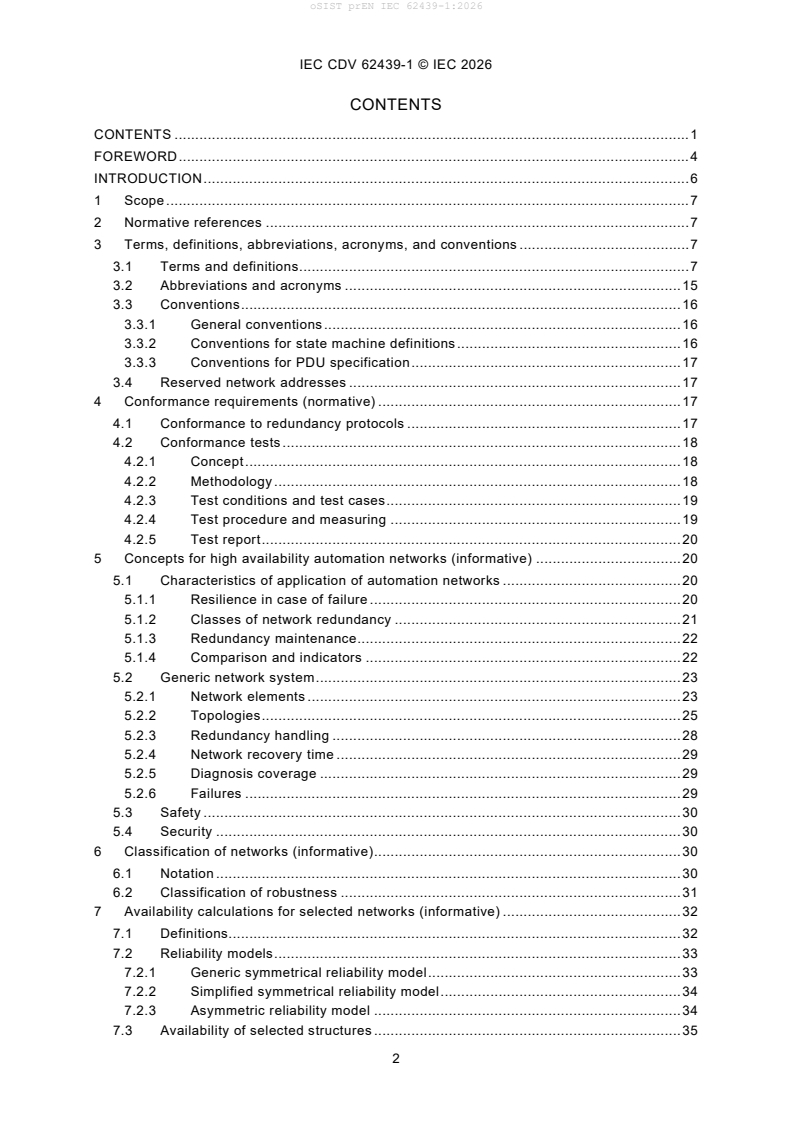
Contents
- 1 Scope
- 2 Normative references
- 3 Terms, definitions, abbreviations, acronyms, and conventions
- 3.1 Terms and definitions
- 3.1.1 availability
- 3.1.2 bridge
- 3.1.3 channel
- 3.1.4 common mode failure
- 3.1.5 complete failure
- 3.1.6 connection
- 3.1.7 coverage
- 3.1.8 cut-through switching
- 3.1.9 dependability
- 3.1.10 device
- 3.1.11 doubly attached node
- 3.1.12 edge port
- 3.1.13 end node
- 3.1.14 error
- 3.1.15 failure
- 3.1.16 fault
- 3.1.17 fault recovery time
- 3.1.18 frame
- 3.1.19 high availability
- 3.1.20 (instantaneous) failure rate
- 3.1.21 inter-switch link
- 3.1.22 inter-switch port
- 3.1.23 LAN
- 3.1.24 leaf link
- 3.1.25 linear topology
- 3.1.26 link
- 3.1.27 Link Redundancy Entity
- 3.1.28 link service data unit
- 3.1.29 mean failure rate, average failure rate
- 3.1.30 mean operating time between failures
- 3.1.31 mean time to failure
- 3.1.32 mesh topology
- 3.1.33 message
- 3.1.34 network
- 3.1.35 network recovery time
- 3.1.36 node
- 3.1.37 partial failure
- 3.1.38 path
- 3.1.39 plant
- 3.1.40 port
- 3.1.41 recovery
- 3.1.42 recovery time
- 3.1.43 redundancy, <in a system>
- 3.1.44 reinstatement recovery time
- 3.1.45 reliability
- 3.1.46 repair
- 3.1.47 repair recovery time
- 3.1.48 ring link
- 3.1.49 ring port
- 3.1.50 ring topology
- 3.1.51 robustness
- 3.1.52 root bridge
- 3.1.53 route
- 3.1.54 single failure criterion
- 3.1.55 single point of failure
- 3.1.56 singly attached node
- 3.1.57 star topology
- 3.1.58 store-and-forward switching
- 3.1.59 switch
- 3.1.60 switching end node
- 3.1.61 systematic failure
- 3.1.62 topology
- 3.1.63 tree topology
- 3.1.64 trunk portion
- 3.1.65 upper layer entity
- 3.1.66 worst case recovery time
- 3.2 Abbreviations and acronyms
- 3.3 Conventions
- 3.4 Reserved network addresses
- 4 Conformance requirements (normative)
- 4.1 Conformance to redundancy protocols
- 4.2 Conformance tests
- 5 Concepts for high availability automation networks (informative)
- 5.1 Characteristics of application of automation networks
- 5.2 Generic network system
- 5.3 Safety
INTRODUCTION The IEC 62439 series specifies relevant principles for high availability networks that meet the requirements for industrial automation networks.
In the fault-free state of the network, the protocols of the IEC 62439 series provide ISO/IEC/IEEE 8802-3:2021/Amd 3 (IEEE 802.3) compatible, reliable data communication, and preserve determinism of real-time data communication. In cases of fault, removal, and insertion of a component, they provide deterministic recovery times.
These protocols retain fully the typical Ethernet communication capabilities as used in the office world, so that the software involved remains applicable.
The market is in need of several network solutions, each with different performance characteristics and functional capabilities, matching diverse application requirements. These solutions support different redundancy topologies and mechanisms which are introduced in IEC 62439-1 and specified in the other Parts of the IEC 62439 series. IEC 62439-1 also distinguishes between the different solutions, giving guidance to the user. The IEC 62439 series follows the general structure and terms of IEC 61158 (all parts) [1]. The following items were listed in the bibliography but not cited in the text. Please find a suitable place to cite them to justify their inclusion in the bibliography:
IEC/TR 61158-1, Industrial communication networks – Fieldbus specifications – Part 1:
Overview and guidance for the urn:iec:std:iec:61158::ser::IEC 61158 and urn:iec:std:iec:61784::ser::IEC 61784 seriesIEC/TR 61158-1 [2] IEC/TR 61158-6 (all parts), Industrial communication networks – Fieldbus specifications – Part 6: Symmetrical pair/quad cables with transmission characteristics up to 1 000 MHz – Work area wiringIEC/TR 61158-6 (all parts) [3] ISO/IEC 2382 (all parts), Information technology – VocabularyISO/IEC 2382 (all parts) [4] ISO/IEC 10731, Information technology – Open Systems Interconnection – Basic Reference Model – Conventions for the definition of OSI servicesISO/IEC 10731 [5] ISO/IEC 15802-3, Information technology – Telecommunications and information exchange between systems – Local and metropolitan area networks – Common specifications – Part 3 :
Media Access Control (MAC) BridgesISO/IEC 15802-3 [6] PUSTYLNIK M., ZAFIROVIC-VUKOTIC, M., MOORE, R., Performance of the Rapid Spanning Tree Protocol in Ring Network Topology, Rugged Com.
Inc.http://www.ruggedcom.com/pdfs/white_%20papers/performance_of_rapid_spanning_tree_ protocol_in_ring_network_topology.pdf[7]
oSIST prEN IEC 62439-1:2026
1 Scope
The IEC 62439 series is applicable to high-availability automation networks based on the ISO/IEC/IEEE 8802-3:2021/Amd 3 (IEEE 802.3) (Ethernet) technology. This part of the IEC 62439 series specifies - the common elements and definitions for other parts of the IEC 62439 series; - the conformance test specification (normative); - a classification scheme for network characteristics (informative); - a methodology for estimating network availability (informative); - the configuration rules, calculation and measurement method for a deterministic recovery time in RSTP.
2 Normative references
The following documents are referred to in the text in such a way that some or all of their content constitutes requirements of this document. For dated references, only the edition cited applies. For undated references, the latest edition of the referenced document (including any amendments) applies.
IEC 60050-191:1990, International Electrotechnical Vocabulary – Chapter 191: Dependability and quality of service IEC 60050-192, International Electrotechnical Vocabulary (IEV) - Part 192: Dependability IEC 61158 (all parts), Industrial communication networks – Fieldbus specifications IEC 61158-6-10, Industrial communication networks – Fieldbus specifications – Part 6-10:
Application layer protocol specification – Type 10 elements ISO/IEC/IEEE 8802-3:2021/Amd 3, Telecommunications and exchange between information technology systems — Requirements for local and metropolitan area networks — Part 3:
Standard for Ethernet — Amendment 3: Media access control parameters for 50 Gb/s and physical layers and management parameters for 50 Gb/s, 100 Gb/s, and 200 Gb/s operation IEEE 802.1Q, IEEE standards for local and metropolitan area network. Virtual bridged local area networks IEEE 802.1D:2004, IEEE standard for local Local and metropolitan area networks Media Access Control (MAC) Bridges IETF RFC 791, Internet Protocol;
3 Terms, definitions, abbreviations, acronyms, and conventions
3.1 Terms and definitions
For the purposes of this document, the terms and definitions given in IEC 60050-192, as well as the following, apply
3.1.1 availability
ability to be in a state to perform as required unter given conditions
oSIST prEN IEC 62439-1:2026
Note 1 to entry: Availability considers two states, the up state (available) and the down state (unavailable). All time intervals, such as administrative delay (see Figure 1), are defined either as belonging to one of these two states or are excluded. (It is to be noted that the definition of Dependability does not refer to “states” as it has a much broader meaning. See 192-01-22 for further clarification).
Note 2 to entry: Availability depends upon the combined attributes of the reliability (192-01-24), maintainability (192-01-27), supportability (192-01-31) and the maintenance and support provided. [SOURCE: IEC 60050-192]
3.1.2 bridge
device connecting LAN segments at layer 2 according to IEEE 802.1D:2004 Note 1 to entry: The words “switch” and “bridge” are considered synonyms, the word “bridge” is used in the context of standards such as RSTP (IEEE 802.1D:2004), PTP (IEC 61588 [8]) or IEC 62439-3 [9] (PRP & HSR).
3.1.3 channel
layer 2 connection between two end nodes which consists of one or more paths (for redundancy) between end nodes
3.1.4 common mode failure
failure that affects all redundant elements for a given function at the same time
3.1.5 complete failure
failure characterized by the loss of all required functions [SOURCE: IEC 60050-192]
3.1.6 connection
logical relationship between two nodes
3.1.7 coverage
probability that a failure is discovered within a time short enough for redundancy to handle it, also expressing the percentage of failures caught up by redundancy vs. total number of failures
3.1.8 cut-through switching
a technology in which a switching node starts transmitting a received frame before this frame has been fully received
3.1.9 dependability
ability to perform as and when required Note 1 to entry: A dependable item is one where there is justified confidence that it operates as desired and satisfies agreed stakeholder expectations.
[SOURCE: IEC 60050-192]
3.1.10 device
physical entity connected to the network composed of communication element and possibly other functional elements Note 1 to entry: Devices are for instance nodes, routers and switches.
oSIST prEN IEC 62439-1:2026
3.1.11 doubly attached node
node that has two ports for the purpose of redundant operation
3.1.12 edge port
port of a switch connected to a leaf link
3.1.13 end node
node which is producer or consumer of application data Note 1 to entry: For the purpose of the IEC 62439 series, further specification is given in 0.
3.1.14 error
discrepancy between a computed, observed or measured value or condition and the specified or theoretically correct value or condition Note 1 to entry: An error within a system can be caused by failure of one or more of its components, or by the activation of a systematic fault.
Note 2 to entry: See also human error [SOURCE: IEC 60050-192 ] NOTE 1 modified
3.1.15 failure
loss of ability to perform as required Note 1 to entry: A failure of an item is an event that results in a fault of that item: see "fault" (IEV 192-04-01). [SOURCE: IEC 60050-192]
3.1.16 fault
inability to perform as required, due to an internal state Note 1 to entry: A fault of an item results from a failure, either of the item itself, or from a deficiency in an earlier stage of the life cycle, such as specification, design, manufacture or maintenance. See latent fault (192-04-08). [SOURCE: IEC 60050-192]
3.1.17 fault recovery time
time from the fault event, to the time when the network regains its required communication function in the presence of the fault Note 1 to entry: After fault recovery, the network is operating in a degraded mode using some of the redundancy elements, so it has reduced fault resilience, and may not be able to recover from a second fault.
3.1.18 frame
unit of data transmission on an ISO/IEC/IEEE 8802-3:2021/Amd 3 MAC (Media Access Control) that conveys a protocol data unit (PDU) between MAC service users [SOURCE: IEEE 802.1Q [10]] NOTE 2 modified
oSIST prEN IEC 62439-1:2026
3.1.19 high availability
significantly increased availability of communication systems by using topologies and protocols that introduce redundancy and automatically reconfigure redundant communication elements in case of failure Note 1 to entry: In the case of IEC 62439 technologies, automatic reconfiguration is not necessary for protocols with redundancy managed in the end nodes.
[SOURCE: IEC PAS 63595]
3.1.20 (instantaneous) failure rate
limit, if it exists, of the quotient of the conditional probability that the instant of a failure of a non-repairable item falls within time interval (t, t + Δt) by Δt, when Δt tends to zero, given that failure has not occurred within time interval (0, t)
where F(t) and f(t) are, respectively, the distribution function and the probability density at the failure instant, and where R(t) is the reliability function, related to the reliability R(t , t ) by R(t) 1 2 = R(0, t).
Note 1 to entry: See IEC 61703, Mathematical expressions for reliability, availability, maintainability and maintenance support terms, for more detail.
[SOURCE: IEC 60050-192]
3.1.21 inter-switch link
link between two switches
3.1.22 inter-switch port
port of a switch connected to another switch via an inter-switch link
3.1.23 LAN
A layer 2 broadcast domain in which MAC addresses are unique and can be addressed from any other device belonging to that broadcast domain Note 1 to entry: A VLAN allows multiplexing several LANs on the same network infrastructure. Note 2 to entry: In the context of redundancy, a network may consist of several LANs operated in redundancy, in which case it is called a redundant LAN.
3.1.24 leaf link
link between an end node and the LAN Note 1 to entry: For the purpose of the IEC 62439 series, further specification is given in 5.2.1.3.
3.1.25 linear topology
topology where the switches are connected in series, with two switches each connected to only one other switch and all other switch each connected to two other switches (that is, connected in the shape of a line)
oSIST prEN IEC 62439-1:2026
Note 1 to entry: This topology corresponds to that of an open ring. Note 2 to entry: This configuration is sometimes named “daisy chain”. The IEC 62439 series does not use the term “daisy chain” because of possible confusion with the term “daisy chain” used elsewhere for busses. From the wiring point of view they require two different implementations.
[SOURCE: IEC 61918:2007 [11], 3.1.39] NOTE 3 modified
3.1.26 link
physical, point-to-point, generally duplex connection between two adjacent nodes Note 1 to entry: “Link” is different from “bus”, which is a broadcast physical medium. [SOURCE: ISO/IEC 11801:2002 [12], 3.1.51] NOTE 4 modified
3.1.27 Link Redundancy Entity
entity at layer 2 that hides port redundancy from the upper layers, by forwarding to the upper layers the frames received from the active redundant ports as if they came from a single port, and by forwarding to the active redundant ports a frame coming from the upper layers
3.1.28 link service data unit
data transported within a protocol layer on behalf of the upper layer Note 1 to entry: The link service data unit in an Ethernet frame is the content of the frame located between the Length/Type field and the Frame Check Sequence.
3.1.29 mean failure rate, average failure rate
average value of the instantaneous failure rate over a given time interval λ(t , t ) 1 2
[SOURCE: IEC 60050-192]
3.1.30 mean operating time between failures
MTBF, MOTBF expectation of the duration of the operating time between failures Note 1 to entry: Mean operating time between failures should only be applied to repairable items. For non-repairable items, see mean operating time to failure (192-05-11).
[SOURCE: IEC 60050-192]
3.1.31 mean time to failure
MTTF expectation of the time to failure [SOURCE: IEC 60050-191:1990]
oSIST prEN IEC 62439-1:2026
3.1.32 mesh topology
topology where each node is connected with three or more inter-switch links
3.1.33 message
ordered series of octets intended to convey information Note 1 to entry: Normally used to convey information between peers at the application layer. [SOURCE: IEC 61784-2:2007 [13], 3.1.14]
3.1.34 network
communication system consisting of end nodes, leaf links and LAN(s) Note 1 to entry: A network may have more than one LAN for the purpose of redundancy.
3.1.35 network recovery time
time span from the moment of the first failure of a component or media inside the network to the moment the network reconfiguration is finished and from which all devices that are still able to participate in network communication are able to reach all other such devices in the network again Note 1 to entry: When a network redundancy control protocol (like RSTP) reconfigures the network due to a fault, parts of the network may still be available and communication outages may vary in time and location over the whole network. In the calculations, only the worst case scenario is considered.
3.1.36 node
network entity connected to one or more links Note 1 to entry: Nodes may be either a switch or an end node or both. [SOURCE: IEC 61784-2:2007 [13], 3.1.16] NOTE 5 modified
3.1.37 partial failure
failure which results in the inability of an item to perform some, but not all, required functions
3.1.38 path
set of links and switches joined in series Note 1 to entry: There may be two or more paths between two switches to provide redundancy.
3.1.39 plant
system that depends on the availability of the automation network to operate
EXAMPLE Plants can be power plants, printing machines, manufacturing systems, substations, vehicles.
3.1.40 port
connection point of a node to the network Note 1 to entry: This definition is different from a TCP port or a UDP port, which the IEC 62439 series qualifies explicitly if necessary.
oSIST prEN IEC 62439-1:2026
Note 2 to entry: A port includes the layer 1 and 2 implementation. [SOURCE: ISO/IEC/IEEE 8802-3:2021/Amd 3 ] NOTE 6 modified
3.1.41 recovery
event when the network regains the ability to perform its required communication function after a disruption Note 1 to entry: Examples of disruptions could be a fault or removal and reinsertion of a component.
3.1.42 recovery time
time period between disruption and recovery
3.1.43 redundancy, <in a system>
provision of more than one means for performing a function Note 1 to entry: The additional means of performing the function can be intentionally different (diverse) to reduce the potential for common mode failures (192-03-19).
Note 2 to entry: In the IEC 62439 series, the existence of more than one path (consisting of links and switches) between end nodes.
[SOURCE: IEC 60050-192]
3.1.44 reinstatement recovery time
time to reinstate the original, or pre-fault, network configuration, including original operating and management states in each device
3.1.45 reliability
ability to perform as required, without failure, for a given time interval, under given conditions Note 1 to entry: The time interval duration can be expressed in units appropriate to the item concerned, e.g. calendar time, operating cycles, distance run, etc., and the units should always be clearly stated. Note 2 to entry: Given conditions include aspects that affect reliability, such as: mode of operation, stress levels, environmental conditions, and maintenance.
Note 3 to entry: Reliability can be quantified using measures defined in IEV Section 192-05, Reliability related concepts: measures.
[SOURCE: IEC 60050-192]
3.1.46 repair
action taken for the re-establishment of the specified condition
3.1.47 repair recovery time
delay between the start of the repair action and the completion of repair of the faulty element such that the network has regained both its required communication function and its required fault resilience Note 1 to entry: This time includes any network down time caused by the repair process, for example a network outage to replace a switch with several good ports and one faulty port. Note 2 to entry: This time does not include re-instatement time to return the network from its backup mode of operation to the original mode of operation.
oSIST prEN IEC 62439-1:2026
3.1.48 ring link
link that connects two switches of a ring
3.1.49 ring port
port of a switch to which a ring link is attached
3.1.50 ring topology
topology in which each node is connected in series to two other nodes Note 1 to entry: Nodes are connected to one another in the logical shape of a circle. Note 2 to entry: Frames are passed sequentially between active nodes, each node being able to examine or modify the frame before forwarding it.
3.1.51 robustness
behaviour of the network in face of failures
3.1.52 root bridge
switch with the lowest value of an RSTP Bridge Identifier parameter in the network [SOURCE: IEEE 802.1D:2004]
3.1.53 route
layer 3 communication path between two nodes
3.1.54 single failure criterion
capacity of a system that includes redundant components to maintain its full functionality upon one failure of any of its components, prior to maintenance or automatic recovery
3.1.55 single point of failure
single failure point component whose failure would result in failure of the system and is not compensated for by redundancy or alternative operational procedure Note 1 to entry: A single point of failure or single failure point causes a common mode failure. It may be caused by a design error in the redundant elements or by an external cause that affects all redundant elements in the same way, e.g. extreme temperature.
3.1.56 singly attached node
node that has only one port to a LAN
3.1.57 star topology
topology in which all devices are connected to a central node
3.1.58 store-and-forward switching
a technology in which a switching node starts transmitting a received frame only after this frame has been fully received
oSIST prEN IEC 62439-1:2026
3.1.59 switch
switch node MAC bridge as defined in IEEE 802.1D:2004 Note 1 to entry: The term “switch” is used as a synonym for the term “switch node”.
3.1.60 switching end node
an end node and a switch combined in one device
3.1.61 systematic failure
failure that consistently occurs under particular conditions of handling, storage or use Note 1 to entry: A systematic failure can be reproduced by deliberately applying the same conditions, although not all reproducible failures are systematic.
Note 2 to entry: The cause of a systematic failure originates in the specification, design, manufacture, installation, operation or maintenance of the item.
[SOURCE: IEC 60050-192]
...