

kSIST FprEN 1762:2026
(Main)Rubber hoses and hose assemblies for liquefied petroleum gas, LPG (liquid or gaseous phase), and natural gas up to 25 bar (2,5 MPa) - Specification
- Abstract
This document specifies the requirements for rubber hoses and rubber hose assemblies used for the transfer of liquefied petroleum gas (LPG) in liquid or gaseous phase and natural gas with a maximum working pressure of 25 bar (2,5 MPa) and vacuum within the temperature range of −30 °C to +70 °C and, when designated -LT, −50 °C to +70 °C.
- Status
- Not Published
- Public Enquiry End Date
- 19-Jan-2026
- Technical Committee
- IPMA - Polimer materials and products
- Current Stage
- 5020 - Formal vote (FV) (Adopted Project)
- Start Date
- 12-Oct-2026
- Due Date
- 30-Nov-2026
- Completion Date
- 13-Oct-2026



kSIST FprEN 1762:2026 is the Slovenian draft standard from SIST based on the CEN European standard prEN 1762. It specifies rubber hoses and hose assemblies for liquefied petroleum gas (LPG) in liquid or gaseous phase and natural gas up to 25 bar, including vacuum service and a low-temperature designation marked -LT.
What does kSIST FprEN 1762:2026 specify?
kSIST FprEN 1762:2026 specifies the requirements for rubber hoses and rubber hose assemblies used to transfer LPG and natural gas within the stated pressure and temperature ranges. The document is organized into clauses on scope, normative references, terms and definitions, classification, materials and construction, dimensions, physical properties, electrical properties, type testing, test frequency, and marking.
The annexes add the detailed test and planning material that supports manufacture and verification.
| Annex | What it covers |
|---|---|
| Annex A | Test method for flammability |
| Annex B | Test frequency for type tests and routine tests |
| Annex C | Test frequency for production acceptance tests |
| Annex D | Environmental checklist |
What are the key requirements of kSIST FprEN 1762:2026?
kSIST FprEN 1762:2026 combines product design rules, performance tests, and marking rules. In practice, it tells a manufacturer what to build, what to test, and what to put on the hose so the product can be identified and matched to its service.
Classification and construction
Clause 4 classifies hoses and hose assemblies into five types - D, D-LT, SD, SD-LTS, and SD-LTR - and three electrical grades - M, Ω, and discontinuous. The type tells the user whether the hose is for delivery, suction and delivery, or low-temperature service, while the grade tells the user how static electricity is controlled.
Clause 5 sets the main construction features. The hose uses a lining resistant to n-pentane, reinforcement of textile material or stainless steel wire, a cover resistant to abrasion and outdoor exposure, and, for some types, an embedded or internal stainless steel helix. This matters because the wrong lining, reinforcement, or cover can affect chemical resistance, flexing, and electrical safety.
Dimensions and geometry
Clause 6 controls hose size and shape. It covers nominal bore, internal and outside diameter, tolerances, minimum bend radius, lining and cover thickness, concentricity, and length tolerance.
For a buyer or quality manager, this is the clause that defines interchangeability and fit. It is the part to check when confirming whether a hose will connect correctly, bend safely, and stay within manufacturing tolerance.
Physical properties and performance
Clause 7 requires the rubber compounds for the lining and cover to pass material tests such as tensile properties, elongation, abrasion resistance, ageing, liquid resistance, and permeability-related checks. Finished hoses and hose assemblies are then checked for proof pressure, burst pressure, resistance to vacuum where relevant, adhesion between components, ozone resistance, low-temperature flexibility, electrical resistance, flammability, and bend performance.
In practice, this is the evidence that the hose works as a pressure-containing and gas-handling product, not just as a shaped rubber item. It links raw material quality to the behavior of the finished hose and assembly.
Electrical safety
Clause 8 gives the allowed ways to achieve electrical performance. The document covers hoses with bonding wires, hoses with a conductive rubber layer, wire-helix reinforced hoses, and hose assemblies that must remain discontinuous.
This is important because LPG and natural gas transfer can create static risks. The clause tells the manufacturer how continuity or discontinuity is created and how the hose or assembly is checked with EN ISO 8031.
Testing, production control, and marking
Clause 9 requires type testing to show that a design and manufacturing method meet the standard, and it requires repeating those tests at intervals or after changes in design, manufacture, or materials. Clause 10 and Annex B separate type tests from routine tests, while Annex C gives guidance for production acceptance tests by batch.
Clause 11 defines the marking on hoses and hose assemblies. A hose is marked with the manufacturer, document number, type, nominal bore, maximum working pressure, electrical grade symbol, and quarter and year of manufacture; hose assemblies also carry the assembler’s identification and assembly date when the fitting is not built in. That marking supports traceability in service, inspection, and purchasing.
What terms does kSIST FprEN 1762:2026 define?
kSIST FprEN 1762:2026 uses the terminology of EN ISO 8330 and then adds three hose-specific definitions.
- Electrically bonded hose/hose assembly - a hose or assembly that conducts static electricity through a metallic wire connection.
- Electrically conductive hose/hose assembly - a hose or assembly that conducts static charge through a conductive rubber layer without using a metallic wire.
- Electrically discontinuous hose/hose assembly - a hose or assembly that has a metallic connection to only one end fitting, or is insulated from both end fittings.
- LPG - liquefied petroleum gas, used here in liquid or gaseous phase.
- -LT - the low-temperature designation used for hoses intended for the lower temperature range covered by the standard.
- M - the marking used for electrically bonded hoses and hose assemblies.
- Ω - the marking used for electrically conductive hoses and hose assemblies.
Who uses kSIST FprEN 1762:2026?
kSIST FprEN 1762:2026 is used by hose manufacturers, hose assembly makers, test laboratories, quality managers, and buyers who specify hoses for LPG and natural gas transfer. It is also relevant to users of gas dispensing systems, storage and handling equipment, and industrial installations that need pressure-rated rubber hoses with defined electrical behavior.
For manufacturers, it is the product specification and test plan. For buyers and inspectors, it is the reference for checking that the hose type, size, electrical grade, marking, and test evidence match the intended use.
What changed in kSIST FprEN 1762:2026 from the previous edition?
kSIST FprEN 1762:2026 supersedes EN 1762:2018. The foreword states these changes from that edition:
- the lining material range has been extended
- additional dimensions have been added in Table 1 and Table 2
- routine tests have been revised
- the marking no longer requires the year of publication of the document
- water has been added as a test fluid in Annex A
- the document has been editorially revised
Which standards are used with kSIST FprEN 1762:2026?
The document relies on these normative references:
- EN ISO 1402 - hydrostatic testing for proof pressure, burst pressure, and length or twist change.
- EN ISO 4671 - measurement of hose dimensions, hose assembly lengths, thickness, and concentricity-related checks.
- EN ISO 6179 - permeation testing used for the lining and cover comparison.
- EN ISO 7233 - resistance to vacuum.
- EN ISO 7326 - ozone resistance under static conditions.
- EN ISO 8031 - electrical resistance and conductivity measurements.
- EN ISO 8033 - adhesion between hose components.
- EN ISO 8330 - vocabulary for rubber hoses and hose assemblies.
- EN ISO 10619-1 - bending tests at ambient temperature.
- EN ISO 10619-2 - bending tests at sub-ambient temperature.
- ISO 37 - tensile stress-strain properties of rubber.
- ISO 188 - accelerated ageing and heat resistance.
- ISO 1817 - effect of liquids on rubber.
- ISO 4649 - abrasion resistance.
The text also names EN 1360 in connection with LPG gas dispensers and the permeation comparison for unpricked hoses.
What does the kSIST FprEN 1762:2026 document contain?
kSIST FprEN 1762:2026 contains the tables and test methods that turn the specification into a practical manufacturing and verification document. Tables 1 and 2 set the dimensional ranges and bend-radius requirements by hose type, Table 3 covers compound properties, and Table 4 covers the finished hose and hose assembly tests.
Annex A gives the flammability test arrangement and assessment rules, including the test setup shown in Figure A.1. Annex B and Annex C set the test schedules for type testing, routine testing, and production acceptance testing, which are the core tools for quality control and factory release. Annex D adds an environmental checklist for materials, packaging, use, transport, and end-of-life considerations.
Relations
- Effective Date
- 08-Jan-2025
Get Certified
Connect with accredited certification bodies for this standard

DIN CERTCO
DIN Group product certification.

Element Materials Technology
Materials testing and product certification.
ABS Group Brazil
ABS Group certification services in Brazil.
Sponsored listings
Frequently Asked Questions
kSIST FprEN 1762:2026 is a draft published by the Slovenian Institute for Standardization (SIST). Its full title is "Rubber hoses and hose assemblies for liquefied petroleum gas, LPG (liquid or gaseous phase), and natural gas up to 25 bar (2,5 MPa) - Specification". This standard covers: This document specifies the requirements for rubber hoses and rubber hose assemblies used for the transfer of liquefied petroleum gas (LPG) in liquid or gaseous phase and natural gas with a maximum working pressure of 25 bar (2,5 MPa) and vacuum within the temperature range of −30 °C to +70 °C and, when designated -LT, −50 °C to +70 °C.
This document specifies the requirements for rubber hoses and rubber hose assemblies used for the transfer of liquefied petroleum gas (LPG) in liquid or gaseous phase and natural gas with a maximum working pressure of 25 bar (2,5 MPa) and vacuum within the temperature range of −30 °C to +70 °C and, when designated -LT, −50 °C to +70 °C.
kSIST FprEN 1762:2026 is classified under the following ICS (International Classification for Standards) categories: 23.040.70 - Hoses and hose assemblies; 75.200 - Petroleum products and natural gas handling equipment; 83.140.40 - Hoses. The ICS classification helps identify the subject area and facilitates finding related standards.
kSIST FprEN 1762:2026 has the following relationships with other standards: It is inter standard links to SIST EN 1762:2019. Understanding these relationships helps ensure you are using the most current and applicable version of the standard.
kSIST FprEN 1762:2026 is available in PDF format for immediate download after purchase. The document can be added to your cart and obtained through the secure checkout process. Digital delivery ensures instant access to the complete standard document.
Standards Content (Sample)
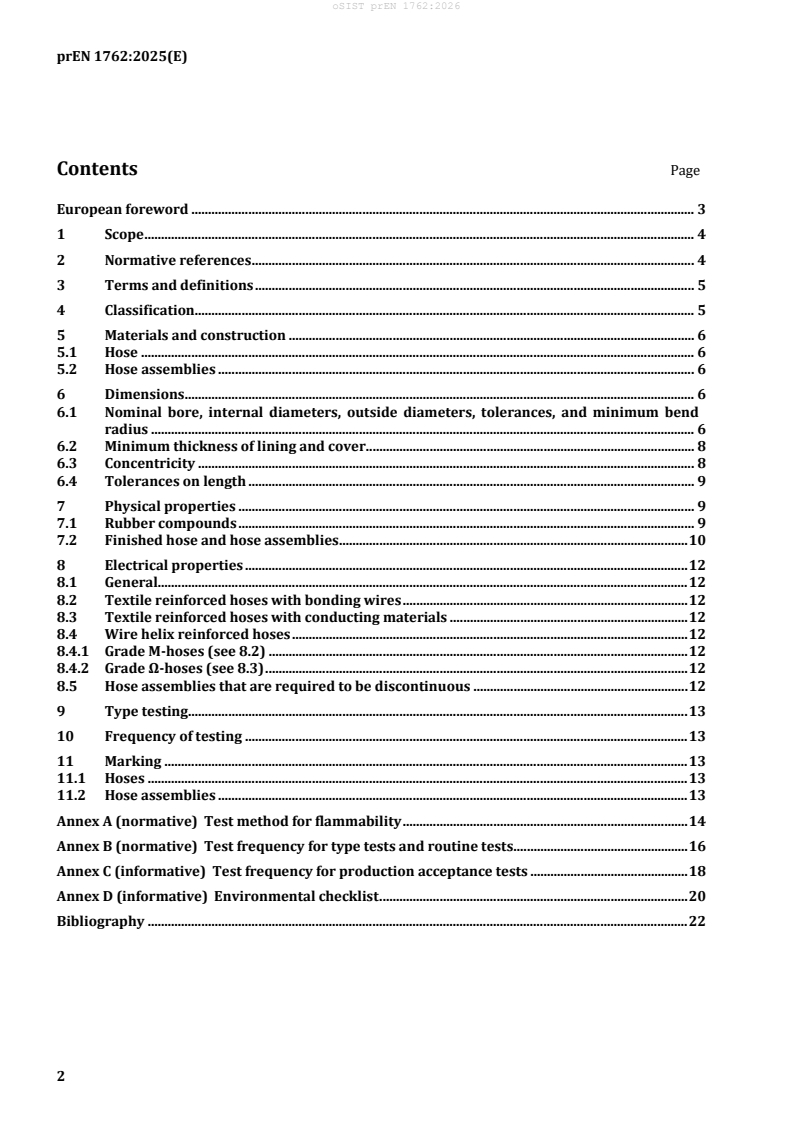
Contents
- 1 Scope
- 2 Normative references
- 3 Terms and definitions
- 3.1 electrically bonded hose/hose assembly
- 3.2 electrically conductive hose/hose assembly
- 3.3 electrically discontinuous hose/hose assembly
- 4 Classification
- 5 Materials and construction
- 5.1 Hose
- 5.2 Hose assemblies
- 6 Dimensions
- 6.1 Nominal bore, internal diameters, outside diameters, tolerances, and minimum
- 6.2 Minimum thickness of lining and cover
- 6.3 Concentricity
- 6.4 Tolerances on length
- 7 Physical properties
- 7.1 Rubber compounds
- 7.2 Finished hose and hose assemblies
- 8 Electrical properties
- 8.1 General
- 8.2 Textile reinforced hoses with bonding wires
- 8.3 Textile reinforced hoses with conducting materials
- 1 × 10 Ω per length. When obtaining electrical resistance by this method the hose shall be
- 8.4 Wire helix reinforced hoses
- 8.5 Hose assemblies that are required to be discontinuous
- 9 Type testing
- 10 Frequency of testing
- 11 Marking
- 11.1 Hoses
- 11.2 Hose assemblies
- Annex A
- 5 Propane (LPG) approximately 50 mbar
- Annex B
- Annex C
- Annex D
- Bibliography
1 Scope
This document specifies the requirements for rubber hoses and rubber hose assemblies used for the transfer of liquefied petroleum gas (LPG) in liquid or gaseous phase and natural gas with a maximum working pressure of 25 bar (2,5 MPa) and vacuum within the temperature range of −30 °C to +70 °C and, when designated -LT, −50 °C to +70 °C.
2 Normative references
The following documents are referred to in the text in such a way that some or all of their content constitutes requirements of this document. For dated references, only the edition cited applies. For undated references, the latest edition of the referenced document (including any amendments) applies.
EN ISO 1402, Rubber and plastics hoses and hose assemblies — Hydrostatic testing EN ISO 4671, Rubber and plastics hoses and hose assemblies — Methods of measurement of the dimensions of hoses and the lengths of hose assemblies EN ISO 6179, Rubber, vulcanized or thermoplastic — Rubber sheets and rubber-coated fabrics — Determination of transmission rate of volatile liquids (gravimetric technique) EN ISO 7233, Rubber and plastics hoses and hose assemblies — Determination of resistance to vacuum EN ISO 7326, Rubber and plastics hoses — Assessment of ozone resistance under static conditions EN ISO 8031, Rubber and plastics hoses and hose assemblies — Determination of electrical resistance and conductivity EN ISO 8033, Rubber and plastics hoses — Determination of adhesion between components EN ISO 8330, Rubber and plastics hoses and hose assemblies — Vocabulary EN ISO 10619-1, Rubber and plastics hoses and tubing — Measurement of flexibility and stiffness — Part 1: Bending tests at ambient temperature EN ISO 10619-2, Rubber and plastics hoses and tubing — Measurement of flexibility and stiffness — Part 2: Bending tests at sub-ambient temperatures ISO 37, Rubber, vulcanized or thermoplastic — Determination of tensile stress-strain properties ISO 188, Rubber, vulcanized or thermoplastic — Accelerated ageing and heat resistance tests ISO 1817, Rubber, vulcanized or thermoplastic — Determination of the effect of liquids ISO 4649, Rubber, vulcanized or thermoplastic — Determination of abrasion resistance using a rotating cylindrical drum device
oSIST prEN 1762:2026 prEN 1762:2025 (E)
3 Terms and definitions
For the purposes of this document, the terms and definitions given in EN ISO 8330 and the following apply.
ISO and IEC maintain terminology databases for use in standardization at the following addresses:
- ISO Online browsing platform: available at https://www.iso.org/obp
- IEC Electropedia: available at https://www.electropedia.org/
3.1 electrically bonded hose/hose assembly
hose/hose assembly that uses a metallic wire connection to conduct static electricity
3.2 electrically conductive hose/hose assembly
hose/hose assembly that is capable of conducting static electrical charges, using a conductive rubber layer, without the use of a metallic wire
3.3 electrically discontinuous hose/hose assembly
hose/hose assembly that incorporates a metallic wire connection to one end fittings of the assembly only or is electrically insulated from both end-fittings
4 Classification
Hoses/hose assemblies for this application are classified into 5 types and 3 grades according to their use, construction, and electrical properties. The maximum working pressure for all hoses/hose assemblies is 25 bar.
The 5 types are as follows:
Type Application D delivery hose D-LT delivery hose, low temperature; SD suction and delivery hose, helix reinforced SD-LTS suction and delivery hose “smooth hose”, helix reinforced, low temperature SD-LTR suction and delivery hose, rough bore (having an internal, non-embedded helical wire of stainless steel), low temperature Hoses for this application are divided into 3 grades according to their electrical properties:
Grade Electrical property designation M Electrically bonded Ω Electrically conductive using a conductive rubber layer Discontinuous Electrically discontinuous
oSIST prEN 1762:2026 prEN 1762:2025(E)
5 Materials and construction
5.1 Hose
The hose shall consist of the following:
- a lining resistant to n-pentane;
- a reinforcement of layers of woven, braided or spirally wound textile material or braided or spirally wound stainless steel wire,
- an embedded stainless steel metallic helix reinforcement (types SD, SD-LTS and SD-LTR only);
- two or more low resistance electrical bonding wires (grade “M” only);
- an outer cover of black or coloured synthetic rubber, resistant to abrasion and outdoor exposure; the cover may be pricked to allow gas permeation. If the cover is not pricked a comparative measurement of permeation between the rubber materials of cover and lining shall be carried out, see Table 3, item 6;
- an internal, non-embedded stainless steel helical wire, suitable for use at –50 °C (type SD-LTR only).
5.2 Hose assemblies
Hose assemblies shall incorporate metallic fittings attached to the hose by the assembler or built in by the manufacturer. In order to produce the required electrical properties, the fittings should be attached in accordance with Clause 8.
Chlorinated materials shall not be used in contact with any stainless steel materials.
6 Dimensions
6.1 Nominal bore, internal diameters, outside diameters, tolerances, and minimum
bend radius For hoses without built-in couplings, and when measured in accordance with method A of EN ISO 4671, the internal diameter and outside diameter and their tolerances shall conform to Table 1 or Table 2, depending on the type.
For hoses with built-in couplings, the outside diameters in Tables 1 and 2 do not apply. When tested by the method described in EN ISO 10619-1, the value of the minimum bend radius shall be as given in Table 1 or Table 2, depending on the type.
oSIST prEN 1762:2026 prEN 1762:2025 (E) Table 1 — Dimensions and tolerances of hoses of types D and D-LT Nominal bore Internal Tolerance Outside Tolerance Design min.
a diameter diameter bend radius
mm mm mm mm mm 10 10 ±0,5 20,0 ±1,0 90 13 12,7 ±0,5 22,7 ±1,0 100 15 15 ±0,5 25 ±1,0 120 16 15,9 ±0,5 25,9 ±1,0 125 19 19 ±0,5 31 ±1,0 160 25 25 ±0,5 38 ±1,0 200 32 32 ±0,5 45 ±1,0 250 38 38 ±0,5 52 ±1,0 320 50 50 ±0,6 66 ±1,2 400 51 51 ±0,6 67 ±1,2 400 63 63 ±0,6 81 ±1,2 550 75 75 ±0,6 93 ±1,2 650 76 76 ±0,6 94 ±1,2 650 80 80 ±0,6 98 ±1,2 725 100 100 ±1,6 120 ±1,6 800 150 150 ±2,0 174 ±2,0 1200 b 200 200 ±2,0 226 or 232 ±3,0 1600 250 254 ±2,0 — — 2000 300 305 ±2,0 — — 2500 a The design minimum bend radius is measured to the surface of the hose on the inside of the bend. b alternating outer diameter depending on the hose construction. NOTE Other dimension and measurements possible in accordance with the customer.
oSIST prEN 1762:2026 prEN 1762:2025(E) Table 2 — Dimensions and tolerances of hoses of types SD, SD-LTS and SD-LTR Nominal bore Internal Tolerance Outside Tolerance Design min.
a diameter diameter bend radius mm mm mm mm mm 10 10 ±0,5 20,0 ±1,0 85 13 12,7 ±0,5 22,7 ±1,0 90 15 15 ±0,5 25 ±1,0 95 16 15,9 ±0,5 25,9 ±1,0 95 19 19 ±0,5 31 ±1,0 100 25 25 ±0,5 38 ±1,0 150 32 32 ±0,5 45 ±1,0 200 38 38 ±0,5 52 ±1,0 280 50 50 ±0,6 66 ±1,2 350 51 51 ±0,6 67 ±1,2 350 63 63 ±0,6 81 ±1,2 480 75 75 ±0,6 93 ±1,2 550 76 76 ±0,6 94 ±1,2 550 80 80 ±0,6 98 ±1,2 680 100 100 ±1,6 120 ±1,6 720 150 150 ±2,0 174 ±2,0 1000 b 200 200 ±2,0 226 or 232 ±3,0 1400 250 254 ±2,0 — — 1750 300 305 ±2,0 — — 2100 a The design minimum bend radius is measured to the surface of the hose on the inside of the bend. b Alternating outer diameter depending on the hose construction. NOTE 1 Other dimension and measurements possible in accordance with the customer NOTE 2 Nominal bores 250 and 300 apply to hoses with built-in couplings only.
6.2 Minimum thickness of lining and cover
When measured in accordance with EN ISO 4671, the minimum thickness of both the lining and cover of all hoses shall be 1,6 mm.
Not applicable to hose assemblies with built-in couplings.
...