

FprEN 1762
(Main)Rubber hoses and hose assemblies for liquefied petroleum gas, LPG (liquid or gaseous phase), and natural gas up to 25 bar (2,5 MPa) - Specification
- Abstract
This document specifies the requirements for rubber hoses and rubber hose assemblies used for the transfer of liquefied petroleum gas (LPG) in liquid or gaseous phase and natural gas with a maximum working pressure of 25 bar (2,5 MPa) and vacuum within the temperature range of −30 °C to +70 °C and, when designated -LT, −50 °C to +70 °C.
- Status
- Not Published
- Publication Date
- 20-Jan-2027
- Technical Committee
- CEN/TC 218 - Rubber and plastics hoses and hose assemblies
- Current Stage
- 5020 - Submission to Vote - Formal Approval
- Start Date
- 01-Oct-2026
- Due Date
- 15-Dec-2026
- Completion Date
- 15-Dec-2026



FprEN 1762 is a CEN draft European standard for rubber hoses and hose assemblies used with liquefied petroleum gas (LPG) and natural gas. It specifies construction, dimensions, physical and electrical performance, test methods, testing frequency, and marking for hoses up to 25 bar, for use in liquid or gaseous phase and in vacuum, within the stated temperature range.
What does FprEN 1762 specify?
FprEN 1762 specifies requirements for rubber hoses and rubber hose assemblies used to transfer LPG and natural gas at a maximum working pressure of 25 bar. It covers standard-temperature hoses and low-temperature versions designated -LT, and it sets out how these products are classified, built, tested, and marked.
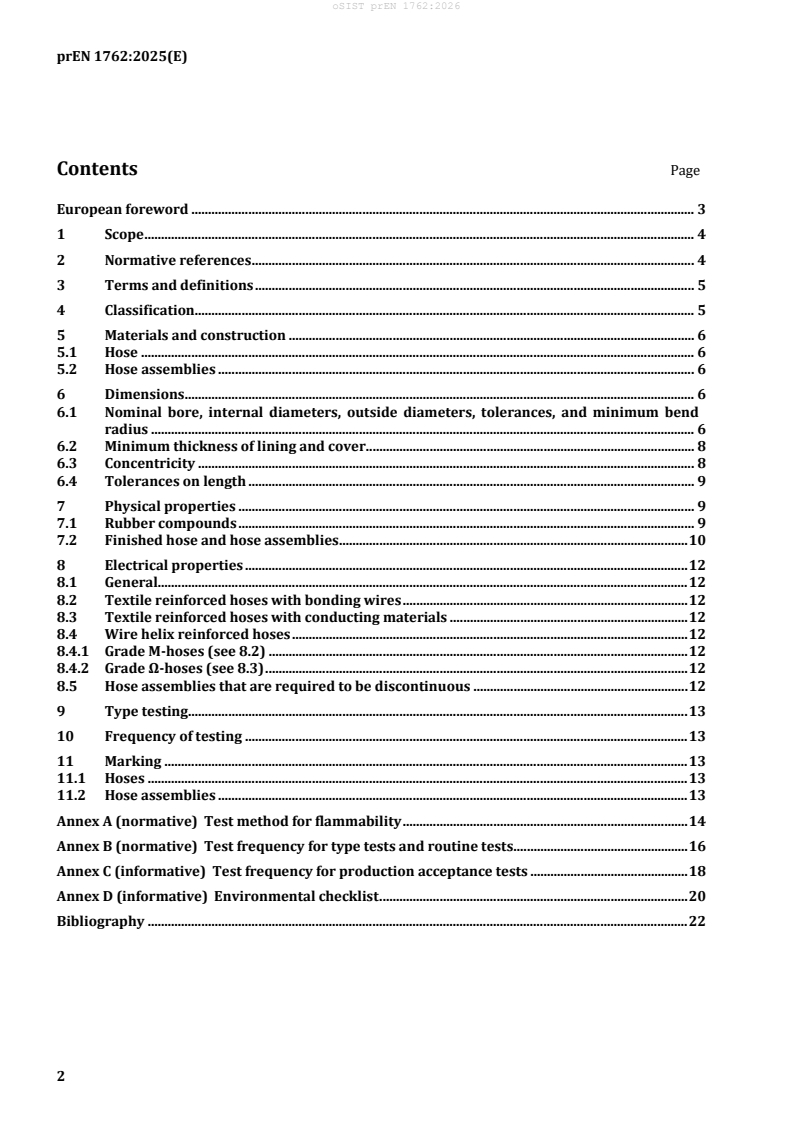
The document is organized into clauses 1 to 11 and four annexes.
| Annex | What it covers |
|---|---|
| Annex A | Normative flammability test method |
| Annex B | Normative test frequency for type tests and routine tests |
| Annex C | Informative test frequency for production acceptance tests |
| Annex D | Informative environmental checklist |
Clause 4 classifies hoses by use and electrical property. Clauses 5 and 6 cover materials, construction, and dimensional limits. Clauses 7 and 8 cover physical and electrical performance. Clauses 9 to 11 cover type testing, test frequency, and marking.
What are the key requirements of FprEN 1762?
Product types and grades
FprEN 1762 classifies hoses and hose assemblies into five types and three grades. The types are D, D-LT, SD, SD-LTS, and SD-LTR, and the grades are M, Ω, and Discontinuous.
This matters in practice because the hose type has to match the service condition, especially suction, delivery, and low-temperature use. The grade has to match the required static-electricity behavior and the way the hose is assembled and marked.
Materials and construction
FprEN 1762 requires a lining resistant to n-pentane, reinforcement using textile material or stainless steel wire, and a black or coloured synthetic-rubber cover resistant to abrasion and outdoor exposure. For SD, SD-LTS, and SD-LTR, an embedded stainless steel metallic helix is required, and type SD-LTR also uses an internal non-embedded stainless steel helical wire suitable for -50 °C.
The document also requires metallic fittings for hose assemblies, with the electrical properties achieved by the fitting arrangement. Chlorinated materials are not allowed in contact with stainless steel materials, which matters for durability and corrosion control.
Dimensions and tolerances
FprEN 1762 sets limits for nominal bore, internal diameter, outside diameter, minimum bend radius, lining and cover thickness, concentricity, and length tolerance. It gives separate dimensional tables for D and D-LT hoses and for SD, SD-LTS, and SD-LTR hoses.
For users, this means hose size and flexibility are controlled, so a hose can be specified and inspected against clear dimensional limits. The document also requires a minimum lining and cover thickness of 1.6 mm, concentricity limits for selected bore sizes, and a length tolerance of ± 1 %.
Physical performance of compounds and finished hoses
FprEN 1762 requires the rubber compounds used for lining and cover to meet tensile, elongation, abrasion, ageing, and liquid-resistance requirements. It also sets requirements for the finished hose and hose assembly, including proof pressure, burst pressure, adhesion, ozone resistance, low-temperature flexibility, deformation at minimum bend radius, and flammability.
In practice, this means manufacturers have to verify both the raw compound and the completed product. The compound tests check whether the rubber can survive LPG exposure, heat, and wear, while the finished-product tests check whether the hose remains sound under pressure, bending, cold conditions, and fire exposure.
Electrical properties
FprEN 1762 requires hoses and hose assemblies to satisfy one of the electrical-property arrangements defined in Clause 8. These include electrically bonded hoses using bonding wires, electrically conductive hoses using a conductive rubber layer, wire-helix reinforced hoses, and electrically discontinuous hose assemblies.
This matters because LPG and natural gas transfer can create static electricity risks. The document therefore ties the electrical design of the hose to a measured resistance limit and to the way the hose or assembly is marked.
Testing, frequency, and marking
FprEN 1762 requires type testing to demonstrate that a hose design and its materials comply with the standard, and type tests are repeated at least every five years or after changes in design, manufacture, or materials. Annex B sets the frequency for type tests and routine tests, and Annex C gives recommended production acceptance testing frequencies.
Marking is also mandatory. Each hose length has to be marked continuously with the manufacturer identification, document number, type, nominal bore, maximum working pressure, electrical grade symbol, and quarter and year of manufacture; hose assemblies also need assembler identification and assembly date when the fitting is not built in.
What terms does FprEN 1762 define?
Liquefied petroleum gas (LPG) - The gas handled by this standard, used here in liquid or gaseous phase.
Electrically bonded hose/hose assembly - A hose or hose assembly that uses a metallic wire connection to conduct static electricity.
Electrically conductive hose/hose assembly - A hose or hose assembly that conducts static electricity through a conductive rubber layer without a metallic wire.
Electrically discontinuous hose/hose assembly - A hose or hose assembly arranged so that only one end fitting, or neither end fitting, is electrically connected to the metallic reinforcement.
Nominal bore - The size designation used for the hose dimensions and tolerances in the dimensional tables.
Grade M - The electrical designation for a hose or hose assembly that is electrically bonded.
Grade Ω - The electrical designation for a hose or hose assembly that is electrically conductive using a conductive rubber layer.
Who uses FprEN 1762?
FprEN 1762 is used by hose manufacturers, hose assemblers, test laboratories, gas-distribution equipment suppliers, and buyers of LPG and natural gas transfer equipment. It is also used by quality managers who need to verify production testing, product marking, and batch release.
In practice, it supports selection and checking of hoses for LPG dispensing, gas handling, and other transfer applications where pressure, flexibility, low-temperature behavior, and static control matter. It is relevant to procurement teams that need to compare hose types and electrical grades, and to compliance teams that need a clear test and marking basis.
What changed in FprEN 1762 from the previous edition?
FprEN 1762 will supersede EN 1762:2018. The document states these significant technical changes compared with EN 1762:2018:
- extension of the lining material
- additional dimensions added in Tables 1 and 2
- revision of routine tests
- deletion of the requirement to include the year of publication of the document in the marking
- water added as a test fluid in Annex A
- editorial revision
Which standards are used with FprEN 1762?
FprEN 1762 refers to the following standards, which supply the test and vocabulary methods used throughout the document:
- EN ISO 1402 - hydrostatic testing for proof pressure, burst pressure, and related pressure-change checks
- EN ISO 4671 - measurement of hose dimensions and hose assembly lengths
- EN ISO 6179 - gravimetric measurement of volatile-liquid transmission, used for permeation-related assessment
- EN ISO 7233 - resistance to vacuum
- EN ISO 7326 - ozone resistance under static conditions
- EN ISO 8031 - electrical resistance and conductivity
- EN ISO 8033 - adhesion between components
- EN ISO 8330 - vocabulary for rubber hoses and hose assemblies
- EN ISO 10619-1 - flexibility and stiffness by bending at ambient temperature
- EN ISO 10619-2 - flexibility and stiffness by bending at sub-ambient temperatures
- ISO 37 - tensile stress-strain properties
- ISO 188 - accelerated ageing and heat resistance
- ISO 1817 - effect of liquids
- ISO 4649 - abrasion resistance using a rotating cylindrical drum device
What does the FprEN 1762 document contain?
FprEN 1762 contains tables for dimensions and tolerances, physical properties, test frequencies, and production acceptance guidance. It also contains procedures for pressure testing, vacuum testing, electrical testing, low-temperature flexibility, ozone resistance, adhesion, and flammability.
Annex A gives the flammability test setup and assessment rule, including the test arrangement shown in Figure A.1. Annex B and Annex C set out how often the different tests are carried out, which is important for design validation, routine manufacture, and batch control. Annex D provides an environmental checklist that points users to material selection, packaging, transport, and accident-risk considerations.
Relations
- Effective Date
- 08-Jan-2025
Get Certified
Connect with accredited certification bodies for this standard

Institut za varilstvo d.o.o. (Welding Institute)
Slovenia's leading welding institute since 1952. ISO 3834, EN 1090, pressure equipment certification, NDT personnel, welder qualification. Only IIW Au
Sponsored listings
Frequently Asked Questions
FprEN 1762 is a draft published by the European Committee for Standardization (CEN). Its full title is "Rubber hoses and hose assemblies for liquefied petroleum gas, LPG (liquid or gaseous phase), and natural gas up to 25 bar (2,5 MPa) - Specification". This standard covers: This document specifies the requirements for rubber hoses and rubber hose assemblies used for the transfer of liquefied petroleum gas (LPG) in liquid or gaseous phase and natural gas with a maximum working pressure of 25 bar (2,5 MPa) and vacuum within the temperature range of −30 °C to +70 °C and, when designated -LT, −50 °C to +70 °C.
This document specifies the requirements for rubber hoses and rubber hose assemblies used for the transfer of liquefied petroleum gas (LPG) in liquid or gaseous phase and natural gas with a maximum working pressure of 25 bar (2,5 MPa) and vacuum within the temperature range of −30 °C to +70 °C and, when designated -LT, −50 °C to +70 °C.
FprEN 1762 is classified under the following ICS (International Classification for Standards) categories: 23.040.70 - Hoses and hose assemblies. The ICS classification helps identify the subject area and facilitates finding related standards.
FprEN 1762 has the following relationships with other standards: It is inter standard links to EN 1762:2018. Understanding these relationships helps ensure you are using the most current and applicable version of the standard.
FprEN 1762 is available in PDF format for immediate download after purchase. The document can be added to your cart and obtained through the secure checkout process. Digital delivery ensures instant access to the complete standard document.
Standards Content (Sample)
Contents
- 1 Scope
- 2 Normative references
- 3 Terms and definitions
- 3.1 electrically bonded hose/hose assembly
- 3.2 electrically conductive hose/hose assembly
- 3.3 electrically discontinuous hose/hose assembly
- 4 Classification
- 5 Materials and construction
- 5.1 Hose
- 5.2 Hose assemblies
- 6 Dimensions
- 6.1 Nominal bore, internal diameters, outside diameters, tolerances, and minimum
- 6.2 Minimum thickness of lining and cover
- 6.3 Concentricity
- 6.4 Tolerances on length
- 7 Physical properties
- 7.1 Rubber compounds
- 7.2 Finished hose and hose assemblies
- 8 Electrical properties
- 8.1 General
- 8.2 Textile reinforced hoses with bonding wires
- 8.3 Textile reinforced hoses with conducting materials
- 1 × 10 Ω per length. When obtaining electrical resistance by this method the hose shall be
- 8.4 Wire helix reinforced hoses
- 8.5 Hose assemblies that are required to be discontinuous
- 9 Type testing
- 10 Frequency of testing
- 11 Marking
- 11.1 Hoses
- 11.2 Hose assemblies
- Annex A
- 5 Propane (LPG) approximately 50 mbar
- Annex B
- Annex C
- Annex D
- Bibliography
1 Scope
This document specifies the requirements for rubber hoses and rubber hose assemblies used for the transfer of liquefied petroleum gas (LPG) in liquid or gaseous phase and natural gas with a maximum working pressure of 25 bar (2,5 MPa) and vacuum within the temperature range of −30 °C to +70 °C and, when designated -LT, −50 °C to +70 °C.
2 Normative references
The following documents are referred to in the text in such a way that some or all of their content constitutes requirements of this document. For dated references, only the edition cited applies. For undated references, the latest edition of the referenced document (including any amendments) applies.
EN ISO 1402, Rubber and plastics hoses and hose assemblies — Hydrostatic testing EN ISO 4671, Rubber and plastics hoses and hose assemblies — Methods of measurement of the dimensions of hoses and the lengths of hose assemblies EN ISO 6179, Rubber, vulcanized or thermoplastic — Rubber sheets and rubber-coated fabrics — Determination of transmission rate of volatile liquids (gravimetric technique) EN ISO 7233, Rubber and plastics hoses and hose assemblies — Determination of resistance to vacuum EN ISO 7326, Rubber and plastics hoses — Assessment of ozone resistance under static conditions EN ISO 8031, Rubber and plastics hoses and hose assemblies — Determination of electrical resistance and conductivity EN ISO 8033, Rubber and plastics hoses — Determination of adhesion between components EN ISO 8330, Rubber and plastics hoses and hose assemblies — Vocabulary EN ISO 10619-1, Rubber and plastics hoses and tubing — Measurement of flexibility and stiffness — Part 1: Bending tests at ambient temperature EN ISO 10619-2, Rubber and plastics hoses and tubing — Measurement of flexibility and stiffness — Part 2: Bending tests at sub-ambient temperatures ISO 37, Rubber, vulcanized or thermoplastic — Determination of tensile stress-strain properties ISO 188, Rubber, vulcanized or thermoplastic — Accelerated ageing and heat resistance tests ISO 1817, Rubber, vulcanized or thermoplastic — Determination of the effect of liquids ISO 4649, Rubber, vulcanized or thermoplastic — Determination of abrasion resistance using a rotating cylindrical drum device
oSIST prEN 1762:2026 prEN 1762:2025 (E)
3 Terms and definitions
For the purposes of this document, the terms and definitions given in EN ISO 8330 and the following apply.
ISO and IEC maintain terminology databases for use in standardization at the following addresses:
- ISO Online browsing platform: available at https://www.iso.org/obp
- IEC Electropedia: available at https://www.electropedia.org/
3.1 electrically bonded hose/hose assembly
hose/hose assembly that uses a metallic wire connection to conduct static electricity
3.2 electrically conductive hose/hose assembly
hose/hose assembly that is capable of conducting static electrical charges, using a conductive rubber layer, without the use of a metallic wire
3.3 electrically discontinuous hose/hose assembly
hose/hose assembly that incorporates a metallic wire connection to one end fittings of the assembly only or is electrically insulated from both end-fittings
4 Classification
Hoses/hose assemblies for this application are classified into 5 types and 3 grades according to their use, construction, and electrical properties. The maximum working pressure for all hoses/hose assemblies is 25 bar.
The 5 types are as follows:
Type Application D delivery hose D-LT delivery hose, low temperature; SD suction and delivery hose, helix reinforced SD-LTS suction and delivery hose “smooth hose”, helix reinforced, low temperature SD-LTR suction and delivery hose, rough bore (having an internal, non-embedded helical wire of stainless steel), low temperature Hoses for this application are divided into 3 grades according to their electrical properties:
Grade Electrical property designation M Electrically bonded Ω Electrically conductive using a conductive rubber layer Discontinuous Electrically discontinuous
oSIST prEN 1762:2026 prEN 1762:2025(E)
5 Materials and construction
5.1 Hose
The hose shall consist of the following:
- a lining resistant to n-pentane;
- a reinforcement of layers of woven, braided or spirally wound textile material or braided or spirally wound stainless steel wire,
- an embedded stainless steel metallic helix reinforcement (types SD, SD-LTS and SD-LTR only);
- two or more low resistance electrical bonding wires (grade “M” only);
- an outer cover of black or coloured synthetic rubber, resistant to abrasion and outdoor exposure; the cover may be pricked to allow gas permeation. If the cover is not pricked a comparative measurement of permeation between the rubber materials of cover and lining shall be carried out, see Table 3, item 6;
- an internal, non-embedded stainless steel helical wire, suitable for use at –50 °C (type SD-LTR only).
5.2 Hose assemblies
Hose assemblies shall incorporate metallic fittings attached to the hose by the assembler or built in by the manufacturer. In order to produce the required electrical properties, the fittings should be attached in accordance with Clause 8.
Chlorinated materials shall not be used in contact with any stainless steel materials.
6 Dimensions
6.1 Nominal bore, internal diameters, outside diameters, tolerances, and minimum
bend radius For hoses without built-in couplings, and when measured in accordance with method A of EN ISO 4671, the internal diameter and outside diameter and their tolerances shall conform to Table 1 or Table 2, depending on the type.
For hoses with built-in couplings, the outside diameters in Tables 1 and 2 do not apply. When tested by the method described in EN ISO 10619-1, the value of the minimum bend radius shall be as given in Table 1 or Table 2, depending on the type.
oSIST prEN 1762:2026 prEN 1762:2025 (E) Table 1 — Dimensions and tolerances of hoses of types D and D-LT Nominal bore Internal Tolerance Outside Tolerance Design min.
a diameter diameter bend radius
mm mm mm mm mm 10 10 ±0,5 20,0 ±1,0 90 13 12,7 ±0,5 22,7 ±1,0 100 15 15 ±0,5 25 ±1,0 120 16 15,9 ±0,5 25,9 ±1,0 125 19 19 ±0,5 31 ±1,0 160 25 25 ±0,5 38 ±1,0 200 32 32 ±0,5 45 ±1,0 250 38 38 ±0,5 52 ±1,0 320 50 50 ±0,6 66 ±1,2 400 51 51 ±0,6 67 ±1,2 400 63 63 ±0,6 81 ±1,2 550 75 75 ±0,6 93 ±1,2 650 76 76 ±0,6 94 ±1,2 650 80 80 ±0,6 98 ±1,2 725 100 100 ±1,6 120 ±1,6 800 150 150 ±2,0 174 ±2,0 1200 b 200 200 ±2,0 226 or 232 ±3,0 1600 250 254 ±2,0 — — 2000 300 305 ±2,0 — — 2500 a The design minimum bend radius is measured to the surface of the hose on the inside of the bend. b alternating outer diameter depending on the hose construction. NOTE Other dimension and measurements possible in accordance with the customer.
oSIST prEN 1762:2026 prEN 1762:2025(E) Table 2 — Dimensions and tolerances of hoses of types SD, SD-LTS and SD-LTR Nominal bore Internal Tolerance Outside Tolerance Design min.
a diameter diameter bend radius mm mm mm mm mm 10 10 ±0,5 20,0 ±1,0 85 13 12,7 ±0,5 22,7 ±1,0 90 15 15 ±0,5 25 ±1,0 95 16 15,9 ±0,5 25,9 ±1,0 95 19 19 ±0,5 31 ±1,0 100 25 25 ±0,5 38 ±1,0 150 32 32 ±0,5 45 ±1,0 200 38 38 ±0,5 52 ±1,0 280 50 50 ±0,6 66 ±1,2 350 51 51 ±0,6 67 ±1,2 350 63 63 ±0,6 81 ±1,2 480 75 75 ±0,6 93 ±1,2 550 76 76 ±0,6 94 ±1,2 550 80 80 ±0,6 98 ±1,2 680 100 100 ±1,6 120 ±1,6 720 150 150 ±2,0 174 ±2,0 1000 b 200 200 ±2,0 226 or 232 ±3,0 1400 250 254 ±2,0 — — 1750 300 305 ±2,0 — — 2100 a The design minimum bend radius is measured to the surface of the hose on the inside of the bend. b Alternating outer diameter depending on the hose construction. NOTE 1 Other dimension and measurements possible in accordance with the customer NOTE 2 Nominal bores 250 and 300 apply to hoses with built-in couplings only.
6.2 Minimum thickness of lining and cover
When measured in accordance with EN ISO 4671, the minimum thickness of both the lining and cover of all hoses shall be 1,6 mm.
Not applicable to hose assemblies with built-in couplings.
...