

SIST EN 1965-2:2011
(Main)Structural adhesives - Corrosion - Part 2: Determination and classification of corrosion to a brass substrate
- Abstract
This European Standard describes a method to determine the ability of an adhesive to corrode a brass substrate under the influence of an applied voltage and high humidity. The temperature, humidity, ageing period and applied voltage are chosen to ensure the maximum differentiation between the corrosivity of different adhesives and are not intended to represent any particular service condition.
- Status
- Published
- Publication Date
- 03-Oct-2011
- Technical Committee
- IPMA - Polimer materials and products
- Current Stage
- 6060 - National Implementation/Publication (Adopted Project)
- Start Date
- 16-Sep-2011
- Due Date
- 21-Nov-2011
- Completion Date
- 04-Oct-2011

SIST EN 1965-2:2011 is the Slovenian national standard identical to EN 1965-2:2011, published by SIST. It specifies a laboratory method for determining and classifying corrosion of a brass substrate caused by structural adhesives under applied voltage and high humidity. The standard is used to compare adhesives under fixed test conditions, not to simulate a specific service environment.
What does SIST EN 1965-2:2011 specify?
SIST EN 1965-2:2011 describes a comparative corrosion test for structural adhesives on brass. The test uses cured adhesive samples, brass electrodes, humidity, heat, and direct current to make differences between adhesives easier to see in practice.
The test conditions are deliberately severe and controlled so that more corrosive and less corrosive adhesives can be distinguished. The document is arranged in clauses 1 to 10 and one normative annex.
| Annex | What it covers |
|---|---|
| A | Visual grading of the plus pole and minus pole test foils at the contact surface |
What are the key requirements of SIST EN 1965-2:2011?
Clause 4 - test principle. SIST EN 1965-2:2011 places two brass electrodes in contact with a flat cured adhesive sample, then exposes the assembly to 92 % relative humidity at 42 °C with 100 V direct current for four days. In practice, this creates a repeatable stress that highlights whether the adhesive promotes brass corrosion.
Clause 5 - apparatus and materials. SIST EN 1965-2:2011 requires specific tools and materials: brass foil electrodes, a hot/humid conditioning chamber, a direct current source with low alternating current content, a 2.5x magnifier, and inert clamping parts. This matters because the test only works if the electrical and environmental conditions are stable.
Clause 6 - brass substrate preparation. SIST EN 1965-2:2011 requires the brass foil to be degreased, etched, rinsed, dried and cut to size so that it has a uniform dull finish. That surface condition affects colour change, so consistent preparation is needed for comparable results.
Clause 7 - test specimens. SIST EN 1965-2:2011 requires the specimen thickness to match the product thickness, the test faces to be machined flat, and flash to be removed. At least three specimens are used for each evaluation, which gives a more reliable classification.
Clause 8 - procedure. SIST EN 1965-2:2011 requires the assembled test set-up to be preheated before humid ageing, then held under the test conditions for four days. After cooling, the brass foils are examined for green corrosion products, red colouration linked to dezincification, and other discolouration.
Clause 8 - separating corrosion from staining. SIST EN 1965-2:2011 notes that some colour changes can occur without direct current and may be tarnishing rather than electrochemical corrosion. In practice, this helps users avoid calling every colour change corrosion.
Clause 9 and Annex A - classification. SIST EN 1965-2:2011 grades the positive pole and negative pole foils using the visual scale in Annex A. This gives the user a documented corrosion rating rather than a simple pass or fail judgment.
Clause 10 - test report. SIST EN 1965-2:2011 requires the report to identify the standard used, the product tested, substrate preparation, substrate type and thickness, the grade ranking, and any departures from the method. This is the information needed for technical files, comparisons, and customer communication.
What terms does SIST EN 1965-2:2011 define?
- Corrosion - destructive attack on metals that can be chemical or electrochemical in nature.
- Electrochemical attack - the form of attack that the method mainly measures in this test.
- Dezincification - red colouration on brass that signals the start of zinc loss.
- Tarnishing - a non-structural colour change that may appear as a brown to dark layer and is not necessarily corrosion.
- Plus pole - the positive electrode side used in the visual grading of the brass foil.
- Minus pole - the negative electrode side used in the visual grading of the brass foil.
Who uses SIST EN 1965-2:2011?
SIST EN 1965-2:2011 is used by adhesive manufacturers, testing laboratories, and quality managers who need to compare the corrosion behavior of structural adhesives on brass. It is also useful for buyers and specifiers who need a laboratory result to support product selection, incoming inspection, or supplier qualification for metal bonding applications.
What changed in SIST EN 1965-2:2011 from the previous edition?
SIST EN 1965-2:2011 supersedes EN 1965-2:2001.
Which standards are used with SIST EN 1965-2:2011?
- EN 923:2005+A1:2008 - provides adhesive terminology used in the document.
- EN ISO 291 - gives the standard hot/humid conditioning atmosphere used for the chamber conditions.
- EN ISO 8044:1999 - provides basic corrosion terms and definitions, including the dezincification reference.
- ISO 426 (all parts) - supports the selection and form of the wrought copper-zinc alloy used for the brass foil.
What does the SIST EN 1965-2:2011 document contain?
The document sets out the test principle, lists the required materials and apparatus, and gives a step-by-step method for preparing the brass substrate and the adhesive test specimens. It also defines how to run the humidity and voltage exposure, how to inspect the foils afterward, and how to record the result in the test report.
Figure 1 shows the electrode and clamping arrangement used in the test set-up. Annex A provides the visual grading system for the contact surfaces of the positive and negative test foils, and the bibliography points to EN 60426 for coloured representations of test foil appearance.
Relations
- Effective Date
- 01-Nov-2011
- Refers
SIST EN ISO 291:2009 - Plastics - Standard atmospheres for conditioning and testing (ISO 291:2008) - Effective Date
- 28-Jan-2026
- Effective Date
- 28-Jan-2026
- Effective Date
- 28-Jan-2026
- Refers
SIST EN ISO 8044:2000 - Corrosion of metals and alloys - Basic terms and definitions (ISO 8044:1999) - Effective Date
- 28-Jan-2026
- Referred By
SIST EN 17522:2023 - Design and construction of backfilled and grouted borehole heat exchangers - Effective Date
- 28-Jan-2026
Get Certified
Connect with accredited certification bodies for this standard

DIN CERTCO
DIN Group product certification.

Element Materials Technology
Materials testing and product certification.
Inštitut za kovinske materiale in tehnologije
Institute of Metals and Technology. Materials testing, metallurgical analysis, NDT.
Sponsored listings
Frequently Asked Questions
SIST EN 1965-2:2011 is a standard published by the Slovenian Institute for Standardization (SIST). Its full title is "Structural adhesives - Corrosion - Part 2: Determination and classification of corrosion to a brass substrate". This standard covers: This European Standard describes a method to determine the ability of an adhesive to corrode a brass substrate under the influence of an applied voltage and high humidity. The temperature, humidity, ageing period and applied voltage are chosen to ensure the maximum differentiation between the corrosivity of different adhesives and are not intended to represent any particular service condition.
This European Standard describes a method to determine the ability of an adhesive to corrode a brass substrate under the influence of an applied voltage and high humidity. The temperature, humidity, ageing period and applied voltage are chosen to ensure the maximum differentiation between the corrosivity of different adhesives and are not intended to represent any particular service condition.
SIST EN 1965-2:2011 is classified under the following ICS (International Classification for Standards) categories: 77.060 - Corrosion of metals; 83.180 - Adhesives. The ICS classification helps identify the subject area and facilitates finding related standards.
SIST EN 1965-2:2011 has the following relationships with other standards: It is inter standard links to SIST EN 1965-2:2002, SIST EN ISO 291:2009, SIST EN 923:2006+A1:2008, SIST EN 14936-2:2006, SIST EN ISO 8044:2000, SIST EN 17522:2023. Understanding these relationships helps ensure you are using the most current and applicable version of the standard.
SIST EN 1965-2:2011 is associated with the following European legislation: EU Directives/Regulations: 305/2011, 89/106/EEC. When a standard is cited in the Official Journal of the European Union, products manufactured in conformity with it benefit from a presumption of conformity with the essential requirements of the corresponding EU directive or regulation.
SIST EN 1965-2:2011 is available in PDF format for immediate download after purchase. The document can be added to your cart and obtained through the secure checkout process. Digital delivery ensures instant access to the complete standard document.
Standards Content (Sample)
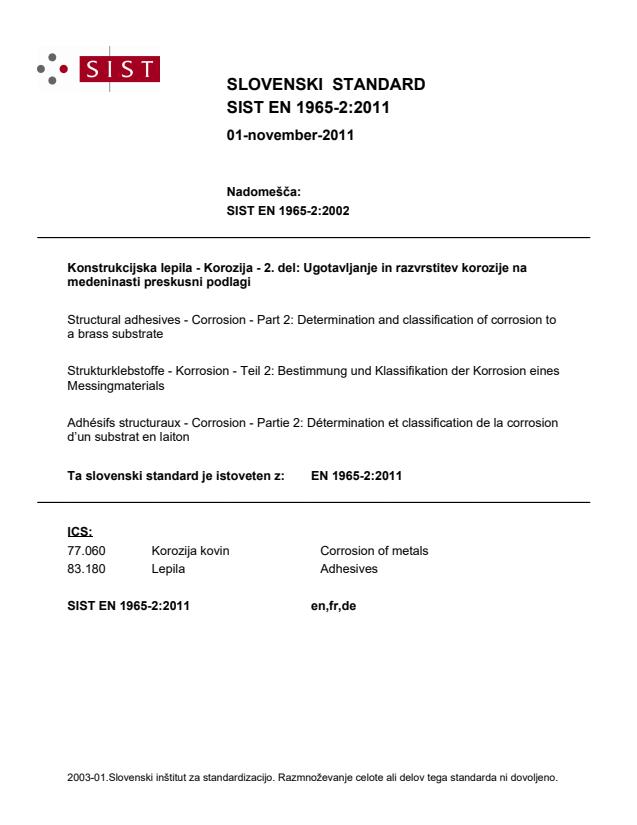
2003-01.Slovenski inštitut za standardizacijo. Razmnoževanje celote ali delov tega standarda ni dovoljeno.Konstrukcijska lepila - Korozija - 2. del: Ugotavljanje in razvrstitev korozije na medeninasti preskusni podlagiStrukturklebstoffe - Korrosion - Teil 2: Bestimmung und Klassifikation der Korrosion eines MessingmaterialsAdhésifs structuraux - Corrosion - Partie 2: Détermination et classification de la corrosion d’un substrat en laitonStructural adhesives - Corrosion - Part 2: Determination and classification of corrosion to a brass substrate83.180LepilaAdhesives77.060Korozija kovinCorrosion of metalsICS:Ta slovenski standard je istoveten z:EN 1965-2:2011SIST EN 1965-2:2011en,fr,de01-november-2011SIST EN 1965-2:2011SLOVENSKI
STANDARDSIST EN 1965-2:20021DGRPHãþD
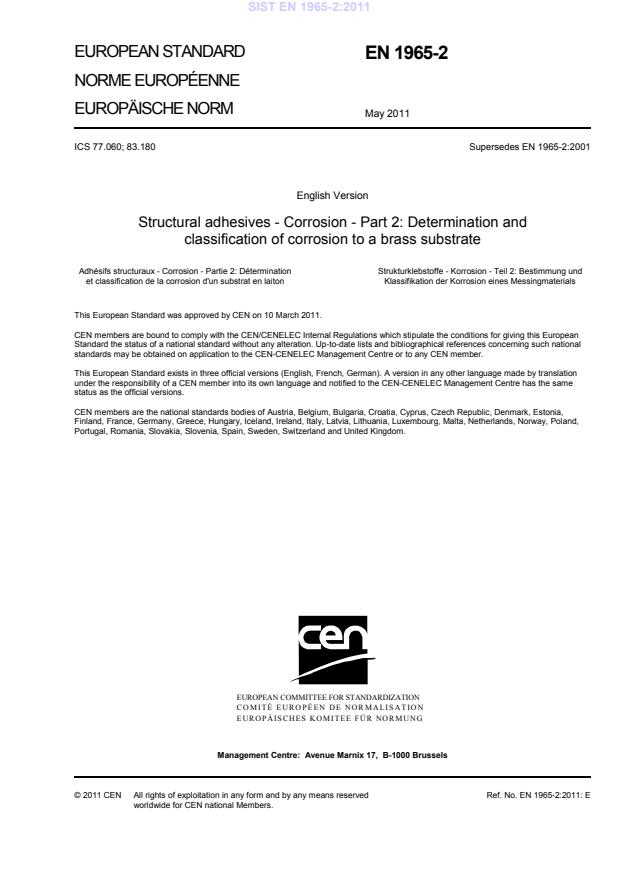
EUROPEAN STANDARD NORME EUROPÉENNE EUROPÄISCHE NORM
EN 1965-2
May 2011 ICS 77.060; 83.180 Supersedes EN 1965-2:2001English Version
Structural adhesives - Corrosion - Part 2: Determination and classification of corrosion to a brass substrate
Adhésifs structuraux - Corrosion - Partie 2: Détermination et classification de la corrosion d'un substrat en laiton
Strukturklebstoffe - Korrosion - Teil 2: Bestimmung und Klassifikation der Korrosion eines Messingmaterials This European Standard was approved by CEN on 10 March 2011.
CEN members are bound to comply with the CEN/CENELEC Internal Regulations which stipulate the conditions for giving this European Standard the status of a national standard without any alteration. Up-to-date lists and bibliographical references concerning such national standards may be obtained on application to the CEN-CENELEC Management Centre or to any CEN member.
This European Standard exists in three official versions (English, French, German). A version in any other language made by translation under the responsibility of a CEN member into its own language and notified to the CEN-CENELEC Management Centre has the same status as the official versions.
CEN members are the national standards bodies of Austria, Belgium, Bulgaria, Croatia, Cyprus, Czech Republic, Denmark, Estonia, Finland, France, Germany, Greece, Hungary, Iceland, Ireland, Italy, Latvia, Lithuania, Luxembourg, Malta, Netherlands, Norway, Poland, Portugal, Romania, Slovakia, Slovenia, Spain, Sweden, Switzerland and United Kingdom.
EUROPEAN COMMITTEE FOR STANDARDIZATION
COMITÉ EUROPÉEN DE NORMALISATION EUROPÄISCHES KOMITEE FÜR NORMUNG
Management Centre:
Avenue Marnix 17,
B-1000 Brussels © 2011 CEN All rights of exploitation in any form and by any means reserved worldwide for CEN national Members. Ref. No. EN 1965-2:2011: ESIST EN 1965-2:2011
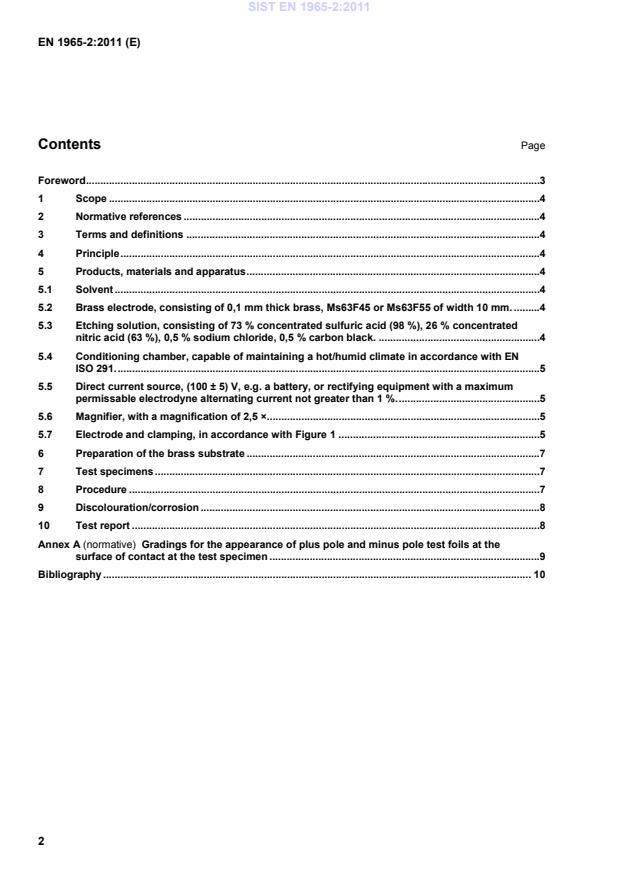
Gradings for the appearance of plus pole and minus pole test foils at the surface of contact at the test specimen .9Bibliography . 10 SIST EN 1965-2:2011
...