

kSIST FprEN 18215:2026
(Main)Innovation management professionals - Competence requirements
- Abstract
This document defines the requirements related to the professional activity of individuals active in the innovation management field at different levels of complexity for all types of organizations, regardless of type, sector, maturity-level and size.
The competence requirements contained in this document are specified based on the identified tasks and activities in terms of knowledge, skills, autonomy and responsibility. The different professional profiles align to the European Qualifications Framework (EQF) to facilitate harmonization to the evaluation and validation of learning outcomes. This document can be used in relation to conformity assessment processes.
This document does not prescribe specific organizational roles, job titles or organizational structures.
- Status
- Not Published
- Public Enquiry End Date
- 30-Dec-2025
- Technical Committee
- I13 - Imaginarni 13
- Current Stage
- 5020 - Formal vote (FV) (Adopted Project)
- Start Date
- 04-Sep-2026
- Due Date
- 23-Oct-2026
- Completion Date
- 07-Sep-2026

kSIST FprEN 18215:2026 is a CEN European Standard that defines competence requirements for innovation management professionals. It describes what people active in innovation management should know and be able to do at different levels of complexity, from Innovation Assistant to Chief Innovation Officer. The standard is written for organizations, professionals, and bodies involved in training, validation, or conformity assessment.
What does kSIST FprEN 18215:2026 specify?
kSIST FprEN 18215:2026 specifies competence requirements for professional activity in the innovation management field across all types of organizations, regardless of sector, maturity level, type, or size. It organizes those requirements around tasks and activities, then expresses them as knowledge, skills, autonomy, and responsibility aligned with the European Qualifications Framework (EQF).
The standard does not prescribe organizational roles, job titles, or structures. In practice, that gives users a competence framework they can adapt to their own organization instead of forcing a fixed job model.
| Annex | What it covers |
|---|---|
| Annex A | Evaluation and validation of learning outcomes, including access, assessment methods, and ongoing maintenance of conformity |
| Annex B | Professional ethics and code of conduct, including an integrity culture framework |
| Annex C | Specialized roles in innovation management that can complement the general profiles |
The document is organized into Scope, Normative references, Terms and definitions, Tasks and activities of professional profiles, and Knowledge, skills, autonomy and responsibility, followed by the three annexes and a bibliography.
What are the key requirements of kSIST FprEN 18215:2026?
kSIST FprEN 18215:2026 builds its requirements around five professional profiles and a shared task structure. The profiles are Chief Innovation Officer, Innovation Manager, Innovation Specialist, Innovation Technician, and Innovation Assistant, with indicative EQF levels from 8 down to 4. In practice, this lets an employer or assessor compare a person’s competence against the level of responsibility expected for the role.
Tasks and activities are scaled by level
Clause 4 defines common tasks such as managing relationships, handling data and knowledge, shaping innovation strategy, deciding on innovation initiatives, applying Innovation Management Principles (IMPs), using an HS-based approach, deciding on an Innovation Management System (IMS), implementing and improving the IMS, integrating the IMS with other management systems, and communicating or training on innovation management. The same task can appear at several levels, but with different depth, independence, and scope.
That matters because the standard is not only about what someone does, but how independently and strategically they do it. Higher levels are expected to influence policy, guide top management, and handle broader organizational impact, while lower levels focus more on support and supervised execution.
Knowledge, skills, autonomy and responsibility are tied to EQF
Clause 5 turns those tasks into profile-specific competence sets. For each profile, the document sets out the knowledge and skills needed and indicates the corresponding level of autonomy and responsibility using EQF descriptors.
This is important for hiring, appraisal, and development planning. A manager can use the profile tables to see whether a person needs basic, consolidated, or in-depth and consolidated knowledge, and whether the person is expected to work independently, advise others, or lead at strategic level.
Innovation management is linked to structured methods and systems
The standard repeatedly refers to the ISO 5600X family, IMPs, the HS-based approach, and the IMS. It also distinguishes between deciding to adopt an IMS, operating it, and integrating it with other management systems. In practice, the document supports organizations that want to place innovation management inside a structured management system rather than treating it as an isolated activity.
Development and assessment are covered
Clause 4.9 says the competence development of these profiles is not tied to a specific mandatory training program, but professionals are expected to keep developing their competences. Annex A then gives a framework for evaluating and validating learning outcomes, including formal, non-formal, and informal learning.
That matters for certification, recruitment, and internal validation. It provides a basis for checking experience, education, tests, interviews, case studies, and continuing development in a repeatable way.
Ethics and specialized roles are included
Annex B adds a framework for professional ethics, integrity, and conduct, with emphasis on human dignity, sustainability, fairness, and responsibility. Annex C then lists specialized roles such as Innovation System Manager, Innovation Ecosystem Manager, Innovation Portfolio Manager, Innovation Initiative Manager, and Innovation Antifragility Manager.
These annexes help organizations go beyond a basic role profile. They can use them to shape internal policies, codes of conduct, or specialist career paths.
What terms does kSIST FprEN 18215:2026 define?
kSIST FprEN 18215:2026 defines a set of terms that anchor the whole framework.
- Innovation - a new or changed entity that realizes or redistributes value; the standard treats novelty and value as relative to the organization and its interested parties.
- Innovation management - management with regard to innovation, including policy, vision, strategy, objectives, structures, and processes.
- Innovation management system (IMS) - a management system with regard to innovation, which can be part of a general or integrated management system.
- Innovation ecosystem - an interdependent system of people or organizations that collectively develop or enable innovation.
- Innovation activity - an activity with regard to innovation, planned or unplanned, usually carried out under uncertainty.
- Competence - the ability to apply knowledge and skills to achieve intended results.
- Autonomy and responsibility - the ability to apply knowledge and skills independently and with responsibility.
- European Qualifications Framework (EQF) - the reference used in the standard to express the levels of responsibility and autonomy for the profiles.
Who uses kSIST FprEN 18215:2026?
kSIST FprEN 18215:2026 is aimed at professionals who need guidance on career development in innovation management, and at organizations that design internal innovation management structures or recruitment strategies. It is also relevant to training providers, accreditation bodies, certification bodies, and organizations involved in validation of learning outcomes or conformity assessment.
In practice, buyers, HR teams, quality managers, and innovation leaders can use the standard to define competence profiles, compare candidates, structure development plans, or assess whether existing staff match the level of innovation work expected in the organization.
Which standards are used with kSIST FprEN 18215:2026?
Clause 2 lists no normative references, but kSIST FprEN 18215:2026 relies on several companion standards and references throughout the text.
- EN ISO 56000 - provides the innovation management fundamentals and vocabulary used for the profiles, tasks, and competence language.
- ISO 56001 and ISO 56002 - support the IMS requirements and guidance used for implementation, maintenance, improvement, and integration.
- ISO 56003, ISO 56005, and ISO 56006 - support innovation partnerships, intellectual property management, and strategic intelligence for innovation paths and data handling.
- ISO 21500 - supports the project management approach used for innovation activities and initiatives.
- ISO 26000 - supports the sustainability, social responsibility, and integrity aspects of the profiles.
- ISO 30401 - supports knowledge management, especially reporting and presentation for decision-making.
- ISO 22316, ISO 31000, and EN IEC 31010 - support resilience and risk-related thinking in the competence profiles.
- ISO 44001 - supports collaborative business relationships referenced in the higher-level profiles.
- Oslo Manual - supports assessment of innovation typologies and innovation data.
- ISO/IEC 42001 and ISO/IEC 22989 - support the document’s AI-related competence references.
What does the kSIST FprEN 18215:2026 document contain?
kSIST FprEN 18215:2026 contains a task framework, profile-by-profile competence tables, and supporting annexes. Clause 4 gives the shared innovation management tasks and the profile-specific activities, while Table 1 summarizes how those tasks map across the five professional levels.
Clause 5 contains the detailed knowledge and skills requirements for each profile, with tables that relate tasks to competence elements. Annex A provides methods for evaluating and validating learning outcomes and for maintaining conformity over time. Annex B sets out an integrity culture, ethics, and deontological framework, and Annex C gives examples of specialized innovation management roles.
Get Certified
Connect with accredited certification bodies for this standard

BSI Group
BSI (British Standards Institution) is the business standards company that helps organizations make excellence a habit.

Bureau Veritas
Bureau Veritas is a world leader in laboratory testing, inspection and certification services.

DNV
DNV is an independent assurance and risk management provider.
Sponsored listings
Frequently Asked Questions
kSIST FprEN 18215:2026 is a draft published by the Slovenian Institute for Standardization (SIST). Its full title is "Innovation management professionals - Competence requirements". This standard covers: This document defines the requirements related to the professional activity of individuals active in the innovation management field at different levels of complexity for all types of organizations, regardless of type, sector, maturity-level and size. The competence requirements contained in this document are specified based on the identified tasks and activities in terms of knowledge, skills, autonomy and responsibility. The different professional profiles align to the European Qualifications Framework (EQF) to facilitate harmonization to the evaluation and validation of learning outcomes. This document can be used in relation to conformity assessment processes. This document does not prescribe specific organizational roles, job titles or organizational structures.
This document defines the requirements related to the professional activity of individuals active in the innovation management field at different levels of complexity for all types of organizations, regardless of type, sector, maturity-level and size. The competence requirements contained in this document are specified based on the identified tasks and activities in terms of knowledge, skills, autonomy and responsibility. The different professional profiles align to the European Qualifications Framework (EQF) to facilitate harmonization to the evaluation and validation of learning outcomes. This document can be used in relation to conformity assessment processes. This document does not prescribe specific organizational roles, job titles or organizational structures.
kSIST FprEN 18215:2026 is classified under the following ICS (International Classification for Standards) categories: 03.100.30 - Management of human resources; 03.100.40 - Research and development. The ICS classification helps identify the subject area and facilitates finding related standards.
kSIST FprEN 18215:2026 is available in PDF format for immediate download after purchase. The document can be added to your cart and obtained through the secure checkout process. Digital delivery ensures instant access to the complete standard document.
Standards Content (Sample)
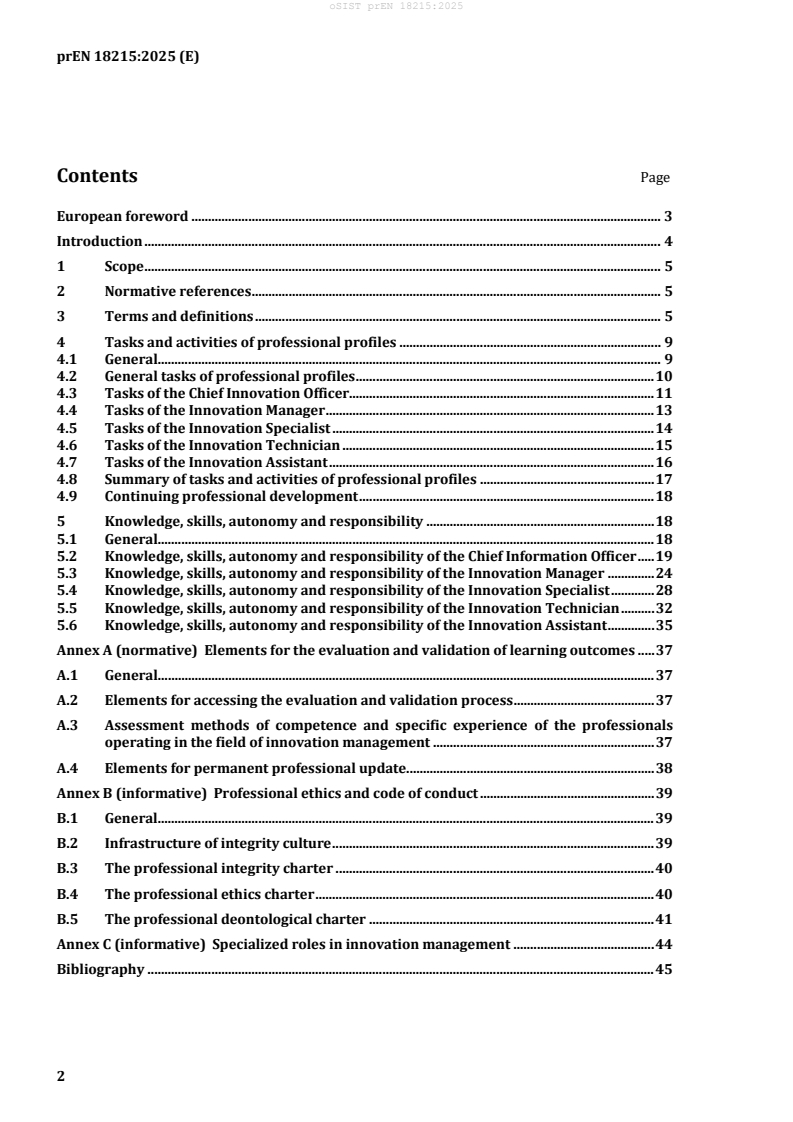
Contents
- Introduction
- 1 Scope
- 2 Normative references
- 3 Terms and definitions
- 3.1 innovation
- 3.2 Chief Innovation Officer
- 3.3 Innovation Manager
- 3.4 Innovation Specialist
- 3.5 Innovation Technician
- 3.6 Innovation Assistant
- 3.7 innovation management
- 3.8 innovation management system
- 3.9 innovation ecosystem
- 3.10 innovation activity
- 3.11 culture
- 3.12 uncertainty
- 3.13 risk
- 3.14 antifragile
- 3.15 value
- 3.16 knowledge
- 3.17 skill
- 3.18 competence
- 3.19 autonomy and responsibility
- 3.20 formal learning
- 3.21 informal learning
- 3.22 non-formal learning
- 4 Tasks and activities of professional profiles
- 4.1 General
- 4.2 General tasks of professional profiles
- 4.3 Tasks of the Chief Innovation Officer
- 4.4 Tasks of the Innovation Manager
- 4.5 Tasks of the Innovation Specialist
- 4.6 Tasks of the Innovation Technician
- 4.7 Tasks of the Innovation Assistant
- 4.8 Summary of tasks and activities of professional profiles
- 4.9 Continuing professional development
- 5 Knowledge, skills, autonomy and responsibility
- 5.1 General
- 5.2 Knowledge, skills, autonomy and responsibility of the Chief Information Officer
- 5.3 Knowledge, skills, autonomy and responsibility of the Innovation Manager
- 5.4 Knowledge, skills, autonomy and responsibility of the Innovation Specialist
- 5.5 Knowledge, skills, autonomy and responsibility of the Innovation Technician
- 5.6 Knowledge, skills, autonomy and responsibility of the Innovation Assistant
- Annex A
- Annex B
- Annex C
- Bibliography
Introduction
Defining the requirements for professional profiles in the field of innovation management is crucial for identifying the core knowledge, skills, and competencies that define these roles. This document applies to professional profiles in this domain, irrespective of working methods or types of employment relationships. The tasks and activities associated with these roles are described based on the actual functions carried out by professionals across diverse work environments. The profiles outlined in this document are not intended to be exhaustive but serve as a flexible framework applicable to various organizational contexts within the innovation management sector. The document is primarily targeted at professionals seeking career development guidance, organizations designing their internal innovation management structures and recruitment strategies, and entities involved in training, accreditation, or certification services. From a methodological perspective, the following key aspects were established:
- Basic terms and definitions (Clause 3): The terms and definitions adopted are primarily derived from the European Qualifications Framework (EQF) and relevant EU terminology.
- Tasks and activities identification (Clause 4): To describe the requirements related to knowledge, skills, autonomy, and responsibility for the specific professional profile, it is essential to first identify the tasks and specific activities associated with the profession.
- Professional requirements (Clause 5): The requirements for the professional profile are defined in terms of knowledge, skills, autonomy, and responsibility. Where applicable, expected personal capabilities are also specified. The level of autonomy and responsibility associated with the professional activities is indicated, using the EQF descriptors as a reference.
- Elements for the evaluation and validation of learning outcomes (Annex A – normative): This annex provides useful elements for the objective evaluation and validation of learning outcomes for professional profiles operating in the field of innovation management, with reference to the competence elements defined in Clause 5.
- Ethical and deontological aspects (Annex B - informative): This annex includes guidance on applicable ethical and deontological principles, alongside a general framework for fostering a culture of professional integrity. This framework is particularly relevant for protecting consumers, users, and other stakeholders.
- Specialized roles in Innovation Management (Annex C – informative): This annex presents a set of specialized roles reflecting emerging practices in innovation management, which may complement the general professional profiles defined in this document.
- Bibliography: A comprehensive list of applicable European references and other relevant documents is provided to support the accurate understanding and application of this document. Where relevant, the guidelines specified in the CEN Guide 14:2010 are also followed.
oSIST prEN 18215:2025 prEN 18215:2025 (E)
1 Scope
This document defines the requirements related to the professional activity of individuals active in the innovation management field at different levels of complexity for all types of organizations, regardless of type, sector, maturity-level or size.
The competence requirements contained in this document are specified based on the identified tasks and activities in terms of knowledge, skills, autonomy and responsibility. The different professional profiles align to the European Qualifications Framework (EQF) to facilitate harmonization to the evaluation and validation of learning outcomes. This document can be used in relation to conformity assessment processes.
2 Normative references
There are no normative references in this document.
3 Terms and definitions
For the purposes of this document, the following terms and definitions apply. ISO and IEC maintain terminology databases for use in standardization at the following addresses:
- ISO Online browsing platform: available at https://www.iso.org/obp/
- IEC Electropedia: available at https://www.electropedia.org/
3.1 innovation
new or changed entity, realizing or redistributing value Note 1 to entry: Novelty and value are relative to, and determined by, the perception of the organization and relevant interested parties.
Note 2 to entry: An innovation can be a product, service, process, model, method, etc. Note 3 to entry: Innovation is an outcome. The word “innovation” sometimes refers to activities or processes resulting in, or aiming for, innovation. When “innovation” is used in this sense, it should always be used with some form of qualifier, e.g. “innovation activities”.
Note 4 to entry: For the purpose of statistical measurement, refer to the Oslo Manual by OECD/Eurostat [XX]. [SOURCE: ISO 56000:2025, 3.1.1]
3.2 Chief Innovation Officer
professional working in the field of innovation management at a political strategic level with a leading role Note 1 to entry: The professional in question is associated with an EQF level of autonomy and responsibility equal to 8 (see 5.2).
3.3 Innovation Manager
professional working in the field of innovation management at a political-strategic level
oSIST prEN 18215:2025 prEN 18215:2025 (E) Note 1 to entry: The professional in question is associated with an EQF level of autonomy and responsibility equal to 7 (see 5.3).
3.4 Innovation Specialist
professional working in the field of innovation management at a tactical-managerial level Note 1 to entry: The professional in question is associated with an EQF level of autonomy and responsibility equal to 6 (see 5.4).
3.5 Innovation Technician
professional working in the field of innovation management at an operational level Note 1 to entry: The professional in question is associated with an EQF level of autonomy and responsibility equal to 5 (see 5.5).
3.6 Innovation Assistant
professional working in the field of innovation management at an operational level, under supervision Note 1 to entry: The professional in question is associated with an EQF level of autonomy and responsibility equal to 4 (see 5.6).
3.7 innovation management
management with regard to innovation Note 1 to entry: Innovation management can include establishing an innovation policy, innovation vision, innovation strategy, and innovation objectives, and organizational structures and innovation processes to achieve those objectives through planning, support, operations, performance evaluation and improvement. [SOURCE: ISO 56000:2025, 3.1.2.1]
3.8 innovation management system
management system with regard to innovation Note 1 to entry: An innovation management system can be part of a general or integrated management system of an organization.
[SOURCE: ISO 56000:2025, 3.1.3.3]
3.9 innovation ecosystem
system of interdependent persons or organizations collectively or collaboratively developing or enabling innovation Note 1 to entry: Ecosystem participants can include private and public organizations. Note 2 to entry: The scope of an innovation ecosystem can be defined in terms of a platform, set of technologies, knowledge area, set of skills, sector, community or geographic area. Note 3 to entry: An innovation ecosystem can range from being an arbitrary group of participants to an orchestrated, multi-party community based on collaborative innovation partnerships.
oSIST prEN 18215:2025 prEN 18215:2025 (E) [SOURCE: ISO 56000:2025, 3.1.3.4]
3.10 innovation activity
activity with regard to innovation Note 1 to entry: Innovation activities can be planned or unplanned and are normally conducted in the context of uncertainty.
Note 2 to entry: Innovation activities are directly or indirectly aiming for innovation. Not all innovation activities result in innovation.
[SOURCE: ISO 56000:2025, 3.1.4]
3.11 culture
shared pattern of beliefs, values and behaviours of an organization or community over time [SOURCE: ISO 56000:2025, 3.2.3]
3.12 uncertainty
state of deficiency of information, understanding, or knowledge Note 1 to entry: Uncertainty can be related to the consequences or likelihood of an event, or the characteristics of an entity.
Note 2 to entry: Uncertainties can be managed by systematically addressing assumptions regarding the consequences, likelihood or characteristics of events and entities, to gain information, understanding and knowledge.
[SOURCE: ISO 56000:2025, 3.2.12]
3.13 risk
effect of uncertainty (3.12) Note 1 to entry: An effect is a deviation from the expected — positive or negative. Note 2 to entry: Uncertainty is the state, even partial, of deficiency of information related to, understanding or knowledge of, an event, its consequence, or likelihood.
Note 3 to entry: Risk is often characterized by reference to potential events and consequences, or a combination of these.
Note 4 to entry: Risk is often expressed in terms of a combination of the consequences of an event (including changes in circumstances) and the associated likelihood of occurrence. [SOURCE: ISO 56000:2025, 3.2.13]
3.14 antifragile
ability to gain from stressors, uncertainty (3.12) and risk (3.13) Note 1 to entry: Stressors can be shocks, failures, disruptions, emergencies, crises, etc.
oSIST prEN 18215:2025 prEN 18215:2025 (E) Note 2 to entry: An antifragile entity can thrive and/or evolve from unexpected stressors, take advantage of uncertainty and positively assume risk.
[SOURCE: ISO 56000:2025, 3.2.14]
3.15 value
gains from satisfying needs and expectations, in relation to the resources used EXAMPLE Revenues, savings, productivity, sustainability, satisfaction, empowerment, engagement, experience, trust.
Note 1 to entry: Value is relative to, and determined by the perception of, the organization and interested parties. Note 2 to entry: Value can be financial or non-financial.
Note 3 to entry: Value can be created, realized, acquired, redistributed, shared, lost or destroyed. Note 4 to entry: The value of an entity is generally determined in terms of the amount of other entities for which it can be exchanged.
Note 5 to entry: The word “value” sometimes refers to a (numerical) unit of data, e.g. the output from measurement, and “values” sometimes refers to principles or standards of behaviour, e.g. included in the concept of culture (3.11). When “value” is used in these senses, it should always be used with some form of qualifier, e.g. “numerical value” or the meaning should be obvious from the context.
[SOURCE: ISO 56000:2025, 3.7.7]
3.16 knowledge
result of the assimilation of information through learning Note 1 to entry: Knowledge can be acquired through, for example, research, experience, education and user feedback.
Note 2 to entry: Knowledge includes information, facts, principles, theories and practices that is related to a field of work or study.
Note 3 to entry: Knowledge can be individual or collective. Collective knowledge is gained from people collaborating and releasing their tacit and subconscious knowledge. [SOURCE: ISO 56000:2025, 3.4.1]
3.17 skill
ability to perform a task or activity
oSIST prEN 18215:2025 prEN 18215:2025 (E) Note 1 to entry: Skills can be acquired through education, training, experience or other means. [SOURCE: ISO 56000:2025, 3.4.4]
3.18 competence
competency ability to apply knowledge (3.16) and skills (3.17) to achieve intended results [SOURCE: ISO 56000:2025, 3.4.2]
3.19 autonomy and responsibility
ability of the individual to apply knowledge (3.16) and skills (3.17) autonomously and with responsibility [SOURCE: EQF, Annex I, definition h), modified - the term “learner” has been replaced by the term “individual”]
3.20 formal learning
learning process deriving from training activities, intentional and structured, carried out by entities/institutions of education and training recognized by a competent authority Note 1 to entry: Formal learning can involve the issues of certificate with legal value.
3.21 informal learning
learning process deriving from work experiences, from family life and also from leisure time Note 1 to entry: Informal learning is not a deliberately structured activity and sometimes learning is not intentional.
3.22 non-formal learning
learning process resulting from training activities, intentional and structured, implemented in any field other than formal Note 1 to entry: Such a training does not issue a certificate with legal value.
4 Tasks and activities of professional profiles
4.1 General
This document defines five distinct professional levels, the related tasks and specific activities of which are described in the following subclauses:
- Chief Innovation Officer: 4.3,
- Innovation Manager: 4.4,
- Innovation Specialist: 4.5,
- Innovation Technician: 4.6,
- Innovation Assistant: 4.7.
oSIST prEN 18215:2025 prEN 18215:2025 (E) The tasks and specific activities attributed to each level reflect the intention to identify the different organizational levels at which these professionals are expected to operate, in accordance with the corresponding definitions (see 3.2, 3.3, 3.4, 3.5, and 3.6). These levels are identified as:
- political-strategic,
- tactical-managerial, and
- operational.
This approach is consistent with both the characterization of the EQF descriptors (see 5.2 to 5.6), as well as with the HS-based approach used in management systems.
Annex C provides examples of specialized roles that may be assumed in addition to the general professional profiles, depending on the organizational context. The formulation of the tasks presented in the following clauses is based on the following methodological considerations:
- some tasks are common to all professional levels, but are performed with different degrees of autonomy and responsibility, in accordance with the respective EQF level;
- other tasks are exclusive to higher professional levels, as they require advanced competence and the capacity to act with strategic and organizational impact;
- professionals at a higher EQF level perform additional and distinctive tasks;
- the performance of such additional and distinctive tasks requires the acquisition and application of additional or advanced knowledge and skills (see 5.1).
In light of these considerations, subclause 4.2 defines the general tasks, which are subsequently detailed through the specific activities corresponding to each professional level in 4.3 to 4.7.
4.2 General tasks of professional profiles
The following set of general tasks outlines the key activities carried out by professionals involved in the field of innovation management.
These tasks follow a logical sequence and cover the key activity areas of innovation management, from building relationships and gathering information to defining strategy, managing initiatives, and, where applicable, integrating innovation into organizational systems. Each task is performed with a corresponding degree of knowledge, skills, and autonomy and responsibility appropriate to each profile, according to the related EQF level also. The tasks are defined as follows, together with brief descriptions which are intended to support understanding and implementation:
- T1 – Manage relationships with relevant people and functions within and outside the organization in the innovation field of the organization Initiating and maintaining relationships within the organization and with the external innovation ecosystem to enable information flow, cooperation, and alignment.
- T2 – Gather, structure, interpret, and manage data, information and knowledge within the innovation field of the organization Developing a robust knowledge base to support strategic and operational innovation decisions.
oSIST prEN 18215:2025 prEN 18215:2025 (E) - T3 – Establish and implement the innovation strategy and related objectives Formulating strategic directions and innovation goals based on contextual analysis and organizational ambition.
- T4 – Take decisions about innovation initiatives and assess their impact Selecting, prioritizing and committing to specific innovation actions, in line with strategic intent.
- T5 – Undertake innovation paths according to the ISO Standard 5600X family (where appropriate).
Undertaking innovation paths with reference to the ISO 5600X standards, which provide guidance for structured and coherent approaches to innovation.
- T6 – Apply Innovation Management Principles (IMPs) within the organization's management system Integrate Innovation Management Principles (IMPs) into the organization and its processes to support and align innovation activities with strategic objectives.
- T7 – Adopt an HS-Based (Harmonized Structure) approach to manage the organization's innovation initiatives Structuring innovation processes using a consistent and integrated management framework.
- T8 – Make a strategic decision to have an IMS (where applicable) Formally committing to the establishment of an Innovation Management System to structure and manage innovation processes within the organization
- T9 – Implement, maintain, and improve the IMS (where applicable) Implementing, managing, and continuously improving the Innovation Management System to ensure its effectiveness and alignment with organizational goals.
- T10 – Integrate the IMS with other management systems (where applicable) Creating synergies by aligning the IMS with other existing management systems, such as those for quality or environment.
- T11 – Communicate information, train, and advise on Innovation Management Fostering innovation capabilities and culture through targeted internal communication, training, and advisory support on Innovation Management.
4.3 Tasks of the Chief Innovation Officer
The tasks and specific activities of the Chief Innovation Officer are defined as follows:
- T1 – Manage relationships with relevant people and functions within and outside the organization in the innovation field of the organization
oSIST prEN 18215:2025 prEN 18215:2025 (E) Provide strategic leadership in managing key relationships within the organization's innovation field, ensuring alignment with its innovation strategy and fostering active engagement with external stakeholders within the innovation ecosystem.
...