

kSIST FprEN IEC 55032:2026
(Main)Electromagnetic compatibility of multimedia equipment - Emission requirements
- Status
- Not Published
- Public Enquiry End Date
- 31-Jan-2026
- Technical Committee
- EMC - Electromagnetic compatibility
- Current Stage
- 5020 - Formal vote (FV) (Adopted Project)
- Start Date
- 10-Nov-2026
- Due Date
- 29-Dec-2026
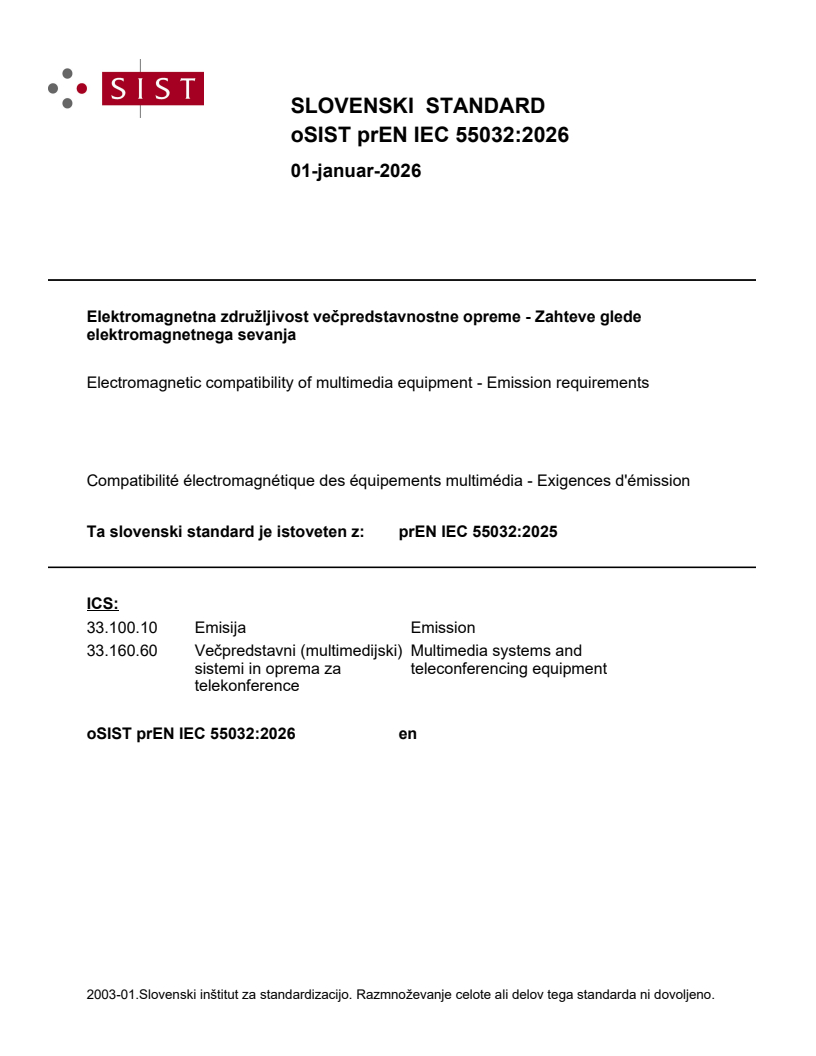

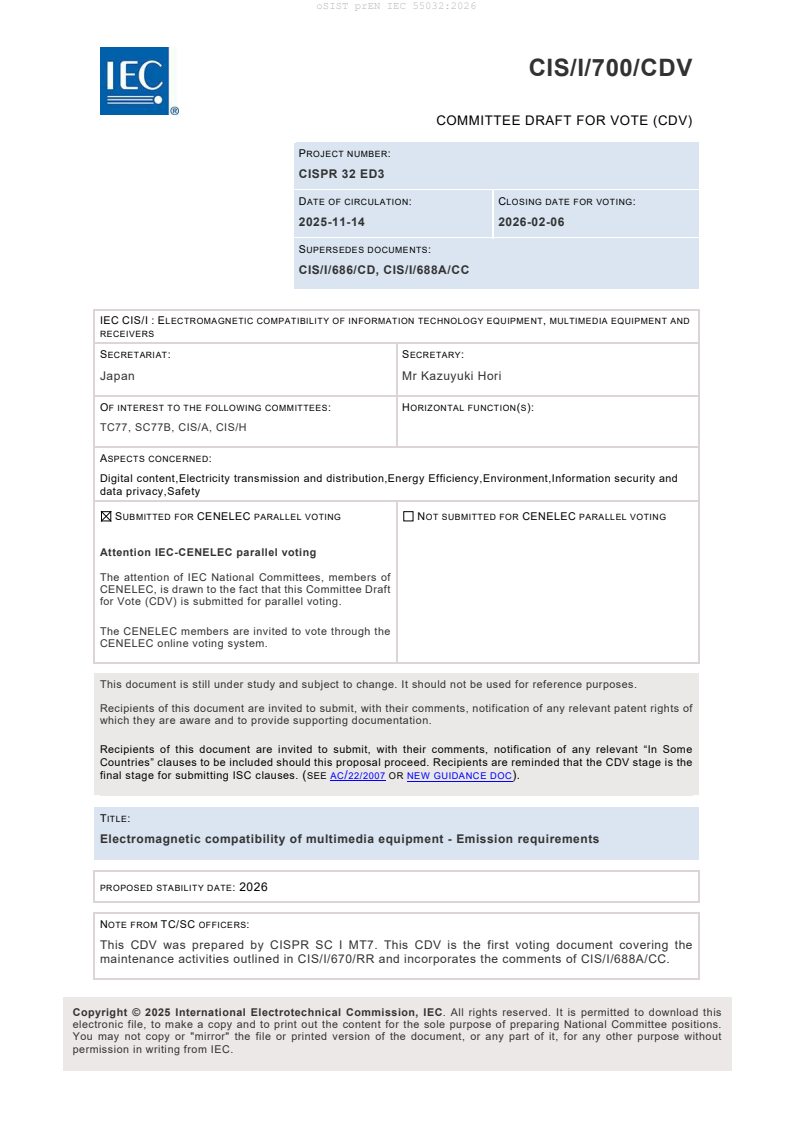
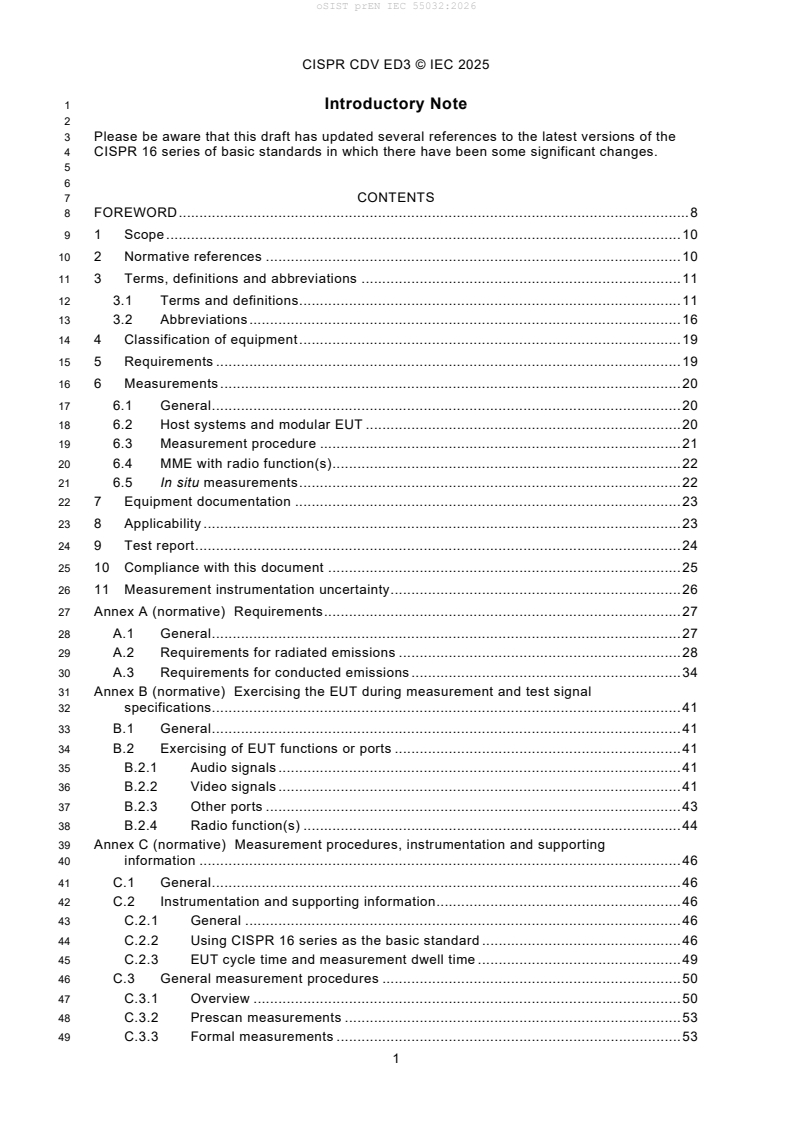
kSIST FprEN IEC 55032:2026 is the SIST publication of IEC/CISPR 32, Electromagnetic compatibility of multimedia equipment - Emission requirements. It specifies radiated and conducted emission requirements, measurement methods, and reporting rules for multimedia equipment (MME) with rated r.m.s. AC or DC supply voltage not exceeding 600 V. The SIST publication is identical to prEN IEC 55032:2025.
What does kSIST FprEN IEC 55032:2026 specify?
kSIST FprEN IEC 55032:2026 defines the emission compliance framework for MME and shows how to measure it in a repeatable way. Clause 1 gives the scope, Clauses 2 to 11 cover references, terms, classification, requirements, measurements, documentation, applicability, test report, compliance, and measurement uncertainty.
| Annex | What it covers |
|---|---|
| Annex A | Normative emission requirements and limits, including radiated and conducted emissions, plus special cases such as FM receivers and outdoor units of home satellite broadcast receiving systems |
| Annex B | How to exercise the EUT during measurement and the test signal specifications |
| Annex C | Measurement procedures, instrumentation, supporting information, and port-specific methods |
| Annex D | Arrangement of the EUT, local AE, and associated cabling |
| Annex E | Prescan measurements |
| Annex F | Test report contents summary |
| Annex G | Support information for the procedures in C.4.1.1 |
| Annex H | Outdoor unit of home satellite broadcast receiving systems |
| Annex I | Other test methods and associated limits for radiated emissions, including GTEM |
| Annex J | Colour bar image |
| Annex K | Guidance on testing MME incorporating radiocommunication or radiodetermination functionality |
| Annex L | In situ measurement |
| Annex M | Explanation of the changes to radiated electric field emission requirements above 1 GHz in CISPR 32 Edition 2 Amendment 1 |
| Annex N | Use of VHF-LISN for radiated emission measurements |
What are the key requirements of kSIST FprEN IEC 55032:2026?
Scope, classes, and what is being controlled
Clause 1 limits the document to MME with rated r.m.s. AC or DC supply voltage not exceeding 600 V. It includes professional-use equipment, battery-powered equipment, and MME with radio functions, but it excludes intentional radio transmissions and emissions that are exclusively from a radiocommunication or radiodetermination function.
Clause 4 divides covered products into Class A and Class B equipment. That class choice matters because Annex A gives different limits and sometimes different measurement arrangements for the two classes.
Limits and measurement methods
Clause 5, together with Annex A, is the core compliance part of the document. Annex A sets radiated emission limits, conducted emission limits, and special procedures for cases such as AC mains power ports, DC network power ports, wired network ports, optical fibre ports with metallic shield or metallic tension members, broadcast receiver tuner ports, RF modulator output ports, FM receivers, and outdoor units of home satellite broadcast receiving systems.
For radiated emissions, Annex A separates measurements below 1 GHz from those above 1 GHz and ties them to the appropriate facility and detector type. In practice, the tester must select the correct table clause for the product class, frequency range, and test site, then show that all applicable limits are met.
Clause 6 and Annex C define how to perform the measurements. The document uses prescan measurements to find the operating mode and frequencies with the highest emissions, then formal measurements to confirm compliance. This matters because the final result depends on using the right mode, detector, bandwidth, and arrangement of the EUT, local AE, and cabling.
Annex B tells users how to exercise the EUT during testing. It requires representative operating modes, including low-power or standby modes where relevant, and it covers display and video settings, broadcast receiver tuner ports, wired network ports, and other ports. The practical effect is that the equipment must be tested in a realistic mode that can produce the highest emission level.
Measurement set-up, special cases, and frequency range
Clause 6 and Table 1 set the highest radiated measurement frequency. For most equipment, the practical upper limit is 6 GHz; for outdoor units of home satellite broadcast receiving systems, it is 18 GHz. If the highest internal frequency source is unknown, radiated measurements go to 6 GHz.
Annex D fixes the physical arrangement of the test. It covers table-top, floor standing, combined table-top and floor standing arrangements, and the arrangements used for FAR, ALTS, and RVC measurements. In practice, the equipment, local AE, cable routing, heights, spacing, and ground-plane distances are part of the compliance method, not just the room layout.
Annex L adds in situ measurement. That gives a formal route for conducted and radiated emission measurements at the installation site, and Clause 9 requires the report to say clearly when in situ testing was used. This is important when a standard chamber setup is not practical.
Reporting, documentation, and uncertainty
Clauses 7, 9, 10, and 11 define what has to be documented. The test report must identify the operating mode, how the ports were exercised, the method used, the limits applied, the class claimed, the six highest emissions relative to the limit for each detector type, and the calculated measurement instrumentation uncertainty.
Annex F summarizes the report content, and Clause 10 ties compliance to the applicable limits in Annex A. The result is a report that can be reviewed and repeated without guessing how the measurement was done.
What terms does kSIST FprEN IEC 55032:2026 define?
- Multimedia equipment (MME) - the equipment category covered by the document, including products used for multimedia functions and related broadcast or networked functions.
- Equipment under test (EUT) - the specific product, assembly, or module being measured for emission compliance.
- Associated equipment (AE) - equipment used with the EUT during the test, such as signal sources or companion units needed for normal operation.
- Artificial antenna (AAN) - a coupling network used for certain unscreened balanced pairs so the common-mode measurement condition is controlled and repeatable.
- Capacitive voltage probe (CVP) - a probe used to measure emission voltage on certain ports where a voltage-based method is specified.
- Common-mode current probe (CP) - a probe used to measure common-mode current on a cable or port under test.
- Low coupling loss (LCL) - a property of the AAN that describes how well the network couples to the pair under test; it affects which measurement method can be used reliably.
- Reverberation chamber (RVC) - a chamber method used for some radiated emission measurements under the normative procedure in Annex A.
Who uses kSIST FprEN IEC 55032:2026?
EMC test laboratories use kSIST FprEN IEC 55032:2026 to set up radiated and conducted emission tests and to write formal test reports. Certification bodies and conformity assessment teams use it to judge whether an MME product meets Class A or Class B emission limits.
Manufacturers of multimedia equipment use it during product design and verification, especially for equipment with display, audio, broadcast receiver, wired network, DC power, or radio functions. Quality managers and buyers use it to specify what has to be tested, which operating modes matter, and what evidence should appear in the report.
What changed in kSIST FprEN IEC 55032:2026 from the previous edition?
The foreword states that this third edition is a technical revision. It lists these changes:
- numerous maintenance items were added to improve testing of MME
- the scope was aligned and updated
- in situ methods and requirements were incorporated
- TV tuner port requirements were revised
- APD methods and limits were included
- conducted requirements below 950 MHz were added for satellite broadcast receiver tuner ports
- editorial improvements and corrections from Edition 2 Amendment 1 were included
- DC network port requirements were added
- testing of MME with radio function was added
- an informative annex explains the changes above 1 GHz in Edition 2 Amendment 1
- an informative annex was added on VHF-LISN use to improve test reproducibility
- references were updated to the latest basic standards
- the RVC methodology was moved from informative to normative
Which standards are used with kSIST FprEN IEC 55032:2026?
- CISPR 16-1-1:2015 and CISPR 16-1-1:2019 - define the measuring apparatus used for disturbance measurements.
- CISPR 16-1-2:2014 and CISPR 16-1-2:2014/AMD1:2017 - provide coupling devices for conducted disturbance measurements.
- CISPR 16-1-4:2019 and its amendments - define antennas and test sites for radiated disturbance measurements.
- CISPR 16-1-5:2014 and CISPR 16-1-5:2014/AMD1:2016 - cover antenna calibration sites and reference test sites for 5 MHz to 18 GHz.
- CISPR 16-1-6:2014 and its amendments - cover EMC antenna calibration.
- CISPR 16-2-1:2014 and CISPR 16-2-1:2014/AMD1:2017 - provide the conducted disturbance measurement methods used in Annex C and Annex A.
- CISPR 16-2-3:2016 and its amendments - provide the radiated disturbance measurement methods used for the main compliance measurements.
- CISPR 16-4-2:2011 and its amendments - provide the measurement instrumentation uncertainty method used in Clause 11.
What does the kSIST FprEN IEC 55032:2026 document contain?
kSIST FprEN IEC 55032:2026 contains the normative limit tables, the test-condition tables, and the measurement procedures needed to assess emission compliance. It also contains many figures showing port examples, test arrangements, antenna and cable layouts, detector decision trees, GTEM arrangements, and satellite broadcast receiver setups.
The annexes provide the working detail that the main clauses refer to: port exercising rules, prescan guidance, report content, cable and probe arrangements, and special measurement methods for radio-function equipment, in situ testing, and home satellite broadcast receiving systems. Several informative annexes also explain the technical background for the above-1 GHz changes and the optional VHF-LISN method.
Relations
- Effective Date
- 20-Feb-2024
- Effective Date
- 20-Feb-2024
- Revises
SIST EN 55032:2015 - Electromagnetic compatibility of multimedia equipment - Emission Requirements - Effective Date
- 20-Feb-2024
- Effective Date
- 20-Feb-2024
- Effective Date
- 20-Feb-2024
Get Certified
Connect with accredited certification bodies for this standard

ANCE
Mexican certification and testing association.

Intertek Slovenia
Intertek testing, inspection, and certification services in Slovenia.

LNE (Laboratoire National de Métrologie et d'Essais)
French national laboratory for metrology and testing.
Sponsored listings
Frequently Asked Questions
kSIST FprEN IEC 55032:2026 is a draft published by the Slovenian Institute for Standardization (SIST). Its full title is "Electromagnetic compatibility of multimedia equipment - Emission requirements". This standard covers: Electromagnetic compatibility of multimedia equipment - Emission requirements
Electromagnetic compatibility of multimedia equipment - Emission requirements
kSIST FprEN IEC 55032:2026 is classified under the following ICS (International Classification for Standards) categories: 33.100.10 - Emission; 33.160.60 - Multimedia systems and teleconferencing equipment. The ICS classification helps identify the subject area and facilitates finding related standards.
kSIST FprEN IEC 55032:2026 has the following relationships with other standards: It is inter standard links to SIST EN 55032:2015/FprAB:2026, SIST EN 55032:2015/A1:2021, SIST EN 55032:2015, SIST EN 55032:2015/A11:2020, SIST EN 55032:2015/AC:2016. Understanding these relationships helps ensure you are using the most current and applicable version of the standard.
kSIST FprEN IEC 55032:2026 is associated with the following European legislation: EU Directives/Regulations: 2014/30/EU, 2014/53/EU; Standardization Mandates: M/536, M/552. When a standard is cited in the Official Journal of the European Union, products manufactured in conformity with it benefit from a presumption of conformity with the essential requirements of the corresponding EU directive or regulation.
kSIST FprEN IEC 55032:2026 is available in PDF format for immediate download after purchase. The document can be added to your cart and obtained through the secure checkout process. Digital delivery ensures instant access to the complete standard document.
Standards Content (Sample)
Contents
- 101 H.3 Operation conditions
- 102 H.4 EUT arrangements
- 103 H.4.1 Conducted measurements (table clause A8.4)
- 104 H.4.2 Radiated measurements
- 105 Annex I (informative) Other test methods and associated limits for radiated emissions
- 106 I.1 General
- 107 I.2 Procedures for radiated emission measurements using a GTEM
- 108 I.3 Additional measurement procedure information
- 109 I.3.1 General
- 110 I.3.2 Specific considerations for radiated emission measurements using 111 a GTEM
- 112 I.4 Use of a GTEM for radiated emission measurements
- 113 I.4.1 General
- 114 I.4.2 EUT layout
- 115 I.4.3 GTEM, measurements above 1 GHz
- 116 I.4.4 Uncertainties
- 117 I.5 Reference documents
- 118 Annex J (informative) Colour bar image
- 119 J.1 Overview
- 120 J.2 Image description
- 121 J.3 Primary colour contributions and saturation
- 122 J.4 Moving element
- 123 Annex K (informative) Guidance on testing MME incorporating radiocommunication or 124 radiodetermination functionality
- 125 K.1 Introduction
- 126 K.2 MME with radio functionality
- 127 K.3 Test arrangements
- 128 Annex L (normative) In situ measurement
- 129 L.1 General
- 130 L.2 In situ conducted emission measurement
- 131 L.2.1 General
- 132 L.2.2 Mains power ports
- 133 L.2.3 Analogue/digital data ports
- 134 L.3 In situ radiated emission measurement
- 135 L.3.1 General
- 136 L.3.2 Ambient noise
- 137 Annex M (informative) Explanation of the changes to radiated electric field emission 138 requirements for frequencies above 1 GHz in CISPR 32 Edition 2 Amendment 1
- 139 M.1 Introduction
- 140 M.2 Original requirements development
- 141 M.2.1 FCC 47 CFR 15
- 142 M.2.2 Test method
- 143 M.2.3 Original 4 dB limit reduction
- 144 M.2.4 Class A limits
- 145 M.3 Problems found from the measurement of actual equipment
- 146 M.4 Solutions to the problems
- 147 M.5 CISPR 16-4-4 Model
- 148 Annex N (informative) Use of VHF-LISN for radiated emission measurements
- 149 N.1 Introduction
...