

SIST EN 55032:2015/FprAB:2026
(Amendment)Electromagnetic compatibility of multimedia equipment - Emission requirements
- Abstract
Amendment of items as required to ensure listing in OJEU
- Status
- Not Published
- Public Enquiry End Date
- 28-Feb-2025
- Technical Committee
- EMC - Electromagnetic compatibility
- Current Stage
- 5020 - Formal vote (FV) (Adopted Project)
- Start Date
- 07-Jul-2026
- Due Date
- 25-Aug-2026
- Completion Date
- 08-Jul-2026



SIST EN 55032:2015/FprAB:2026 is a draft amendment to EN 55032:2015 for electromagnetic compatibility of multimedia equipment, focused on emission requirements. It updates wording, references, and test-related clauses so the standard can be cited in the EU Official Journal. Engineers, test laboratories, and compliance teams use it when assessing radiated and conducted emissions from multimedia equipment.
What does SIST EN 55032:2015/FprAB:2026 specify?
SIST EN 55032:2015/FprAB:2026 specifies amendments to EN 55032:2015, not a stand-alone emission standard. Its scope is limited to the changes needed to improve legal certainty for citation in the EU Official Journal and to align the European text with current references and measurement practice.
The amendment touches the main technical and administrative parts of the base standard. It modifies Clauses 1 to 11, Annexes A, B, C, D, F, G, H, I, ZA and ZZ, and the Bibliography. Clause 7 in the European version is replaced by a statement that the clause is not used.
| Annex | What it covers |
|---|---|
| Annex A | Class A and Class B emission requirements, including radiated and conducted emissions |
| Annex B | How to exercise audio, video and other signals during testing |
| Annex C | Measurement methods and set-ups for radiated and conducted emissions |
| Annex D | EUT, AE and cabling arrangements for measurements |
| Annex F | Test report contents summary |
| Annex G | Combination of current and voltage limit |
| Annex ZA | Normative references to European publications |
| Annex ZZ | Relationship with Directive 2014/30/EU |
What are the key requirements of SIST EN 55032:2015/FprAB:2026?
SIST EN 55032:2015/FprAB:2026 keeps the core compliance model of EN 55032:2015, where the EUT has to meet either Class A or Class B requirements in Annex A. The amendment also clarifies how to choose measurement methods, how to configure ports and cables, and what has to be recorded in the report.
Compliance and measurement choice
Clause 10 states that compliance is shown by meeting the Class A or Class B requirements in Annex A, as appropriate. It also says the alternative measurement methods in the document are equivalent, so a lab may use any of them with the specified limits and restrictions. In practice, this gives flexibility in test planning, but the chosen method still has to match the port type and the configuration under test.
Ports, hosts and modules
Subclause 6.1 says that if one port fits more than one port type, the requirements for each relevant port type apply. If a port can support screened and unscreened cables, both cable types have to be considered. This matters because mixed-function ports are common in multimedia equipment and can otherwise be under-tested.
Subclause 6.2 requires self-contained modules intended for use with a host to be assessed in at least one representative host system. Modules that can be internal, mounted, plug-in or external have to be assessed in each applicable configuration to find the worst case. The host and modules used during testing have to be listed in the report.
Measurement arrangement and exercise of the EUT
Subclause 6.3 requires a representative arrangement of the EUT, local AE and associated cabling. The EUT and AE may be arranged as floor-standing, table-top, or combinations of these, and the methods in Table A.1, Table A.8 and Annex C are used together with the exercise methods in Annex B. Prescan measurements may be used to find the cable arrangement that gives the highest emission level.
Signal exercise methods
Annex B tightens how equipment is exercised during testing. Audio-capable EUTs are exercised with a 1 kHz sinusoidal signal unless another frequency better fits the operational acoustic range, and the frequency used has to be recorded. Video ports are exercised at the highest complexity level the EUT can generate, while other ports are exercised by the methods in Table B.3 and the method used is recorded.
Instrumentation, antennas and measurement distance
Subclause C.2.2.1 requires the measuring receiver to meet CISPR 16-1-1 and says the detector and bandwidth come from the tables in Annex A. Subclause C.2.2.2 allows suitable broadband linearly polarised antennas or tuned dipoles, calibrated in free space conditions using CISPR 16-1-6 and CISPR 16-1-5. Subclause C.2.2.4 allows a different validated measurement distance, with the limit recalculated from the selected distance.
Cable routing and conducted-emission set-ups
Annex D gives detailed rules for cable type, routing and loading. Cables used in the set-up have to reflect normal or typical use, and mitigation features such as screening or ferrites should only be used if they are intended for all deployments. For conducted emissions, the EUT grounding and AMN connections are specified, and mains cables are routed vertically then horizontally unless a different arrangement is typical of normal use.
Uncertainty and reporting
Clause 11 requires measurement instrumentation uncertainty to be calculated according to CISPR 16-4-2 and reported, but the emission limits are not modified by that uncertainty when deciding compliance. Annex F summarizes what the report has to contain, including the measurement arrangement, host and modules, port exercise, class of limit, measurement distance, cabling disposition, uncertainty, and the compliance statement.
What terms does SIST EN 55032:2015/FprAB:2026 define?
SIST EN 55032:2015/FprAB:2026 uses a set of EMC terms that are central to testing and reporting.
- Equipment under test (EUT) - the multimedia equipment being measured for emissions.
- Auxiliary equipment (AE) - supporting equipment used with the EUT during testing.
- Artificial mains network (AMN) - the network used to provide a standardized mains connection for conducted-emission measurements.
- Artificial ancillary network (AAN) - a standardized network used for some wired network port measurements.
- Common mode voltage probe (CVP) - a probe used in conducted-emission methods that combine voltage and current measurement.
- Reference ground plane (RGP) - the conductive reference plane used in the test arrangement.
- Normalized site attenuation (NSA) - a site parameter used to describe and validate radiated-emission measurement conditions.
Who uses SIST EN 55032:2015/FprAB:2026?
SIST EN 55032:2015/FprAB:2026 is used by manufacturers of multimedia equipment, EMC test laboratories, and conformity assessment teams. It is also relevant to quality managers and buyers who need evidence that a product has been tested using the correct emission standard. The practical tasks are test planning, configuration of EUT and AE, measurement reporting, and technical review of emission results.
What changed in SIST EN 55032:2015/FprAB:2026 from the previous edition?
SIST EN 55032:2015/FprAB:2026 modifies EN 55032:2015 to improve legal certainty for citation in the EU Official Journal. The amendment updates normative references, clarifies port classification and host/module assessment, revises measurement and reporting clauses, and replaces Annex ZA and Annex ZZ to reflect the current European legal relationship with Directive 2014/30/EU.
Which standards are used with SIST EN 55032:2015/FprAB:2026?
SIST EN 55032:2015/FprAB:2026 relies on several companion standards for measurement methods, instrumentation and reporting.
- CISPR 16-1-1 - specifies measuring apparatus used by the receiver.
- CISPR 16-1-2 - covers coupling devices for conducted disturbance measurements.
- CISPR 16-1-4 - covers antennas and test sites for radiated disturbance measurements.
- CISPR 16-1-5 - covers antenna calibration sites and reference test sites.
- CISPR 16-1-6 - covers EMC antenna calibration.
- CISPR 16-2-1 - covers conducted disturbance measurement methods.
- CISPR 16-2-3 - covers radiated disturbance measurement methods.
- CISPR 16-4-2 - covers measurement instrumentation uncertainty.
- IEC 61000-4-6 - supports conducted-disturbance test techniques and some load/adaptor details.
- ISO/IEC 17025 - provides the laboratory competence and reporting framework.
- CISPR TR 16-4-5 - gives guidance on alternative test methods and their equivalence.
- IEEE Std 802.3 - is cited in the bibliography for Ethernet physical-layer context.
What does the SIST EN 55032:2015/FprAB:2026 document contain?
SIST EN 55032:2015/FprAB:2026 contains amendment text that revises wording in clauses and annexes rather than reproducing the full underlying standard. It includes updated tables, revised test-report content, and changes to measurement set-ups for radiated and conducted emissions. It also adds or revises figures and procedures used for EUT arrangement, antenna use, common-mode measurements, and cable impedance-related methods. The document is used in design verification, EMC testing, and compliance documentation for multimedia equipment.
Relations
- Effective Date
- 28-Feb-2023
- Amends
SIST EN 55032:2015 - Electromagnetic compatibility of multimedia equipment - Emission Requirements - Effective Date
- 28-Feb-2023
- Effective Date
- 20-Feb-2024
Get Certified
Connect with accredited certification bodies for this standard

ANCE
Mexican certification and testing association.

Intertek Slovenia
Intertek testing, inspection, and certification services in Slovenia.

LNE (Laboratoire National de Métrologie et d'Essais)
French national laboratory for metrology and testing.
Sponsored listings
Frequently Asked Questions
SIST EN 55032:2015/FprAB:2026 is a draft published by the Slovenian Institute for Standardization (SIST). Its full title is "Electromagnetic compatibility of multimedia equipment - Emission requirements". This standard covers: Amendment of items as required to ensure listing in OJEU
Amendment of items as required to ensure listing in OJEU
SIST EN 55032:2015/FprAB:2026 is classified under the following ICS (International Classification for Standards) categories: 33.100.10 - Emission; 33.160.60 - Multimedia systems and teleconferencing equipment. The ICS classification helps identify the subject area and facilitates finding related standards.
SIST EN 55032:2015/FprAB:2026 has the following relationships with other standards: It is inter standard links to SIST EN 55032:2015/A1:2021, SIST EN 55032:2015, kSIST FprEN IEC 55032:2026. Understanding these relationships helps ensure you are using the most current and applicable version of the standard.
SIST EN 55032:2015/FprAB:2026 is associated with the following European legislation: EU Directives/Regulations: 2014/30/EU, 2014/53/EU; Standardization Mandates: M/536, M/552. When a standard is cited in the Official Journal of the European Union, products manufactured in conformity with it benefit from a presumption of conformity with the essential requirements of the corresponding EU directive or regulation.
SIST EN 55032:2015/FprAB:2026 is available in PDF format for immediate download after purchase. The document can be added to your cart and obtained through the secure checkout process. Digital delivery ensures instant access to the complete standard document.
Standards Content (Sample)
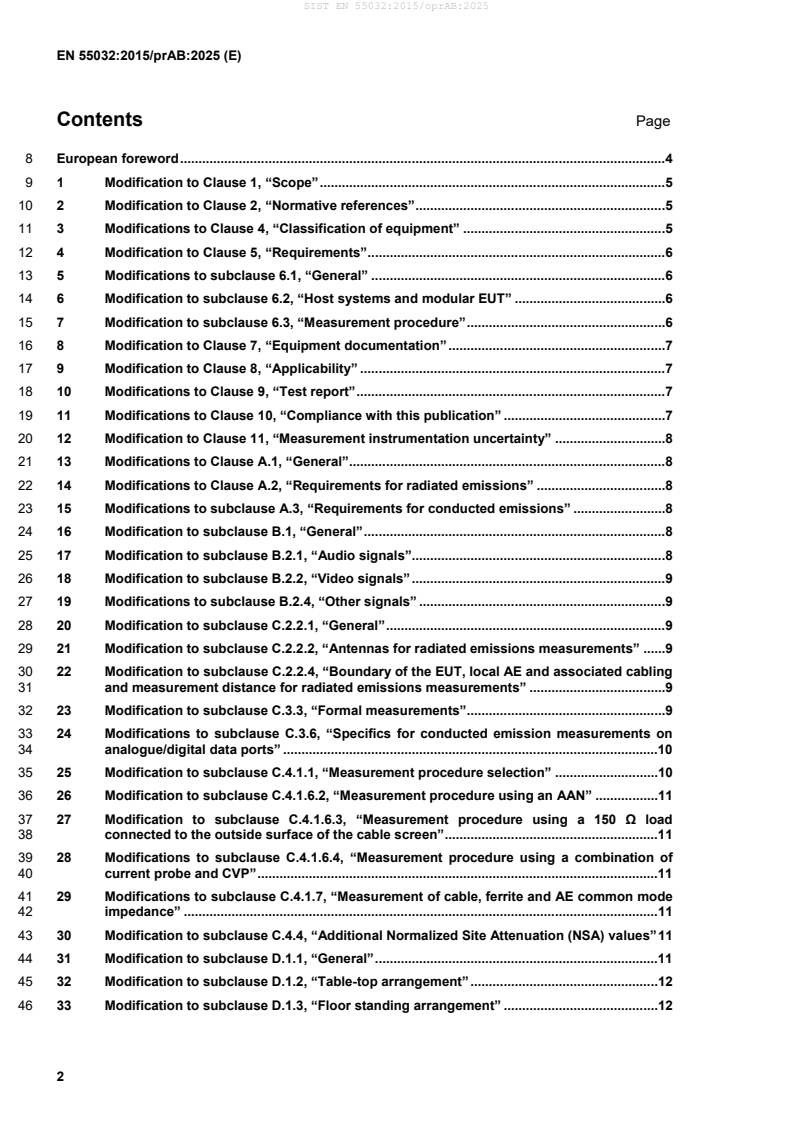
Contents
- 8 European foreword
- 9 1 Modification to Clause 1, “Scope”
- 10 2 Modification to Clause 2, “Normative references”
- 11 3 Modifications to Clause 4, “Classification of equipment”
- 12 4 Modification to Clause 5, “Requirements”
- 13 5 Modifications to subclause 6.1, “General”
- 14 6 Modification to subclause 6.2, “Host systems and modular EUT”
- 15 7 Modification to subclause 6.3, “Measurement procedure”
- 16 8 Modification to Clause 7, “Equipment documentation”
- 17 9 Modification to Clause 8, “Applicability”
- 18 10 Modifications to Clause 9, “Test report”
- 19 11 Modifications to Clause 10, “Compliance with this publication”
- 20 12 Modification to Clause 11, “Measurement instrumentation uncertainty”
- 21 13 Modifications to Clause A.1, “General”
- 22 14 Modifications to Clause A.2, “Requirements for radiated emissions”
- 23 15 Modifications to subclause A.3, “Requirements for conducted emissions”
- 24 16 Modification to subclause B.1, “General”
- 25 17 Modification to subclause B.2.1, “Audio signals”
- 26 18 Modification to subclause B.2.2, “Video signals”
- 27 19 Modifications to subclause B.2.4, “Other signals”
- 28 20 Modification to subclause C.2.2.1, “General”
- 29 21 Modification to subclause C.2.2.2, “Antennas for radiated emissions measurements”
- 30 22 Modification to subclause C.2.2.4, “Boundary of the EUT, local AE and associated cabling 31 and measurement distance for radiated emissions measurements”
- 32 23 Modification to subclause C.3.3, “Formal measurements”
- 33 24 Modifications to subclause C.3.6, “Specifics for conducted emission measurements on 34 analogue/digital data ports”
- 35 25 Modification to subclause C.4.1.1, “Measurement procedure selection”
- 36 26 Modification to subclause C.4.1.6.2, “Measurement procedure using an AAN”
- 37 27 Modification to subclause C.4.1.6.3, “Measurement procedure using a 150 Ω load 38 connected to the outside surface of the cable screen”
- 39 28 Modifications to subclause C.4.1.6.4, “Measurement procedure using a combination of 40 current probe and CVP”
- 41 29 Modifications to subclause C.4.1.7, “Measurement of cable, ferrite and AE common mode 42 impedance”
- 43 30 Modification to subclause C.4.4, “Additional Normalized Site Attenuation (NSA) values” 11 44 31 Modification to subclause D.1.1, “General”
- 45 32 Modification to subclause D.1.2, “Table-top arrangement”
- 46 33 Modification to subclause D.1.3, “Floor standing arrangement”
47 34 Modification to subclause D.1.5, “Arrangements for radiated measurement in a FAR” .... 12 48 35 Modification to subclause D.2.1, “General”............................................................................. 12 49 36 Modification to subclause D.3.1, “General”............................................................................. 13 50 37 Modification to Annex F, “Test report contents summary” ................................................... 13 51 38 Modification to subclause G.2.4, “Combination of current and voltage limit” .................... 14 52 39 Modification to Clause H.2, “General” ..................................................................................... 14 53 40 Modification to Clause I.1, “General” ....................................................................................... 14 54 41 Replacement of Annex ZA, “Normative references to international publications with their 55 corresponding European publications” and Annex ZZ, “Relationship between this 56 European standard and the essential requirements of Directive 2014/30/EU [2014 OJ L96] 57 aimed to be covered” ................................................................................................................. 14 58 42 Modification to Bibliography ..................................................................................................... 19 59 European foreword 60 This document (EN 55032:2015/prAB:2025) has been prepared by CLC/TC 210 “Electromagnetic Compatibility 61 (EMC)”.
62 This document is currently submitted to the Enquiry.
63 The following dates are proposed:
- latest date by which the existence of this (doa) dav + 6 months document has to be announced at national level
- latest date by which this document has to be (dop) dav + 12 months implemented at national level by publication of an identical national standard or by endorsement
- latest date by which the national standards (dow) dav + 36 months conflicting with this document have to be (to be confirmed or withdrawn modified when voting) 64 EN 55032:2015/prAB:2025 introduces modifications to improve legal certainty for citation in the EU Official 65 Journal.
66 This document has been prepared under a standardization request addressed to CENELEC by the European 67 Commission. The Standing Committee of the EFTA States subsequently approves these requests for its 68 Member States.
69 For the relationship with EU Legislation, see informative Annex ZZ, which is an integral part of this document.
70 1 Modification to Clause 1, “Scope” 71 Delete the note.
72 In six places replace the words “this publication” with “this document”.
73 2 Modification to Clause 2, “Normative references” 74 Replace all references with:
1 75 CISPR 16-1-1:2015, Specification for radio disturbance and immunity measuring apparatus and methods – 76 Part 1-1: Radio disturbance and immunity measuring apparatus – Measuring apparatus 2 77 CISPR 16-1-2:2014, Specification for radio disturbance and immunity measuring apparatus and methods – 78 Part 1-2: Radio disturbance and immunity measuring apparatus – Coupling devices for conducted disturbance 79 measurements 3 80 CISPR 16-1-4:2019, Specification for radio disturbance and immunity measuring apparatus and methods – 81 Part 1-4: Radio disturbance and immunity measuring apparatus – Antennas and test sites for radiated 82 disturbance measurements 4 83 CISPR 16-1-5:2014, Specification for radio disturbance and immunity measuring apparatus and methods – 84 Part 1-5: Radio disturbance and immunity measuring apparatus – Antenna calibration sites and reference test 85 sites for 5 MHz to 18 GHz 5 86 CISPR 16-1-6:2014, Specification for radio disturbance and immunity measuring apparatus and methods – 87 Part 1-6: Radio disturbance and immunity measuring apparatus – EMC antenna calibration 6 88 CISPR 16-2-1:2014, Specification for radio disturbance and immunity measuring apparatus and methods – 89 Part 2-1: Methods of measurement of disturbances and immunity – Conducted disturbance measurements 7 90 CISPR 16-2-3:2016, Specification for radio disturbance and immunity measuring apparatus and methods – 91 Part 2-3: Methods of measurement of disturbances and immunity – Radiated disturbance measurements 8 92 CISPR 16-4-2:2011, Specification for radio disturbance and immunity measuring apparatus and methods – 93 Part 4-2: Uncertainties, statistics and limit modelling – Measurement instrumentation uncertainty 94 IEC 61000-4-6:2023, Electromagnetic compatibility (EMC) – Part 4-6: Testing and measurement techniques – 95 Immunity to conducted disturbances, induced by radio-frequency fields 96 ISO/IEC 17025:2017, General requirements for the competence of testing and calibration laboratories 97 3 Modifications to Clause 4, “Classification of equipment” 98 Replace the fourth paragraph with:
1 4th edition (2015). This 4th edition has been replaced in 2019 by a 5th Edition CISPR 16-1-1:2019, Specification for radio disturbance and immunity measuring apparatus and methods – Part 1-1: Radio disturbance and immunity measuring apparatus – Measuring apparatus. But the listed edition applies, see C.2.2.1.
2
As impacted by CISPR 16-1-2:2014/AMD1:2017.
3
As impacted by CISPR 16-1-4:2019/AMD1:2020 and CISPR 16-1-4:2019/AMD2:2023.
4
As impacted by CISPR 16-1-5:2014/AMD1:2016.
5
As impacted by CISPR 16-1-6:2014/AMD1:2017 and CISPR 16-1-6:2014/AMD2:2022.
6
As impacted by CISPR 16-2-1:2014/AMD1:2017.
7
As impacted by CISPR 16-2-3:2016/AMD1:2019 and CISPR 16-2-3:2016/AMD2:2023.
As impacted by CISPR 16-4-2:2011/AMD1:2014 and CISPR 16-4-2:2011/AMD2:2018.
99 “The Class B requirements for equipment are intended to offer adequate protection to radio services within the 100 residential environment.” 101 Replace the note with:
102 “ 103 NOTE Equipment meeting Class A requirements is not intended to offer adequate protection to radio services within a 104 residential environment.” 105 4 Modification to Clause 5, “Requirements” 106 Replace the words “this publication” with “this document”.
107 5 Modifications to subclause 6.1, “General” 108 In the third paragraph, in two places, replace the words “this publication” with “this document”. 109 Replace the last paragraph with:
110 “If a single port satisfies the definition of more than one of the types of port defined in this document, it is subject 111 to the requirements for each of the port types that it satisfies. Where a port can support both screened and 112 unscreened cables, the port shall be evaluated with both cable types.” 113 6 Modification to subclause 6.2, “Host systems and modular EUT” 114 Replace the second, third and fourth paragraphs with the following:
115 “Self-contained modules intended for use with a host shall be assessed in at least one representative host 116 system. The modules may be internal, mounted, plug-in or external as illustrated in Figure 2. The port(s) of any 117 module being assessed shall be terminated in accordance with Annex D. The functions of the host device that 118 are specific to the module being assessed shall be exercised during the measurements. The host and modules 119 used during measurements shall be listed in the test report.
120 Modules whose functionality and connectivity allow them to be either, plug-in, internal, mounted and/or external 121 shall be assessed in each of the applicable configurations to find the worst case to be measured. 122 When the EUT is a host, it shall be configured with modules so that the resulting system is representative of 123 normal use.” 124 7 Modification to subclause 6.3, “Measurement procedure” 125 Replace the content of the subclause with the following:
126 “The arrangement for formal measurement shall be representative of a typical arrangement of the EUT, local 127 AE and associated cabling.
128 The measurement is performed with the EUT and/or AE arranged either as floor-standing equipment, table-top 129 equipment or combinations thereof as defined in D.1.1 and illustrated in Figures D.2 to D.12. 130 Measurements shall be performed as follows:
131 — using the relevant measurement methods and procedures given in Table A.1, Table A.8 and Annex C, and 132 the EUT exercised in accordance with Annex B; 133 — with the EUT, local AE and associated cabling configured and arranged, and with ports loaded as shown 134 in 6.2 and Annex D; 135 — in accordance with supporting information and clarifications defined elsewhere within this document.
136 For some products it is not always obvious how the EUT and/or AE should be arranged. This can be due to 137 variations in the configurations of the EUT in practice, physical or practical limitations. Examples of these 138 arrangements include:
139 — wall, ceiling or rack mounted, 140 — hand-held, 141 — body worn.
142 For example, a video projector can be positioned in various ways with respect to walls, ceiling or the floor of a 143 room. D.1.1 defines the additional information needed to configure the EUT to simulate these types of 144 arrangements.
145 Prescan measurements may be performed in which the arrangement of the EUT, the arrangement of the local 146 AE and the placement of cables is varied within the range of typical and normal placement to attempt to 147 determine the cable arrangement giving the maximum emission level, as described in Annex D.” 148 8 Modification to Clause 7, “Equipment documentation” 149 Replace the content of the clause with the following:
150 “This clause is not used in the European version of this document”.
151 9 Modification to Clause 8, “Applicability” 152 Delete the second paragraph.
153 10 Modifications to Clause 9, “Test report” 154 In the first sentence of the first paragraph, replace 155 “5.10 of ISO/IEC 17025:2005” 156 with:
157 “7.8 of ISO/IEC 17025:2017”.
...