

SIST EN 45552:2020
(Main)General method for the assessment of the durability of energy-related products
General Information
- Abstract
The standard will cover a set of parameters for assessing durability of energy-related products (ErP) and a general method to describe and assess the durability of ErP, i.e. both electrotechnical and non-electro technical products, respectively it shall be applicable to all energy-related products, that is, all products covered by the Ecodesign Directive 2009/125/EC.
- Status
- Published
- Public Enquiry End Date
- 16-Jan-2019
- Publication Date
- 01-Apr-2020
- Technical Committee
- I11 - Imaginarni 11
- Current Stage
- 6060 - National Implementation/Publication (Adopted Project)
- Start Date
- 01-Apr-2020
- Due Date
- 06-Jun-2020
- Completion Date
- 02-Apr-2020


Overview
EN 45552:2020 - published by CEN (March 2020) - defines a general method for the assessment of the durability of energy-related products (ErP). It provides a framework of parameters, definitions and processes to assess both durability (time to a limiting state) and reliability (probability of functioning without a limiting event) for all products covered by the Ecodesign Directive 2009/125/EC. The standard is intended as a horizontal, adaptable method to be applied in product- or product‑group specific standards rather than to generate product‑specific test results.
Key topics and technical requirements
- Definitions and terminology: clear definitions for durability, reliability, limiting event, limiting state, wear‑out failure, primary/secondary/tertiary functions and units (time, cycles, distance).
- Concept and process overview: guidance on the assessment workflow and the difference between reliability and durability.
- Product definition & functional analysis: identify primary/secondary functions, operating and environmental conditions, and relevant performance criteria.
- Reliability analysis & methods: probability‑based approaches to estimate time‑to‑failure and between‑failure intervals.
- Durability analysis & methods: deterministic measures of expected life under defined use, including units and end‑of‑life transition criteria.
- Testing and acceleration: references to accelerated testing methods and stress modelling (see Annex B and normative references EN 62506).
- Stress, damage and ageing modelling: guidance on stress analysis, damage modelling and acceleration factors (Annex A).
- Maintenance, repair & spare parts: design considerations for extending life through maintainability and repairability (Annex C).
- Documentation requirements: what elements to record when documenting reliability and durability assessments.
- Informative annexes: more detail on testing development, limiting states, and maintenance/repair considerations.
Practical applications & users
Who uses EN 45552:
- Technical committees creating product‑specific or product‑group standards
- Product designers and R&D teams integrating durability into design
- Test laboratories developing accelerated test programs
- Ecodesign assessors, compliance engineers and policy analysts
- Manufacturers seeking to demonstrate material efficiency and lifetime performance
Practical uses:
- Build harmonized durability assessment protocols for ErP
- Inform ecodesign requirements and life‑cycle trade‑offs (longer lifetime vs newer energy‑efficient replacements)
- Design for repairability, spare parts planning, and material efficiency
- Develop accelerated test plans and reliability modelling to predict service life
Related standards
- EN 45554:2020 (repair, reuse, upgrade assessment)
- EN 45553 (remanufacturing) - under preparation
- EN 45559 (information for material efficiency)
- EN 62308, EN 62506, EN 60812 (reliability and accelerated test methods)
Keywords: EN 45552, durability assessment, energy‑related products, ErP, reliability, Ecodesign Directive 2009/125/EC, accelerated testing, maintenance, material efficiency.
Relations
- Effective Date
- 09-Feb-2026
- Effective Date
- 09-Feb-2026
- Effective Date
- 09-Feb-2026
- Effective Date
- 28-Jan-2026
Get Certified
Connect with accredited certification bodies for this standard

BSI Group
BSI (British Standards Institution) is the business standards company that helps organizations make excellence a habit.

Bureau Veritas
Bureau Veritas is a world leader in laboratory testing, inspection and certification services.

DNV
DNV is an independent assurance and risk management provider.
Sponsored listings
Frequently Asked Questions
SIST EN 45552:2020 is a standard published by the Slovenian Institute for Standardization (SIST). Its full title is "General method for the assessment of the durability of energy-related products". This standard covers: The standard will cover a set of parameters for assessing durability of energy-related products (ErP) and a general method to describe and assess the durability of ErP, i.e. both electrotechnical and non-electro technical products, respectively it shall be applicable to all energy-related products, that is, all products covered by the Ecodesign Directive 2009/125/EC.
The standard will cover a set of parameters for assessing durability of energy-related products (ErP) and a general method to describe and assess the durability of ErP, i.e. both electrotechnical and non-electro technical products, respectively it shall be applicable to all energy-related products, that is, all products covered by the Ecodesign Directive 2009/125/EC.
SIST EN 45552:2020 is classified under the following ICS (International Classification for Standards) categories: 13.020.20 - Environmental economics. Sustainability. The ICS classification helps identify the subject area and facilitates finding related standards.
SIST EN 45552:2020 has the following relationships with other standards: It is inter standard links to SIST EN 62506:2014, SIST EN IEC 60812:2018, SIST EN 62308:2007, SIST EN 12973:2000. Understanding these relationships helps ensure you are using the most current and applicable version of the standard.
SIST EN 45552:2020 is associated with the following European legislation: EU Directives/Regulations: 2009/125/EC; Standardization Mandates: M/543. When a standard is cited in the Official Journal of the European Union, products manufactured in conformity with it benefit from a presumption of conformity with the essential requirements of the corresponding EU directive or regulation.
SIST EN 45552:2020 is available in PDF format for immediate download after purchase. The document can be added to your cart and obtained through the secure checkout process. Digital delivery ensures instant access to the complete standard document.
Standards Content (Sample)
SLOVENSKI STANDARD
01-junij-2020
Splošna metoda za oceno trajnosti izdelkov, povezanih z energijo
General method for the assessment of the durability of energy-related products
Allgemeines Verfahren zur Bewertung der Lebensdauer energieverbrauchsrelevanter
Produkte
Méthode générale pour l'évaluation de la durabilité des produits liés à l'énergie
Ta slovenski standard je istoveten z: EN 45552:2020
ICS:
13.020.20 Okoljska ekonomija. Environmental economics.
Trajnostnost Sustainability
2003-01.Slovenski inštitut za standardizacijo. Razmnoževanje celote ali delov tega standarda ni dovoljeno.
EUROPEAN STANDARD
EN 45552
NORME EUROPÉENNE
EUROPÄISCHE NORM
March 2020
ICS 13.020.20
English version
General method for the assessment of the durability of
energy-related products
Méthode générale pour l'évaluation de la durabilité Allgemeines Verfahren zur Bewertung der
des produits liés à l'énergie Funktionsbeständigkeit energieverbrauchsrelevanter
Produkte
This European Standard was approved by CEN on 13 February 2020.
CEN and CENELEC members are bound to comply with the CEN/CENELEC Internal Regulations which stipulate the conditions for
giving this European Standard the status of a national standard without any alteration. Up-to-date lists and bibliographical
references concerning such national standards may be obtained on application to the CEN-CENELEC Management Centre or to
any CEN and CENELEC member.
This European Standard exists in three official versions (English, French, German). A version in any other language made by
translation under the responsibility of a CEN and CENELEC member into its own language and notified to the CEN-CENELEC
Management Centre has the same status as the official versions.
CEN and CENELEC members are the national standards bodies and national electrotechnical committees of Austria, Belgium,
Bulgaria, Croatia, Cyprus, Czech Republic, Denmark, Estonia, Finland, France, Germany, Greece, Hungary, Iceland, Ireland, Italy,
Latvia, Lithuania, Luxembourg, Malta, Netherlands, Norway, Poland, Portugal, Republic of North Macedonia, Romania, Serbia,
Slovakia, Slovenia, Spain, Sweden, Switzerland, Turkey and United Kingdom.
CEN-CENELEC Management Centre:
Rue de la Science 23, B-1040 Brussels
© 2020 CEN/CENELEC All rights of exploitation in any form and by any means Ref. No. EN 45552:2020 E
reserved worldwide for CEN national Members and for
CENELEC Members.
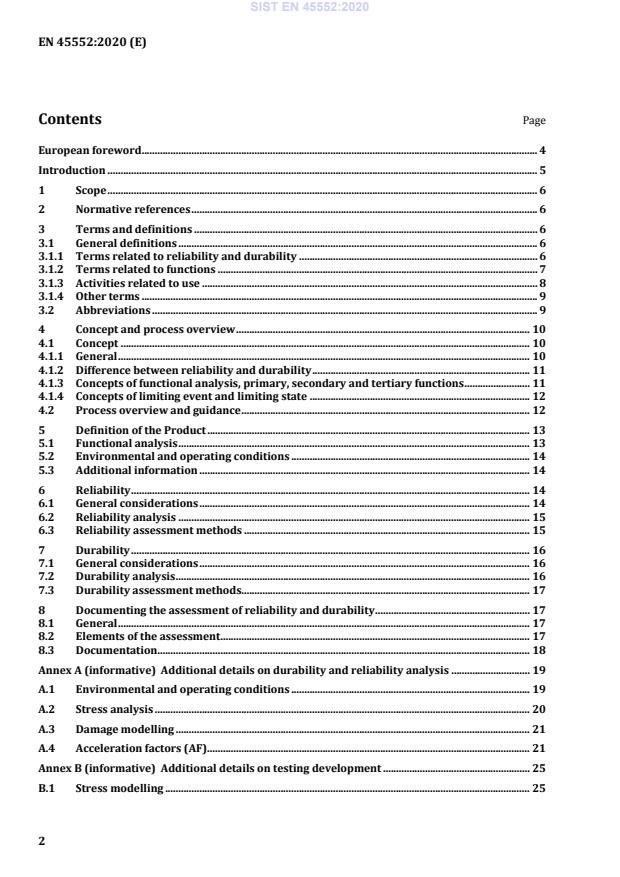
Contents Page
European foreword . 4
Introduction . 5
1 Scope . 6
2 Normative references . 6
3 Terms and definitions . 6
3.1 General definitions . 6
3.1.1 Terms related to reliability and durability . 6
3.1.2 Terms related to functions . 7
3.1.3 Activities related to use . 8
3.1.4 Other terms . 9
3.2 Abbreviations . 9
4 Concept and process overview . 10
4.1 Concept . 10
4.1.1 General . 10
4.1.2 Difference between reliability and durability . 11
4.1.3 Concepts of functional analysis, primary, secondary and tertiary functions . 11
4.1.4 Concepts of limiting event and limiting state . 12
4.2 Process overview and guidance . 12
5 Definition of the Product . 13
5.1 Functional analysis . 13
5.2 Environmental and operating conditions . 14
5.3 Additional information . 14
6 Reliability . 14
6.1 General considerations . 14
6.2 Reliability analysis . 15
6.3 Reliability assessment methods . 15
7 Durability . 16
7.1 General considerations . 16
7.2 Durability analysis . 16
7.3 Durability assessment methods. 17
8 Documenting the assessment of reliability and durability . 17
8.1 General . 17
8.2 Elements of the assessment . 17
8.3 Documentation . 18
Annex A (informative) Additional details on durability and reliability analysis . 19
A.1 Environmental and operating conditions . 19
A.2 Stress analysis . 20
A.3 Damage modelling . 21
A.4 Acceleration factors (AF) . 21
Annex B (informative) Additional details on testing development . 25
B.1 Stress modelling . 25
B.2 Accelerated tests . 25
Annex C (informative) Maintenance and repair considerations for an increased reliability
and durability . 28
C.1 General . 28
C.2 Wear-out parts and spare parts considerations . 29
Annex D (informative) Additional details on limiting event and limiting state . 31
Bibliography . 32
European foreword
This document (EN 45552:2020) has been prepared by Technical Committee CEN-CENELEC/JTC 10
“Energy-related products – Material Efficiency Aspects for Ecodesign”, the secretariat of which is held
by NEN.
This European Standard shall be given the status of a national standard, either by publication of an
identical text or by endorsement, at the latest by September 2020, and conflicting national standards
shall be withdrawn at the latest by September 2020.
Attention is drawn to the possibility that some of the elements of this document may be the subject of
patent rights. CEN shall not be held responsible for identifying any or all such patent rights.
This document has been prepared under a standardization request given to CEN by the European
Commission and the European Free Trade Association, and supports essential requirements of
EU Directive (2009/125/EC).
The dual logo CEN-CENELEC standardization deliverables, in the numerical range of 45550 – 45559,
have been developed under standardization request M/543 of the European Commission and are
intended to potentially apply to any product within the scope of the energy-related products (ErP)
Directive (2009/125/EC).
Topics covered in the above standardization request are linked to the following material efficiency
aspects:
a) Extending product lifetime;
b) Ability to re-use components or recycle materials from products at end-of-life;
c) Use of re-used components and/or recycled materials in products
These standards are general in nature and describe or define fundamental principles, concepts,
terminology or technical characteristics. They can be cited together with other product-specific or
product-group standards, e.g. developed by product technical committees.
This document is intended to be used by technical committees when producing horizontal, generic, and
product, or product-group, standards.
NOTE CEN/CENELEC/JTC 10 is a joint TC, and uses either CEN or CENELEC foreword templates, as
appropriate. The template for the current document is correct at the time of publication.
According to the CEN-CENELEC Internal Regulations, the national standards organisations of the
following countries are bound to implement this European Standard: Austria, Belgium, Bulgaria,
Croatia, Cyprus, Czech Republic, Denmark, Estonia, Finland, France, Germany, Greece, Hungary, Iceland,
Ireland, Italy, Latvia, Lithuania, Luxembourg, Malta, Netherlands, Norway, Poland, Portugal, Republic of
North Macedonia, Romania, Serbia, Slovakia, Slovenia, Spain, Sweden, Switzerland, Turkey and the
United Kingdom.
Introduction
As energy-related products (ErP) can often not be completely recycled, and the benefits associated with
material recovery cannot fully compensate the energy (and material) demand of the whole production
chain, each disposed ErP also means losses in energy and materials. Therefore, increasing the durability
of ErPs can contribute to a reduction in the quantity of raw materials used and energy required for the
production/disposal of ErPs and consequently reduces adverse environmental impacts.
When considering durability, the trade-off between longer lifetime (reducing impacts related to the
manufacturing and disposal of the product) and reduced environmental impacts of new products
(compared to worse/decreasing energy efficiency of older products) needs to be considered. In
addition, consumer behaviour and advances in technology have to be taken into account.
Considerations such as these are addressed in the preparatory studies commissioned under
Directive 2009/125/EC. Whilst such aspects establish a relevant context for this standard, they are not
addressed in this document.
This document covers a general method for the assessment of the reliability and the durability of ErPs.
Reliability represents the assessment of a probability of duration from first use to first failure or in-
between failures. Durability is the whole expected time for this same period and not a probability. To
cover other material efficiency aspects of a product, the generic standards on “General methods for the
assessment of the ability to repair, reuse and upgrade energy-related products – EN 45554:2020”,
“General method for assessing the ability of an energy-related product to be remanufactured –
EN 45553:-” , or equivalent standards can be taken into consideration.
This document describes a general assessment method that is intended to be adapted for application at
a product or product-group level, in order to assess the reliability/the durability of ErPs.
Under preparation. Stage at time of publication: FprEN 45553:2020.
1 Scope
This document defines a framework comprising of parameters and methods for assessing the reliability
and durability of ErPs. It is intended to be used in the preparation of product or product-group
standardization deliverables.
NOTE 1 This document has been developed under standardization request M/543 of the European
Commission to support Directive 2009/125/EC.
NOTE 2 Throughout this document, reference to ‘user of this document’ refers to those members of technical
committees that are developing horizontal, generic, and product, or product-group standards. This document is
not intended to be applied to generate product-specific information.
NOTE 3 Product-group, as used in this document, is an umbrella term used to refer to a group of products with
similar properties and primary function(s).
2 Normative references
The following documents are referred to in the text in such a way that some or all of their content
constitutes requirements of this document. For dated references, only the edition cited applies. For
undated references, the latest edition of the referenced document (including any amendments) applies.
EN 12973:2000, Value management
EN 45559, Methods for providing information relating to material efficiency aspects of energy-related
products
EN 62308:2006, Equipment reliability - Reliability assessment methods
EN 62506:2013, Methods for product accelerated testing
EN 60812, Analysis techniques for system reliability - Procedure for failure mode and effects analysis
(FMEA)
3 Terms and definitions
For the purposes of this document, the following terms and definitions apply.
ISO and IEC maintain terminological databases for use in standardization at the following addresses:
— IEC Electropedia: available at http://www.electropedia.org/
— ISO Online browsing platform: available at http://www.iso.org/obp
Note 1 to entry: See CLC/prTR 45550 for additional definitions.
3.1 General definitions
3.1.1 Terms related to reliability and durability
3.1.1.1
durability
< of a part or a product >
ability to function as required, under defined conditions of use, maintenance and repair, until a limiting
state is reached
Note 1 to entry: The degree to which maintenance and repair are within the scope of durability will vary by
product or product-group.
Note 2 to entry: The user of this document has to define the criteria for the transition from limiting state to end-
of-life (EoL). For more information see Figure D.1.
Note 3 to entry: Durability can be expressed in units appropriate to the part or product concerned, e.g. calendar
time, operating cycles, distance run, etc. The units should always be clearly stated.
3.1.1.2
reliability
probability that a product functions as required under given conditions, including maintenance, for a
given duration without limiting event
Note 1 to entry: The intended function(s) and given conditions are described in the information for use
provided with the product.
Note 2 to entry: Duration can be expressed in units appropriate to the part or product concerned, e.g. calendar
time, operating cycles, distance run, etc. The units should always be clearly stated.
3.1.1.3
limiting event
occurrence which results in a primary or secondary function no longer being delivered
Note 1 to entry: Examples of limiting events are failure, wear-out failure or deviation of any analogue signal.
3.1.1.4
limiting state
condition after one or more limiting event(s)
Note 1 to entry: A limiting state can be changed to a functional state by maintenance or repair of the ErP.
Note 2 to entry: A limiting state can change to EoL-status if maintenance or repair is no longer viable due to
socio-economic or technical reasons.
3.1.1.5
wear-out failure
failure due to cumulative deterioration caused by the stresses imposed in normal use
Note 1 to entry: The probability of occurrence of a wear-out failure typically increases with the accumulated
operating time, number of operations, and/or stress applications.
Note 2 to entry: In some instances, it can be difficult to distinguish between wear-out and ageing phenomena.
[SOURCE: IEV 192-03-15]
3.1.2 Terms related to functions
3.1.2.1
primary function
function fulfilling the intended use
Note 1 to entry: There can be more than one primary function.
3.1.2.2
secondary function
function that enables, supplements or enhances the primary function(s)
[SOURCE: EN 62542:2017; 5.14]
3.1.2.3
tertiary function
function other than a primary or a secondary function
[SOURCE: EN 62542:2017; 5.16, modified examples deleted]
3.1.2.4
functional analysis
process that describes the functions of a product and their relationships, which are systematically
characterized, classified and evaluated
3.1.3 Activities related to use
3.1.3.1
normal use
use of a product, including its transport and storage, or a process, in accordance with the provided
information for use or, in the absence of such, in accordance with generally understood patterns of
usage
Note 1 to entry: Normal use should not be confused with intended use. While both include the concept of use as
intended by the manufacturer, intended use focuses on the purpose while normal use incorporates not only the
purpose, but transport and storage as well.
[SOURCE: IEV 871-04-22]
3.1.3.2
intended use
use in accordance with information provided with a product or system, or, in absence of such
information, by generally understood patterns of usage
Note 1 to entry: Intended use should not be confused with normal use. While both include the concept of use as
intended by the manufacturer, intended use focuses on the purpose while normal use incorporates not only the
purpose, but transport and storage as well.
[SOURCE: ISO/IEC Guide 51:2014; 3.6, modified Note 1 to entry added]
3.1.3.3
normal operating conditions
characteristic in operation which may affect performance of the product during intended use
Note 1 to entry: Examples of operating conditions are modified environmental conditions when the product
operates (self-heating, condensation), characteristics of the power supply, duty cycle, load factor, vibration due to
operation.
Note 2 to entry: Given normal operating conditions and defined operating conditions of use, maintenance and
repair, refer to a specified subset of normal operating conditions which are used for the assessments.
3.1.3.4
maintenance
action carried out to retain a product in a condition where it is able to function as required
NOTE 1 to entry Examples of such actions include inspection, adjustments, cleaning, lubrication, testing,
software update and replacement of a wear-out part. Such actions could be performed by users in accordance with
instructions provided with the equipment (e.g. replacement or recharging of batteries); or the actions could be
performed by service personnel in order to ensure that parts with a known time to failure are replaced in order to
keep the product functioning.
3.1.3.5
repair
process of restoring a faulty product to a condition where it can fulfil its intended use
3.1.4 Other terms
3.1.4.1
part
hardware, firmware or software constituent of a product
[SOURCE: EN 45554:2020; 3.2]
3.1.4.2
normal environmental conditions
characteristics of the environment in the immediate vicinity of the product during transport, storage,
use, maintenance and repair, which may affect its performance during normal use
Note 1 to entry: Examples of environmental conditions are pressure, temperature, humidity, radiation,
vibration.
Note 2 to entry: Given normal environmental conditions and defined environmental conditions of transport,
storage, use, maintenance and repair, refer to specified subsets of normal environmental conditions which are
used for the assessments.
3.2 Abbreviations
AF Acceleration Factor
ALT Accelerated Life Test
EMC Electromagnetic Compatibility
EMF Electromagnetic Fields
ErP energy-related product
EoL end-of-life
FAST Function Analysis System Technique
FMEA Failure Mode and Effects Analysis
FMECA Failure Mode, Effects and Criticality Analysis
FTA Fault Tree Analysis
HASA Highly Accelerated Stress Audit
HALT Highly Accelerated Life Test
HASS Highly Accelerated Stress Screen
LCD Liquid Crystal Display
LED Light Emitting Diode
MTBF Mean Operating Time Between Failures
MTTF Mean Operating Time To Failure
MTTFF Mean Operating Time To First Failure
PCB Printed Circuit Board
TTF Time to Failure
4 Concept and process overview
4.1 Concept
4.1.1 General
This subclause explains the concepts relevant to both reliability and durability. Reliability is defined in
3.1.1.2 and durability in 3.1.1.1. The relation between reliability and durability is also depicted in
Figure D.1 of Annex D.
There are some key concepts to consider when addressing durability. Durability can be limited by the
fatigue/ageing of a part, which can cause a limiting event. A limiting event occurs when a primary or
secondary function is no longer delivered. This results in the product being in a limiting state.
There are also some key concepts to consider when addressing reliability. To assess reliability, the time
at which a certain percentage of products has reached a limiting state is used (e.g. the time by which an
accumulated X % of a population will fail (B), where X is expressed in orders of magnitude of 10 such as
0,1, 1, 10 for respectively B0,1, B1 or B10). However, other reliability assessments such as mean
operating time to failure (MTTF), mean operating time to first failure (MTTFF) and mean operating time
between failures (MTBF) are also used. The reliability assessment between the first use of the product
and the first limiting event does not take repair into account. Whilst the reliability assessment between
two consecutive limiting events takes into account the effects of a previous repair action, such cases are
not covered in this document.
NOTE 1 MTTF, MTTFF and MTBF are measures of constant risk and therefore, they do not give the expected
time to failure. In the case of a non-repairable product, MTTFF equals MTTF. For products with an exponential
distribution of operating times to failure (i.e. a constant failure rate), MTTF is numerically equal to the reciprocal (
) of the failure rate. Mean operating time between failures can only be applied to repairable products.
failure rate
NOTE 2 Reliability and durability are defined in standardization and are relevant methods to estimate the
technical lifetime of a product. Whilst “Minimum Lifetime” can be specified, this requires a wider consideration
than reliability and durability assessment, as it could include additional aspects such as economic, social or
regulatory requirements.
Durability can be expressed in units like calendar time, the number of operating cycles, distance, etc.
Reliability can be expressed as a unit combined with a probability (see example below). The user of this
document shall specify the most appropriate units for expressing reliability and durability.
EXAMPLE Durability could be 7 years for which a car is able to operate under defined environmental
conditions and operating conditions (20 000 km/year). If the car is used under different operating conditions
(28 000 km/year), the expected durability could be 5 years. This assumes that all parts are able to withstand the
defined conditions. A car operates with a reliability R(t1, t2) > 0,9 (90 %) where t1 and t2 could be respectively
0 km and 100 000 km, under defined environmental and operating conditions.
NOTE 3 A car, although not falling under the definition of an ErP, has been chosen as the example product for
ease of understanding.
4.1.2 Difference between reliability and durability
The user of this document shall specify requirements for the assessment procedures for reliability,
durability, or both.
The terms reliability and durability convey similar concepts but have distinct and separate meanings,
which are described in this section. At the simplest level, reliability and durability are both concerned
with the ability to function as required under certain conditions until a limiting state (see 4.1.4) is
reached. Both reliability and durability expect that maintenance will be undertaken as applicable to the
product (by the user/a professional service provider), to retain the product in a condition where it is
able to function as required. If appropriate, the user of this document should set parameters concerning
maintenance and expected conditions of use, for example by requiring information to be provided by
the manufacturer in the information of use.
Durability can be considered to be the most likely maximum normal use of a product until the transition
from a limiting state to EoL. It considers the ability to function as required, under defined conditions of
use, maintenance and repair. When the ErPs are repairable, durability includes the possibility of
extending the use-phase by one or multiple repairs, potentially involving different parts, to return the
ErPs to a functional state. In this case, the number of repair actions to be considered for the durability
assessment method shall be defined. Requirements for assessing durability are given in Clause 7.
NOTE In terms of circular economy, the lifetime of the materials, parts, or ErPs could be further extended by
reuse, update, upgrade, refurbishing, remanufacturing and recycling.
In the context of this document, reliability does not include repair actions, as considering these can lead
to a complex and non-comparable assessment of similar products. The reliability of a product is directly
related to its probability of failure under given normal environmental and operating conditions
(examples are available in EN 61703:2016). Requirements for assessing reliability are given in Clause 6.
A durability assessment and a reliability assessment can be applied to both ErPs as a whole and parts of
those ErPs.
EXAMPLE A representative sample of the same type of cars in use (10 %) shows a failure in the electronic
control device within 3 years. When they are repaired with a more reliable electronic control device, the repaired
cars fail within the next 4 years. The second fault cannot be repaired. The following can be stated (assuming that
the only limitation is a failure of the electronic control device):
— The measured B10 (reliability) of the cars before the repair is 3 years.
— The measured durability of all of the repaired cars is 7 years.
— The estimated durability of all cars of the same type in use (100 %) will be over 3 years without repair and
over 7 years taking into account one repair action.
4.1.3 Concepts of functional analysis, primary, secondary and tertiary functions
Functional analysis is a process that results in a comprehensive description of the functions and their
relationships, which are systematically characterized and classified. A complete functional analysis
enables a detailed understanding of the product characteristics and how the functionalities are
achieved, embedding constraints coming from the regulatory framework (such as electromagnetic
compatibility (EMC) or minimum performance (Ecodesign)).
The user of this document shall define the primary, secondary and tertiary functions of a product or
product-group. Primary functions relate to the intended use and express the main purpose of the
product. Secondary functions are the functions that are needed for the product to fulfil the primary
functions. If a product consists of more than one part, then it might have multiple secondary functions,
which directly relate to the normal use of the product. Other functions, which are not critical for
fulfilling the primary or secondary functions, are tertiary functions.
EXAMPLE The primary function of a car, fulfilling its intended use, is to safely transport persons, under
defined conditions. Secondary functions that can be derived from its primary function (enabling, enhancing or
supplementing it) are e.g. accelerating, decelerating and turning the car under the conditions defined for the
primary function. An example tertiary function of the car can be the sound system playing music.
4.1.4 Concepts of limiting event and limiting state
The user of this document shall define the limiting states. The concepts of limiting events and limiting
states are fundamental for the assessment of reliability and durability. For more information see
Figure D.1 in Annex D.
Limiting events could be for example a failure, a wear-out failure or a deviation of signal. Since limiting
events result in a primary or secondary function no longer being delivered, this means that the ErP no
longer fulfils its normal use or intended use.
The user of this document shall specify the criteria for the transition from a limiting state to EoL (see
Figure D.1).
EXAMPLE 1 A limiting event for a car could be the engine breaking down. The car is not able to fulfil its
primary function (movement). With the engine broken, the car is in a limiting state and needs a repair action to
return to a functional state.
EXAMPLE 2 A limiting event for a car could also be worn brake pads. The car is not able to fulfil one of the
secondary functions (deceleration). With worn brake pads, the car is in a limiting state and needs maintenance to
return to a functional state.
EXAMPLE 3 A limiting event for a car could be an excessive over-heating in the cooling system of the engine
during the intended use beyond the specified value. This over-heating could be caused by a small leakage of the
cooling liquid due to the ageing of a gasket or a pipe material. This limiting event is considered as a deviation of
signal. The car is not able to fulfil the secondary function as specified (keeping the engine operational). The car
needs maintenance to return to a functional state.
4.2 Process overview and guidance
The key stages and the information required for an assessment of the reliability and durability are
illustrated in Figure 1. The reliability assessment (labelled 1 in Figure 1) and the durability assessment
(labelled 2 in Figure 1) are interdependent but can be assessed separately. The user of this document
shall define the product or product-group in terms of functions and, if applicable, in accordance with
relevant product-group standards (see 5.1).
The user of this document shall use the results of the functional analysis (see 5.1), environmental and
operating conditions (see 5.2) and additional information (see 5.3) in order to develop a product or
product-group reliability analysis (see 6.2). The result of the product definition is a rank-ordered list
containing functions, parts providing these functions and the associated:
— failure modes,
— failure mechanisms,
— failure sites, and
— failure frequencies.
Subsequently, the reliability assessment method of the product should be defined (see 6.3).
For the durability analysis of a product or product-group (see 7.2), the user of the document shall take
into account, among others, repair considerations. Consecutively, the durability assessment method of
the product should be defined (see 7.3).
Results of the reliability/durability analyses shall be documented according to Clause 8.
Documenting the assessment of reliability and durability
Functional analysis Environmental and operating Additional
(5.1) conditions (5.2) information (5.3)
1 2
Reliability analysis Durability analysis (7.2)
(6.2)
Reliability assessment Durability assessment
methods (6.3) methods (7.3)
Elements of the Elements of the assessment
assessment for the for the durability analysis
reliability analysis (8.2 e)
(8.2 d)
Figure 1 — General reliability and durability assessment procedure
5 Definition of the Product
5.1 Functional analysis
The product or product-group being addressed shall be defined in terms of functions. Functional
analysis in accordance with EN 12973:2000, A.1.2 or equivalent should be applied to determine all
functions of the product or product-group during its lifecycle.
NOTE As an example of functional analysis, the Function Analysis System Technique (FAST) methodology
could be applied (EN 12973:2000; A.1.2.2.3 c) to assess an existing product or to design a product.
The user of this document shall select functions which are representative for the product or product-
group as input to the reliability analysis described in 6.2 and/or the durability analysis described in 7.2.
The user of this document shall identify those parts of the products that are involved in providing each
secondary function. If a specific function can be achieved by different technologies, each technology
shall be assessed individually.
EXAMPLE An example for a part providing a specific function which can be achieved by different
technologies is an electrical motor. The electrical connection of a motor can be achieved by brushes or by a
brushless connection.
5.2 Environmental and operating conditions
The given normal environmental and operating conditions are a set of parameters reflecting the
expected use patterns of the product or product-group. The user of this document shall define these
conditions for the respective product or product-group and check to which extent conditions beyond
normal environmental and operating conditions need to be included in the assessment. Depending on
the application of the product or product-group, more than one set of environmental and operating
conditions may be needed. Examples of environmental and operating conditions are given in Annex A.1.
Maintenance and repair actions shall be considered when defining the given normal environmental and
operating conditions.
5.3 Additional information
Apart from the selected functions (see 5.1) and the given normal environmental and operating
conditions (see 5.2), additional information is needed to conduct a reliability/durability analysis.
Information shall be representative in terms of geographical, time-related and technological coverage.
The following sources of information related to limiting events can be considered as input for the
reliability and durability analyses:
— Experience from past or current products;
— Field data;
— Failure Mode and Effect Analysis (FMEA), Failure Mode, Effects and Criticality Analysis (FMECA)
see A.4, and Fault Tree Analysis (FTA), see EN 61025;
— Manufacturer constraints;
— Regulations;
— Stress analysis (see Annex A.2) and Damage modelling (see Annex A.4);
— Test results already available;
— Users' experience;
— Risk assessment.
FMEA or FMECA shall be in accordance with EN 60812 or equivalent. They shall include any foreseeable
misuse.
NOTE 1 Information on limiting events and states can be found in Annex D.
Testing data taken into account may include tests of parts under conditions differing from normal
conditions providing there is a representative number of samples. Representativeness of the number
samples is to be determined by the user of this document.
NOTE 2 Reliability data on electronic parts contained within the product can be available within published
reliability handbooks (see EN 61709 or equivalent).
6 Reliability
6.1 General considerations
For the purpose of conducting reliability analysis, given normal environmental and given normal
operating conditions shall be considered. The analysis links functions to failure modes, failure sites and
failure mechanisms. The result of the analysis may be expressed for example as probability of failure or
survival or time to failure (TTF), to be determined by the user of this document. This shall be followed
by an analysis of parts where the respective failures occur, as described in 6.2, leading to a ranked list.
The results of 6.2 shall be used to identify or develop a reliability assessment method according to 6.3.
The user of this standard shall consider if this procedure is to be repeated when design or input data
have been modified.
6.2 Reliability analysis
The reliability analysis according to EN 62308 or equivalent shall take into account each function
selected in 5.1. This analysis should consider additional information. The user of this document shall
define what constitutes a failure within the product or product-group for the intended application.
An FMEA, FMECA or equivalent analysis shall be conducted. The analysis allows the identification of the
failure modes, failure mechanisms, the locations of the failures and the parts which are involved in the
failure for each analysed function. The user of this document shall establish the results as a list of failure
sites, mechanisms and modes. Failure modes affecting selected functions should be listed and ranked
according to likelihood. The most likely failures affecting the selected functions shall be determined and
the related parts identified.
6.3 Reliability assessment methods
The purpose of the assessment is to determine the reliability of a product and to establish, if applicable,
measurement methods for testing or accelerated testing of a defined set of functions or parts of a
product or product-group selected in 5.1.
NOTE 1 On accelerated testing see also Annex B.2 for further information.
In general, preference shall be given to existing standardized methods. However, the user of this
document shall ensure that these methods are appropriate or check if they need to be adapted for the
purpose of the reliability assessment. If no applicable assessment method exists, it shall be developed
(for further information see EN 60300-3-1). Developed assessment methods shall produce results
within defined confidence limits without being prohibitively expensive or being overly time consuming.
When accelerated tests can be carried out, EN 62506, which provides guidance on the application of
various accelerated test techniques for measurements, or equivalent standards shall be applied.
Measurement uncertainties shall be stated for any developed test method.
NOTE 2 Standards, which provide information on statistical test plans include IEC 61123, EN 61124, which
further support EN 62506.
NOTE 3 If the test is accelerated, the testing time can be reduced. The larger number of failures that occur with
accelerated testing, reduce the statistical uncertainty. However, the technical uncertainty is higher, since the
accelerated test conditions can cause failure modes that do not occur in the field. If accelerating factors (see
Annex A.4) are used, they are chosen so as to avoid the introduction of failure mechanisms which differ from those
occurring in the field.
For each specific product or product-group the assessment methods shall be one or more of the
following:
— testing of a physical sample and/or
— calculation from data e.g. durability figures, test results for parts, handbooks or field data.
Test methods shall be applied according to the following priorities:
1) reliability testing of the whole ErP;
2) reliability testing of functions/parts selected in 5.1/6.2 while integrated in the ErP;
3) reliability testing of functions/parts selected in 5.1/6.2 while not integrated in the ErP.
The selected assessment method may be different when assessing the whole product or specific parts; it
may also be different depending on which stress against which the product or part is assessed (see
Annex B.1).
The tests shall be specified in terms of test parameters and if applicable test apparatus (arrangement
and dimension of test equipment) and shall contain a description on how to conduct the test. The test
shall be accompanied by a sampling plan. Testing procedures shall be tailored to reflect the given
normal environmental and operating conditions, and stresses to which the product will be exposed to
during normal use. Tests shall, wherever possible, prevent circumvention strategies.
7 Durability
7.1 General considerations
Durability analysis within this standard shall investigate the ability of any function or part selected
in 5.1 to function as required including possible maintenance and repair actions (see also Annex C.1).
Durability can be expressed in units appropriate to the part or product concerned, e.g. calendar time,
operating cycles, distance run, etc. The units shall always be clearly stated by the user of this document.
Durability assessment met
...