


kSIST FprEN 18140:2025
(Main)Sustainable and smart cities and communities - Nature-based solutions (NbSs) - Terminology and classification
Sustainable and smart cities and communities - Nature-based solutions (NbSs) - Terminology and classification
Building on the consolidated definitions of NbS, this document establishes a terminology to support the development of an agreed vocabulary, forming the basis of the standardisation process.
Nachhaltige und intelligente Städte und Gemeinden - Naturbasierte Lösungen (NbL) - Terminologie und Grundsätze
In diesem Dokument wird, aufbauend auf den konsolidierten Definitionen von naturbasierten Lösungen, eine Terminologie festgelegt, um die Entwicklung eines vereinbarten Vokabulars zu unterstützen, das die Grundlage des Normungsprozesses ist.
Villes et communautés territoriales durables et intelligentes - Solutions fondées sur la nature (SFN) - Vocabulaire et classification
En se fondant sur les définitions consolidées des SFN, le présent document établit une terminologie visant à aider au développement d'un vocabulaire faisant l'objet d'un consensus, constituant la base du processus de normalisation.
Trajnostna in pametna mesta in skupnosti - Na naravi temelječe rešitve (NbSs) - Terminologija in razvrstitev
General Information
- Status
- Not Published
- Public Enquiry End Date
- 31-Jan-2025
- Technical Committee
- I11 - Imaginarni 11
- Current Stage
- 5020 - Formal vote (FV) (Adopted Project)
- Start Date
- 12-Nov-2025
- Due Date
- 31-Dec-2025
- Completion Date
- 12-Nov-2025
Overview
The prEN 18140:2024 standard by CEN addresses Sustainable and smart cities and communities with a focus on Nature-Based Solutions (NBSs). Its primary purpose is to establish a clear and unified terminology and classification framework that supports the development of standardized vocabularies around NBSs. This is fundamental to advancing the standardization process for nature-based solutions applied in urban and community settings.
Recognizing the increasing importance of sustainability and climate resilience, this standard builds upon consolidated definitions of NBS to create an agreed vocabulary. It encompasses diverse ecosystems-terrestrial, freshwater, coastal, and marine-and emphasizes how NBSs can effectively tackle social, economic, and environmental challenges while promoting human well-being, biodiversity, and ecosystem services.
Key Topics
- Nature-Based Solutions (NBS): Defined as actions that protect, restore, or sustainably manage ecosystems to address societal challenges adaptively.
- Terminology and Classification: The document standardizes terms related to NBS, ranging from general definitions to specific solution types and management practices including artificial reef NBS.
- Adaptive Management: Continuous refinement of management strategies based on outcomes to enhance NBS efficacy.
- Environmental Concepts: Includes terminology on biodiversity, ecosystem services, ecosystem restoration, ecological engineering, and climate adaptation.
- Societal Challenges and Classification Approaches:
- Classifying NBS by societal challenges they address (e.g., climate adaptation, urban development).
- Intervention approaches and spatial scales of application.
- Stakeholder involvement to ensure inclusive governance of NBS initiatives.
- Ecosystem Services: Highlights provisioning, regulating, cultural, and supporting services derived from natural systems.
- Climate Change Integration: Addresses climate change mitigation and adaptation through ecosystem-based strategies.
Applications
This standard offers practical value by guiding policymakers, urban planners, environmental managers, and researchers in:
- Developing sustainable urban infrastructures that integrate nature-based solutions for resilience and livability.
- Implementing NBS initiatives aimed at ecosystem restoration, biodiversity conservation, and climate risk reduction.
- Enhancing blue-green networks and blue infrastructures-creating strategically planned, interconnected natural spaces for ecosystem services such as flood control and air quality improvement.
- Supporting decision-making with clear definitions for cost-benefit analyses, disaster risk reduction, and carbon sequestration methods linked to nature-based solutions.
- Facilitating cross-sectoral collaboration by providing a standardized language that bridges environmental science, urban governance, and societal engagement.
- Informing the development of monitoring and evaluation frameworks tailored to measure both tangible and intangible impacts of NBS over time.
Related Standards
While prEN 18140 focuses on terminology and classification, it is complementary to several international and regional frameworks including:
- ISO and IEC terminology databases: The standard aligns with terms from these widely accepted repositories supporting consistency in global standardization efforts.
- EU Policies on Nature-Based Solutions: Builds upon documents such as “Towards an EU Research and Innovation policy agenda for Nature-Based Solutions and Re-Naturing Cities” and integrates environmental objectives from the “EU taxonomy for sustainable activities.”
- CEN/TC 465 Work: prEN 18140 is part of the CEN Technical Committee 465’s broader mandate on sustainable cities and communities, linking ecosystem-based management practices with urban sustainability goals.
- Handbooks and Guidance on NBS Monitoring: Addresses gaps highlighted in practitioner handbooks regarding definitions, long-term monitoring, and stakeholder communication.
Keywords: Nature-Based Solutions, NBS terminology, sustainable cities, smart communities, ecosystem services, biodiversity, climate adaptation, blue-green infrastructure, ecosystem restoration, environmental standardization, CEN standards, urban sustainability, adaptive management

Frequently Asked Questions
kSIST FprEN 18140:2025 is a draft published by the Slovenian Institute for Standardization (SIST). Its full title is "Sustainable and smart cities and communities - Nature-based solutions (NbSs) - Terminology and classification". This standard covers: Building on the consolidated definitions of NbS, this document establishes a terminology to support the development of an agreed vocabulary, forming the basis of the standardisation process.
Building on the consolidated definitions of NbS, this document establishes a terminology to support the development of an agreed vocabulary, forming the basis of the standardisation process.
kSIST FprEN 18140:2025 is classified under the following ICS (International Classification for Standards) categories: 01.040.13 - Environment. Health protection. Safety (Vocabularies); 13.020.20 - Environmental economics. Sustainability. The ICS classification helps identify the subject area and facilitates finding related standards.
kSIST FprEN 18140:2025 is available in PDF format for immediate download after purchase. The document can be added to your cart and obtained through the secure checkout process. Digital delivery ensures instant access to the complete standard document.
Standards Content (Sample)
SLOVENSKI STANDARD
oSIST prEN 18140:2025
01-januar-2025
Trajnostna in pametna mesta in skupnosti - Na naravi temelječe rešitve (NBSs) -
Slovar in načela
Sustainable and smart cities and communities - Nature-based solutions (NBSs) -
Vocabulary and principles
Nachhaltige und intelligente Städte und Gemeinden - Naturbasierte Lösungen (NBSs) -
Vokabular und Prinzipien
Villes et communautés territoriales durables et intelligentes - Solutions fondées sur la
nature (SFN) - Vocabulaire et principes
Ta slovenski standard je istoveten z: prEN 18140
ICS:
01.040.13 Okolje. Varovanje zdravja. Environment. Health
Varnost (Slovarji) protection. Safety
(Vocabularies)
13.020.20 Okoljska ekonomija. Environmental economics.
Trajnostnost Sustainability
oSIST prEN 18140:2025 en,fr,de
2003-01.Slovenski inštitut za standardizacijo. Razmnoževanje celote ali delov tega standarda ni dovoljeno.
oSIST prEN 18140:2025
oSIST prEN 18140:2025
DRAFT
EUROPEAN STANDARD
prEN 18140
NORME EUROPÉENNE
EUROPÄISCHE NORM
November 2024
ICS 01.040.13
English Version
Sustainable and smart cities and communities - Nature-
based solutions (NBSs) - Vocabulary and principles
Villes et communautés territoriales durables et Nachhaltige und intelligente Städte und Gemeinden -
intelligentes - Solutions fondées sur la nature (SFN) - Naturbasierte Lösungen (NBSs) - Vokabular und
Vocabulaire et principes Prinzipien
This draft European Standard is submitted to CEN members for enquiry. It has been drawn up by the Technical Committee
CEN/TC 465.
If this draft becomes a European Standard, CEN members are bound to comply with the CEN/CENELEC Internal Regulations
which stipulate the conditions for giving this European Standard the status of a national standard without any alteration.
This draft European Standard was established by CEN in three official versions (English, French, German). A version in any other
language made by translation under the responsibility of a CEN member into its own language and notified to the CEN-CENELEC
Management Centre has the same status as the official versions.
CEN members are the national standards bodies of Austria, Belgium, Bulgaria, Croatia, Cyprus, Czech Republic, Denmark, Estonia,
Finland, France, Germany, Greece, Hungary, Iceland, Ireland, Italy, Latvia, Lithuania, Luxembourg, Malta, Netherlands, Norway,
Poland, Portugal, Republic of North Macedonia, Romania, Serbia, Slovakia, Slovenia, Spain, Sweden, Switzerland, Türkiye and
United Kingdom.
Recipients of this draft are invited to submit, with their comments, notification of any relevant patent rights of which they are
aware and to provide supporting documentation.
Warning : This document is not a European Standard. It is distributed for review and comments. It is subject to change without
notice and shall not be referred to as a European Standard.
EUROPEAN COMMITTEE FOR STANDARDIZATION
COMITÉ EUROPÉEN DE NORMALISATION
EUROPÄISCHES KOMITEE FÜR NORMUNG
CEN-CENELEC Management Centre: Rue de la Science 23, B-1040 Brussels
© 2024 CEN All rights of exploitation in any form and by any means reserved Ref. No. prEN 18140:2024 E
worldwide for CEN national Members.
oSIST prEN 18140:2025
prEN 18140:2024 (E)
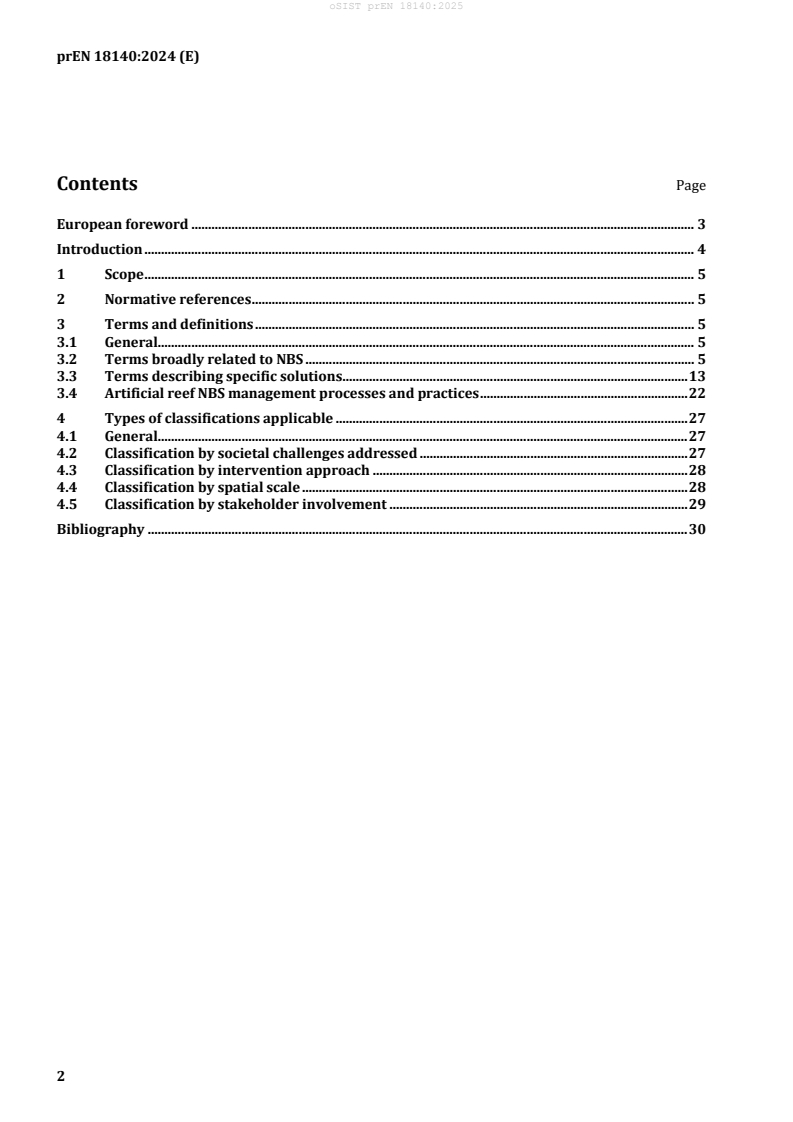
Contents Page
European foreword . 3
Introduction . 4
1 Scope . 5
2 Normative references . 5
3 Terms and definitions . 5
3.1 General. 5
3.2 Terms broadly related to NBS . 5
3.3 Terms describing specific solutions. 13
3.4 Artificial reef NBS management processes and practices . 22
4 Types of classifications applicable . 27
4.1 General. 27
4.2 Classification by societal challenges addressed . 27
4.3 Classification by intervention approach . 28
4.4 Classification by spatial scale . 28
4.5 Classification by stakeholder involvement . 29
Bibliography . 30
oSIST prEN 18140:2025
prEN 18140:2024 (E)
European foreword
This document (prEN 18140:2024) has been prepared by Technical Committee CEN/TC 465 “Sustainable
cities and communities”, the secretariat of which is held by AFNOR.
This document is currently submitted to the CEN Enquiry.
oSIST prEN 18140:2025
prEN 18140:2024 (E)
Introduction
At European level the European Commission (EC) released the first document on NBS: Towards an EU
Research and Innovation policy agenda for Nature-Based Solutions and Re-Naturing Cities, in 2015. In this
document the EC identified four goals that can be addressed by nature-based solutions:
— enhancing sustainable urbanisation;
— restoring degraded ecosystems;
— developing climate change adaptation and mitigation;
— Improving risk management and resilience.
In the recent document “EU taxonomy for sustainable activities” has considered as environmental
objectives the following categories: climate change mitigation and adaptation, the sustainable use and
protection of water and marine resources, the transition to a circular economy, pollution prevention and
control, the protection and restoration of biodiversity and ecosystems.
Evaluating the impact of NBS the “Handbook of practitioners” (2021) reported a gap analysis in terms of:
— lack of definition of nature-based solutions (NBS);
— lack of NBS monitoring methodology and implementation stages (longer-term evaluations to assess
NBS effects over time and guaranteeing continuity of monitoring measurements);
— measurability of intangible impacts (e.g. aesthetic enjoyment) and spillovers (impact of NBS
intervention may spread beyond the treated area or group);
— accounting for trade-offs, difficulties in communicating to non-scientific partners the need and the
challenges in a less -technical language.
EC (2021c)
oSIST prEN 18140:2025
prEN 18140:2024 (E)
1 Scope
Building on the consolidated definitions of NBS, this document proposes a classification of NBS to support
the development of an agreed terminology, the basis of the standardization process.
2 Normative references
There are no normative references in this document.
3 Terms and definitions
For the purposes of this document, the following terms and definitions apply.
ISO and IEC maintain terminology databases for use in standardization at the following addresses:
— ISO Online browsing platform: available at https://www.iso.org/obp/
— IEC Electropedia: available at https://www.electropedia.org/
3.1 General
3.1.1
nature-based solution
NBS
action to protect, conserve, restore, sustainably use and manage natural or modified terrestrial,
freshwater, coastal and marine ecosystems which addresses social, economic and environmental
challenges effectively and adaptively, while simultaneously providing human well-being, ecosystem
services, resilience and biodiversity benefit
3.2 Terms broadly related to NBS
3.2.1
adaptive management
systematic process of continually improving management policies and practices by learning from the
outcomes of existing programmes
3.2.2
anthropogenic climate change
change of climate which is attributed directly or indirectly to human activity that alters the composition
of the global atmosphere and which is in addition to natural climate variability observed over comparable
time period
3.2.3
biodiversity
variability among living organisms from all sources including terrestrial, marine and other aquatic
ecosystems and the ecological complexes of which they are a part
Note 1 to entry: This includes variation in genetic, phenotypic, phylogenetic, and functional attributes, as well as
changes in abundance and distribution over time and space within and among species, biological communities and
ecosystems.
oSIST prEN 18140:2025
prEN 18140:2024 (E)
3.2.4
blue infrastructure
BI
strategically planned network of natural and semi-natural areas with other environmental features
designed and managed to deliver a wide range of ecosystem services such as water purification, water
retention, air quality improvement, space for recreation and climate resilience and adaptation
Note 1 to entry: This network of blue (water) spaces can improve environmental conditions and therefore citizens'
health and quality of life. It also supports a green economy, creates job opportunities and enhances biodiversity.
3.2.5
blue-green network
urban space development concept defining a network of existing and/or restored rivers and their valleys
(blue areas) and green areas (agricultural areas, parks, old orchards, wastelands, degraded areas and
others), as a basis for the spatial planning of cities that will provide sustainable development and
adaptation to global climate change
Note 1 to entry: The network aims to create or preserve key ‘reservoirs’ for biodiversity and to link these through
ecological corridors vital to the free movement of species. Blue-green networks can range from small-scale
endeavours to all-encompassing city plans.
3.2.6
carbon sequestration
process of capturing and storing atmospheric carbon dioxide
Note 1 to entry: It is one method of reducing the amount of carbon dioxide in the atmosphere with the goal of
reducing global climate change
3.2.7
climate adaptation services
benefits to people from increased social ability to respond to climate change, provided by the capacity of
ecosystems to moderate and adapt to climate change and variability
3.2.8
climate change
any change in climate over time, whether due to natural variability or as a result of human activity
3.2.9
coastal erosion
net landward retreat of the shoreline, as measured relative to a given datum, over a given temporal scale
that is longer than cyclic patterns of coastal variability
3.2.10
conservation
concept used in the context of biodiversity, environment, and natural resources, including protection and
management
Note 1 to entry: It refers to the act of preserving, guarding or protecting, meanwhile keeping in mind the
sustainable character and wise use
3.2.11
conservation areas or protected areas
clearly defined geographical space, recognized, dedicated and managed, through legal or other effective
means, to achieve the long-term conservation of nature with associated ecosystem services and cultural
oSIST prEN 18140:2025
prEN 18140:2024 (E)
values, including maritime areas, in which human presence or the exploitation of natural resources is
limited
3.2.12
cost-benefit analysis
decision tool which judges the desirability of projects by comparing their costs and benefits
3.2.13
cultural heritage conservation
measures taken to extend the life of cultural heritage while strengthening transmission of its significant
heritage messages and values
Note 1 to entry: In the domain of cultural property, the aim of conservation is to maintain the physical and cultural
characteristics of the object to ensure that its value is not diminished and that it will outlive our limited time span
3.2.14
cultural landscape
one of the following three main categories:
— clearly defined landscape designed and created intentionally by man, often built for aesthetics
reasons associated with religious or other monumental buildings and ensembles;
— organically evolved landscape, developed by association with and in response to its natural
environment (a relict, or fossil, landscape or; a continuing landscape is one which retains an active
social role in contemporary society);
— associative cultural landscape with powerful religious, artistic or cultural associations of the natural
element
3.2.15
disaster risk
potential loss of life, injury, destroyed or damaged assets which could occur to a system, society or a
community in a specific period of time, determined probabilistically as a function of hazards, exposure,
vulnerability and capacity
3.2.16
disaster risk reduction
DRR
actions “aimed at preventing new risks and reducing existing ones and managing residual risk, which
contribute to strengthening resilience and therefore to the achievement of sustainable development
objectives”
3.2.17
ecohydrology
EH
understanding of relationships between hydrological and biological processes at different scales to
improve water security, enhance biodiversity and further opportunities for sustainable development by
lessening ecological threats and maximizing greater harmony within catchment processes
3.2.18
ecohydrological nature-based solution
EH-NBS
action enhancing efficiency of hydrotechnical infrastructure, in agricultural and urban landscapes, for
adaptation to the ongoing climate change and enhancing catchments sustainability by creating
oSIST prEN 18140:2025
prEN 18140:2024 (E)
multidimensional potential of the WBSRC (water, biodiversity, ecosystem services for society, resilience
to climatic changes, culture and education)
Note 1 to entry: It also promotes a holistic approach by encouraging transdisciplinary sustainability science and
education; an integral part of this strategy is the implementation of EH-NBS for water quality and quantity
improvement.
3.2.19
ecological engineering
engagement of systems of human and environmental self-design or light management that joins human
design and environmental self-design, so that they are mutually symbiotic
Note 1 to entry: Ecological engineering can also entail the design of sustainable ecosystems that integrate human
society with its natural environment for the benefit of both.
3.2.20
ecosystem
dynamic complex of vegetable, animal and microorganism communities and their non-living
environment that interact as a functional unit
Note 1 to entry: Ecosystems can be small and simple, like an isolated pond, or large and complex, like a specific
tropical rainforest or a coral reef in tropical seas
3.2.21
ecosystem approach
strategy for the integrated management of land, water and living resources that promotes conservation
and sustainable use in an equitable way
Note 1 to entry: The ecosystem approach places human needs at the centre of biodiversity management. It aims to
manage the ecosystem, based on the multiple functions that ecosystems perform and the multiple uses that are
made of these functions. The ecosystem approach does not aim for short-term economic gains but aims to optimize
the use of an ecosystem without damaging it.
3.2.22
ecosystem service
benefits people obtain from ecosystems
Note 1 to entry: These include provisioning services such as food and water; regulating services such as flood and
disease control; cultural services such as spiritual, recreational, and cultural benefits; and supporting services such
as nutrient cycling that maintain the conditions for life on Earth. The concept “ecosystem goods and services” is
synonymous with ecosystem services.
3.2.23
ecosystem-based adaptation
use of biodiversity and ecosystem services as part of an overall adaptation strategy to help people to
adapt to the adverse effects of climate change
3.2.24
ecosystem-based management
integrated, science-based approach to the management of natural resources that aims to sustain the
health, resilience and diversity of ecosystems while allowing for sustainable use by humans of the goods
and services they provide
oSIST prEN 18140:2025
prEN 18140:2024 (E)
3.2.25
ecosystem-based mitigation
action meant to mitigate the negative effects of climate change through the management of ecosystems
Note 1 to entry: These actions can aim to do one of the following: decrease greenhouse gas emissions related to
deforestation and land use; capture and store carbon dioxide from the atmosphere, protect natural ecosystems from
loss and degradation, restore ecosystems that have been degraded, and more sustainably manage working lands
such as fields and managed forests; enhance the benefits for and avoid negative impacts on biodiversity from
reducing greenhouse gases emissions, taking into account the need to ensure the full and effective participation of
indigenous and local communities in relevant policy-making and implementation processes, where appropriate;
enhance the conservation, sustainable use and restoration of marine and coastal habitats that are vulnerable to the
effects of climate change or which contribute to climate-change mitigation.
3.2.26
ecosystem maintenance
ongoing activity, applied after full recovery of an ecosystem, intended to counteract processes of
ecological degradation to sustain the attributes of an ecosystem
Note 1 to entry: Higher ongoing maintenance is likely to be required at restored sites where higher levels of threats
continue, compared to sites where threats have been controlled.
3.2.27
ecosystem restoration
process that assists in initiating or accelerating the recovery of the health, integrity, and stability of an
ecosystem that has been degraded, damaged, or destroyed
Note 1 to entry: Ecosystems can degrade because of pollution, climate change or human intervention. Ecological
restoration processes can make use of different instruments, tools and methods going from technological
innovations to nature-based solutions and innovations.
3.2.28
ecosystem resilience
capacity of a system to absorb disturbance and reorganize while still retaining similar function, structure,
and feedback
Note 1 to entry: In plant and animal communities, this property is highly dependent on adaptations by individual
species to disturbances or stresses experienced during the species’ evolution.
3.2.29
endemic species
species for which the entire global range is strictly limited to a specified region or locality
3.2.30
environmental protection
prevention of unwanted changes to ecosystems and their constituent parts
3.2.31
floodplain
area bordering a river that naturally provides space for the retention of flood and rainwater
Note 1 to entry: The potential floodplain extent is the lateral extent of a flood that has a return period of once every
100 years.
oSIST prEN 18140:2025
prEN 18140:2024 (E)
3.2.32
green infrastructure
strategically planned network of natural and semi-natural areas with other environmental features
designed and managed to deliver a wide range of ecosystem services
Note 1 to entry: It incorporates green spaces (or blue if aquatic ecosystems are concerned) and other physical
features in terrestrial (including coastal) and marine areas. On land, green infrastructure is present in rural and
urban settings.
3.2.33
human health
state of complete physical, mental, and social wellbeing and not merely the absence of disease or infirmity
Note 1 to entry: The health of a whole community or population is reflected in measurements of disease incidence
and prevalence, age-specific death rates, and life expectancy. Constituents of well-being: The experiential aspects of
well-being, such as health, happiness, and freedom to be and do, and, more broadly, basic liberties. Determinants of
well-being: Inputs into the production of wellbeing, such as food, clothing, potable water, and access to knowledge
and information.
3.2.34
human wellbeing
prosperity or quality of life
Note 1 to entry: Human wellbeing is assumed to have multiple constituents, including the basic material for a good
life, such as secure and adequate livelihoods, enough food at all times, shelter, clothing, and access to goods; health,
including feeling well and having a healthy physical environment, such as clean air and access to clean water; good
social relations, including social cohesion, mutual respect, and the ability to help others and provide for children;
security, including secure access to natural and other resources, personal safety, and security from natural and
human-made disasters; and freedom of choice and action, including the opportunity to achieve what an individual
values doing and being.
3.2.35
alien species
exotic species
introduced species
species, subspecies or lower taxon introduced outside its natural past or present distribution, including
any part, gametes, seeds, eggs, or propagules of such species that might survive and subsequently
reproduce
3.2.36
hybrid infrastructure
grey infrastructure
conservation and restoration of nature (including natural coastal buffers such as mangroves and
seagrasses) with conventional approaches (such as concrete dams, roads, pipes and seawalls), potentially
delivering benefits for the economy, communities, and the environment
3.2.37
invasive species
invasive alien species
species whose introduction and/or spread threaten biological diversity
3.2.38
just transition
set of principles, processes and practices that aim to ensure that no people, workers, places, sectors,
countries or regions are left behind in the transition from a high-carbon to a low carbon economy and
oSIST prEN 18140:2025
prEN 18140:2024 (E)
environmentally sustainable economies and societies, can enable more ambitious climate action and
provide an impetus to attaining the Sustainable Development Goals
3.2.39
marine protected area
MPA
designated area in the ocean within which human activities are regulated more stringently than
elsewhere in the marine environment
Note 1 to entry: The protection afforded by MPAs can vary widely, from minimal protection to full protection, that
is, no-take reserves. Such areas are carved out to maintain, at least to some extent, the natural environment of the
designated area for ecological, economic, cultural, social, recreational, and other reasons.
3.2.40
native species
indigenous species
species, subspecies or lower taxon occurring within its natural range (past or present) and dispersal
potential (i.e. within the range it occupies naturally or could occupy without direct or indirect
introduction or care by humans)
3.2.41
natural capital
world’s stock of natural assets which include geology, soil, air, water and all living things
Note 1 to entry: It is from this natural capital that humans derive a wide range of services, often called ecosystem
services, which make human life possible.
3.2.42
nature’s contribution to people
NCP
contributions both positive and negative of living nature (diversity of organisms, ecosystems and their
associated ecological and evolutionary processes) to people’s quality of life
Note 1 to entry: The NCP concept is building on the ecosystem services (ES) concept and aims to incorporate social
sciences more inclusively into the already established economic and ecological aspects of ES, broadening its
epistemological boundaries. The NCP framework has not been designed to replace the ES framework and can be
used to complete it.
3.2.43
NBS maintenance
maintenance ranging from landscaping to water engineering and civil infrastructure
Note 1 to entry: It may be undertaken by the local entity, by stakeholders through agreements or outsourced. In
any case, it should be considered in the NBS implementation financial plan, which covers the whole NBS life-cycle,
from design to construction, monitoring and end of life, with funds made available in the annual municipal budget
as well as for medium and long term plans. The maintenance programme should include preventive and corrective
measures for the short and long term.
3.2.44
NBS stewardship
ongoing participatory management and maintenance of NBS
Note 1 to entry: Stewardship includes the monitoring and evaluation of the nature-based solutions, which enables
the making of adaptations that ensure long-term sustainability and resilience.
oSIST prEN 18140:2025
prEN 18140:2024 (E)
3.2.45
nature-derived solution
wind, wave and solar energy, all of which are derived from nature and help to fulfil low carbon energy
needs through production methods deriving from natural sources
Note 1 to entry: Although these energy sources come from the natural world, they are not directly based on
functioning ecosystems, therefore should not be confused with nature-based solutions.
3.2.46
nature-inspired solution
innovative design and production of materials, structures and systems that are modelled on biological
processes and are nature-inspired
Note 1 to entry: For example, biomimicry is a practice that learns from and mimics the strategies found in nature
to solve challenges. They are not based on functioning ecosystems, therefore should not be confused with nature-
based solutions.
3.2.47
resilience
ability of a system, community or society exposed to hazards to resist, absorb, accommodate to and
recover from the effects of a hazard in a timely and efficient manner, including through the preservation
and restoration of its essential basic structures and functions
3.2.48
risk assessment
qualitative and/or quantitative scientific estimation of risks
3.2.49
scale
measurable dimensions of phenomena or observations
Note 1 to entry: Expressed in physical units, such as meters, years, population size, or quantities moved or
exchanged. In observation, scale determines the relative fineness and coarseness of different detail and the
selectivity among patterns these data may form.
3.2.50
soil conservation
management of soil to prevent or reduce soil erosion and depletion by wind and water
Note 1 to entry: Preservation of soil against deterioration and loss by using it within its capabilities; application of
conservation practices needed for its protection and improvement.
3.2.51
stepping stones
habitat patches that are scattered throughout a landscape that facilitate dispersal among otherwise
isolated habitat areas
3.2.52
stakeholder
person or group who are directly or indirectly affected by a project, as well as those who may have
interests in a project and/or the ability to influence its outcome, positively or negatively
Note 1 to entry: Stakeholders can include locally affected communities or individuals and their formal and informal
representatives, national or local government authorities, politicians, religious leaders, civil society, organizations
oSIST prEN 18140:2025
prEN 18140:2024 (E)
and groups with special interests, the academic community, or other businesses. The “stake” that each of these
different individuals or groups has in a project or investment will vary.
3.2.53
sustainability
process that helps create a vibrant economy and a high quality of life, while respecting the need to sustain
natural resources and protect the environment
Note 1 to entry: It expresses the principle that future generations should live in a world that the present generation
has enjoyed but not diminished.
3.2.54
trade-off
choice that involves losing one quality or service (of an ecosystem) in return for gaining another quality
or service
Note 1 to entry: Many decisions affecting ecosystems involve trade-offs, sometimes mainly in the long term
3.2.55
urban ecosystem
urban environment as a whole, embodying both the built infrastructure and the ecological infrastructure,
so the built environment is fully part of the urban ecosystem
Note 1 to entry: It is largely artificial ecosystem dominated by human activities including settlements, commercial
and industrial areas that have changed the structure, transformed the material cycle and partially changed the
energy conversion process.
3.2.56
urban resilience
ability of any urban system, with its inhabitants, in a changing environment, to anticipate, prepare,
respond to and absorb shocks, positively adapt and transform in the face of stresses and challenges, such
as the urban heat island effect, while facilitating inclusive and sustainable development
3.2.57
vulnerability assessment
assessment that emphasizes exposure, sensitivity and adaptive capacity of systems, assets and
populations. Indicator-based vulnerability assessments use sets of pre-defined indicators that can be
both quantitative and qualitative and can be assessed both through modelling or stakeholder
consultation. It can be combined with risk assessment
3.3 Terms describing specific solutions
3.3.1
artificial reef
human-made structures that are intentionally placed on the seafloor or submerged in bodies of water to
enhance marine habitats and ecosystems
3.3.2
biofilter
filter developed to collect and treat storm- and wastewater using bacteria and microorganisms
Terms describing components that are widely accepted and used as nature-based solutions when implemented in
a manner to deliver NBS benefits.
oSIST prEN 18140:2025
prEN 18140:2024 (E)
Note 1 to entry: Bacteria and microorganisms are located on a filter medium (biofilm), which often consists of sand
or granular activated carbon. The biofilm degrades nutrients and contaminants in the wastewater (influent) that is
pumped through the filter material. The term “filter,” however, can be misleading. Biofilters separate and remove
nutrients and organic carbons from storm- and wastewater through biodegradation. As a result, biofiltration
improves the quality of storm- and wastewater (e.g. the reduction of nutrients, metals, sediments) while
temporarily storing stormwater, which can help reduce peak flows.
3.3.3
biogenic reef
structure (concretions, encrustations, and bivalve beds originating from dead or living animals) arising
from the seafloor
Note 1 to entry: The restoration of biogenic reefs, such as native shellfish reefs (oysters or other bivalve) or coral
reefs, is a NBS that provides several ecosystem services, such as coastal protection from climate change-related
hazards, water quality improvement, carbon sequestration and food provision. Biogenic reefs also stabilize
sediments and provide habitat for several marine species.
3.3.4
bioretention cell
green infrastructure that uses plants and soil to collect and filter stormwater runoff by an engineered
system where pollutants are removed by physical, chemical, and biological processes
3.3.5
biosolar roof
type of green roof that integrates solar panels (either photovoltaic or thermal) above the plant layer
Note 1 to entry: The panels can enhance the biodiversity of the green roof by creating different levels of shade and
water distribution, and the vegetated roof can enhance the efficiency of the panels.
3.3.6
blue green roof
roofing system that combines green roof elements with advanced water management capabilities
Note 1 to entry: It is designed to mitigate urban environmental challenges by integrating traditional green roof
benefits with enhanced rainwater handling. This system significantly contributes to reducing urban heat islands
and volatile pollutants. BGRs also improve thermal insulation of buildings, leading to reduced energy consumption
for climate control. Key features include a layered structure with primary and secondary water accumulation basins
and the use of Internet of Things technologies for optimized, remote management of water use and sustainable
urban resilience.
3.3.7
boulevard
tree lined avenue, in which trees are arranged on both sides of the route, along streets, bicycle paths, and
sidewalks
Note 1 to entry: The canopies of opposite trees often form a (nearly) closed canopy. As a result, the area between
the two tree lines is shaded and the air temperature cooler. However, when they border a high traffic road, they can
form a “canyon effect” increasing air pollution under the canopy.
3.3.8
community garden
area of land dedicated to the cultivation of vegetables, fruits and/or flowers
Note 1 to entry: This kind of solution is usually encountered in public spaces, allotments or private residential
properties.
oSIST prEN 18140:2025
prEN 18140:2024 (E)
3.3.9
constructed soil
engineered soil
artificial soil
growing medium that can be compacted to pavement design and installation requirements while
permitting root growth
Note 1 to entry: It is a mixture of gap-graded rock (mostly made of crushed stone) and soil (mineral content and
organic content). Constructed technosols (CTs), consisting of mixtures of organic and mineral waste, are man-made
soils designed to meet specific requirements and have great potential for use in GI. Technosols are defined as
deliberate mixtures of organic and mineral wastes and by-products constructed to meet specific requirements
3.3.10
constructed wetland
treatment wetland
treatment system that uses natural processes involving wetland vegetation, soils, and their associated
microbial assemblages to improve water quality
Note 1 to entry: This NBS can be divided in two main hydrological categories: free water surface wetlands, a
shallow sealed basin or sequence of basins (open water areas) containing floating plants, submerged plants or
emergent plants (similar in appearance to natural marshes); subsurface flow wetlands, which include horizontal
flow (HF) wetlands and vertical flow (VF) wetlands. In this case, the water flows beneath the surface level, either
horizontally or vertically, through the filter bed.
3.3.11
diverting and deflecting element
element placed in a riverbed with the main objective to redirect, disturb, divert and deflect the current
and initiate water dynamics
3.3.12
green cemetery
burial ground often covered by lawns, trees and other ornamental plants
Note 1 to entry: Although often underestimated, they are important components of NBS due to their number, size,
habitat heterogeneity and habitat continuity. It is open to wide-range communities.
3.3.13
green tram track
unsealed and greened with grasses or sedum species and thus achieve several valuable ecological,
economic and urban design benefits
3.3.14
extensive green roof
planted system characterised by lightweight, low-maintenance design, primarily installed on buildings
where they are typically inaccessible to the public
Note 1 to entry: These systems predominantly feature plants such as sedum, perennial herbs, mosses, and grasses.
The key focus of extensive green roofs is on their technical and economic advantages, serving as cost-effective and
ecologically beneficial installations. Notably, the growth medium of these roofs is considerably thinner, ranging
between 8 to 10 cm, which is significantly less than the minimum 15 cm required for intensive green roof systems.
3.3.15
floating agriculture
agricultural procedure using naturally occurring bodies of water, such as lakes and ponds, to create
floating beds
oSIST prEN 18140:2025
prEN 18140:2024 (E)
Note 1 to entry: This agricultural approach, rooted in age-old traditions, has transformed and is now a commonly
used and accepted farming method in the monsoon area. Known as modern natural floating gardens, these creative
solutions are cleverly made from water hyacinths. Besides its aesthetic value, floating agriculture fulfils several
ecological roles. It reduces soil erosion, greatly increases the amount of arable land that can be used for farming and
promotes a healthy ecosystem by making it easier for nutrients to be recycled.
3.3.16
floating wetland
floating marsh
emergent vascular plants that grow over the surface of free water by a mat of alive and dead roots, organic
growth matrix and/or detritus
Note 1 to entry: They perform a variety of ecosystem services related to hydrological, biological, and
biogeochemical processes.
3.3.17
forest
land of more than 0,5 hectares, with trees higher than 5 metres and a tree canopy cover of more than
10 %, which is not primarily under agricultural or urban land use
Note 1 to entry: Forests can be considered as nature-based solutions when they are managed in a sustainable way,
in order to provide multiple ecosystem services, increase resilience and support biodiversity.
3.3.18
green corridor
linear park made of regenerated areas of derelict infrastructure such railway lines or along waterways
and rivers
Note 1 to entry: This NBS can be considered as a transitional area between biomes that connect neighbourhoods.
This NBS can play an important role in urban green infrastructure networks.
3.3.19
green facade
application of climbing plants along the wall (in building I or other types of walls)
Note 1 to entry: The wall is completely or partially covered with greenery and the plants can grow upwards. The
climber plants are planted in the ground (soil) or in containers (filled with soil or substrate) and grow directly on
the wall (direct systems) or climb using climbing-aids (indirect systems) that are attached to the wall.
3.3.20
green wall system
greening vertical panel that may be fixed onto walls (in building facades or other types of walls), or free-
standing
Note 1 to entry: The panels allow the placement of plants and substrate on the entire surface. In contrast to green
facades, this NBS can support a wider variety of plant species (e.g. shrubs, grasses and several perennials). The
panels can be continuous or modular. Continuous panels are lightweight and permeable screens in which plants are
inserted individually. A frame is fixed to the wall to support the panel, normally leaving a gap between the system
and the surface. Modular panels can have several elements with specific dimensions (e.g. trays, vessels, planter tiles,
flexible bags), which include the growing media where plants can grow. These elements together can create
modular sections that are supported by a complementary structure or fixed directly on the vertical surface. Some
systems allow the removal of panels during wintertime. A living pillar is a way to introduce planting to street lighting
columns they are solar powered with re-circulating irrigation.
oSIST prEN 18140:2025
prEN 18140:2024 (E)
3.3.21
infiltration basin
detention pond
retention pond
shallow impound area with highly permeable soil designed to temporarily detain and infiltrate
stormwater runoff
Note 1 to entry: It collects and stores runoff, allowing it to infiltrate into the ground (allowing pollutants to settle
and filter out). The water fills up the depression and then soaks into the ground or is discharged to a conveyance
system or a receiving waterbody (in the latter case, the term detention pond can be used). This NBS does not retain
a permanent pool of water, if there is no heavy rainfall event, the detention ponds are dry and could be used as a
green area.
3.3.22
infiltration trench
shallow excavation with rubble or stone that create temporary subsurface storage of stormwater runoff,
thereby enhancing the natural capacity of the ground to store and drain water
Note 1 to entry: Infiltration trenches allow water to exfiltrate into the surrounding soils from the bottom and sides
of the trench. Ideally, they should receive lateral inflow from an adjacent impermeable surface but point source
inflows may be acceptable.
3.3.23
integrated multitrophic aquaculture
IMTA
practice which combines, in the appropriate proportions, the cultivation of fed aquaculture species (e.g.
finfish/shrimp) with organic extractive aquaculture species (e.g. shellfish/herbivorous fish) and
inorganic extractive aquaculture species (e.g. seaweed) to create balanced systems for environmental
sustainability (biomitigation) economic stability (product diversification and risk reduction) and social
acceptability (better management practices)
3.3.24
intensive green roof
green roof with a rich diversity of vegetation, greater than what is found in extensive green roofs
Note 1 to entry: These spaces are typically accessible to the public and are designed for recreational, gardening,
relaxation, and socialising purposes. They are heavier systems compared to extensive ones, with a deeper substrate
not less than 15 cm. Intensive green roofs require more substantial installation and maintenance efforts, including
regular irrigation and fertilisation. If designed for ecological performance, the greater loading enables a broader
diversity of habitat types to be created than on extensive roofs.
3.3.25
kelp forest
habitat-forming brown algae in the orders Laminariales, Fucales, and Desmarestiales
Note 1 to entry: The restoration of kelp forests is a NBS that provides key ecosystem services such as habitat
provisioning, nutrient cycling and carbon sequestration. Kelp forests also underpin harvest services, for example,
supporting direct kelp harvest or fisheries through the species that they support.
3.3.26
urban park
green area (>0,5 ha) within a city with a variety of active and passive recreational facilities that meets the
recreational and social needs of the residents and of visitors to the city
Note 1 to entry: They are open to wide-range communities.
oSIST prEN 18140:2025
prEN 18140:2024 (E)
3.3.27
living fascine
bundles of living wood, sometimes mixed with dead wood, used for the stabilization of riversides and
hills
Note 1 to entry: Living fascines can also provide habitat for plants and animals. Implementing living fascines, rather
than their “hard” engineering counterparts, provides better structural connectivity of natural habitats, thereby
supporting biodiversity. In terms of stabilization, living fascines are superior in comparison to “dead” fascines, as
plants readily develop from the living wood (vegetative growth) and developing roots provide soil protection.
Additional species can also settle later into this new microhabitat.
3.3.28
living shoreline
green infrastructure technique using native vegetation alone or in combination with low sills to stabilize
the shoreline
Note 1 to entry: Living shorelines provide a natural alternative to ‘hard’ shoreline stabilization methods like rip rap
or bulkheads, and provide numerous benefits including nutrient pollution remediation, essential fish habitat
structure, and buffering of shorelines from waves and storms. Research indicates th
...
Questions, Comments and Discussion
Ask us and Technical Secretary will try to provide an answer. You can facilitate discussion about the standard in here.
Loading comments...