

SIST EN 18074:2025
(Main)Industrial decarbonization - Requirements and guidelines for sectoral transition plans
General Information
- Abstract
This document specifies the requirements and recommendations relative to the construction of a sectoral transition plan for industry decarbonization.
This document does not specify the requirements for the construction of a roadmap of single industrial company’s transition plan (a plant or a group), however, a sectoral transition plan can be used as a reference in an entity transition plan.
This document is intended to be used by organizations, including national and public bodies, trade associations, federations, companies and NGOs that wish to establish or monitor sectoral decarbonization plans.
This document is climate-programme neutral. If a climate programme is applicable, requirements of this programme are additional to the requirement of this document.
In this document, either natural or technological sequestrations occur inside the geographical and sectoral boundaries considered in the sectoral transition plan. Otherwise, they are excluded.
In this document, considering its energy consumption and its cost, the direct air capture and storage technology (DACS) is not considered relevant and is excluded from the sectoral transition plan.
Carbon offsets are excluded from this document.
NOTE Carbon offsets are intended as be understood as “Emissions reduction or removal resulting from an action outside the geographical and sectoral boundary used to counterbalance the sector’s residual emissions”.
- Status
- Published
- Public Enquiry End Date
- 29-Jun-2024
- Publication Date
- 27-Oct-2025
- Technical Committee
- I13 - Imaginarni 13
- Current Stage
- 6060 - National Implementation/Publication (Adopted Project)
- Start Date
- 27-Oct-2025
- Due Date
- 01-Jan-2026
- Completion Date
- 28-Oct-2025

Overview
EN 18074:2025 - Industrial decarbonization: Requirements and guidelines for sectoral transition plans (CEN) provides a standardized method for developing credible, comparable sectoral transition plans (STPs) to guide industry decarbonization. The standard is aimed at organizations that establish or monitor sector-level decarbonization efforts, including national bodies, trade associations, federations, companies and NGOs. It is climate-programme neutral: where a specific climate programme applies, its requirements are additional to EN 18074.
Key points:
- Focuses on sectoral (not single-company) transition planning.
- Excludes direct air capture and storage (DACS) as not relevant due to energy/cost considerations.
- Carbon offsets are excluded - removals or reductions outside the sector/geographical boundary are not accepted as compensations.
- Results expected: a sectoral inventory, multiple decarbonization scenarios, and an action plan.
Key Topics and Requirements
EN 18074 defines principles, method and reporting requirements to ensure STPs are robust and verifiable. Major technical topics include:
- Principles: inclusiveness, do no significant harm (DNSH), just transition, risk‑based approach, comparability, verifiability, credibility and relevance.
- Framework elements: definition of geographical and sectoral boundaries, selection of a base year, time horizon, and stakeholder collaboration.
- Sectoral inventory: quantification of GHG emissions and removals, energy consumption, value-chain boundaries, market flows, circularity factors, and process/technological characteristics.
- Decarbonization levers: identification of technology, process changes and demand/market measures relevant to the sector.
- Scenarios: development of multiple sector transition scenarios with both technological and market pathways, scenario assumptions, and investment planning.
- Risk assessment: inclusion of physical climate risks within the sectoral analysis.
- Action plan and reporting: actionable measures, timelines and transparent reporting to support monitoring and verification.
Applications and Who Uses It
EN 18074 is practical for:
- National/regional policymakers designing sector strategies for industrial decarbonization.
- Trade associations and federations creating sectoral roadmaps aligned with net‑zero objectives.
- NGOs and consultancies evaluating sector-level GHG inventories and transition scenarios.
- Companies and entity planners referencing sectoral plans to align corporate transition plans with recognized sector methodologies.
Benefits include improved comparability between sectors, stronger governance of decarbonization roadmaps, and enhanced credibility and verifiability of sector-level climate action.
Related Standards
- EN 19694 (all parts) - Stationary source emissions: GHG determination in energy‑intensive industries
- EN ISO 14064‑1:2019 - Greenhouse gases - Organization‑level quantification and reporting
Keywords: industrial decarbonization, sectoral transition plan, GHG inventory, decarbonization scenarios, just transition, climate programme, DACS excluded, carbon offsets excluded.
Relations
- Effective Date
- 28-Jan-2026
- Effective Date
- 28-Jan-2026
- Effective Date
- 28-Jan-2026
- Effective Date
- 28-Jan-2026
- Effective Date
- 28-Jan-2026
- Effective Date
- 28-Jan-2026
- Effective Date
- 28-Jan-2026
Get Certified
Connect with accredited certification bodies for this standard

BSI Group
BSI (British Standards Institution) is the business standards company that helps organizations make excellence a habit.

Bureau Veritas
Bureau Veritas is a world leader in laboratory testing, inspection and certification services.

DNV
DNV is an independent assurance and risk management provider.
Sponsored listings
Frequently Asked Questions
SIST EN 18074:2025 is a standard published by the Slovenian Institute for Standardization (SIST). Its full title is "Industrial decarbonization - Requirements and guidelines for sectoral transition plans". This standard covers: This document specifies the requirements and recommendations relative to the construction of a sectoral transition plan for industry decarbonization. This document does not specify the requirements for the construction of a roadmap of single industrial company’s transition plan (a plant or a group), however, a sectoral transition plan can be used as a reference in an entity transition plan. This document is intended to be used by organizations, including national and public bodies, trade associations, federations, companies and NGOs that wish to establish or monitor sectoral decarbonization plans. This document is climate-programme neutral. If a climate programme is applicable, requirements of this programme are additional to the requirement of this document. In this document, either natural or technological sequestrations occur inside the geographical and sectoral boundaries considered in the sectoral transition plan. Otherwise, they are excluded. In this document, considering its energy consumption and its cost, the direct air capture and storage technology (DACS) is not considered relevant and is excluded from the sectoral transition plan. Carbon offsets are excluded from this document. NOTE Carbon offsets are intended as be understood as “Emissions reduction or removal resulting from an action outside the geographical and sectoral boundary used to counterbalance the sector’s residual emissions”.
This document specifies the requirements and recommendations relative to the construction of a sectoral transition plan for industry decarbonization. This document does not specify the requirements for the construction of a roadmap of single industrial company’s transition plan (a plant or a group), however, a sectoral transition plan can be used as a reference in an entity transition plan. This document is intended to be used by organizations, including national and public bodies, trade associations, federations, companies and NGOs that wish to establish or monitor sectoral decarbonization plans. This document is climate-programme neutral. If a climate programme is applicable, requirements of this programme are additional to the requirement of this document. In this document, either natural or technological sequestrations occur inside the geographical and sectoral boundaries considered in the sectoral transition plan. Otherwise, they are excluded. In this document, considering its energy consumption and its cost, the direct air capture and storage technology (DACS) is not considered relevant and is excluded from the sectoral transition plan. Carbon offsets are excluded from this document. NOTE Carbon offsets are intended as be understood as “Emissions reduction or removal resulting from an action outside the geographical and sectoral boundary used to counterbalance the sector’s residual emissions”.
SIST EN 18074:2025 is classified under the following ICS (International Classification for Standards) categories: 03.100.70 - Management systems; 13.020.20 - Environmental economics. Sustainability; 13.020.40 - Pollution, pollution control and conservation. The ICS classification helps identify the subject area and facilitates finding related standards.
SIST EN 18074:2025 has the following relationships with other standards: It is inter standard links to SIST EN 19694-1:2017, SIST EN 19694-4:2017, SIST EN ISO 14064-1:2019, SIST EN 19694-6:2017, SIST EN 19694-2:2017, SIST EN 19694-3:2017, SIST EN 19694-5:2017. Understanding these relationships helps ensure you are using the most current and applicable version of the standard.
SIST EN 18074:2025 is available in PDF format for immediate download after purchase. The document can be added to your cart and obtained through the secure checkout process. Digital delivery ensures instant access to the complete standard document.
Standards Content (Sample)
SLOVENSKI STANDARD
01-december-2025
Razogljičenje industrije - Zahteve in smernice za sektorske načrte prehoda
Industrial decarbonization - Requirements and guidelines for sectoral transition plans
Industrielle Dekarbonisierung - Anforderungen und Leitlinien für sektorale
Übergangspläne
Décarbonation de l’industrie - Exigences et lignes directrices pour les plans de transition
sectoriels
Ta slovenski standard je istoveten z: EN 18074:2025
ICS:
03.100.70 Sistemi vodenja Management systems
13.020.20 Okoljska ekonomija. Environmental economics.
Trajnostnost Sustainability
13.020.40 Onesnaževanje, nadzor nad Pollution, pollution control
onesnaževanjem in and conservation
ohranjanje
2003-01.Slovenski inštitut za standardizacijo. Razmnoževanje celote ali delov tega standarda ni dovoljeno.
EN 18074
EUROPEAN STANDARD
NORME EUROPÉENNE
October 2025
EUROPÄISCHE NORM
ICS 13.020.40
English Version
Industrial decarbonization - Requirements and guidelines
for sectoral transition plans
Décarbonation de l'industrie - Exigences et lignes Industrielle Dekarbonisierung - Anforderungen und
directrices pour les plans de transition sectoriels Leitlinien für sektorale Übergangspläne
This European Standard was approved by CEN on 27 July 2025.
CEN members are bound to comply with the CEN/CENELEC Internal Regulations which stipulate the conditions for giving this
European Standard the status of a national standard without any alteration. Up-to-date lists and bibliographical references
concerning such national standards may be obtained on application to the CEN-CENELEC Management Centre or to any CEN
member.
This European Standard exists in three official versions (English, French, German). A version in any other language made by
translation under the responsibility of a CEN member into its own language and notified to the CEN-CENELEC Management
Centre has the same status as the official versions.
CEN members are the national standards bodies of Austria, Belgium, Bulgaria, Croatia, Cyprus, Czech Republic, Denmark, Estonia,
Finland, France, Germany, Greece, Hungary, Iceland, Ireland, Italy, Latvia, Lithuania, Luxembourg, Malta, Netherlands, Norway,
Poland, Portugal, Republic of North Macedonia, Romania, Serbia, Slovakia, Slovenia, Spain, Sweden, Switzerland, Türkiye and
United Kingdom.
EUROPEAN COMMITTEE FOR STANDARDIZATION
COMITÉ EUROPÉEN DE NORMALISATION
EUROPÄISCHES KOMITEE FÜR NORMUNG
CEN-CENELEC Management Centre: Rue de la Science 23, B-1040 Brussels
© 2025 CEN All rights of exploitation in any form and by any means reserved Ref. No. EN 18074:2025 E
worldwide for CEN national Members.
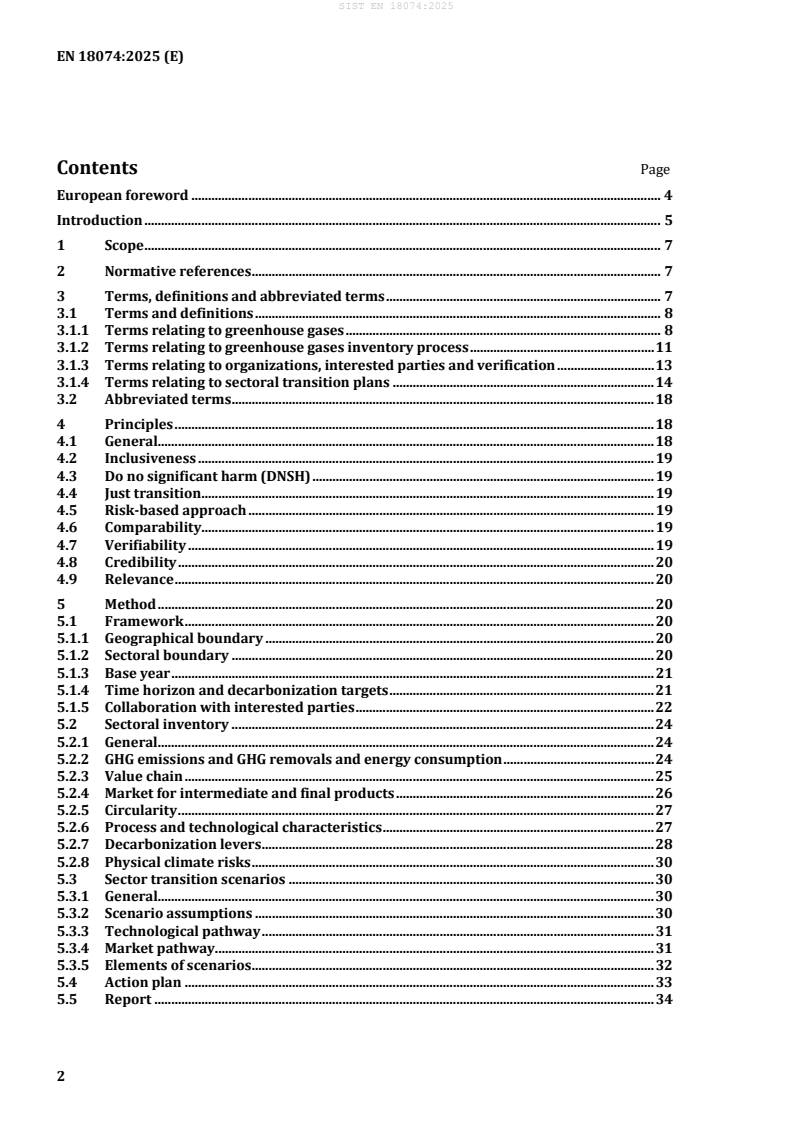
Contents Page
European foreword . 4
Introduction . 5
1 Scope . 7
2 Normative references . 7
3 Terms, definitions and abbreviated terms . 7
3.1 Terms and definitions . 8
3.1.1 Terms relating to greenhouse gases . 8
3.1.2 Terms relating to greenhouse gases inventory process . 11
3.1.3 Terms relating to organizations, interested parties and verification . 13
3.1.4 Terms relating to sectoral transition plans . 14
3.2 Abbreviated terms . 18
4 Principles . 18
4.1 General. 18
4.2 Inclusiveness . 19
4.3 Do no significant harm (DNSH) . 19
4.4 Just transition . 19
4.5 Risk-based approach . 19
4.6 Comparability . 19
4.7 Verifiability . 19
4.8 Credibility . 20
4.9 Relevance . 20
5 Method . 20
5.1 Framework . 20
5.1.1 Geographical boundary . 20
5.1.2 Sectoral boundary . 20
5.1.3 Base year . 21
5.1.4 Time horizon and decarbonization targets . 21
5.1.5 Collaboration with interested parties . 22
5.2 Sectoral inventory . 24
5.2.1 General. 24
5.2.2 GHG emissions and GHG removals and energy consumption . 24
5.2.3 Value chain . 25
5.2.4 Market for intermediate and final products . 26
5.2.5 Circularity . 27
5.2.6 Process and technological characteristics . 27
5.2.7 Decarbonization levers . 28
5.2.8 Physical climate risks . 30
5.3 Sector transition scenarios . 30
5.3.1 General. 30
5.3.2 Scenario assumptions . 30
5.3.3 Technological pathway . 31
5.3.4 Market pathway . 31
5.3.5 Elements of scenarios . 32
5.4 Action plan . 33
5.5 Report . 34
Annex A (informative) Example of an action in the action plan . 36
A.1 Extract from French cement sectoral transition plan . 36
Annex B (informative) Reference to the just transition . 38
B.1 General . 38
B.2 What is a just transition . 38
B.3 Objectives of a just transition. 39
B.4 Reference documents for a just transition . 39
Annex C (informative) Guidance for the process of identifying significant indirect GHG
emissions . 40
C.1 General . 40
C.2 Define criteria to evaluate the significance of GHG emissions, consistent with the
targets of the Sectoral Transition Plan . 40
C.3 Identify and evaluate direct and indirect emissions . 40
C.4 Apply criteria to select significant direct and indirect emissions . 41
Bibliography . 42
European foreword
This document (EN 18074:2025) has been prepared by Technical Committee CEN/TC 467 “Climate
Change”, the secretariat of which is held by UNI.
This European Standard shall be given the status of a national standard, either by publication of an
identical text or by endorsement, at the latest by April 2026, and conflicting national standards shall be
withdrawn at the latest by April 2026.
Attention is drawn to the possibility that some of the elements of this document may be the subject of
patent rights. CEN shall not be held responsible for identifying any or all such patent rights.
Any feedback and questions on this document should be directed to the users’ national standards body.
A complete listing of these bodies can be found on the CEN website.
According to the CEN-CENELEC Internal Regulations, the national standards organisations of the
following countries are bound to implement this European Standard: Austria, Belgium, Bulgaria, Croatia,
Cyprus, Czech Republic, Denmark, Estonia, Finland, France, Germany, Greece, Hungary, Iceland, Ireland,
Italy, Latvia, Lithuania, Luxembourg, Malta, Netherlands, Norway, Poland, Portugal, Republic of North
Macedonia, Romania, Serbia, Slovakia, Slovenia, Spain, Sweden, Switzerland, Türkiye and the United
Kingdom.
Introduction
As industry represents around 20 % of greenhouse gases (GHG) emissions [1], it is at the centre of many
discussions regarding a decarbonization transition.
Many industrial sectoral roadmaps and companies’ commitments for transition have been published but
without governance or methodological baseline. This gap is questioning the credibility of those
documents. A great number of initiatives work on establishing standards for entity transition plans (ETP)
compatible with 1,5°C or 2°C pathways in line with the Paris Agreement. It seems relevant to ensure the
consistency of entity transition plans with sectoral transition plans (STP), established using a common
and recognized methodology. Furthermore, the review of the European industrial strategy by the
European Commission in 2021 mentions the necessary development of transition plans for more
resilient, digitalized and sustainable industrial infrastructure and systems. Again, a common method
across sectors would give credibility by harmonizing these plans and enhancing validation and
verifiability. No standardized method is available yet for sectoral transition plans which leads to
differences in the scopes and results.
Finally, requirements and recommendations to develop a sectoral transition plan would facilitate an
adequate answer from industrial sectors to the decarbonization challenge. A sectoral standard would also
question sectoral transformation regarding all the value chains being able to respond to the same need.
Therefore, production and consumption ways could be progressively transformed.
Climate change is one of the most pressing challenges that our world faces. Scientific assessments from
the Intergovernmental Panel on Climate Change (IPCC) reports have shown that many of the worst
consequences of climate change can be avoided by limiting global warming to 1,5 °C above pre-industrial
levels. Scenarios assessed by the IPCC indicate that limiting warming to 1,5 °C, with no or limited
temperature overshoot, requires achieving at least net zero global carbon dioxide (CO ) emissions in the
early 2050s, along with deep and sustained global reductions in other GHG emissions [2] [3]. These
scenarios also show that the earlier and faster emission reductions occur, the lower peak warming and
the lower the likelihood of overshooting warming limits.
The 2015 Paris Agreement [4] states the importance of achieving a global balance between human-
caused emissions by sources and human-led removals by sinks in the second half of the 21st century,
taking into account varying capabilities in different parts of the world, on the basis of equity, and in the
context of sustainable development and efforts to eradicate poverty. This document therefore includes
recommendations on just transition (more details available in Annex B).
The results of a sectoral transition plan include:
— a sectoral inventory as defined in 5.1;
— several decarbonization scenarios composed of several decarbonization trajectories including a
technological and a market pathway and investment planning;
— an action plan for the implementation of the scenarios exposed before.
This document aims to help an organization to elaborate a credible, qualitative, and ambitious sectoral
transition plan.
This document aims to fill the gap exposed previously. The development of a European Standard (EN) is
of particular importance to standardize practices, strengthen trust between sectoral transition plan’s
interested parties and guarantee the quality of the transition plan. It will facilitate the replicability of
sectoral transition plans for industry decarbonization and their dissemination.
In this document, the following verbal forms are used:
— “shall” indicates a requirement;
— “should” indicates a recommendation;
— “may” indicates a permission;
— “can” indicates a possibility or a capability.
1 Scope
This document specifies the requirements and recommendations relative to the construction of a sectoral
transition plan for industry decarbonization.
This document does not specify the requirements for the construction of a roadmap of single industrial
company’s transition plan (a plant or a group), however, a sectoral transition plan can be used as a
reference in an entity transition plan.
This document is intended to be used by organizations, including national and public bodies, trade
associations, federations, companies and NGOs that wish to establish or monitor sectoral decarbonization
plans.
This document is climate-programme neutral. If a climate programme is applicable, requirements of this
programme are additional to the requirement of this document.
In this document, either natural or technological sequestrations occur inside the geographical and
sectoral boundaries considered in the sectoral transition plan. Otherwise, they are excluded.
In this document, considering its energy consumption and its cost, the direct air capture and storage
technology (DACS) is not considered relevant and is excluded from the sectoral transition plan.
Carbon offsets are excluded from this document.
NOTE Carbon offsets are intended as be understood as “Emissions reduction or removal resulting from an action
outside the geographical and sectoral boundary used to counterbalance the sector’s residual emissions”.
2 Normative references
The following documents are referred to in the text in such a way that some or all of their content
constitutes requirements of this document. For dated references, only the edition cited applies. For
undated references, the latest edition of the referenced document (including any amendments) applies.
EN 19694 (all parts), Stationary source emissions — Determination of greenhouse gas (GHG) emissions in
energy-intensive industries
EN ISO 14064-1:2019, Greenhouse gases — Part 1: Specification with guidance at the organization level
for quantification and reporting of greenhouse gas emissions and removals (ISO 14064-1:2018)
3 Terms, definitions and abbreviated terms
For the purposes of this document, the following terms and definitions apply.
ISO and IEC maintain terminology databases for use in standardization at the following addresses:
— ISO Online browsing platform: available at https://www.iso.org/obp/
— IEC Electropedia: available at https://www.electropedia.org/
3.1 Terms and definitions
3.1.1 Terms relating to greenhouse gases
3.1.1.1
greenhouse gases
GHG
gaseous constituent of the atmosphere, both natural and anthropogenic, that absorbs and emits radiation
at specific wavelengths within the spectrum of infrared radiation emitted by the Earth’s surface, the
atmosphere and clouds
Note 1 to entry: For a list of GHGs, see the latest Intergovernmental Panel on Climate Change (IPCC) Assessment
Report.
Note 2 to entry: Water vapour and ozone are anthropogenic as well as natural GHGs but are not included as
recognized GHGs due to difficulties, in most cases, in isolating the human-induced component of global warming
attributable to their presence in the atmosphere.
[SOURCE: EN ISO 14064-1:2019, 3.1.1]
3.1.1.2
greenhouse gas source
GHG source
process that releases a greenhouse gas (3.1.1.1) into the atmosphere
[SOURCE: EN ISO 14064-1:2019, 3.1.2]
3.1.1.3
greenhouse gas sink
GHG sink
process that removes a greenhouse gas (3.1.1.1) from the atmosphere
[SOURCE: EN ISO 14064-1:2019, 3.1.3]
3.1.1.4
greenhouse gas emission
GHG emission
release of a greenhouse gas (3.1.1.1) into the atmosphere
[SOURCE: EN ISO 14064-1:2019, 3.1.5]
3.1.1.5
greenhouse gas removals
GHG removal
withdrawal of a greenhouse gas (3.1.1.1) from the atmosphere by GHG sinks (3.1.1.3)
Note 1 to entry: These include enhancing biological sinks of CO and using chemical engineering to achieve
permanent removal and storage.
Note 2 to entry: Carbon capture and storage (CCS) from industrial and energy-related sources, which alone does
not remove CO in the atmosphere, can reduce atmospheric CO if it is combined with bioenergy production
2 2
(BECCS).
Note 3 to entry: Storage permanence relates to risk of reversal. Storage is generally considered at low risk of
reversal if no GHG is re-released for at least 100 years after storage or within the lifespan of the GHG being
counterbalanced.
Note 4 to entry: Anthropogenic GHG removal refers to the withdrawal of GHGs from the atmosphere as a result of
deliberate human activities.
[SOURCE: EN ISO 14064-1:2019, 3.1.6, modified – the notes to entry have been added]
3.1.1.6
carbon dioxide capture and storage
CCS
process in which a stream of carbon dioxide (CO ) from industrial or energy-related sources is separated
(captured) and transported to a storage location for permanent isolation from the atmosphere
Note 1 to entry: Sometimes it is referred to as carbon capture and storage.
[SOURCE: IPCC glossary, available at https://www.ipcc.ch/sr15/chapter/glossary/, modified – the terms
“relatively pure” and “conditioned, compressed” have been removed, “long-term isolation” has been
replaced with “permanent isolation”]
3.1.1.7
biomass
material of biological origin, excluding material embedded in geological formations and material
transformed to fossilized material
Note 1 to entry: Biomass includes organic material (both living and dead), e.g. trees, crops, grasses, tree litter, algae,
animals, manure and waste of biological origin.
[SOURCE: EN ISO 14064-1:2019, 3.3.1]
3.1.1.8
bioenergy
energy derived from any form of biomass or its metabolic by-products
[SOURCE: IPCC glossary available at https://www.ipcc.ch/sr15/chapter/glossary/]
3.1.1.9
bioenergy with carbon dioxide capture and storage
BECCS
carbon dioxide capture and storage (CCS) technology applied to a bioenergy plant
Note 1 to entry: Depending on the total emissions of the BECCS supply chain, carbon dioxide (CO ) can be removed
from the atmosphere.
[SOURCE: IPCC glossary available at https://www.ipcc.ch/sr15/chapter/glossary/]
3.1.1.10
greenhouse gas emission factor
GHG emission factor
coefficient relating GHG activity data (3.1.2.1) with the GHG emission (3.1.1.4)
[SOURCE: EN ISO 14064-1:2019, 3.1.7]
3.1.1.11
greenhouse gas removal factor
GHG removal factor
coefficient relating GHG activity data (3.1.2.1) with the GHG removal (3.1.1.5)
[SOURCE: EN ISO 14064-1:2019, 3.1.8]
3.1.1.12
direct greenhouse gas removal
direct GHG removal
GHG removal (3.1.1.5) from GHG sinks owned or controlled by an organization (3.1.3.2) inside the sectoral
boundary
[SOURCE: EN ISO 14064-1:2019, 3.1.10, modified – “inside the sectoral boundary” has been added]
3.1.1.13
direct greenhouse gas emission
direct GHG emission
GHG emission (3.1.1.4) from GHG sources (3.1.1.2) owned or controlled by the organizations (3.1.3.2)
inside the sectoral boundary
Note 1 to entry: This document uses the concepts of equity share or control (financial or operational control) to
establish organizational boundaries.
[SOURCE: EN ISO 14064-1:2019, 3.1.9, modified – “inside the sectoral boundary” has been added]
3.1.1.14
indirect greenhouse gas emission
indirect GHG emission
GHG emission (3.1.1.4) that is a consequence of an organization’s operations and activities, but that arises
from GHG sources (3.1.1.2) that are not owned or controlled by the organizations (3.1.3.2) within the
sectoral boundary
Note 1 to entry: These emissions occur generally in the upstream and/or downstream chain.
[SOURCE: EN ISO 14064-1:2019, 3.1.11, modified – “within the sectoral boundary” has been added]
3.1.1.15
global warming potential
GWP
index, based on radiative properties of GHGs (3.1.1.1), measuring the radiative forcing following a pulse
emission of a unit mass of a given GHG in the present-day atmosphere integrated over a chosen time
horizon, relative to that of carbon dioxide (CO )
[SOURCE: EN ISO 14064-1:2019, 3.1.12]
3.1.1.16
carbon dioxide equivalent
CO e
unit for comparing the radiative forcing of a GHG (3.1.1.1) to that of carbon dioxide
Note 1 to entry: The carbon dioxide equivalent is calculated using the mass of a given GHG multiplied by its global
warming potential.
[SOURCE: EN ISO 14064-1:2019, 3.1.13]
3.1.1.17
climate change mitigation
human intervention to reduce greenhouse gas emissions (3.1.1.4) or enhance greenhouse gas removals
(3.1.1.5)
[SOURCE: EN ISO 14050:2020, 3.8.6]
3.1.2 Terms relating to greenhouse gases inventory process
3.1.2.1
greenhouse gas activity data
GHG activity data
quantitative measure of activity that results in a GHG emission (3.1.1.4) or GHG removal (3.1.1.5)
EXAMPLE Amount of energy, fuels or electricity consumed, material produced, service provided, area of land
affected.
[SOURCE: EN ISO 14064-1:2019, 3.2.1]
3.1.2.2
primary data
quantified value of a process or an activity obtained from a direct measurement, or a calculation based
on direct measurements
Note 1 to entry: Primary data can include GHG emission factors (3.1.1.9) or GHG removal factors (3.1.1.10) and/or
GHG activity data (3.1.2.1).
[SOURCE: EN ISO 14064-1:2019, 3.2.2]
3.1.2.3
greenhouse gas statement
GHG statement
factual and objective declaration that provides the subject matter for the verification or validation
Note 1 to entry: The GHG statement could be presented at a point in time or could cover a period of time.
Note 2 to entry: The GHG statement provided by the responsible party is clearly identifiable, capable of consistent
evaluation or measurement against suitable criteria by a verifier or validator.
Note 3 to entry: The GHG statement could be provided in a GHG report or GHG project plan.
[SOURCE: EN ISO 14064-1:2019, 3.2.5]
3.1.2.4
greenhouse gas inventory
GHG inventory
list of GHG sources (3.1.1.2) and GHG sinks (3.1.1.3), and their quantified GHG emissions (3.1.1.4) and GHG
removals (3.1.1.5)
[SOURCE: EN ISO 14064-1:2019, 3.2.6]
3.1.2.5
greenhouse gas project
GHG project
activity or activities that alter the conditions of a GHG baseline and which cause GHG emission (3.1.1.4)
reductions or GHG removal (3.1.1.5) enhancements
Note 1 to entry: EN ISO 14064-2 [7] provides information on how to determine and use GHG baselines.
[SOURCE: EN ISO 14064-1:2019, 3.2.7]
3.1.2.6
base year
specific, historical period identified for the purpose of comparing GHG emissions (3.1.1.4) or GHG removals
(3.1.1.5) or other GHG-related information over time
[SOURCE: EN ISO 14064-1:2019, 3.2.10]
3.1.2.7
uncertainty
parameter associated with the result of quantification that characterizes the dispersion of the values that
could be reasonably attributed to the quantified amount
Note 1 to entry: Uncertainty information typically specifies quantitative estimates of the likely dispersion of values
and a qualitative description of the likely causes of the dispersion.
[SOURCE: EN ISO 14064-1:2019, 3.2.13]
3.1.2.8
significant indirect greenhouse gas emission
significant indirect GHG emission
sector’s quantified and reported GHG emissions (3.1.1.4) complying with the significance criteria set by
the STP leader (3.1.4.2)
[SOURCE: EN ISO 14064-1:2019, 3.2.14, modified – “organization” has been replaced with “sector” the
first time and “STP leader” the second time]
3.1.3 Terms relating to organizations, interested parties and verification
3.1.3.1
plant
single installation, set of installations or production processes (stationary or mobile), which can be
defined within a single geographical boundary, organizational unit or production process
[SOURCE: EN ISO 14064-1:2019, 3.4.1, modified – the term “facility” has been replaced with “plant”]
3.1.3.2
organization
person or group of people that has its own functions with responsibilities, authorities, and relationships
to achieve its objectives
[SOURCE: ISO 14064-1:2018, 3.4.2]
3.1.3.3
company
owner or organization that is responsible for development of and/or operation of an installation/facility
[SOURCE: EN ISO 17782:2018, 3.1.3, modified – the note to entry has been removed]
3.1.3.4
responsible party
person or persons responsible for the provision of the GHG statement (3.1.2.3) and the supporting GHG
(3.1.1.1) information
Note 1 to entry: The responsible party can be either individuals or representatives of an organization or project
and can be the party who engages the verifier or validator.
[SOURCE: EN ISO 14064-1:2019, 3.4.3]
3.1.3.5
organizational boundary
grouping of activities or facilities in which an organization (3.1.3.2) exercises operational or financial
control or has an equity share
[SOURCE: EN ISO 14064-1:2019, 3.4.7]
3.1.3.6
verification
process for evaluating a statement of historical data and information to determine if the statement is
materially correct and conforms to criteria
[SOURCE: EN ISO 14064-1:2019, 3.4.9]
3.1.3.7
validation
process for evaluating the reasonableness of the assumptions, limitations and methods that support a
statement about the outcome of future activities
[SOURCE: EN ISO 14064-1:2019, 3.4.10]
3.1.3.8
verifier
competent and impartial person with responsibility for performing and reporting on a verification
[SOURCE: EN ISO 14064-1:2019, 3.4.11]
3.1.3.9
validator
competent and impartial person with responsibility for performing and reporting on a validation
[SOURCE: EN ISO 14064-1:2019, 3.4.12]
3.1.4 Terms relating to sectoral transition plans
3.1.4.1
sectoral transition plan
strategic plan elaborated in collaboration with interested parties detailing actionable measures to
achieve a sector's decarbonization goals
3.1.4.2
sectoral transition plan leader
STP leader
organization in charge of the development of the sectoral transition plan
Note 1 to entry: STP leader can be a business sector body such as sectoral technical institute, sectoral business
union or network or think tank, governmental body (agency, ministry…), intergovernmental or international
organizations or agencies, NGOs, specialized academic, trade unions, company of the sector…
3.1.4.3
decarbonization
active reduction or removal of carbon dioxide and other GHG output into the atmosphere
3.1.4.4
decarbonization lever
aggregated types of mitigation actions such as energy efficiency, electrification, fuel switching, use of
renewable energy, products change, and supply-chain decarbonization that fit with undertakings' specific
actions
[SOURCE: ESRS E1 report, ANNEX A]
3.1.4.5
industrial sector
activity producing goods or services or transforming material typically corresponding to a 3- or 4- digit
ISIC classification [15] or the Statistical classification of economic activities in the European Community
(NACE) [16]
3.1.4.6
value chain
entire sequence of activities or parties that provide or receive value in the form of a product
Note 1 to entry: Parties that provide value include employees, suppliers, outsourced workers, contractors and
others.
Note 2 to entry: Parties that receive value include customers, consumers, clients and other users.
Note 3 to entry: In this document, products are defined as goods or services offered by a provider.
Note 4 to entry: See Figure 1.
[SOURCE: EN ISO 26000:2010, 2.25, modified – Note 3 and 4 to entry have been added]
3.1.4.7
objective
result to be achieved
Note 1 to entry: An objective can be strategic, tactical, or operational.
Note 2 to entry: Objectives can relate to different disciplines (such as financial, health and safety, and
environmental goals) and can apply at different levels (such as strategic, organization-wide, project, product, and
process).
Note 3 to entry: An objective can be expressed in other ways, e.g. as an intended outcome, a purpose, an operational
criterion, as a collaborative business relationship objective or by the use of other words with similar meaning (e.g.
aim, goal, or target).
Note 4 to entry: In the context of collaborative business relationship management systems, collaborative business
relationship objectives are set initially by the organization (3.1.3.2), consistent with the collaborative business
relationship policy, to achieve specific results. Once a partner is selected, the collaborative business relationship
objectives are incorporated into the joint objectives.
[SOURCE: ISO 44001:2017, 3.8]
3.1.4.8
interested party
person or organization (3.1.3.2) that can affect, be affected by, or perceive itself to be affected by a
decision or activity
[SOURCE: EN ISO 14050:2020, 3.1.2]
3.1.4.9
time horizon
year by which the decarbonization objective is reached
3.1.4.10
scenario
projections of what can happen by creating plausible, coherent, and internally consistent descriptions of
possible futures
Note 1 to entry: A scenario is the coupling of three elements:
— scenario assumptions (see 3.1.4.20),
— technological pathway (see 3.1.4.21),
— market pathway (see 3.1.4.22).
Note 2 to entry: Scenarios are not predictions of the future.
[SOURCE: https://assets.bbhub.io/company/sites/63/2022/06/GFANZ_Guidance-on-Use-of-Sectoral-
Pathways-for-Financial-Institutions_June2022.pdf, page 24, Note 1 and 2 to entry have been added]
3.1.4.11
sectoral boundary
boundaries of the sector or sub-sector studied in the STP, that is all the production assets and activities
whose GHG emissions (3.1.1.4) and GHG removals (3.1.1.5) will be accounted in the STP and that are
targeted for decarbonization
Note 1 to entry: It is established by the STP leader on the basis of the sectoral inventory.
3.1.4.12
locked-in emission
estimate of future GHG emissions (3.1.1.4) that are caused by an asset or product over their lifespan
Note 1 to entry: It corresponds to long-lived infrastructure and products; it can take years or even decades before
they are eventually replaced or decommissioned.
Note 2 to entry: In the case of products, this accounts for GHG emissions during the products downstream chain
(including disposal or recycling).
3.1.4.13
adaptation to climate change
process of adjustment to actual or expected climate and its effects
[SOURCE: EN ISO 14050:2020, 3.8.5]
3.1.4.14
climate change exposure
potential impact of climate change on locations and their social, economic and natural structures
[SOURCE: EN ISO 14050:2020, 3.8.15]
3.1.4.15
hazard
potential source of injury or damage to the health of people, or damage to property or the environment
Note 1 to entry: In this document, the term hazard usually refers to climate-related physical events or trends or
their physical impacts. Thus, it includes processes that range from brief events, such as severe storms, to slow
trends, such as multi-decade droughts or multi-century sea level rise. Appreciating a climate hazard involves
considering its likelihood, magnitude and duration.
[SOURCE: EN ISO 14050:2020, 3.1.8, modified – Note 1 to entry has been added]
3.1.4.16
climate change impact
effect on natural or human systems as a result of exposure (3.1.4.14) to climate change
[SOURCE: EN ISO 14050:2020, 3.8.10]
3.1.4.17
climate change risk
potential of negative climate change impacts (3.1.4.14) that reflects the interaction among vulnerability
(3.1.4.18), climate change exposure (3.1.4.14) and hazard (3.1.4.15)
[SOURCE: EN ISO 14050:2020, 3.8.12]
3.1.4.18
vulnerability
propensity or predisposition to be adversely affected by climate variability or climate change
[SOURCE: EN ISO 14050:2020, 3.8.13]
3.1.4.19
pre-industrial levels
multi-century period prior to the onset of large-scale industrial activity that occurred around 1750
Note 1 to entry: The period 1850 to 1900 represents the earliest period of sufficiently globally complete
observations to estimate global surface temperature and is used in the IPCC Sixth Assessment Reports as an
approximation for pre-industrial conditions.
3.1.4.20
scenario assumptions
exogenous context in which the sector decarbonization might occur until the chosen time horizon
Note 1 to entry: Scenario assumptions are described by quantitative and qualitative elements that might have an
impact either on the production volume (of products and thus of emissions linked to their production) or the
industrial decarbonization strategies.
3.1.4.21
technological pathway
trajectory presenting the deployment modalities of the decarbonization levers (3.1.4.4)
3.1.4.22
market pathway
trajectory of the production volumes within the sectoral boundary (3.1.4.11)
3.1.4.23
geographical dependency
dependency of a decarbonization lever (3.1.4.4) on the conditions in its geographical boundary
Note 1 to entry: Conditions include but are not limited to public policy or legal factors, economic factors,
technological and infrastructure readiness, social factors, environmental factors and resource availability.
3.1.4.24
waste hierarchy
priority order in waste prevention and management legislation and policy
Note 1 to entry: The priority order in the waste hierarchy is defined here as: (a) prevention; (b) preparing for reuse,
(c) recycling, (d) other recovery, e.g. energy recovery, and (e) disposal.
[SOURCE: Directive 2008/98/EC [11], Article 4, modified – unnecessary text has been removed]
3.2 Abbreviated terms
STP sectoral transition plan
GHG greenhouse gases
CO e carbon dioxide equivalent
IPCC Intergovernmental Panel on Climate Change
GWP global warming potential
CAPEX capital expenditures
OPEX operational expenditures
NUTS Nomenclature of Territorial Units for Statistics
BECCS bioenergy with carbon capture and storage
DNSH do no significant harm
4 Principles
4.1 General
This document focuses on decarbonization transition plans. However, other key environmental aspects
should be considered with the Do No Significant Harm (DNSH) perspective and shall take into account
existing sectoral rules, European policies, and methodologies.
A qualitative sectoral transition plan concerns both the total volume of the sector’s GHG emissions and
GHG removals and the sector’s GHG emission intensity (per ton of product or per functional unit of
product). Therefore, the transition plan includes the evolution of the industrial production of the sector
studied. The evolution might vary following different changes:
— modification of demand for the product within the geographical boundary;
— modification of the trade outside the geographical boundary.
The decarbonization objective is consistent with a 1,5°C globally above pre-industrial levels trajectory. If
it is not possible for some reasons which shall be explained, the objective is at least consistent with a well
below 2°C globally above pre-industrial levels trajectory.
4.2 Inclusiveness
The quality, ambition and credibility of a sectoral transition plan is guaranteed by the collaboration with
relevant interested parties.
4.3 Do no significant harm (DNSH)
Measures or activities towards decarbonization targets avoid adverse impact on the environment (no
significant harm to any of the 6 environmental objectives within the meaning of article 17 of the
Taxonomy Regulation) or society (respect of the minimum safeguards as per article 18 of the Taxonomy
Regulation) to ensure environmental integrity.
4.4 Just transition
A sectoral transition plan indicates how the transition explored “maximises positive economic, social, and
decent work gains and minimises and mitigates negative impacts” and ensures that “processes and
outcomes are inclusive and fair” [12]. A credible sectoral transition plan considers how the sector’s
transition is expected to impact workers, suppliers, local communities, and consumers.
The sectoral transition plan takes into account the imperatives of a just transition of the workforce and
the creation of decent work and quality jobs in accordance with nationally defined development priorities
[13].
Decisions are aligned with the principle of equity and justice and shall take into account fair share and
just transition. Decisions are reviewed regularly, and targets, policies and actions are adapted as
knowledge and science evolves.
NOTE More information regarding just transition is available in Annex B.
4.5 Risk-based approach
Risks related to climate change mitigation actions are assessed and controls shall be put in place to
address them. The risk-based approach takes into account uncertainty, potential negative impacts,
unintended consequences and other foreseeable risks. The risks of each mitigation action are compared
with the risks of not taking action. There is ongoing monitoring of mitigation actions taken and a
commitment to take urgent corrective action if issues arise.
NOTE 1 “Unintended consequences” relate to any direct or indirect effect that reduces or eliminates the
effectiveness of a mitigation action. For example:
— reversal of a removal through non-permanent storage or leakage of GHG emissions;
— double counting of emissions reductions, removals or offset investments made outside the organization’s
boundaries or influence.
NOTE 2 Further information on the risks of not taking action is provided in the IPCC Sixth Assessment Report
[14].
4.6 Comparability
STPs enable interested parties to track and compare the performance of a specific sector over time, as
well as across different sectors within the same time frame.
4.7 Verifiability
Data used in preparing the STP is subject to verification to guarantee its robustness and quality.
4.8 Credibility
Mitigation actions are selected to be real, permanent and of high quality, prioritising actions with the
largest emission reductions, and taking into account geographical dependencies
4.9 Relevance
The selection of the data and methodologies is appropriate to the sector specificities.
5 Method
5.1 Framework
5.1.1 Geographical boundary
Geographical boundaries shall be defined at an appropriate level for the intended user.
EXAMPLE Supranational, national, subnational.
The geographical boundary shall be documented. Geographical boundaries should facilitate analysis of:
(i) material and ec
...