


ISO/IEC TR 27019:2013
(Main)Information technology — Security techniques — Information security management guidelines based on ISO/IEC 27002 for process control systems specific to the energy utility industry
Information technology — Security techniques — Information security management guidelines based on ISO/IEC 27002 for process control systems specific to the energy utility industry
ISO/IEC TR 27019:2013 provides guiding principles based on ISO/IEC 27002 for information security management applied to process control systems as used in the energy utility industry. The aim of ISO/IEC TR 27019:2013 is to extend the ISO/IEC 27000 set of standards to the domain of process control systems and automation technology, thus allowing the energy utility industry to implement a standardized information security management system (ISMS) in accordance with ISO/IEC 27001 that extends from the business to the process control level. The scope of ISO/IEC TR 27019:2013 covers process control systems used by the energy utility industry for controlling and monitoring the generation, transmission, storage and distribution of electric power, gas and heat in combination with the control of supporting processes. This includes in particular the following systems, applications and components: the overall IT-supported central and distributed process control, monitoring and automation technology as well as IT systems used for their operation, such as programming and parameterization devices; digital controllers and automation components such as control and field devices or PLCs, including digital sensor and actuator elements; all further supporting IT systems used in the process control domain, e.g. for supplementary data visualization tasks and for controlling, monitoring, data archiving and documentation purposes; the overall communications technology used in the process control domain, e.g. networks, telemetry, telecontrol applications and remote control technology; digital metering and measurement devices, e.g. for measuring energy consumption, generation or emission values; digital protection and safety systems, e.g. protection relays or safety PLCs; distributed components of future smart grid environments; all software, firmware and applications installed on above mentioned systems. Outside the scope of ISO/IEC TR 27019:2013 is the conventional or classic control equipment that is non-digital, i.e. purely electro-mechanical or electronic monitoring and process control systems. Furthermore, energy process control systems in private households and other, comparable residential building installations are outside the scope of ISO/IEC TR 27019:2013. Telecommunication systems and components used in the process control environment are also not directly part of the scope of ISO/IEC TR 27019:2013. These are covered by ISO/IEC 27011:2008.
Technologies de l'information — Techniques de sécurité — Lignes directrices de management de la sécurité de l'information fondées sur l'ISO/CEI 27002 pour les systèmes de contrôle des procédés spécifiques à l'industrie de l'énergie
General Information
- Status
- Withdrawn
- Publication Date
- 16-Jul-2013
- Withdrawal Date
- 16-Jul-2013
- Drafting Committee
- ISO/IEC JTC 1/SC 27/WG 1 - Information security management systems
- Current Stage
- 9599 - Withdrawal of International Standard
- Start Date
- 01-Nov-2017
- Completion Date
- 14-Feb-2026
Relations
- Effective Date
- 05-Nov-2015
Buy Documents


ISO/IEC TR 27019:2013 - Information technology -- Security techniques -- Information security management guidelines based on ISO/IEC 27002 for process control systems specific to the energy utility industry
Get Certified
Connect with accredited certification bodies for this standard

BSI Group
BSI (British Standards Institution) is the business standards company that helps organizations make excellence a habit.

Bureau Veritas
Bureau Veritas is a world leader in laboratory testing, inspection and certification services.

DNV
DNV is an independent assurance and risk management provider.
Sponsored listings
Frequently Asked Questions
ISO/IEC TR 27019:2013 is a technical report published by the International Organization for Standardization (ISO). Its full title is "Information technology — Security techniques — Information security management guidelines based on ISO/IEC 27002 for process control systems specific to the energy utility industry". This standard covers: ISO/IEC TR 27019:2013 provides guiding principles based on ISO/IEC 27002 for information security management applied to process control systems as used in the energy utility industry. The aim of ISO/IEC TR 27019:2013 is to extend the ISO/IEC 27000 set of standards to the domain of process control systems and automation technology, thus allowing the energy utility industry to implement a standardized information security management system (ISMS) in accordance with ISO/IEC 27001 that extends from the business to the process control level. The scope of ISO/IEC TR 27019:2013 covers process control systems used by the energy utility industry for controlling and monitoring the generation, transmission, storage and distribution of electric power, gas and heat in combination with the control of supporting processes. This includes in particular the following systems, applications and components: the overall IT-supported central and distributed process control, monitoring and automation technology as well as IT systems used for their operation, such as programming and parameterization devices; digital controllers and automation components such as control and field devices or PLCs, including digital sensor and actuator elements; all further supporting IT systems used in the process control domain, e.g. for supplementary data visualization tasks and for controlling, monitoring, data archiving and documentation purposes; the overall communications technology used in the process control domain, e.g. networks, telemetry, telecontrol applications and remote control technology; digital metering and measurement devices, e.g. for measuring energy consumption, generation or emission values; digital protection and safety systems, e.g. protection relays or safety PLCs; distributed components of future smart grid environments; all software, firmware and applications installed on above mentioned systems. Outside the scope of ISO/IEC TR 27019:2013 is the conventional or classic control equipment that is non-digital, i.e. purely electro-mechanical or electronic monitoring and process control systems. Furthermore, energy process control systems in private households and other, comparable residential building installations are outside the scope of ISO/IEC TR 27019:2013. Telecommunication systems and components used in the process control environment are also not directly part of the scope of ISO/IEC TR 27019:2013. These are covered by ISO/IEC 27011:2008.
ISO/IEC TR 27019:2013 provides guiding principles based on ISO/IEC 27002 for information security management applied to process control systems as used in the energy utility industry. The aim of ISO/IEC TR 27019:2013 is to extend the ISO/IEC 27000 set of standards to the domain of process control systems and automation technology, thus allowing the energy utility industry to implement a standardized information security management system (ISMS) in accordance with ISO/IEC 27001 that extends from the business to the process control level. The scope of ISO/IEC TR 27019:2013 covers process control systems used by the energy utility industry for controlling and monitoring the generation, transmission, storage and distribution of electric power, gas and heat in combination with the control of supporting processes. This includes in particular the following systems, applications and components: the overall IT-supported central and distributed process control, monitoring and automation technology as well as IT systems used for their operation, such as programming and parameterization devices; digital controllers and automation components such as control and field devices or PLCs, including digital sensor and actuator elements; all further supporting IT systems used in the process control domain, e.g. for supplementary data visualization tasks and for controlling, monitoring, data archiving and documentation purposes; the overall communications technology used in the process control domain, e.g. networks, telemetry, telecontrol applications and remote control technology; digital metering and measurement devices, e.g. for measuring energy consumption, generation or emission values; digital protection and safety systems, e.g. protection relays or safety PLCs; distributed components of future smart grid environments; all software, firmware and applications installed on above mentioned systems. Outside the scope of ISO/IEC TR 27019:2013 is the conventional or classic control equipment that is non-digital, i.e. purely electro-mechanical or electronic monitoring and process control systems. Furthermore, energy process control systems in private households and other, comparable residential building installations are outside the scope of ISO/IEC TR 27019:2013. Telecommunication systems and components used in the process control environment are also not directly part of the scope of ISO/IEC TR 27019:2013. These are covered by ISO/IEC 27011:2008.
ISO/IEC TR 27019:2013 is classified under the following ICS (International Classification for Standards) categories: 03.100.70 - Management systems; 35.030 - IT Security; 35.040 - Information coding; 35.240.99 - IT applications in other fields. The ICS classification helps identify the subject area and facilitates finding related standards.
ISO/IEC TR 27019:2013 has the following relationships with other standards: It is inter standard links to ISO/IEC 27019:2017. Understanding these relationships helps ensure you are using the most current and applicable version of the standard.
ISO/IEC TR 27019:2013 is available in PDF format for immediate download after purchase. The document can be added to your cart and obtained through the secure checkout process. Digital delivery ensures instant access to the complete standard document.
Standards Content (Sample)
TECHNICAL ISO/IEC
REPORT TR
First edition
2013-07-15
Information technology — Security
techniques — Information security
management guidelines based on
ISO/IEC 27002 for process control
systems specific to the energy utility
industry
Technologies de l'information — Techniques de sécurité — Lignes
directrices de management de la sécurité de l'information fondées sur
l'ISO/CEI 27002 pour les systèmes de contrôle des procédés
spécifiques à l'industrie des opérateurs énergétiques
Reference number
©
ISO/IEC 2013
© ISO/IEC 2013
All rights reserved. Unless otherwise specified, no part of this publication may be reproduced or utilized otherwise in any form or by any
means, electronic or mechanical, including photocopying, or posting on the internet or an intranet, without prior written permission.
Permission can be requested from either ISO at the address below or ISO’s member body in the country of the requester.
ISO copyright office
Case postale 56 CH-1211 Geneva 20
Tel. + 41 22 749 01 11
Fax + 41 22 749 09 47
E-mail copyright@iso.org
Web www.iso.org
Published in Switzerland
ii © ISO/IEC 2013 – All rights reserved
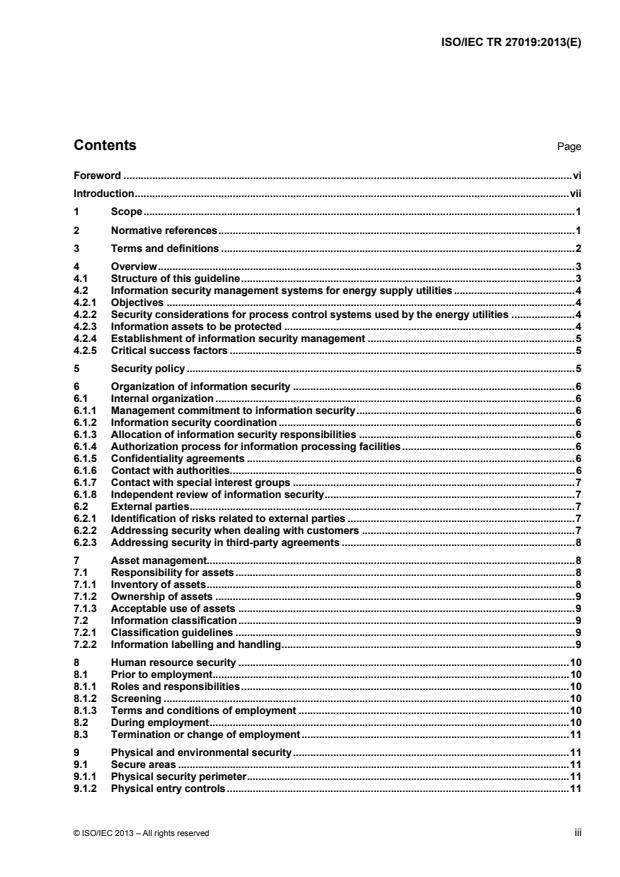
Contents Page
Foreword . vi
Introduction . vii
1 Scope . 1
2 Normative references . 1
3 Terms and definitions . 2
4 Overview . 3
4.1 Structure of this guideline . 3
4.2 Information security management systems for energy supply utilities . 4
4.2.1 Objectives . 4
4.2.2 Security considerations for process control systems used by the energy utilities . 4
4.2.3 Information assets to be protected . 4
4.2.4 Establishment of information security management . 5
4.2.5 Critical success factors . 5
5 Security policy . 5
6 Organization of information security . 6
6.1 Internal organization . 6
6.1.1 Management commitment to information security . 6
6.1.2 Information security coordination . 6
6.1.3 Allocation of information security responsibilities . 6
6.1.4 Authorization process for information processing facilities . 6
6.1.5 Confidentiality agreements . 6
6.1.6 Contact with authorities . 6
6.1.7 Contact with special interest groups . 7
6.1.8 Independent review of information security . 7
6.2 External parties . 7
6.2.1 Identification of risks related to external parties . 7
6.2.2 Addressing security when dealing with customers . 7
6.2.3 Addressing security in third-party agreements . 8
7 Asset management . 8
7.1 Responsibility for assets . 8
7.1.1 Inventory of assets . 8
7.1.2 Ownership of assets . 9
7.1.3 Acceptable use of assets . 9
7.2 Information classification . 9
7.2.1 Classification guidelines . 9
7.2.2 Information labelling and handling . 9
8 Human resource security . 10
8.1 Prior to employment . 10
8.1.1 Roles and responsibilities . 10
8.1.2 Screening . 10
8.1.3 Terms and conditions of employment . 10
8.2 During employment . 10
8.3 Termination or change of employment . 11
9 Physical and environmental security . 11
9.1 Secure areas . 11
9.1.1 Physical security perimeter . 11
9.1.2 Physical entry controls . 11
© ISO/IEC 2013 – All rights reserved iii
9.1.3 Securing offices, rooms and facilities .11
9.1.4 Protecting against external and environmental threats .11
9.1.5 Working in secure areas .11
9.1.6 Public access, delivery and loading areas .11
9.1.7 Securing control centers .11
9.1.8 Securing equipment rooms .12
9.1.9 Securing peripheral sites .13
9.2 Equipment security .14
9.2.1 Equipment siting and protection .14
9.2.2 Supporting utilities .14
9.2.3 Cabling security .14
9.2.4 Equipment maintenance .15
9.2.5 Security of equipment off-premises .15
9.2.6 Secure disposal or reuse of equipment .15
9.2.7 Removal of property .15
rd
9.3 Security in premises of 3 parties .15
9.3.1 Equipment sited on the premises of other energy utility organizations .15
9.3.2 Equipment sited on customer’s premises .16
9.3.3 Interconnected control and communication systems .16
10 Communications and operations management .16
10.1 Operational procedures and responsibilities .16
10.1.1 Documented operating procedures .16
10.1.2 Change management .17
10.1.3 Segregation of duties .17
10.1.4 Separation of development, test and operational facilities .17
10.2 Third party service delivery management .17
10.3 System planning and acceptance .17
10.4 Protection against malicious and mobile code .17
10.4.1 Controls against malicious code .17
10.4.2 Controls against mobile code .18
10.5 Back-up .18
10.6 Network security management .18
10.6.1 Network controls .18
10.6.2 Security of network services .18
10.6.3 Securing process control data communication .18
10.7 Media handling .19
10.8 Exchange of information .19
10.9 Electronic commerce services .19
10.10 Monitoring .19
10.10.1 Audit logging .19
10.10.2 Monitoring system use .19
10.10.3 Protection of log information .19
10.10.4 Administrator and operator logs .19
10.10.5 Fault logging .19
10.10.6 Clock synchronization .20
10.11 Legacy systems .20
10.11.1 Treatment of legacy systems .20
10.12 Safety functions .20
10.12.1 Integrity and availability of safety functions .21
11 Access control .21
11.1 Business requirement for access control .21
11.1.1 Access control policy .21
11.2 User access management .21
11.3 User responsibilities .21
11.3.1 Password use .21
11.3.2 Unattended user equipment .22
11.3.3 Clear desk and clear screen policy .22
11.4 Network access control .22
iv © ISO/IEC 2013 – All rights reserved
11.4.1 Policy on use of network services . 22
11.4.2 User authentication for external connections . 22
11.4.3 Equipment identification in networks . 22
11.4.4 Remote diagnostic and configuration port protection . 22
11.4.5 Segregation in networks . 22
11.4.6 Network connection control . 23
11.4.7 Network routing control . 23
11.4.8 Logical coupling of external process control systems . 23
11.5 Operating system access control . 23
11.5.1 Secure log-on procedures . 23
11.5.2 User identification and authentication . 23
11.5.3 Password management system . 23
11.5.4 Use of system utilities . 23
11.5.5 Session time-out . 24
11.5.6 Limitation of connection time . 24
11.6 Application and information access control . 24
11.7 Mobile computing and teleworking . 24
12 Information systems acquisition, development and maintenance . 24
12.1 Security requirements of information systems . 24
12.1.1 Security requirements analysis and specification . 24
12.2 Correct processing in applications . 24
12.3 Cryptographic controls . 24
12.4 Security of system files . 24
12.4.1 Control of operational software . 24
12.4.2 Protection of system test data . 25
12.4.3 Access control to program source code . 25
12.5 Security in development and support processes . 25
12.6 Technical vulnerability management . 25
13 Information security incident management . 25
13.1 Reporting information security events and weaknesses . 25
13.2 Management of information security incidents and improvements . 25
14 Business continuity management . 25
14.1 Information security aspects of business continuity management . 25
14.1.1 Including information security in the business continuity management process . 25
14.1.2 Business continuity and risk assessment . 25
14.1.3 Developing and implementing continuity plans including information security . 25
14.1.4 Business continuity planning framework . 26
14.1.5 Testing, maintaining and re-assessing business continuity plans . 26
14.2 Essential emergency services . 26
14.2.1 Emergency communication . 26
15 Compliance . 27
15.1 Compliance with legal requirements . 27
15.1.1 Identification of applicable legislation . 27
15.1.2 Intellectual property rights (IPR) . 27
15.1.3 Protection of organizational records . 27
15.1.4 Data protection and privacy of personal information . 27
15.1.5 Prevention of misuse of information processing facilities . 27
15.1.6 Regulation of cryptographic controls . 27
15.2 Compliance with security policies and standards, and technical compliance . 27
15.3 Information systems audit considerations . 28
Annex A (Informative) Energy utility extended control set . 29
Annex B (Informative) Additional implementation guidance . 31
Bibliographic references . 37
© ISO/IEC 2013 – All rights reserved v
Foreword
ISO (the International Organization for Standardization) and IEC (the International Electrotechnical
Commission) form the specialized system for worldwide standardization. National bodies that are members of
ISO or IEC participate in the development of International Standards through technical committees
established by the respective organization to deal with particular fields of technical activity. ISO and IEC
technical committees collaborate in fields of mutual interest. Other international organizations, governmental
and non-governmental, in liaison with ISO and IEC, also take part in the work. In the field of information
technology, ISO and IEC have established a joint technical committee, ISO/IEC JTC 1.
International Standards are drafted in accordance with the rules given in the ISO/IEC Directives, Part 2.
The main task of the joint technical committee is to prepare International Standards. Draft International
Standards adopted by the joint technical committee are circulated to national bodies for voting. Publication as
an International Standard requires approval by at least 75 % of the national bodies casting a vote.
In exceptional circumstances, when the joint technical committee has collected data of a different kind from
that which is normally published as an International Standard ("state of the art", for example), it may decide to
publish a Technical Report. A Technical Report is entirely informative in nature and shall be subject to review
every five years in the same manner as an International Standard.
Attention is drawn to the possibility that some of the elements of this document may be the subject of patent
rights. ISO and IEC shall not be held responsible for identifying any or all such patent rights.
ISO/IEC TR 27019 was prepared by DIN Deutsches Institut für Normung e. V. (as DIN SPEC 27009:2012-04
[4]) and was adopted, under a special "fast-track procedure", by Joint Technical Committee ISO/IEC JTC 1,
Information technology, in parallel with its approval by the national bodies of ISO and IEC.
vi © ISO/IEC 2013 – All rights reserved
Introduction
This Technical Report provides guiding principles based on ISO/IEC 27002 “Code of practice for information
security management” for information security management applied to process control systems as used in the
energy utility industry. The aim of this document is to extend the ISO/IEC 27000 standards to the domain of
process control systems and automation technology, thus allowing the energy utility industry to implement a
standardized information security management system (ISMS) in accordance with ISO/IEC 27001 that
extends from the business to the process control level.
At the focus of application of this document are the systems and networks for controlling and supervising the
generation, transmission and distribution of electric power, gas and heat in combination with the control of
facilitating processes. This includes control and automation systems, protection and safety systems and
measurement systems, including their associated communications and telecontrol applications. For purposes
of simplification, these systems will be collectively referred to in the following as “process control systems”.
In addition to the security objectives and measures that are set forth in ISO/IEC 27002:2005, the process
control systems used by energy utilities and energy suppliers are subject to further, special requirements. In
comparison with conventional IT environments (e.g. office IT) there are fundamental and significant
differences with respect to the development, operation, repair, maintenance and operating environment of
process control systems. Furthermore, the process technology referred to in this document may represent
integral components of critical infrastructures which means they are therefore essential for the secure and
reliable operation of such infrastructures. These distinctions and characteristics need to be taken into due
consideration by the management processes for process control systems and justify separate consideration
within the ISO/IEC 27000 series of standards.
In particular, the following fundamental differences exist compared with conventional IT systems:
Security features
In comparison with conventional IT systems, process control systems exhibit increased requirements with
regard to their availability and integrity. In some operational environments failure of the process monitoring
and control systems cannot be tolerated. Also, the integrity of the data processed is frequently of crucial
importance. Incorrect data can lead to incorrect control inputs, resulting in failure of protection or safety
systems or trigger incorrect decisions by operating personnel, as a result of an erroneous representation of
current process conditions. These requirements therefore need to be taken into consideration during the
system design stage as well as in normal operation.
System architecture
Besides the central IT installations within control centers for grid operation or conventional power plants there
are several systems which are typically distributed over larger areas, e.g.:
process control and monitoring systems within substations and gas pressure regulating and metering
stations;
process control and monitoring systems for distributed generation, like wind-farms or photovoltaic
generation units;
digital metering and measurement devices.
© ISO/IEC 2013 – All rights reserved vii
Often, these remote systems cannot be physically protected at the same level as centrally located systems.
Therefore, the system architecture needs to take these differences into consideration and it may be necessary
to provide additional safeguards at the interface between distributed and central systems.
Also, the operating and management processes for distributed systems may vary in comparison with
centralized IT architectures. It is for instance, not normal procedure to apply changes to essential systems in
critical substations or at other important sites via remote access, unless the corresponding field service
personnel are present on-site.
Furthermore, in many process control environments the architecture should allow for autonomous (local)
operation of each distributed site – without network access to central installations. In case of outages it has to
be possible to restart selected sites without an external energy source, e.g. for grid restoration (“black start
capable” systems).
Maintenance
Process control systems are often designed for a service life of 20 or more years. If standard operating
systems or software packages are used, special measures to handle outdated and no-longer supported
software are needed.
Frequent shutdowns of process control components, e.g. to install software patches or updates, are normally
not possible. System restarts after software installation may also not be acceptable due to the availability
requirements. Maintenance periods have to be planned and scheduled in advance. Particularly thorough and
careful pre-deployment testing is required in order to ensure that the integrity of the process control system is
maintained.
Equipment resources
The in-process components (e.g. field control elements) of process control systems are generally designed to
support only the intended process data applications and frequently do not have sufficient system resources to
support additional security features such as encryption or authentication.
Audience
This guideline is targeted at the persons responsible for the operation of process control systems used by
energy utilities, information security managers, vendors, system integrators and auditors. For this target group
it details the fundamental measures in accordance with the objectives of the ISO/IEC 27002:2005 standard
and defines specific measures for process control systems, their supporting systems and the associated
infrastructure.
viii © ISO/IEC 2013 – All rights reserved
TECHNICAL REPORT ISO/IEC TR 27019:2013(E)
Information technology — Security techniques — Information
security management guidelines based on ISO/IEC 27002 for
process control systems specific to the energy utility industry
1 Scope
The scope of this guideline covers process control systems used by the energy utility industry for controlling
and monitoring the generation, transmission, storage and distribution of electric power, gas and heat in
combination with the control of supporting processes. This includes in particular the following systems,
applications and components:
the overall IT-supported central and distributed process control, monitoring and automation technology as
well as IT systems used for their operation, such as programming and parameterization devices;
digital controllers and automation components such as control and field devices or PLCs, including digital
sensor and actuator elements;
all further supporting IT systems used in the process control domain, e.g. for supplementary data
visualization tasks and for controlling, monitoring, data archiving and documentation purposes;
the overall communications technology used in the process control domain, e.g. networks, telemetry,
telecontrol applications and remote control technology;
digital metering and measurement devices, e.g. for measuring energy consumption, generation or
emission values;
digital protection and safety systems, e.g. protection relays or safety PLCs;
distributed components of future smart grid environments;
all software, firmware and applications installed on above mentioned systems.
Outside the scope of this guideline is the conventional or classic control equipment that is non-digital, i.e.
purely electro-mechanical or electronic monitoring and process control systems. Furthermore, energy process
control systems in private households and other, comparable residential building installations are outside the
scope of this guideline.
Telecommunication systems and components used in the process control environment are also not directly
part of the scope of this guideline. These are covered by the standard “ISO/IEC 27011:2008 Information
technology – Security techniques – Information security management guidelines for telecommunications
organizations based on ISO/IEC 27002”. It is recommended that users of this guideline should implement the
measures defined in that standard for the telecommunication systems and components used in the process
control environment.
2 Normative references
The documents referred to below are required for the purposes of this document. When such references are
made only the version stated shall be applicable. If references are made without stating dates then the latest
version of the document in question shall be applicable (including all changes).
ISO/IEC 27001:2005, Information technology — Security techniques — Information security management
systems — Requirements
© ISO/IEC 2013 – All rights reserved
ISO/IEC 27002:2005, Information technology — Security techniques — Code of practice for information
security management
3 Terms and definitions
For the purposes of this document, the definitions in accordance with ISO/IEC 27001:2005 and
ISO/IEC 27002:2005 shall apply, together with the following definitions.
3.1
blackout
widespread electrical power outage
3.2
Computer Emergency Response Team
CERT
team of security experts to support the handling of information security incidents
3.3
critical infrastructure
organizations and facilities that are essential for the functioning of society and the economy as a whole
NOTE A failure or malfunction of such organizations and facilities would result in sustained supply shortfalls, make a
significant impact on public security and have other wide ranging impacts.
3.4
debugging
analysing malfunctions in computer systems
3.5
distribution
the transport of electrical energy of high, medium or low voltage over a distribution grid or the transport of gas
or heat over local or regional distribution networks
3.6
energy equipment installation
equipment or plant for the generation, conversion, storage, transfer or supply of energy
3.7
energy supply
the process of generation, production or storage of energy for delivery to customers and the operation of an
energy supply network
3.8
energy utility
legal body or a person that supplies energy in form of electricity, gas or heat to other parties, to an energy
distribution network or to a storage complex
3.9
human-machine interface
HMI
user interface for operating and monitoring of a process control systems and/or a plant
3.10
maintenance
all measures used in the field of energy supply that are normally related to inspection, maintenance, fault
clearance and improvement
© ISO/IEC 2013 – All rights reserved
3.11
PLC
programmable logic controller
3.12
process control system
system that serves to control and monitor the generation, transmission, storage and distribution of electric
power, gas and heat in combination with the control of supporting processes
3.13
safety
functional safety
3.14
safety systems
systems and components that are required to ensure functional safety
3.15
smart grid
electric grid system, which is characterized by the use of communication networks and the control of grid
components and loads
3.16
statement of applicability
SOA
Documented statement describing the control objectives and controls that are relevant and applicable to the
organization’s ISMS
3.17
transmission system
transmission grid for the transport of electrical energy using a high voltage or ultra-high voltage grid or a gas
transmission network for the transport of natural gas using a high pressure pipeline network
4 Overview
4.1 Structure of this guideline
This guideline has been structured in a format compatible with ISO/IEC 27002:2005. Where no additional
detailed information is necessary direct reference is made here to the specifications applicable to the
objectives and measures set forth in ISO/IEC 27002:2005. In cases where the measures set forth in
ISO/IEC 27002:2005 require a method of implementation that is specific to the energy supply sector or some
form of expanded implementation this is provided in the form of implementation guidelines for the energy
supply sector or as further information. A list of the new control objectives and/or measures for the energy
supply sector is set forth in Annex A. Supplementary comments and notes are set forth in Annex B.
Further recommendations for implementation and information specific to energy utilities are included in the
following clauses:
Organization of information security (clause 6);
Asset management (clause 7);
Human resources security (clause 8);
Physical and environmental security (clause 9);
Communications and operations management (clause 10);
Access control (clause 11);
© ISO/IEC 2013 – All rights reserved
Information systems acquisition, development and maintenance (clause 12);
Business continuity management (clause 14);
Compliance (clause 15).
4.2 Information security management systems for energy supply utilities
4.2.1 Objectives
From the viewpoint of design and function, process control systems used by the energy utility sector are in
fact information processing systems. They collect process data and monitor the status of the physical process
using sensors. The systems then process this data and generate control outputs that regulate actions using
actuators. The control and regulation is automatic but manual intervention by operating personnel is also
possible. Information and information processing systems are therefore an essential part of operational
processes within energy utilities. This means that appropriate protection measures should be applied in the
same manner as for other organizational units.
Software and hardware components based on standard IT technology are being utilized increasingly in
process control environments.
Nowadays, the information and information processing systems in process control environments are
consequently also exposed to an increasing number of threats and vulnerabilities. It is therefore essential that,
in the process control domain of the energy utility industry, adequate information security is achieved through
the implementation and continuous improvement of an ISMS in accordance with ISO/IEC 27001.
Effective information security in the process control domain of the energy utility sector can be achieved by
establishing, implementing, monitoring, reviewing and if necessary improving the applicable measures set
forth in this guideline, in order to attain the specific security and business objectives of the organization.
Particular consideration should be given here to the special role of the energy utilities in society and to the
economic necessity of a secure and reliable energy supply.
4.2.2 Security considerations for process control systems used by the energy utilities
The requirement for a general and overall information security framework for the process control domain of
the energy utility industry is based on several basic requirements:
a) Customers expect a secure and reliable energy supply.
b) Legal and regulatory requirements demand secure and reliable operation of energy supply systems.
c) In their own interests energy providers themselves require information security in order to safeguard their
business interests and to fulfil customer needs and comply with the legal regulations.
4.2.3 Information assets to be protected
In order to establish an information security management system, it is necessary for the organization to
identify all of its organizational assets. The identification of organizational assets and the clarification of their
importance enable the application of appropriate controls.
Further advice regarding the type of organizational assets that should be protected by an energy supply
organization can be found in 7.1.1, Inventory of assets.
© ISO/IEC 2013 – All rights reserved
4.2.4 Establishment of information security management
4.2.4.1 How to establish security requirements
It is essential that energy utility organizations identify their security requirements. There are three main
sources of security requirements:
a) The results of an organization’s risk assessment, taking into account the organization’s general business
strategies and objectives. Through a risk assessment, threats to the organization’s own assets will be
identified; vulnerabilities and likelihood of occurrence will be evaluated and potential impact estimated.
b) The requirements which result from legislation and bye-laws, regulations and contracts which have to be
fulfilled by an organization, and sociocultural requirements. Particular examples include safeguarding a
reliable, effective and secure energy supply as well as the reliable fulfilment of the requirements of a
deregulated energy market, in particular the reliable and secure transfer of data with third parties.
c) The specific principles, objectives and business requirements placed on information processing, which
were developed by the organization for supporting its business operations.
4.2.4.2 Assessing security risks
The necessary security measures or controls are determined by the methodical assessment of security risks.
The cost of controls has to be balanced against the economic losses that may be incurred due to security
issues. The results of the risk assessmen
...
Questions, Comments and Discussion
Ask us and Technical Secretary will try to provide an answer. You can facilitate discussion about the standard in here.
Loading comments...