

ISO 14532:2026
(Main)Natural gas — Vocabulary
- Abstract
This document establishes the terms and definitions that are used in the field of natural gas, natural gas substitutes, mixtures of natural gas with gaseous fuels (such as unconventional and renewable gases) and wet gas.
- Status
- Published
- Publication Date
- 09-Aug-2026
- Technical Committee
- ISO/TC 193 - Natural gas
- Drafting Committee
- ISO/TC 193/WG 4 - Vocabulary
- Current Stage
- 6060 - International Standard published - 60 Publication
- Start Date
- 10-Aug-2026
- Due Date
- 03-Jul-2026
- Completion Date
- 03-Jul-2026

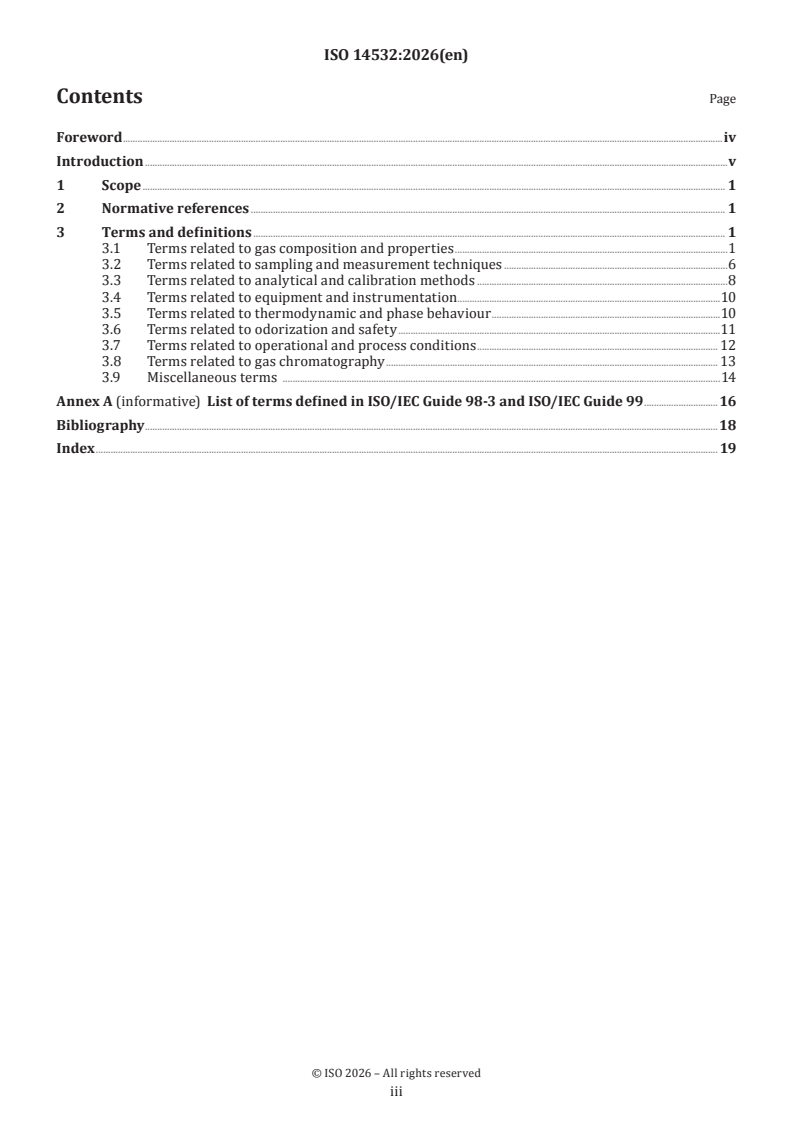

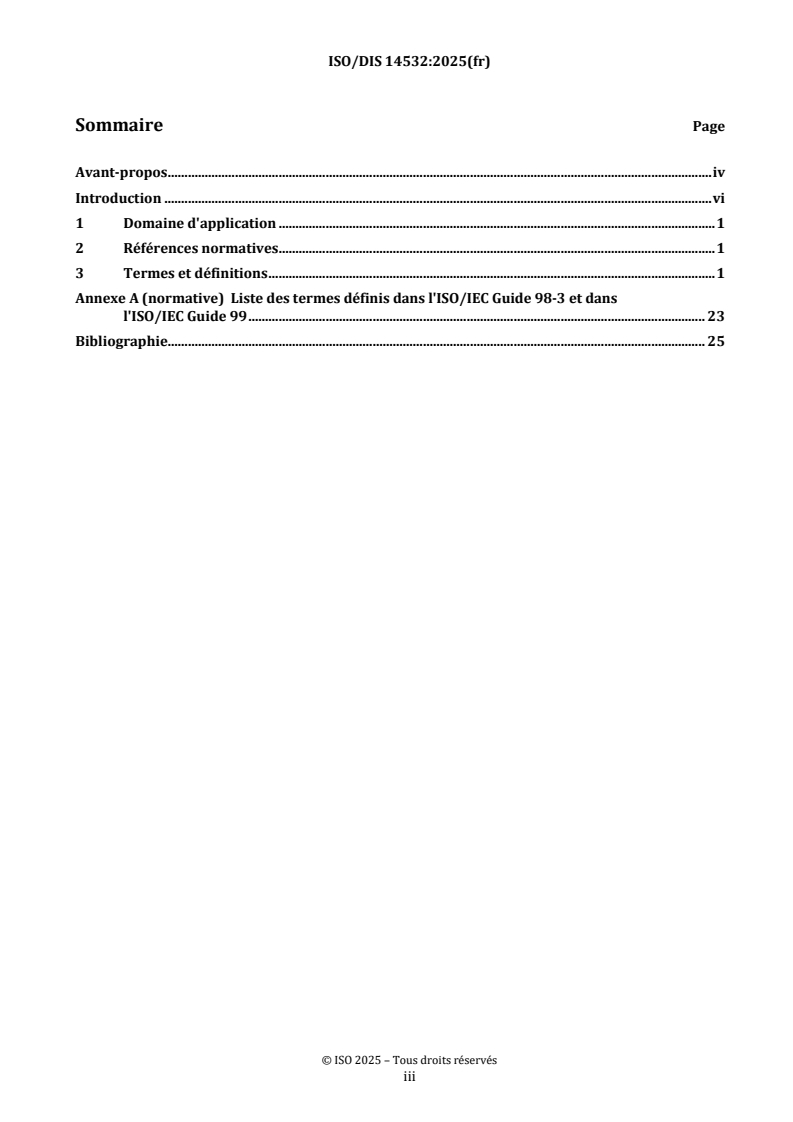
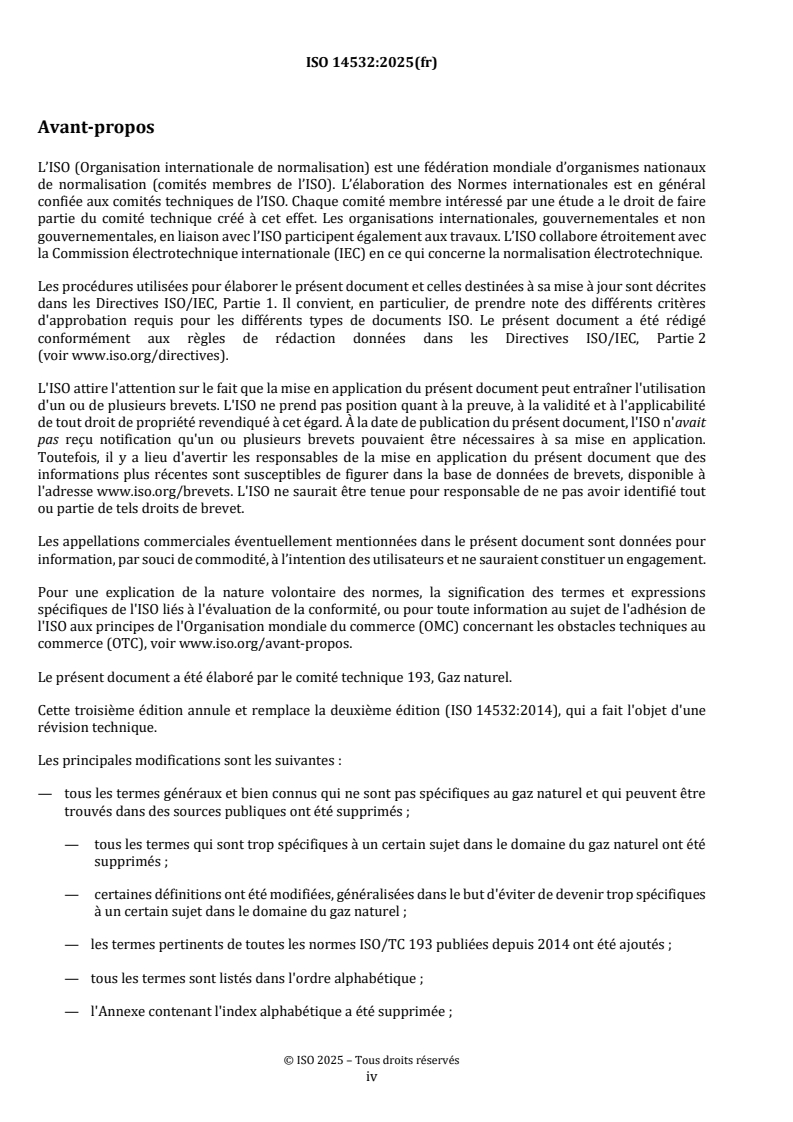
ISO 14532:2026 is an International Standard from ISO that defines the vocabulary used in the field of natural gas. It gives terms and definitions for natural gas, natural gas substitutes, mixtures of natural gas with gaseous fuels such as unconventional and renewable gases, and wet gas, so engineers, laboratories, pipeline operators and buyers can use the same language in specifications, measurement and reporting.
What does ISO 14532:2026 specify?
ISO 14532:2026 specifies terms and definitions for natural gas and related gaseous fuels. It is a vocabulary standard, so its role is to align language rather than to set product limits, test methods or performance criteria.
The document is organized into a short front matter, Clause 1 Scope, Clause 2 Normative references, and Clause 3 Terms and definitions. Clause 3 is split into topic-based subclauses covering composition and properties, sampling and measurement, analytical and calibration methods, equipment and instrumentation, thermodynamic and phase behaviour, odorization and safety, operational and process conditions, gas chromatography, and miscellaneous terms.
Annex A is informative and gives a table of terms already defined in ISO/IEC Guide 98-3 and ISO/IEC Guide 99.
| Annex | What it covers |
|---|---|
| Annex A | Terms used in natural gas work that are defined in ISO/IEC Guide 98-3 or ISO/IEC Guide 99 |
What are the key requirements of ISO 14532:2026?
ISO 14532:2026 does not impose technical requirements in the usual sense; its main content is the controlled vocabulary used across natural gas work. In practice, the document matters because it fixes the meaning of common terms that appear in contracts, measurements, laboratory reports, pipeline specifications and appliance discussions.
Gas composition, properties and reference conditions
Clause 3.1 defines the basic quantities used to describe gas composition and quality, including amount of substance fraction, mass fraction, volume fraction, gas composition, gas quality, density, relative density and Wobbe index. It also defines several sets of reference conditions, including standard reference conditions, normal reference conditions, metering reference conditions and reference conditions. In practice, these terms tell readers exactly which pressure, temperature and humidity basis is being used when a gas value is reported.
Clause 3.1 also distinguishes gas types such as natural gas, biogas, biomethane, substitute natural gas (SNG), dry gas, wet gas, lean gas, rich gas, sour gas and raw gas. That distinction matters because the same network, storage or appliance can behave very differently depending on energy content, contaminants and condensation tendency.
Sampling and measurement
Clause 3.2 sets the vocabulary for sampling and sample handling, including direct sampling, indirect sampling, representative sample, spot sample, incremental sampler, flow-proportional incremental sampler, sample line, sample probe, sampling point, sampling position, sample container, residence time and purging time. These terms matter because a gas result is only useful if the sample actually represents the gas in the pipeline or process plant.
Clause 3.2 also defines fast loop, hot loop and floating piston cylinder, which are practical sampling arrangements. For users, these definitions help describe how a sample is taken, transported and conditioned before analysis.
Calibration, analysis and chromatography
Clause 3.3 defines the language of analytical calibration: calibration gas mixture, reference gas mixture, reference component, relative response factor, response factor, response function, analysis function, calibration function, span gas, span point, single-point calibration, multi-point calibration, bracketing, normalization, raw mole fraction and normalized mole fraction. This is important for gas chromatography and other gas-analysis systems because the reported composition depends on how the instrument is calibrated and how the measured values are processed.
Clause 3.8 adds gas-chromatography terms such as bridge component, group of components, chromatographic resolution, interference, interfering substance and single-point calibration. In practice, these terms are used when laboratories combine results from different analytical steps or judge whether peaks are sufficiently separated.
Equipment, phase behaviour and safety
Clause 3.4 defines in-line instrument, on-line instrument, off-line instrument, condenser and transfer station. These terms help users state where an instrument is installed and whether it measures directly in the pipeline, externally from it, or without a direct pipeline connection.
Clause 3.5 defines dew and bubble terms, critical point, cricondenbar, cricondentherm, retrograde condensation, saturated gas and potential hydrocarbon liquid content (PHLC). These definitions matter when predicting liquid dropout, two-phase behaviour and operating envelopes for gas transport and processing.
Clause 3.6 defines odorant, odorization, odorant content, odour character, odour intensity, odour intensity curve, odour perception, olfactory evaluation and olfactory test. Clause 3.9 adds flash back, lifting and yellow tipping. Together, these terms support leak detection and combustion safety work.
What terms does ISO 14532:2026 define?
ISO 14532:2026 gives formal meanings for widely used terms in natural gas work.
- Natural gas (NG) - a naturally occurring mixture of hydrocarbon and non-hydrocarbon gases found in porous geological formations.
- Substitute natural gas (SNG) - a manufactured or blended gas with properties that make it interchangeable with natural gas.
- Wet gas - gas containing water or condensable components in amounts that can condense, or are already condensed, at pipeline conditions.
- Representative sample - a sample with the same composition as the gas from which it is taken when the gas is considered homogeneous.
- Methane number (MN) - a numerical rating of the knock resistance of a gaseous fuel.
- Wobbe index - a comparison value for combustion interchangeability based on calorific value and relative density.
- Reference conditions - the temperature, pressure and humidity basis used for measurements and calculations on gaseous fluids.
Who uses ISO 14532:2026?
ISO 14532:2026 is used by natural gas producers, gas processors, transmission and distribution operators, metering and custody transfer teams, laboratory analysts, calibration specialists, appliance engineers, and odorization and safety personnel. It is also useful for buyers, sellers and contract writers who need shared definitions for gas quality, sampling and measurement.
In practice, these users rely on the standard when writing specifications, interpreting analysis reports, selecting sampling arrangements, comparing gas properties, and describing operational conditions consistently across organizations and countries.
What changed in ISO 14532:2026 from the previous edition?
ISO 14532:2026 is the third edition and it cancels and replaces ISO 14532:2014. The document says it was technically revised.
The stated changes are:
- General, well-known terms that are not specific to natural gas and are already available in public sources were removed.
- Terms that were too specific to one topic in natural gas were removed.
- Some definitions were modified or generalized to avoid being too narrow.
- Relevant terms from ISO/TC 193 documents published since 2014 were added.
- The index was deleted in the revision history note.
- The former annex containing indices, symbols and units was deleted.
- Annex A was added with terms defined in ISO/IEC Guide 98-3 and ISO/IEC Guide 99.
Which standards are used with ISO 14532:2026?
ISO 14532:2026 draws on, or points to, several companion standards and references that give the technical background for its vocabulary.
| Standard | What it contributes |
|---|---|
| ISO 6974 (all parts) | Gas chromatography terminology and composition determination of natural gas |
| ISO 6143:2025 | Calibration and analysis functions for gas mixture work |
| ISO 7504:2015 | Gas analysis vocabulary and calibration gas mixture terminology |
| ISO 17507-1:2025 | Calculation of methane number by the MNc method |
| ISO 17507-2:2025 | Calculation of methane number by the PKI method |
| ISO 18453:2004 | Correlation between water content and water dew point |
| ISO 80000-2:2019, ISO 80000-3:2019, ISO 80000-4:2019, ISO 80000-9:2019 | Quantities and units used for mathematical, space-time, mechanics and physical-chemistry terms |
| ISO/IEC Guide 98-3 | Uncertainty of measurement concepts used in Annex A |
| ISO/IEC Guide 99 | Metrology vocabulary used in Annex A |
| EN 16723-1:2016 | Source definitions for biogas and biomethane terms |
What does the ISO 14532:2026 document contain?
ISO 14532:2026 is mainly a structured vocabulary. It contains short formal definitions, many of them with notes to clarify use, and it groups the terms by subject so readers can find related concepts together.
The document also contains source references inside the term entries, an informative annex with a table of metrology terms, a bibliography of related standards and literature, and an alphabetical index of defined terms. For users, that makes the standard useful both as a terminology reference and as a lookup document during drafting, analysis and review.
Relations
- Effective Date
- 12-Feb-2026
- Effective Date
- 08-Jul-2023
- Effective Date
- 02-Jul-2022
Get Certified
Connect with accredited certification bodies for this standard

Element Materials Technology
Materials testing and product certification.

ABS Group Brazil
ABS Group certification services in Brazil.

ABS Quality Evaluations Inc.
American Bureau of Shipping quality certification.
Sponsored listings
Frequently Asked Questions
ISO 14532:2026 is a standard published by the International Organization for Standardization (ISO). Its full title is "Natural gas — Vocabulary". This standard covers: This document establishes the terms and definitions that are used in the field of natural gas, natural gas substitutes, mixtures of natural gas with gaseous fuels (such as unconventional and renewable gases) and wet gas.
This document establishes the terms and definitions that are used in the field of natural gas, natural gas substitutes, mixtures of natural gas with gaseous fuels (such as unconventional and renewable gases) and wet gas.
ISO 14532:2026 is classified under the following ICS (International Classification for Standards) categories: 01.040.75 - Petroleum and related technologies (Vocabularies); 75.060 - Natural gas. The ICS classification helps identify the subject area and facilitates finding related standards.
ISO 14532:2026 has the following relationships with other standards: It is inter standard links to FprEN ISO 14532, ISO/IEC 30105-8:2022, ISO 14532:2014. Understanding these relationships helps ensure you are using the most current and applicable version of the standard.
ISO 14532:2026 is available in PDF format for immediate download after purchase. The document can be added to your cart and obtained through the secure checkout process. Digital delivery ensures instant access to the complete standard document.
Standards Content (Sample)
Contents
- Introduction
- 1 Scope
- 2 Normative references
- 3 Terms and definitions
- 3.1 Terms related to gas composition and properties
- 3.1.1 amount of substance fraction
- 3.1.2 biogas
- 3.1.3 biomass
- 3.1.4 biomethane
- 3.1.5 calculated methane number
- 3.1.6 calorific value
- 3.1.7 combustion reference conditions
- 3.1.8 component
- 3.1.9 compression factor
- 3.1.10 contaminant
- 3.1.11 density
- 3.1.12 density ratio
- 3.1.13 equation of state
- 3.1.14 gas analysis
- 3.1.15 gas composition
- 3.1.16 gas hydrate
- 3.1.17 gas quality
- 3.1.18 gross calorific value
- 3.1.19 hydrocarbon dew temperature
- 3.1.20 interchangeability
- 3.1.21 lean gas
- 3.1.22 mass concentration
- 3.1.23 mass fraction
- 3.1.24 metering reference conditions
- 3.1.25 methane number
- 3.1.26 molar mass
- 3.1.27 molar volume
- 3.1.28 natural gas
- 3.1.29 net calorific value
- 3.1.30 normal pressure
- 3.1.31 normal reference conditions
- 3.1.32 other component
- 3.1.33 PKI methane number
- 3.1.34 reference conditions
- 3.1.35 relative density
- 3.1.36 relative humidity
- 3.1.37 rich gas
- 3.1.38 standard reference conditions
- 3.1.39 substitute natural gas
- 3.1.40 volume fraction
- 3.1.41 water content
- 3.1.42 water dew temperature
- 3.1.43 wet gas
- 3.1.44 Wobbe index
- 3.2 Terms related to sampling and measurement techniques
- 3.2.1 absorption
- 3.2.2 adsorption
- 3.2.3 desorption
- 3.2.4 direct measurement
- 3.2.5 direct sampling
- 3.2.6 fast loop
- 3.2.7 floating piston cylinder
- 3.2.8 flow-proportional incremental sampler
- 3.2.9 gas sorption effect
- 3.2.10 hot loop
- 3.2.11 incremental sampler
- 3.2.12 indirect measurement
- 3.2.13 indirect sampling
- 3.2.14 purging time
- 3.2.15 representative sample
- 3.2.16 residence time
- 3.2.17 sample container
- 3.2.18 sample line
- 3.2.19 sample probe
- 3.2.20 sampling place
- 3.2.21 sampling point
- 3.2.22 sampling position
- 3.2.23 sorption
- 3.2.24 spot sample
- 3.2.25 wetted surface
- 3.3 Terms related to analytical and calibration methods
- 3.3.1 analysis function
- 3.3.2 calibration function
- 3.3.3 calibration gas mixture
- 3.3.4 molar composition
Introduction
ISO/TC 193 Natural gas was established in May 1988. Its current scope is:
- to standardize terminology, quality specifications, methods of measurement, sampling, analysis and testing, including thermophysical property calculation and measurement, from production to delivery to all possible end users across national boundaries, for:
- natural gas;
- natural gas substitutes;
- mixtures of natural gas with other gaseous fuels (such as unconventional and renewable gases);
- wet gas.
- to standardize methods of analysis of liquefied natural gas (LNG). The aim is to create a coherent body of standards which support each other with regard to their definitions. Common and unambiguous terms and definitions are the starting point for understanding and applying International Standards.
The intention of this document is to incorporate the reviewed terms and definitions into ISO/TC 193 standards.
The presentation of this document has been arranged to facilitate its use as follows:
- Notes are given under numerous definitions where it was deemed important to give informative guidance for a given definition. The notes are not considered a part of the definition. The terms and definitions have been reviewed and studied in order to cover all aspects of any particular term with input from other sources such as European Standards from the European Committee for Standardization (CEN), standards from ASTM International, national standards and existing definitions in the International Gas Union (IGU) Dictionary of the Gas Industry. Terms used in the field of gas analysis that are well defined by either ISO/IEC Guide 98-3 or ISO/IEC Guide 99 are included in Annex A.
International Standard ISO 14532:2026(en) Natural gas — Vocabulary
1 Scope
This document establishes the terms and definitions that are used in the field of natural gas, natural gas substitutes, mixtures of natural gas with gaseous fuels (such as unconventional and renewable gases) and wet gas.
2 Normative references
There are no normative references in this document.
3 Terms and definitions
ISO and IEC maintain terminology databases for use in standardization at the following addresses:
- ISO Online browsing platform: available at https:// www .iso .org/ obp
- IEC Electropedia: available at https:// www .electropedia .org/
3.1 Terms related to gas composition and properties
3.1.1 amount of substance fraction
amount fraction mole fraction quotient of amount of substance of a component and total amount of substance in the mixture [SOURCE: ISO 80000-9:2019, 9-13, modified — "For substance X in a mixture" has been deleted. Terms n
and X in "amount of substance n of X" and n in "total amount n" have been deleted. The formula x = n /n has x x x been deleted.]
3.1.2 biogas
gas, comprising principally methane and carbon dioxide, obtained from the anaerobic digestion of biomass [SOURCE: EN 16723-1:2016, 3.1]
3.1.3 biomass
biological material from living or recently living organisms Note 1 to entry: Typically, biomass comes from plants or plant-derived materials. [SOURCE: EN 16723-1:2016, 3.2, modified — Note 1 to entry has been added; the content was taken from the original term definition.]
3.1.4 biomethane
gas comprising principally methane, obtained from either upgrading of biogas or methanation of bio-syngas [SOURCE: EN 16723-1:2016, 3.3]
ISO 14532:2026(en)
3.1.5 calculated methane number
MN C numerical rating index obtained by a calculation, indicating the knock resistance of a gaseous fuel, according to ISO 17507-1 Note 1 to entry: This analytical estimate of a methane number is based on using volume fraction gaseous fuel composition as input.
3.1.6 calorific value
heating value amount of heat released by the complete combustion with oxygen of a specified quantity of gas in such a way that the pressure at which the reaction takes place remains constant and all the products of combustion are returned to the same specified temperature as that of the reactants
3.1.7 combustion reference conditions
specified temperature and pressure at which a fuel is notionally burned
3.1.8 component
chemical compound
3.1.9 compression factor
compressibility factor quotient of the volume of an amount of gas at a specified pressure and temperature and the volume of the same amount of ideal gas at the same pressure and temperature
3.1.10 contaminant
constituent in very low levels, such as particulates, glycol, compressor oil, etc., that are assumed to be intrusive
3.1.11 density
quotient of the mass of a gas and its volume
3.1.12 density ratio
<of a fluid> quotient of the gas density and the liquid density of a fluid at line conditions
3.1.13 equation of state
EoS mathematical relationship between state variables of a gas or homogeneous gas mixture Note 1 to entry: For an ideal gas, the equation of state is the ideal gas law. EXAMPLE Equations of state have been developed to model the behaviour of real gases over a range of pressures and temperatures. See References [13] to [16].
3.1.14 gas analysis
measurement methods and techniques for determining gas composition
3.1.15 gas composition
fractions or concentrations of all the components in a mixture
ISO 14532:2026(en)
3.1.16 gas hydrate
solid crystalline substance resembling ice formed by gas molecules and water molecules
3.1.17 gas quality
set of attributes of a gas that characterises important aspects of its production, transportation or use EXAMPLE Composition, calorific value, Wobbe index, methane number, relative density and dew points.
3.1.18 gross calorific value
superior calorific value gross heating value higher heating value calorific value when the combustion products are in the gaseous state, except for water, which is condensed to the liquid state
3.1.19 hydrocarbon dew temperature
hydrocarbon dew point HCDP temperature at which an infinitesimal amount of liquid hydrocarbons is in equilibrium with a bulk vapour for a specified pressure
3.1.20 interchangeability
characteristic of gases where one gas is compatible with another gas with regard to combustion Note 1 to entry: Two gases are said to be interchangeable when one gas can be substituted for the other gas without interfering with the operation of gas-burning appliances or equipment.
3.1.21 lean gas
natural gas having a relatively low energy content, close to or lower than that of pure methane Note 1 to entry: Lean gas typically contains high amounts of nitrogen and carbon dioxide.
3.1.22 mass concentration
quotient of mass of a substance and volume of the mixture [SOURCE: ISO 80000-9:2019, 9-10, modified — "For a substance X in a mixture" has been deleted. Terms for mass m , substance X and volume V have been deleted. The formula γ=m /V has been deleted.] x x
3.1.23 mass fraction
quotient of mass of a substance and total mass of the mixture [SOURCE: ISO 80000-9:2019, 9-11, modified — “For substance X in a mixture” at the beginning of the definition has been deleted. “m (ISO 80000-4)” after mass has been deleted. “X” after "substance" has been X deleted. “m” after "total mass" has been deleted. The formula after the definition has been deleted.]
3.1.24 metering reference conditions
specified temperature and pressure at which a volume of gas is expressed
ISO 14532:2026(en)
3.1.25 methane number
MN numerical rating indicating the knock resistance of a gaseous fuel Note 1 to entry: The methane number is analogous to the octane number for petrol. The methane number is the volume fraction expressed as the percentage of methane in a methane-hydrogen mixture, that in a test engine under standard conditions has the same knock resistance as the gaseous fuel to be examined.
3.1.26 molar mass
quotient of mass and amount of substance [SOURCE: ISO 80000-9:2019, 9-4, modified — "For a pure substance X" has been deleted. Terms for mass m(X) and amount n have been deleted. The formula M=m/n has been deleted.]
3.1.27 molar volume
quotient of the volume of a substance and amount of substance [SOURCE: ISO 80000-9:2019, 9-5 modified — "For a pure substance" has been deleted. Terms for volume V and amount n have been deleted. The formula V =V/n has also been deleted.] m
3.1.28 natural gas
NG naturally occurring mixture of hydrocarbon and non-hydrocarbon gases found in porous geological formations (reservoirs) beneath the earth’s surface Note 1 to entry: Natural gas contains primarily methane, but generally includes ethane, propane and higher hydrocarbons, and some non-combustible gases such as nitrogen and carbon dioxide. Natural gas can also contain components such as sulfur compounds or other chemical species.
3.1.29 net calorific value
inferior calorific value net heating value lower heating value calorific value when the combustion products are in the gaseous state
3.1.30 normal pressure
<for appliance testing> pressure at which appliances operate under nominal conditions when they are supplied with the corresponding reference gas
3.1.31 normal reference conditions
conditions equal to 101,325 kPa for pressure and 273,15 K for temperature for a real gas in the dry state
3.1.32 other component
other constituent component in the gas sample which either is not subject to analysis in accordance with the ISO 6974 series or can be regarded as being present at a constant mole fraction or both
ISO 14532:2026(en)
3.1.33 PKI methane number
MN PKI numerical rating index obtained by a calculation, indicating the knock resistance of a gaseous fuel, according to ISO 17507-2 Note 1 to entry: This analytical estimate of a methane number is based on using mole fraction gaseous fuel composition as input.
3.1.34 reference conditions
conditions of temperature, pressure and humidity (state of saturation) to be used for measurements and calculations carried out on natural gases, natural gas substitutes and similar fluids in the gaseous state
3.1.35 relative density
quotient of the density of a gas and the density of dry air of standard composition at the same specified conditions of pressure and temperature
3.1.36 relative humidity
quotient of the actual vapour pressure and the saturation vapour pressure over a plane liquid water surface at the same temperature Note 1 to entry: The phrase "relative humidity" is commonly abbreviated to RH although this is not a recognised abbreviated term.
Note 2 to entry: Values of relative humidity are commonly expressed as a percentage.
3.1.37 rich gas
natural gas having a relatively high energy content, higher than that of pure methane Note 1 to entry: Rich gas typically contains high amounts of ethane or propane or higher hydrocarbons.
3.1.38 standard reference conditions
conditions equal to 101,325 kPa for pressure and 288,15 K for temperature for a real gas in the dry state
3.1.39 substitute natural gas
SNG manufactured or blended gas with properties which make it interchangeable with natural gas Note 1 to entry: This also includes gases manufactured by thermal process from biomass.
3.1.40 volume fraction
φ quotient of product of amount of substance fraction x and molar volume V of the pure substance X at x mx the same temperature and pressure, and the sum over all substances i of products of amount of substance fractions x of substance i and their molar volumes V i mi xV Xm,X
xV ii m,i [SOURCE: ISO 80000-9:2019, 9-14 modified — "For substance X" at the beginning and "of X" after "substance fraction" have been deleted. "Substance" after "over all" has been written in plural.]
ISO 14532:2026(en)
3.1.41 water content
quantity of water contained in unit quantity of gas Note 1 to entry: Water content can be expressed as a concentration or as a mole or volume fraction.
3.1.42 water dew temperature
water dew point temperature at which an infinitesimal amount of liquid water is in equilibrium with a bulk vapour for a specified pressure
3.1.43 wet gas
gas containing water or condensable components such as either water vapour or hydrocarbons, or both, in such amounts that they can condense or are already condensed at pipeline conditions
3.1.44 Wobbe index
quotient of the calorific value on a volumetric basis at specified reference conditions and the square root of the relative density at the same specified metering reference conditions Note 1 to entry: The Wobbe Index is said to be gross or net according to whether the calorific value used is the gross or net calorific value.
3.2 Terms related to sampling and measurement techniques
3.2.1 absorption
retention, by physical or chemical forces of gas molecules, dissolved substances or liquids, by the bulk of solids or liquids with which they are in contact Note 1 to entry: The absorption process causes (or is accompanied by) a physical or chemical change, or both, in the sorbent material.
EXAMPLE Retention of siloxanes by charcoal.
3.2.2 adsorption
retention, by physical or chemical forces of gas molecules, dissolved substances or liquids, by the surface of solids or liquids with which they are in contact EXAMPLE Retention of methane by carbon.
3.2.3 desorption
removal of a sorbed substance by the reverse process of adsorption or absorption
3.2.4 direct measurement
<of a component content> measurement in which the content of individual components or group of components is determined by comparison with the content of identical components in the reference gas mixture
3.2.5 direct sampling
sampling in situations where there is a direct connection between the natural gas to be sampled and the analytical unit
ISO 14532:2026(en)
3.2.6 fast loop
sampling system that takes more sample from the process than is needed to make the measurement to reduce the residence time
3.2.7 floating piston cylinder
container that has a moving piston separating the sample from a buffer gas
3.2.8 flow-proportional incremental sampler
sampler that collects a series of spot samples over a period of time with the spot samples taken in such a manner as to ensure the incremental sample is proportional to the incremental totalised flow Note 1 to entry: This is normally achieved by varying the frequency of extraction of a constant volume spot sample (grab).
...
Contents
- Introduction
- 1 Domaine d'application
- 2 Références normatives
- 3 Termes et définitions
- 3.1 absorption
- 3.2 adsorption
- 3.3 fraction de quantité de matière
- 3.4 fonction d'analyse
- 3.5 valeur assignée
- 3.6 disponibilité (d'un système de mesure ou d'un instrument)
- 3.7 biogaz
- 3.8 biomasse
- 3.9 biométhane
- 3.10 encadrement
- 3.11 composé pont
- 3.12 pression de bulle
- 3.13 température de bulle
- 3.14 indice de méthane calculé
- 3.15 fonction d'étalonnage
- 3.16 mélange de gaz d'étalonnage
- 3.17 pouvoir calorifique
- 3.18 résolution chromatographique
- 3.19 gaz naturel synthétique à base de charbon
- 3.20 conditions de référence de combustion
- 3.21 composant
- 3.22 gaz naturel comprimé
- 3.23 facteur de compression
- 3.24 condenseur
- 3.25 contaminant
- 3.26 cricondenbar
- 3.27 cricondentherme
- 3.28 point critique
- 3.29 point interface transactionnel
- 3.30 masse volumique
- 3.31 rapport de masse volumique (d'un fluide)
- 3.32 désorption
- 3.33 pression de rosée
- 3.34 température de rosée
- 3.35 mesurage direct (de la teneur d'un constituant)
- 3.36 échantillonnage direct
- 3.37 gaz sec
- 3.38 équation d'état
- 3.39 famille de gaz
- 3.40 boucle rapide
- 3.41 retour de flamme
- 3.42 cylindre à piston flottant
- 3.43 échantillonneur par prélèvements élémentaires proportionnels au débit
- 3.44 analyse des gaz
- 3.45 composition du gaz
- 3.46 hydrates de gaz
- 3.47 qualité du gaz
- 3.48 effet de sorption du gaz
- 3.49 rapport gaz/pétrole
- 3.50 combustible gazeux
- 3.51 pouvoir calorifique supérieur
- 3.52 groupe de constituants
- 3.53 boucle en charge
- 3.54 température de rosée hydrocarbures
- 3.55 échantillonneur par prélèvements graduels
- 3.56 mesurage indirect (d'un constituant)
- 3.57 échantillonnage indirect
- 3.58 instrument en ligne (in-line)
- 3.59 interchangeabilité
- 3.60 interférence
- 3.61 substance interférente
- 3.62 biais du laboratoire
- 3.63 gaz pauvre
- 3.64 décollement de flamme
- 3.65 gaz limite
- 3.66 conditions opératoires
- 3.67 gaz naturel liquéfié
- 3.68 fraction de volume de liquide
- 3.69 réseau local de distribution
- 3.70 concentration massique
- 3.71 débit massique
- 3.72 fraction massique
- 3.73 conditions de référence du mesurage
- 3.74 indice de méthane
- 3.75 composition molaire
- 3.76 masse molaire
Introduction
L'ISO/TC 193 Gaz naturel a été établie en mai 1988, son domaine d'application actuel étant de :
- normaliser la terminologie, les spécifications de qualité, les méthodes de mesure, l'échantillonnage, l'analyse et les essais, y compris le calcul et la mesure des propriétés thermophysiques, pour :
- gaz naturel ;
- substituts du gaz naturel ;
- mélanges de gaz naturel avec d'autres combustibles gazeux (tels que les gaz non conventionnels et renouvelables) ; et
- gaz humide ; sous tous ces aspects, de la production à la livraison à tous les utilisateurs finaux possibles au-delà des frontières nationales ;
- pour normaliser les méthodes d'analyse du gaz naturel liquéfié (GNL). Comme le but est de créer un ensemble cohérent de normes qui se soutiennent mutuellement en ce qui concerne leurs définitions, des termes et définitions communs et sans ambiguïté utilisés dans toutes les normes internationales sont le point de départ pour la compréhension et l'application de chaque Norme internationale.
L'intention définitive de ce document est d'intégrer les définitions révisées dans les normes de l'ISO/TC 193. La présentation du présent document a été conçue pour faciliter son utilisation comme suit :
- tous les termes sont listés dans l'ordre alphabétique ;
- des notes sont données sous de nombreuses définitions où il a été jugé important de donner des lignes directrices informatives pour une définition donnée. Ces notes ne sont pas considérées comme faisant partie de la définition.
Les termes et définitions ont été étudiés et revus de manière à couvrir toutes les acceptations particulières des termes provenant également d'autres sources telles que les normes européennes du CEN (Comité Européen de Normalisation), les normes de l'ASTM, les normes nationales et les définitions existantes dans le dictionnaire U.I.I.G de l'industrie du gaz.
PROJET de Norme internationale ISO/DIS 14532:2025(fr)
Gaz naturel — Vocabulaire
1 Domaine d'application
Le présent document établit les termes et définitions utilisés dans le domaine du gaz naturel, des substituts de gaz naturel, des mélanges de gaz naturel avec des combustibles gazeux (tels que les gaz non conventionnels et renouvelables) et du gaz humide.
2 Références normatives
Le présent document ne contient aucune référence normative.
3 Termes et définitions
L’ISO et l’IEC tiennent à jour des bases de données terminologiques destinées à être utilisées en normalisation, consultables aux adresses suivantes :
- ISO Online browsing platform : disponible à l'adresse https://www.iso.org/obp
- IEC Electropedia : disponible à l'adresse https://www.electropedia.org/
3.1 absorption
rétention par action physique ou chimique, de molécules de gaz, de substances dissoutes ou de liquides dans la masse de solides ou de liquides avec lesquels ils sont en contact Note 1 à l'article : Le processus entraîne, subséquemment ou concomitamment, une modification physique, chimique ou physico-chimique du sorbant.
EXEMPLE Rétention des siloxanes par le charbon de bois.
3.2 adsorption
rétention, par action physique ou chimique, de molécules de gaz, de substances dissoutes ou de liquides sur la surface de solides ou de liquides avec lesquels ils sont en contact EXEMPLE Rétention du méthane sur le carbone.
[SOURCE : ISO 10715:2022, 3.2]
3.3 fraction de quantité de matière
fraction molaire quotient de la quantité de matière d'un composant sur la quantité totale de matière dans le mélange [SOURCE : ISO 80000-9, 9.13, modifié. Définition initiale : pour un constituant X d'un mélange, quotient de la quantité de matière nx du constituant X sur la quantité de matière n totale dans le mélange : X = n /n] x x
ISO 14532:2025(fr)
3.4 fonction d'analyse
la teneur de l’analyte, exprimée en fonction de la réponse instrumentale [SOURCE : ISO 6143:2001, modifié]
3.5 valeur assignée
valeur attribuée à une propriété particulière d'une entité soumise à l'essai d'aptitude [SOURCE : ISO 6974-3:2018, 3.11]
3.6 disponibilité (d'un système de mesure ou d'un instrument)
probabilité que le système de mesure ou qu'un instrument de mesure constituant une partie du système, fonctionne, à tout moment, conformément aux spécifications [SOURCE : ISO 15112:2018, 3.4]
3.7 biogaz
gaz, comprenant principalement du méthane et du dioxyde de carbone, obtenu à partir de la digestion anaérobie de la biomasse [SOURCE : EN 16723-1:2016, 3.1]
3.8 biomasse
matériau biologique issu d’organismes vivants ou récemment vivants, il peut typiquement s'agir de plantes ou de matières d'origine végétale [SOURCE : EN 16723-1:2016, 3.2]
3.9 biométhane
gaz comprenant principalement du méthane, obtenu soit à partir du traitement de biogaz ou de la méthanation de bio-syngaz [SOURCE : EN 16723-1:2016, 3.3]
3.10 encadrement
établissement d'une fonction d’étalonnage linéaire à partir de deux points d'étalonnage définissant une plage Note 1 à l'article : La plage est établie de façon que la teneur attendue d'un constituant soit censée se situer entre les teneurs du constituant dans les mélanges de gaz d'étalonnage.
ISO/DIS 14532:2025(fr)
3.11 composé pont
composé sélectionné afin de permettre l'association des résultats des constituants mesurés par différentes opérations analytiques [SOURCE : ISO 6974-1:2012, 3.18, modifié — « Pontage » entre les mots « association » et « des » a été supprimé.]
3.12 pression de bulle
pression à laquelle une quantité infinitésimale de vapeur est en équilibre avec une phase liquide à une température spécifiée [SOURCE : ISO 20765-2:2015, 3.1, modifié]
3.13 température de bulle
température à laquelle une quantité infinitésimale de vapeur est en équilibre avec une phase liquide à une pression spécifiée [SOURCE : ISO 20765-2:2015, 3.2, modifié]
3.14 indice de méthane calculé
MN C indice de valeur numérique obtenu par un calcul, indiquant la résistance au cliquetis d'un combustible gazeux conformément à l'ISO 17507-1 Note 1 à l'article : Cette estimation analytique d'un indice de méthane est basée sur l'utilisation de la fraction volumique de la composition du combustible gazeux comme entrée. [SOURCE : ISO/DIS 17507-1:2024, 3.2]
3.15 fonction d'étalonnage
la réponse instrumentale exprimée en fonction de la teneur de l’analyte [SOURCE : ISO/DIS 6143:2024, 3.4.1, modifié]
3.16 mélange de gaz d'étalonnage
mélange de gaz ayant une stabilité et une homogénéité connues, dont la composition est établie afin de réaliser l'étalonnage ou la vérification d'un instrument de mesure, ou la validation d'un mesurage [SOURCE : ISO 7504:2015, 5.1]
ISO 14532:2025(fr)
3.17 pouvoir calorifique
valeur calorifique quantité de chaleur qui serait libérée par la combustion complète d’une quantité spécifiée de gaz dans l'air, de manière telle que la pression à laquelle la réaction a lieu reste constante et que tous les produits de la combustion soient ramenés à la même température spécifiée que celle des corps en réaction [SOURCE : ISO 13686:2013, 3.8]
3.18 résolution chromatographique
caractéristique de l’efficacité de séparation d'une colonne chromatographique, décrivant le degré de séparation entre deux pics adjacents dans le chromatogramme Note 1 à l'article : La résolution est définie comme deux fois la distance entre les sommets des pics désignés divisée par la somme des intersections avec la ligne de base des tangentes à la mi-hauteur des sommets.
3.19 gaz naturel synthétique à base de charbon
mélange gazeux synthétisé à partir de charbon, composé principalement de méthane et d'hydrogène, mais comprend généralement aussi de l'éthane et certains gaz non combustibles tels que l'azote et le dioxyde de carbone [SOURCE : ISO/TR 17910:2023, 3.18]
3.20 conditions de référence de combustion
température et pression spécifiées auxquelles un combustible est théoriquement brûlé
3.21 composant
composé chimique
3.22 gaz naturel comprimé
GNC gaz naturel qui a subi un traitement de compression pour pouvoir être stocké ou transporté Note 1 à l'article : Le GNC est principalement utilisé comme carburant pour les véhicules, généralement comprimé à l'état gazeux jusqu'à 20 000 kPa.
Note 2 à l'article : Généralement, la pression maximale pour le gaz naturel stocké dans un conteneur est de 25 000 kPa.
3.23 facteur de compression
facteur de compressibilité quotient obtenu en divisant le volume d'une quantité de gaz, à une pression et température spécifiées, par le volume de la même quantité de gaz parfait, à la même pression et température
ISO/DIS 14532:2025(fr)
3.24 condenseur
appareil utilisé pour faire passer, par réfrigération, la fraction condensable de la vapeur d'eau et/ou des hydrocarbures plus lourds contenus dans le gaz naturel de l'état de vapeur à l'état liquide
3.25 contaminant
composé présent à de très faibles niveaux de concentration, tels que matières particulaires, glycol et huile, etc., qui sont considérés comme gênants [SOURCE : ISO 10715:2022, 3.3, modifié — À la fin de la définition « et distincts du gaz devant être échantillonné » a été supprimé.]
3.26 cricondenbar
pression maximale à laquelle la séparation des deux phases peut se produire [SOURCE : ISO 20765-2:2015, 3.3]
3.27 cricondentherme
température maximale à laquelle la séparation des deux phases peut se produire [SOURCE : ISO 20765-2:2015, 3.4]
3.28 point critique
point de saturation unique sur la courbe d'équilibre liquide-vapeur où la phase vapeur et la phase liquide ont des compositions et des masses volumiques identiques [SOURCE : ISO 20765-2:2015, 3.5]
3.29 point interface transactionnel
emplacement entre deux systèmes de canalisations où la quantité d'énergie du gaz naturel doit être comptée Note 1 à l'article : À un tel emplacement, un changement de régime de pression peut également se produire.
3.30 masse volumique
quotient de la masse d'un gaz sur son volume
3.31 rapport de masse volumique (d'un fluide)
quotient de la masse volumique du gaz sur la masse volumique du liquide d'un fluide dans les conditions opératoires [SOURCE : ISO 12748_2015, 2.6, modifié — « rapport » a été remplacé par « quotient ».]
ISO 14532:2025(fr)
3.32 désorption
libération d'une substance sorbée par le processus inverse de l'adsorption ou de l'absorption [SOURCE : ISO 10715:2022, 3.4, modifié; la Note 1 à l’article a été supprimée.]
3.33 pression de rosée
pression à laquelle une quantité infinitésimale de liquide est en équilibre avec une phase vapeur à une température spécifiée [SOURCE : ISO 20765-2:2015, 3.6, modifié]
3.34 température de rosée
température à laquelle une quantité infinitésimale de liquide est en équilibre avec une phase vapeur à une pression spécifiée [SOURCE : ISO 20765-2:2015, 3.7, modifié]
3.35 mesurage direct (de la teneur d'un constituant)
mesurage dans lequel la teneur des constituants individuels ou groupes de constituants sont déterminés par comparaison avec la teneur des constituants identiques dans le mélange de gaz de référence
3.36 échantillonnage direct
échantillonnage dans des situations où il y a connexion directe entre le gaz naturel à échantillonner et l'unité analytique [SOURCE : ISO 10715:2022,3.5 ISO/TR 7262:2022, 3.3]
3.37 gaz sec
gaz contenant une fraction molaire d'eau et/ou d'hydrocarbures qui ne sont pas censés se condenser dans les conditions observées en canalisation Note 1 à l'article : La teneur en eau et/ou la teneur en hydrocarbures du gaz sec sont principalement définies par les utilisateurs ou les transporteurs.
Note 2 à l'article : La corrélation entre la teneur en eau et le point de rosée de l'eau est donnée dans l'ISO 18453.[17]
3.38 équation d'état
EoS équation mathématique établissant la relation entre les variables d'état d'un gaz ou d'un mélange gazeux homogène EXEMPLE Pour un gaz parfait, l'équation d'état est la loi des gaz parfaits. Des équations d'état plus complexes ont été développées pour modéliser le comportement des gaz réels sur une plage de pressions et de températures, par exemple Benedict, Webb, Rubin (équation BWR), Redlich, Kwong et Soave (équation RKS) et l'équation GERG 2008.
ISO/DIS 14532:2025(fr)
3.39 famille de gaz
ensemble de gaz combustibles ayant des caractéristiques de combustion similaires et liés par une plage d'indice de Wobbe
3.40 boucle rapide
système d'échantillonnage qui prélève du procédé une quantité d’échantillon supérieure à celle nécessaire pour effectuer la mesure de manière à réduire le temps de séjour
3.41 retour de flamme
situation dans laquelle la vitesse de flamme est supérieure à celle du mélange air gaz, entraînant une combustion avant l'orifice du brûleur Note 1 à l'article : Il se traduit généralement par une extinction de la flamme et peut endommager le brûleur de l'appareil.
3.42 cylindre à piston flottant
récipient doté d'un piston mobile séparant l'échantillon d'un gaz tampon
3.43 échantillonneur par prélèvements élémentaires proportionnels au débit
échantillonneur qui recueille une série d'échantillons élémentaires sur une période de temps, ces échantillons élémentaires étant pris de manière qu'il soit proportionnel au débit total élémentaire Note 1 à l'article : Ceci est obtenu normalement en faisant varier la fréquence de l'extraction d'un échantillon ponctuel de volume constant (grab).
3.44 analyse des gaz
méthodes et techniques de mesurage pour déterminer la composition du gaz [SOURCE : ISO 13686:2013, 3.17, modifié — « utilisation de méthodes d'essai » a été remplacée par « mesurage », et « autres » avant « techniques » a été supprimé.]
3.45 composition du gaz
fractions ou concentrations de tous les constituants d'un mélange
3.46 hydrates de gaz
substance solide cristalline ressemblant à de la glace formée par des molécules de gaz et des molécules d'eau
3.47 qualité du gaz
ensemble d'attributs d'un gaz qui caractérise des aspects importants de sa production, de son transport ou de son utilisation Note 1 à l'article : La composition, le pouvoir calorifique, l'indice de Wobbe, l'indice de méthane, la densité relative et les points de rosée sont des exemples d'attributs.
ISO 14532:2025(fr)
3.48 effet de sorption du gaz
phénomène physique d'adsorption ou de désorption observé entre certains gaz et la surface d'un solide sans transformation des molécules Note à l’article : La force d'attraction entre certains gaz et des solides est purement physique et dépend de la nature du matériau en contact. Le gaz naturel peut renfermer un certain nombre de constituants présentant de forts effets de sorption. Il convient de veiller à ces phénomènes, en particulier lors de la détermination des concentrations d'éléments à l'état de traces, tels que les hydrocarbures lourds, l'eau, les composés soufrés, le mercure et l'hydrogène.
[SOURCE : ISO 10715:2022, 3.7]
3.49 rapport gaz/pétrole
rapport entre le débit volumique de gaz et le débit volumique de liquide d'hydrocarbure [SOURCE : ISO/TR 12748:2015, 2.21]
...