

ISO/IEC TR 20226:2025
(Main)Information technology — Artificial intelligence — Environmental sustainability aspects of AI systems
General Information
- Abstract
This document provides an overview of the environmental sustainability aspects (e.g. workload, resource and asset utilization, carbon impact, pollution, waste, transportation, location) of AI systems during their life cycle, and related potential metrics. NOTE 1 This document does not identify opportunities on how AI, AI applications and AI systems can improve environmental, social or economic sustainability outcomes. NOTE 2 This document can help other projects related to AI system environmental sustainability.
- Status
- Published
- Publication Date
- 30-Jun-2025
- Technical Committee
- ISO/IEC JTC 1/SC 42 - Artificial intelligence
- Drafting Committee
- ISO/IEC JTC 1/SC 42 - Artificial intelligence
- Current Stage
- 6060 - International Standard published
- Start Date
- 01-Jul-2025
- Due Date
- 01-Dec-2024
- Completion Date
- 01-Jul-2025

Overview
ISO/IEC TR 20226:2025 - Information technology - Artificial intelligence - Environmental sustainability aspects of AI systems - is a Technical Report that provides a structured overview of environmental sustainability considerations for AI systems across their life cycle. It summarizes relevant topics (energy, water, cooling, carbon, waste, location, transportation), outlines potential metrics for measurement, and positions those aspects within AI ecosystems, life cycles and supply chains. As a TR, it is informative guidance rather than a prescriptive standard.
Key technical topics and considerations
The report organizes environmental sustainability topics into clear, actionable areas, including:
- Energy consumption and sources
- Types and sources of energy, renewable procurements (e.g., PPAs, offsets)
- Energy accounting for CPUs, GPUs and accelerated processing units (APUs)
- Energy efficiency metrics and measurement approaches
- Carbon footprint and accounting
- Measurement vs. estimation considerations
- Carbon leakage and applicable carbon accounting methods
- Water use and cooling
- Cooling types, water consumption and post-cooling reuse
- Geographic and infrastructure considerations
- Location impacts, distribution of energy sources, freight and handling
- Waste and e‑waste
- Types of waste, device abandonment, collection, recovery and disposal practices
- AI system perspectives
- Ecosystem view (cloud, edge, data sources, resource pools)
- Life cycle stages: inception, design, training, deployment, operation, continuous validation, retirement
- Supply chain elements
- Mines, smelters/refiners, component manufacturers, assemblers, distributors, internet/domestic infrastructure
- Measuring and metrics
- Candidate metrics and measurement points for system-level, component-level and process-level assessment
- Contextual and regulatory linkage
- Relationship to life cycle assessment standards (ISO 14040/14044), ISO/IEC 5338 life cycle framework, the EU AI Act and international initiatives (e.g., London Declaration)
Note: The TR explicitly does not prescribe how AI can be used to improve sustainability outcomes; it focuses on impacts and measurement.
Practical applications and who uses it
ISO/IEC TR 20226:2025 is useful for:
- AI developers and architects - to design systems with reduced environmental footprint and select efficient compute and cooling strategies.
- Data center operators and cloud providers - for benchmarking energy use, cooling choices and renewable sourcing.
- Sustainability officers and LCA practitioners - to align AI system assessments with established life cycle and carbon accounting practices.
- Procurement teams and IT asset managers - to consider supply chain impacts, device end‑of‑life and e‑waste processes.
- Regulators, auditors and policy makers - to inform guidance, conformity assessment and policy on AI environmental impacts.
- Researchers - to identify measurement gaps and harmonize metrics for energy and carbon in AI.
Related standards and keywords
Related standards and frameworks referenced include ISO 14040 / ISO 14044 (life cycle assessment) and ISO/IEC 5338 (AI system life cycle).
SEO keywords: ISO/IEC TR 20226:2025, environmental sustainability, AI systems, carbon footprint, energy consumption, life cycle assessment, e‑waste, AI supply chain, AI metrics.
Get Certified
Connect with accredited certification bodies for this standard

BSI Group
BSI (British Standards Institution) is the business standards company that helps organizations make excellence a habit.

Bureau Veritas
Bureau Veritas is a world leader in laboratory testing, inspection and certification services.

DNV
DNV is an independent assurance and risk management provider.
Sponsored listings
Frequently Asked Questions
ISO/IEC TR 20226:2025 is a technical report published by the International Organization for Standardization (ISO). Its full title is "Information technology — Artificial intelligence — Environmental sustainability aspects of AI systems". This standard covers: This document provides an overview of the environmental sustainability aspects (e.g. workload, resource and asset utilization, carbon impact, pollution, waste, transportation, location) of AI systems during their life cycle, and related potential metrics. NOTE 1 This document does not identify opportunities on how AI, AI applications and AI systems can improve environmental, social or economic sustainability outcomes. NOTE 2 This document can help other projects related to AI system environmental sustainability.
This document provides an overview of the environmental sustainability aspects (e.g. workload, resource and asset utilization, carbon impact, pollution, waste, transportation, location) of AI systems during their life cycle, and related potential metrics. NOTE 1 This document does not identify opportunities on how AI, AI applications and AI systems can improve environmental, social or economic sustainability outcomes. NOTE 2 This document can help other projects related to AI system environmental sustainability.
ISO/IEC TR 20226:2025 is classified under the following ICS (International Classification for Standards) categories: 13.020.20 - Environmental economics. Sustainability; 35.020 - Information technology (IT) in general. The ICS classification helps identify the subject area and facilitates finding related standards.
ISO/IEC TR 20226:2025 is available in PDF format for immediate download after purchase. The document can be added to your cart and obtained through the secure checkout process. Digital delivery ensures instant access to the complete standard document.
Standards Content (Sample)
Technical
Report
ISO/IEC TR 20226
First edition
Information technology — Artificial
2025-07
intelligence — Environmental
sustainability aspects of AI systems
Technologies de l'information — Intelligence artificielle —
Aspects de durabilité environnementale des systèmes d'IA
Reference number
© ISO/IEC 2025
All rights reserved. Unless otherwise specified, or required in the context of its implementation, no part of this publication may
be reproduced or utilized otherwise in any form or by any means, electronic or mechanical, including photocopying, or posting on
the internet or an intranet, without prior written permission. Permission can be requested from either ISO at the address below
or ISO’s member body in the country of the requester.
ISO copyright office
CP 401 • Ch. de Blandonnet 8
CH-1214 Vernier, Geneva
Phone: +41 22 749 01 11
Email: copyright@iso.org
Website: www.iso.org
Published in Switzerland
© ISO/IEC 2025 – All rights reserved
ii
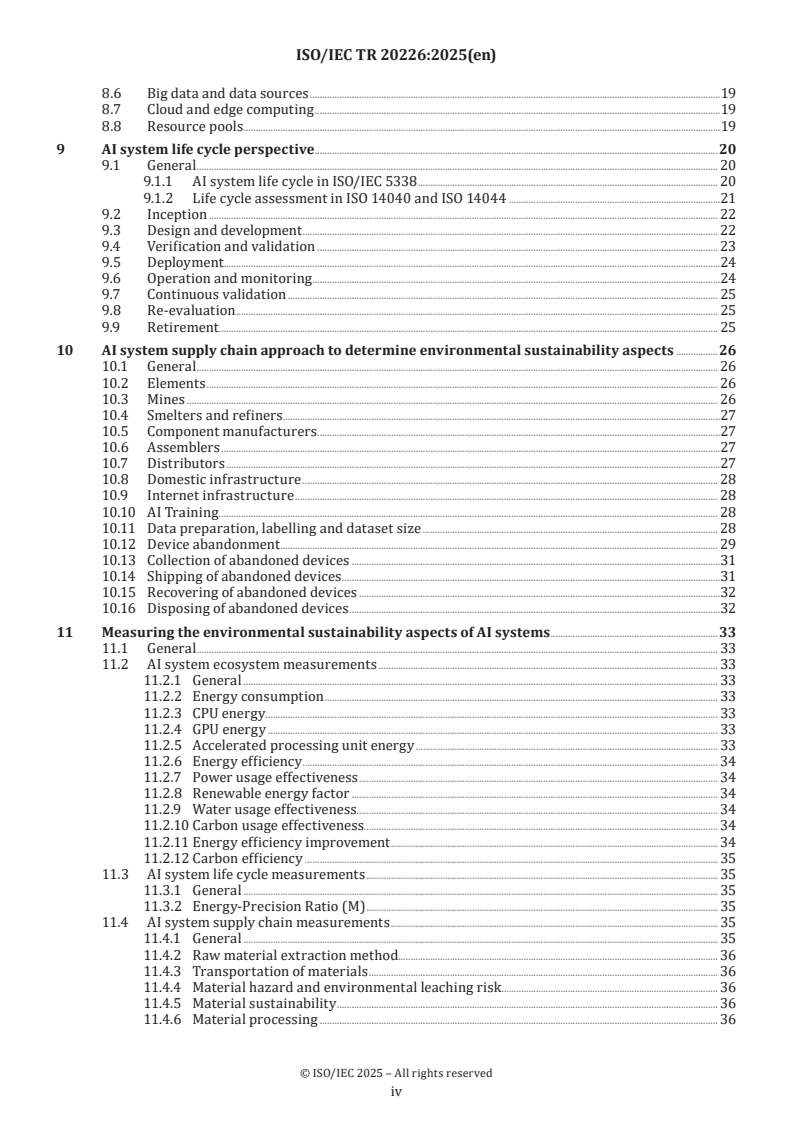
Contents Page
Foreword .vi
Introduction .vii
1 Scope . 1
2 Normative references . 1
3 Terms and definitions . 1
4 Symbols and abbreviated terms. 4
5 Purpose . 5
5.1 General .5
5.2 The London Declaration .6
5.3 Existing International Standards .6
5.4 Environmental sustainability in the European Artificial Intelligence Act .6
5.5 Enacted climate change legislation and market response .6
5.6 Access to affordable, reliable, sustainable and modern energy .7
6 Environmental sustainability . 7
6.1 General .7
6.2 Energy consumption .7
6.2.1 General .7
6.2.2 Types and sources of energy .8
6.2.3 Physical renewable energy supply, Power Purchasing Agreements and offsets .8
6.3 Geographic considerations .9
6.3.1 General .9
6.3.2 Location .9
6.3.3 Distribution of energy sources .9
6.3.4 Freight transportation of energy sources .9
6.3.5 Handling and storage of energy sources .10
6.4 Water use .10
6.5 Cooling .11
6.5.1 General .11
6.5.2 Types of cooling .11
6.5.3 Post cooling use .11
6.6 Carbon footprint .11
6.6.1 General .11
6.6.2 Applicable use of measurements and carbon accounting methods . 12
6.6.3 Estimation versus measurement . 13
6.6.4 Carbon leakage . 13
6.7 Consumption patterns and rebound effects . 13
6.8 Waste . 13
6.8.1 General . 13
6.8.2 Types of waste . 13
6.8.3 E-waste . .14
7 Perspectives of environmental sustainability of AI systems . 14
7.1 General .14
7.2 AI system ecosystem . 15
7.3 AI system life cycle .16
7.4 AI system supply chain .16
7.5 Other perspectives .16
8 AI system ecosystem perspective . 17
8.1 General .17
8.2 AI system .17
8.3 AI application .18
8.4 Machine learning .18
8.5 AI engineering .18
© ISO/IEC 2025 – All rights reserved
iii
8.6 Big data and data sources .19
8.7 Cloud and edge computing .19
8.8 Resource pools .19
9 AI system life cycle perspective .20
9.1 General . 20
9.1.1 AI system life cycle in ISO/IEC 5338 . 20
9.1.2 Life cycle assessment in ISO 14040 and ISO 14044 .21
9.2 Inception . 22
9.3 Design and development . 22
9.4 Verification and validation . 23
9.5 Deployment .24
9.6 Operation and monitoring . .24
9.7 Continuous validation . 25
9.8 Re-evaluation . 25
9.9 Retirement . . 25
10 AI system supply chain approach to determine environmental sustainability aspects .26
10.1 General . 26
10.2 Elements . 26
10.3 Mines . 26
10.4 Smelters and refiners.27
10.5 Component manufacturers .27
10.6 Assemblers .27
10.7 Distributors .27
10.8 Domestic infrastructure . 28
10.9 Internet infrastructure . 28
10.10 AI Training . 28
10.11 Data preparation, labelling and dataset size . 28
10.12 Device abandonment . 29
10.13 Collection of abandoned devices .31
10.14 Shipping of abandoned devices .31
10.15 Recovering of abandoned devices .32
10.16 Disposing of abandoned devices .32
11 Measuring the environmental sustainability aspects of AI systems .33
11.1 General . 33
11.2 AI system ecosystem measurements . 33
11.2.1 General . 33
11.2.2 Energy consumption . 33
11.2.3 CPU energy. 33
11.2.4 GPU energy . 33
11.2.5 Accelerated processing unit energy . 33
11.2.6 Energy efficiency . 34
11.2.7 Power usage effectiveness . 34
11.2.8 Renewable energy factor . 34
11.2.9 Water usage effectiveness. 34
11.2.10 Carbon usage effectiveness. 34
11.2.11 Energy efficiency improvement . 34
11.2.12 Carbon efficiency . 35
11.3 AI system life cycle measurements . 35
11.3.1 General . 35
11.3.2 Energy-Precision Ratio (M) . 35
11.4 AI system supply chain measurements . 35
11.4.1 General . 35
11.4.2 Raw material extraction method. 36
11.4.3 Transportation of materials . 36
11.4.4 Material hazard and environmental leaching risk . 36
11.4.5 Material sustainability . 36
11.4.6 Material processing . 36
© ISO/IEC 2025 – All rights reserved
iv
11.4.7 Transportation emissions .37
11.4.8 Manufacturing and product emissions .37
11.4.9 Water use .37
11.4.10 Natural gas . .37
11.4.11 Power . 38
11.4.12 Light pollution . 38
11.4.13 Electrical, signal or radio wave pollution . 38
11.4.14 Physical ecosystem disruption . 38
11.4.15 Community . 38
11.5 Other measurements . 38
11.5.1 General . 38
11.5.2 Carbon intensity of a machine learning model . 39
11.5.3 Software Carbon Intensity . 39
11.5.4 Operational carbon emissions . 40
11.5.5 Embodied carbon emissions . 40
12 Approaches to reducing AI systems’ negative environmental impacts . 41
12.1 General .41
12.2 Ecosystem approaches .41
12.2.1 General .41
12.2.2 Geographic location .41
12.2.3 Carbon aware scheduling .41
12.2.4 Carbon aware pausing .41
12.2.5 Generative AI .42
12.2.6 Synthetic data .42
12.2.7 Adapting a foundation .42
12.2.8 Transfer learning .42
12.2.9 Use of structured data versus brute force .42
12.2.10 Utilising local hardware and specialised circuits .42
12.2.11 Augmenting cloud usage data .42
12.3 Life cycle approaches .43
12.3.1 General .43
12.3.2 Carbon-Aware Core SDK .43
12.3.3 Computationally efficient algorithms.43
12.3.4 Using pretrained models .43
12.3.5 Automated ML .43
12.3.6 Federated learning methods . . 44
12.3.7 Customized processors. 44
12.3.8 Energy efficient reinforcement learning practises . 44
12.3.9 Using public APIs . 44
12.4 Supply chain approaches . 44
12.4.1 General . 44
12.4.2 Certification of hardware and data centres . 44
12.4.3 Using recycled rare earth elements in AI specific hardware . 44
12.4.4 Applying circular economy concepts and principles .45
12.4.5 Business-improvement methodologies .45
Annex A This document's clauses mapped to the UN Sustainability Development Goals .46
Bibliography .49
© ISO/IEC 2025 – All rights reserved
v
Foreword
ISO (the International Organization for Standardization) and IEC (the International Electrotechnical
Commission) form the specialized system for worldwide standardization. National bodies that are
members of ISO or IEC participate in the development of International Standards through technical
committees established by the respective organization to deal with particular fields of technical activity.
ISO and IEC technical committees collaborate in fields of mutual interest. Other international organizations,
governmental and non-governmental, in liaison with ISO and IEC, also take part in the work.
The procedures used to develop this document and those intended for its further maintenance are described
in the ISO/IEC Directives, Part 1. In particular, the different approval criteria needed for the different types
of document should be noted. This document was drafted in accordance with the editorial rules of the ISO/
IEC Directives, Part 2 (see www.iso.org/directives or www.iec.ch/members_experts/refdocs).
ISO and IEC draw attention to the possibility that the implementation of this document may involve the
use of (a) patent(s). ISO and IEC take no position concerning the evidence, validity or applicability of any
claimed patent rights in respect thereof. As of the date of publication of this document, ISO and IEC had not
received notice of (a) patent(s) which may be required to implement this document. However, implementers
are cautioned that this may not represent the latest information, which may be obtained from the patent
database available at www.iso.org/patents and https://patents.iec.ch. ISO and IEC shall not be held
responsible for identifying any or all such patent rights.
Any trade name used in this document is information given for the convenience of users and does not
constitute an endorsement.
For an explanation of the voluntary nature of standards, the meaning of ISO specific terms and expressions
related to conformity assessment, as well as information about ISO's adherence to the World Trade
Organization (WTO) principles in the Technical Barriers to Trade (TBT) see www.iso.org/iso/foreword.html.
In the IEC, see www.iec.ch/understanding-standards.
This document was prepared by Joint Technical Committee ISO/IEC JTC 1, Information technology,
Subcommittee SC 42, Artificial intelligence.
Any feedback or questions on this document should be directed to the user’s national standards
body. A complete listing of these bodies can be found at www.iso.org/members.html and
www.iec.ch/national-committees.
© ISO/IEC 2025 – All rights reserved
vi
Introduction
Unprecedentedly large and ever-growing deep learning models, large language models, natural language
understanding networks and generative AI applications require vast data storage capacities, take weeks to
train, are running continuously and require a lot of compute power as well as memory to load the models.
And once completed they consume substantial amounts of network connectivity bandwidth in operation.
Sixty per cent of IT industry carbon emissions come from the downstream use of products by customers.
The use of power intensive GPUs to run machine learning training (and non-AI uses such as crypto currency
[1]
mining) has already been cited as contributing to increased carbon dioxide emissions. Many machine
learning packages have been modified to take advantage of the extensive parallelism available inside the
average graphics processing unit. Often this resource intensity is used to exemplify environmental concerns
with AI systems.
According to the World Economic Forum and experts in the field, AI has “the potential to accelerate
[1,2] [3]
environmental degradation, and is already doing so” . In 2022, the OECD’s Policy Observatory that
provided input into basic framework for understanding, measuring and benchmarking domestic AI
[4]
computing capacity by country and region, did not consider environmental sustainability in its charter .
The AI system life cycle does provide opportunities to consider and positively influence the environmental
[5]
sustainability aspects of the system: for example, using and applying teacher–student models in deep
neural networks represents a trade-off between more learning and better inference performance when in
production.
Improving in-operation product performance can, conversely, aid sustainability. Publications from the
[6,7] [8-10] [11,12] [13]
European Union, the United States, the United Nations and other regional and global think
[14]
tanks have called for better understanding and disclosure with regards to ICT’s environmental footprint
and that of AI systems in particular.
© ISO/IEC 2025 – All rights reserved
vii
Technical Report ISO/IEC TR 20226:2025(en)
Information technology — Artificial intelligence —
Environmental sustainability aspects of AI systems
1 Scope
This document provides an overview of the environmental sustainability aspects (e.g. workload, resource
and asset utilization, carbon impact, pollution, waste, transportation, location) of AI systems during their
life cycle, and related potential metrics.
NOTE 1 This document does not identify opportunities on how AI, AI applications and AI systems can improve
environmental, social or economic sustainability outcomes.
NOTE 2 This document can help other projects related to AI system environmental sustainability.
2 Normative references
The following documents are referred to in the text in such a way that some or all of their content constitutes
requirements of this document. For dated references, only the edition cited applies. For undated references,
the latest edition of the referenced document (including any amendments) applies.
ISO/IEC 22989:2022, Information technology — Artificial intelligence — Artificial intelligence concepts and
terminology
3 Terms and definitions
For the purposes of this document, the terms and definitions given in ISO/IEC 22989 and the following apply.
ISO and IEC maintain terminology databases for use in standardization at the following addresses:
— ISO Online browsing platform: available at https:// www .iso .org/ obp
— IEC Electropedia: available at https:// www .electropedia .org/
3.1
environmental sustainability
state in which the ecosystem and its functions are maintained for the present and future generations
[SOURCE: ISO 17889-1:2021, 3.1.1]
3.2
social responsibility
responsibility of an organization for the impacts of its decisions and activities on society and the
environment, through transparent and ethical behaviour that:
— contributes to sustainable development, including health and the welfare of society;
— takes into account the expectations of stakeholders;
— is in compliance with applicable law and consistent with international norms of behaviour; and
— is integrated throughout the organization and practised in its relationships
Note 1 to entry: Activities include products, services and processes.
Note 2 to entry: Relationships refer to an organization's activities within its sphere of influence.
© ISO/IEC 2025 – All rights reserved
[SOURCE: ISO 26000:2010, 2.18]
3.3
life cycle
consecutive and interlinked stages of a product system, from raw material acquisition or
generation from natural resources to final disposal
[SOURCE: ISO 14040:2006, 3.1]
3.4
supply chain
series of processes or activities involved in the production and distribution of a material or
product through which it passes from the source
[SOURCE: ISO 22095:2020, 3.2.1, modified — Note 1 to entry has been removed.]
3.5
energy consumption
quantity of energy (3.9) applied
[SOURCE: ISO/IEC 13273-1:2015, 3.1.13, modified — Note 1 to entry has been removed.]
3.6
carbon footprint of a product
CFP
sum of greenhouse gas (GHG) emissions and GHG removals in a product system, expressed as carbon dioxide
equivalents and based on a life cycle assessment using the single impact category of climate change
[SOURCE: ISO 22948:2020, 3.1.1, changed “CO ” to “carbon dioxide”]
3.7
carbon intensity
carbon metric (3.16) expressed in relation to a specific reference unit related to the function of the AI system
Note 1 to entry: For the purposes of this document, the following terms are used as per their definitions in the
following reference documents: function (ISO 15686-10:2010, 3.10) and building (ISO 6707-1:2004, 3.1.3).
Note 2 to entry: Examples of reference units may include per unit area, per person, per kilobyte, per unit output, and
per GDP.
[SOURCE: ISO 16745-1:2017, 3.2, modified by changing “the function of the building” to “the function of the
AI system”]
3.8
e-waste
electrical or electronic equipment which is waste (3.18), including all components, sub-assemblies and
consumables which are part of the product at the time of discarding
Note 1 to entry: Electrical and electronic products include TVs, computers, laptops, handphones, printers, printed
circuit boards, refrigerators, washing machines and audio and video systems.
Note 2 to entry: E-waste contains valuable renewable resources and certain toxic substances.
[SOURCE: ISO 24161:2022, 3.1.2.5, modified — “valuable resources” in Note 2 to entry has been changed to
“valuable renewable resources”.]
3.9
energy
E
capacity of a system to produce external activity or to perform work
Note 1 to entry: Commonly the term energy is used for electricity, fuel, steam, heat, compressed air and other similar
substances.
© ISO/IEC 2025 – All rights reserved
Note 2 to entry: Energy is commonly expressed as a scalar quantity.
Note 3 to entry: Work as used in this definition means external supplied or extracted energy to a system. In mechanical
systems, forces in or against direction of movement; in thermal systems, heat supply or heat removal.
[SOURCE: ISO/IEC 13273-1:2015, 3.3.1, modified — Note 1 to entry has been updated: “media” has been
replaced with “other similar substances”.]
3.10
energy efficiency
E
f
ratio or other quantitative relationship between an output of performance, service, goods or energy (3.9),
and an input of energy
EXAMPLE Efficiency conversion energy; energy required/energy used; output/input; theoretical energy used to
operate/energy used to operate.
[SOURCE: ISO/IEC 13273-1:2015, 3.4.1, modified — Note 1 to entry has been deleted.]
3.11
energy efficiency improvement
increase in energy efficiency (3.10) as a result of technological, design, behavioural or economic changes
[SOURCE: ISO/IEC 13273-1:2015, 3.4.3]
3.12
inputs
material or product that enters an organization or part of an organization
[SOURCE: ISO 22095:2020, 3.2.2, modified — Notes to entry have been deleted.]
3.13
outputs
material or product that leaves an organization or part of an organization
[SOURCE: ISO 22095:2020, 3.2.3, modified — Notes to entry have been deleted.]
3.14
supply chain
set of organizations with a linked set of resources and processes, each of which acts as a customer, supplier
or both to form successive supplier relationships established upon placement of a purchase order, agreement,
or other formal sourcing agreement.
Note 1 to entry: A supply chain includes organizations involved in the provision of data, the design and development of
AI systems or AI components or service providers involved in the development, operation, management and provision
of AI services.
Note 2 to entry: The supply chain view is relative to the position of the customer.
[SOURCE: ISO/IEC 27036-1:2021, 3.10, modified —Note 1 to entry has been rewritten to be entirely AI-
specific.]
3.15
chain of custody
process by which inputs (3.13) and outputs (3.13) and associated information are transferred, monitored
and controlled as they move through each step in the relevant supply chain (3.14)
[SOURCE: ISO 22095:2020, 3.1.1]
© ISO/IEC 2025 – All rights reserved
3.16
carbon metric
sum of annual greenhouse gas emissions and removals, expressed as carbon dioxide equivalents, associated
with the use stage of a building
Note 1 to entry: For the purposes of this document, the following terms are used as per their definitions in the
following reference documents: greenhouse gas emissions (ISO 14064-1:2006, 2.5), and carbon dioxide equivalents
(ISO 14064-1:2006, 2.19).
[SOURCE: ISO 16745-1:2017, 3.2, modified —changed “CO to “carbon dioxide” and Note 1 to entry has been
2”
modified to remove non-AI system references.]
3.17
carbon-aware
attribute of software or hardware that adjusts its behaviour (consumption of inputs, processing, or
production of outputs) in response to the carbon intensity of the energy it consumes
[SOURCE: ISO/IEC 21031:2024, 2.2]
3.18
waste
substances or objects which the
...