

ISO/IEC TS 20000-16:2025
(Main)Information technology — Service management — Part 16: Guidance on sustainability within a service management system based on ISO/IEC 20000-1
General Information
- Abstract
This document provides guidance for including sustainability within a service management system (SMS) based on the requirements defined in ISO/IEC 20000-1. It is aimed at: — organizations that are intending to implement the requirements of ISO/IEC 20000-1 and directly address sustainability; — organizations that intend to leverage their existing SMS to enable sustainability actions and sustainable delivery; — consultants, trainers and other experts supporting organizations that utilize ISO/IEC 20000-1, so that they can be informed on how to include sustainability actions in an SMS. Sustainability in this context has three interdependent dimensions, which are environmental, social and economic. Annex A expands on the three dimensions with examples of each. The guidance provided in this document aims to help organizations consider and address sustainability objectives as well as challenges related to their services. The complexity and detail surrounding the inclusion of sustainability within an SMS will vary and be dependent on the context of the organization, the scope of the SMS, compliance obligations and the nature of the services within the scope of the SMS. This document is intended to be used in conjunction with ISO/IEC 20000-1 to address sustainability objectives related to specific requirements in ISO/IEC 20000-1. As such, it is anticipated that the user of this document is aware of the requirements in ISO/IEC 20000-1. The suggestions included across clauses in this document will be most effective when applied to an SMS which is implemented according to the corresponding clauses in ISO/IEC 20000-1. Application of this guidance to an SMS according to ISO/IEC 20000-1 is therefore recommended. This document supports and is an addition to the guidance already provided in ISO/IEC 20000-2, ISO/IEC 20000-3, ISO/IEC TS 20000-5 and other parts of the ISO/IEC 20000 series. Organizations can use the guidance in this document to also address the new requirements identified in ISO/IEC 20000-1:2018/Amd 1:2024 and ISO’s objectives to address climate change. The recommendations in this document for improving sustainability within an SMS are not exclusive and can be implemented along with other sustainability initiatives.
- Status
- Published
- Publication Date
- 02-Feb-2025
- Technical Committee
- ISO/IEC JTC 1/SC 40 - IT service management and IT governance
- Drafting Committee
- ISO/IEC JTC 1/SC 40 - IT service management and IT governance
- Current Stage
- 6060 - International Standard published
- Start Date
- 03-Feb-2025
- Due Date
- 14-Dec-2025
- Completion Date
- 03-Feb-2025
Overview
ISO/IEC TS 20000-16:2025 - Technical Specification - provides guidance on integrating sustainability into a service management system (SMS) that is based on ISO/IEC 20000-1. It helps organizations consider sustainability objectives and challenges across the three interdependent dimensions: environmental, social and economic. The document is intended to be used alongside ISO/IEC 20000-1 and is aimed at organizations implementing or extending an SMS, and the consultants, trainers and auditors who support them.
Key topics
- Alignment with ISO/IEC 20000-1 clauses: contextualized guidance for clauses such as leadership, planning, support, operation, performance evaluation and improvement.
- Sustainability dimensions: environmental, social and economic aspects with examples (see Annex A).
- Risk and opportunity analysis: considering sustainability risks and opportunities when planning the SMS.
- Objectives and planning: how to establish, plan and measure sustainability-related service management objectives.
- Operational guidance: embedding sustainability into service portfolio, asset and configuration management, supplier management, change and release processes, and service delivery.
- Measurement and reporting: monitoring, internal audit, management review and service reporting in the context of sustainability.
- Supplier and competency guidance: sustainability questions for suppliers (Annex B) and example sustainability competencies (Annex C).
- Practical integration: recommendations linked to specific ISO/IEC 20000-1 requirements and the organization’s context, scope and compliance obligations.
Practical applications
- Embedding sustainability into service lifecycle activities (design, transition, delivery and assurance) so IT and service delivery align with environmental and social goals.
- Using SMS processes to set, track and improve sustainability objectives (e.g., energy efficiency, responsible sourcing, social outcomes).
- Informing supplier selection and contract clauses by applying Annex B supplier questions.
- Developing staff competence programs using Annex C to ensure teams have skills to deliver sustainable services.
- Reporting and continual improvement: leveraging existing monitoring, audit and management review processes to measure sustainability performance and actions.
Who should use this standard
- IT service providers implementing or certified to ISO/IEC 20000-1 who want to address sustainability systematically.
- Organizations that plan to leverage an existing SMS to enable sustainable delivery.
- Consultants, trainers, auditors and sustainability officers advising or assessing SMS implementations.
Related standards
- ISO/IEC 20000-1 (requirements for SMS) - primary normative reference
- ISO/IEC 20000-2, ISO/IEC 20000-3, ISO/IEC TS 20000-5 and other parts of the ISO/IEC 20000 series - complementary guidance
- Supports alignment with ISO/IEC 20000-1:2018/Amd 1:2024 and broader climate-change and sustainability objectives
ISO/IEC TS 20000-16:2025 is a practical, standards-based guide to make sustainability an integral, measurable part of service management systems.
Get Certified
Connect with accredited certification bodies for this standard

BSI Group
BSI (British Standards Institution) is the business standards company that helps organizations make excellence a habit.

Bureau Veritas
Bureau Veritas is a world leader in laboratory testing, inspection and certification services.

DNV
DNV is an independent assurance and risk management provider.
Sponsored listings
Frequently Asked Questions
ISO/IEC TS 20000-16:2025 is a technical specification published by the International Organization for Standardization (ISO). Its full title is "Information technology — Service management — Part 16: Guidance on sustainability within a service management system based on ISO/IEC 20000-1". This standard covers: This document provides guidance for including sustainability within a service management system (SMS) based on the requirements defined in ISO/IEC 20000-1. It is aimed at: — organizations that are intending to implement the requirements of ISO/IEC 20000-1 and directly address sustainability; — organizations that intend to leverage their existing SMS to enable sustainability actions and sustainable delivery; — consultants, trainers and other experts supporting organizations that utilize ISO/IEC 20000-1, so that they can be informed on how to include sustainability actions in an SMS. Sustainability in this context has three interdependent dimensions, which are environmental, social and economic. Annex A expands on the three dimensions with examples of each. The guidance provided in this document aims to help organizations consider and address sustainability objectives as well as challenges related to their services. The complexity and detail surrounding the inclusion of sustainability within an SMS will vary and be dependent on the context of the organization, the scope of the SMS, compliance obligations and the nature of the services within the scope of the SMS. This document is intended to be used in conjunction with ISO/IEC 20000-1 to address sustainability objectives related to specific requirements in ISO/IEC 20000-1. As such, it is anticipated that the user of this document is aware of the requirements in ISO/IEC 20000-1. The suggestions included across clauses in this document will be most effective when applied to an SMS which is implemented according to the corresponding clauses in ISO/IEC 20000-1. Application of this guidance to an SMS according to ISO/IEC 20000-1 is therefore recommended. This document supports and is an addition to the guidance already provided in ISO/IEC 20000-2, ISO/IEC 20000-3, ISO/IEC TS 20000-5 and other parts of the ISO/IEC 20000 series. Organizations can use the guidance in this document to also address the new requirements identified in ISO/IEC 20000-1:2018/Amd 1:2024 and ISO’s objectives to address climate change. The recommendations in this document for improving sustainability within an SMS are not exclusive and can be implemented along with other sustainability initiatives.
This document provides guidance for including sustainability within a service management system (SMS) based on the requirements defined in ISO/IEC 20000-1. It is aimed at: — organizations that are intending to implement the requirements of ISO/IEC 20000-1 and directly address sustainability; — organizations that intend to leverage their existing SMS to enable sustainability actions and sustainable delivery; — consultants, trainers and other experts supporting organizations that utilize ISO/IEC 20000-1, so that they can be informed on how to include sustainability actions in an SMS. Sustainability in this context has three interdependent dimensions, which are environmental, social and economic. Annex A expands on the three dimensions with examples of each. The guidance provided in this document aims to help organizations consider and address sustainability objectives as well as challenges related to their services. The complexity and detail surrounding the inclusion of sustainability within an SMS will vary and be dependent on the context of the organization, the scope of the SMS, compliance obligations and the nature of the services within the scope of the SMS. This document is intended to be used in conjunction with ISO/IEC 20000-1 to address sustainability objectives related to specific requirements in ISO/IEC 20000-1. As such, it is anticipated that the user of this document is aware of the requirements in ISO/IEC 20000-1. The suggestions included across clauses in this document will be most effective when applied to an SMS which is implemented according to the corresponding clauses in ISO/IEC 20000-1. Application of this guidance to an SMS according to ISO/IEC 20000-1 is therefore recommended. This document supports and is an addition to the guidance already provided in ISO/IEC 20000-2, ISO/IEC 20000-3, ISO/IEC TS 20000-5 and other parts of the ISO/IEC 20000 series. Organizations can use the guidance in this document to also address the new requirements identified in ISO/IEC 20000-1:2018/Amd 1:2024 and ISO’s objectives to address climate change. The recommendations in this document for improving sustainability within an SMS are not exclusive and can be implemented along with other sustainability initiatives.
ISO/IEC TS 20000-16:2025 is classified under the following ICS (International Classification for Standards) categories: 03.080.99 - Other services; 13.020.20 - Environmental economics. Sustainability; 35.020 - Information technology (IT) in general. The ICS classification helps identify the subject area and facilitates finding related standards.
ISO/IEC TS 20000-16:2025 is available in PDF format for immediate download after purchase. The document can be added to your cart and obtained through the secure checkout process. Digital delivery ensures instant access to the complete standard document.
Standards Content (Sample)
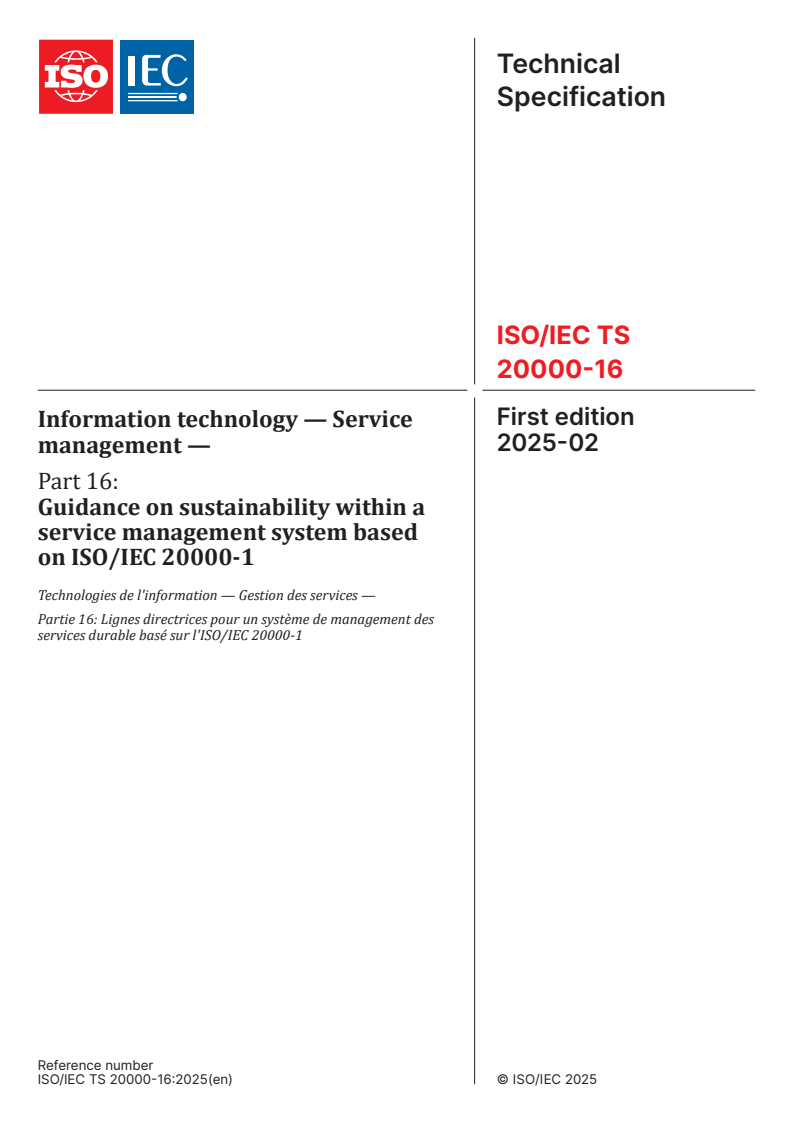
Technical
Specification
ISO/IEC TS
20000-16
First edition
Information technology — Service
2025-02
management —
Part 16:
Guidance on sustainability within a
service management system based
on ISO/IEC 20000-1
Technologies de l'information — Gestion des services —
Partie 16: Lignes directrices pour un système de management des
services durable basé sur l'ISO/IEC 20000-1
Reference number
© ISO/IEC 2025
All rights reserved. Unless otherwise specified, or required in the context of its implementation, no part of this publication may
be reproduced or utilized otherwise in any form or by any means, electronic or mechanical, including photocopying, or posting on
the internet or an intranet, without prior written permission. Permission can be requested from either ISO at the address below
or ISO’s member body in the country of the requester.
ISO copyright office
CP 401 • Ch. de Blandonnet 8
CH-1214 Vernier, Geneva
Phone: +41 22 749 01 11
Email: copyright@iso.org
Website: www.iso.org
Published in Switzerland
© ISO/IEC 2025 – All rights reserved
ii
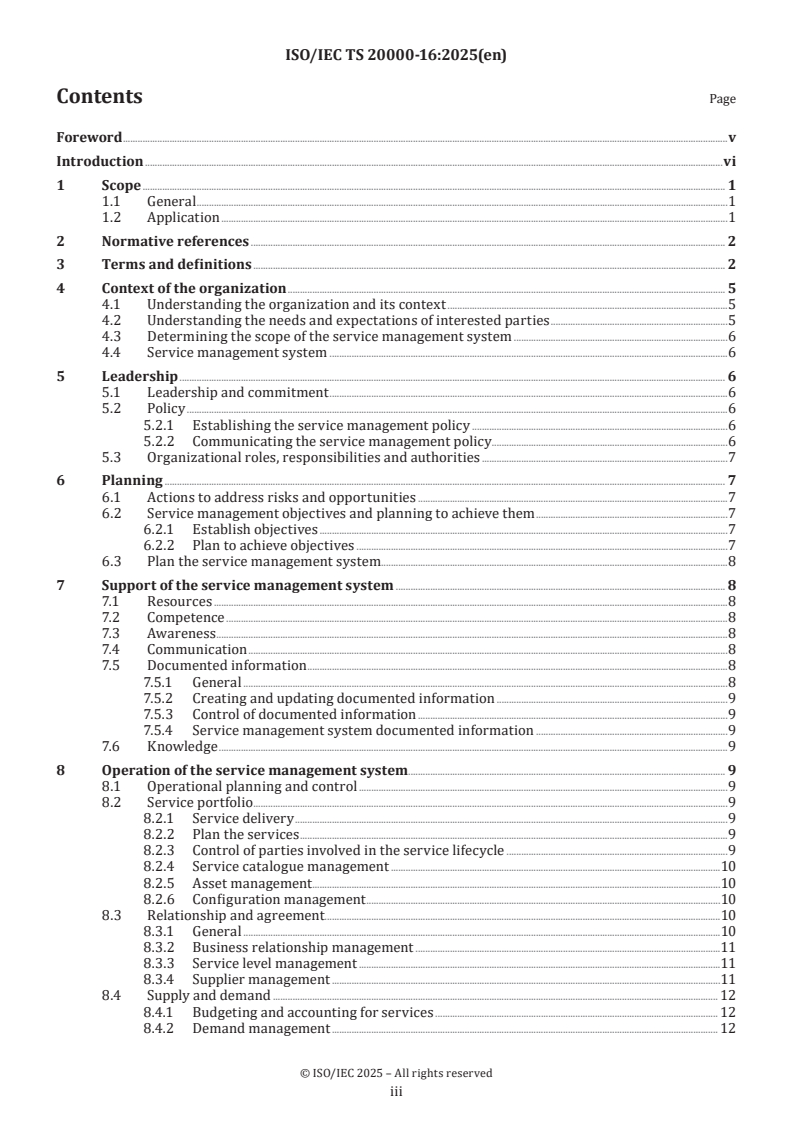
Contents Page
Foreword .v
Introduction .vi
1 Scope . 1
1.1 General .1
1.2 Application .1
2 Normative references . 2
3 Terms and definitions . 2
4 Context of the organization . 5
4.1 Understanding the organization and its context .5
4.2 Understanding the needs and expectations of interested parties .5
4.3 Determining the scope of the service management system .6
4.4 Service management system .6
5 Leadership . 6
5.1 Leadership and commitment .6
5.2 Policy .6
5.2.1 Establishing the service management policy .6
5.2.2 Communicating the service management policy.6
5.3 Organizational roles, responsibilities and authorities .7
6 Planning . 7
6.1 Actions to address risks and opportunities .7
6.2 Service management objectives and planning to achieve them .7
6.2.1 Establish objectives .7
6.2.2 Plan to achieve objectives .7
6.3 Plan the service management system.8
7 Support of the service management system . 8
7.1 Resources .8
7.2 Competence .8
7.3 Awareness .8
7.4 Communication .8
7.5 Documented information .8
7.5.1 General .8
7.5.2 Creating and updating documented information .9
7.5.3 Control of documented information .9
7.5.4 Service management system documented information .9
7.6 Knowledge .9
8 Operation of the service management system . 9
8.1 Operational planning and control .9
8.2 Service portfolio . .9
8.2.1 Service delivery .9
8.2.2 Plan the services .9
8.2.3 Control of parties involved in the service lifecycle .9
8.2.4 Service catalogue management .10
8.2.5 Asset management . .10
8.2.6 Configuration management .10
8.3 Relationship and agreement.10
8.3.1 General .10
8.3.2 Business relationship management .11
8.3.3 Service level management .11
8.3.4 Supplier management .11
8.4 Supply and demand . 12
8.4.1 Budgeting and accounting for services . 12
8.4.2 Demand management . 12
© ISO/IEC 2025 – All rights reserved
iii
8.4.3 Capacity management . 12
8.5 Service design, build and transition . 13
8.5.1 Change management . 13
8.5.2 Service design and transition . 13
8.5.3 Release and deployment management . 13
8.6 Resolution and fulfilment . 13
8.6.1 Incident management . . 13
8.6.2 Service request management .14
8.6.3 Problem management .14
8.7 Service assurance .14
8.7.1 Service availability management .14
8.7.2 Service continuity management .14
8.7.3 Information security management .14
9 Performance evaluation .15
9.1 Monitoring, measurement, analysis and evaluation . . 15
9.2 Internal audit . 15
9.3 Management review . 15
9.4 Service reporting . . 15
10 Improvement .15
10.1 Nonconformity and corrective action . 15
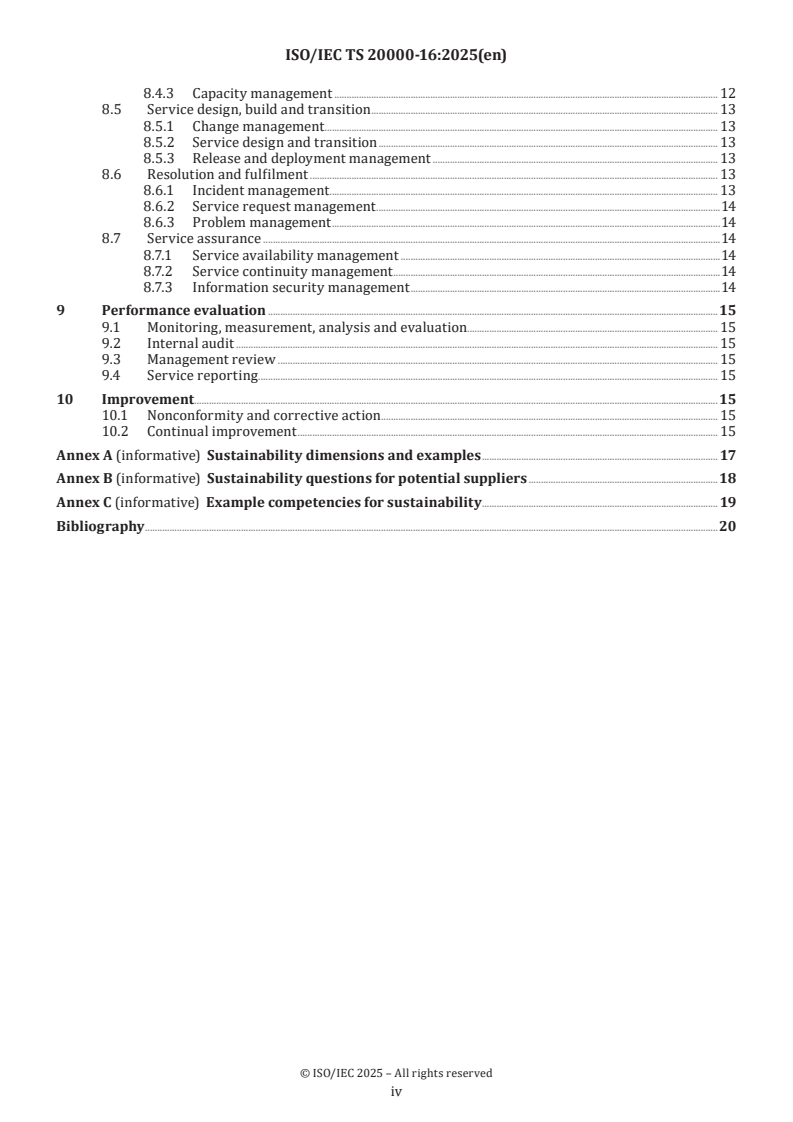
10.2 Continual improvement . 15
Annex A (informative) Sustainability dimensions and examples . 17
Annex B (informative) Sustainability questions for potential suppliers .18
Annex C (informative) Example competencies for sustainability . 19
Bibliography .20
© ISO/IEC 2025 – All rights reserved
iv
Foreword
ISO (the International Organization for Standardization) and IEC (the International Electrotechnical
Commission) form the specialized system for worldwide standardization. National bodies that are
members of ISO or IEC participate in the development of International Standards through technical
committees established by the respective organization to deal with particular fields of technical activity.
ISO and IEC technical committees collaborate in fields of mutual interest. Other international organizations,
governmental and non-governmental, in liaison with ISO and IEC, also take part in the work.
The procedures used to develop this document and those intended for its further maintenance are described
in the ISO/IEC Directives, Part 1. In particular, the different approval criteria needed for the different types
of document should be noted. This document was drafted in accordance with the editorial rules of the ISO/
IEC Directives, Part 2 (see www.iso.org/directives or www.iec.ch/members_experts/refdocs).
ISO and IEC draw attention to the possibility that the implementation of this document may involve the
use of (a) patent(s). ISO and IEC take no position concerning the evidence, validity or applicability of any
claimed patent rights in respect thereof. As of the date of publication of this document, ISO and IEC had not
received notice of (a) patent(s) which may be required to implement this document. However, implementers
are cautioned that this may not represent the latest information, which may be obtained from the patent
database available at www.iso.org/patents and https://patents.iec.ch. ISO and IEC shall not be held
responsible for identifying any or all such patent rights.
Any trade name used in this document is information given for the convenience of users and does not
constitute an endorsement.
For an explanation of the voluntary nature of standards, the meaning of ISO specific terms and expressions
related to conformity assessment, as well as information about ISO's adherence to the World Trade
Organization (WTO) principles in the Technical Barriers to Trade (TBT) see www.iso.org/iso/foreword.html.
In the IEC, see www.iec.ch/understanding-standards.
This document was prepared by Joint Technical Committee ISO/IEC JTC 1, Information Technology, SC 40, IT
Service Management and IT Governance.
A list of all parts in the ISO/IEC 20000 series can be found on the ISO and IEC websites.
Any feedback or questions on this document should be directed to the user’s national standards
body. A complete listing of these bodies can be found at www.iso.org/members.html and
www.iec.ch/national-committees.
© ISO/IEC 2025 – All rights reserved
v
Introduction
Climate change and the decline of biodiversity in the last few decades have highlighted the effect of human
actions on the planet and life. Recognizing this impact, the United Nations (UN) has called for a global
partnership for sustainable development to improve human life and protect the environment. Sustainable
development is defined as development that meets the needs of the present without compromising the
ability of future generations to meet their own needs. The UN 2030 Agenda for Sustainable Development,
which is adopted by all member states, provides a shared blueprint for peace and prosperity for people and
the planet, now and into the future. This agenda includes 17 Sustainable Development Goals (SDGs) across
three interdependent dimensions of sustainability, which are:
— environmental;
— social; and
— economic.
Many national and international standards, guidelines and documents have been published on how to better
address environmental, social and economic world issues. In response to an ISO initiative (the London
[23]
Declaration ), ISO/IEC 20000-1 is an example of where sustainability can be built into the existing
structure. Information technology (IT) has a critical role to play in the operation of services within any
organization and has great potential to drive sustainable development.
This document provides guidance for sustainability within a service management system (SMS).
Sustainability actions can span across diverse areas, including eco-responsibility, eco-labelling of products
and services, moving to net zero greenhouse gas (GHG) emissions (i.e. negating the amount of greenhouse
gases produced by human activity), social responsibility, circular economy, long-term viability and
organizational culture change to deal with the present and prepare for the future. As sustainability is applied
to an SMS, this guidance will focus on the three sustainability dimensions and not the specific actions to
support sustainable operations (e.g. eco-responsibility, GHG). An SMS aligned to the sustainability strategy
of the organization extends the focus from service resilience to sustainable service delivery and operations.
Organizations, through strategic planning and top management commitment, can directly minimize the
environmental, social and economic adverse effects of service delivery throughout the service lifecycle. This
strategy is reflected in the service management objectives, service management plan and ongoing activities/
operations needed for service delivery.
An SMS focused on sustainability will provide opportunities for ongoing visibility, control of services
and continual improvement, leading to greater effectiveness, efficiency and reduction of the impact on
global resources. These benefits can arise from optimized IT asset utilization, responsible procurement,
sustainable supplier management, improving data centre facilities, and operations management in terms of
electricity, water, HVAC (Heating, Ventilation, Air Conditioning), hardware components, etc.
ISO/IEC 20000-1 has been written generically, which means that the type, size or nature of the services
delivered makes no difference when applying the requirements. This document, following the structure of
ISO/IEC 20000-1, focuses on which areas to consider for improving sustainability within an SMS. It does not
state any performance criteria across the dimensions of sustainability. The complexity of an SMS focused
on sustainability will depend solely on the context of the organization, the scope of operation, compliance
obligations, and the nature of the organizational activities, products and services.
Figure 1 illustrates an SMS showing the clause content of ISO/IEC 20000-1. Numbers in parentheses in
Figure 1 indicate ISO/IEC 20000-1 clause numbers.
© ISO/IEC 2025 – All rights reserved
vi
Figure 1 — Service management system (SMS)
© ISO/IEC 2025 – All rights reserved
vii
Technical Specification ISO/IEC TS 20000-16:2025(en)
Information technology — Service management —
Part 16:
Guidance on sustainability within a service management
system based on ISO/IEC 20000-1
1 Scope
1.1 General
This document provides guidance for including sustainability within a service management system (SMS)
based on the requirements defined in ISO/IEC 20000-1. It is aimed at:
— organizations that are intending to implement the requirements of ISO/IEC 20000-1 and directly address
sustainability;
— organizations that intend to leverage their existing SMS to enable sustainability actions and sustainable
delivery;
— consultants, trainers and other experts supporting organizations that utilize ISO/IEC 20000-1, so that
they can be informed on how to include sustainability actions in an SMS.
Sustainability in this context has three interdependent dimensions, which are environmental, social and
economic. Annex A expands on the three dimensions with examples of each.
The guidance provided in this document aims to help organizations consider and address sustainability
objectives as well as challenges related to their services. The complexity and detail surrounding the inclusion
of sustainability within an SMS will vary and be dependent on the context of the organization, the scope of
the SMS, compliance obligations and the nature of the services within the scope of the SMS.
1.2 Application
This document is intended to be used in conjunction with ISO/IEC 20000-1 to address sustainability
objectives related to specific requirements in ISO/IEC 20000-1. As such, it is anticipated that the user of this
document is aware of the requirements in ISO/IEC 20000-1. The suggestions included across clauses in this
document will be most effective when applied to an SMS which is implemented according to the corresponding
clauses in ISO/IEC 20000-1. Application of this guidance to an SMS according to ISO/IEC 20000-1 is therefore
recommended.
This document supports and is an addition to the guidance already provided in ISO/IEC 20000-2,
ISO/IEC 20000-3, ISO/IEC TS 20000-5 and other parts of the ISO/IEC 20000 series.
Organizations can use the guidance in this document to also address the new requirements identified in
ISO/IEC 20000-1:2018/Amd 1:2024 and ISO’s objectives to address climate change.
The recommendations in this document for improving sustainability within an SMS are not exclusive and
can be implemented along with other sustainability initiatives.
© ISO/IEC 2025 – All rights reserved
2 Normative references
The following documents are referred to in the text in such a way that some or all of their content constitutes
requirements of this document. For dated references, only the edition cited applies. For undated references,
the latest edition of the referenced document (including any amendments) applies.
ISO/IEC 20000-1, Information technology — Service management — Part 1: Service management system
requirements
ISO/IEC 20000-10, Information technology — Service management — Part 10: Concepts and vocabulary
3 Terms and definitions
For the purposes of this document, the terms and definitions given in ISO/IEC 20000-1, ISO/IEC 20000-10
and the following apply.
ISO and IEC maintain terminology databases for use in standardization at the following addresses:
— ISO Online browsing platform: available at https:// www .iso .org/ obp
— IEC Electropedia: available at https:// www .electropedia .org/
3.1
adaptation
adjustments in ecological, social or economic systems in response to actual or expected climatic stimuli and
their effects or impacts
Note 1 to entry: Adaptation refers to changes in processes, practices and structures to moderate potential damages or
to benefit from opportunities associated with climate change.
[SOURCE: ISO/IWA 42:2022, 3.1.5]
3.2
bribery
offering, promising, giving, accepting or soliciting of an undue advantage of any value (which could be
financial or non-financial), directly, or indirectly, and irrespective of location(s), in violation of applicable
law, as an inducement or reward for a person acting or refraining from acting in relation to the performance
of that person’s duties
Note 1 to entry: The above is a generic definition. The meaning of the term "bribery" is as defined by the anti-bribery
law applicable to the organization and by the anti-bribery management system designed by the organization.
[SOURCE: ISO 37001:2016, 3.1]
3.3
climate
statistical description of weather in terms of the mean and variability of relevant quantities over a period of
time ranging from months to thousands or millions of years
Note 1 to entry: The classical period for averaging these variables is 30 years, as defined by the World Meteorological
Organization.
Note 2 to entry: The relevant quantities are most often near-surface variables such as temperature, precipitation and wind.
[SOURCE: ISO Guide 84:2020, 3.1.1]
3.4
climate change
change in climate that persists for an extended period, typically decades or longer
Note 1 to entry: Change in climate can be identified (e.g. by using statistical tests) by changes in the mean and/or the
variability of its properties.
© ISO/IEC 2025 – All rights reserved
Note 2 to entry: Climate change might be due to natural processes, internal to the climate system, or external forces
such as modulations of the solar cycles, volcanic eruptions, and persistent anthropogenic changes in the composition
of the atmosphere or in land use.
[SOURCE: ISO Guide 84:2020, 3.1.2, modified — "external forcings" changed to "external forces" in the
definition.]
3.5
circular economy
economic system that systemically maintains a circular flow of resources, by regenerating, retaining or
adding to their value while contributing to sustainable development
[SOURCE: ISO 5020:2022, 3.3.1]
3.6
eco-design
methodical approach that takes into consideration the environmental aspects of the design and development
process with the aim of reducing the negative environmental impacts throughout the lifecycle of a product
[SOURCE: IEC 62430:2019]
3.7
ecolabel
environmental label
claim which indicates the environmental aspects of goods or services
Note 1 to entry: An environmental label or declaration may take the form of a statement, symbol or graphic on a product
or package label, in product literature, in technical bulletins, in advertising or in publicity, amongst other things.
[24]
Note 2 to entry: Ecolabels are an international method of showing compliance to various sustainability frameworks.
[SOURCE: ISO 20400:2017, 3.4, modified — Note 2 to entry has been added; the preferred term "environmental
label" has been changed to an admitted term and "ecolabel" has been added as the preferred term.]
3.8
eco-responsibility
attitude, behaviour and activity of a person or an organization to make informed environmental, social and
economic choices to position the protection of the planet first
3.9
environmental impact
change to the environment whether adverse or beneficial, wholly or partially resulting from an organization’s
environmental aspects
[SOURCE: ISO 14001:2015, 3.2.4]
3.10
greenhouse gas
GHG
gaseous constituent of the atmosphere, natural or anthropogenic, that absorbs and emits radiation
at specific wavelengths within the spectrum of infrared radiation emitted by the Earth's surface, the
atmosphere and clouds
Note 1 to entry: Greenhouse gases caused by human activities and relevant for this document include carbon dioxide
(CO ), methane (CH ), nitrous oxide (N O), hydrofluorocarbons (HFCs), perfluorocarbons (PFCs), sulfur hexafluoride
2 4 2
(SF ) and nitrogen trifluoride (NF ).
6 3
[SOURCE: IWA 42:2022, 3.2.1]
© ISO/IEC 2025 – All rights reserved
3.11
resilience
ability to resist, adapt to, or quickly recover from potentially disruptive events or conditions, whether
natural or anthropogenic, in order to maintain or restore the intended service
[SOURCE: ISO 21931-1:2022, 3.1.12]
3.12
social responsibility
responsibility of an organization for the impacts of its decisions and activities on society and the
environment, through transparent and ethical behaviour that:
— contributes to sustainable development, including the health and the welfare of society;
— takes into account the expectations of stakeholders;
— is in compliance with applicable law and consistent with international norms of behaviour;
— is integrated throughout the organization and practised in its relationships.
Note 1 to entry: Activities include products, services and processes.
Note 2 to entry: Relationships refer to an organization's activities within its sphere of influence.
[SOURCE: ISO Guide 82:2019, 3.4]
3.13
supply chain
two-way relationship of organizations, people, processes, logistics, information, technology and resources
engaged in activities and creating value from the sourcing of materials through the delivery of products or
services
Note 1 to entry: The supply chain may include vendors, subcontractors, manufacturing facilities, logistics providers,
internal distribution centres, distributors, wholesalers and other entities that lead to the end user.
[SOURCE: ISO 22300:2021, 3.1.271]
3.14
sustainability
state of the global system, including environmental, social and economic aspects, in which the needs of the
present are met without compromising the ability of future generations to meet their own needs
Note 1 to entry: The environmental, social and economic aspects interact, are interdependent and are often referred
to as the three dimensions of sustainability.
Note 2 to entry: Sustainability is the goal of sustainable development.
[SOURCE: ISO Guide 82:2019, 3.1]
3.15
sustainability aspect
aspect of an activity or goods or services that, during the life cycle of the activity, or goods or services, is
related to sustainability, positively or negatively
[SOURCE: ISO 20400:2017, 3.34]
3.16
sustainability impact
positive or negative change to society, economy or the environment, wholly or partially resulting from past
and present decisions and activities of an organization
[SOURCE: ISO 21401:2018, 3.39, modified — "accommodation establishment" has been changed to
"organization" in the definition.]
© ISO/IEC 2025 – All rights reserved
3.17
sustainability indicator
indicator related to economic, environmental and social impacts
[SOURCE: ISO 6707-3:2022, 3.10.9]
3.18
sustainable development
development that meets the environmental, social and economic needs of the present without compromising
the ability of future generations to meet their own needs
[25]
Note 1 to entry: Derived from the Brundtland Report.
[SOURCE: ISO Guide 82:2019, 3.2]
3.19
sustainable procurement
procurement that has the most positive environmental, social and economic impacts possible over the entire
lifecycle
Note 1 to entry: Sustainable procurement involves the sustainability aspects related to the goods or services and to
the suppliers along the supply chains.
Note 2 to entry: Sustainable procurement contributes to the achievement of organizational sustainability objectives
and goals and to sustainable development in general.
[SOURCE: ISO 20400:2017, 3.38]
4 Context of the organization
4.1 Understanding the organization and its context
The organization should consider sustainability objectives and relevant sustainability-related regulations
(local, regional, national or industry-specific) to determine the internal and external issues that can affect
the outcomes of its SMS. Consideration should be given to any internal and external factors, impacting
environmental, social or economic dimensions of sustainability.
The organization should determine whether climate change is a relevant issue for their SMS by including
climate change/impact in their discussions and decision-making.
As a regulatory requirement to exhibit compliance on certain sustainability requirements, an organization
can have a need to demonstrate an ecolabel, which is objective evidence of having complied with certain
sustainability requirements, or certification to sustainability-related standards (e.g. ISO 14001). This can be
applicable to the suppliers and partners of the organization as well.
4.2 Understanding the needs and expectations of interested parties
The organization should anticipate changing sustainability requirements via feedback from customers and
interested parties. Sustainability requirements can also arise in response to organizational conditions that
have altered (e.g. adaptation due to social pressures).
Relevant interested parties can have significant environmental, social and economic obligations or needs,
including those relating to climate change (see Annex A for examples of each dimension). From an analysis,
the organization should identify which of these will be addressed through the SMS. Examples of potential
interested parties to be considered for specific sustainability requirements are:
— customers;
— owners/investors;
— parent or subsidiary organizations;
© ISO/IEC 2025 – All rights reserved
— workers within the organization, their representatives, apprentices;
— suppliers, their employees;
— partners;
— trade and professional associations;
— regulators (local, regional, national or international);
— non-governmental organizations;
— competitors;
— future generations.
4.3 Determining the scope of the service management system
No further guidance is provided in addition to ISO/IEC 20000-1:2018, 4.3.
4.4 Service management system
The SMS should include specific sustainability actions to support the processes along with their interactions
and the services within the defined scope.
5 Leadership
5.1 Leadership and commitment
Top management should ensure that a sustainability vision and plan for the organization is established
with appropriate details in the service management policy, service management objectives and service
management plan. These should mirror the strategic direction of the organization for sustainability.
The organization should establish a culture of sustainability. Top management and the governing body
should create an environment where emphasis is placed on environmental, social and economic dimensions
of sustainability.
Top management should ensure that there are appropriate levels of resources and authority to execute
sustainability actions within the SMS. Communications on service management objectives, requirements
and value should include planned sustainability aspects of the SMS.
Additionally, top management should identify and manage their own training needs to enable better
understanding of the context and to encourage the changed attitudes and expectations in view of the focus
on sustainability.
5.2 Policy
5.2.1 Establishing the service management policy
The organization should determine the sustainability aspects of its activities and services. Top management
should ensure that the service management policy includes commitment to effectively manage the
sustainability aspects identified.
For examples of key sustainability aspects that can be considered in each of the three sustainability
dimensions see Annex A.
5.2.2 Communicating the service management policy
No further guidance is provided in addition to ISO/IEC 20000-1:2018, 5.2.2.
© ISO/IEC 2025 – All rights reserved
5.3 Organizational roles, responsibilities and authorities
Consideration should be given to assigning responsibility for the planning, implementation and measurement
of the sustainability aspects of the SMS.
6 Planning
6.1 Actions to address risks and opportunities
The organization should determine the risks and opportunities that need to be addressed to give assurance
that the SMS can achieve its intended outcomes for sustainability.
It is possible that risks related to environmental, social and economic dimensions (see Annex A) will be
managed independently. There can be an opportunity to manage these dimensions together. Potential risks
related to sustainability in an SMS can be present across any of the areas listed in Annex A. Design of new
or changed services should consider the potential impact on sustainability objectives. For example, if an
organization has an objective of reducing GHG emissions, this objective can be at risk from increased power
usage by IT systems as new services are added to the organizational portfolio.
An example for the social dimension is the identification and management of health risks from performing
human activities.
An example for the environmental dimension is the opportunity to establish responsible IT asset reuse,
recycling and disposal practices to minimize environmental impact.
An example of the economic dimension is identifying and managing risks to the profitability of the
organization by balancing the costs of sustainability actions with the benefits.
Bribery is another potential risk for the organization within the context of sustainability. Implementing an
anti-bribery policy and other internal controls to detect possible bribery instances can mitigate these risks.
Sample risk mitigations for bribery are:
a) use a pre-qualification process, including assessing the likelihood of staff participating in bribery and
the location of the supplier, as bribery risk can be higher in some areas;
b) require at least two signatures on contract awards, work approvals, etc. to reduce the risk of corrupt
awards, approvals, payments or benefits.
NOTE For more information on anti-bribery management, see ISO 37001.
6.2 Service management objectives and planning to achieve them
6.2.1 Establish objectives
The organization should establish measurable objectives about sustainability within the context of service
management (e.g. obtain a 5 % reduction in power consumption of data centres by the end of the year).
Any relevant SMS sustainability-related initiatives and actions should always be aligned with the
organization’s strategic objectives for sustainability.
The organization should ensure that there are measurable commitments that demonstrate the sustainability
efforts of the service provider (e.g. energy consumption of IT equipment per rack cabinet to be reduced by
5 % by the end of the year).
6.2.2 Plan to achieve objectives
Planning to achieve all service management objectives should consider the sustainability aspects, especially
for the resources required and how the results will be evaluated.
© ISO/IEC 2025 – All rights reserved
6.3 Plan the service management system
The organization should determine the compliance obligations for sustainability and how these apply to the
SMS and the services.
NOTE For further information on compliance obligations for the environmental dimension, see ISO 14001:2015,
6.1. Additional relevant legal or regulatory requirements can also be applicable.
Known limitations in the service management plan can include sustainability aspects of the SMS such as
procurement budget constraints. The approach to be taken for other parties involved in the service lifecycle
should expand on any requirements for suppliers to demonstrate sustainability actions. Authorities and
responsibilities should specify sustainability actions where relevant. Measurement of the effectiveness of
the SMS should consider the sustainability actions of the organization as well as its suppliers.
7 Support of the service management system
7.1 Resources
The organization should determine and provide the resources required to execute the sustainability actions
within the SMS. Examples of sustainability aspects for the four types of resources are:
— human resources: fair pay, well-being, inclusion and diversity, community support, hybrid mode of
working for reducing transport needs;
— technical resources: extended equipment lifespan, recycling end-of-life equipment;
— information resources: reduced storage utilization through optimization of information retention
criteria;
— financial resources: maximize software licence utilization.
7.2 Competence
The organization should determine and ensure necessary competence for persons involved in sustainability
actions.
NOTE Annex C provides a list of possible competencies to assist in adding sustainability to an SMS. When defining
new competencies, see ISO 10015.
7.3 Awareness
Effective delivery of sustainability aspects within an SMS requires that individuals involved, including
internal interested parties (e.g. operations staff, budget holders or others engaged with suppliers in any
capacity) and top management, understand the reasons for the focus on sustainability. To effectively deliver
sustainability within an SMS, a supportive organizational culture, performance management, education,
training and other support (e.g. working from home, reduced travel) can be useful.
7.4 Communication
No further guidance is provided in addition to ISO/IEC 20000-1:2018, 7.4.
7.5 Documented information
7.5.1 General
Printing and physical storage of documents should be minimized.
© ISO/IEC 2025 – All rights reserved
------
...