

ISO 11970:2016
(Main)Specification and qualification of welding procedures for production welding of steel castings
General Information
- Abstract
ISO 11970:2016 specifies how a welding procedure specification (WPS) for production welding of steel castings is qualified. It defines the conditions for the execution of welding procedure qualification tests and the limits of validity of a qualified welding procedure for all practical welding operations within the range of essential variables. Tests are intended to be carried out in accordance with this International Standard unless additional tests are specified by the purchaser or by agreement between the contracting parties. ISO 11970:2016 applies to the arc welding of steel castings. The principles of this International Standard can be applied to other fusion welding processes subject to agreement between the contracting parties. In the case of specific service, material or manufacturing conditions, tests more comprehensive than those specified by this International Standard can be specified by the purchaser, in order to gain more information, e.g. longitudinal weld tensile tests, bend tests, chemical analyses, ferrite determination in austenitic stainless steels, elongation, Charpy "V" impact tests, and radiography.
- Status
- Withdrawn
- Publication Date
- 06-Mar-2016
- Technical Committee
- ISO/TC 17/SC 11 - Steel castings
- Drafting Committee
- ISO/TC 17/SC 11 - Steel castings
- Current Stage
- 9599 - Withdrawal of International Standard
- Start Date
- 14-Nov-2025
- Completion Date
- 29-Aug-2026
Buy Documents

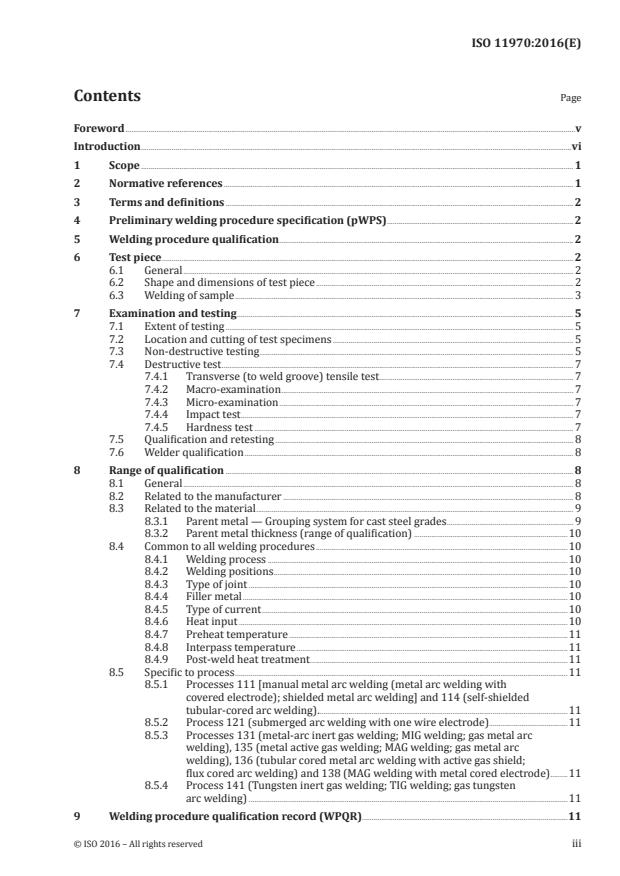
ISO 11970:2016 - Specification and qualification of welding procedures for production welding of steel castings Released:3/7/2016

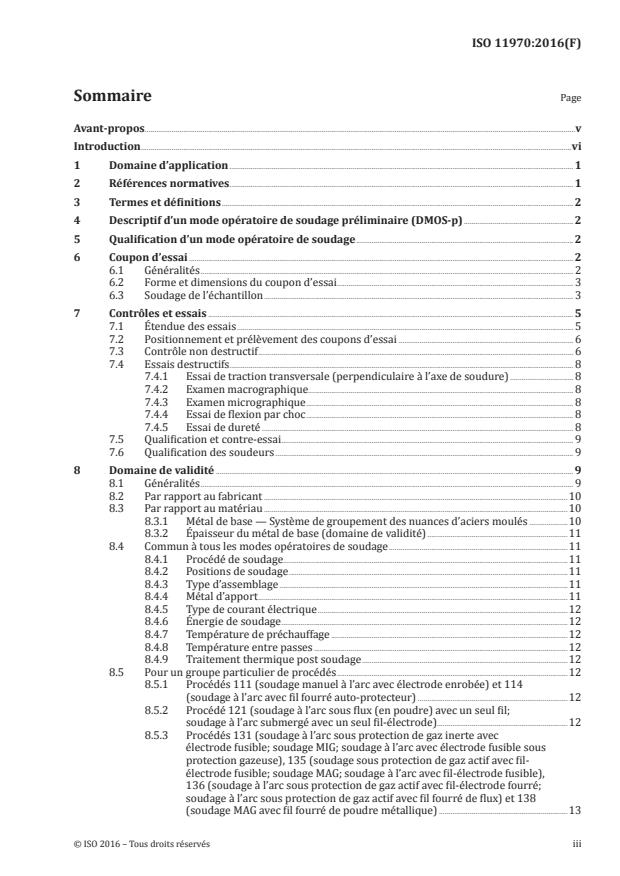
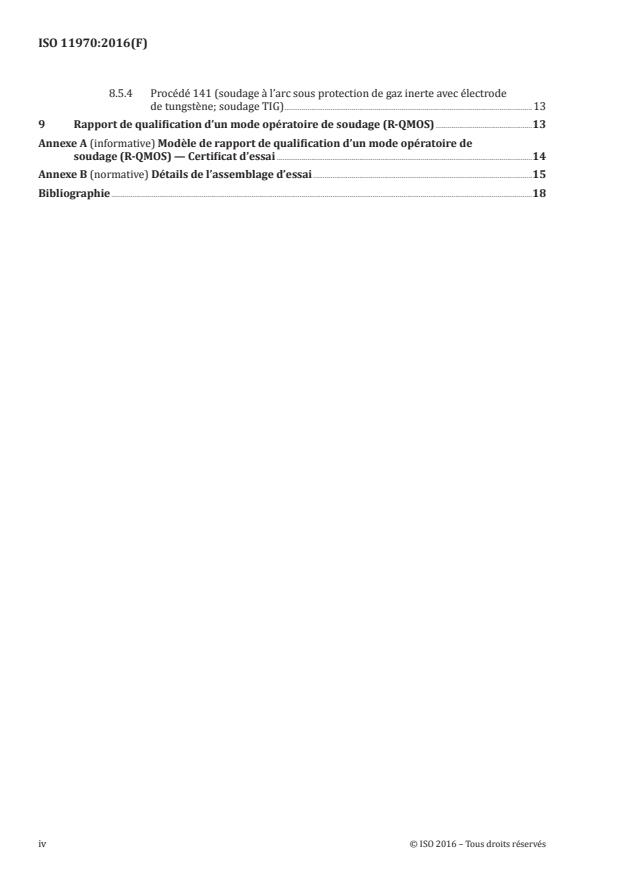
ISO 11970:2016 - Descriptif et qualification de modes opératoires de soudage pour le soudage de production des aciers moulés Released:3/7/2016
Overview
ISO 11970:2016 - Specification and qualification of welding procedures for production welding of steel castings - defines how to qualify a Welding Procedure Specification (WPS) and documents the required tests and limits of validity for production welding of steel castings. The standard applies primarily to arc welding of steel castings, but its principles can be applied to other fusion welding processes by agreement between the contracting parties. It sets out requirements for preparing a preliminary WPS (pWPS), performing welding procedure qualification tests and recording results in a Welding Procedure Qualification Record (WPQR).
Key topics and technical requirements
- Scope of qualification: Defines the essential variables and the limits of validity for qualified procedures (material groupings, thickness ranges, welding process, position, joint type, filler metal, current type, heat input, preheat/interpass/post‑weld heat treatment).
- pWPS and WPQR: Preparation of a preliminary WPS and formal WPQR documentation for traceability and acceptance.
- Test piece and sample preparation: Shapes and dimensions for plate, tube and cavity samples (figures provided), including requirements for tack weld handling and angular tolerances.
- Examinations and tests:
- Non‑destructive testing (NDT): magnetic particle inspection (MPI), liquid penetrant (LPI), ultrasonic (UT) and radiography as applicable.
- Destructive testing: transverse tensile tests, macro‑examination, micro‑examination, hardness testing and impact testing (Charpy V) where required.
- Additional purchaser‑specified tests: longitudinal tensile, bend tests, chemical analysis, ferrite in austenitic stainless steels, elongation and radiography.
- Welder qualification: Welding procedure tests qualify the welder within the appropriate range in accordance with ISO 9606‑1; additional welder qualification rules apply.
- Range and limits: Clause 8 details how qualification ranges apply to material, manufacturer, process specifics and common variables.
Practical applications - who uses ISO 11970
- Welding engineers and procedure writers creating WPS/pWPS for steel castings
- Foundries and manufacturers performing production welding or repair welding on cast components
- Quality managers and inspection bodies responsible for WPQR preparation and witness testing
- Purchasers and clients specifying acceptance criteria and additional tests for critical service or material conditions
- Certification bodies and auditors assessing compliance with welding procedure qualification requirements
Related standards
- ISO 15607 / ISO 15612 - General rules for specification and qualification of welding procedures
- ISO 9606‑1 - Welder qualification (steels)
- ISO 5817 - Quality levels for welding imperfections
- NDT and testing standards referenced: ISO 148‑1 (Charpy), ISO 4136 (tensile), ISO 4992 (UT), ISO 4993 (radiography), ISO 4986/4987 (MPI/LPI), ISO 6507‑1 (hardness)
ISO 11970 is essential for organizations that need robust, auditable welding procedure qualification for steel castings - ensuring repeatable quality, traceability and acceptance for production welding.
Relations
- Effective Date
- 25-Aug-2026
- Effective Date
- 12-Feb-2026
- Effective Date
- 06-Jun-2022
- Effective Date
- 06-Jun-2022
- Effective Date
- 12-Feb-2011
Buy Documents
ISO 11970:2016 - Specification and qualification of welding procedures for production welding of steel castings Released:3/7/2016
ISO 11970:2016 - Descriptif et qualification de modes opératoires de soudage pour le soudage de production des aciers moulés Released:3/7/2016
Get Certified
Connect with accredited certification bodies for this standard

DVS-ZERT GmbH
German welding certification society.

Element Materials Technology
Materials testing and product certification.
Inštitut za kovinske materiale in tehnologije
Institute of Metals and Technology. Materials testing, metallurgical analysis, NDT.
Sponsored listings
Frequently Asked Questions
ISO 11970:2016 is a standard published by the International Organization for Standardization (ISO). Its full title is "Specification and qualification of welding procedures for production welding of steel castings". This standard covers: ISO 11970:2016 specifies how a welding procedure specification (WPS) for production welding of steel castings is qualified. It defines the conditions for the execution of welding procedure qualification tests and the limits of validity of a qualified welding procedure for all practical welding operations within the range of essential variables. Tests are intended to be carried out in accordance with this International Standard unless additional tests are specified by the purchaser or by agreement between the contracting parties. ISO 11970:2016 applies to the arc welding of steel castings. The principles of this International Standard can be applied to other fusion welding processes subject to agreement between the contracting parties. In the case of specific service, material or manufacturing conditions, tests more comprehensive than those specified by this International Standard can be specified by the purchaser, in order to gain more information, e.g. longitudinal weld tensile tests, bend tests, chemical analyses, ferrite determination in austenitic stainless steels, elongation, Charpy "V" impact tests, and radiography.
ISO 11970:2016 specifies how a welding procedure specification (WPS) for production welding of steel castings is qualified. It defines the conditions for the execution of welding procedure qualification tests and the limits of validity of a qualified welding procedure for all practical welding operations within the range of essential variables. Tests are intended to be carried out in accordance with this International Standard unless additional tests are specified by the purchaser or by agreement between the contracting parties. ISO 11970:2016 applies to the arc welding of steel castings. The principles of this International Standard can be applied to other fusion welding processes subject to agreement between the contracting parties. In the case of specific service, material or manufacturing conditions, tests more comprehensive than those specified by this International Standard can be specified by the purchaser, in order to gain more information, e.g. longitudinal weld tensile tests, bend tests, chemical analyses, ferrite determination in austenitic stainless steels, elongation, Charpy "V" impact tests, and radiography.
ISO 11970:2016 is classified under the following ICS (International Classification for Standards) categories: 25.160.10 - Welding processes; 77.140.80 - Iron and steel castings. The ICS classification helps identify the subject area and facilitates finding related standards.
ISO 11970:2016 has the following relationships with other standards: It is inter standard links to EN ISO 13703-2:2023, EN ISO 11970:2016, ISO 7866:2012, ISO 11970:2025, ISO 11970:2001. Understanding these relationships helps ensure you are using the most current and applicable version of the standard.
ISO 11970:2016 is available in PDF format for immediate download after purchase. The document can be added to your cart and obtained through the secure checkout process. Digital delivery ensures instant access to the complete standard document.
Standards Content (Sample)
INTERNATIONAL ISO
STANDARD 11970
Second edition
2016-03-01
Specification and qualification of
welding procedures for production
welding of steel castings
Descriptif et qualification de modes opératoires de soudage pour le
soudage de production des aciers moulés
Reference number
©
ISO 2016
© ISO 2016, Published in Switzerland
All rights reserved. Unless otherwise specified, no part of this publication may be reproduced or utilized otherwise in any form
or by any means, electronic or mechanical, including photocopying, or posting on the internet or an intranet, without prior
written permission. Permission can be requested from either ISO at the address below or ISO’s member body in the country of
the requester.
ISO copyright office
Ch. de Blandonnet 8 • CP 401
CH-1214 Vernier, Geneva, Switzerland
Tel. +41 22 749 01 11
Fax +41 22 749 09 47
copyright@iso.org
www.iso.org
ii © ISO 2016 – All rights reserved
Contents Page
Foreword .v
Introduction .vi
1 Scope .1
2 Normative references .1
3 Terms and definitions . 2
4 Preliminary welding procedure specification (pWPS) . 2
5 Welding procedure qualification . 2
6 Test piece . 2
6.1 General . 2
6.2 Shape and dimensions of test piece . 2
6.3 Welding of sample . 3
7 Examination and testing .5
7.1 Extent of testing . 5
7.2 Location and cutting of test specimens . 5
7.3 Non-destructive testing . 5
7.4 Destructive test . 7
7.4.1 Transverse (to weld groove) tensile test . 7
7.4.2 Macro-examination . 7
7.4.3 Micro-examination . 7
7.4.4 Impact test . 7
7.4.5 Hardness test . 7
7.5 Qualification and retesting . 8
7.6 Welder qualification . 8
8 Range of qualification .8
8.1 General . 8
8.2 Related to the manufacturer . 8
8.3 Related to the material . 9
8.3.1 Parent metal — Grouping system for cast steel grades. 9
8.3.2 Parent metal thickness (range of qualification) .10
8.4 Common to all welding procedures .10
8.4.1 Welding process .10
8.4.2 Welding positions . . .10
8.4.3 Type of joint .10
8.4.4 Filler metal .10
8.4.5 Type of current .10
8.4.6 Heat input .10
8.4.7 Preheat temperature .11
8.4.8 Interpass temperature .11
8.4.9 Post-weld heat treatment .11
8.5 Specific to process .11
8.5.1 Processes 111 [manual metal arc welding (metal arc welding with
covered electrode); shielded metal arc welding] and 114 (self-shielded
tubular-cored arc welding). .11
8.5.2 Process 121 (submerged arc welding with one wire electrode).11
8.5.3 Processes 131 (metal-arc inert gas welding; MIG welding; gas metal arc
welding), 135 (metal active gas welding; MAG welding; gas metal arc
welding), 136 (tubular cored metal arc welding with active gas shield;
flux cored arc welding) and 138 (MAG welding with metal cored electrode) .11
8.5.4 Process 141 (Tungsten inert gas welding; TIG welding; gas tungsten
arc welding) .11
9 Welding procedure qualification record (WPQR) .11
Annex A (informative) Record form (WPQR) welding procedure qualification — Test certificate .13
Annex B (normative) Details of weld test .14
Bibliography .16
iv © ISO 2016 – All rights reserved
Foreword
ISO (the International Organization for Standardization) is a worldwide federation of national standards
bodies (ISO member bodies). The work of preparing International Standards is normally carried out
through ISO technical committees. Each member body interested in a subject for which a technical
committee has been established has the right to be represented on that committee. International
organizations, governmental and non-governmental, in liaison with ISO, also take part in the work.
ISO collaborates closely with the International Electrotechnical Commission (IEC) on all matters of
electrotechnical standardization.
The procedures used to develop this document and those intended for its further maintenance are
described in the ISO/IEC Directives, Part 1. In particular the different approval criteria needed for the
different types of ISO documents should be noted. This document was drafted in accordance with the
editorial rules of the ISO/IEC Directives, Part 2 (see www.iso.org/directives).
Attention is drawn to the possibility that some of the elements of this document may be the subject of
patent rights. ISO shall not be held responsible for identifying any or all such patent rights. Details of
any patent rights identified during the development of the document will be in the Introduction and/or
on the ISO list of patent declarations received (see www.iso.org/patents).
Any trade name used in this document is information given for the convenience of users and does not
constitute an endorsement.
For an explanation on the meaning of ISO specific terms and expressions related to conformity
assessment, as well as information about ISO’s adherence to the WTO principles in the Technical
Barriers to Trade (TBT) see the following URL: Foreword - Supplementary information
The committee responsible for this document is ISO/TC 17, Steel, Subcommittee SC 11, Steel castings.
This second edition cancels and replaces the first edition (ISO 11970:2001), which has been technically
revised. In particular, Figures 1, 2 and 3 have been redrawn to clarify labels.
Introduction
All welding procedure qualifications for production welding of steel castings are intended to be in
accordance with this International Standard.
Previous procedure qualifications that conform to the range of qualification of Clause 8 are valid under
this International Standard.
Where additional tests have to be carried out to complete the qualification, it is only necessary to
perform the additional tests to the requirements of Clauses 6 and 7.
vi © ISO 2016 – All rights reserved
INTERNATIONAL STANDARD ISO 11970:2016(E)
Specification and qualification of welding procedures for
production welding of steel castings
1 Scope
This International Standard specifies how a welding procedure specification (WPS) for production
welding of steel castings is qualified.
It defines the conditions for the execution of welding procedure qualification tests and the limits of
validity of a qualified welding procedure for all practical welding operations within the range of
essential variables.
Tests are intended to be carried out in accordance with this International Standard unless additional
tests are specified by the purchaser or by agreement between the contracting parties.
This International Standard applies to the arc welding of steel castings. The principles of this
International Standard can be applied to other fusion welding processes subject to agreement between
the contracting parties.
In the case of specific service, material or manufacturing conditions, tests more comprehensive than
those specified by this International Standard can be specified by the purchaser, in order to gain more
information, e.g. longitudinal weld tensile tests, bend tests, chemical analyses, ferrite determination in
austenitic stainless steels, elongation, Charpy “V” impact tests, and radiography.
2 Normative references
The following documents, in whole or in part, are normatively referenced in this document and are
indispensable to its application. For dated references, only the edition cited applies. For undated
references, the latest edition of the referenced document (including any amendments) applies.
ISO 148-1, Metallic materials — Charpy pendulum impact test — Part 1: Test method
ISO 857-1, Welding and allied processes — Vocabulary — Part 1: Metal welding processes
ISO 4136, Destructive tests on welds in metallic materials — Transverse tensile test
ISO 4969, Steel — Macroscopic examination by etching with strong mineral acids
ISO 4986, Steel castings — Magnetic particle inspection
ISO 4987, Steel castings — Liquid penetrant inspection
ISO 4992-1, Steel castings — Ultrasonic examination — Part 1: Steel castings for general purposes
ISO 4992-2, Steel castings — Ultrasonic examination — Part 2: Steel castings for highly stressed components
ISO 4993, Steel and iron castings – Radiographic inspection
ISO 5817, Welding — Fusion-welded joints in steel, nickel, titanium and their alloys (beam welding
excluded) — Quality levels for imperfections
ISO 6507-1, Metallic materials — Vickers hardness test — Part 1: Test method
ISO 6892-1, Metallic materials – Tensile testing – Part 1: Method of test at room temperature
ISO 9016, Destructive tests on welds in metallic materials — Impact tests — Test specimen location, notch
orientation and examination
ISO 9606-1, Qualification testing of welders — Fusion welding — Part 1: Steels
ISO 15607, Specification and qualification of welding procedures for metallic materials — General rules
ISO 15612, Specification and qualification of welding procedures for metallic materials — Qualification by
adoption of a standard welding procedure
3 Terms and definitions
For the purposes of this document, the terms and definitions given in ISO 857-1 and ISO 15607 and the
following apply.
3.1
production welding
any welding carried out during manufacturing before final delivery to the purchaser
3.1.1
joint welding
production welding used to weld cast components together or weld cast components to wrought steels
3.1.2
finishing welding
production welding carried out in order to ensure the agreed quality of the casting
3.2
repair welding
welding carried out after delivery to the end user, i.e. after the casting has been in service
4 Preliminary welding procedure specification (pWPS)
A preliminary welding procedure specification shall be prepared. It shall specify the range of all the
relevant parameters in accordance with ISO 15612.
5 Welding procedure qualification
The making and testing of test specimens representing the type and the position of welding used in
production shall be in accordance with Clauses 6 and 7.
The welder who undertakes the welding procedure test satisfactorily in accordance with this
International Standard is qualified for the appropriate range of qualification according to ISO 9606-1.
Additional welders shall be qualified in accordance with 7.6.
6 Test piece
6.1 General
The test piece shall be in accordance with those shown in Figures 1, 2, 3, and 4.
Dimensions in the figures are for information only and may be adjusted to meet production and testing
requirements.
6.2 Shape and dimensions of test piece
Additional test pieces, or longer test pieces than the minimum size may be prepared in order to allow
for extra and/or retesting specimens (in accordance with 7.5).
2 © ISO 2016 – All rights reserved
6.3 Welding of sample
The preparation and welding of the sample shall be carried out in accordance with the relevant pWPS.
Angular tolerances may be agreed between the contracting parties or by the relevant application
standard.
The dimensions and shape of the groove shall be in accordance with Figures 1, 2, 3, and 4.
If tack welds are to be fused into the final joint, they shall be included in the sample.
Unless otherwise specified in the purchase order or contract review, welding and testing of the samples
shall be witnessed by an examiner (or test body). When the examiner (or test body) is not specified in
the purchase order, the manufacturer may appoint a suitable examiner.
Ke
...
NORME ISO
INTERNATIONALE 11970
Deuxième édition
2016-03-01
Descriptif et qualification de modes
opératoires de soudage pour le
soudage de production des aciers
moulés
Specification and qualification of welding procedures for production
welding of steel castings
Numéro de référence
©
ISO 2016
DOCUMENT PROTÉGÉ PAR COPYRIGHT
© ISO 2016, Publié en Suisse
Droits de reproduction réservés. Sauf indication contraire, aucune partie de cette publication ne peut être reproduite ni utilisée
sous quelque forme que ce soit et par aucun procédé, électronique ou mécanique, y compris la photocopie, l’affichage sur
l’internet ou sur un Intranet, sans autorisation écrite préalable. Les demandes d’autorisation peuvent être adressées à l’ISO à
l’adresse ci-après ou au comité membre de l’ISO dans le pays du demandeur.
ISO copyright office
Ch. de Blandonnet 8 • CP 401
CH-1214 Vernier, Geneva, Switzerland
Tel. +41 22 749 01 11
Fax +41 22 749 09 47
copyright@iso.org
www.iso.org
ii © ISO 2016 – Tous droits réservés
Sommaire Page
Avant-propos .v
Introduction .vi
1 Domaine d’application . 1
2 Références normatives . 1
3 Termes et définitions . 2
4 Descriptif d’un mode opératoire de soudage préliminaire (DMOS-p) .2
5 Qualification d’un mode opératoire de soudage . 2
6 Coupon d’essai . 2
6.1 Généralités .2
6.2 Forme et dimensions du coupon d’essai .3
6.3 Soudage de l’échantillon .3
7 Contrôles et essais . 5
7.1 Étendue des essais .5
7.2 Positionnement et prélèvement des coupons d’essai .6
7.3 Contrôle non destructif .6
7.4 Essais destructifs.8
7.4.1 Essai de traction transversale (perpendiculaire à l’axe de soudure) .8
7.4.2 Examen macrographique .8
7.4.3 Examen micrographique .8
7.4.4 Essai de flexion par choc .8
7.4.5 Essai de dureté .8
7.5 Qualification et contre-essai .9
7.6 Qualification des soudeurs .9
8 Domaine de validité . 9
8.1 Généralités .9
8.2 Par rapport au fabricant .10
8.3 Par rapport au matériau .10
8.3.1 Métal de base — Système de groupement des nuances d’aciers moulés .10
8.3.2 Épaisseur du métal de base (domaine de validité) .11
8.4 Commun à tous les modes opératoires de soudage .11
8.4.1 Procédé de soudage .11
8.4.2 Positions de soudage .11
8.4.3 Type d’assemblage .11
8.4.4 Métal d’apport .11
8.4.5 Type de courant électrique .12
8.4.6 Énergie de soudage .12
8.4.7 Température de préchauffage .12
8.4.8 Température entre passes .12
8.4.9 Traitement thermique post soudage .12
8.5 Pour un groupe particulier de procédés .12
8.5.1 Procédés 111 (soudage manuel à l’arc avec électrode enrobée) et 114
(soudage à l’arc avec fil fourré auto-protecteur) .12
8.5.2 Procédé 121 (soudage à l’arc sous flux (en poudre) avec un seul fil;
soudage à l’arc submergé avec un seul fil-électrode).12
8.5.3 Procédés 131 (soudage à l’arc sous protection de gaz inerte avec
électrode fusible; soudage MIG; soudage à l’arc avec électrode fusible sous
protection gazeuse), 135 (soudage sous protection de gaz actif avec fil-
électrode fusible; soudage MAG; soudage à l’arc avec fil-électrode fusible),
136 (soudage à l’arc sous protection de gaz actif avec fil-électrode fourré;
soudage à l’arc sous protection de gaz actif avec fil fourré de flux) et 138
(soudage MAG avec fil fourré de poudre métallique) .13
8.5.4 Procédé 141 (soudage à l’arc sous protection de gaz inerte avec électrode
de tungstène; soudage TIG) .13
9 Rapport de qualification d’un mode opératoire de soudage (R-QMOS) .13
Annexe A (informative) Modèle de rapport de qualification d’un mode opératoire de
soudage (R-QMOS) — Certificat d’essai .14
Annexe B (normative) Détails de l’assemblage d’essai .15
Bibliographie .18
iv © ISO 2016 – Tous droits réservés
Avant-propos
L’ISO (Organisation internationale de normalisation) est une fédération mondiale d’organismes
nationaux de normalisation (comités membres de l’ISO). L’élaboration des Normes internationales est
en général confiée aux comités techniques de l’ISO. Chaque comité membre intéressé par une étude
a le droit de faire partie du comité technique créé à cet effet. Les organisations internationales,
gouvernementales et non gouvernementales, en liaison avec l’ISO participent également aux travaux.
L’ISO collabore étroitement avec la Commission électrotechnique internationale (IEC) en ce qui
concerne la normalisation électrotechnique.
Les procédures utilisées pour élaborer le présent document et celles destinées à sa mise à jour sont
décrites dans les Directives ISO/IEC, Partie 1. Il convient, en particulier de prendre note des différents
critères d’approbation requis pour les différents types de documents ISO. Le présent document a été
rédigé conformément aux règles de rédaction données dans les Directives ISO/IEC, Partie 2 (voir www.
iso.org/directives).
L’attention est appelée sur le fait que certains des éléments du présent document peuvent faire l’objet de
droits de propriété intellectuelle ou de droits analogues. L’ISO ne saurait être tenue pour responsable
de ne pas avoir identifié de tels droits de propriété et averti de leur existence. Les détails concernant
les références aux droits de propriété intellectuelle ou autres droits analogues identifiés lors de
l’élaboration du document sont indiqués dans l’Introduction et/ou dans la liste des déclarations de
brevets reçues par l’ISO (voir www.iso.org/brevets).
Les appellations commerciales éventuellement mentionnées dans le présent document sont données
pour information, par souci de commodité, à l’intention des utilisateurs et ne sauraient constituer un
engagement.
Pour une explication de la signification des termes et expressions spécifiques de l’ISO liés à
l’évaluation de la conformité, ou pour toute information au sujet de l’adhésion de l’ISO aux principes
de l’OMC concernant les obstacles techniques au commerce (OTC), voir le lien suivant: Avant-propos —
Informations supplémentaires.
Le comité chargé de l’élaboration du présent document est l’ISO/TC 17, Acier, sous-comité SC 11,
Aciers moulés.
Cette deuxième édition annule et remplace la première édition (ISO 11970:2001), qui a fait l’objet d’une
révision technique. En particulier, les Figures 1, 2 et 3 ont été redessinées pour clarifier les légendes.
Introduction
Toute qualification d’un mode opératoire de soudage de production pour des pièces moulées en acier
doit être obtenue en conformité avec la présente Norme internationale.
Les qualifications des modes opératoires existantes qui répondent au domaine de validité de l’Article 8
sont validées par la présente Norme internationale.
Si des essais complémentaires sont nécessaires pour réaliser la qualification, il y a seulement lieu
d’effectuer les essais complémentaires conformément aux exigences des Articles 6 et 7.
vi © ISO 2016 – Tous droits réservés
NORME INTERNATIONALE ISO 11970:2016(F)
Descriptif et qualification de modes opératoires de
soudage pour le soudage de production des aciers moulés
1 Domaine d’application
La présente Norme internationale spécifie comment qualifier un descriptif de mode opératoire de
soudage (DMOS) pour le soudage de production des pièces en acier moulé.
Elle définit les conditions d’exécution des épreuves de qualification et les limites de validité d’un mode
opératoire qualifié, pour toutes les opérations pratiques de soudage dans la limite de variation des
paramètres essentiels considérés.
Les essais sont destinés à être effectués conformément à la présente Norme internationale, sauf si des
essais complémentaires sont spécifiés par l’acheteur ou par accord entre les parties contractantes.
La présente Norme internationale s’applique au soudage à l’arc des pièces en acier moulé. Les principes
de la présente Norme internationale peuvent s’appliquer à d’autres procédés de soudage par fusion,
sous réserve d’accord préalable entre les parties contractantes.
Dans le cas d’une utilisation, d’un matériau ou de conditions de fabrication spécifiques, des essais plus
étendus que ceux spécifiés par la présente Norme internationale peuvent être demandés par l’acheteur,
afin d’obtenir plus d’informations, par exemple essais de traction longitudinale dans la soudure,
essais de pliage, analyses chimiques, détermination du taux de ferrite dans les aciers inoxydables
austénitiques, allongement, essais de flexion par choc Charpy «V» et contrôles radiographiques.
2 Références normatives
Les documents ci-après, dans leur intégralité ou non, sont des références normatives indispensables à
l’application du présent document. Pour les références datées, seule l’édition citée s’applique. Pour les
références non datées, la dernière édition du document de référence s’applique (y compris les éventuels
amendements).
ISO 148-1, Matériaux métalliques — Essai de flexion par choc sur éprouvette Charpy — Partie 1:
Méthode d’essai
ISO 857-1, Soudage et techniques connexes — Vocabulaire — Partie 1: Soudage des métaux
ISO 4136, Essais destructifs des soudures sur matériaux métalliques — Essai de traction transversale
ISO 4969, Acier — Méthode d’attaque pour examen macroscopique
ISO 4986, Pièces moulées en acier — Contrôle par magnétoscopie
ISO 4987, Pièces moulées en acier — Contrôle par ressuage
ISO 4992-1, Pièces moulées en acier — Contrôle aux ultrasons — Partie 1: Pièces moulées en acier pour
usages généraux
ISO 4992-2, Pièces moulées en acier — Contrôle aux ultrasons — Partie 2: Pièces moulées en acier pour
composants fortement sollicités
ISO 4993, Pièces moulées en acier ou en fonte — Contrôle radiographique
ISO 5817, Soudage — Assemblages en acier, nickel, titane et leurs alliages soudés par fusion (soudage par
faisceau exclu) — Niveaux de qualité par rapport aux défauts
ISO 6507-1, Matériaux métalliques — Essai de dureté Vickers — Partie 1: Méthode d’essai
ISO 6892-1, Matériaux métalliques — Essai de traction — Partie 1: Méthode d’essai à température ambiante
ISO 9016, Essais destructifs des soudures sur matériaux métalliques — Essai de flexion par choc — Position
de l’éprouvette, orientation de l’entaille et examen
ISO 9606-1, Épreuve de qualification des soudeurs — Soudage par fusion — Partie 1: Aciers
ISO 15607, Descriptif et qualification d’un mode opératoire de soudage pour les matériaux métalliques —
Règles générales.
ISO 15612, Descriptif et qualification d’un mode opératoire de soudage pour les matériaux métalliques —
Qualification par référence à un mode opératoire de soudage standard.
3 Termes et définitions
Pour les besoins du présent document, les termes et définitions donnés dans l’ISO 857-1 et dans
l’ISO 15607, ainsi que les suivants s’appliquent.
3.1
soudage de production
tout soudage effectué pendant la fabrication avant la livraison finale à l’acheteur
3.1.1
soudage d’assemblage
soudage de production effectué pour assembler des pièces moulées entre elles ou des pièces moulées à
des aciers corroyés
3.1.2
soudage de finition
soudage de production effectué afin d’assurer la qualité convenue des pièces moulées
3.2
soudage de réparation
soudage effectué après la livraison à l’utilisateur final, c’est-à-dire après la mise en service de la
pièce moulée
4 Descriptif d’un mode opératoire de soudage préliminaire (DMOS-p)
Un descriptif de mode opératoire de soudage préliminaire doit être préparé. Il doit spécifier le domaine
de tous les paramètres pertinents selon l’ISO 15612.
5 Qualification d’un mode opératoire de soudage
La réalisation ainsi que les contrôles des coupons d’essai représentatifs du type et de la position de
soudage utilisés en production doivent être conformes aux prescriptions des Articles 6 et 7.
Le soudeur qui accomplit de manière satisfaisante l’épreuve de qualification d’un mode opératoire de
soudage conformément à la présente Norme internationale est qualifié pour le domaine de validité
correspondant selon l’ISO 9606-1. Les autres soudeurs doivent être qualifiés conformément à 7.6.
6 Coupon d’essai
6.1 Généralités
Le coupon d’essai doit être conforme à ceux représentés sur les Figures 1, 2, 3 et 4.
2 © ISO 2016 – Tous droits réservés
Les dimensions des figures sont seulement pour information et peuvent être ajustées pour répondre
aux exigences de la production et des essais.
6.2 Forme et dimensions du coupon d’essai
Des coupons d’essai supplémentaires ou des coupons d’essai de longueur supérieure au minimum
indiqué peuvent être préparés en vue d’essais supplémentaires et/ou de contre-essais éventuels
(conformément à 7.5).
6.3 Soudage de l’échantillon
La préparation et le soudage de l’échantillon doivent être effectués conformément au DMOS-p
correspondant. Les tolérances angulaires peuvent faire l’objet d’un accord entre les parties
contractantes ou selon la norme d’application concernée.
Les dimensions et la forme du chanfrein doivent être conformes aux Figures 1, 2, 3 et 4.
Si l’assemblage final incorpore le pointage, celui-ci doit faire partie intégrante de l’échantillon.
Sauf spécification contraire à la commande ou à la revue de contrat, le soudage ainsi que l’examen, le
contrôle ou l’essai du ou des échantillons doivent être attestés par un inspecteur (ou un organisme
d’inspection). Si l’inspecteur (ou l’organisme d’inspection) n’est pas spécifié à la commande, le fabricant
peut désigner un inspecteur approprié.
Légende
t épaisseur du métal de base > 15 mm
d profondeur de l’affouillement > 0,5 t. Pour le soudage TIG, «d» peut être ≤ 0,5 t
Figure 1 — Section transversale d’affouillement de soudage
Légende
t épaisseur du métal de base > 15 mm
r largeur de base 15 mm > r > 5 mm
β angle du chanfrein 20° > β >5°
Figure 2 — Joint soudé
Légende
w largeur du métal de base à souder (le plus élevé entre w = 3 t ou ≥ 50 mm)
l longueur du soudage (le plus élevé entre l = 6 t ou 350 mm)
i longueur à examiner (i = l moins 50 mm, à partir de chaque extrémité)
Figure 3 — Echantillon de soudage (tôle)
4 © ISO 2016 – Tous droits réservés
Légende
l longueur de section du tube (l ≥ 150 mm)
d diamètre extérieur du tube
e préparation et accostage des bords, suivant le descriptif du mode opératoire de soudage préliminaire (DMOS-p)
Figure 4 — Echantillon de soudage (tube)
7 Contrôles et essais
7.1 Étendue des essais
Les contrôles et essais comportent à la fois des contrôles non destructifs (CND) et des essais
destructifs (CD) qui doivent être conformes aux exigences données dans le Tableau 1.
Tableau 1 — Contrôles et essais des coupons d’essai
Type d
...