

ISO 17297:2025
(Main)Microbeam analysis — Focused ion beam application for TEM specimen preparation — Vocabulary
General Information
- Abstract
This document defines the most commonly used terms for transmission electron microscopy (TEM) specimen preparation using focused ion beam (FIB).
- Status
- Published
- Publication Date
- 25-May-2025
- Technical Committee
- ISO/TC 202/SC 1 - Terminology
- Drafting Committee
- ISO/TC 202/SC 1 - Terminology
- Current Stage
- 6060 - International Standard published
- Start Date
- 26-May-2025
- Due Date
- 18-Jul-2025
- Completion Date
- 26-May-2025


Overview
ISO 17297:2025 - "Microbeam analysis - Focused ion beam application for TEM specimen preparation - Vocabulary" is an international vocabulary standard that defines the most commonly used terms for preparing transmission electron microscopy (TEM) specimens using focused ion beam (FIB) techniques. Published by ISO and prepared by ISO/TC 202/SC 01, the document standardizes terminology across FIB, FIB‑SEM and TEM specimen‑preparation workflows to reduce miscommunication and support consistent reporting and training.
Key topics and requirements
- Scope and intent: Provides standardized definitions for terms used in FIB‑based TEM specimen preparation. Scope covers physical basis of FIB systems, FIB instrumentation, TEM sample preparation by FIB, and terms related to scanning ion and electron microscopy using dual‑beam FIB‑SEM systems.
- Structure: Organized into sections that include:
- Terms related to the physical basis (e.g., altered layer, collision cascade, sputtering, amorphization)
- Instrumentation terms (e.g., beam current, beam diameter, angle of incidence, ion species)
- TEM sample‑preparation terminology (site‑specific lift‑out, thinning, curtaining)
- Terms for scanning ion/electron microscopy on FIB‑SEM platforms
- Normative aspects: This is a vocabulary/terminology standard; there are no normative references and it does not prescribe process parameters or performance metrics. Its “requirements” are editorial: consistent use of defined terms in technical documents, reports, and training.
- Cross‑references: Several entries cite existing ISO references (for example ISO 18115‑1:2023 and ISO 21466:2019) for source alignment.
Applications
- Standardizes language in documentation, laboratory reports, method descriptions, and publications involving FIB and TEM specimen preparation.
- Facilitates clear communication in:
- Failure analysis and root‑cause investigations
- Materials characterization across semiconductors, metals, polymers, composites, glass and biological samples
- Development and validation of TEM sample‑prep procedures (site‑specific lift‑out, final thinning, cryogenic prep)
- Instrumentation specs and vendor documentation for FIB‑SEM systems
Who should use this standard
- FIB operators and TEM microscopists
- Materials scientists and failure‑analysis engineers
- Instrument manufacturers and software developers
- Standards committees, educators and technical authors producing protocols, training materials or regulatory submissions
Related standards
- ISO 18115‑1:2023 (referenced as source for several definitions)
- ISO 21466:2019 (cited for inelastic mean free path terminology)
- ISO/IEC Directives (editorial rules referenced in foreword)
Using ISO 17297:2025 helps ensure consistent, searchable, and SEO‑friendly documentation and communication for focused ion beam applications in TEM specimen preparation.
Get Certified
Connect with accredited certification bodies for this standard

ECOCERT
Organic and sustainability certification.

Eurofins Food Testing Global
Global leader in food, environment, and pharmaceutical product testing.

Intertek Bangladesh
Intertek certification and testing services in Bangladesh.
Sponsored listings
Frequently Asked Questions
ISO 17297:2025 is a standard published by the International Organization for Standardization (ISO). Its full title is "Microbeam analysis — Focused ion beam application for TEM specimen preparation — Vocabulary". This standard covers: This document defines the most commonly used terms for transmission electron microscopy (TEM) specimen preparation using focused ion beam (FIB).
This document defines the most commonly used terms for transmission electron microscopy (TEM) specimen preparation using focused ion beam (FIB).
ISO 17297:2025 is classified under the following ICS (International Classification for Standards) categories: 01.040.37 - Image technology (Vocabularies); 01.040.71 - Chemical technology (Vocabularies); 71.040.50 - Physicochemical methods of analysis. The ICS classification helps identify the subject area and facilitates finding related standards.
ISO 17297:2025 is available in PDF format for immediate download after purchase. The document can be added to your cart and obtained through the secure checkout process. Digital delivery ensures instant access to the complete standard document.
Standards Content (Sample)
International
Standard
ISO 17297
First edition
Microbeam analysis — Focused ion
2025-05
beam application for TEM specimen
preparation — Vocabulary
Analyse par microfaisceaux — Application de faisceaux
d'ions focalisés pour la préparation d'éprouvettes de MET —
Vocabulaire
Reference number
© ISO 2025
All rights reserved. Unless otherwise specified, or required in the context of its implementation, no part of this publication may
be reproduced or utilized otherwise in any form or by any means, electronic or mechanical, including photocopying, or posting on
the internet or an intranet, without prior written permission. Permission can be requested from either ISO at the address below
or ISO’s member body in the country of the requester.
ISO copyright office
CP 401 • Ch. de Blandonnet 8
CH-1214 Vernier, Geneva
Phone: +41 22 749 01 11
Email: copyright@iso.org
Website: www.iso.org
Published in Switzerland
ii
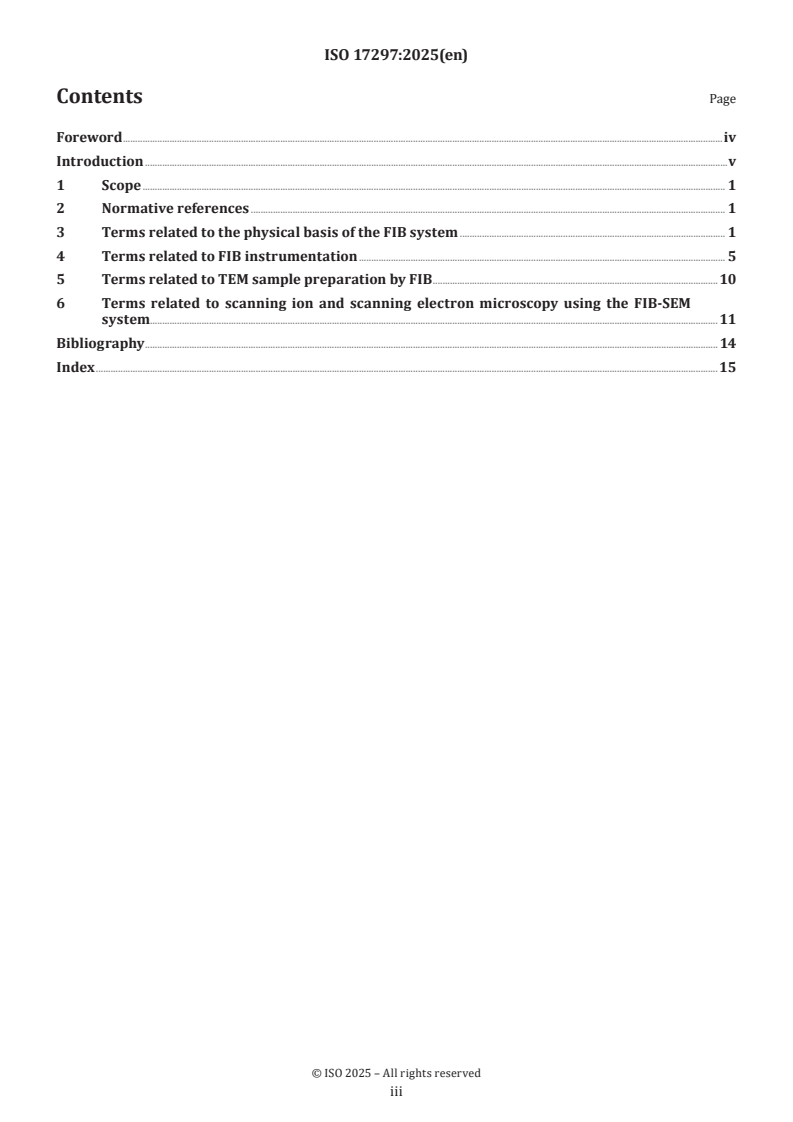
Contents Page
Foreword .iv
Introduction .v
1 Scope . 1
2 Normative references . 1
3 Terms related to the physical basis of the FIB system . 1
4 Terms related to FIB instrumentation . 5
5 Terms related to TEM sample preparation by FIB .10
6 Terms related to scanning ion and scanning electron microscopy using the FIB-SEM
system.11
Bibliography . 14
Index .15
iii
Foreword
ISO (the International Organization for Standardization) is a worldwide federation of national standards
bodies (ISO member bodies). The work of preparing International Standards is normally carried out through
ISO technical committees. Each member body interested in a subject for which a technical committee
has been established has the right to be represented on that committee. International organizations,
governmental and non-governmental, in liaison with ISO, also take part in the work. ISO collaborates closely
with the International Electrotechnical Commission (IEC) on all matters of electrotechnical standardization.
The procedures used to develop this document and those intended for its further maintenance are described
in the ISO/IEC Directives, Part 1. In particular, the different approval criteria needed for the different types
of ISO document should be noted. This document was drafted in accordance with the editorial rules of the
ISO/IEC Directives, Part 2 (see www.iso.org/directives).
ISO draws attention to the possibility that the implementation of this document may involve the use of (a)
patent(s). ISO takes no position concerning the evidence, validity or applicability of any claimed patent
rights in respect thereof. As of the date of publication of this document, ISO had not received notice of (a)
patent(s) which may be required to implement this document. However, implementers are cautioned that
this may not represent the latest information, which may be obtained from the patent database available at
www.iso.org/patents. ISO shall not be held responsible for identifying any or all such patent rights.
Any trade name used in this document is information given for the convenience of users and does not
constitute an endorsement.
For an explanation of the voluntary nature of standards, the meaning of ISO specific terms and expressions
related to conformity assessment, as well as information about ISO's adherence to the World Trade
Organization (WTO) principles in the Technical Barriers to Trade (TBT), see www.iso.org/iso/foreword.html.
This document was prepared by Technical Committee ISO/TC 202, Microbeam analysis, Subcommittee SC
01, Terminology.
Any feedback or questions on this document should be directed to the user’s national standards body. A
complete listing of these bodies can be found at www.iso.org/members.html.
iv
Introduction
Electron microscopy is frequently used to acquire high-resolution images as well as a large amount of sample
information, such as structural and compositional information. Two main types of electron microscopy are
scanning electron microscopy (SEM) and transmission electron microscopy (TEM).
In the case of TEM, transmitted electrons are used for nanoscopic characterization of samples and information
on the inner structure of the sample is obtained, such as the structure, morphology, and compositional
information. Due to the necessity of electron transmission through the sample, TEM specimens must be
prepared as thin as possible, in the range of a few tens of nanometres.
Typical capabilities of focused ion beam (FIB) instruments are the material removal by sputtering, imaging
by ion beam, and the deposition of materials at the nanoscale, which have enabled many FIB applications,
including the preparation of specimens for SEM and TEM. The site-specific and lift-out capabilities of FIB
instruments have not only enhanced failure analysis but also the minimization of the specimen preparation
period for materials science.
The dual-beam FIB-SEM platform allows for 3D analysis and significant improvements in the ability
to prepare thin TEM specimens. A large variety of specimens can now be analysed by TEM, including
semiconductors, metals, glass, polymers, composites, and biological specimens, via the benefits of FIB
advancements. Further FIB applications are expected to be available with additional development and
advancement of FIB instruments, including in-line automatic operation, multiple sample preparations, in-
situ lift-out, new ion sources, and cryogenic techniques, which are still in their infancy.
Due to the numerous instrument parameters and large body of technical knowledge for application, FIB-
based applications are expected to increase and there exists a risk of uncoordinated development of
technologies. Hence, there is a need to standardize certain aspects of the technique at the international level
and establish an international standard serving as a basis for facilitating the use of the FIB technique by
TEM users.
v
International Standard ISO 17297:2025(en)
Microbeam analysis — Focused ion beam application for TEM
specimen preparation — Vocabulary
1 Scope
This document defines the most commonly used terms for transmission electron microscopy (TEM)
specimen preparation using focused ion beam (FIB).
2 Normative references
There are no normative references in this document.
3 Terms related to the physical basis of the FIB system
ISO and IEC maintain terminology databases for use in standardization at the following addresses:
— ISO Online browsing platform: available at https:// www .iso .org/ obp
— IEC Electropedia: available at https:// www .electropedia .org/
3.1
altered layer
surface region of material under ion bombardment where the chemical state or physical structure is
modified by the effects of the ion bombardment
[SOURCE: ISO 18115-1:2023, 9.17]
3.2
amorphization
development of an amorphous phase on the surface of a crystalline specimen by displacement of atoms from their
equilibrium positions, by the impingement of energetic ions generating a collision cascade within the sample
3.3
atomic mixing
migration of sample atoms due to energy transfer with incident ions in the surface region
[SOURCE: ISO 18115-1:2023, 9.9, modified — "incident particles" replaced with "incident ions" in the
definition and Note 1 to entry removed.]
3.4
beam tail
low-intensity edge of an ion beam that typically has a Gaussian intensity distribution
Note 1 to entry: These (rounded) beam tails inhibit the milling of flat cross-section surfaces with sharp edges unless a
protective layer on top of the specimens is used.
3.5
charge neutralization
process in which positive charge accumulation at the surface produced by an ion beam can be reduced or
eliminated by flooding the surface with an electron beam
3.6
charging potential
positive charge accumulation at the surface produced by an ion beam
Note 1 to entry: Charge accumulation can be reduced or eliminated by flooding the surface with an
electron beam.
3.7
chemical species
atom, molecule, ion, or functional group
[SOURCE: ISO 18115-1:2023, 3.5]
3.8
collision
instance of the closest approach governed by interatomic potentials between the incident ion and the target atom
3.9
collision cascade
sequential energy transfer between atoms in a solid as a result of ion bombardment by energetic ions
[SOURCE: ISO 18115-1:2023, 9.4, modified — the word “ion” has been added]
3.10
curtaining effect
waterfall effect
topographic irregularities on cross-section surfaces resembling curtains or waterfalls
Note 1 to entry: It is usually caused either by material inhomogeneities due to different sputtering rates (3.36), or by
rough specimen surfaces with strong topography, or by modulation of current density.
Note 2 to entry: Both can produce facets or vertical striations and/or an irregular cross-section surface.
3.11
diffusion range
projected range
path length for a single ion travel while moving in a sample
Note 1 to entry: Diffusion range (3.11) is inversely related to the sample's stopping power (3.39).
3.12
elastic scattering
interaction between a moving energetic ion and a sample, without energy transfer between ion and
sample atoms
Note 1 to entry: Elastic scattering usually results in the displacement of atoms and ion implantation (3.20) which can
induce amorphization (3.2) and atomic mixing
3.13
field-induced migration
effect occurring in insulators where internal electric fields created by ion bombardment cause the migration
of sample atoms
[SOURCE: ISO 18115-1:2023, 5.18]
3.14
inelastic mean free path
average distance that an ion with a given energy travels through a sample before losing kinetic energy (3.23)
via inelastic scattering (3.15)
[SOURCE: ISO 21466: 2019, 3.32, modified — the word “electron” has been replaced by the “ion”.]
3.15
inelastic scattering
interaction between a moving energetic ion and a sample without conservation of the total kinetic energy
Note 1 to entry: Inelastic scattering (3.15) can result in the production of phonons, plasmons (in metals), and the
emission of secondary electrons and secondary ions
[SOURCE: ISO 18115-1:2023, 4.2, modified — sentence has been simplified.]
3.16
interface
boundary between two bulk phases, with each phase having different chemical, elemental, or physical
properties from the other
3.17
interfacial region
volume between two bulk phases having chemical, elemental, or physical properties different from either
bulk phase
[SOURCE: ISO 18115-1:2023, 5.3]
3.18
ion beam
directed flux of charged atoms or molecules
[SOURCE: ISO 18115-1:2023, 8.8]
3.19
ion beam-induced mass transport
movement of atoms in a sample caused by ion bombardment
[SOURCE: ISO 18115-1:2023, 9.8]
3.20
ion implantation
beam of ions with sufficient kinetic energy (3.23) injected to penetrate the sample
3.21
ion species
types of ions used to form the ion beam (3.18)
+ + + 2+ + + 2+
Note 1 to entry: Typical species are Ga , Xe , Ar , N , He , Ne , O .
3.22
isotopes
atoms with identical numbers of protons but different numbers of neutrons
Note 1 to entry: Ion beam source can emit one isotope or multiple isotopes leading to different interactions with the
specimens.
3.23
kinetic energy
energy of motion
[SOURCE: ISO 18115-1:2023, 3.35]
3.24
knock-in
knock-on
recoil implantation
movement of constituent atoms of the sample deeper into the sample as a result of collisions (3.8) with a
primary ion (3.29)
[SOURCE: ISO 18115-1:2023, 9.12, modified —“particle” changed to “ion”.]
3.25
linear cascade
linear collision cascade
dilute collision cascade (3.9) in which the number of atoms set in motion by an energetic primary ion (3.29) is
proportional to the amount of recoil energy deposited on the sample
[SOURCE: ISO 18115-1:2023, 9.5, modified — “particle” changed to “ion”.]
3.26
mean free path
average distance that an energetic ion travels before its momentum in its initial direction of motion is
reduced to 1/e of its initial value by elastic scattering (3.12)
3.27
noise
uncertainty in the signal intensity
3.28
penetration depth
depth to which an incident ion travels in a sample varies with material
3.29
primary ion
ion extracted from an ion source and directed at a sample
[SOURCE: ISO 18115-1:2023, 20.26 modified — word “ion” has been added.]
3.30
projected range straggling
standard deviation of the projected range
3.31
radiation-enhanced diffusion
ion-induced diffusion
radiation-induced diffusion
atom movement in the solid, well beyond the typical penetration depth (3.28) of an incident ion, due to ion
beam damage (4.30) or bombardment-induced defects
[SOURCE: ISO 18115-1:2023, 4.47, modified — word “ion” has been added. ]
3.32
spreading range
distance between the original position and the projection of range on the surface
3.33
segregation
partitioning of homogeneously distributed atoms or molecules from one region that become inhomogeneously
distributed ones to particular locations or other regions, resulting in localised changes in the concentration
of one or more species
3.34
sputtering
phenomenon in which the surface composition of a multicomponent sample changes during sputtering
(3.34), resulting in a non-equilibrium surface composition due to the preferential removal of one or more of
the components
3.35
preferential sputtering
change in the equilibrium surface composition and crystal orientation of the sample which can occur when
sputtering multicomponent samples
[SOURCE: ISO 18115-1:2023, 9.26, modified — phrase “and crystal orientation” added.]
3.36
sputtering rate
quotient of the amount of volume being sputtered from a sample, because of ion bombardment, by unit time
[SOURCE: ISO 18115-1:2023, 9.19]
3.37
sputtering yield
ratio of the average number of atoms and ions sputtered from a sample to the total number of incident
primary ions (3.29)
[SOURCE: ISO 18115-1:2023, 20.4, modified — “primary particle” replaced by “primary ion”.]
3.38
differential sputtering yield
ratio of the number of atoms and ions of a particular species sputtered from a sample to the total number of
atoms and ions sputtered from the sample
3.39
stopping power
rate of energy loss of an ion with distance along its trajectory in a sample
[SOURCE: ISO 18115-1:2023, 4.17, modified — “particle” replaced by “ion”.]
3.40
surface
interface between a condensed phase and a gas, vapor, or free space
[SOURCE: ISO 18115-1:2023, 3.2]
3.41
surface binding energy
bonding strength of surface atoms
3.42
surface segregation
partitioning of a species from the bulk of a material to the surface (3.40) because of kinetic or
thermodynamic effects
[SOURCE: ISO 18115-1:2023, 5.5]
4 Terms related to FIB instrumentation
4.1
absorbed current
portion of the probe current that is absorbed in the specimen
4.2
angle of emission
take-off angle
angle between the trajectory of an ion as it leaves a surface (3.40) and the local or average surface normal
[SOURCE: ISO 18115-1:2023, 8.5, modified — “paricle” replaced by “ion”.]
4.3
angle of incidence
incident angle
ion beam angle made with the surface from which the TEM specimen is to be extracted
Note 1 to entry: The angle of incidence can range between a glancing angle or near 0° incidence with the TEM specimen
to normal (90°) with the specimen surface.
Note 2 to entry: The surface (3.40) is rarely milled from top-down but milled at high incident angles.
4.4
scattering angle
angle between the direction of the incident ion and the direction that the ion is traveling after scattering
[SOURCE: ISO 18115-1:2023, 8.4, modified — “paricle” replaced by “ion”.]
4.5
backscattering energy
energy of a particle from the primary ion beam (4.11) after it has undergone a backscattering collision and
escaped from the sample
[SOURCE: ISO 18115-1:2023, 4.4, modified – word “ion” added.]
4.6
beam current
probe current
value of the electric current flow in the ion beam (3.18) that bombards the sample or the number of ions that
are delivered per unit of time
4.7
beam diameter
full width of the ion beam (3.18) at half maximum intensity where the intensity falls to 1/e of the maximum
intensity measured in a plane normal to the beam direction
[SOURCE: ISO 18115-1:2023, 8.30, modified — “particle” replaced by “ion”.]
4.8
beam divergence angle
angular interval containing 1/e of the ion beam (3.18) in the space after the focal plane
4.9
ion beam energy
kinetic energy (3.23) of the accelerated ions in the beam
4.10
ion beam flux density
time rate of flow of
...