

ISO 25556:2025
(Main)Ageing societies — General requirements and guidelines for ageing-inclusive digital economy
General Information
- Abstract
This document provides general requirements and guidelines for an ageing-inclusive digital economy, aiming to enhance its applicability and credibility. It specifies the principles, aspects, scenarios, and actions for establishing or transforming to an ageing-inclusive digital economy. This document is applicable to consumers, policymakers, administrations, organizations, and other stakeholders in the digital economy. The requirements and guidelines in this document focus specifically on older persons. This document does not cover information technology, ergonomics, and related requirements and guidelines which are defined or covered by other standards.
- Status
- Published
- Publication Date
- 04-May-2025
- Technical Committee
- ISO/TC 314 - Ageing societies
- Drafting Committee
- ISO/TC 314 - Ageing societies
- Current Stage
- 6060 - International Standard published
- Start Date
- 05-May-2025
- Due Date
- 14-Jan-2026
- Completion Date
- 05-May-2025

Overview
ISO 25556:2025 - Ageing societies - General requirements and guidelines for ageing-inclusive digital economy - is an international standard that sets out high-level principles, aspects, scenarios and actions for creating a digital economy that is inclusive of older persons. Published by ISO/TC 314 in 2025, the standard targets digital inclusion across public and private sectors and aims to enhance the applicability and credibility of ageing‑inclusive digital policies, products and services. It is applicable to consumers, policymakers, administrations, organizations and other stakeholders in the digital economy.
Key topics and technical scope
ISO 25556:2025 structures its guidance around two main parts: principles and aspects. Key technical topics include:
Principles for an ageing‑inclusive digital economy
- Combatting ageism (requirements and recommendations)
- Accessibility (requirements and recommendations)
- Usability (requirements and recommendations)
- Availability (requirements and recommendations)
- Affordability (requirements and recommendations)
- Security and Privacy (each with requirements and recommendations)
Aspects of implementation
- Digital infrastructure (coverage, resilience, inclusion)
- Intelligent products (age‑aware product considerations)
- Digital services (service design and delivery)
- Digital environment (safe, ethical online spaces)
- Digital literacy (training, support and empowerment)
The standard contains normative sections (terms, scope) plus informative annexes with scenarios and actions to guide implementation. It explicitly focuses on older persons and does not re‑cover detailed information technology, ergonomics or other domain‑specific requirements handled by other standards.
Practical applications - who uses ISO 25556
ISO 25556 is intended for organizations and stakeholders who design, deliver or regulate digital products and services, including:
- Government agencies and public administrations drafting inclusive digital policies
- Service designers and product managers building age‑friendly digital services and intelligent products
- Health and social care providers deploying digital solutions for older adults
- NGOs, community groups and digital inclusion programs developing literacy and outreach
- Businesses seeking to improve accessibility, usability, affordability and trust for older customers
Practically, the standard helps prioritize anti‑ageism measures, accessibility engineering, user‑centred design for older adults, affordable access models, privacy/security safeguards, and digital literacy strategies.
Related standards
ISO 25556 complements other ISO/IEC standards and technical guidance that address specific information technology, ergonomics, assistive technologies and implementation details. Organizations should apply ISO 25556’s high‑level requirements alongside relevant technical standards for IT, human factors and accessibility to achieve a fully ageing‑inclusive digital economy.
Keywords: ISO 25556, ageing‑inclusive digital economy, digital inclusion, age‑friendly design, accessibility, digital literacy, older persons.
Get Certified
Connect with accredited certification bodies for this standard

BSI Group
BSI (British Standards Institution) is the business standards company that helps organizations make excellence a habit.

Great Wall Tianjin Quality Assurance Center
Established 1993, first batch to receive national accreditation with IAF recognition.
Hong Kong Quality Assurance Agency (HKQAA)
Hong Kong's leading certification body.
Sponsored listings
Frequently Asked Questions
ISO 25556:2025 is a standard published by the International Organization for Standardization (ISO). Its full title is "Ageing societies — General requirements and guidelines for ageing-inclusive digital economy". This standard covers: This document provides general requirements and guidelines for an ageing-inclusive digital economy, aiming to enhance its applicability and credibility. It specifies the principles, aspects, scenarios, and actions for establishing or transforming to an ageing-inclusive digital economy. This document is applicable to consumers, policymakers, administrations, organizations, and other stakeholders in the digital economy. The requirements and guidelines in this document focus specifically on older persons. This document does not cover information technology, ergonomics, and related requirements and guidelines which are defined or covered by other standards.
This document provides general requirements and guidelines for an ageing-inclusive digital economy, aiming to enhance its applicability and credibility. It specifies the principles, aspects, scenarios, and actions for establishing or transforming to an ageing-inclusive digital economy. This document is applicable to consumers, policymakers, administrations, organizations, and other stakeholders in the digital economy. The requirements and guidelines in this document focus specifically on older persons. This document does not cover information technology, ergonomics, and related requirements and guidelines which are defined or covered by other standards.
ISO 25556:2025 is classified under the following ICS (International Classification for Standards) categories: 03.020 - Sociology. Demography; 03.080.01 - Services in general; 35.020 - Information technology (IT) in general. The ICS classification helps identify the subject area and facilitates finding related standards.
ISO 25556:2025 is available in PDF format for immediate download after purchase. The document can be added to your cart and obtained through the secure checkout process. Digital delivery ensures instant access to the complete standard document.
Standards Content (Sample)
International
Standard
ISO 25556
First edition
Ageing societies — General
2025-05
requirements and guidelines for
ageing-inclusive digital economy
Vieillissement de la population — Exigences générales et lignes
directrices pour une économie numérique inclusive en matière de
vieillissement
Reference number
© ISO 2025
All rights reserved. Unless otherwise specified, or required in the context of its implementation, no part of this publication may
be reproduced or utilized otherwise in any form or by any means, electronic or mechanical, including photocopying, or posting on
the internet or an intranet, without prior written permission. Permission can be requested from either ISO at the address below
or ISO’s member body in the country of the requester.
ISO copyright office
CP 401 • Ch. de Blandonnet 8
CH-1214 Vernier, Geneva
Phone: +41 22 749 01 11
Email: copyright@iso.org
Website: www.iso.org
Published in Switzerland
ii
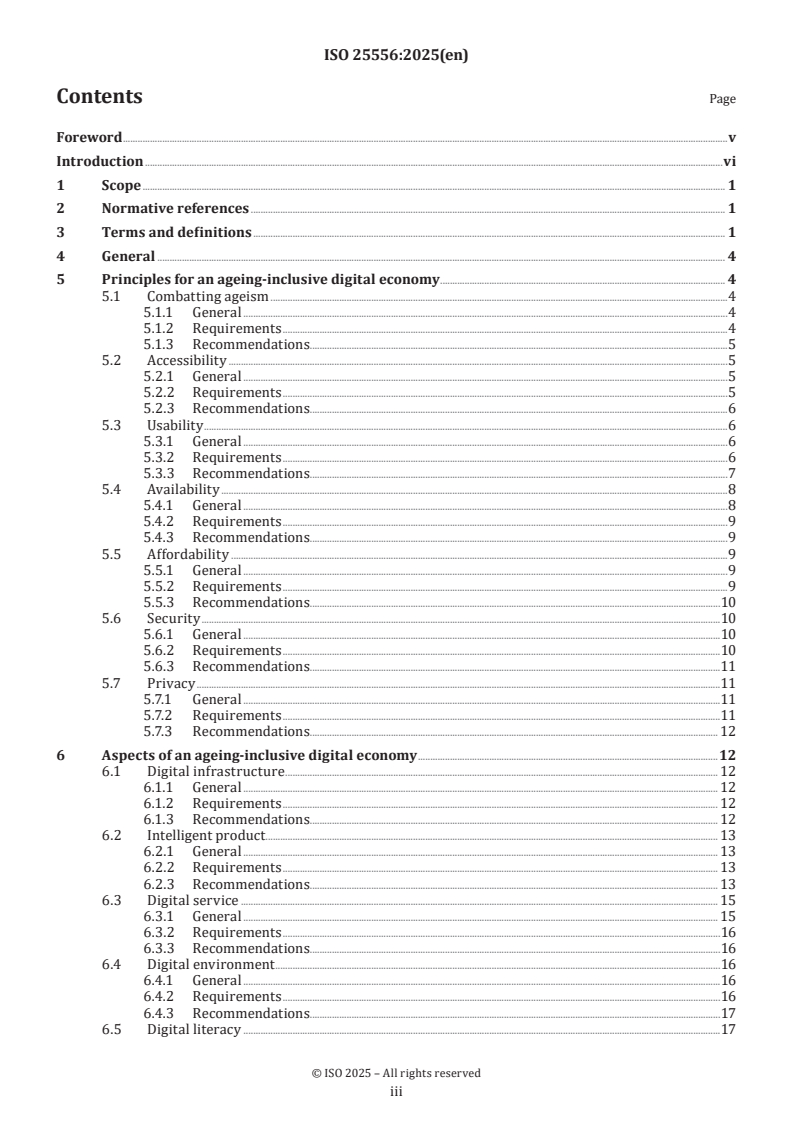
Contents Page
Foreword .v
Introduction .vi
1 Scope . 1
2 Normative references . 1
3 Terms and definitions . 1
4 General . 4
5 Principles for an ageing-inclusive digital economy . 4
5.1 Combatting ageism .4
5.1.1 General .4
5.1.2 Requirements .4
5.1.3 Recommendations.5
5.2 Accessibility .5
5.2.1 General .5
5.2.2 Requirements .5
5.2.3 Recommendations.6
5.3 Usability .6
5.3.1 General .6
5.3.2 Requirements .6
5.3.3 Recommendations.7
5.4 Availability .8
5.4.1 General .8
5.4.2 Requirements .9
5.4.3 Recommendations.9
5.5 Affordability .9
5.5.1 General .9
5.5.2 Requirements .9
5.5.3 Recommendations.10
5.6 Security .10
5.6.1 General .10
5.6.2 Requirements .10
5.6.3 Recommendations.11
5.7 Privacy .11
5.7.1 General .11
5.7.2 Requirements .11
5.7.3 Recommendations. 12
6 Aspects of an ageing-inclusive digital economy .12
6.1 Digital infrastructure . 12
6.1.1 General . 12
6.1.2 Requirements . 12
6.1.3 Recommendations. 12
6.2 Intelligent product . . 13
6.2.1 General . 13
6.2.2 Requirements . 13
6.2.3 Recommendations. 13
6.3 Digital service . 15
6.3.1 General . 15
6.3.2 Requirements .16
6.3.3 Recommendations.16
6.4 Digital environment .16
6.4.1 General .16
6.4.2 Requirements .16
6.4.3 Recommendations.17
6.5 Digital literacy .17
iii
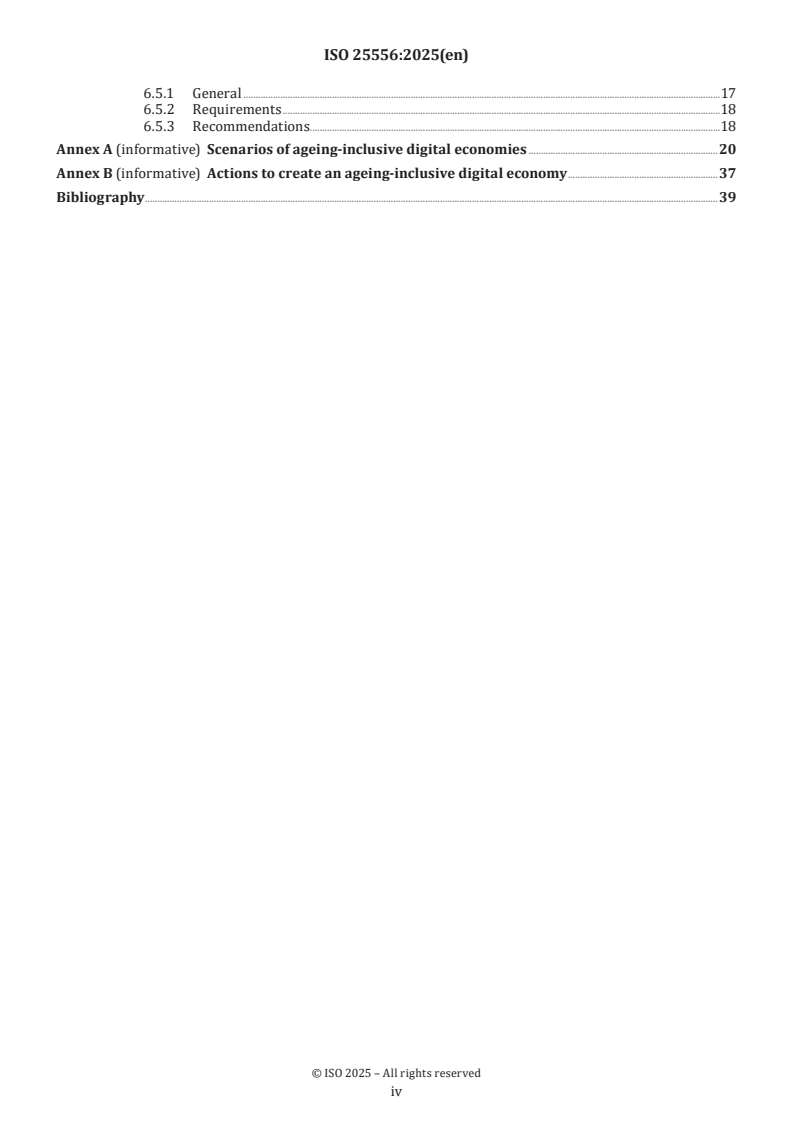
6.5.1 General .17
6.5.2 Requirements .18
6.5.3 Recommendations.18
Annex A (informative) Scenarios of ageing-inclusive digital economies .20
Annex B (informative) Actions to create an ageing-inclusive digital economy .37
Bibliography .39
iv
Foreword
ISO (the International Organization for Standardization) is a worldwide federation of national standards
bodies (ISO member bodies). The work of preparing International Standards is normally carried out through
ISO technical committees. Each member body interested in a subject for which a technical committee
has been established has the right to be represented on that committee. International organizations,
governmental and non-governmental, in liaison with ISO, also take part in the work. ISO collaborates closely
with the International Electrotechnical Commission (IEC) on all matters of electrotechnical standardization.
The procedures used to develop this document and those intended for its further maintenance are described
in the ISO/IEC Directives, Part 1. In particular, the different approval criteria needed for the different types
of ISO documents should be noted. This document was drafted in accordance with the editorial rules of the
ISO/IEC Directives, Part 2 (see www.iso.org/directives).
ISO draws attention to the possibility that the implementation of this document may involve the use of (a)
patent(s). ISO takes no position concerning the evidence, validity or applicability of any claimed patent
rights in respect thereof. As of the date of publication of this document, ISO had not received notice of (a)
patent(s) which may be required to implement this document. However, implementers are cautioned that
this may not represent the latest information, which may be obtained from the patent database available at
www.iso.org/patents. ISO shall not be held responsible for identifying any or all such patent rights.
Any trade name used in this document is information given for the convenience of users and does not
constitute an endorsement.
For an explanation of the voluntary nature of standards, the meaning of ISO specific terms and expressions
related to conformity assessment, as well as information about ISO’s adherence to the World Trade
Organization (WTO) principles in the Technical Barriers to Trade (TBT), see www.iso.org/iso/foreword.html.
This document was prepared by Technical Committee ISO/TC 314, Ageing societies.
Any feedback or questions on this document should be directed to the user’s national standards body. A
complete listing of these bodies can be found at www.iso.org/members.html.
v
Introduction
0.1 General
The fourth industrial revolution, characterized by rapid digital innovation and exponential growth, has
transformed all sectors of society, including how we live, work, and relate to one another. Digital technology
can assist in learning new skills, facilitate social interactions, foster independent and autonomous ways of
living, and improve the management and delivery of public health, social care and other services. However,
this does not mean that everyone and everything is connected or digitised. Nor does it mean that the social
and economic consequences of digital technology are necessarily inclusive or beneficial. Digital technology
can both create opportunities and increase inequalities. In fact, not everyone can benefit equally from digital
technology. The COVID-19 pandemic has highlighted unequal access to digital technology across and within
ageing societies.
Products and services are increasingly provided online. In ageing societies, some people are more likely to be
digitally excluded and to experience barriers to accessing products and services online. The reasons vary, for
example, people lack access to technology, or they are unable to use and fully benefit from the opportunities
provided by technology. Digital inclusion can create opportunities for active and healthy ageing, including
social and economic participation. Improving digital access and digital literacy can empower people. It is
essential to ensure aging-inclusive design and to ensure the relevance of digital services and products. It is
important to create ethical, safe digital environments free from ageism that embrace the diversity of older
individuals.
Digital economy refers to economic and social activity reliant on, or significantly enhanced by, the use of
[42]
digital inputs .Establishing ageing-inclusive digital economies (and related standardization) is not only
significant but urgent. This document seeks to respond to the context and demands of rapidly evolving
digital economies, by providing general requirements and guidelines for ageing-inclusive digital economies
from the perspective of the needs of ageing societies, and by addressing common problems of an ageing-
inclusive digital economy.
0.2 Opportunities of digitalisation in ageing societies
Digital technology can provide new opportunities and solutions for people living in ageing societies, such as:
— maintaining social connectedness, including connectedness to family members living apart;
— accessing digital communities for the latest updates and information;
— working online by using the internet and mobile devices;
— seeking employment using digital tools;
— participating in online learning;
— accessing digital services, e.g. online shopping, and smart transportation systems;
— accessing medical and health care online, as well as electronic personal health records, e.g. online
diagnosis and treatment;
— using digital safety tools and measures, e.g. using smart devices to make an emergency call.
0.3 How can digital technologies support ageing societies?
Digital technology can support ageing societies in multiple ways, for example with regard to the following
aspects.
— Visual capabilities − It can be increasingly challenging for older persons and other people to read texts
written in small fonts. Therefore, text that can easily be enlarged or compatible with the use of screen
magnifiers and screen readers, or both, can be essential.
vi
— Hearing capabilities − Accessible content includes options for communicating with people with hearing
difficulties, such as the availability of chats or messaging as an alternative to voice services. Accessible
content is also compatible with hearing aid devices, for example, accessible smart TVs.
— Motor ability − To accommodate people with decreased motor skills, accessible information and
communication technology (ICT) can be designed to interact seamlessly without requiring precise motor
control. It can also support assistive technologies for optimal usability. For example, large clickable areas
that include labels, especially for smaller controls, such as radio buttons and checkboxes are important
accessibility features for people with limited dexterity.
— Cognitive capabilities − Some people can find it increasingly difficult to find specific information or
recognize and access hyperlinks. It is important to consider these issues of usable and accessible designs.
Making content easy to read and adding helpful features such as reminders can facilitate access.
— Communicating with the people responsible for websites or mobile apps is sometimes challenging.
Accessible and easy customer support channels are important in order to help all customers.
— Social connection and isolation − Social connection can be increased through various ICT-related
activities such as digital training and education, online peer-to-peer learning, and by providing support
for sharing information.
— Vitality − People can experience a loss of vitality. E-health, telehealth and health apps can encourage
healthy behaviour, monitor health and wellbeing.
Everybody ages differently, and people become more diverse as they age, for example in their independence,
need for assistance, level of activity.
NOTE See Reference [46] for more information on ageing-inclusive digital economy.
vii
International Standard ISO 25556:2025(en)
Ageing societies — General requirements and guidelines for
ageing-inclusive digital economy
1 Scope
This document provides general requirements and guidelines for an ageing-inclusive digital economy,
aiming to enhance its applicability and credibility. It specifies the principles, aspects, scenarios, and actions
for establishing or transforming to an ageing-inclusive digital economy.
This document is applicable to consumers, policymakers, administrations, organizations, and other
stakeholders in the digital economy.
The requirements and guidelines in this document focus specifically on older persons.
This document does not cover information technology, ergonomics, and related requirements and guidelines
which are defined or covered by other standards.
2 Normative references
There are no normative references in this document.
3 Terms and definitions
For the purposes of this document, the following terms and definitions apply.
ISO and IEC maintain terminology databases for use in standardization at the following addresses:
— ISO Online browsing platform: available at https:// www .iso .org/ obp
— IEC Electropedia: available at https:// www .electropedia .org/
3.1
ageing
natural progression of an individual’s characteristics over time
Note 1 to entry: The impact of ageing will vary at different ages.
Note 2 to entry: The concept of ageing is very broad and comprehensive, and may include chronological ageing, biological
ageing, psychological (psychosocial) ageing, cognitive ageing, functional ageing, social ageing, organizational age, and
career age. See ISO 25550 for more information.
[SOURCE: ISO/IEC TR 22116:2021, 3.2, modified — Note 2 to entry was added.]
3.2
ageing society
demographics of an older population that shifts overtime
[SOURCE: ISO 25550:2022, 3.1]
3.3
diversity
characteristics of differences and similarities between people
Note 1 to entry: Diversity includes factors that influence the identities and perspectives that people bring when
interacting in digital economy.
[SOURCE: ISO 25550:2022, 3.10, modified — In Note 1 to entry, “at work” was changed to “in digital
economy”; Note 2 to entry was deleted.]
3.4
inclusion
inclusiveness
process of including all stakeholders
Note 1 to entry: This involves stakeholders from different groups being accepted, welcomed, and enabled to have a
voice and to develop a sense of belonging.
[SOURCE: ISO 25550:2022, 3.11, modified — “inclusiveness” was added as admitted term; “in organizational
contexts” was deleted from the definition; original Notes 1 and 2 to entry were deleted.]
3.5
ageing-inclusive
including all stakeholders in ageing (3.1) contexts where people of diverse ages are treated fairly and equally
and included in all aspects of those contexts
[SOURCE: ISO 25550:2022, 3.15, modified — the term was changed from “age-inclusive” to “ageing-inclusive”;
“organization contexts” was changed to “ageing contexts”; “all aspects of the organization” was changed to
“all aspects of those contexts”.]
3.6
digital economy
economic and social activities reliant on, or significantly enhanced by, the use of digital inputs
Note 1 to entry: Digital economy includes digital technologies, digital infrastructure (3.8), digital services and data.
Note 2 to entry: Digital economy refers to all producers and consumers, including governments, utilizing these digital
inputs in their economic activities.
Note 3 to entry: Adapted from Reference [42].
3.7
ageing-inclusive digital economy
digital economy (3.6) which is fair and equal to all stakeholders including people across all age groups in
ageing (3.1) contexts
3.8
digital infrastructure
infrastructure driven by data and technology, based on the communication network, and centred on data
computing facilities
3.9
user
customer
individual who utilizes infrastructures, products, services, environments, and any other components of an
ageing-inclusive digital economy (3.7)
3.10
policymaker
government department, legislature, or other organization (3.12) that is responsible for making rules, laws,
regulations, etc. for ageing-inclusive digital economy (3.7) and related issues
3.11
administration
government, agent, or other organization (3.12) who is authorized to supervise ageing-inclusive digital
economy (3.7) and related issues
3.12
organization
public or private entity or partnership with the responsibility for the operation of ageing-inclusivedigital
economy (3.7) or part of it
EXAMPLE Relevant digital infrastructure (3.8) owner, intelligent product manufacturer, digital service provider,
digital platform operator, digital environment operator, and employer adopting digital work approach.
3.13
social media
online technologies and practices that people use to share opinions, insights, experiences and perspectives
with each other, transforming traditional one-to-many interactions into many-to-many interactions
[SOURCE: ISO 690:2021, 3.43]
3.14
ageism
stereotyping, prejudice, and discrimination against people on the basis of their age
Note 1 to entry: Ageism takes many forms, including prejudicial attitudes, discriminatory practices, or institutional
policies and practices that perpetuate stereotypical beliefs.
[SOURCE: ISO 25550:2022, 3.17]
3.15
accessibility
extent to which products, systems, services, environments and facilities can be used by users (3.9) with
the widest range of user needs, characteristics and capabilities to achieve identified goals in identified
contexts of use
[SOURCE: ISO 25550:2022, 3.2, modified — “people from a population” was changed to “users”.]
3.16
usability
extent to which an infrastructure, system, product or service can be used by specified users (3.9) to achieve
specified goals with effectiveness, efficiency, convenience, safety, and satisfaction in a specified context of use
[SOURCE: ISO 19869:2019, 3.2.8, modified — “infrastructure” and “convenience, safety” were added to the
definition.]
3.17
availability
degree to which a facility or service is available to users (3.9) when needed
[SOURCE: ISO/IEC TS 25011:2017, 3.2.4.3, modified — “an IT service” was changed to “a facility or service”.]
3.18
affordability
ability to be economically bearable for the target users (3.9)
[SOURCE: ISO 24513:2019, 3.3.19, modified — “target” was added before “users”; Note 1 to entry was
deleted.]
3.19
security
combination of availability (3.17), confidentiality, integrity, and accountability
[SOURCE: ISO 17090-1:2021, 3.2.24]
3.20
privacy
right of an entity (normally an individual or an organization), acting on its own behalf, to determine the
degree to which the confidentiality of their private information is maintained
[SOURCE: ISO/IEC 24775-2:2021, 3.1.46]
3.21
assistive technology
equipment, product system, hardware, software or service that is used to increase, maintain or improve
capabilities and safety of individuals
Note 1 to entry: Assistive technology can include assistive services and professional services needed for assessment,
recommendation, and provision.
[SOURCE: ISO 25552:2022, 3.28]
4 General
This document addresses the needs of older persons, with the goal of ensuring that older persons are active
and valuable contributors in the digital economy. However, the requirements and guidelines in this document
are also useful for including as many consumers as possible and emphasizing the principle of design for all.
Annex A provides information and recommendations on different scenarios of the ageing-inclusive
digital economies, such as online shopping, banking products or services (BPoS), digital hospitals, digital
entertainment, social media, transportation, smart communities, smart homes, working from home and in
the workplace, and online learning.
Annex B provides information and recommendations on the actions needed to create an ageing-inclusive
digital economy.
5 Principles for an ageing-inclusive digital economy
5.1 Combatting ageism
5.1.1 General
Ageism refers to stereotypes, prejudice, and discrimination against people on the basis of their age.
Ageism is often replicated in the digital economy, just as other implicit and explicit biases of society, and this
can partly cause a digital divide between younger and older persons. The prevailing stereotype that older
persons cannot master technologies is already internalized by some older persons themselves (an example
of self-directed ageism), who sometimes do not even try to adopt new technologies, even when they are both
available (see 5.4) and affordable (see 5.5).
Challenging ageism is critical to ensure well-being and the respect of human rights. Governments,
organizations, and individuals can help to eliminate ageism in the digital economy.
5.1.2 Requirements
The organization shall:
a) address ageism to ensure that the digital economy is designed, developed, tested, implemented and
evaluated equitably and responsibly;
b) take measures to:
1) mitigate the risk of ageism;
2) enhance digital economy inclusion and benefits for older persons.
EXAMPLE 1 Involving older persons directly in the design, development, implementation and evaluation
of the digital economy.
EXAMPLE 2 Enhancing the inter-generational communication in the design, development, implementation
and evaluation of the digital economy.
NOTE See Reference [47] for more information.
5.1.3 Recommendations
The organization should:
a) design, develop, test, implement, and evaluate the ageing-inclusive digital economy by, with, and for
older persons;
b) train the multiple-generation workforce, irrespective of age, in both recognizing and avoiding ageism
when approaching their tasks, and in their perception or recognition of ageing;
NOTE See Reference [47] for more information.
c) overcome and decrease forms of ageism and stereotype by capturing and respecting the heterogeneity
of older persons and offering them more activities, products, and opportunities for self-fulfilment
rather than only for health care and chronic disease management, e.g. entertainment, leisure, learning,
productivity (work or other income-generating opportunities), sharing their knowledge and skills with
younger generations, service to the community;
d) offer equal opportunities to older persons for participating in digital economy activities, to avoid the
ageist cycles of injustice both in inputs and outputs, including, but not limited to:
1) offer options such as “retired” in forms which require disclosing occupational information;
2) offer free options of avatars, portraits, and virtual images with some symbols of some older persons,
e.g. silver hair;
3) conduct online recruitment by using algorithms without age bias.
5.2 Accessibility
5.2.1 General
The goal of accessibility for an ageing-inclusive digital economy is to help ensure that people with progressive
functional decline, disabilities and impairments related to age can perceive, understand, navigate and
interact with intelligent products, digital services, digital platforms and digital environments by assistive
technology.
5.2.2 Requirements
The organization shall:
a) present information that uses plain and non-discriminatory language;
NOTE 1 See ISO 24495-1 for more information about plain language.
b) design and present the structure and hierarchy of websites, apps, electronic documents and other digital
assets, e.g. navigation features and user interfaces, to conform with standards such as the Web Content
[38]
Accessibility Guidelines (WCAG), ensuring accessibility for users with progressive functional decline,
disabilities and impairments related to age;
c) ensure the intelligent product, digital service, digital platform and digital environment are compatible
with user tools, including assistive technologies used by target users.
5.2.3 Recommendations
The organization should:
a) present information that is:
1) accessible via multiple channels, e.g. tablets, smartphones, computers;
2) accessible to all user types regardless of sensory abilities or restrictions, i.e. users can receive it
through any of their senses;
3) supportive of multiple language users;
b) provide users with easy-to-understand captions and descriptions for audio and video content
respectively;
c) offer users an easy-to-use element that increases text size without loss of content or functionality;
d) provide ample time for users to read and understand content;
e) pause, stop, or hide the content that automatically moves, blinks, or scrolls;
f) not use colour as the only way to convey information;
g) provide legible labels when content requires input from users;
h) avoid either the interference or conflict, or both, with assistive technology and devices;
EXAMPLE 1 A pacemaker can be influenced by a strong magnetic field or current.
EXAMPLE 2 Hearing aids can increase environmental noise and generate new electromagnetic noise when
working in a digital environment.
i) use well-formed elements with matching start and end tags, which are nested correctly, in accordance
with the specific guidelines or specifications that apply to them.
5.3 Usability
5.3.1 General
Usability refers to several aspects of people engagement with and interaction within the digital economy
that includes ageing populations. Usability encompasses the quality of the experience, the efficiency of task
completion and the satisfaction derived from accomplishing those tasks.
Many functions can decline as people age, e.g. eyesight, hearing, speech, memory, balance, manual dexterity
and skin sensitivity. Also, some older persons can need much more time to encode, retrieve and process
information, and to make decisions.
Usability and accessibility (see 5.2) are two slightly different perspectives within an ageing-inclusive digital
economy. Accessibility aims to ensure that people can complete tasks using technology, while usability
strives to deliver high-quality, effective and satisfying experiences for all users. Ideally, these two concepts
can converge to create solutions that provide equal access for all to digital products and services.
5.3.2 Requirements
The organization shall take the changing needs of ageing into account in the usability by design. In addition
to accessibility, this includes, but is not limited to:
a) keeping the interface, layout, and navigation stable;
b) reducing the update frequency of apps, websites, software and other digital resources;
c) limiting the displayed information to necessary content;
d) avoiding overly distracting advertisements;
e) simplifying the operation and reducing cognitive load;
f) providing multi-sensory navigation.
5.3.3 Recommendations
The organization should:
a) create a variety of topics and content for a broad range of interests, preferences, expectations and needs
of users, which are not limited by stereotypes of ageing;
b) arrange content by topic, not by age or demographic characteristics;
c) provide content and information in a direct and objective style avoiding any misleading or
sensationalized styles;
d) deliver the content and information in manageable, easy-to-scan and easy-to-understand segments,
using plain language and short sentences;
NOTE 1 Messages that have too much text, confusing words, programming language or daunting designs can
make some people anxious.
e) use a suitable and legible font size for different situations;
NOTE 2 See ISO 24509 for more information about the legible font size for people at different ages.
f) promote recognition over recall in design whenever possible;
NOTE 3 According to psychologists, “recognition” is an easier task than “recall”, because “recall” is a more
demanding process for human memory.
NOTE 4 Memory impairment can worsen with ageing. In several instances, people can forget where they had
previously navigated to or what they had previously clicked on, and thus revisit those areas and pages again.
g) offer choices to users in an easy-to-understand manner;
h) place the important information and prioritize commonly used features at the easy-to-find places,
making navigation easier for the maximum number of potential users;
EXAMPLE 1 The top of the website.
i) limit the design of pull-down menus and scrolling lists;
NOTE 5 Some users have difficulty managing both pull-down menus (which require users to hold them open
to click a list item) and scrolling menu lists, since they possibly can’t control their hands, fingers and wrist
movements enough to use these user interface (UI) elements.
NOTE 6 For some users, some scrolling menus go by too quickly, and some UI elements require challenging
dexterity when swiping up and down to select the correct items.
NOTE 7 The illusion of completeness occurs when the content visible on the screen appears to be complete
even though there is more information available below the viewable area. Users can assume that there is nothing
more to see and are less likely to scroll down.
j) avoid actions requiring double clicks;
k) use more white space between text, foreground and background to maximize the legibility, e.g.
character, line and paragraph spacing and other white spaces;
l) offer the choice of a colour scheme, other than black and white;
m) avoid yellow, blue and green tones;
n) avoid rapid changes in brightness between screens;
o) differentiate between interactive elements and static elements visually;
NOTE 8 Some people can be confused about the static elements with interactive visual signifiers, and they can
find it difficult to distinguish them from interactive elements.
p) use large targets, and clear and visible confirmation for target capture on the user interface;
q) create adequate spacing around the interactive targets, to avoid clicking or tapping the wrong one
accidentally;
NOTE 9 Large click targets are essential for all users, because not everyone has the ability or time to precisely
hit small targets.
r) avoid image-only links;
s) use image and graphics which:
1) are high quality, clear, and large enough to be legible and discernible;
2) contain informative content, emotional content or other added value, which helps to convey
information, explain concepts or showcase details;
EXAMPLE 2 The appearance, functionality, application scenarios, and usage methods of a product.
3) are relevant;
4) avoid distractions by not only being decorative;
5) can be accompanied by text to enhance comprehension, yet text should not fully substitute for them;
t) provide understandable terms and conditions, and increase user understanding;
1)
NOTE 10 See ISO 21800 for more information.
u) provide easy-to-find telephone contact information in a prominent location, in addition to online chat
support;
NOTE 11 Some users often prefer picking up the phone over finding the information on the interface.
v) enable the downloading of any information from the webpage into PDF (portable document format)
format for printing, a vital function for people who encounter difficulties with reading or web navigation,
specifically those affected by dementia.
5.4 Availability
5.4.1 General
Availability is often used to describe the time when a facility or service is available in the digital economy,
as well as the time required by a digital platform or system to respond to a request made by a user. High
availability is the quality of a system or component that assures a high level of operational performance for
a given time.
Some older persons who participate in the digital economy are more likely to blame themselves than younger
groups when failures happen. In particular, it can be difficult for them to figure out whether the failures are
due to their own operating mistake or to a system or network failure. Therefore, limited availability can
further entrench the digital divide, which easily becomes the reason why some older persons mistrust and
choose to not participate in the digital economy.
1) Under preparation. Stage at the time of publication: ISO/DIS 21800.
5.4.2 Requirements
The policymaker or the administration, or both, shall provide the communities and residences, especially
those in remote areas or with few people, with:
a) resources or services to facilitate internet access with good speed and bandwidth for the average user;
b) trusted and stable digital infrastructure providing internet access, accessory devices, guidance and
support.
EXAMPLE Community service centre, cybercafé, public library.
5.4.3 Recommendations
The policymaker or the administration, or both, should:
a) encourage the public institutions, e.g. local public libraries, and community groups to lend their Wi-Fi
hotspot and increase Wi-Fi signals, so people can have no-cost broadband access when they need it;
b) motivate the organization to design and equip the intelligent products, digital services and digital
platforms with appropriate tools alternative to the internet, e.g. telephone, which can work with low
or intermittent internet connectivity and less digital skills, thereby facilitating the access to the digital
economy;
c) provide relevant customer contact services with human staff, by telephone or other habitual contact
methods, using easy-to-understand terms, descriptions and explanations, at a convenient time.
5.5 Affordability
5.5.1 General
Affordability has long been a foundational principle in communications policy, and it is key to bridging the
digital divide. No matter how fast the connection is, how much data is available, how smart the device is, or
how relevant the digital content is, people will only have meaningful connectivity if they can afford it.
The affordability of an ageing-inclusive digital economy means that the target users, including older persons,
can bear the expenses, e.g. the cost of internet access and storage, laptops, mobile devices and digital
services. Barriers to affordable infrastructure, internet service, computers and digital skill training prevent
access to resources, services and opportunities, deepening social and economic gaps.
Strict budgeting, lack of digital skills, and low trust in free or discount internet offers or in digital skills
training are actual barriers for some older persons to be involved in the digital economy.
What counts as affordable can be unstable over time. The unenthusiastic attitudes about the necessity
...