

ISO/TTA 5:2007
(Main)Code of practice for creep/fatigue testing of cracked components
- Abstract
ISO/TTA 5:2007 recommends and establishes standardized techniques for measuring and analysing Creep Crack Initiation (CCI), Creep Crack Growth (CCG), and Creep Fatigue Crack Growth (CFCG) characteristics, using a wide range of pre-cracked standard and non-standard "feature" geometries.
- Status
- Published
- Publication Date
- 08-Oct-2007
- Technical Committee
- ISO/TC 164/SC 1 - Uniaxial testing
- Drafting Committee
- ISO/TC 164/SC 1 - Uniaxial testing
- Parallel Committee
- VAMAS - Versailles Project on Advanced Materials and Standards
- Current Stage
- 9093 - International Standard confirmed
- Start Date
- 07-Oct-2026
- Completion Date
- 10-Oct-2026
Overview
ISO/TTA 5:2007 - Code of practice for creep/fatigue testing of cracked components is an ISO Technology Trend Assessment (ISO/TTA) that documents recommended, standardized techniques for measuring and analysing time-dependent fracture behaviour of cracked components. It focuses on Creep Crack Initiation (CCI), Creep Crack Growth (CCG) and Creep‑Fatigue Crack Growth (CFCG) using a wide range of pre‑cracked standard and non‑standard specimen geometries. Published as a second‑edition (2007), this ISO/TTA is a pre‑standardization guidance document intended to harmonize test methods and inform future standards and life‑assessment codes.
Key topics and technical requirements
- Test scope and objectives: Guidance on producing validated test data relevant to industrial life‑assessment and R&D needs.
- Specimen and geometry guidance: Recommendations for specimen selection, machining, crack‑plane orientation, side‑grooving and pre‑cracking methods to introduce sharp, flat crack fronts.
- Experimental setup and monitoring: Procedures for specimen heating, loading, displacement measurement, temperature control and initial pre‑load.
- Crack measurement techniques: Use of direct measurements and electrical methods such as Potential Drop (PD) for in‑test crack length monitoring and post‑test crack front measurement.
- Data collection and logging: Minimum data capture, data smoothing, PD signal preparation, and recommendations on the number and duration of tests to address variability.
- Data analysis parameters: Fracture‑mechanics parameters including stress intensity factor (K), J‑integral, C parameter, Q and the Time‑Dependent Failure Assessment Diagram (TDFAD); guidance on validity checks, small‑scale creep, steady‑state creep and transition criteria.
- Reporting and uncertainty: Recommended reporting elements and considerations for sensitivity and accuracy limits of CCI/CCG/CFCG results.
Applications
ISO/TTA 5:2007 is practical for:
- Materials and mechanical engineers performing high‑temperature fracture testing.
- Test laboratories developing creep and creep‑fatigue test programs.
- Component life‑assessment and fitness‑for‑service analysts using experimental parameters (C*, K, J) as inputs to predictive models.
- R&D teams validating new alloys, welds or component designs against time‑dependent crack initiation and growth.
- Standards developers seeking harmonized prestandard data and methods for future formal standards.
Who should use it
- Materials scientists, fracture mechanics specialists, mechanical test engineers, quality assurance teams, and regulators concerned with high‑temperature structural integrity and life assessment.
Related standards
ISO/TTA documents are prestandardization guidance; users should apply ISO/TTA 5:2007 alongside established fracture‑mechanics and creep testing standards and national codes used for component life assessment and fitness‑for‑service evaluations.
Relations
- Effective Date
- 15-Apr-2008
Get Certified
Connect with accredited certification bodies for this standard

IMP NDT d.o.o.
Non-destructive testing services. Radiography, ultrasonic, magnetic particle, penetrant, visual inspection.
Inštitut za kovinske materiale in tehnologije
Institute of Metals and Technology. Materials testing, metallurgical analysis, NDT.
Q Techna d.o.o.
NDT and quality assurance specialist. 30+ years experience. NDT personnel certification per ISO 9712, nuclear and thermal power plant inspections, QA/
Sponsored listings
Frequently Asked Questions
ISO/TTA 5:2007 is a technical report published by the International Organization for Standardization (ISO). Its full title is "Code of practice for creep/fatigue testing of cracked components". This standard covers: ISO/TTA 5:2007 recommends and establishes standardized techniques for measuring and analysing Creep Crack Initiation (CCI), Creep Crack Growth (CCG), and Creep Fatigue Crack Growth (CFCG) characteristics, using a wide range of pre-cracked standard and non-standard "feature" geometries.
ISO/TTA 5:2007 recommends and establishes standardized techniques for measuring and analysing Creep Crack Initiation (CCI), Creep Crack Growth (CCG), and Creep Fatigue Crack Growth (CFCG) characteristics, using a wide range of pre-cracked standard and non-standard "feature" geometries.
ISO/TTA 5:2007 is classified under the following ICS (International Classification for Standards) categories: 19.060 - Mechanical testing. The ICS classification helps identify the subject area and facilitates finding related standards.
ISO/TTA 5:2007 has the following relationships with other standards: It is inter standard links to ISO/TTA 5:2006. Understanding these relationships helps ensure you are using the most current and applicable version of the standard.
ISO/TTA 5:2007 is available in PDF format for immediate download after purchase. The document can be added to your cart and obtained through the secure checkout process. Digital delivery ensures instant access to the complete standard document.
Standards Content (Sample)
TECHNOLOGY ISO/TTA 5
TRENDS
ASSESSMENT
Second edition
2007-10-15
Code of practice for creep/fatigue testing
of cracked components
Code de bonne pratique pour les essais de fluage/fatigue des
composants fissurés
Reference number
©
ISO 2007
PDF disclaimer
This PDF file may contain embedded typefaces. In accordance with Adobe's licensing policy, this file may be printed or viewed but
shall not be edited unless the typefaces which are embedded are licensed to and installed on the computer performing the editing. In
downloading this file, parties accept therein the responsibility of not infringing Adobe's licensing policy. The ISO Central Secretariat
accepts no liability in this area.
Adobe is a trademark of Adobe Systems Incorporated.
Details of the software products used to create this PDF file can be found in the General Info relative to the file; the PDF-creation
parameters were optimized for printing. Every care has been taken to ensure that the file is suitable for use by ISO member bodies. In
the unlikely event that a problem relating to it is found, please inform the Central Secretariat at the address given below.
© ISO 2007
All rights reserved. Unless otherwise specified, no part of this publication may be reproduced or utilized in any form or by any means,
electronic or mechanical, including photocopying and microfilm, without permission in writing from either ISO at the address below or
ISO's member body in the country of the requester.
ISO copyright office
Case postale 56 • CH-1211 Geneva 20
Tel. + 41 22 749 01 11
Fax + 41 22 749 09 47
E-mail copyright@iso.org
Web www.iso.org
Published in Switzerland
ii © ISO 2007 – All rights reserved
Foreword
ISO (the International Organization for Standardization) is a worldwide federation of national standards bodies
(ISO member bodies). The work of preparing International Standards is normally carried out through ISO
technical committees. Each member body interested in a subject for which a technical committee has been
established has the right to be represented on that committee. International organizations, governmental and
non-governmental, in liaison with ISO, also take part in the work. ISO collaborates closely with the
International Electrotechnical Commission (IEC) on all matters of electrotechnical standardization.
International Standards are drafted in accordance with the rules given in the ISO/IEC Directives, Part 2.
The main task of technical committees is to prepare International Standards. Draft International Standards
adopted by the technical committees are circulated to the member bodies for voting. Publication as an
International Standard requires approval by at least 75 % of the member bodies casting a vote.
To respond to the need for global collaboration on standardization questions at early stages of technological
innovation, the ISO CounciI, following recommendations of the ISO/IEC Presidents' Advisory Board on
Technological Trends, decided to establish a new series of ISO publications named 'Technology Trends
Assessments' (ISO/TTA). These publications are the results of either direct cooperation with
prestandardization organizations or ad hoc Workshops of experts concemed with standardization needs and
trends in emerging fields.
Technology Trends Assessments are thus the result of prestandardization work or research. As a condition of
publication by ISO, ISO/TTAs shall not conflict with existing International Standards or draft International
Standards (DIS), but shall contain information that would normally form the basis of standardization. ISO has
decided to publish such documents to promote the harmonization of the objectives of ongoing
prestandardization work with those of new initiatives in the Research and Development environment. It is
intended that these publications will contribute towards rationalization of technological choice prior to market
entry. Whilst ISO/TTAs are not Standards, it is intended that they will be able to be used as a basis for
standards development in the future by the various existing standards agencies.
Attention is drawn to the possibility that some of the elements of this document may be the subject of patent
rights. ISO shall not be held responsible for identifying any or all such patent rights.
ISO/TTA 5 was prepared by VAMAS TWA25 and published under a memorandum of understanding
concluded between ISO and VAMAS.
This second edition cancels and replaces the first edition (ISO/TTA 5:2006), which has been technically
revised.
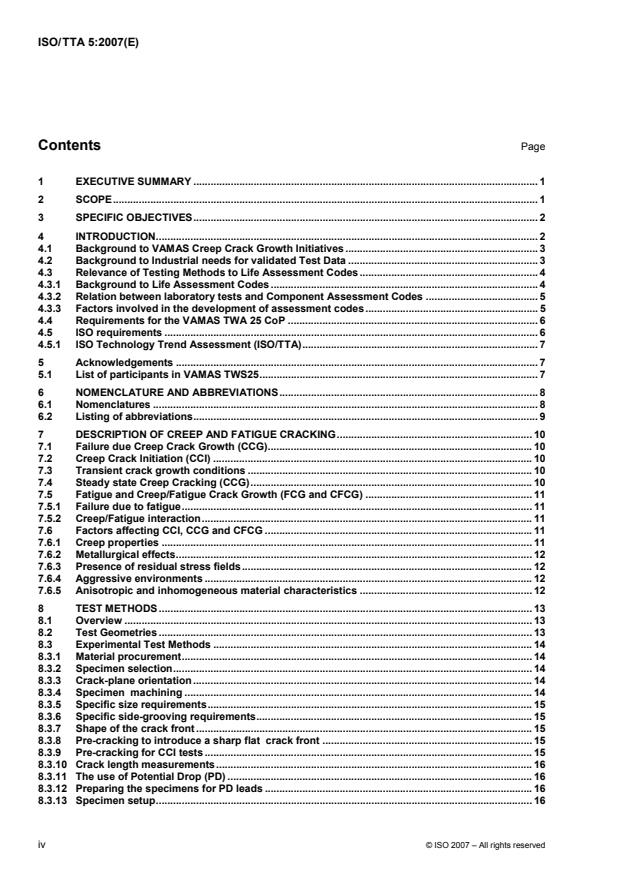
Contents Page
1 EXECUTIVE SUMMARY . 1
2 SCOPE. 1
3 SPECIFIC OBJECTIVES. 2
4 INTRODUCTION. 2
4.1 Background to VAMAS Creep Crack Growth Initiatives . 3
4.2 Background to Industrial needs for validated Test Data . 3
4.3 Relevance of Testing Methods to Life Assessment Codes. 4
4.3.1 Background to Life Assessment Codes .4
4.3.2 Relation between laboratory tests and Component Assessment Codes . 5
4.3.3 Factors involved in the development of assessment codes. 5
4.4 Requirements for the VAMAS TWA 25 CoP . 6
4.5 ISO requirements . 6
4.5.1 ISO Technology Trend Assessment (ISO/TTA). 7
5 Acknowledgements . 7
5.1 List of participants in VAMAS TWS25. 7
6 NOMENCLATURE AND ABBREVIATIONS. 8
6.1 Nomenclatures . 8
6.2 Listing of abbreviations. 9
7 DESCRIPTION OF CREEP AND FATIGUE CRACKING. 10
7.1 Failure due Creep Crack Growth (CCG).10
7.2 Creep Crack Initiation (CCI) . 10
7.3 Transient crack growth conditions . 10
7.4 Steady state Creep Cracking (CCG). 10
7.5 Fatigue and Creep/Fatigue Crack Growth (FCG and CFCG) . 11
7.5.1 Failure due to fatigue. 11
7.5.2 Creep/Fatigue interaction. 11
7.6 Factors affecting CCI, CCG and CFCG .11
7.6.1 Creep properties . 11
7.6.2 Metallurgical effects. 12
7.6.3 Presence of residual stress fields. 12
7.6.4 Aggressive environments . 12
7.6.5 Anisotropic and inhomogeneous material characteristics . 12
8 TEST METHODS . 13
8.1 Overview . 13
8.2 Test Geometries . 13
8.3 Experimental Test Methods . 14
8.3.1 Material procurement. 14
8.3.2 Specimen selection. 14
8.3.3 Crack-plane orientation . 14
8.3.4 Specimen machining . 14
8.3.5 Specific size requirements. 15
8.3.6 Specific side-grooving requirements. 15
8.3.7 Shape of the crack front . 15
8.3.8 Pre-cracking to introduce a sharp flat crack front . 15
8.3.9 Pre-cracking for CCI tests. 15
8.3.10 Crack length measurements. 16
8.3.11 The use of Potential Drop (PD) . 16
8.3.12 Preparing the specimens for PD leads . 16
8.3.13 Specimen setup. 16
iv © ISO 2007 – All rights reserved
8.3.14 Loading and creep displacement measurements .16
8.3.15 Displacement gauge.17
8.3.16 Heating of the specimens .17
8.3.17 Initial pre-load .17
8.3.18 Monitoring the temperature .17
8.3.19 Unplanned temperature excursions .17
8.3.20 Initial pre-load .18
8.3.21 Specimen loading .18
8.4 Data Collection.18
8.4.1 Detailed test and data monitoring.18
8.4.2 Data logging .18
8.4.3 Displacement measurements.18
8.5 Post-Test Measurements .19
8.5.1 Measurement of the final crack front.19
8.5.2 Crack tip bowing.19
8.5.3 Crack extension criteria .19
8.5.4 Crack deviation criteria .19
8.6 Recommended Minimum Number and Duration for Tests.20
8.6.1 Batch to batch variability .20
8.6.2 Minimum test requirements.20
8.6.3 Single point data per test.21
8.6.4 Multiple points data per test .21
8.6.5 Test duration requirements .21
8.7 Sensitivity and Accuracy Limits of the Results.21
8.7.1 Effects of data variability on correlation for FCG, CCG and CCI.21
8.8 Preparation of Test Data .22
8.8.1 Data collection .22
8.8.2 Time at which the test should be stopped .22
8.8.3 Smoothing the PD output data.22
8.8.4 Deriving the crack length from the PD output .22
8.8.5 Recommended number of data points .23
8.8.6 Calculating cracking and displacement rates .23
9 DATA ANALYSIS PROCEDURES .23
9.1 Choosing an appropriate CCI or CCG rate Correlating Parameter.23
9.1.1 Choice of parameter for correlating CCG .23
9.1.2 Choice of the C* term for CCG rate.23
9.1.3 Choice of parameter for CCI .24
9.2 Definitions for the relevant Fracture Mechanics Parameters .24
9.2.1 Stress intensity factor, K .24
9.2.2 J-integral.24
9.2.3 The C* parameter .24
9.2.4 Creep zone.25
9.2.5 Steady state creep .25
9.2.6 The C parameter.26
t
9.2.7 Small-scale creep.26
9.2.8 Interpretation of C* parameter.26
9.2.9 Time Dependant Failure Assessment Diagram (TDFAD) for CCI .26
9.2.10 The Q* Parameter.27
9.3 Criteria for Validity Checks of C* and K .27
9.3.1 Check for validity of C* .27
9.3.2 Components of displacement rates.27
9.3.3 Validity criteria for C* for highly ductile materials .28
9.3.4 Validity criteria for creep brittle materials.29
9.3.5 Transition time criteria for C* .29
10 REPORTING PROCEDURES .30
10.1 Details of test information to be reported .30
10.1.1 Report of findings.30
10.1.2 Pedigree of the material .30
10.1.3 Material properties to be logged .30
10.1.4 Test machine description. 30
10.1.5 Details of starter crack . 30
10.1.6 Details for loading. 30
10.1.7 Report of data analysis. 30
10.1.8 Plots of data. 31
10.1.9 Tabulation of results. 31
10.1.10 Photographic/micrographic evidence. 31
10.1.11 Treatment of anomalous data. 31
11 CORRELATING CRACK GROWTH USING FRACTURE MECHANICS. 31
11.1 CCG rate analysis . 31
11.2 Crack Initiation (CCI) Analysis. 32
11.3 FCG rate Analysis . 32
11.4 Creep/fatigue crack growth rate analysis. 33
12 Methods for Calculating the C* Parameter . 33
12.1 Experimental Estimates of C* . 33
12.2 Reference Stress Method of Estimating C* . 34
13 APPENDIX I. 36
13.1 Test Specimen Geometries. 36
13.2 Geometry Definitions for Laboratory Specimens. 36
14 SPECIMEN FRACTURE MECHANICS PARAMETER SOLUTIONS. 38
14.1 Stress Intensity Factor K. 38
14.2 Solutions for the Y function. 38
14.2.1 Y factor for C(T). 39
14.2.2 Y factor for CS(T) . 39
14.2.3 Y factor for for SEN(T) . 39
14.2.4 Y factor for SEN(B) (3 Point Bend Specimen). 39
14.2.5 Y factor for DEN(T). 40
14.2.6 Y factor for M(T) . 40
14.3 C* Solutions. 40
14.4 Reference Stress (σ ) Solutions. 41
ref
14.4.1 σ for C(T). 41
ref
14.4.2 σ for CS(T) . 42
ref
14.4.3 σ for SEN(T) . 42
ref
14.4.4 σ for SEN(B) (3 Point Bend Specimen). 42
ref
14.4.5 σ for DEN(T). 42
ref
14.4.6 σ for M(T) . 43
ref
14.5 η Functions for cracked geometries . 43
14.5.1 Nomenclature (see Figure A.1.3) . 43
14.5.2 Solutions for creep crack growth parameter, C* . 44
14.5.3 Best fit solutions of η from finite element calculations . 45
14.5.4 Choice of η for evaluating C* for material CCI and CCG properties. 45
14.5.5 Choice of η for evaluating C* in life assessment. 45
14.6 η Function Equations . 46
14.6.1 η functions for C(T). 46
14.6.2 η functions for CS(T) . 46
14.6.3 η functions for SEN(T). 46
14.6.4 η functions for SEN(B) — 3PB. 47
14.6.5 η functions for DEN(T). 47
14.6.6 η functions for M(T) . 47
LLD
14.7 Table for η . 49
CMOD
14.8 Table for η . 50
14.9 Geometry Definitions for 'Feature' Type Specimens. 51
14.9.1 Details form Pipe, Plate and Notched bar 'feature specimens' . 51
14.10 Fracture Mechanics Functions for Feature Components . 52
14.10.1 K solutions for pipes and plates. 52
14.10.2 Reference stress solutions for pipes. 53
14.10.3 Reference stress solutions for plates. 53
vi © ISO 2007 – All rights reserved
14.10.4 Stress intensity factor K for the round notch bar .54
14.10.5 C* parameter for the notched bar.54
c
15 APPENDIX II :(TDFAD) K approach for CCI.55
mat
15.1 Introduction.55
15.2 Nomenclature.55
15.3 Failure Assessment Diagram .56
15.4 Materials Data Requirements .57
16 APPENDIX III: The Q* Parameter.61
16.1 Symbols and Designations.61
16.2 Scope .62
16.3 Specimen Geometry .62
16.4 Guideline for Calculation of the Q* parameter.62
16.4.1 Crack Growth Analysis .62
16.4.2 Crack initiation Analysis .63
17 APPENDIX IV: Local CTOD Approach .64
17.1 Crack Tip Opening Displacement (CTOD).64
18 APPENDIX V: Further Detailed Advice on Testing.66
18.1 Advice on Testing and Machine Specification .66
18.2 Loading Machine.66
18.3 Machine Tolerances .66
18.4 Grips.66
18.5 Alignment .66
18.6 Specimen Dimensional Measurement .67
18.7 Specimen Preparation.67
18.8 Permissible Temperature Deviation.67
18.9 Temperature Hold-time before start of Test.67
18.10 Thermocouple Junction and Wiring .67
18.11 Thermocouple Attachment .68
18.12 Verification of Thermocouple.68
18.13 Application of Load .68
18.14 Loading Precautions .68
18.15 Displacement Measurement .68
18.16 Apparatus for Crack Size Measurement.69
18.17 Potential Difference (PD) Performance .69
18.18 Specimen Preparation for Electric Potential Measurement .69
18.19 Premature Test Failure.69
18.20 Recommended Method for Treating Extensive Plasticity .69
18.21 Recommended Data Reduction Techniques .70
18.21.1 Calculating the cracking and displacement rates.70
18.21.2 Method for calculating the cracking and displacement rates.70
18.21.3 Secant method for deriving CCG and displacement rates.70
18.21.4 Incremental polynomial method to derive CCG and displacement rates .70
18.21.5 Calculating crack length .71
18.21.6 Voltage versus crack length relation.71
19 REFERENCES – Related International Standards and Codes .72
20 REFERENCES – Relevant Publications.74
TECHNOLOGY TRENDS ASSESSMENT ISO/TTA 5:2007(E)
Code of practice for creep/fatigue testing of cracked
components
1 EXECUTIVE SUMMARY
Following a brief description of the mechanism for creep and creep/fatigue this document details
testing methods and analysis procedures needed for creep and creep/fatigue crack growth testing of
generic geometries containing cracks. Use of the terms 'generic geometries', 'component' or 'feature
component', 'feature specimens' in testing assumes that the test geometry is non-standard as
compared to standard laboratory fracture mechanics geometry such as the Compact Tension (C(T)).
These tests maybe needed when the users need additional validation of results and in cases where
excessive costs, unavailability of pedigree material, and other testing constraints would allow
nominal numbers of tests can be carried out. So far as available, specific advice and additional
reference material is given throughout the document in order to assist the user in carrying out a
programme of testing and analysis of the data. Specific geometries are identified and appropriate
fracture mechanics parameters are presented for each of them.
This document takes into account the experience gained in testing techniques from previous
Standards and Codes of Practice [[a]-[kk]] and integrates early advances in the field of high
temperature fracture mechanics [1-23] with the more recent findings [24-80] to give advice on
testing, measurement and analysis of CCI, CCG and CFCG data for a range of creep brittle to creep
ductile materials using a very wide range of pre-cracked geometries. In quantitative terms the
information from these tests can be used to consider the individual and combined effects of
metallurgical, fabrication, operating temperature, and loading variables on creep crack growth life of
a component.
This document, by the very nature of the subject's diversity, cannot go into detail on every issue
relating to the methods of testing and the type of geometry that could be tested. Rather it identifies
common grounds in the procedures and highlights the sensitivity of the various parameters in
completing a validated programme to derive material 'basis' data. Attempts have been made to
simplify the procedures whilst at the same time not compromise the overall accuracy that is required
in a test programme. Finally advice and recommendations are given to identify the limitations of test
results and/or analysis for any specific condition.
2 SCOPE
The scope of this document is to recommend and establish standardized techniques for measuring
and analysing Creep Crack Initiation (CCI), Creep Crack Growth (CCG), and Creep Fatigue Crack
Growth (CFCG) characteristics using a wide range of pre-cracked standard and non-standard 'feature'
geometries. Specimens considered in this document are shown in APPENDIX I. The list of geometries
is not by any means complete and the user is advised to use appropriate information from other
databases for other geometries to derive the relevant fracture mechanics parameters (see Section 11)
to use in the analysis. The validation of the parameters that are to be used however is important,
especially where concern exists regarding the compatibility of test geometry with the actual
component in terms of size, the type of loading and stress state. This document allows increased
flexibility and a wider choice of geometries than previously were made available without comprising
on the important issues such as accuracy of testing and data measurements and the appropriate
derivation of the correlating parameter. Less emphasis and detail has been placed on cycle dependent
fatigue test methods compared to time dependent creep test methods as fatigue testing has been
comprehensively dealt with in other standards [g] and the parameters needed for its analysis are
linear elastic in nature and therefore simpler than the non-linear time dependent creep regime.
3 SPECIFIC OBJECTIVES
Availability of Creep Crack Initiation (CCI) and Creep Crack Growth (CCG) and Creep/Fatigue
Crack Growth (CFCG) properties are essential for defect assessments of components operating at
elevated temperatures. Methods for deriving the uniaxial creep properties are well established. The
following identifies the specific objectives for this CoP
1 The user is given advice and information on specific test geometries, techniques, testing
methods to allow obtain the maximum amount of verifiable test information for creep and
creep/fatigue tests.
2 The information presented has been derived from collaborative experiments on a range of
geometries forming the basis for the validation of results in this CoP.
3 Maximum flexibility has been introduced in test techniques without compromising accuracy.
Hence the advice will also be relevant to geometries that are not identified specifically in the
appendices
4 Advice is given on specimen selection and the appropriateness of fracture mechanics parameters
for use in the analysis taking into account the creep properties of the material.
5 Without compromising overall accuracy simplifications of parameters have been introduced and
the appropriate variability due to the method of analysis is estimated.
6 The results for the geometries listed in APPENDIX I have been compared and validated and the
analysis methods standardized so that testing variability between different laboratories can be
reduced to a minimum.
7 The CoP sets out to identify the commonality in the wide variety tests and provides the user with
sufficient advice to devise, carry out and analyse a test.
In effect the overall objective of this CoP is to unify, as far as possible, testing and analysis methods
between different laboratories. This is in order that subsequent or future analysis of the data or its use
in life assessment analysis could be performed with confidence and increased overall accuracy.
4 INTRODUCTION
The Versailles Project on Advanced Materials and Standards (VAMAS) supports trade in high
technology products through International collaborative projects aimed at providing the technical
basis for drafting codes of practice and specifications for advanced materials. The scope of the
collaboration embraces all agreed aspects of enabling science and technology which are required as a
precursor to the drafting of standards for advanced materials. The VAMAS activity emphasizes
collaboration on pre-standards measurement research, inter-comparison of test results, and
consolidation of existing views on priorities for standardization action.
2 © ISO 2007 – All rights reserved
4.1 Background to VAMAS Creep Crack Growth Initiatives
At this point it is useful to outline the background to the development of this document as it will
place it in context with the already available codes and standards related to this subject.
VAMAS has been active in the field of standardisation of testing and analysis of elevated
temperatures fracture mechanics specimens since 1987. A working group, TWA 11, was setup in
1987-1992 to develop and formulate a standard for a high temperature test method. This involved
making recommendations for measuring the creep crack growth properties of materials and using the
creep fracture mechanics parameter C* in the analysis of the data. The method was restricted to
creep-ductile cracking conditions. The findings were incorporated into ASTM test procedure E1457-
92 [i] that was the first standard to deal with crack growth testing at elevated temperatures.
This methodology was extended under TWA 19 (1993-1998) to conditions where only limited creep
deformation or otherwise creep brittle conditions were observed. As a consequence of a Round
Robin testing and analysis programme on four relatively creep brittle alloys, namely two aluminium
a titanium and a carbon-manganese alloy, recommendations were made to change the original testing
procedure, to incorporate the methodology for a more creep brittle circumstances. The findings of
TWA19 were published in a special issue of Engineering Fracture Mechanics [11]. Subsequently a
revised version of the ASTM testing standards E1457-01 [i] was published. This edition covers the
wider range of creep ductile to creep brittle testing conditions observed in engineering alloys.
Following these earlier developments it has become evident recently that industry needs additional
justifications and verifications in order to apply the standard test data with confidence in present
component defect assessment codes such as R5 [29-31], A16 [32-33], BS-7910 [34] and API 579
[35]. As a result of experience gained from TWA 11 and TWA 19 the present TWA 25 was
established
...