

ISO/TR 27929:2025
(Main)Carbon dioxide capture, transportation and storage — Transportation of carbon dioxide by ship
General Information
- Abstract
This document provides insights into the essential aspects of CO2 shipping and provides basic descriptions of how a CO2 carrier and its technology therein is technically integrated with the CCS value chain. This document describes specific challenges of transporting CO2 as cargo, how this differs from other gases transported by ships today, and how this influences the ship's design and operation. Finally, this document introduces how CO2 ships are regulated within the existing international maritime regulatory framework. This document’s main focus is on the technical aspects of CO2 shipping. Commercial, liability and financial aspects are not covered in this document. However, general reference to commercial impact is made where relevant. This document focuses on the ship transportation of CO2 between loading and offloading facilities where the system boundaries are at the ship manifold equipment that connects the ship to the other components in the value chain. In this document, the basis for the description of ship operation is transportation between two shore-based terminals. A high-level description of other relevant interfaces is given on a conceptual level as this has an impact on the ship's design. However, any further descriptions of potential solutions upstream and downstream from the CO2 carrier are not covered in this document. This document also gives a high-level description of the physical properties of CO2 streams at the conditions relevant for shipping and how relevant impurities can impact the ship and ship operation.
- Status
- Published
- Publication Date
- 17-Dec-2025
- Technical Committee
- ISO/TC 265 - Carbon dioxide capture, transportation, and geological storage
- Current Stage
- 6060 - International Standard published
- Start Date
- 18-Dec-2025
- Completion Date
- 18-Dec-2025
Overview
ISO/TR 27929:2025 - Carbon dioxide capture, transportation and storage - Transportation of carbon dioxide by ship is a technical report that explains the technical integration of CO2 carriers into the CCS value chain. The document focuses on the ship side of CO2 shipping between shore‑based terminals, covering how CO2 cargo characteristics and impurities affect ship design, operation and safety. Commercial, liability and financial aspects are intentionally excluded.
Key topics
- Regulatory regime: how CO2 ships are considered within the existing international maritime and inland waterways regulatory framework.
- CO2 cargo conditions: classification of transport regimes (low, medium, high pressure), density effects and behaviour of liquid CO2 (including solid formation).
- Cargo tank design: tank geometry, materials, insulation, design pressure and novel materials relevant to CO2 carriage.
- Ship concepts: terminal‑to‑terminal carriers, barges for inland waterways, offshore floating storage and injection units (FSIU) and offshore injection options.
- Multi‑gas vs dedicated carriers and considerations for converting existing ships.
- CO2 stream properties: thermodynamic behaviour, stream composition, common impurities and how mixing of streams impacts operations and design.
- Ship operation and cargo handling: modes of operation, interface and compatibility at manifolds, loading/offloading procedures, cargo preparation and voyage management.
- Measurement and verification: quantification of CO2 cargo, cargo measurement, quality assurance, co‑mingling and verification principles.
- Safety and risks: HSE topics such as toxicity/asphyxiation risks, hazards of liquid CO2, material integrity, electrostatic charge, detection systems and emergency systems.
- Technical gaps: areas where existing rules, qualification processes and requirements need further development for CO2 shipping.
Applications
ISO/TR 27929:2025 is intended as a technical reference to support:
- Ship and cargo tank design specific to CO2 transport
- Integration of CO2 carriers into CCS project design and logistics planning
- Operational procedures for terminal operators, ship crews and cargo handlers
- Risk assessments and safety planning, including HSE management for liquid CO2
- Measurement, verification and accounting workflows for CO2 shipments
Who should use this standard
- Naval architects and ship designers
- Shipowners and operators planning CO2 carriers or conversions
- CCS project developers and logisticians
- Terminal and port operators handling CO2 loading/offloading
- Regulators, classification societies and maritime safety engineers
- HSE and environmental compliance teams
Related standards
ISO/TR 27929:2025 complements other ISO documents and international maritime regulations that govern carriage of cargoes and CCS value‑chain elements, by providing focused technical guidance for CO2 transport by ship.
Relations
- Effective Date
- 05-Apr-2025
Get Certified
Connect with accredited certification bodies for this standard

BSI Group
BSI (British Standards Institution) is the business standards company that helps organizations make excellence a habit.

Bureau Veritas
Bureau Veritas is a world leader in laboratory testing, inspection and certification services.

DNV
DNV is an independent assurance and risk management provider.
Sponsored listings
Frequently Asked Questions
ISO/TR 27929:2025 is a technical report published by the International Organization for Standardization (ISO). Its full title is "Carbon dioxide capture, transportation and storage — Transportation of carbon dioxide by ship". This standard covers: This document provides insights into the essential aspects of CO2 shipping and provides basic descriptions of how a CO2 carrier and its technology therein is technically integrated with the CCS value chain. This document describes specific challenges of transporting CO2 as cargo, how this differs from other gases transported by ships today, and how this influences the ship's design and operation. Finally, this document introduces how CO2 ships are regulated within the existing international maritime regulatory framework. This document’s main focus is on the technical aspects of CO2 shipping. Commercial, liability and financial aspects are not covered in this document. However, general reference to commercial impact is made where relevant. This document focuses on the ship transportation of CO2 between loading and offloading facilities where the system boundaries are at the ship manifold equipment that connects the ship to the other components in the value chain. In this document, the basis for the description of ship operation is transportation between two shore-based terminals. A high-level description of other relevant interfaces is given on a conceptual level as this has an impact on the ship's design. However, any further descriptions of potential solutions upstream and downstream from the CO2 carrier are not covered in this document. This document also gives a high-level description of the physical properties of CO2 streams at the conditions relevant for shipping and how relevant impurities can impact the ship and ship operation.
This document provides insights into the essential aspects of CO2 shipping and provides basic descriptions of how a CO2 carrier and its technology therein is technically integrated with the CCS value chain. This document describes specific challenges of transporting CO2 as cargo, how this differs from other gases transported by ships today, and how this influences the ship's design and operation. Finally, this document introduces how CO2 ships are regulated within the existing international maritime regulatory framework. This document’s main focus is on the technical aspects of CO2 shipping. Commercial, liability and financial aspects are not covered in this document. However, general reference to commercial impact is made where relevant. This document focuses on the ship transportation of CO2 between loading and offloading facilities where the system boundaries are at the ship manifold equipment that connects the ship to the other components in the value chain. In this document, the basis for the description of ship operation is transportation between two shore-based terminals. A high-level description of other relevant interfaces is given on a conceptual level as this has an impact on the ship's design. However, any further descriptions of potential solutions upstream and downstream from the CO2 carrier are not covered in this document. This document also gives a high-level description of the physical properties of CO2 streams at the conditions relevant for shipping and how relevant impurities can impact the ship and ship operation.
ISO/TR 27929:2025 is classified under the following ICS (International Classification for Standards) categories: 03.220.40 - Transport by water; 13.020.99 - Other standards related to environmental protection. The ICS classification helps identify the subject area and facilitates finding related standards.
ISO/TR 27929:2025 has the following relationships with other standards: It is inter standard links to ISO/TR 27929:2024. Understanding these relationships helps ensure you are using the most current and applicable version of the standard.
ISO/TR 27929:2025 is available in PDF format for immediate download after purchase. The document can be added to your cart and obtained through the secure checkout process. Digital delivery ensures instant access to the complete standard document.
Standards Content (Sample)
Technical
Report
ISO/TR 27929
Second edition
Carbon dioxide capture,
2025-12
transportation and storage —
Transportation of carbon dioxide by
ship
Capture, transport et stockage du dioxyde de carbone —
Transport de dioxyde de carbone par bateau
Reference number
© ISO 2025
All rights reserved. Unless otherwise specified, or required in the context of its implementation, no part of this publication may
be reproduced or utilized otherwise in any form or by any means, electronic or mechanical, including photocopying, or posting on
the internet or an intranet, without prior written permission. Permission can be requested from either ISO at the address below
or ISO’s member body in the country of the requester.
ISO copyright office
CP 401 • Ch. de Blandonnet 8
CH-1214 Vernier, Geneva
Phone: +41 22 749 01 11
Email: copyright@iso.org
Website: www.iso.org
Published in Switzerland
ii
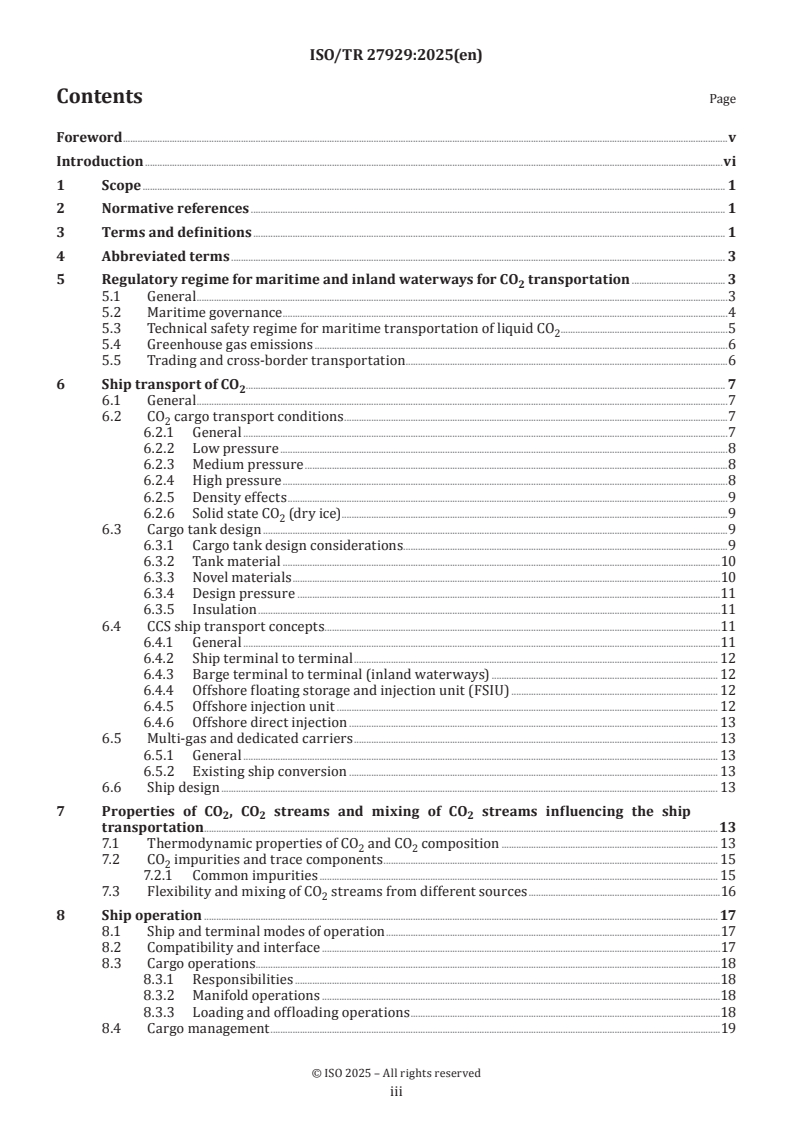
Contents Page
Foreword .v
Introduction .vi
1 Scope . 1
2 Normative references . 1
3 Terms and definitions . 1
4 Abbreviated terms . 3
5 Regulatory regime for maritime and inland waterways for CO transportation . 3
5.1 General .3
5.2 Maritime governance .4
5.3 Technical safety regime for maritime transportation of liquid CO .5
5.4 Greenhouse gas emissions .6
5.5 Trading and cross-border transportation .6
6 Ship transport of CO . . 7
6.1 General .7
6.2 CO cargo transport conditions .7
6.2.1 General .7
6.2.2 Low pressure .8
6.2.3 Medium pressure .8
6.2.4 High pressure .8
6.2.5 Density effects .9
6.2.6 Solid state CO (dry ice) .9
6.3 Cargo tank design .9
6.3.1 Cargo tank design considerations.9
6.3.2 Tank material .10
6.3.3 Novel materials .10
6.3.4 Design pressure .11
6.3.5 Insulation .11
6.4 CCS ship transport concepts.11
6.4.1 General .11
6.4.2 Ship terminal to terminal . 12
6.4.3 Barge terminal to terminal (inland waterways) . 12
6.4.4 Offshore floating storage and injection unit (FSIU) . 12
6.4.5 Offshore injection unit . 12
6.4.6 Offshore direct injection . 13
6.5 Multi-gas and dedicated carriers . 13
6.5.1 General . 13
6.5.2 Existing ship conversion . 13
6.6 Ship design . 13
7 Properties of CO , CO streams and mixing of CO streams influencing the ship
2 2 2
transportation .13
7.1 Thermodynamic properties of CO and CO composition . 13
2 2
7.2 CO impurities and trace components . 15
7.2.1 Common impurities . 15
7.3 Flexibility and mixing of CO streams from different sources .16
8 Ship operation . 17
8.1 Ship and terminal modes of operation .17
8.2 Compatibility and interface .17
8.3 Cargo operations . .18
8.3.1 Responsibilities .18
8.3.2 Manifold operations .18
8.3.3 Loading and offloading operations .18
8.4 Cargo management .19
iii
8.4.1 General .19
8.4.2 Cargo tank preparation .19
8.4.3 Cargo voyage management .19
8.4.4 Cargo losses . 20
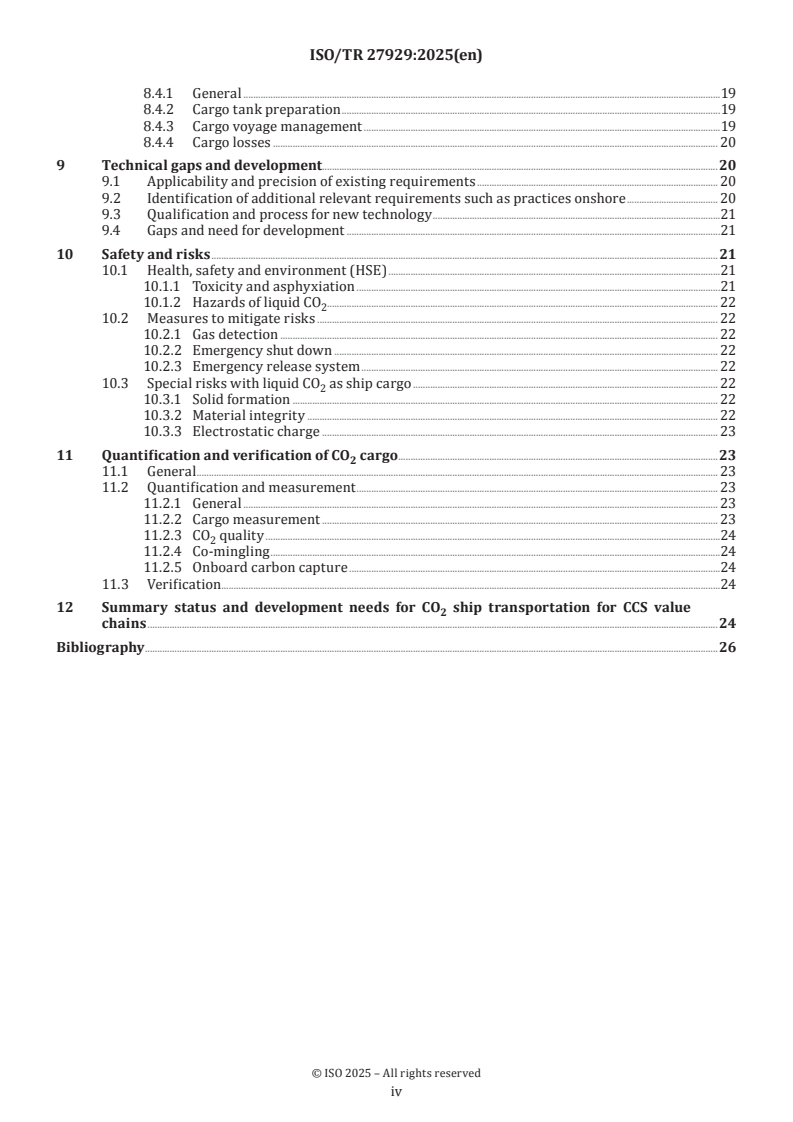
9 Technical gaps and development.20
9.1 Applicability and precision of existing requirements . 20
9.2 Identification of additional relevant requirements such as practices onshore . 20
9.3 Qualification and process for new technology .21
9.4 Gaps and need for development .21
10 Safety and risks .21
10.1 Health, safety and environment (HSE) .21
10.1.1 Toxicity and asphyxiation .21
10.1.2 Hazards of liquid CO . 22
10.2 Measures to mitigate risks . 22
10.2.1 Gas detection . 22
10.2.2 Emergency shut down . 22
10.2.3 Emergency release system . 22
10.3 Special risks with liquid CO as ship cargo . 22
10.3.1 Solid formation . 22
10.3.2 Material integrity . 22
10.3.3 Electrostatic charge . 23
11 Quantification and verification of CO cargo .23
11.1 General . 23
11.2 Quantification and measurement . 23
11.2.1 General . 23
11.2.2 Cargo measurement . 23
11.2.3 CO quality .24
11.2.4 Co-mingling .24
11.2.5 Onboard carbon capture .24
11.3 Verification . .24
12 Summary status and development needs for CO ship transportation for CCS value
chains .24
Bibliography .26
iv
Foreword
ISO (the International Organization for Standardization) is a worldwide federation of national standards
bodies (ISO member bodies). The work of preparing International Standards is normally carried out through
ISO technical committees. Each member body interested in a subject for which a technical committee
has been established has the right to be represented on that committee. International organizations,
governmental and non-governmental, in liaison with ISO, also take part in the work. ISO collaborates closely
with the International Electrotechnical Commission (IEC) on all matters of electrotechnical standardization.
The procedures used to develop this document and those intended for its further maintenance are described
in the ISO/IEC Directives, Part 1. In particular, the different approval criteria needed for the different types
of ISO document should be noted. This document was drafted in accordance with the editorial rules of the
ISO/IEC Directives, Part 2 (see www.iso.org/directives).
ISO draws attention to the possibility that the implementation of this document may involve the use of (a)
patent(s). ISO takes no position concerning the evidence, validity or applicability of any claimed patent
rights in respect thereof. As of the date of publication of this document, ISO had not received notice of (a)
patent(s) which may be required to implement this document. However, implementers are cautioned that
this may not represent the latest information, which may be obtained from the patent database available at
www.iso.org/patents. ISO shall not be held responsible for identifying any or all such patent rights.
Any trade name used in this document is information given for the convenience of users and does not
constitute an endorsement.
For an explanation of the voluntary nature of standards, the meaning of ISO specific terms and expressions
related to conformity assessment, as well as information about ISO's adherence to the World Trade
Organization (WTO) principles in the Technical Barriers to Trade (TBT), see www.iso.org/iso/foreword.html.
This document was prepared by Technical Committee ISO/TC 265, Carbon dioxide capture, transportation,
and storage.
This second edition cancels and replaces the first edition (ISO/TR 27929:2024), which has been technically
revised.
The main changes are as follows:
— Figure 4 has been corrected to represent the correct phase diagram for CO ;
— Figure 5 has been revised to be consistent in wording.
Any feedback or questions on this document should be directed to the user’s national standards body. A
complete listing of these bodies can be found at www.iso.org/members.html.
v
Introduction
In a carbon dioxide capture and storage (CCS) value chain, the main means for transportation of CO from an
emitter to storage are by ships or by pipelines. Transportation of gas in liquid state is well established in the
shipping industry and has been done for decades. However, liquid CO is different from other gases carried
by ships and poses new challenges for both ship design and ship operation. Compatibility along the value
chain is an essential element in the development of CCS. A common understanding of how different aspects,
such as cargo temperature and pressure, can influence the ship design and ship operation is needed.
The purpose of this document is to support consistency and compatibility in the design of CCS value chains
and address important areas where future development and standardization can add value. This document
discusses CO ship designs, ship logistics and interface-specific aspects related to the safe and reliable
design and operation of CO ships.
Transportation of liquified gas on ships is governed by the regulations, codes and conventions drawn up
under the International Maritime Organization (IMO) which is referred to under United Nations Convention
[8]
on the Laws of the Sea (UNCLOS) . Ships carrying CO are regulated by the IMO International Code for the
[10]
Construction and Equipment of Ships Carrying Liquefied Gases in Bulk (IGC Code) , which serves as the
main technical regulation for CO carriers under the International Convention for the Safety of Life at Sea
[7]
(SOLAS) .
Ship transportation of CO is traditionally limited to commercial trade for small-scale use in industries such
as the food or beverage industries but is now expanding into CCS projects. The evolving industry around
CCS demands transportation volumes of a different magnitude and will involve the development of new
ship designs and ship logistics concepts. Therefore, there is a need for knowledge-sharing related to type of
transportation concepts, CCS value chain compatibility, technical and operational reliability and the safety
of CO carriers.
As quantification, verification and reporting of the CO stream throughout the CCS value chain are becoming
important, this document briefly describes their limitations and challenges and how they can be done on
board the ship.
In this document, the term "CO " is used to refer to a captured CO stream, including potential impurities
2 2
following the capture process, if not otherwise explicitly referred to as pure CO .
vi
Technical Report ISO/TR 27929:2025(en)
Carbon dioxide capture, transportation and storage —
Transportation of carbon dioxide by ship
1 Scope
This document provides insights into the essential aspects of CO shipping and provides basic descriptions
of how a CO carrier and its technology therein is technically integrated with the CCS value chain. This
document describes specific challenges of transporting CO as cargo, how this differs from other gases
transported by ships today, and how this influences the ship's design and operation. Finally, this document
introduces how CO ships are regulated within the existing international maritime regulatory framework.
This document’s main focus is on the technical aspects of CO shipping. Commercial, liability and financial
aspects are not covered in this document. However, general reference to commercial impact is made where
relevant.
This document focuses on the ship transportation of CO between loading and offloading facilities where the
system boundaries are at the ship manifold equipment that connects the ship to the other components in the
value chain. In this document, the basis for the description of ship operation is transportation between two
shore-based terminals. A high-level description of other relevant interfaces is given on a conceptual level as
this has an impact on the ship's design. However, any further descriptions of potential solutions upstream
and downstream from the CO carrier are not covered in this document. This document also gives a high-
level description of the physical properties of CO streams at the conditions relevant for shipping and how
relevant impurities can impact the ship and ship operation.
2 Normative references
There are no normative references in this document.
3 Terms and definitions
For the purposes of this document, the following terms and definitions apply.
ISO and IEC maintain terminology databases for use in standardization at the following addresses:
— ISO Online browsing platform: available at https:// www .iso .org/ obp
— IEC Electropedia: available at https:// www .electropedia .org/
3.1
barge
floating unit carrying freight on canals, rivers and in ports, either under its own power or towed by another
3.2
cargo containment system
arrangement for containment of the cargo including, where fitted, a primary and secondary barrier,
associated insulation and any intervening spaces, and adjacent structure, if necessary, for the support of
these elements
Note 1 to entry: For more details on the cargo containment system, see Reference [10].
3.3
CO carrier
cargo ship or barge (3.1) constructed or adapted and used for the carriage of CO as cargo
3.4
CO stream
stream consisting overwhelmingly of carbon dioxide
[SOURCE: ISO 27917:2017, 3.2.10, modified — Note 1 to entry has been deleted.]
3.5
dynamic positioning system
equipment and system that is used for keeping a vessel at a given position using the thruster and propulsion
of the vessel to compensate for the environmental loads, including waves, wind, current, etc.
3.6
export location
location where the ship loads the CO for transport to the import location (3.10)
3.7
flag state
jurisdiction under whose laws the ship is registered
3.8
heat ingress
transfer of heat from the surroundings into the cargo
3.9
heel
liquid cargo maintained at the bottom of the tank on the return voyage to maintain cargo tank temperature
3.10
import location
location where the ship offloads the CO that is transported from the export location (3.6)
3.11
inland waterway
natural or artificial navigable inland body of water, or system of interconnected bodies of water, used for
transport, such as lakes, rivers or canals
3.12
intermediate storage
storage of CO volumes before being loaded to a ship and storage after being offloaded from the ship
3.13
multi-lobe
bi-lobe
tri-lobe
cargo tanks which consist of two (bi-lobe) or three (tri-lobe) lobes where lobes represent cylinder segments
partly merged and connected by a common bulkhead
3.14
muster area
location where the crew assemble in the event of an emergency
3.15
riser
flexible pipe that connects an offshore well to a ship or floating offshore unit
3.16
territorial sea
area which extends up to 12 nautical miles from the baseline of a country’s coastal line
3.17
triple point
temperature and pressure at which three phases (gas, liquid and solid) of a substance coexist in
thermodynamic equilibrium
3.18
two-phase flow
simultaneous flow of gas and liquid
3.19
vapour return
connection between ship and terminal for vapour exchange to ensure pressure equilibrium between the
shore storage tanks and the ship cargo tanks
3.20
vapour-liquid equilibrium
state where a substance's liquid and vapour phases are in equilibrium
4 Abbreviated terms
CO carbon dioxide
CCS carbon dioxide capture and storage
ESD emergency shut down
FPSO floating production storage and offloading
FSIU floating storage and injection unit
IGC Code International Code of the Construction and Equipment of Ships Carrying Liquefied Gases in Bulk
IMO International Maritime Organization
LNG liquified natural gas
LPG liquefied petroleum gas
NIST National Institute of Standards and Technology
OCIMF Oil Companies International Maritime Forum
SIGTTO Society of International Gas Tanker and Terminal Operators
SOLAS International Convention for the Safety of Life at Sea
UNCLOS United Nations Convention on the Law of the Sea
IACS International Association of Classification Societies
ES-TRIN European Standard — Technical Requirements for Inland Navigation vessels
5 Regulatory regime for maritime and inland waterways for CO transportation
5.1 General
International and national shipping are subject to an extensive and stringent set of laws and regulations
which are enforced by international, regional and national regulatory bodies. Considering the large number
of stakeholders and the significant environmental and economic impact the maritime industry has on the
society, regulations are developed to enable cooperation between stakeholders and to promote and improve
safety, security and efficiency, and to mitigate risks from marine and atmospheric pollution by ships.
Marine transportation of liquefied gases, including CO in bulk by dedicated gas carriers, is well
regulated with proven and high safety standards developed by IMO and other governmental and industry
organizations. Considering the increased focus on CCS, it is however expected that laws and regulations for
maritime transportation of CO will be further developed.
A general description of the maritime governance scheme is given in 5.2. It is followed by a description of the
main regulatory regime for CO carriers.
5.2 Maritime governance
International shipping involves vessels which operate across the oceans as well as territorial seas and
exclusive economic zones. Other vessels are limited to coastal and inland waterways transport within
territorial waters covered by the jurisdictions of a single state or multiple states. Maritime shipping is a
mature industry with well-established international governance institutions; however, the regulatory
scheme can be different depending on the area and type of operation. A generic overview of the maritime
governance scheme and stakeholders involved in maritime shipping is shown in Figure 1.
Figure 1 — Governance and stakeholders in maritime shipping
[8]
The governance of the ocean emerges from the United Nations. UNCLOS lays down a comprehensive
regime of law and order in the world’s oceans and seas by, inter alia, defining the maritime geographical
jurisdiction, including the coastal states’ sovereignty over their respective maritime zones.
IMO is a specialized agency under the United Nations that develops conventions containing detailed
regulations to safety, security and environment, with the intention of establishing a global minimum
standard for the shipping industry. Under IMO, more than 60 conventions, codes and regulations have been
developed which serve the basis for the implementation in the legislations of the individual member states.
Regional governmental organizations can develop additional regulations which apply for specific
geographical areas or member states. The European Union (EU) is an example of a regional governmental
organization which through, its regulations and directives, aim at ensuring common standards among the
EU member states.
The regulations developed by IMO or any other governmental organization are upon ratification implemented
into the national laws of the ratifying states. The flag states enforce the regulations for ships registered
under their flag. Port states exercise port state control on ships visiting their ports based on domestic
laws, to ensure the ship’s condition and equipment are in compliance with the provisions of international
conventions and that the ship is safely manned and operated pursuant to applicable international law.
Flag and port states can introduce additional regional or domestic regulations which apply within their
jurisdiction.
Within the convention framework set by IMO and the regulations set by flag states, the classification
societies play an important role as independent governance actors. The major classification societies form
the International Association of Classification Societies (IACS), which works together with the industry
and maritime regulators to ensure that the legislative framework is supported and enhanced by the
practical implementation of classification rules. IACS has an observer role in IMO which allows them to
provide support and advice on the IMO process. The classification societies develop and maintain technical
rules and standards for the construction and operation of ships, and carry out classification, certification
and verification services, as well as surveys to ensure compliance with the standards. The classification
is the basis for the registration with the flag state and is required by IMO for international voyages. The
classification standards are generally internationally recognized and in compliance with international
maritime regulations.
The classification societies can, on behalf of a flag state administration, undertake statutory certification
to the extent the society has been authorized to do so by the individual flag state administration. Statutory
certification includes among others approval, surveys, and the issuance of statutory certificates.
Other non-governmental organizations such as International Chamber of Shipping (ICS), International
Association of Independent Tanker Owners (INTERTANKO), Oil Companies International Maritime Forum
(OCIMF), Society of International Gas Tanker and Terminal Operators (SIGTTO), are also important
stakeholders in maritime shipping. These are industry organizations with the aim of sharing experiences,
addressing common problems and establishing a framework of standards, guidelines and best practices for
the industry. Publications from these organizations often become industry standards and are important
for ensuring standardization particularly regarding operational compatibility and safety. Several of these
organizations have consultative status in IMO.
[8]
Considering the sovereignty of the territorial seas and internal waters as laid down in UNCLOS , the coastal
states are not bound by the framework issued by IMO and other organizations when forming the legislative
framework for ships operating within the territory of the state, unless the instruments are ratified by the
individual states. Hence, the regulatory framework which is basis for the national legislations can differ
from that of international shipping. Many states do however use the international legislative framework
as a basis for their national frameworks, potentially with modifications and adjustments as found relevant
depending on the type of ship and trade, the operational area, etc. regional (e.g. bi-lateral or multi-lateral)
requirements and agreements can apply to specific operational areas within the territories of two or more
states. One example is the regulations applicable for the inland waterways system in Europe, which is
described in more detail in 5.3.
5.3 Technical safety regime for maritime transportation of liquid CO
The carriage of liquid CO onboard ships for international trade is governed pursuant to the IMO framework
[7]
and by the provisions in the SOLAS , and is further detailed in mandatory codes, depending on the mode
of transport. The regulations distinguish between the carriage of the product in packaged form, e.g. as
modular tank containers on cargo ships, and the carriage of the product in bulk on dedicated gas carriers
as explained in more detail in the following. Carriage of product in package form is regulated by the
International Maritime Dangerous Goods Code (IMDG) while the carriage of product in bulk on dedicated
[10]
gas carriers is regulated by the IGC Code .
[10]
The IGC Code is the governing international technical standard prescribing the design and construction
[10]
requirements of ships carrying liquid gases, including CO in bulk. The IGC Code requirements are
targeted to address the particular hazards related to different liquefied gases, including flammability,
toxicity, asphyxiation, etc., including a set of specific requirements for the carriage of CO .
Classification societies normally have specific class notations which cover design and construction
[10]
requirements for gas carriers. These requirements are normally based on the IGC Code , but are often
more detailed on the specific requirements to ensure practical implementation of the requirements given in
the Code and that the overall safety targets are met. Industry organizations such as SIGTTO have developed
a series of best practices, guidelines and standards targeting liquified gas carriers and terminals. Although
these are focusing on commonly transported products such as LNG and LPG, many of these can also be
applicable for CO transportation.
As explained in 5.2, an individual state is not bound to the international standards and codes described
above for trades within the territory of the state, e.g. for inland waterways. Russia, Brazil, China, India,
EU members and many other countries have well developed inland waterway systems which can be an
attractive alternative for CO transportation. It is expected that a regulatory framework will need to be
developed for the individual areas when and where this mode of transport becomes relevant, including
cross border agreements. Some countries have existing regulations for transport of dangerous goods on
[10]
inland waterways which can be relevant. It is, however, expected that IGC Code and other international
standards will be used as supplementary references for establishing the regulatory framework for domestic
and cross-border CO trades on inland waterways.
Vessels used for goods transport on inland waterways within the European Union are regulated by the
[13]
EU Directive 2016/1629 Technical Requirements for Inland Waterway Vessels , which is the mechanism
for incorporating technical standards (e.g. ES-TRIN) into EU law. Within this framework the European
[12]
Agreement concerning the International Carriage of Dangerous Goods by Inland Waterways contains
the provisions for the carriage of dangerous goods in packages and in bulk. Other countries, regions and
territories can have other applicable regulations.
5.4 Greenhouse gas emissions
Today, ships use fossil fuels for propulsion, only with few exceptions, and, in that sense ship, transportation
of CO has a CO footprint depending mainly on the type of fuel and the size of the ship. IMO has an ambition
2 2
to reduce the total emissions from the world fleet and in carbon intensity (CO emitted per cargo-carrying
capacity and nautical mile) by 2050. To meet the defined targets regulations are gradually being enforced.
Emissions from a ship’s machinery during operation are reported through schemes defined by both IMO and
EU (for vessels calling at European ports).
5.5 Trading and cross-border transportation
For cross-border transportation of CO where the CO is transported for the purpose of offshore storage, the
2 2
1972 Convention on the Prevention of Marine Pollution by Dumping of Wastes and Other Matter (London
[6] [9] [6]
Convention) and its 1996 London Protocol are important. The London Convention is one of the first
international conventions protecting the marine environment from human activities. Its objective is to
promote the effective control of all sources of marine dumping and take all practicable steps to prevent
pollution of the sea by the dumping of waste and other matter. The contracting parties (countries party to
[9]
the London Protocol ) eventually recognized the need for a more precautionary and preventative approach
[9]
and undertook a full review of the Convention. This review resulted in the London Protocol .
[9] [6]
The London Protocol is a stand-alone agreement that supersedes the London Convention for the
states that are party to both instruments. This means that the London Protocol will prevail if there is a
[9]
conflict between the two instruments. The London Protocol is more restrictive and adopts a general
ban on all dumping activities, with the exception of the wastes and other matter listed in Annex 1 of the
[9]
London Protocol . The dumping of wastes and other matter listed as an exception in the London Protocol
[9] [9]
Annex 1 requires a prior permit issued in line with the London Protocol Annex 2 requirements. In 2006,
[9]
the contracting parties to the London Protocol adopted an amendment to Annex 1, adding CO to the list of
exceptions, thereby creating a legal basis in international environmental law to regulate CO storage in sub-
seabed geological formations. This was necessary as storage falls within the definition of dumping.
[9]
Article 6 of the London Protocol prohibits the export of wastes and other matter across borders for
dumping at sea. This presented a barrier for cross-border CCS operations as it prohibits the export of CO
for storage in other countries where the intended storage site is offshore. In order to overcome this barrier,
Article 6 was amended in 2009 to allow for export of CO for offshore storage by adding a second paragraph
exempting CO from the general ban. The new Article 6.2 sets out criteria for the export to occur, including
the need for an agreement or arrangement between the states involved identifying and allocating permitting
responsibilities. The amendment is not yet in force at the time of writing as an amendment requires two-
thirds of the contracting parties to have formally accepted it. After ten years with little progress of reaching
the required number, the contracting parties agreed to an interim solution of provisional application in
2019. This entails that the contracting parties can provisionally apply the 2009 amendment and export CO
across borders provided that the parties have deposited a declaration of provisional application to the IMO
[6] [9]
(who acts as the Secretariat for the London Convention and the London Protocol ).
[9]
While the London Protocol has implications for cross-border transportation and offshore storage for its
contracting parties, it can also impact non-contracting parties that wish to engage in such CCS operations.
This is the case where a contracting party seeks to export CO by pipeline or ship for offshore storage in a
non-contracting party. In this scenario, the contracting party has a duty to ensure that the non-contracting
party has a regulatory framework in place that is the same as, or provides better protection of the marine
[9]
environment than, the provisions contained in the London Protocol . This is to ensure that the contracting
[9]
parties do not evade their obligations under the London Protocol , and that the CO is always stored
[9]
according to the London Protocol’s requirements in a safe and long-term manner. The London Protocol can
therefore indirectly apply to non-contracting parties in these instances. In the case where a non-contracting
party seeks to export CO in a contracting party, no explicit obligation to enter a bilateral agreement exists
[9]
from the perspective of the London Protocol .
6 Ship transport of CO
6.1 General
The main option for transporting CO by ships is in liquid state. CO is different from other liquefied gases
2 2
transported by ships as it cannot be liquid at atmospheric pressure regardless of temperature. CO therefore
needs to be pressurized to above the triple point pressure to exist in liquid form. The combination of
temperature and pressure r
...