


ISO 10297:2014
(Main)Gas cylinders — Cylinder valves — Specification and type testing
Gas cylinders — Cylinder valves — Specification and type testing
ISO 10297:2014 specifies design, type testing and marking requirements for: a) cylinder valves intended to be fitted to refillable transportable gas cylinders; b) main valves (excluding ball valves) for cylinder bundles; c) cylinder valves or main valves with integrated pressure regulator (VIPR); which convey compressed, liquefied or dissolved gases. ISO 10297:2014 covers the function of a valve as a closure. It does not apply to valves for cryogenic equipment, portable fire extinguishers and liquefied petroleum gas (LPG) and quick-release valves (e.g. for fire-extinguishing, explosion protection and rescue applications), non-return valves or ball valves.
Bouteilles à gaz — Robinets de bouteilles — Spécifications et essais de type
L'ISO 10297:2014 spécifie la conception, les méthodes d'essai de type et les exigences de marquage pour: a) les robinets de bouteilles destinés à être montés sur des bouteilles à gaz transportables rechargeables; b) les vannes de cadre (à l'exception des robinets à boisseau sphérique) pour cadres de bouteilles; c) les robinets de bouteilles ou vannes de cadre à régulateur intégré (VIPR); qui acheminent des gaz comprimés, liquéfiés ou dissous. L'ISO 10297:2014 couvre la fonction d'un robinet en tant que dispositif de fermeture. Elle ne s'applique pas aux robinets pour équipement cryogénique, extincteurs portables et gaz de pétrole liquéfié (GPL) et aux robinets à ouverture rapide (par exemple, pour extinction d'incendie, protection contre l'explosion et opérations de sauvetage), aux clapets anti-retour ou aux robinets à boisseau sphérique.
General Information
- Status
- Withdrawn
- Publication Date
- 15-Jul-2014
- Technical Committee
- ISO/TC 58/SC 2 - Cylinder fittings
- Drafting Committee
- ISO/TC 58/SC 2/WG 6 - Gas cylinder valves - Specifications and testing
- Current Stage
- 9599 - Withdrawal of International Standard
- Start Date
- 01-Apr-2024
- Completion Date
- 14-Feb-2026
Relations
- Effective Date
- 11-Feb-2026
- Effective Date
- 09-Feb-2026
- Effective Date
- 09-Feb-2026
- Effective Date
- 09-Feb-2026
- Effective Date
- 09-Feb-2026
- Effective Date
- 09-Feb-2026
- Effective Date
- 09-Feb-2026
- Effective Date
- 09-Feb-2026
- Effective Date
- 09-Feb-2026
- Effective Date
- 09-Feb-2026
- Effective Date
- 09-Feb-2026
- Effective Date
- 09-Feb-2026
- Effective Date
- 09-Feb-2026
- Effective Date
- 09-Feb-2026
- Effective Date
- 09-Feb-2026
Buy Documents

ISO 10297:2014 - Gas cylinders -- Cylinder valves -- Specification and type testing

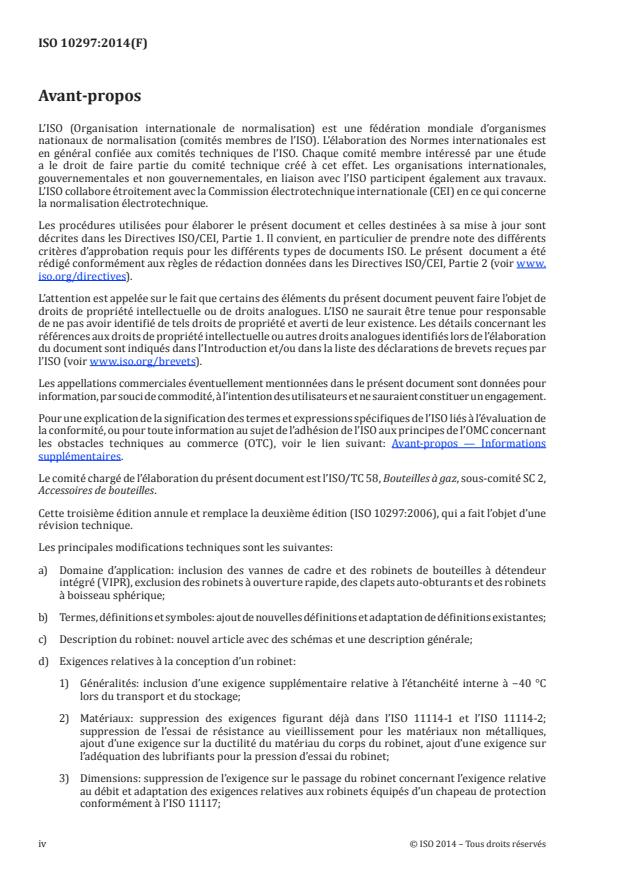
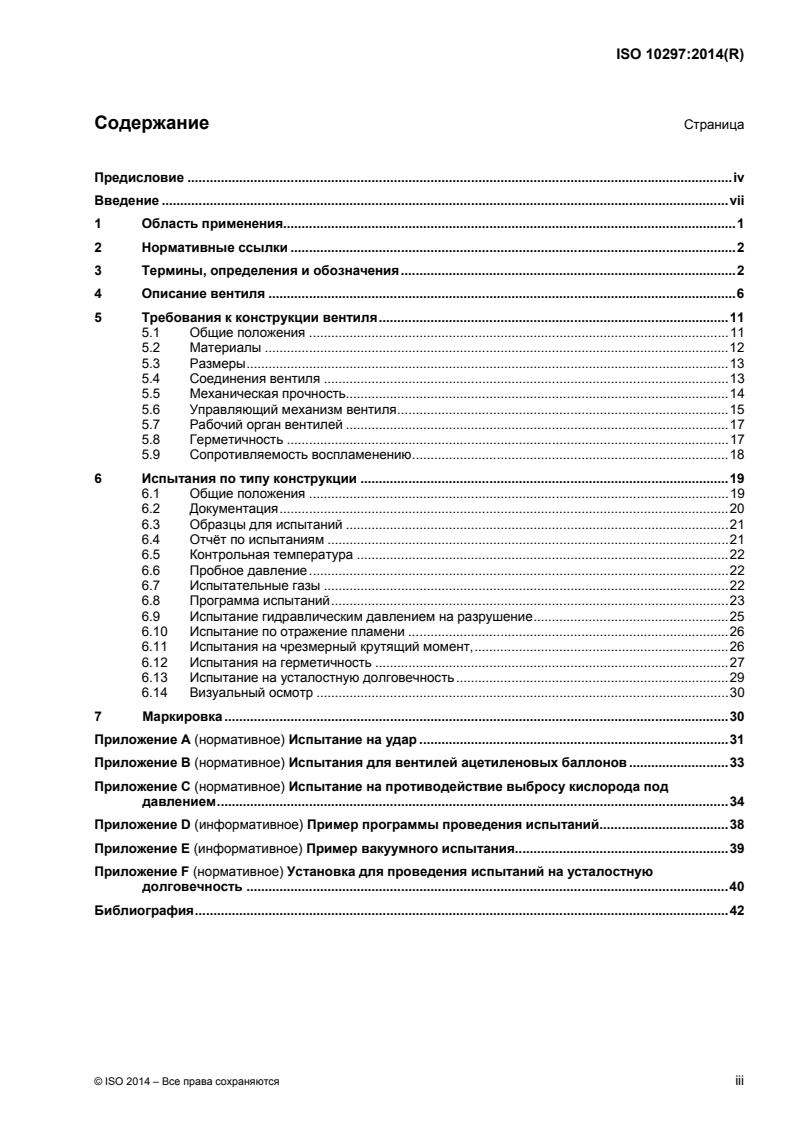
ISO 10297:2014 - Bouteilles à gaz -- Robinets de bouteilles -- Spécifications et essais de type

Get Certified
Connect with accredited certification bodies for this standard

Institut za varilstvo d.o.o. (Welding Institute)
Slovenia's leading welding institute since 1952. ISO 3834, EN 1090, pressure equipment certification, NDT personnel, welder qualification. Only IIW Au
Sponsored listings
Frequently Asked Questions
ISO 10297:2014 is a standard published by the International Organization for Standardization (ISO). Its full title is "Gas cylinders — Cylinder valves — Specification and type testing". This standard covers: ISO 10297:2014 specifies design, type testing and marking requirements for: a) cylinder valves intended to be fitted to refillable transportable gas cylinders; b) main valves (excluding ball valves) for cylinder bundles; c) cylinder valves or main valves with integrated pressure regulator (VIPR); which convey compressed, liquefied or dissolved gases. ISO 10297:2014 covers the function of a valve as a closure. It does not apply to valves for cryogenic equipment, portable fire extinguishers and liquefied petroleum gas (LPG) and quick-release valves (e.g. for fire-extinguishing, explosion protection and rescue applications), non-return valves or ball valves.
ISO 10297:2014 specifies design, type testing and marking requirements for: a) cylinder valves intended to be fitted to refillable transportable gas cylinders; b) main valves (excluding ball valves) for cylinder bundles; c) cylinder valves or main valves with integrated pressure regulator (VIPR); which convey compressed, liquefied or dissolved gases. ISO 10297:2014 covers the function of a valve as a closure. It does not apply to valves for cryogenic equipment, portable fire extinguishers and liquefied petroleum gas (LPG) and quick-release valves (e.g. for fire-extinguishing, explosion protection and rescue applications), non-return valves or ball valves.
ISO 10297:2014 is classified under the following ICS (International Classification for Standards) categories: 23.020.30 - Pressure vessels, gas cylinders; 23.020.35 - Gas cylinders; 23.060.40 - Pressure regulators. The ICS classification helps identify the subject area and facilitates finding related standards.
ISO 10297:2014 has the following relationships with other standards: It is inter standard links to EN ISO 15615:2022, EN ISO 3807:2013, EN ISO 22435:2024, EN ISO 10651-5:2021, EN ISO 17879:2017, EN ISO 14246:2022, EN ISO 11118:2015, EN ISO 10524-2:2019, EN ISO 10524-3:2019, EN ISO 17871:2020, EN ISO 11114-2:2021, EN 16603-35-10:2014, EN ISO 10524-1:2019, EN ISO 11114-1:2020, EN ISO 17871:2015. Understanding these relationships helps ensure you are using the most current and applicable version of the standard.
ISO 10297:2014 is available in PDF format for immediate download after purchase. The document can be added to your cart and obtained through the secure checkout process. Digital delivery ensures instant access to the complete standard document.
Standards Content (Sample)
INTERNATIONAL ISO
STANDARD 10297
Third edition
2014-07-15
Corrected version
2014-11-01
Gas cylinders — Cylinder valves —
Specification and type testing
Bouteilles à gaz — Robinets de bouteilles — Spécifications et essais de
type
Reference number
©
ISO 2014
© ISO 2014
All rights reserved. Unless otherwise specified, no part of this publication may be reproduced or utilized otherwise in any form
or by any means, electronic or mechanical, including photocopying, or posting on the internet or an intranet, without prior
written permission. Permission can be requested from either ISO at the address below or ISO’s member body in the country of
the requester.
ISO copyright office
Case postale 56 • CH-1211 Geneva 20
Tel. + 41 22 749 01 11
Fax + 41 22 749 09 47
E-mail copyright@iso.org
Web www.iso.org
Published in Switzerland
ii © ISO 2014 – All rights reserved
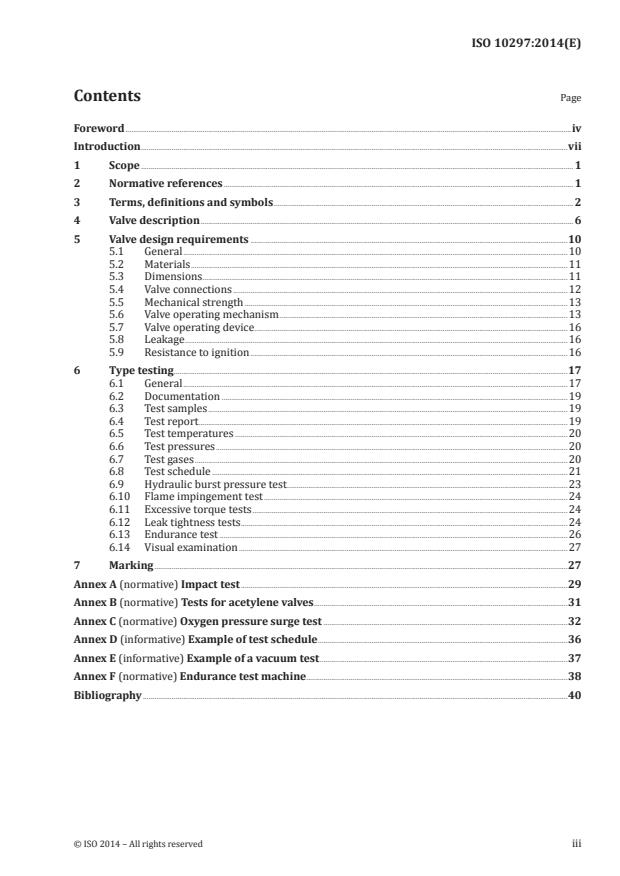
Contents Page
Foreword .iv
Introduction .vii
1 Scope . 1
2 Normative references . 1
3 Terms, definitions and symbols . 2
4 Valve description . 6
5 Valve design requirements .10
5.1 General .10
5.2 Materials .11
5.3 Dimensions .11
5.4 Valve connections .12
5.5 Mechanical strength .13
5.6 Valve operating mechanism .13
5.7 Valve operating device .16
5.8 Leakage .16
5.9 Resistance to ignition .16
6 Type testing.17
6.1 General .17
6.2 Documentation .19
6.3 Test samples .19
6.4 Test report .19
6.5 Test temperatures .20
6.6 Test pressures .20
6.7 Test gases .20
6.8 Test schedule .21
6.9 Hydraulic burst pressure test .23
6.10 Flame impingement test .24
6.11 Excessive torque tests .24
6.12 Leak tightness tests .24
6.13 Endurance test .26
6.14 Visual examination .27
7 Marking .27
Annex A (normative) Impact test .29
Annex B (normative) Tests for acetylene valves .31
Annex C (normative) Oxygen pressure surge test .32
Annex D (informative) Example of test schedule .36
Annex E (informative) Example of a vacuum test
.................................................................................................................................37
Annex F (normative) Endurance test machine .38
Bibliography .40
Foreword
ISO (the International Organization for Standardization) is a worldwide federation of national standards
bodies (ISO member bodies). The work of preparing International Standards is normally carried out
through ISO technical committees. Each member body interested in a subject for which a technical
committee has been established has the right to be represented on that committee. International
organizations, governmental and non-governmental, in liaison with ISO, also take part in the work.
ISO collaborates closely with the International Electrotechnical Commission (IEC) on all matters of
electrotechnical standardization.
The procedures used to develop this document and those intended for its further maintenance are
described in the ISO/IEC Directives, Part 1. In particular the different approval criteria needed for the
different types of ISO documents should be noted. This document was drafted in accordance with the
editorial rules of the ISO/IEC Directives, Part 2. www.iso.org/directives
Attention is drawn to the possibility that some of the elements of this document may be the subject of
patent rights. ISO shall not be held responsible for identifying any or all such patent rights. Details of any
patent rights identified during the development of the document will be in the Introduction and/or on
the ISO list of patent declarations received. www.iso.org/patents
Any trade name used in this document is information given for the convenience of users and does not
constitute an endorsement.
For an explanation on the meaning of ISO specific terms and expressions related to conformity
assessment, as well as information about ISO’s adherence to the WTO principles in the Technical Barriers
to Trade (TBT), see the following URL: Foreword - Supplementary information
The committee responsible for this document is ISO/TC 58, Gas cylinders, Subcommittee SC 2, Cylinder
fittings.
This third edition cancels and replaces the second edition (ISO 10297:2006), which has been technically
revised.
The main technical modifications are:
a) Scope: inclusion of main valves and valves with integrated pressure regulator (VIPR), exclusion of
quick-release valves, non-return valves and ball valves;
b) Terms, definitions and symbols: introduction of new definitions and adaptation of existing
definitions;
c) Valve description: new clause with figures and general description;
d) Valve design requirements:
1) General: inclusion of additional requirement of internal leak tightness at −40 °C during transport
and storage;
2) Materials: deletion of requirements already given in ISO 11114-1 and ISO 11114-2; deletion of
ageing sensitivity test for non-metallic materials; addition of requirement on ductility of valve
body material; addition of requirement on suitability of lubricants for valve test pressure;
3) Dimensions: deletion of requirement on bore of the valve with regard to flow requirement and
adaption of requirements for valves fitted with a valve protection cap according to ISO 11117;
4) Valve connections: addition of requirements for separate valve filling connection;
5) Resistance to mechanical impact: addition of requirement for impact testing valves protected
by a valve guard but fixed only to the valve, modification of acceptance criteria;
iv © ISO 2014 – All rights reserved
6) Valve operating mechanism: inclusion of allowance to increase the endurance torque for some
valve designs and to adjust compressed packed valves during endurance testing; replacement of
acetylene flashback test by alternative tests without using acetylene and addition of acetylene
decomposition test for main valves; modification of acceptance criteria;
7) Valve operating device: addition of requirement on the handwheel diameter required to achieve
the minimum closing torque; modification of acceptance criteria for flame impingement test;
8) Resistance to ignition: addition of requirement of oxygen pressure surge testing for certain
cylinder valves for gas mixtures containing oxygen and other oxidizing gases and of detailed
information on acceptance criteria; addition of mandatory reference to oxygen pressure surge
test for VIPR specified in ISO 22435 or ISO 10524-3 and for cylinder valves with residual
pressure devices specified in ISO 15996;
e) Production requirements: deletion of all respective requirements but reference to ISO 14246 in
scope;
f) Type testing:
1) General: addition of requirements for repeating tests depending on applied changes for a valve
design;
2) Documentation: addition of detailed information on documentation required;
3) Test samples: addition of requirement to have pressure gauges/indicators fitted;
4) Test report: addition of detailed information required;
5) Test pressures: adaption of information on burst test pressure (former hydraulic test pressure);
6) Test gas: addition of requirement for using helium or hydrogen or an inert mixture of these
gases for the leak tightness tests for cylinder valves for helium and hydrogen and their mixtures;
extension of requirements on gas quality;
7) Test schedule: deletion of ageing as preconditioning and leak tightness test before ageing;
addition of internal leak tightness test at −40 °C after endurance test; adaption of oxygen
pressure surge test for cylinder valves with lubricants not rated for valve test pressure; listing
of impact test;
8) Hydraulic burst pressure test: addition of testing the valve in closed position;
9) Excessive torque tests: addition of requirement to carry out the test with the valve operating
device in place; differentiation between handwheel and key/toggle operated valves; extension
of tests with requirement of two additional test samples;
10) Leak tightness tests: reference to informative Annex E for an example of a vacuum test;
unification of the lower test pressure of 0,5 bar for all gases; implementation of internal leak
tightness test at −40 °C; addition of information on required position of the valve operating
mechanism for external leak tightness test; adaption of requirement for test order for all
required test pressures; adaption of requirement for changing and maintaining the different
test temperatures; adaption of requirement for minimum closing torque;
11) Endurance test: addition of requirement to carry out the test with the handwheel in place and
of description of procedure for increasing the endurance torque for some valve designs;
12) Visual examination: addition of separate sub-clause for visual examination with detailed
information on acceptance criteria;
13) Oxygen pressure surge test: information on test installation and test procedure transferred to
normative Annex C; addition of detailed information on determination of pressure rise time;
addition of divergent installation requirements for testing main valves; addition of detailed
information on acceptance criteria;
14) Acetylene test: information transferred to normative Annex B;
15) Impact test: addition of information on the valving torque according to ISO 13341 to be
used; addition of subsequent hydraulic burst pressure test and internal leak tightness test;
modification of test procedure;
16) Marking: addition of requirement for marking cylinder valves oxygen pressure surge tested via
different connections and of detailed information on marking of valve inlet, valve outlet and
separate valve filling connections;
17) Example of test sequence: information transferred from informative Annex B to informative
Annex D and adaptation according to new requirements for valve designs and changes and
material specifications within a valve design;
18) Addition of informative Annex E, giving an example of a vacuum test;
19) Endurance test equipment and procedure: information transferred from normative Annex C to
normative Annex F.
g) full editorial rework.
This corrected version of ISO 10297:2014 incorporates the addition of titles to Figures 5 and 6.
vi © ISO 2014 – All rights reserved
Introduction
This International Standard covers the function of a cylinder valve as a closure (defined by the UN Model
Regulations). Additional features of cylinder valves (e.g. pressure regulators, residual pressure devices,
non-return devices and pressure relief devices) might be covered by other standards and/or regulations.
Cylinder valves complying with this International Standard can be expected to perform satisfactorily
under normal service conditions.
This International Standard pays particular attention to:
a) suitability of materials;
b) safety (mechanical strength, impact strength, endurance, leak tightness, resistance to ignition,
resistance to acetylene flashback);
c) testing;
d) marking.
This standard has been written to be in conformity with the UN Model Regulations. When published
it will be submitted to the UN Sub Committee of Experts on the Transport of Dangerous Goods with a
request that it be included in the UN Model Regulations.
Where there is any conflict between this International Standard and any applicable regulation, the
regulation always takes precedence.
Considering the changes described in the Foreword, when a cylinder valve has been approved according
to the previous version of this International Standard the body responsible for approving the same
cylinder valve to this new edition should consider which tests need to be performed.
In this International Standard the unit bar is used, due to its universal use in the field of technical gases.
It should, however, be noted that bar is not an SI unit, and that the corresponding SI unit for pressure is
5 5 2
Pa (1 bar = 10 Pa = 10 N/m ).
Pressure values given in this International Standard are given as gauge pressure (pressure exceeding
atmospheric pressure) unless noted otherwise.
INTERNATIONAL STANDARD ISO 10297:2014(E)
Gas cylinders — Cylinder valves — Specification and type
testing
1 Scope
This International Standard specifies design, type testing and marking requirements for:
a) cylinder valves intended to be fitted to refillable transportable gas cylinders;
b) main valves (excluding ball valves) for cylinder bundles;
c) cylinder valves or main valves with integrated pressure regulator (VIPR);
which convey compressed, liquefied or dissolved gases.
NOTE 1 Where there is no risk of ambiguity, cylinder valves, main valves and VIPR are addressed with the
collective term “valves” within this International Standard.
This International Standard covers the function of a valve as a closure.
This International Standard does not apply to
— valves for cryogenic equipment, portable fire extinguishers and liquefied petroleum gas (LPG), and
— quick-release valves (e.g. for fire-extinguishing, explosion protection and rescue applications), non-
return valves or ball valves.
NOTE 2 Requirements for valves for cryogenic vessels are specified in ISO 21011 and at a regional level e.g. in
EN 1626. Requirements for LPG valves are specified in ISO 14245 or ISO 15995. Requirements for quick-release
valves are specified e.g. in ISO 17871. Requirements for valves for portable fire extinguishers at a regional
level are specified e.g. in EN 3 series. Requirements for non-return valves and ball valves might be specified in
international/regional standards.
NOTE 3 Requirements for manufacturing tests and examinations of valves covered by this International
Standard are given in ISO 14246.
NOTE 4 Additional requirements for VIPR are specified in ISO 22435 for industrial applications or ISO 10524-3
for medical applications. Additional requirements for residual pressure valves with or without a non-return
function are specified in ISO 15996. Additional requirements for pressure-relief devices might be specified in
international/regional regulations/standards.
NOTE 5 Additional specific requirements for valves for breathing apparatus at a regional level are specified
e.g. in EN 144 series. Additional specific requirements for quick-release valves for fixed fire-fighting systems are
specified in ISO 16003 and at a regional level e.g. in EN 12094–4.
2 Normative references
The following referenced documents, in whole or in part, are normatively referenced in this document
and are indispensable for its application. For dated references, only the edition cited applies. For undated
references, the latest edition of the referenced document (including any amendments) applies.
ISO 148-1, Metallic materials — Charpy pendulum impact test — Part 1: Test method
ISO 407, Small medical gas cylinders — Pin-index yoke-type valve connections
ISO 10286, Gas cylinders — Terminology
ISO 10524-3, Pressure regulators for use with medical gases — Part 3: Pressure regulators integrated with
cylinder valves
ISO 11114-1, Gas cylinders — Compatibility of cylinder and valve materials with gas contents — Part 1:
Metallic materials
ISO 11114-2, Gas cylinders — Compatibility of cylinder and valve materials with gas contents — Part 2:
Non-metallic materials
ISO 11117:2008, Gas cylinders — Valve protection caps and valve guards — Design, construction and tests
ISO 13341, Gas cylinders — Fitting of valves to gas cylinders
ISO 15615:2013, Gas welding equipment — Acetylene manifold systems for welding, cutting and allied
processes — Safety requirements in high-pressure devices
ISO 15996, Gas cylinders — Residual pressure valves — General requirements and type testing
ISO 22435, Gas cylinders — Cylinder valves with integrated pressure regulators — Specification and type
testing
3 Terms, definitions and symbols
For the purposes of this document, the terms and definitions given in ISO 10286, and the following apply.
3.1
valve operating mechanism
mechanism which closes and opens the valve orifice and which includes the internal and external sealing
systems
Note 1 to entry: In ISO 22435 the valve operating mechanism is called shut-off mechanism.
Note 2 to entry: For some VIPR designs the pressure regulating valve can act as the shut-off mechanism.
EXAMPLE A threaded valve spindle which, when rotated, raises and lowers a seal/seat.
3.2
valve design
classification of valves with regard to the valve operating mechanism (3.1)
3.3
valve operating device
component which actuates the valve operating mechanism (3.1)
EXAMPLE Handwheel, key, knob, toggle, lever or actuator.
3.4
external leak tightness
leak tightness to atmosphere (leakage in and/or leakage out) when the valve is open
Note 1 to entry: See Figure 1.
2 © ISO 2014 – All rights reserved
p < p p > p
a a
Key
1 valve outlet connection (sealed)
a
Leakage in (vacuum test)
b
Leakage out
p internal pressure
p atmospheric pressure
a
Figure 1 — External leak tightness
3.5
internal leak tightness
leak tightness across the valve seat (leakage in and/or leakage out) when the valve is closed
Note 1 to entry: See Figure 2.
p < p p > p
a a
Key
1 valve outlet connection (open)
a
Leakage in (vacuum test).
b
Leakage out.
p internal pressure
p atmospheric pressure
a
Figure 2 — Internal leak tightness
3.6
valve working pressure
p
w
settled pressure of a compressed gas at a uniform reference temperature of 15 °C in a full gas cylinder
or cylinder bundle for which the valve is intended
Note 1 to entry: This definition does not apply to liquefied gases (e.g. carbon dioxide), or dissolved gases (e.g.
acetylene).
Note 2 to entry: The valve working pressure is expressed in bar.
3.7
valve burst test pressure
p
vbt
minimum pressure applied to a valve during hydraulic burst pressure test
Note 1 to entry: The valve burst test pressure is expressed in bar.
3.8
valve test pressure
p
vt
minimum pressure applied to a valve during testing
Note 1 to entry: The valve test pressure is expressed in bar.
3.9
handwheel diameter
D
nominal value of twice the largest radius from the centre of the handwheel
Note 1 to entry: The handwheel diameter is expressed in mm.
3.10
minimum torque
T
c
torque necessary to be applied to a valve operating device (3.3) of a newly manufactured valve to obtain
internal leak tightness (3.5) at valve test pressure (3.8) and room temperature
Note 1 to entry: The minimum closing torque is expressed in Nm.
3.11
endurance torque
T
e
closing torque applied during the endurance test
Note 1 to entry: The endurance torque is expressed in Nm.
4 © ISO 2014 – All rights reserved
3.11.1
endurance torque at start
T
e,start
endurance torque (3.11) to be applied at the beginning of the endurance test
3.11.2
endurance torque at end
T
e,end
endurance torque (3.11) measured at the end of the endurance test to achieve internal leak tightness (3.5)
3.12
over torque
T
o
opening or closing torque (whichever is the lower value) applied to the valve operating device (3.3) to
determine the level of torque which the valve operating mechanism (3.1) can tolerate and remain operable
Note 1 to entry: The over torque is expressed in Nm.
3.13
failure torque
T
f
opening or closing torque (whichever is the lower value) applied to the valve operating device (3.3) to
obtain mechanical failure of the valve operating mechanism (3.1) and/or valve operating device (3.3)
Note 1 to entry: The failure torque is expressed in Nm.
3.14
total package mass
combined mass of a gas cylinder (including, for dissolved gases, any porous material and solvent), its
valve(s), its permanent attachment(s) and its maximum allowed gas content
Note 1 to entry: Valve guards but not valve protection caps are examples of permanent attachments.
Note 2 to entry: The total package mass is expressed in kg.
3.15
main valve
valve which is fitted to a cylinder bundle’s manifold isolating it from the main connection(s)
3.16
valve inlet connection
connection on the valve which connects the valve to the cylinder(s)
3.17
valve outlet connection
connection on the valve used to discharge the cylinder(s)
Note 1 to entry: For most valves this connection is also used for filling the cylinder(s).
3.18
valve filling connection
connection on the valve used to fill the cylinder(s)
Note 1 to entry: For some valves (e.g. VIPRs) the valve filling connection is different from the valve outlet
connection.
3.19
NTP
normal temperature and pressure
[SOURCE: 20,0 °C (293,15 K), 1,013 bar absolute (0,101 3 MPa absolute)]
4 Valve description
4.1 A valve typically comprises of:
a) valve body;
b) valve operating mechanism;
c) valve operating device;
d) means to ensure internal leak tightness;
e) means to ensure external leak tightness;
f) valve outlet connection(s);
g) valve inlet connection;
4.2 Valves can also include:
a) pressure-relief device;
NOTE The relevant transport regulation might require or forbid pressure relief devices for some gases,
gas mixtures or gas groups.
b) dip tube;
c) outlet connection plug/cap;
d) excess flow device;
e) non-return valve on the valve filling connection;
f) residual pressure device with or without non-return function;
g) pressure regulating device;
h) separate valve filling connection;
i) flow restricting orifice;
j) filter(s).
4.3 Common valve designs are:
a) o-ring gland seal valves (see Figure 3);
b) diaphragm gland seal valves (see Figure 4);
c) compression packed gland seal valves (see Figure 5);
d) pressure seal valves (see Figure 6); and
e) reverse seated valves (see Figure 7).
1)
The valve designs shown in Figures 3 to 7 are given as typical examples, each with one sealing system
and one valve operating device only.
1) Figure 3 to Figure 7 © Compressed Gas Association (CGA). These figures are reproduced from CGA V-9—
2012, Compressed Gas Association Standard for Compressed Gas Cylinder Valves, with permission from the Compressed
Gas Association. All rights reserved.
6 © ISO 2014 – All rights reserved
2)
A pin-index (post-type medical) valve (see Figure 8 ) is shown for illustration to identify unique
geometry in common medical gas cylinder applications.
Key
1 handwheel 1 handwheel retaining screw
2 handwheel retaining nut/stem nut 2 washer
3 upper spindle/upper stem 3 gland nut/bonnet
4 o-ring 4 diaphragms
5 seat insert 5 flow restrictor (when specified)
6 valve outlet connection 6 seat insert
7 valve inlet connection 7 pressure relief device
8 pressure relief device 8 body seat
9 body seat 9 seat opening spring
10 lower spindle/lower plug 10 lower spindle/lower plug
11 washer 11 upper spindle/upper stem
12 gland nut/bonnet 12 handwheel
Figure 3 — O-ring gland seal valve Figure 4 — Diaphragm gland seal valve
1) 1)
(non-metallic seal, handwheel operated) (non-metallic seal, handwheel operated)
2) Figure 8 © Compressed Gas Association (CGA). This figure is reproduced from CGA V-9—2012, Compressed
Gas Association Standard for Compressed Gas Cylinder Valves, with permission from the Compressed Gas Association.
All rights reserved.
Key
1 spindle/valve stem, one-piece 1 handwheel retaining nut/stem nut
2 packings 2 pressure seal loading spring
3 cap nut/outlet seal cap 3 washer
4 outlet seal gasket 4 packings
5 valve inlet connection 5 upper spindle / upper stem
6 pressure relief device 6 tang
7 packing collar 7 valve outlet connection
8 packing gland 8 body seat
9 packing nut 9 valve inlet connection
10 pressure relief device
11 seat insert
12 lower spindle/lower plug
13 gland nut/bonnet
14 handwheel
Figure 5 — Compression packed gland seal Figure 6 — Pressure seal valve (non-metallic seal,
1) 1)
valve (metal to metal seal, key operated) handwheel operated)
8 © ISO 2014 – All rights reserved
Key
1 seat insert
2 poppet
3 lever
4 o-ring
5 body seat
6 handle
7 valve inlet connection
8 seat closing spring
9 pressure relief device
10 gland nut/bonnet
11 valve outlet connection
12 diffuser
1)
Figure 7 — Reverse seated valve (non-metallic seal, lever operated)
Key
1 toggle
2 upper spindle/upper stem
3 packings
4 lower spindle/lower plug
5 valve outlet connection
6 pin index holes
7 valve inlet connection
8 pressure relief device
9 body seat
10 seat insert
11 pressure seal loading spring
12 gland nut/bonnet
2)
Figure 8 — Pin-index (post-type medical) valve (non-metallic seal, toggle operated)
5 Valve design requirements
5.1 General
Valves shall operate within specification and be leak tight over a range of service temperatures, from at
least −20 °C to +65 °C in indoor and outdoor environments.
Closed valves shall be internally leak tight during transport and storage (see test 6 in Table 3) for
temperatures down to −40 °C.
Where higher or lower service temperatures are required, any additional requirements and tests shall
be agreed between the manufacturer and purchaser.
10 © ISO 2014 – All rights reserved
5.2 Materials
Metallic and non-metallic materials in contact with the gas shall be chemically and physically compatible
with the gas, according to ISO 11114-1 and ISO 11114-2 under all intended operating conditions. For
valves used for dissolved gases, the compatibility of the materials in contact with the solvent shall also
be considered. For valves used with gas mixtures, the compatibility of the gas wetted materials with
each component of the gas mixture shall be considered.
When using plated or coated components in gas wetted areas the material compatibility of both, the
plating/coating material and the substrate material shall be taken into account. In addition consideration
should be given to avoid flaking or particle generation, especially for oxygen, other oxidizing gases (as
defined in ISO 10156) and gas mixtures containing oxygen or other oxidizing gases.
The material used for the valve body shall be either
a) a material not showing a ductile to brittle transition (e.g. copper alloys, austenitic stainless steels,
aluminium alloys and nickel alloys), or
b) a ferritic material (e.g. carbon steel) having an impact value greater than 27 J at −40 °C when
submitted to the Charpy pendulum impact test as specified in ISO 148-1.
Ignition resistance of non-metallic materials, lubricants and adhesives used in the gas wetted area of
valves requiring oxygen pressure surge testing (see 5.9) should be considered (e.g. using an appropriate
test procedure such as ISO 11114-3 for Auto Ignition Temperature (AIT) testing and ISO 21010:2004,
Annex C for oxygen pressure surge testing of materials). Non-metallic materials used in oxygen wetted
areas should have an AIT of at least 100 °C above its maximum service temperature tested at a pressure
of at least 100 bar (see ISO 15001 or ASTM G63).
Lubricants used in the gas wetted area of valves for gases requiring oxygen pressure surge testing
(see 5.9) shall either
1) be rated for
— at least p in cases of single gases, or
vt
— a pressure not less than the corresponding oxygen partial pressure in case of gas mixtures
containing other oxidizing gases than air with a partial pressure greater than 30 bar, or
NOTE This rated pressure is the maximum pressure at which the lubricant passed the oxygen pressure surge
test described in ISO 21010:2004, Annex C.
2) be permitted only if the corresponding valve passes the oxygen pressure surge test after being pre-
conditioned via the endurance cycling procedure but without subsequent leak tightness tests and
final visual examination being performed.
For medical and breathing applications ISO 15001 should be considered, especially when selecting
materials to reduce the risk of toxic products of combustion/decomposition from non-metallic materials
including lubricants.
5.3 Dimensions
For pin-index (post-type medical) valves in medical gas service (see Figure 8) the external dimensions
shall be in accordance with the requirements of ISO 407.
If the valve is intended to be protected by a valve protection cap, the valve dimensions shall be such that
the combination shall comply with the performance requirements of ISO 11117. For a valve to be used
with a valve protection cap according to ISO 11117:2008, Figure 1, its external dimensions shall comply
with the dimensions given in Figure 9.
Key
r ≤ 32,5 mm h ≤ 90 mm
R ≤ 38 mm L ≤ 125 mm
R shall be measured to the part of the valve furthest from the valve stem axis and includes any valve outlet plugs or
caps if fitted
NOTE 1 h represents the length of the lower part of the valve when R is greater than r.
NOTE 2 L is the length of the valve in the closed position when not fitted to a cylinder.
NOTE 3 r relates to the axis of the valve inlet connection and not to the centreline of the valve operating device.
Figure 9 — Maximum dimensions for valves protected by a valve protection cap in accordance
with ISO 11117:2008, Figure 1
5.4 Valve connections
Valve inlet and outlet connections shall conform to an International Standard, other regional or national
standards or proprietary designs that have been qualified to an acceptable industry standard.
NOTE 1 International valve inlet connection standards are for example ISO 11363-1 and ISO 15245-1.
NOTE 2 International valve outlet connection standards are for example ISO 407, ISO 5145 and ISO 10692-1. A
partial compilation of regional and national standards is given in ISO/TR 7470.
NOTE 3 Qualification procedures for proprietary valve inlet connection designs are for example given in
ISO 10692-2.
NOTE 4 Qualification procedures for proprietary valve outlet connection designs are for example given in
CGA V-1.
If the valve filling connection is separate to the valve outlet connection and not equipped with a non-
return valve or isolating valve, it shall be provided with a pressure-tight device (e.g. a plug or cap which
can be operated or removed only by the use of a special tool). Where applicable, such a pressure-tight
device shall be designed to vent gas before becoming disengaged.
12 © ISO 2014 – All rights reserved
The valve filling connection non-return valve, if fitted, shall comply with the relevant requirements of
ISO 22435 for industrial applications or ISO 10524-3 for medical applications.
NOTE 5 See ISO 5145 for examples of valve filling connections.
5.5 Mechanical strength
5.5.1 Resistance to hydraulic burst pressure
Valves shall withstand p (see 6.6.1) without permanent visible deformation or burst.
vbt
The hydraulic burst pressure test is given in 6.9.
5.5.2 Resistance to mechanical impact
Valves shall withstand a mechanical impact, if
a) used for cylinders with a water capacity greater than 5 l and not intended to be protected during
transport by
— a valve protection cap or a valve guard complying with ISO 11117, or
— other means;
NOTE Applicable transport regulations normally specify the variety of acceptable means.
b) used for cylinders of any water capacity where a valve guard is fixed only to the valve and not to the
cylinder. The valve shall be tested without the valve guard fitted.
NOTE For valves used in cylinders with a water capacity less than 5 l, transport regulations might still
require the valves to be inherently able to withstand damage without release of the contents or to be protected
during transport.
Main valves during transport are adequately protected by the frame of the cylinder bundle, e.g. tested
in accordance with ISO 10961; therefore no impact test is required.
Distortion due to impact is permissible. After being impacted, the closed valve shall withstand a
hydraulic pressure test in the closed position only and an internal tightness test, each at p . Leakage
vt
of gas through the threaded joint between the valve and the cylinder/test fixture is acceptable except
if it results from cracks in the valve inlet connection. This shall be checked by applying p through the
vt
valve inlet gas passage. In addition the test sample shall remain capable of being opened for emergency
venting purposes by hand or by using a simple tool (e.g. a valve key) or actuating connector provided the
opening torque, if relevant, does not exceed Tf, see Table 1.
The impact test is given in Annex A.
5.6 Valve operating mechanism
5.6.1 The valve operating mechanism shall meet the requirements of 5.6.2 to 5.6.6.
5.6.2 It shall be possible to open and close the valve at pressures up to p (see 6.6.2) without using any
vt
additional equipment not recommended by the manufacturer. This shall be verified during endurance
test, see 6.13.
It should be designed in such a way that the setting of the operating position of the valve cannot be
inadvertently altered, i.e. if the valve is closed it should remain closed during normal service or normal
transport.
5.6.3 The valve operating mechanism shall function satisfactorily after 2 000 opening and closing cycles
with T according to Table 1 at p according to 6.6.2 without replacement of the sealing system. For some
e vt
valve designs T is allowed to be increased during the given cycles. For compression packed valves, if
e
needed, adjustment of the packing nut according to the manufacturer’s specification is permitted.
The number of cycles may be increased for certain designs necessary for special applications. This
number of cycles shall be defined by the manufacturer on the basis of a specification from the customer
or industry regarding the likely service conditions.
The endurance test is given in 6.13.
After the endurance test and the subsequent leak tightness tests have been performed a visual
examination shall be carried out to ensure that no components are displaced (no longer in the place
where it was installed), non-functional (e.g. broken) or missing.
The visual examination is given in 6.14.
5.6.4 The valve operating mechanism shall withstand T and T each according to Table 1.
o f
At T the valve shall be able to work without noticeable difficulties. It shall not show any damage or
o
failure of any component of the valve operating mechanism and/or valve operating device. This shall be
checked by visual examination after dismantling the valve.
At T , the valve operating mechanism may be severely damaged and not operable. Mechanical failure
f
shall occur prior to the valve operating mechanism unscrewing itself from the valve body and shall
be in a manner that will not result in ejection of valve components. This shall be checked by visual
examination.
The excessive torque tests are given in 6.11.
The tests are not applicable if an excessive torque cannot be applied, e.g. for lever operated valves or
for valves with pneumatic actuator. For VIPR designs where the pressure regulating valve is acting as
the main-shut off mechanism, test requirement and test procedure have to be decided on a case by case
basis and agreed between the manufacturer and the test laboratory.
Table 1 — Torques to be used for the endurance test and excessive torque tests
Valve design Valve seal/ Valve operat- Endurance torque Over torque Failure torque
as given in 4.3 seat ing device
T T
o f
T
e
(with a relative tolerance of
+10
% )
O-ring gland Handwheel
seal valve diameter
7 Nm 20 Nm 25 Nm
and D = 65 mm
other
pressure seal
Non-metallic
handwheel D × 7/65 D × 20/65 1,25 × T
valve
o
diameters
and
reverse seated a
Key/toggle T / 3 T / 1,25 T
o f f
valve
NOTE 1 Standard industry practice is to apply a 7 Nm closing torque on commonly used 65 mm handwheel diameter valves
during operation.
NOTE 2 There is a general consensus that a nominal maximum torque of 16 Nm can be achieved by hand with a 65 mm
handwheel diameter.
a
The determination of T and T is given in 6.11.3.
f o
14 © ISO 2014 – All rights reserved
Table 1 (continued)
Valve design Valve seal/ Valve operat- Endurance torque Over torque Failure torque
as given in 4.3 seat ing device
T T
o f
T
e
(with a relative tolerance of
+10
% )
Handwheel
T = 7 Nm
e,start
diameter
20 Nm 25 Nm
Diaphragm
T ≤ 10,5 Nm
e,end
gland seal valve
D = 65 mm
and other
Non-metallic T = D × 7/65
e,start
handwheel D × 20/65 1,25 × T
o
T ≤ 1,5 × T ≤ 16 Nm
compression
e,end e,start
diameters
packed gland
T = T /3
seal valve
e,start o
a
Key/toggle T /1,25 T
f f
T ≤ 1,5 × T
e,end e,start
T
e,start
is to be specified by the manu-
facturer, but not less than
Handwheel
diameter 1,5 × T
c
20 Nm 25 Nm
D = 65 mm and not less than
O-ring gland
7 Nm
seal valve
T ≤ 1,5 × T ≤ 16 Nm
e,end e,start
and
T
e,start
diaphragm
Metal to
gland seal valve
is to be specified by the man
...
NORME ISO
INTERNATIONALE 10297
Troisième édition
2014-07-15
Version corrigée
2014-11-01
Bouteilles à gaz — Robinets de
bouteilles — Spécifications et essais
de type
Gas cylinders — Cylinder valves — Specification and type testing
Numéro de référence
©
ISO 2014
DOCUMENT PROTÉGÉ PAR COPYRIGHT
© ISO 2014
Droits de reproduction réservés. Sauf indication contraire, aucune partie de cette publication ne peut être reproduite ni utilisée
sous quelque forme que ce soit et par aucun procédé, électronique ou mécanique, y compris la photocopie, l’affichage sur
l’internet ou sur un Intranet, sans autorisation écrite préalable. Les demandes d’autorisation peuvent être adressées à l’ISO à
l’adresse ci-après ou au comité membre de l’ISO dans le pays du demandeur.
ISO copyright office
Case postale 56 • CH-1211 Geneva 20
Tel. + 41 22 749 01 11
Fax + 41 22 749 09 47
E-mail copyright@iso.org
Web www.iso.org
Publié en Suisse
ii © ISO 2014 – Tous droits réservés
Sommaire Page
Avant-propos .iv
Introduction .vii
1 Domaine d’application . 1
2 Références normatives . 1
3 Termes, définitions et symboles . 2
4 Description du robinet . 6
5 Exigences relatives à la conception du robinet .11
5.1 Généralités .11
5.2 Matériaux .12
5.3 Dimensions .12
5.4 Raccords de robinet .13
5.5 Résistance mécanique .14
5.6 Mécanisme de manœuvre du robinet .14
5.7 Dispositif de manœuvre du robinet .17
5.8 Fuites .17
5.9 Résistance à l’inflammation .18
6 Essais de type .19
6.1 Généralités .19
6.2 Documentation .20
6.3 Échantillons d’essai .21
6.4 Rapport d’essai .21
6.5 Températures d’essai .21
6.6 Pressions d’essai .21
6.7 Gaz d’essai .22
6.8 Séquence d’essai .23
6.9 Essai de pression de rupture hydraulique .24
6.10 Essai d’exposition à la flamme.25
6.11 Essais de résistance à un couple excessif .25
6.12 Essais d’étanchéité .25
6.13 Essai d’endurance .27
6.14 Examen visuel .28
7 Marquage .28
Annexe A (normative) Essai de choc mécanique .30
Annexe B (normative) Essais pour robinets de bouteilles d’acétylène .32
Annexe C (normative) Essai de compression adiabatique à l’oxygène .33
Annexe D (informative) Exemple de séquence d’essais .37
Annexe E (informative) Exemple d’essai de tenue au vide
.........................................................................................................38
Annexe F (normative) Machine d’essai d’endurance .39
Bibliographie .41
Avant-propos
L’ISO (Organisation internationale de normalisation) est une fédération mondiale d’organismes
nationaux de normalisation (comités membres de l’ISO). L’élaboration des Normes internationales est
en général confiée aux comités techniques de l’ISO. Chaque comité membre intéressé par une étude
a le droit de faire partie du comité technique créé à cet effet. Les organisations internationales,
gouvernementales et non gouvernementales, en liaison avec l’ISO participent également aux travaux.
L’ISO collabore étroitement avec la Commission électrotechnique internationale (CEI) en ce qui concerne
la normalisation électrotechnique.
Les procédures utilisées pour élaborer le présent document et celles destinées à sa mise à jour sont
décrites dans les Directives ISO/CEI, Partie 1. Il convient, en particulier de prendre note des différents
critères d’approbation requis pour les différents types de documents ISO. Le présent document a été
rédigé conformément aux règles de rédaction données dans les Directives ISO/CEI, Partie 2 (voir www.
iso.org/directives).
L’attention est appelée sur le fait que certains des éléments du présent document peuvent faire l’objet de
droits de propriété intellectuelle ou de droits analogues. L’ISO ne saurait être tenue pour responsable
de ne pas avoir identifié de tels droits de propriété et averti de leur existence. Les détails concernant les
références aux droits de propriété intellectuelle ou autres droits analogues identifiés lors de l’élaboration
du document sont indiqués dans l’Introduction et/ou dans la liste des déclarations de brevets reçues par
l’ISO (voir www.iso.org/brevets).
Les appellations commerciales éventuellement mentionnées dans le présent document sont données pour
information, par souci de commodité, à l’intention des utilisateurs et ne sauraient constituer un engagement.
Pour une explication de la signification des termes et expressions spécifiques de l’ISO liés à l’évaluation de
la conformité, ou pour toute information au sujet de l’adhésion de l’ISO aux principes de l’OMC concernant
les obstacles techniques au commerce (OTC), voir le lien suivant: Avant-propos — Informations
supplémentaires.
Le comité chargé de l’élaboration du présent document est l’ISO/TC 58, Bouteilles à gaz, sous-comité SC 2,
Accessoires de bouteilles.
Cette troisième édition annule et remplace la deuxième édition (ISO 10297:2006), qui a fait l’objet d’une
révision technique.
Les principales modifications techniques sont les suivantes:
a) Domaine d’application: inclusion des vannes de cadre et des robinets de bouteilles à détendeur
intégré (VIPR), exclusion des robinets à ouverture rapide, des clapets auto-obturants et des robinets
à boisseau sphérique;
b) Termes, définitions et symboles: ajout de nouvelles définitions et adaptation de définitions existantes;
c) Description du robinet: nouvel article avec des schémas et une description générale;
d) Exigences relatives à la conception d’un robinet:
1) Généralités: inclusion d’une exigence supplémentaire relative à l’étanchéité interne à −40 °C
lors du transport et du stockage;
2) Matériaux: suppression des exigences figurant déjà dans l’ISO 11114-1 et l’ISO 11114-2;
suppression de l’essai de résistance au vieillissement pour les matériaux non métalliques,
ajout d’une exigence sur la ductilité du matériau du corps du robinet, ajout d’une exigence sur
l’adéquation des lubrifiants pour la pression d’essai du robinet;
3) Dimensions: suppression de l’exigence sur le passage du robinet concernant l’exigence relative
au débit et adaptation des exigences relatives aux robinets équipés d’un chapeau de protection
conformément à l’ISO 11117;
iv © ISO 2014 – Tous droits réservés
4) Raccords de robinet: ajout d’exigences relatives à un raccord de remplissage séparé;
5) Résistance au choc mécanique: ajout d’une exigence relative aux essais de choc des robinets
protégés par un chapeau ouvert de robinet mais fixé uniquement au robinet, modification des
critères d’acceptation;
6) Mécanisme de manœuvre du robinet: inclusion de la possibilité d’augmenter le couple d’endurance
pour certaines conceptions de robinets et d’ajuster les robinets à garniture comprimée lors des
essais d’endurance, remplacement de l’essai de retour de flamme d’acétylène par d’autres essais
qui n’utilisent pas d’acétylène et ajout de l’essai de décomposition à l’acétylène pour les vannes
de cadre; modification des critères d’acceptation;
7) Dispositif de manœuvre du robinet: ajout d’une exigence relative au diamètre du volant requis
pour atteindre le couple de fermeture minimal; modification des critères d’acceptation pour
essai d’exposition à la flamme;
8) Résistance à l’inflammation: ajout d’une exigence relative à l’essai de compression adiabatique à
l’oxygène pour certains robinets de bouteilles pour les mélanges de gaz contenant de l’oxygène
et pour d’autres gaz comburants et ajout d’informations détaillées sur les critères d’acceptation;
ajout d’une référence obligatoire à l’essai de compression adiabatique à l’oxygène pour les VIPR
spécifiés dans l’ISO 22435 ou l’ISO 10524-3 et pour les robinets de bouteilles avec dispositifs à
pression résiduelle spécifiés dans l’ISO 15996;
e) Exigences de production: suppression de toutes les exigences respectives mais référence à
l’ISO 14246 dans le cadre du domaine d’application;
f) Essais de type:
1) Généralités: ajout d’exigences pour des essais répétés en fonction des modifications appliquées
à la conception d’un robinet;
2) Documentation: ajout d’informations détaillées sur la documentation requise;
3) Échantillons d’essai: ajout d’une exigence portant sur l’installation de manomètres/indicateurs
de pression intégrés;
4) Rapport d’essai: ajout d’informations détaillées requises;
5) Pressions d’essai: adaptation des informations sur la pression d’essai de rupture (anciennement
pression d’essai hydraulique);
6) Gaz d’essai: ajout d’une exigence relative à l’utilisation de l’hélium, de l’hydrogène ou d’un
mélange inerte de ces gaz pour les essais d’étanchéité pour les robinets de bouteilles à hélium,
hydrogène ou des mélanges de ces deux gaz, extension des exigences sur la qualité des gaz;
7) Programme d’essais: suppression du vieillissement en tant que préconditionnement et
suppression de l’essai d’étanchéité avant vieillissement; ajout d’un essai d’étanchéité interne à
-40 °C après l’essai d’endurance, adaptation de l’essai de compression adiabatique à l’oxygène
pour les robinets de bouteilles avec lubrifiants non prévus pour la pression d’essai de robinet,
détail de l’essai de choc mécanique;
8) Essai de pression de rupture hydraulique ajout d’un essai du robinet en position fermée;
9) Essais de résistance à un couple excessif: ajout de l’exigence d’effectuer l’essai avec le dispositif
de manœuvre du robinet en place, différenciation entre les robinets commandés par un volant
et les robinets commandés par une clé/bascule, extension des essais avec l’exigence de deux
échantillons d’essai supplémentaires;
10) Essais d’étanchéité: référence à l’Annexe E informative pour un exemple d’essai de tenue au
vide, unification de la pression d’essai minimale de 0,5 bar pour tous les gaz, ajout de l’essai
d’étanchéité interne à −40 °C, ajout d’informations sur la position requise du mécanisme de
manœuvre du robinet pour l’essai d’étanchéité externe, adaptation de l’exigence relative à
l’ordre de l’essai pour toutes les pressions d’essai requises, adaptation de l’exigence relative à
la modification et au maintien des différentes températures d’essai, adaptation de l’exigence
relative au couple de fermeture minimal;
11) Essai d’endurance: ajout de l’exigence d’effectuer l’essai avec le volant en place et de la description
de la méthode d’augmentation du couple d’endurance pour certaines conceptions de robinets;
12) Examen visuel: ajout d’un paragraphe distinct pour l’examen visuel avec des informations
détaillées sur les critères d’acceptation;
13) Essai de compression adiabatique à l’oxygène: informations sur l’installation d’essai et sur le
mode opératoire d’essai déplacées à l’Annexe C normative; ajout d’informations détaillées sur
la détermination du temps d’élévation de pression; ajout d’exigences d’installation différentes
relatives à l’essai des vannes de cadre; ajout d’informations détaillées sur les critères
d’acceptation;
14) Essai d’acétylène: informations déplacées à l’Annexe B normative;
15) Essai de choc mécanique: ajout d’informations sur le couple de robinet conformément à
l’ISO 13341 à utiliser; ajout d’autres essais de pression de rupture hydraulique et d’étanchéité
interne; modification du mode opératoire d’essai;
16) Marquage: ajout d’une exigence relative au marquage de la compression adiabatique à l’oxygène
des robinets de bouteilles soumis à essai utilisant différents raccords et d’informations détaillées
sur le marquage des raccords d’entrée, des raccords de sortie de robinet et des raccords de
remplissage séparés;
17) Exemple de séquence d’essais: informations déplacées de l’Annexe B informative à l’Annexe D
informative et adaptation en fonction des nouvelles exigences relatives aux conceptions d’un
robinet et aux modifications et spécifications de matériaux au niveau de la conception d’un robinet;
18) Ajout de l’Annexe E informative, avec un exemple d’essai de tenue au vide;
19) Équipement et méthode de l’essai d’endurance: informations déplacées de l’Annexe C normative
à l’Annexe F normative.
g) refonte éditoriale.
La présente version corrigée de l’ISO 10297:2014 inclut l’ajout des titres des Figures 5 et 6.
vi © ISO 2014 – Tous droits réservés
Introduction
La présente Norme internationale couvre la fonction d’un robinet de bouteille en tant que dispositif
de fermeture (définie par le règlement type UN (Nations Unies)). Les autres fonctions d’un robinet de
bouteille (par exemple, détendeurs, dispositifs à pression résiduelle, dispositifs anti-retour et dispositifs
limiteurs de pression) sont susceptibles d’être couvertes par d’autres normes et réglementations.
On peut considérer que les robinets de bouteilles conformes à la présente Norme internationale
fonctionnent de manière satisfaisante dans des conditions normales de service.
La présente Norme internationale traite tout particulièrement des aspects suivants:
a) aptitude à l’emploi des matériaux;
b) sécurité (résistance mécanique, résistance au choc, endurance, étanchéité, résistance à
l’inflammation, résistance au retour de flamme d’acétylène);
c) essais;
d) marquage.
La présente Norme a été rédigée de façon à assurer la conformité au règlement type UN (Nations
Unies). Une fois publiée, elle sera soumise au Sous-comité d’experts des Nations Unies du transport des
marchandises dangereuses avec une demande pour l’inclure dans le règlement type UN (Nations Unies).
En cas de conflit entre la présente Norme internationale et toute réglementation applicable, la
réglementation prévaut toujours.
Compte tenu des modifications décrites dans l’Avant-propos, dès lors qu’un robinet de bouteille a été
approuvé conformément à la version précédente de la présente Norme internationale, il convient que
l’organisme en charge de l’approbation de ce même robinet de bouteille par rapport à la présente nouvelle
édition de déterminer les essais qui doivent être effectués.
Dans cette Norme internationale, l’unité bar est utilisée, en raison de son utilisation universelle dans le
domaine des gaz techniques. Il convient toutefois de noter que le bar n’est pas une unité SI et que l’unité
5 5 2
SI correspondante pour la pression est le Pa (1 bar = 10 Pa = 10 N/m ).
Les valeurs de pression données dans la présente Norme internationale sont données en tant que
pression relative (pression supérieure à la pression atmosphérique) sauf mention contraire.
NORME INTERNATIONALE ISO 10297:2014(F)
Bouteilles à gaz — Robinets de bouteilles — Spécifications
et essais de type
1 Domaine d’application
La présente Norme internationale spécifie la conception, les méthodes d’essai de type et les exigences
de marquage pour:
a) les robinets de bouteilles destinés à être montés sur des bouteilles à gaz transportables rechargeables;
b) les vannes de cadre (à l’exception des robinets à boisseau sphérique) pour cadres de bouteilles;
c) les robinets de bouteilles ou vannes de cadre à régulateur intégré (VIPR);
qui acheminent des gaz comprimés, liquéfiés ou dissous.
NOTE 1 Lorsqu’il n’y a pas de risque d’ambiguïté, les robinets de bouteilles, les vannes de cadre et les VIPR sont
désignés sous le terme générique « robinets » dans la présente Norme internationale.
La présente Norme internationale couvre la fonction d’un robinet en tant que dispositif de fermeture.
Le présent document ne s’applique pas
— aux robinets pour équipement cryogénique, extincteurs portables et gaz de pétrole liquéfié (GPL),
— aux robinets à ouverture rapide (par exemple, pour extinction d’incendie, protection contre
l’explosion et opérations de sauvetage), aux robinets équipés de clapets auto-obturants ou aux
robinets à boisseau sphérique.
NOTE 2 Les exigences relatives aux robinets pour récipients cryogéniques sont spécifiées dans l’ISO 21011 et
au niveau régional, par exemple, dans l’EN 1626. Les exigences relatives aux robinets GPL sont spécifiées dans
l’ISO 14245 ou dans l’ISO 15995. Les exigences relatives aux robinets à ouverture rapide sont spécifiées, par
exemple, dans l’ISO 17871. Les exigences relatives aux extincteurs portatifs sont spécifiées, au niveau régional,
par exemple dans la série EN 3. Les exigences relatives aux clapets anti-retour et aux robinets à boisseau sphérique
peuvent être spécifiées dans des normes internationales/régionales.
NOTE 3 Les exigences relatives aux essais et aux examens en cours de fabrication des robinets couverts par la
présente Norme internationale sont données dans l’ISO 14246.
NOTE 4 D’autres exigences relatives aux VIPR sont spécifiées dans l’ISO 22435 pour les applications industrielles
ou l’ISO 10524-3 pour les applications médicales. D’autres exigences relatives aux robinets montés avec des
dispositifs à pression résiduelle avec ou sans fonction anti-retour sont spécifiées dans l’ISO 15996. D’autres
exigences relatives aux dispositifs limiteurs de pression peuvent être spécifiées dans les réglementations/normes
internationales/régionales.
NOTE 5 D’autres exigences particulières relatives aux robinets destinés aux appareils respiratoires au niveau
régional sont spécifiées dans la série EN 144 par exemple. D’autres exigences particulières relatives aux robinets
à ouverture rapide destinés aux installations fixes de lutte contre l’incendie sont spécifiées dans l’ISO 16003 et au
niveau régional, par exemple, dans l’EN 12094-4.
2 Références normatives
Les documents ci-après, dans leur intégralité ou non, sont des références normatives indispensables à
l’application du présent document. Pour les références datées, seule l’édition citée s’applique. Pour les
références non datées, la dernière édition du document de référence s’applique (y compris les éventuels
amendements).
ISO 148-1, Matériaux métalliques — Essai de flexion par choc sur éprouvette Charpy — Partie 1: Méthode d’essai
ISO 407, Petites bouteilles à gaz médicaux — Raccords de robinets du type à étrier avec ergots de sécurité
ISO 10286, Bouteilles à gaz — Terminologie
ISO 10524-3, Détendeurs pour l’utilisation avec les gaz médicaux — Partie 3: Détendeurs intégrés dans les
robinets des bouteilles de gaz
ISO 11114-1, Bouteilles à gaz — Compatibilité des matériaux des bouteilles et des robinets avec les contenus
gazeux — Partie 1: Matériaux métalliques
ISO 11114-2, Bouteilles à gaz — Compatibilité des matériaux des bouteilles et des robinets avec les contenus
gazeux — Partie 2: Matériaux non métalliques
ISO 11117:2008, Bouteilles à gaz — Chapeaux fermés et chapeaux ouverts de protection des robinets —
Conception, construction et essais
ISO 13341, Bouteilles à gaz — Montage des robinets sur les bouteilles à gaz
ISO 15615:2013, Matériel de soudage aux gaz — Centrales de détente pour la distribution d’acétylène pour
le soudage, le coupage et les techniques connexes — Exigences de sécurité pour les dispositifs haute pression
ISO 15996, Bouteilles à gaz — Robinets à pression résiduelle — Exigences générales et essais de type
ISO 22435, Bouteilles à gaz — Robinets de bouteilles avec détendeur intégré — Spécifications et essais de type
3 Termes, définitions et symboles
Pour les besoins du présent document, les termes et définitions donnés dans l’ISO 10286, ainsi que les
suivants s’appliquent.
3.1
mécanisme de manœuvre du robinet
mécanisme qui permet de fermer et d’ouvrir l’orifice du robinet et qui comprend les systèmes d’étanchéité
interne et externe
Note 1 à l’article: Dans l’ISO 22435 le mécanisme de manœuvre du robinet est appelé mécanisme de fermeture.
Note 2 à l’article: Pour certaines conceptions de VIPR, le robinet de régulation de la pression peut servir de
mécanisme de fermeture.
EXEMPLE Tige de robinet filetée qui, lorsqu’on la tourne, fait monter ou descendre un dispositif
d’obturation/un siège.
3.2
conception du robinet
classification des robinets eu égard au mécanisme de manœuvre du robinet (3.1)
3.3
dispositif de manœuvre du robinet
élément qui permet le pilotage du mécanisme de manœuvre du robinet (3.1)
EXEMPLE Volant, clé, bouton, bascule, levier ou organe de pilotage.
3.4
étanchéité externe
étanchéité par rapport à l’atmosphère (fuite vers l’intérieur et/ou vers l’extérieur) lorsque le robinet est
ouvert
Note 1 à l’article: Voir Figure 1.
2 © ISO 2014 – Tous droits réservés
p < p p > p
a a
Légende
1 raccord de sortie de robinet (obturé)
a
Fuite vers l’intérieur (essai de tenue au vide)
b
Fuite vers l’extérieur
p pression interne
p pression atmosphérique
a
Figure 1 — Étanchéité externe
3.5
étanchéité interne
étanchéité du siège du robinet (fuite vers l’intérieur et/ou vers l’extérieur) lorsque le robinet est fermé
Note 1 à l’article: Voir Figure 2.
p < p p > p
a a
Légende
1 raccord de sortie de robinet (ouvert)
a
Fuite vers l’intérieur (essai de tenue au vide)
b
Fuite vers l’extérieur
p pression interne
p pression atmosphérique
a
Figure 2 — Étanchéité interne
3.6
pression de travail du robinet
p
w
pression stabilisée d’un gaz comprimé à une température de référence uniforme de 15 °C dans une
bouteille à gaz pleine ou dans un cadre de bouteilles pour lesquels le robinet est destiné
Note 1 à l’article: Cette définition ne s’applique pas aux gaz liquéfiés (par exemple le dioxyde de carbone) ou
dissous (par exemple l’acétylène).
Note 2 à l’article: La pression de travail du robinet est exprimée en bar.
3.7
pression d’essai de rupture du robinet
p
vbt
pression minimale appliquée à un robinet pendant l’essai de pression de rupture hydraulique
Note 1 à l’article: La pression d’essai de rupture du robinet est exprimée en bar.
3.8
pression d’essai de robinet
p
vt
pression minimale appliquée à un robinet pendant l’essai
Note 1 à l’article: La pression d’essai du robinet est exprimée en bar.
3.9
diamètre du volant
D
valeur nominale égale à deux fois le rayon maximal partant du centre du volant
Note 1 à l’article: Le diamètre du volant est exprimé en mm.
3.10
couple minimal
T
c
couple qu’il est nécessaire d’appliquer sur le dispositif de manœuvre du robinet (3.3) d’un robinet
nouvellement fabriqué afin d’obtenir une étanchéité interne (3.5) à une pression d’essai de robinet (3.8) et
à température ambiante
Note 1 à l’article: Le couple minimal de fermeture est exprimé en Nm.
3.11
couple d’endurance
T
e
couple de fermeture appliqué lors de l’essai d’endurance
Note 1 à l’article: Le couple d’endurance est exprimé en Nm.
4 © ISO 2014 – Tous droits réservés
3.11.1
couple d’endurance de début
T
e,start
couple d’endurance (3.11) à appliquer au début de l’essai d’endurance
3.11.2
couple d’endurance de fin
T
e,end
couple d’endurance (3.11) mesuré à la fin de l’essai d’endurance pour obtenir une étanchéité interne (3.5)
3.12
couple excessif
T
o
couple d’ouverture ou de fermeture (la valeur la plus faible sera retenue) appliqué au dispositif de
manœuvre du robinet (3.3) pour déterminer le niveau de couple auquel le mécanisme de manœuvre du
robinet (3.1) peut résister sans dommage
Note 1 à l’article: Le couple excessif est exprimé en Nm.
3.13
couple de rupture
T
f
couple d’ouverture ou de fermeture (la valeur la plus faible sera retenue) appliqué au dispositif de
manœuvre du robinet (3.3) pour obtenir la rupture mécanique du mécanisme de manœuvre du robinet
(3.1) et/ou du dispositif de manœuvre du robinet (3.3)
Note 1 à l’article: Le couple de rupture est exprimé en Nm.
3.14
masse totale
masse combinée d’une bouteille à gaz (y compris, pour les gaz dissous, toute matière poreuse et tout
solvant), de son ou ses robinets, de son ou ses accessoires permanents et de son contenu maximal
admissible en gaz
Note 1 à l’article: Par exemple, les chapeaux ouverts de robinet sont des accessoires permanents, mais pas les
chapeaux de protection des robinets.
Note 2 à l’article: La masse totale est exprimée en kg.
3.15
vanne de cadre
vanne fixée sur le conduit collecteur d’un cadre de bouteilles et l’isolant du ou des raccordements principaux
3.16
raccord d’entrée du robinet
raccord sur le robinet qui raccorde le robinet à la (aux) bouteille(s)
3.17
raccord de sortie du robinet
raccord sur le robinet utilisé pour vider la (les) bouteille(s)
Note 1 à l’article: Pour la plupart des robinets, ce raccord est également utilisé pour remplir la (les) bouteille(s).
3.18
raccord de remplissage du robinet
raccord sur le robinet servant à remplir la (les) bouteille(s)
Note 1 à l’article: Pour certains robinets (VIPR, par exemple), le raccord de remplissage du robinet est différent du
raccord de sortie du robinet.
3.19
Température et pression de référence
conditions normales de température et de pression
[SOURCE: 20,0 °C (293,15 K), 1,013 bar absolus (0,101 3 MPa absolus)]
4 Description du robinet
4.1 Un robinet se compose en principe des éléments suivants:
a) corps du robinet;
b) mécanisme de manœuvre du robinet;
c) dispositif de manœuvre du robinet;
d) système d’étanchéité interne;
e) système d’étanchéité externe;
f) raccord(s) de sortie du robinet;
g) raccord d’entrée du robinet;
4.2 Les robinets peuvent également comprendre les éléments suivants:
a) dispositif limiteur de pression;
NOTE La réglementation de transport correspondante peut exiger ou interdire les dispositifs limiteurs
de pression pour certains gaz, mélanges de gaz ou groupes de gaz.
b) tube plongeur;
c) bouchon/chapeau de protection du raccord de sortie;
d) limiteur de débit;
e) clapet anti-retour sur le raccord de remplissage;
f) dispositif à pression résiduelle avec ou sans fonction anti-retour;
g) dispositif de régulation de pression;
h) raccord de remplissage séparé;
i) orifice limiteur de débit;
j) filtre(s).
4.3 Les conceptions de base d’un robinet sont les suivantes:
a) robinets à garniture d’étanchéité par joint torique (voir Figure 3);
b) robinets à membrane (voir Figure 4);
c) robinets à presse-étoupe (voir Figure 5);
d) robinets autoclaves (voir Figure 6); et
e) robinets à siège inversé (voir Figure 7).
6 © ISO 2014 – Tous droits réservés
1)
Les conceptions de robinet illustrées dans les Figures 3 à 7 données comme des exemples types, chacune
d’entre elles étant uniquement munie d’un système d’étanchéité et d’un dispositif de manœuvre de robinet.
1) Figure 3 à Figure 7 © CGA (Association du gaz comprimé). Ces figures sont reproduites de l’ouvrage CGA V-9-
2012, Compressed Gas Association Standard for Compressed Gas Cylinder Valves, avec l’autorisation de la Compressed
Gas Association. Tous droits réservés.
2)
Un robinet (à usage médical) avec ergots de sécurité (voir Figure 8) est illustré afin d’identifier la
géométrie unique dans les applications courantes de bouteilles à gaz médicaux.
Légende
1 volant 1 vis de retenue du volant
2 écrou de retenue du volant/écrou de tige 2 rondelle
de manœuvre
3 tige supérieure/tige de manœuvre 3 écrou presse-étoupe
4 joint torique 4 membranes
5 clapet serti 5 limiteur de débit (si spécifié)
6 raccord de sortie du robinet 6 garniture de clapet
7 raccord d’entrée du robinet 7 dispositif limiteur de pression
8 dispositif limiteur de pression 8 siège
9 Siège 9 ressort d’ouverture du siège
10 tige inférieure/clapet inférieur 10 tige inférieure/clapet inférieur
11 Rondelle 11 tige supérieure/tige de manœuvre
12 écrou presse-étoupe 12 volant
Figure 3 — Robinet à garniture d’étanchéité par Figure 4 — Robinet à membrane
joint torique (clapet non métallique, actionné par (clapet non métallique, actionné par un
1) 1)
un volant) volant)
2) Figure 8 © CGA (Association du gaz comprimé). Cette figure est reproduite de l’ouvrage CGA V-9-2012,
Compressed Gas Association Standard for Compressed Gas Cylinder Valves, avec l’autorisation de la Compressed Gas
Association. Tous droits réservés.
8 © ISO 2014 – Tous droits réservés
Légende
1 tige/queue du robinet, une seule pièce 1 écrou de manœuvre de retenue du volant/écrou de
tige de manœuvre
2 garnitures d’étanchéité 2 ressort de compression sur joints d’étanchéité
3 écrou borgne/bouchon d’étanchéité de 3 rondelle
sortie
4 joint d’étanchéité de sortie 4 garnitures d’étanchéité
5 raccord d’entrée du robinet 5 tige supérieure/tige de manœuvre
6 dispositif limiteur de pression 6 tige
7 bague de presse-étoupe 7 raccord de sortie du robinet
8 presse-étoupe 8 siège
9 écrou de presse-étoupe 9 raccord d’entrée du robinet
10 dispositif limiteur de pression
11 garniture de clapet
12 tige inférieure/clapet inférieur
13 écrou presse-étoupe
14 volant
Figure 5 — Robinet à presse-étoupe Figure 6 — Robinet autoclave (joint non métallique,
1)
(étanchéité métal-métal, actionné par actionné par un volant)
1)
une clé)
Légende
1 garniture de clapet
2 clapet
3 levier
4 joint torique
5 siège
6 poignée
7 raccord d’entrée du robinet
8 ressort de fermeture du siège
9 dispositif limiteur de pression
10 écrou presse-étoupe
11 raccord de sortie du robinet
12 diffuseur
1)
Figure 7 — Robinet à siège inversé (clapet non métallique, actionné par un levier)
10 © ISO 2014 – Tous droits réservés
Légende
1 bascule
2 tige supérieure/tige de manœuvre
3 garnitures d’étanchéité
4 tige inférieure/clapet inférieur
5 raccord de sortie du robinet
6 ergots de sécurité
7 raccord d’entrée du robinet
8 dispositif limiteur de pression
9 siège
10 garniture de clapet
11 ressort de compression sur joints d’étanchéité
12 écrou presse-étoupe
Figure 8 — Robinet (à usage médical) avec ergots de sécurité (clapet non métallique, actionné
2)
par un levier-bascule)
5 Exigences relatives à la conception du robinet
5.1 Généralités
Les robinets doivent fonctionner conformément aux spécifications et doivent être étanches dans une plage
de températures de service au moins comprise entre − 20 °C et + 65 °C, en intérieur comme en extérieur.
Les robinets fermés doivent présenter une étanchéité interne pendant le transport et le stockage (voir
essai 8 dans le Tableau 3) pour des températures descendant jusqu’à −40 °C.
Lorsque des températures de service supérieures ou inférieures sont requises, toute exigence et tout
essai supplémentaires doivent faire l’objet d’un accord entre le fabricant et l’acheteur.
5.2 Matériaux
Les matériaux en contact avec le gaz, qu’ils soient métalliques ou non, doivent être chimiquement et
physiquement compatibles avec le gaz, conformément à l’ISO 11114-1 et l’ISO 11114-2 dans toutes
les conditions de service prévues. Pour les robinets utilisés avec des gaz dissous, la compatibilité des
matériaux en contact avec le solvant doit également être prise en compte. Pour les robinets utilisés avec
des mélanges de gaz, la compatibilité entre les matériaux en contact avec le gaz et chaque composant du
mélange de gaz doit être prise en compte.
Lors de l’utilisation de composants plaqués ou revêtus dans des zones en contact avec le gaz, la
compatibilité du matériau de placage/revêtement et du substrat doit être prise en compte. Il convient
également de veiller à éviter le phénomène d’écaillage ou de production de particules, particulièrement
pour l’oxygène et d’autres gaz comburants (tels que définis dans l’ISO 10156), pour les mélanges de gaz
contenant de l’oxygène ou autres gaz comburants.
Le matériau utilisé pour le corps du robinet doit être:
a) soit un matériau ne montrant pas de transition ductile à fragile (par exemple, les alliages de cuivre,
les aciers inoxydables austénitiques, les alliages d’aluminium ou les alliages de nickel);
b) soit un matériau ferritique (par exemple, l’acier au carbone) présentant une valeur de résistance
au choc supérieure à 27 J à −40 °C lorsqu’il est soumis à l’essai de choc mécanique sur éprouvette
Charpy, tel que spécifié dans l’ISO 148-1.
Il convient de tenir compte de la résistance à l’inflammation des matériaux non métalliques, des
lubrifiants et des adhésifs utilisés dans la zone en contact avec le gaz du robinet et nécessitant un essai
de compression adiabatique à l’oxygène (voir 5.9) (par exemple, en employant un mode opératoire d’essai
approprié tel que celui spécifié dans l’ISO 11114-3 pour l’essai de température d’auto-inflammation
(TAI) et l’ISO 21010:2004, Annexe C pour l’essai de compression adiabatique à l’oxygène des matériaux).
Il convient que les matériaux non métalliques utilisés dans les zones en contact avec l’oxygène aient une
température d’auto-inflammation (TAI) supérieure d’au moins 100 °C à leur température maximale de
service soumise à essai à une pression d’au moins 100 bar (voir l’ISO 15001 ou l’ASTM G63).
Les lubrifiants utilisés dans la zone en contact avec le gaz des robinets pour gaz nécessitant un essai de
compression adiabatique à l’oxygène (voir 5.9) doivent être
1) prévus pour
— au moins p , dans le cas de gaz purs;
vt
— une pression supérieure ou égale à la pression partielle en oxygène dans le cas de mélanges de gaz
contenant des gaz comburants autres que l’air avec une pression partielle supérieure à 30 bar;
NOTE Cette pression nominale est la pression maximale à laquelle le lubrifiant satisfait à l’essai de compression
adiabatique décrit dans l’ISO 21010:2004, Annexe C.
2) ou n’être autorisés que si les robinets correspondant satisfont à l’essai de compression adiabatique
à l’oxygène après avoir été pré-conditionnés par le biais de l’essai d’endurance en cyclage, mais sans
que les autres essais d’étanchéité ni examen visuel final ne soient réalisés.
Pour les applications médicales et respiratoires, il convient de consulter l’ISO 15001, en particulier
pour le choix de matériaux en vue de réduire le risque d’émanation de produits toxiques par
combustion/décomposition de matériaux non métalliques, y compris les lubrifiants.
5.3 Dimensions
Pour les robinets avec ergots de sécurité (à usage médical) pour les services de gaz médicaux
(voir Figure 8), les dimensions extérieures doivent être conformes aux exigences de l’ISO 407.
S’il est prévu que le robinet soit protégé par un chapeau de protection, les dimensions du robinet doivent
être telles que la combinaison soit conforme aux exigences de performance de l’ISO 11117. Pour un
12 © ISO 2014 – Tous droits réservés
robinet destiné à être utilisé avec un chapeau de protection conformément à l’ISO 11117:2008, Figure 1,
ses dimensions extérieures doivent être conformes aux dimensions données dans la Figure 9.
Légende
r ≤ 32,5 mm h ≤ 90 mm
R ≤ 38 mm L ≤ 125 mm
R doit être mesuré au niveau de la partie du robinet la plus éloignée de l’axe d’entrée du robinet et comprend un
éventuel bouchon ou chapeau monté sur le raccord de sortie.
NOTE 1 h représente la longueur de la partie inférieure du robinet, lorsque R est supérieur à r.
NOTE 2 L est la longueur du robinet en clapet fermé, lorsqu’il n’est pas monté sur la bouteille.
NOTE 3 r se rapporte à l’axe du raccord d’entrée du robinet et non à l’axe du dispositif de manœuvre du robinet.
Figure 9 — Dimensions maximales des robinets protégés par un chapeau de protection
conforme à l’ISO 11117:2008, Figure 1
5.4 Raccords de robinet
Les raccords d’entrée et de sortie de robinet doivent être conformes à une Norme internationale, à
d’autres normes régionales ou nationales ou à des conceptions propriétaires ayant été qualifiées selon
une norme industrielle acceptable.
NOTE 1 Par exemple, l’ISO 11363-1 et l’ISO 15245-1 sont des Normes internationales relatives aux raccords
d’entrée de robinet.
NOTE 2 Par exemple, l’ISO 407, l’ISO 5145 et l’ISO 10692-1 sont des Normes internationales relatives aux
raccords de sortie de robinet. Une compilation partielle des normes régionales et nationales est donnée dans
l’ISO/TR 7470.
NOTE 3 Par exemple, les procédures de qualification relatives aux conceptions propriétaires de raccords
d’entrée sont données dans l’ISO 10692-2.
NOTE 4 Par exemple, les procédures de qualification relatives aux conceptions exclusives de raccords de sortie
sont données dans le CGA V-1.
Si le raccord de remplissage du robinet est séparé du raccord de sortie du robinet et s’il n’est pas
équipé d’un clapet anti-retour ou d’un robinet d’isolement, il doit être muni d’un dispositif étanche à la
pression (par exemple, bouchon ou chapeau pouvant uniquement être actionné ou retiré à l’aide d’un
outil spécial). Si nécessaire, un dispositif de ce genre doit être conçu pour purger le gaz avant d’être
mécaniquement désengagé.
Le raccord de remplissage du clapet anti-retour, doit, si nécessaire, être conforme aux exigences applicables
de l’ISO 22435 pour les applications industrielles ou de l’ISO 10524-3 pour les applications médicales.
NOTE 5 Voir l’ISO 5145 pour des exemples de raccords de remplissage.
5.5 Résistance mécanique
5.5.1 Résistance à la pression de rupture hydraulique
Les robinets doivent résister à la pression p (voir 6.6.1) sans déformation visible permanente ni rupture.
vbt
L’essai de pression de rupture hydraulique est décrit en 6.9.
5.5.2 Résistance au choc mécanique
Les robinets doivent résister au choc mécanique, si
a) les robinets sont destinés à des bouteilles dont la capacité en eau est supérieure à 5 l et s’ils ne sont
pas protégés pendant le transport par
— un chapeau fermé ou par un chapeau ouvert de protection conforme à l’ISO 11117; ou par
— d’autres moyens;
NOTE Les réglementations de transport applicables s
...
.
МЕЖДУНАРОДНЫЙ ISO
СТАНДАРТ
Третье издание
2014-07-15
Газовые баллоны. Вентили баллонов.
Технические требования и испытания
по типу конструкции
Gas cylinders — Cylinder valves — Specification and type testing
Ответственность за подготовку русской версии несёт GOST R
(Российская Федерация) в соответствии со статьёй 18.1 Устава ISO
Ссылочный номер
©
ISO 2014
ДОКУМЕНТ ЗАЩИЩЕН АВТОРСКИМ ПРАВОМ
Все права сохраняются. Если не указано иное, никакую часть настоящей публикации нельзя копировать или использовать в
какой-либо форме или каким-либо электронным или механическим способом, включая фотокопии и микрофильмы, пересылку по
интернету или интранету, без предварительного письменного разрешения ISO по соответствующему адресу, указанному ниже,
или комитета-члена ISO в стране заявителя.
ISO copyright office
Case postale 56 CH-1211 Geneva 20
Tel. + 41 22 749 01 11
Fax + 41 22 749 09 47
E-mail copyright@iso.org
Web www.iso.org
Опубликовано в Швейцарии
ii © ISO 2014 – Все права сохраняются
Содержание Страница
Предисловие . iv
Введение . vii
1 Область применения. 1
2 Нормативные ссылки . 2
3 Термины, определения и обозначения . 2
4 Описание вентиля . 6
5 Требования к конструкции вентиля . 11
5.1 Общие положения . 11
5.2 Материалы . 12
5.3 Размеры . 13
5.4 Соединения вентиля . 13
5.5 Механическая прочность. 14
5.6 Управляющий механизм вентиля . 15
5.7 Рабочий орган вентилей . 17
5.8 Герметичность . 17
5.9 Сопротивляемость воспламенению . 18
6 Испытания по типу конструкции . 19
6.1 Общие положения . 19
6.2 Документация . 20
6.3 Образцы для испытаний . 21
6.4 Отчёт по испытаниям . 21
6.5 Контрольная температура . 22
6.6 Пробное давление . 22
6.7 Испытательные газы . 22
6.8 Программа испытаний . 23
6.9 Испытание гидравлическим давлением на разрушение . 25
6.10 Испытание по отражение пламени . 26
6.11 Испытания на чрезмерный крутящий момент, . 26
6.12 Испытания на герметичность . 27
6.13 Испытание на усталостную долговечность . 29
6.14 Визуальный осмотр . 30
7 Маркировка . 30
Приложение А (нормативное) Испытание на удар . 31
Приложение В (нормативное) Испытания для вентилей ацетиленовых баллонов . 33
Приложение С (нормативное) Испытание на противодействие выбросу кислорода под
давлением . 34
Приложение D (информативное) Пример программы проведения испытаний . 38
Приложение E (информативное) Пример вакуумного испытания. 39
Приложение F (нормативное) Установка для проведения испытаний на усталостную
долговечность . 40
Библиография . 42
Предисловие
ISO (Международная организация по стандартизации) является международной организацией,
состоящей из представителей национальных органов по стандартизации (члены ISO). Работа по
подготовке международных стандартов обычно осуществляется техническими комитетами ISO. Любой
член организации, заинтересованный в области деятельности конкретного технического комитета
имеет право быть в нем представлен. Международные, правительственные и неправительственные
организации, в рамках взаимодействия с ISO, также принимают участие в работе организации. По всем
вопросам стандартизации в электротехнике ISO тесно сотрудничает с Международной
электротехнической комиссией (IEC, IEC).
Процедуры, использованные для разработки этого документа, и которые предназначены для его
дальнейшего поддержания, указаны в Директивах ISO/IEC. Часть 1. В частности, указаны различные
критерии, которые используются для утверждения различных типов документов ISO. Этот документ
был разработан в соответствии с правилами редакции Директивы ISO/IEC, Часть 2.
www.iso.org/directives
Необходимо обратить внимание на то, что некоторые части настоящего документа могут являться
объектами патентных прав. ISO не обязана определять какие-либо или все части, являющиеся
объектами патентных прав. Подробная информация относительно патентных прав, выявленных в
процессе разработки документа, будет представлена во введении, а также указана в перечне
полученных ISO патентных деклараций. www.iso.org/patents.
Какая-либо торговая марка, использованная в настоящем документе, приводиться лишь справочно,
для удобства использования, и не является свидетельством публичной поддержки.
Объяснение специальных терминов и выражений ISO, относящихся к оценке соответствия, а также
информация относительно приверженности ISO принципам ВТО в Технических барьерах торговле
(ТБТ), см. следующие URL-адреса: Foreword - Supplementary information
За настоящий документ несет ответственность Технический комитет ISO/TC 58, Газовые баллоны,
Подкомитет SC 2, Арматура баллонов.
Третье издание отменяет и заменяет второе издание (ISO 10297:2006), которое подверглось
техническому пересмотру.
Основные изменения технического характера включают следующее:
a) Область применения: в стандарт включены основные вентили, а также вентили со встроенным
регулятором давления (VIPR), исключены быстродействующие выпускные вентили, обратные
вентили, а также шаровые краны;
b) Термины, определения и обозначения: введены новые термины, а также проведена адаптация
существующих определений;
c) Описание вентилей: новые пункты с рисунками и общим описанием;
d) Требования к конструкции вентилей:
1) Общие положения: включение дополнительных требований по внутренней герметичности
в ходе транспортировки и хранения при −40 °C;
2) Материалы: исключение требований, которые уже включены в стандарты ISO 11114-1 и
ISO 11114-2; исключение испытаний на чувствительности к старению для неметаллических
материалов; добавлено требование по податливости материала корпуса вентиля;
добавлено требование о пригодности смазочных материалов при проведении испытания
вентиля пробным давлением;
iv © ISO 2014 – Все права сохраняются
3) Размеры: исключение требования по проходному сечению вентиля, связанному с
требуемым расходом, а также адаптация требований для вентилей снабженных защитным
колпаком в соответствии с требованиями ISO 11117;
4) Соединения вентиля: добавление требований относительно раздельного соединения
вентилей для заполнения;
5) Сопротивление механическому воздействию (удару): добавление требования по
испытанию на удар, защищенных ограничителем хода, который крепиться только на
арматуре, изменение критериев приемки;
6) Управляющий механизм вентиля: включение в стандарт положения, разрешающего
увеличивать усилие закрытия, для некоторых конструкций арматуры, для регулирования
арматуры с уплотнением, когда в нее подано давление в ходе испытаний, на усталостную
долговечность; замена испытаний на проскок пламени в ацетиленовой горелке
альтернативными испытаниями без использования ацетилена, а также добавление
испытаний по разложению ацетилена для основных вентилей; изменение критериев
приемки;
7) Управляющее устройство вентиля: добавлено требования относительно диаметра
маховика, которое требуется для обеспечения минимального усилия закрывания;
изменение критериев приемки испытаний по отражению удара пламени;
8) Сопротивляемость воспламенению: добавление требования к проведению испытаний по
противодействию выбросу кислорода определенных типов вентилей баллонов для газовых
смесей, содержащих кислород, а также других окисляющих газов, а кроме того подробной
информации по критериям приемки; добавление обязательной ссылки на испытание по
противодействию выбросу (скачку давления) кислорода под давлением для вентилей
VIPR, указанное в ISO 22435 или ISO 10524-3, а также для вентилей баллонов с
устройствами остаточного давления, указанными в ISO 15996;
e) Требования к изготовлению: исключение всех соответствующих требований, за исключением
ссылки на ISO 14246 в области применения;
f) Испытания по типу конструкции:
1) Общие положения: добавление требований относительно повторного проведения
испытаний в зависимости от изменений, которые были внесены в конструкцию вентиля;
2) Документация: добавление подробной информации относительно необходимой
документации;
3) Образцы для испытаний: добавление требований о наличии встроенных
манометров/измерительных приборов;
4) Отчет об испытаниях: добавление требования к необходимой подробной;
5) Испытательное давление при проведении разрушающих испытаний: адаптация
информации по испытаниям на разрушение (бывшее испытание гидравлическим
давлением);
6) Газ для испытаний: добавление требования об использовании гелия или водорода, либо
инертной смеси этих газов при проведении испытаний на герметичность для вентилей
баллонов для гелия и водорода, а также их смесей; расширение требований по качеству
газа;
7) Программа испытаний: исключение из стандарта испытания на старение в качестве
предварительного условия (старения как предварительной обработки), а также проведения
испытаний на герметичность перед старением: добавление испытаний на внутреннюю
герметичность при −40 °C после испытаний на усталостную долговечность; адаптация
испытаний на противодействие выбросу кислорода под давлением для вентилей баллонов
со смазочными материалами, не рассчитанными на пробное давление вентиля;
перечисление динамических испытаний (на удар);
8) Гидравлические испытания на разрушение: добавление испытания вентиля в закрытом
положении;
9) Испытание на максимальное усилие: добавление требования о проведении испытаний с
установленным приводным механизмом (устройством); различие между вентилями,
управляемыми маховиком и ручкой/рычагом (ключом/рычагом); добавление к требованиям
по испытаниям (дополнение к испытаниям) двух дополнительных образцов для испытаний;
10) Испытания на герметичность: ссылка на справочное Приложение E, в котором дан образец
проведения вакуумного испытания; унификация нижнего значения испытательного
давления на уровне 0,5 бар для всех газов; внедрение испытаний на внутреннюю
герметичность при −40 °C; добавление информации относительно необходимого
положения управляющего механизма вентиля при проведении испытания на внутреннюю
герметичность; адаптация требования порядка проведения испытаний для всех
необходимых значений испытательного давления; адаптация требования по изменению и
поддержанию различных значений температур при испытаниях; адаптация требования по
минимальному усилию закрывания;
11) Испытание на усталостную прочность: добавление требования по проведению испытаний
с установленным маховиком, а также о процедуре увеличения длительности приложения
крутящего момента для вентилей некоторых конструкций;
12) Визуальный осмотр: добавление отдельного подпункта по визуальному осмотру вместе с
подробной информацией по критериям приемки;
13) Испытание по противодействию выбросам кислорода под давлением: информация по
подготовке и проведению испытания, которая изложена в обязательном Приложении C;
добавление подробной информации в отношении определения времени повышения
давления; добавление отличных требований по монтажу для испытания основных
вентилей; добавление подробной информации по критериям приемки;
14) Испытание оборудования, в котором используется ацетилен: информация помещается в
обязательное Приложение B;
15) Испытание на удар: добавление и использование информации по крутящему моменту для
вентилей в соответствии с ISO 13341; добавление последующих гидравлических
испытаний на действие внутреннего давления (разрыв), а также испытаний на внутреннюю
герметичность; изменение процедуры испытаний;
16) Маркировка: добавление требования по маркировке вентилей баллона, прошедших
испытание на противодействие выбросу кислорода под давлением через различные
соединения, а также подробной информации по маркировке впускных/выпускных
отверстий вентилей, а также различных соединений для заполнения вентилей;
17) Пример последовательности проведения испытаний: информация, перенесенная из
справочного Приложения B в справочное Приложение D, а также адаптации в
соответствии с новыми требованиями по конструкции вентилей, а кроме того изменения и
спецификации материалов в конструкции вентилей;
18) Добавление справочного Приложения E, которое дает пример вакуумных испытаний;
19) Оборудование и процедура проведения испытаний на усталостную прочность (ресурс):
информация, перенесенная из обязательного Приложения C в обязательное
Приложение F.
g) Полная редакторская правка.
vi © ISO 2014 – Все права сохраняются
Введение
Данный Международный стандарт рассматривает вентили в качестве запорных элементов
(определено Типовыми правилами ООН). Дополнительные компоненты вентилей баллонов (например,
регулятор давления, устройство контроля остаточного давления, невозвратных устройств, а также
предохранительных устройств) могут рассматриваться в других стандартах и/или нормативно-
правовых актах.
Вентили баллонов, которые соответствуют требованиям настоящего международного стандарта,
рассчитаны на удовлетворительное функционирование при нормальных условиях эксплуатации.
В настоящем международном стандарте уделяется особое внимание следующим вопросам:
a) пригодности материалов;
b) безопасности (механическая прочность, ударопрочность, долговечность, герметичность,
сопротивляемость воспламенению, сопротивляемость (обратному) удару пламени ацетилена);
c) испытание;
d) маркировка.
Этот международный стандарт разработан в соответствии с требованиям Типовых правил ООН. После
опубликования стандарт будет рассмотрен экспертами Подкомитета ООН по вопросам
транспортировки опасных грузов с целью оценки возможности включения в Типовые правила ООН.
Если существует какие-либо противоречия между требованиями настоящего международного
стандарта и подходящим нормативно-правовым актом, то нормативно-правовой акт всегда имеет
преимущественную силу.
С учетом изменений, изложенных в предисловии, когда вентиль баллона был утвержден на основании
предыдущей версии настоящего международного стандарта, то организация, которая отвечала за
утверждение вентиля к этому баллону, в этой новой редакции должна определить, какие испытания
нужно провести.
В этом международном стандарте используется единица давления «бар», поскольку она является
универсальной в сфере технических газов. Тем не менее, следует отметить, что бар не является
единицей метрической системы СИ, а соответствующей единицей давления в системе СИ является Па
5 5 2
(1 бар = 10 Па = 10 Н/м ).
Значения давления, приведенные в настоящем международном стандарте, приведены, как
манометрическое давление (давление, которое превышает атмосферное давление), если только не
указано иное.
МЕЖДУНАРОДНЫЙ СТАНДАРТ ISO 10297:2014(R)
Газовые баллоны. Вентили баллонов. Технические
требования и испытания по типу конструкции
1 Область применения
Данный Международный стандарт определяет конструкцию, испытания по типу конструкции, а также
требования по маркировке для:
a) Вентилей баллонов, предназначенных для установки на транспортируемые газовые баллоны
многоразового использования;
b) Основных вентилей (за исключением шаровых кранов) для связок баллонов;
c) Вентилей баллонов или основных вентилей со встроенными регуляторами давления (VIPR);
в которых перевозят сжатые, сжиженные или растворенные газы.
ПРИМЕЧАНИЕ 1 В настоящем международном стандарте, когда отсутствует риск формирования
двусмысленности, то вентили баллонов, основные вентили, а также вентили со встроенными регуляторами
давления обозначаются общим термином “вентили”.
В настоящем международном стандарте рассматривается лишь функция отсечки арматуры.
Действие настоящего международного стандарта не распространяется на:
— Вентили для криогенного оборудования, портативных огнетушителей, а также для сжиженного
нефтяного газа (СНГ), и
— Быстродействующих выпускных вентилей (например, для пожаротушения, защиты от взрывов и
спасательных операций), невозвратные клапаны или шаровые краны.
ПРИМЕЧАНИЕ 2 Требования, предъявляемые к арматуре для криогенных сосудов, указаны в ISO 21011, а на
региональном уровне в таких документах, как например EN 1626. Требования к арматуре для СПГ указаны в
ISO 14245 или ISO 15995. Требования к быстродействующим клапанам указаны, например, в ISO 17871.
Требования к вентилям для портативных огнетушителей на региональном уровне указаны, например, в EN Серии
3. Требования к невозвратным клапанам и шаровым кранам могут быть даны в международных/региональных
стандартах.
ПРИМЕЧАНИЕ 3 Требования к заводским испытаниям и проверкам вентилей, описываемой в данном стандарте,
даны в ISO 14246.
ПРИМЕЧАНИЕ 4 Дополнительные требования к вентилям со встроенными регуляторами давления указаны в
ISO 22435 для промышленных вентилей/задвижек или в ISO 10524-3 для медицинских изделий. Дополнительные
требования к вентилям остаточного давления с/без невозвратной функции указаны в ISO 15996. Дополнительные
требования к перепускным устройствам могут быть приведены в международных/региональных нормативно-
правовых актах/стандартах.
ПРИМЕЧАНИЕ 5 Дополнительные специальные требования к клапанам для дыхательного оборудования на
региональном уровне указаны, например, в EN Серии 144. Дополнительные специальные требования к
быстродействующим клапанам для стационарных систем пожаротушения указаны в ISO 16003, а также на
региональном уровне, например, в EN 12094–4.
2 Нормативные ссылки
В настоящем документе дается ссылка на нижеперечисленные нормативные справочные документы,
которые полностью или частично необходимы для пользования настоящим документом. Для
датированных ссылок используется только редакция, на которую дается ссылка. Для недатированных
ссылок должна использоваться последняя редакция справочного документа (включая любые
изменения).
ISO 148-1, Материалы металлические. Испытание на ударный изгиб на маятниковом копре по
Шарпи. Часть 1. Метод испытания
ISO 407, Баллоны малой вместимости для газов, применяемых в медицине. Соединения клапанные
вилочные с фиксаторами
ISO 10286, Газовые баллоны. Терминология
ISO 10524-3, Регуляторы давления, используемые с медицинскими газами. Часть 3. Регуляторы
давления, встроенные в вентили баллонов
ISO 11114-1, Газовые баллоны. Совместимость материалов баллона и вентиля с используемым
газом. Часть 1. Металлические материалы
ISO 11114-2, Газовые баллоны. Совместимость материалов баллона и вентиля с используемым
газом. Часть 2. Неметаллические материалы
ISO 11117:2008, Баллоны газовые. Защитные колпаки и защита вентилей. Расчет, конструкция и
испытания
ISO 13341, Газовые баллоны. Установка вентилей на газовые баллоны
ISO 15615:2013, Оборудование для газовой сварки. Системы распределения ацетилена для сварки,
резки и связанных с этих процессов. Требования промышленной безопасности к устройствам
высокого давления
ISO 15996, Газовые баллоны. Вентили контролирующие величину остаточного давления. Общие
требования и испытания по типу конструкции
ISO 22435, Газовые баллоны. Вентили баллонов со встроенными регуляторами давления.
Технические требования и испытания по типу конструкции
3 Термины, определения и обозначения
В настоящем документе используются термины и определения стандарта ISO 10286, а также
следующие термины и определения.
3.1
управляющий механизм вентиля
valve operating mechanism
механизм, который закрывает и открывает проходное сечение вентиля и включает в себя системы
внутренней и внешней герметизации
Примечание 1 к статье в ISO 22435 управляющий механизм вентиля называется механизмом отсечки
(закрытия).
Примечание 2 к статье Для некоторых конструкций со встроенным регулятором давления вентиль может
выступать в роли механизма отсечки (закрытия).
2 © ISO 2014 – Все права сохраняются
ПРИМЕР Резьбовой шпиндель вентиля, который при вращении поднимается и снижает давление в месте
уплотнения/посадки.
3.2
конструкция вентиля
valve design
классификация вентилей в зависимости от приводного механизма (3.1)
3.3
рабочий орган вентиля
valve operating device
компонент, который приводит в действие управляющий механизм вентиля (3.1)
ПРИМЕР Ручной маховик, ручка (ключ), рукоятка, рычаг или исполнительный механизм.
3.4
внешняя герметичность
external leak tightness
отсутствие утечек в атмосферу (утечка внутрь и/или утечка наружу), когда вентиль открыт
Примечание 1 к статье См. Рисунок 1.
p < pa p > pa
Обозначения
1 штуцер арматуры (герметичный)
a
утечка вовнутрь (вакуумные испытания)
b
утечка наружу
p внутреннее давление
pa атмосферное давление
Рисунок 1 — Внешняя герметичность
3.5
внутренняя герметичность
internal leak tightness
отсутствие утечек в месте уплотнения (утечка внутрь и/или утечка наружу), когда вентиль закрыт
Примечание 1 к статье См. Рисунок 2.
p < p p > p
a a
Обозначения
1 выпускное соединение вентиля (открыто)
a
утечка вовнутрь (вакуумные испытания).
b
утечка наружу.
внутреннее давление
p
pa атмосферное давление
Рисунок 2 — Внутренняя герметичность
3.6
рабочее давление вентиля
valve working pressure
p
w
установившееся давление сжатого газа при стандартной эталонной температуре 15 °C во всем объеме
газового баллона или связке баллонов, для которых предназначен вентиль
Примечание 1 к статье Это определение не относится к сжиженным газам (например, двуокиси углерода), или
растворенным газам (например, ацетилену).
Примечание 2 к статье рабочее давление вентиля выражается в барах.
3.7
давление испытания, соответствующее разрушению вентиля
valve burst test pressure
p
vbt
минимальное давление, приложенное к вентилю в ходе проведения испытания вентиля
гидравлическим давлением до разрушения
Примечание 1 к статье Давление в ходе испытания вентиля на действие внутреннего давления, выражено в
барах.
3.8
пробное давление испытания вентиля
valve test pressure
p
vt
минимальное давление, приложенное к вентилю в ходе проведения испытания
Примечание 1 к статье Испытательное давление вентиля/задвижки выраженное в барах.
4 © ISO 2014 – Все права сохраняются
3.9
диаметр маховика
handwheel diameter
D
номинальное значение двух наибольших радиусов от центра маховика
Примечание 1 к статье Диаметр маховика выражается в мм.
3.10
минимальный крутящий момент
minimum torque
T
c
крутящий момент, который необходимо приложить к рабочему устройству вентиля (3.3) новой
изготовленной арматуры, чтобы обеспечить внутреннюю герметичность (3.5) при рабочем давлении
вентиля (3.8) при комнатной температуре
Примечание 1 к статье Минимальный крутящий момент закрывания, выражается в Нм.
3.11
крутящий момент в испытаниях на усталостную долговечность
endurance torque
T
e
крутящий момент закрывания, прикладываемый в ходе проведения испытания на усталостную
долговечность
Примечание 1 к статье крутящий момент при проведении испытания на усталостную долговечность
выражается в Нм.
3.11.1
крутящий момент в начале проведения испытания на усталостную долговечность
endurance torque at start
T
e,start
крутящий момент (3.11) прикладываемый в начале проведения испытания на усталостную
долговечность
3.11.2
крутящий момент в конце испытаний на усталостную долговечность
endurance torque at end
T
e,end
крутящий момент (3.11), измеряемый в конце проведения испытания на усталостную долговечность
с целью оценки успешного выполнения требований к внутренней герметичности (3.5)
3.12
чрезмерный крутящий момент
over torque
T
o
крутящий момент открывания или закрывания (в зависимости от того, какое значение меньше)
приложенный к рабочему органу вентиля (3.3) с целью определения уровня крутящего момента,
который может выдержать управляющий механизм вентиля (3.1) при сохранении работоспособности.
Примечание 1 к статье Чрезмерный крутящий момент, выражается в Нм.
3.13
крутящий момент вызывающий разрушение
failure torque
T
f
крутящий момент открывания или закрывания (в зависимости от того, какое значение меньше)
приложенный к рабочему органу вентиля (3.3) и приводящий к механическому разрушению
управляющнго механизма вентиля (3.1) и/или рабочего органа (3.3)
Примечание 1 к статье Крутящий момент вызывающий разрушение, выражается в Нм.
3.14
общая масса сборки
total package mass
суммарная масса газового баллона (включая какие-либо пористые материалы и растворитель в случае
растворенных газов), его вентиля (ей), постоянно присоединённых компонентов при максимально
допустимом содержании газа
Примечание 1 к статье Защитные устройства вентилей без защитных колпаков являются примерами
постоянных принадлежностей.
Примечание 2 к статье Общая масса сборки выражается в кг.
3.15
основной вентиль
main valve
вентиль, соединенный с распределительной системой труб в моноблоке из баллонов и изолирующий
его от основных соединений(я)
3.16
соединение на впуске в вентиль
valve inlet connection
соединение на вентиле, которое соединяет вентиль с баллоном (ами)
3.17
соединение на выходе из вентиля
valve outlet connection
соединение в вентиле используемое для выпуска газа из баллона(ов)
Примечание 1 к статье В большинстве вентилей это соединение также используется для заполнения
баллона(ов).
3.18
Соединение, предназначенное для наполнения
valve filling connection
соединение на вентиле используемое для наполнения баллона(ов)
Примечание 1 к статье Для некоторых вентилей (например, со встроенным регулятором давления) соединение
для наполнения вентиля отличается от соединения на выходе из вентиля.
3.19
нормальное давление и температура
NTP
нормальная температура и давление [20,0 °C (293,15 K), 1,013 бар абсолютного (0,1013 МПа
абсолютного)]
4 Описание вентиля
4.1 Обычно вентиль состоит из:
a) корпуса вентиля;
b) управляющего механизма вентиля;
c) рабочего органа вентиля;
d) средств обеспечения внутренней герметичности;
6 © ISO 2014 – Все права сохраняются
d) средств обеспечения внешней герметичности;
f) соединение (ия) на выходе из вентиля;
g) соединение на впуске в вентиль;
4.2 Вентили также могут включать в себя:
a) предохранительное устройство;
ПРИМЕЧАНИЕ Соответствующие правила по транспортировке могут требовать или запрещать
использование предохранительных устройств для некоторых газов, газовых смесей или групп газов.
b) погружную трубу;
c) выходные соединения для заглушки/колпака;
d) устройство ограничения расхода;
e) невозвратный (обратный) клапан на соединении вентиля, через которое производится
наполнение;
f) устройство, позволяющее контролировать остаточное давление с/без невозвратной функции;
g) устройство регулирования давления;
h) отдельное соединение для наполнения;
i) отверстие для ограничения потока;
j) фильтр(ы).
4.3 Распространенными конструкциями арматуры являются:
a) вентили с кольцевыми сальниковыми уплотнениями (с уплотнением в виде кольца круглого
сечения) (см. Рисунок 3);
a) вентили с диафрагменными сальниковыми уплотнениями (с уплотнением в виде диафрагмы)
(см. Рисунок 4);
a) вентили с набивными сальниковыми уплотнениями (см. Рисунок 5);
d) вентили с герметичным уплотнением (с уплотнением давлением) (см. Рисунок 6); и
e) вентили с обратной посадкой (с обратным уплотнением) (см. Рисунок 7).
1)
Конструкция вентилей, показанная на Рисунках 3 — 7 приведена в качестве типовых примеров,
каждая с одной уплотнительной системой и только одним рабочим органом.
1) Рисунки 3 — 7 © Ассоциация по сжатым газам (CGA). Эти рисунки воспроизведены из Стандарта CGA V-9—
2012, Ассоциации по сжатым газам по арматуре для баллонов со сжатым газом, с разрешения Ассоциации по
сжатым газам. Все права защищены.
2)
Штыревой медицинский вентиль (см. Рисунок 8 ) показан в качестве иллюстрации с целью выявления
уникальной геометрии в общих конструкциях медицинских газовых баллонов.
Обозначения
1 маховик 1 фиксирующий винт маховика
2 фиксирующая/ходовая гайка маховика 2 шайба
3 верхний шпиндель/верхний шток 3 гайка сальника/крышка
4 кольцо 4 диафрагмы
5 вставка седла вентиля/задвижки 5 дроссельное устройство (когда предусмотрено
конструкцией)
6 выпускное соединение вентиля 6 вставка затвора арматуры
7 впускное соединение вентиля 7 устройство сброса давления
8 устройство сброса давления 8 затвор корпуса
9 затвор корпуса 9 открывающая пружина открывания затвора
арматуры
10 нижний шпиндель/нижняя пробка 10 нижний шпиндель/нижняя пробка
11 шайба 11 верхний шпиндель/верхний шток
12 гайка сальника/крышка 12 маховик
Рисунок 3 — Арматура с кольцевым Рисунок 4 — Арматура с мембранным
сальниковым уплотнением (неметаллическое уплотнением (неметаллическое уплотнение, с
1) 1)
уплотнение, с маховиком) маховиком)
2) Рисунок 8 © Ассоциация по сжатым газам (CGA). Этот рисунок воспроизведен из Стандарта CGA V-9—2012,
Ассоциации по сжатым газам по арматуре для баллонов со сжатым газом, с разрешения Ассоциации по
сжатым газам. Все права защищены.
8 © ISO 2014 – Все права сохраняются
Обозначения
1 шпиндель/шток арматуры, неразъемный 1 фиксирующая/ходовая гайка маховика
2 уплотнения 2 пружина прижимного уплотнения
3 колпачковая гайка/уплотняющий колпачок 3 шайба
выпускного отверстия
4 уплотнительная прокладка выпускного отверстия 4 уплотнение
5 впускное соединение вентиля 5 верхний шпиндель/верхний шток
6 устройство сброса давления 6 поводок
7 прокладка в форме обечайки 7 выпускное соединение вентиля
8 манжета сальника 8 седло корпуса
9 нажимная гайка сальника 9 впускное соединение арматуры
10 устройство сброса давления
11 вставка седла арматуры
12 нижний шпиндель/нижняя пробка
13 гайка сальника/крышка
14 маховик
Обозначения
1 вставка затвора арматуры
2 тарельчатый клапан
3 рычаг
4 кольцо
5 опора корпуса
6 рукоятка
7 впускное соединение арматуры
8 закрывающая пружина затвора арматуры
9 устройство сброса давления
10 гайка сальника/крышка
11 выпускное соединение арматуры
12 диффузор
1)
Рисунок 7 — Вентиль с обратной посадкой (неметаллическое уплотнение, с рычагом)
10 © ISO 2014 – Все права сохраняются
Обозначения
1 Коленчатый рычаг
2 верхний шпиндель/верхний шток
3 набивки (уплотнение)
4 нижний шпиндель/нижняя пробка
5 выпускное соединение вентиля
6 отверстия для штырей
7 впускное соединение арматуры
8 устройство сброса давления
9 седло корпуса
10 вставка седла арматуры
11 пружина прижимного уплотнения
12 гайка сальника/крышка
Рисунок 8 — Штыревой медицинский вентиль (неметаллическое уплотнение, с коленчатым
2)
рычагом)
5 Требования к конструкции вентиля
5.1 Общие положения
Вентили должны функционировать в соответствии с техническими условиями и быть герметичными в
диапазоне рабочих температур, по крайней мере, от −20 °C до +65 °C внутри помещений и снаружи.
Вентили в закрытом положении должна быть герметичными в ходе транспортировки и хранения (см.
испытание 6 в Таблице 3) для температур вплоть до −40 °C.
Там, где необходимы более высокие или более низкие рабочие температуры, любые дополнительные
требования и испытания должны быть согласованы между изготовителем и потребителем.
5.2 Материалы
Металлические и неметаллические материалы, находящиеся в контакте с газом должны быть
химически и физически совместимы с газом в соответствии с ISO 11114-1 и ISO 11114-2 при всех
рассматриваемых условиях эксплуатации. Для вентилей, используемых для растворенных газов, также
должна учитываться совместимость материалов, контактирующих с растворителем. Для вентилей,
используемых с газовыми смесями, должна учитываться совместимость материалов, смачиваемых
газом с каждым компонентом газовой смеси.
При использовании компонентов, покрытых слоем другого металла или иного покрытия на участках,
смачиваемых газом, необходимо учитывать совместимость металлического или иного покрытия и
материала подложки. Кроме того, необходимо не допустить образование хлопьев или частиц,
особенно это касается кислорода и других окисляющих газов (как определено в ISO 10156) а также
газовых смесей, содержащих кислород или другие окисляющие газы.
Материал, использующийся для корпуса вентиля должен быть или
a) материалом, не показывающим признаки перехода из вязкого состояния в хрупкое (например,
медные сплавы, аустенитная нержавеющая сталь, алюминиевые сплавы, а также никелевые
сплавы), или
b) ферритные материалы (например, углеродистая сталь) имеющие величину ударной вязкости
выше 27 Дж при −40 °C, в случае проведения испытаний на ударный изгиб на маятниковом копре
по Шарпи в соответствии с ISO 148-1.
Должна учитываться сопротивляемость воспламенению неметаллических материалов, смазочных
материалов, а также клейких материалов, используемых на участке, смачиваемом газом арматуры,
которая должна быть подвергнута испытаниям на противодействие выбросу кислорода под давлением
(см. 5.9) (например, используя соответствующие процедуры испытаний, такие, как ISO 11114-3 для
испытания температуры самовоспламенения и ISO 21010:2004, а также Приложение для испытаний
материалов на противодействие выбросу кислорода под давлением). Неметаллические материалы,
используемые на участках, смачиваемых кислородом должны обладать температурой
самовоспламенения, по крайней мере на 100 °C, превышающей максимальную рабочую температуру,
которая была испытана при давлении не менее 100 бар (см. ISO 15001 или ASTM G63).
Смазочные материалы, использованные на участке, смачиваемом газом, вентилей для газов, которые
подлежат испытаниям на противодействие выбросу кислорода под давлением (см. 5.9) должны либо
1) быть рассчитаны на
давление pvt в случаях одиночных газов, или
давление не менее, чем соответствующее парциальное давление кислорода в случае
газовых смесей, содержащих другие окисляющие газы помимо воздуха с парциальным
давлением, превышающим 30 бар, или
ПРИМЕЧАНИЕ Это расчётное давление является максимальным давлением при котором смазочные
материалы проходят испытания на противодействие выбросу кислорода, описанное в ISO 21010:2004,
Приложение C.
2) допущены только, если соответствующий вентиль проходит испытания на противодействие
выбросу кислорода под давлением после подготовки в ходе процедуры циклических испытаний
на усталостную долговечность, однако без проведения последующих испытаний на
герметичность и заключительного визуального осмотра.
Для вариантов использования медицине и дыхательном оборудовании должен учитываться стандарт
ISO 15001, особенно при выборе материалов, с целью снижения риска токсичных продуктов
сгорания/разложения неметаллических материалов, включая смазочные материалы.
12 © ISO 2014 – Все права сохраняются
5.3 Размеры
В отношении штыревых медицинских вентилей, использующихся для медицинских газов (см.
Рисунок 8), ее наружные размеры должны соответствовать требованиям ISO 407.
Если предполагается, что вентиль будет использоваться с защитным колпаком, то размеры вентиля
должны быть такими, чтобы сочетание соответствовало функциональным требованиям ISO 11117. Для
вентиля, который будет использоваться с защитным колпаком в соответствии с ISO 11117:2008,
Рисунок 1, его внешние размеры должны соответствовать размерам, указанным на Рисунке 9.
Обозначения
r ≤ 32,5 мм h ≤ 90 мм
R ≤ 38 мм L ≤ 125 мм
R должно быть измерено в той части вентиля, которая будет самой дальней от оси штока вентиля и включать
любые пробки или колпачки на выпускном отверстии вентиля, в случае установки
ПРИМЕЧАНИЕ 1 h представляет собой длину нижней части вентиля, когда R больше чем r.
ПРИМЕЧАНИЕ 2 L представляет собой длину вентиля в закрытом положении, когда она не установлена на
баллон.
ПРИМЕЧАНИЕ 3 r относится к оси соединения на впуске вентиля, а не к центральной осевой линии рабочего
органа вентиля.
Рисунок 9 — Максимальные размеры для вентилей, защищенных защитным колпаком в
соответствии с ISO 11117:2008, Рисунок 1
5.4 Соединения вентиля
Соединение на впуске/выпуске из вентиля должны соответствовать требованиям международного
стандарта, другим региональным или национальным стандартам, или частным разработкам, которые
квалифицированы в качестве приемлемого для отрасли стандарта.
ПРИМЕЧАНИЕ 1 Международными стандартами в отношении впускных соединений вентиля, например,
являются ISO 11363-1 и ISO 15245-1.
ПРИМЕЧАНИЕ 2 Международными стандартами в отношении впускных соединений, например, являются
ISO 407, ISO 5145 и ISO 10692-1. Частичная компиляция регионального и национального стандартов дана в
ISO/TR 7470.
ПРИМЕЧАНИЕ 3 Квалификационные процедуры для частных разработок впускных соединений вентиля,
например, даны в ISO 10692-2.
ПРИМЕЧАНИЕ 4 Квалификационные процедуры для частных разработок выпускных соединений вентиля,
например, даны в CGA V-1.
Если соединение вентиля с приемным устройством разделено от выпускного соединения арматуры и
не снабжено невозвратной или изолирующей арматурой, то оно должно быть снабжено устройством
герметизации (например, пробкой или колпачком, которым можно управлять, или снять его с помощью
специального инструмента). Там, где применимо, такое устройство герметизации должно выпустить
газ перед отсоединением.
Невозвратный клапан соединения вентиля с приемным устройством, если он установлен, должен
соответствовать имеющим отношение требованиям стандарта ISO 22435 в случае промышленного
применения или ISO 10524-3 для медицинского применения.
ПРИМЕЧАНИЕ 5 см. ISO 5145 в отношении примеров соединения вентиля с приемным устройством.
5.5 Механическая прочность
5.5.1 Сопротивление действию внутреннего разрушающего давлению
Вентили должны выдерживать p (см. 6.6.1) без постоянно видимой деформации или разрушения.
vbt
Указания по проведению гидравлического испытания на разрушение приведены в 6.9.
5.5.2 Сопротивление механическому удару
Вентили должны выдерживать испытание на механический удар в случае, если
a) используются для баллонов с вместимостью, превышающей 5 л и не предназначенных для
защиты в ходе транспортировки с помощью
защитного колпака вентиля или защиты вентиля в соответствии с ISO 11117, или
другими способами;
ПРИМЕЧАНИЕ Применимые правила по транспортировке, как правило, предусматривают допускаемые
для использования способы.
b) используются для баллонов с любой вместиомостью, когда защита вентиля устанавливается
только на вентиль, а не на баллон. Вентиль должен испытываться без установленного защитного
устройства.
ПРИМЕЧАНИЕ Для вентилей, используемых в баллонах вместимостью менее 5 л, правила по
транспортировке могут требовать, чтобы вентили были способны выдерживать повреждения без выпуска
содержимого или чтобы они были защищены в ходе транспортировки.
Основные вентили в ходе транспортировки достаточно защищены рамой моноблока, например,
испытана в соответствии с ISO 10961; поэтому испытание на удар не требуется.
Деформация вследствие удара допускается. После приложения удара, закрытая арматура должна
выдерживать только гидравлическое испытание в закрытом положении и испытание на внутреннюю
герметичность, каждое при pvt. утечка газа через резьбовое соединение между вентилем и
баллоном/испытательным стендом допускается, за исключением ситуации, когда это происходит за
счет трещин в впускном соединении вентиля/задвижки. Это необходимо проверить за счет приложения
14 © ISO 2014 – Все права сохраняются
...
Questions, Comments and Discussion
Ask us and Technical Secretary will try to provide an answer. You can facilitate discussion about the standard in here.
Loading comments...