


ISO/FDIS 24966
(Main)Determination of flash point — Modified continuously closed cup flash point (MCCCFP) method
Determination of flash point — Modified continuously closed cup flash point (MCCCFP) method
This International Standard specifies a test method for the determination of the flash point of chemicals, lube oils, aviation turbine fuel, diesel fuel, diesel/biodiesel blends and other liquids by a continuously closed cup tester utilizing a specimen size of 2 ml, cup size of 7 ml, with a heating rate of 2.5 °C per minute. This flash point test method is a dynamic method and depends on definite rates of temperature increase. It is one of the many flash point test methods available and every flash point test method, including this one, is an empirical method. It utilises an electric arc as the ignitor and detects the flash point by pressure measurement.This test method is suitable for testing samples with a flash point from 22,5 °C to 235,5 °C. Flash point determinations below 22,5 °C and above 235,5 °C may be performed, but the precision has not been determined.
Détermination du point d'éclair — Méthode modifiée du point d'éclair en vase clos en continu (MCCCFP)
General Information
- Status
- Not Published
- Technical Committee
- ISO/TC 28 - Petroleum and related products, fuels and lubricants from natural or synthetic sources
- Drafting Committee
- ISO/TC 28/WG 9 - Joint ISO/TC 28 - ISO/TC 35 WG: Flash point methods
- Current Stage
- 5020 - FDIS ballot initiated: 2 months. Proof sent to secretariat
- Start Date
- 02-Jan-2026
- Completion Date
- 02-Jan-2026
Relations
- Effective Date
- 12-Feb-2026
Overview
ISO/FDIS 24966:2025 specifies a standardized test method for determining the flash point of various liquids through the Modified Continuously Closed Cup Flash Point (MCCCFP) method. This International Standard is instrumental for industries handling chemicals, lubricating oils, aviation turbine fuels, diesel fuels, and diesel/biodiesel blends. The MCCCFP technique uses a small specimen size of 2 ml within a 7 ml cup and involves a controlled heating rate of 2.5 °C per minute.
This method is a dynamic, empirical testing approach that employs an electric arc ignitor and detects flash point via precise pressure measurements. It is designed to test samples with flash points ranging from 22.5 °C to 235.5 °C, although testing outside this range is possible with less established precision.
By defining a clear and reproducible procedure for flash point determination, this ISO standard supports safety, quality control, and regulatory compliance in fuel and chemical handling industries.
Key Topics
- Flash Point Determination: Measures the lowest temperature at which a liquid produces enough vapor to ignite under test conditions.
- Modified Continuously Closed Cup (MCCCFP) Method: Utilizes a continuously sealed chamber to prevent vapor loss, enhancing test consistency.
- Specimen and Apparatus:
- Specimen volume: 2 ml
- Cup volume: 7 ml
- Heating rate: 2.5 °C per minute
- Ignitor: Electric arc
- Dynamic Testing Process: Flash point detection depends on controlled temperature increase rates for accuracy.
- Pressure-Based Flash Detection: Flash point is detected by monitoring the internal pressure changes upon ignition.
- Test Range: Applicable for flash points between 22.5 °C and 235.5 °C with noted limitations outside this range.
- Detailed Procedures: Includes apparatus setup, sample preparation and handling, test execution, calculation corrections for atmospheric pressure, and precision assessments.
- Precision Metrics: Repeatability and reproducibility criteria ensure reliable inter-laboratory results.
- Annexes: Normative annexes provide apparatus verification procedures using reference materials and detailed apparatus descriptions.
Applications
- Chemical Industry: Ensures product safety by assessing flammability risks of chemicals and solvents.
- Fuel Testing: Essential for evaluating flash points of aviation turbine fuels, diesel, and biodiesel blends to guarantee safe transport and storage.
- Lubricant Quality Control: Determines flash points of different lubricating oils to maintain performance and safety standards.
- Regulatory Compliance: Assists companies in meeting national and international safety regulations related to handling and transporting flammable liquids.
- Research and Development: Used in laboratory settings for developing new fuel blends and chemical products with known flash point characteristics.
- Hazard Assessment: Provides critical data for risk management in industrial processes involving flammable liquids.
Related Standards
- ISO 13736 - Test method for flash point by Pensky-Martens closed cup tester
- ASTM D93 - Standard test methods for flash point by Pensky-Martens closed cup method
- ISO 2719 - Determination of flash point by Pensky-Martens closed cup method
- ISO 3679 / ISO 3680 - Flash point test methods using Abel apparatus and Tag closed cup apparatus
- CLP Regulation (EU) - Classification, labelling and packaging rules involving flash point data
ISO/FDIS 24966 complements these established standards by offering a modified dynamic and continuously closed cup procedure suited for small sample volumes and pressure-based detection, increasing measurement precision for diverse liquid materials.
For organizations involved in chemical manufacturing, fuel retail, research, or safety compliance, ISO/FDIS 24966:2025 provides an indispensable framework for consistent, accurate flash point measurement using the MCCCFP method. This ensures safer handling, better risk assessment, and adherence to international quality requirements.
Buy Documents
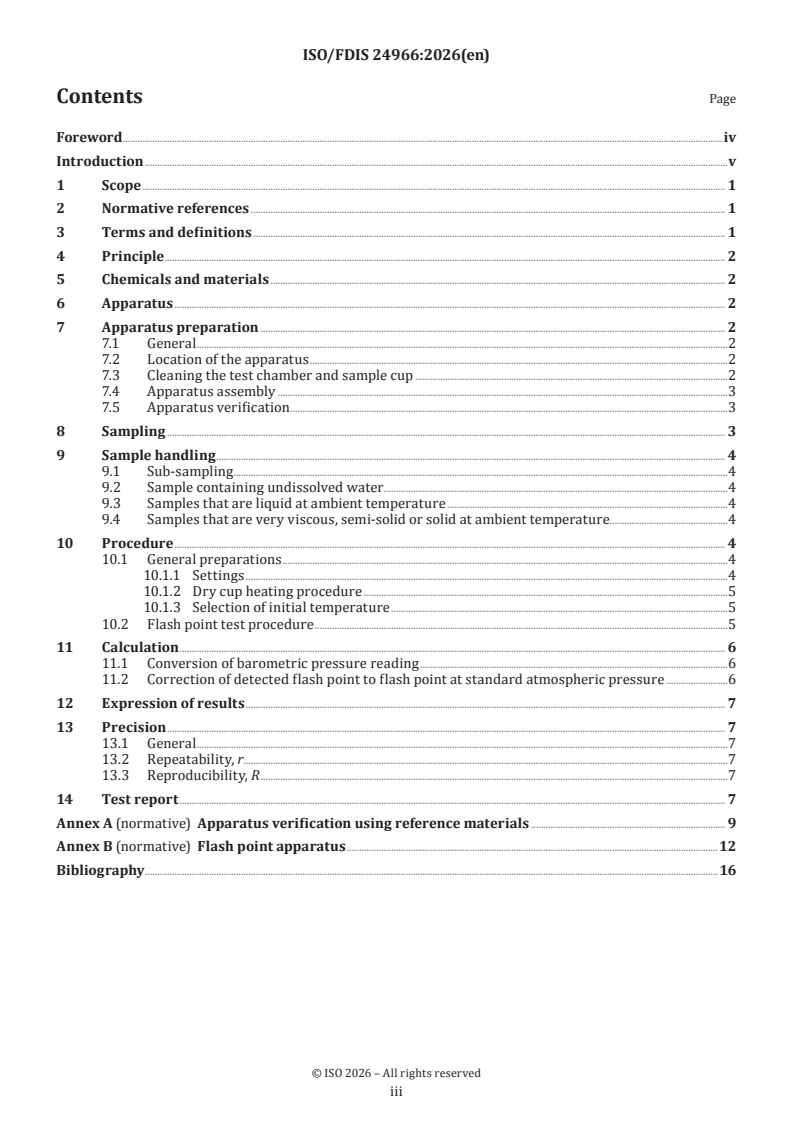
ISO/FDIS 24966 - Determination of flash point — Modified continuously closed cup flash point (MCCCFP) method Released:19. 12. 2025
REDLINE ISO/FDIS 24966 - Determination of flash point — Modified continuously closed cup flash point (MCCCFP) method Released:19. 12. 2025
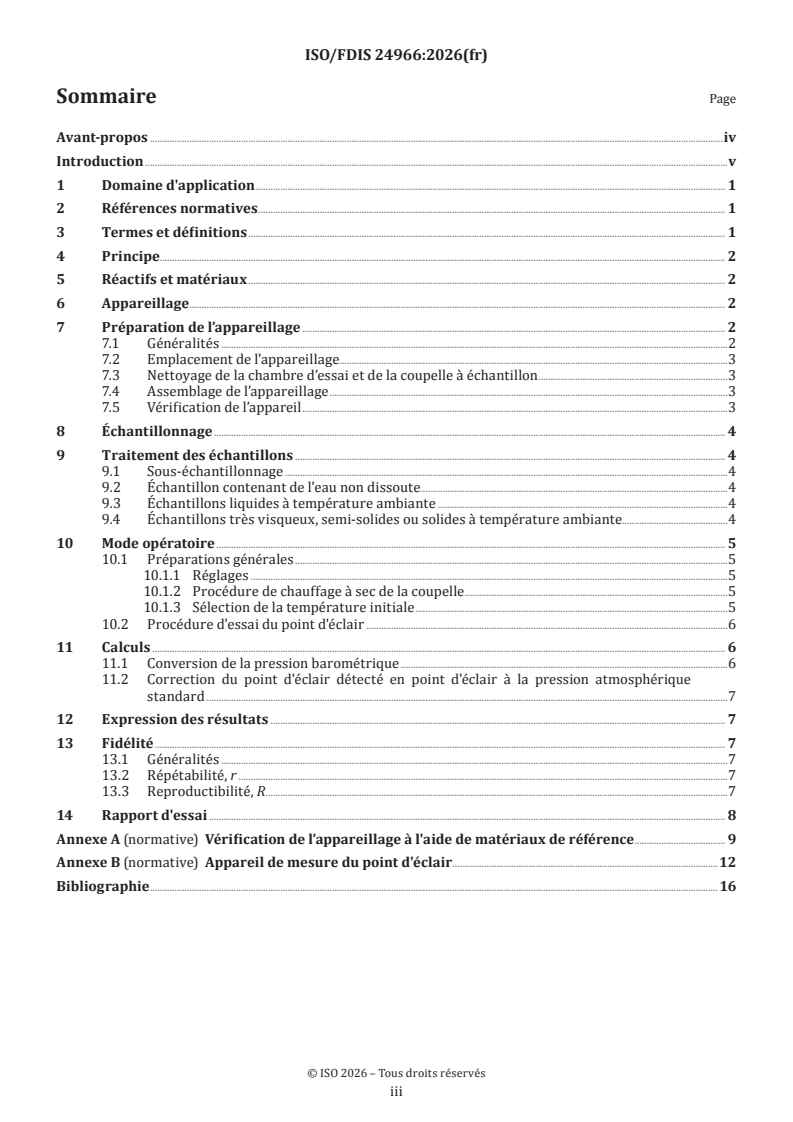
ISO/FDIS 24966 - Détermination du point d'éclair — Méthode modifiée du point d'éclair en vase clos en continu (MCCCFP) Released:3. 02. 2026
Get Certified
Connect with accredited certification bodies for this standard

ABS Quality Evaluations Inc.
American Bureau of Shipping quality certification.

Element Materials Technology
Materials testing and product certification.

ABS Group Brazil
ABS Group certification services in Brazil.
Sponsored listings
Frequently Asked Questions
ISO/FDIS 24966 is a draft published by the International Organization for Standardization (ISO). Its full title is "Determination of flash point — Modified continuously closed cup flash point (MCCCFP) method". This standard covers: This International Standard specifies a test method for the determination of the flash point of chemicals, lube oils, aviation turbine fuel, diesel fuel, diesel/biodiesel blends and other liquids by a continuously closed cup tester utilizing a specimen size of 2 ml, cup size of 7 ml, with a heating rate of 2.5 °C per minute. This flash point test method is a dynamic method and depends on definite rates of temperature increase. It is one of the many flash point test methods available and every flash point test method, including this one, is an empirical method. It utilises an electric arc as the ignitor and detects the flash point by pressure measurement.This test method is suitable for testing samples with a flash point from 22,5 °C to 235,5 °C. Flash point determinations below 22,5 °C and above 235,5 °C may be performed, but the precision has not been determined.
This International Standard specifies a test method for the determination of the flash point of chemicals, lube oils, aviation turbine fuel, diesel fuel, diesel/biodiesel blends and other liquids by a continuously closed cup tester utilizing a specimen size of 2 ml, cup size of 7 ml, with a heating rate of 2.5 °C per minute. This flash point test method is a dynamic method and depends on definite rates of temperature increase. It is one of the many flash point test methods available and every flash point test method, including this one, is an empirical method. It utilises an electric arc as the ignitor and detects the flash point by pressure measurement.This test method is suitable for testing samples with a flash point from 22,5 °C to 235,5 °C. Flash point determinations below 22,5 °C and above 235,5 °C may be performed, but the precision has not been determined.
ISO/FDIS 24966 is classified under the following ICS (International Classification for Standards) categories: 75.100 - Lubricants, industrial oils and related products; 75.160.20 - Liquid fuels; 75.160.40 - Biofuels. The ICS classification helps identify the subject area and facilitates finding related standards.
ISO/FDIS 24966 has the following relationships with other standards: It is inter standard links to FprEN ISO 24966. Understanding these relationships helps ensure you are using the most current and applicable version of the standard.
ISO/FDIS 24966 is available in PDF format for immediate download after purchase. The document can be added to your cart and obtained through the secure checkout process. Digital delivery ensures instant access to the complete standard document.
Standards Content (Sample)
FINAL DRAFT
International
Standard
ISO/TC 28
Determination of flash point —
Secretariat: NEN
Modified continuously closed cup
Voting begins on:
flash point (MCCCFP) method
2026-01-02
Détermination du point d'éclair — Méthode modifiée du point
Voting terminates on:
d'éclair en vase clos en continu (MCCCFP)
2026-02-27
RECIPIENTS OF THIS DRAFT ARE INVITED TO SUBMIT,
WITH THEIR COMMENTS, NOTIFICATION OF ANY
RELEVANT PATENT RIGHTS OF WHICH THEY ARE AWARE
AND TO PROVIDE SUPPOR TING DOCUMENTATION.
IN ADDITION TO THEIR EVALUATION AS
BEING ACCEPTABLE FOR INDUSTRIAL, TECHNO
ISO/CEN PARALLEL PROCESSING LOGICAL, COMMERCIAL AND USER PURPOSES, DRAFT
INTERNATIONAL STANDARDS MAY ON OCCASION HAVE
TO BE CONSIDERED IN THE LIGHT OF THEIR POTENTIAL
TO BECOME STAN DARDS TO WHICH REFERENCE MAY BE
MADE IN NATIONAL REGULATIONS.
Reference number
FINAL DRAFT
International
Standard
ISO/TC 28
Determination of flash point —
Secretariat: NEN
Modified continuously closed cup
Voting begins on:
flash point (MCCCFP) method
2026-01-02
Détermination du point d'éclair — Méthode modifiée du point
Voting terminates on:
d'éclair en vase clos en continu (MCCCFP)
RECIPIENTS OF THIS DRAFT ARE INVITED TO SUBMIT,
WITH THEIR COMMENTS, NOTIFICATION OF ANY
RELEVANT PATENT RIGHTS OF WHICH THEY ARE AWARE
AND TO PROVIDE SUPPOR TING DOCUMENTATION.
© ISO 2026
IN ADDITION TO THEIR EVALUATION AS
All rights reserved. Unless otherwise specified, or required in the context of its implementation, no part of this publication may
BEING ACCEPTABLE FOR INDUSTRIAL, TECHNO
ISO/CEN PARALLEL PROCESSING
LOGICAL, COMMERCIAL AND USER PURPOSES, DRAFT
be reproduced or utilized otherwise in any form or by any means, electronic or mechanical, including photocopying, or posting on
INTERNATIONAL STANDARDS MAY ON OCCASION HAVE
the internet or an intranet, without prior written permission. Permission can be requested from either ISO at the address below
TO BE CONSIDERED IN THE LIGHT OF THEIR POTENTIAL
or ISO’s member body in the country of the requester.
TO BECOME STAN DARDS TO WHICH REFERENCE MAY BE
MADE IN NATIONAL REGULATIONS.
ISO copyright office
CP 401 • Ch. de Blandonnet 8
CH-1214 Vernier, Geneva
Phone: +41 22 749 01 11
Email: copyright@iso.org
Website: www.iso.org
Published in Switzerland Reference number
ii
Contents Page
Foreword .iv
Introduction .v
1 Scope . 1
2 Normative references . 1
3 Terms and definitions . 1
4 Principle . 2
5 Chemicals and materials . 2
6 Apparatus . 2
7 Apparatus preparation . 2
7.1 General .2
7.2 Location of the apparatus .2
7.3 Cleaning the test chamber and sample cup .2
7.4 Apparatus assembly .3
7.5 Apparatus verification .3
8 Sampling . 3
9 Sample handling . 4
9.1 Sub-sampling .4
9.2 Sample containing undissolved water.4
9.3 Samples that are liquid at ambient temperature .4
9.4 Samples that are very viscous, semi-solid or solid at ambient temperature.4
10 Procedure . 4
10.1 General preparations .4
10.1.1 Settings .4
10.1.2 Dry cup heating procedure .5
10.1.3 Selection of initial temperature .5
10.2 Flash point test procedure .5
11 Calculation . 6
11.1 Conversion of barometric pressure reading .6
11.2 Correction of detected flash point to flash point at standard atmospheric pressure .6
12 Expression of results . 7
13 Precision . 7
13.1 General .7
13.2 Repeatability, r.7
13.3 Reproducibility, R .7
14 Test report . 7
Annex A (normative) Apparatus verification using reference materials . 9
Annex B (normative) Flash point apparatus .12
Bibliography .16
iii
Foreword
ISO (the International Organization for Standardization) is a worldwide federation of national standards
bodies (ISO member bodies). The work of preparing International Standards is normally carried out through
ISO technical committees. Each member body interested in a subject for which a technical committee
has been established has the right to be represented on that committee. International organizations,
governmental and non-governmental, in liaison with ISO, also take part in the work. ISO collaborates closely
with the International Electrotechnical Commission (IEC) on all matters of electrotechnical standardization.
The procedures used to develop this document and those intended for its further maintenance are described
in the ISO/IEC Directives, Part 1. In particular, the different approval criteria needed for the different types
of ISO document should be noted. This document was drafted in accordance with the editorial rules of the
ISO/IEC Directives, Part 2 (see www.iso.org/directives).
ISO draws attention to the possibility that the implementation of this document may involve the use of (a)
patent(s). ISO takes no position concerning the evidence, validity or applicability of any claimed patent
rights in respect thereof. As of the date of publication of this document, ISO had not received notice of (a)
patent(s) which may be required to implement this document. However, implementers are cautioned that
this may not represent the latest information, which may be obtained from the patent database available at
www.iso.org/patents. ISO shall not be held responsible for identifying any or all such patent rights.
Any trade name used in this document is information given for the convenience of users and does not
constitute an endorsement.
For an explanation of the voluntary nature of standards, the meaning of ISO specific terms and expressions
related to conformity assessment, as well as information about ISO's adherence to the World Trade
Organization (WTO) principles in the Technical Barriers to Trade (TBT), see www.iso.org/iso/foreword.html.
This document was prepared by Technical Committee ISO/TC 28, Petroleum and related products, fuels and
lubricants from natural or synthetic sources, in collaboration with the European Committee for Standardization
(CEN) Technical Committee CEN/TC 19, Gaseous and liquid fuels, lubricants and related products of petroleum,
synthetic and biological origin, in accordance with the Agreement on technical cooperation between ISO and
CEN (Vienna Agreement).
Any feedback or questions on this document should be directed to the user’s national standards body. A
complete listing of these bodies can be found at www.iso.org/members.html.
iv
Introduction
Flash point values are used in shipping, storage, handling, and safety regulations, as a classification property
to define flammable and combustible materials.
A flash point value can indicate the presence of highly volatile material(s) in a relatively non-volatile or
non-flammable material. Flash point testing can be a preliminary step to other investigations into the
composition of unknown materials.
It is not appropriate for flash point determinations to be carried out on potentially unstable, decomposable,
or explosive materials, unless it has been previously established that heating the specified quantity of such
materials in contact with the metallic components of the flash point apparatus, within the temperature
range required for the method, does not induce decomposition, explosion or other adverse effects.
Flash point values are not a constant physical-chemical property of materials tested. They are a function of
the apparatus design, the condition of the apparatus used, and the operational procedure carried out. Flash
point can therefore be defined only in terms of a standard test method, and no general valid correlation can
be guaranteed between results obtained by different test methods or with test apparatus different from
that specified.
[8]
ISO/TR 29662 gives useful guidance on carrying out flash point tests and interpreting their results.
v
FINAL DRAFT International Standard ISO/FDIS 24966:2026(en)
Determination of flash point — Modified continuously closed
cup flash point (MCCCFP) method
WARNING — The use of this document can involve hazardous materials, operations and equipment.
This document does not purport to address all of the safety problems associated with its use. It is
the responsibility of users of this document to take appropriate measures to ensure the safety and
health of personnel prior to the application of the standard, and to determine the applicability of any
other restrictions for this purpose.
1 Scope
This document describes a test method for the determination of the flash point of chemicals, lube oils, fuels
including aviation turbine fuel, diesel fuel, diesel/biodiesel blends and related products. The precision of
this method has been determined over the range of 24,5 °C to 229,5 °C.
NOTE Apparatus can determine the flash point at higher or lower temperatures than the precision range, however
the precision has not been determined.
2 Normative references
The following documents are referred to in the text in such a way that some or all of their content constitutes
requirements of this document. For dated references, only the edition cited applies. For undated references,
the latest edition of the referenced document (including any amendments) applies.
ISO 3170, Hydrocarbon Liquids — Manual sampling
ISO 3171, Petroleum liquids — Automatic pipeline sampling
3 Terms and definitions
For the purposes of this document, the following terms and definitions apply.
ISO and IEC maintain terminology databases for use in standardization at the following addresses:
— ISO Online browsing platform: available at https:// www .iso .org/ obp
— IEC Electropedia: available at https:// www .electropedia .org/
3.1
flash point
lowest temperature of the test portion, adjusted to account for variations in atmospheric pressure from
101,3 kPa, at which application of an ignition source causes the vapours of the test portion to ignite under
specified conditions of test
Note 1 to entry: For the purpose of this test method, the test portion is deemed to have flashed when the ignited
vapour causes an instantaneous pressure increase of at least 20,0 kPa inside the closed test chamber.
3.2
arc
luminous discharge of electrical current that is formed when a strong current jumps a gap between two
electrodes
4 Principle
A 2 ml test portion is introduced into the sample cup, which is then raised and pressed onto the lid to form
the continuously closed but unsealed test chamber. The lid is heated at a prescribed, constant rate. For the
flash tests, a high voltage arc of defined energy is discharged inside the test chamber at regular intervals.
After each arc application, the instantaneous pressure increase above the barometric pressure inside the
test chamber is monitored. When the pressure increase is equal to or exceeds 20,0 kPa, the temperature
at that point is recorded as the detected flash point. The detected flash point temperature is corrected for
the variation in ambient pressure from a standard pressure of 101,3 kPa. When no flash point is detected,
a defined amount of air dependent on the test portion temperature is introduced into the test chamber to
provide the necessary oxygen for the next flash test.
5 Chemicals and materials
5.1 Cleaning solvent, for removal of traces of the sample from the sample cup and lid.
The choice of solvent depends upon the previous material tested, and the tenacity of the residue. Low
volatility aromatic (benzene free) solvents may be used to remove traces of oil, and mixed solvents such as
toluene-acetone-methanol can be efficacious for the removal of gum-type deposits.
5.2 Reference material (RM) for flash point, i.e. either a certified reference material (CRM) or secondary
working standard (SWS), or both, as specified in Annex A.
6 Apparatus
6.1 Apparatus specified in Annex B, including the details of the test chamber and sample cup together
with dimensions. The critical elements are shown in Figure B.1 and Figure B.2.
6.2 Circulating bath or tap water (optional), can be required for cooling the heat sink of the apparatus
for flash point test temperatures below 5 °C.
6.3 Cooling cup (optional), cup made of plastic material to avoid ice formation during cooling to initial
temperatures equal to or less than 0 °C.
6.4 Pipette or syringe, for the introduction of 2,0 ml ± 0,2 ml test portion.
7 Apparatus preparation
7.1 General
Follow the manufacturer’s instructions for the correct set-up, calibration, verification (7.5) and operation of
the apparatus.
7.2 Location of the apparatus
Support the apparatus (6.1) on a level and steady surface in a draught-free position.
7.3 Cleaning the test chamber and sample cup
Clean the sample cup, sample temperature sensor, lid, arc pins and stirring magnet with a tissue or with
an appropriate solvent (5.1) to remove any traces of gum or residue remaining from a previous test. When
solvents are used, dry with a stream of clean air to ensure complete removal.
Cleaning arcs may be selected to burn off residuals from the arc pins. These cleaning arcs are automatically
initiated before the flash point test is started.
7.4 Apparatus assembly
Examine the sample cup and other parts to ensure that they are free from signs of damage and deposits.
7.5 Apparatus verification
7.5.1 Check the temperature sensors used to monitor the temperature of the test portion and of the
lid against a certified reference thermometer at least once a year. Use only reference thermometers with
calibration/verification traceable to a national certification organization. If the displayed temperature
readings deviate from the reference thermometer by more than 0,2 °C for the sample sensor and 0,5 °C for
the lid sensor, at either of the two temperature calibration points, follow the manufacturer's instructions for
corrections.
7.5.2 Check the pressure transducer at least once a year using the atmospheric barometric pressure as a
reference.
If the displayed atmospheric pressure deviates from the atmospheric pressure by more than 0,5 kPa, follow
the manufacturer's instructions for corrections.
WARNING — Many aneroid barometers, such as those used at weather stations and airports, are
pre-corrected to give sea level readings. These shall not be used for verification of the pressure
transducer.
7.5.3 Verify the correct amount of air being introduced at least once per year. Follow the manufacturer’s
instructions.
7.5.4 Verify the correct functioning of the apparatus at least once a year by testing a certified reference
material (CRM) (as specified in 5.2 and Annex A). It is recommended that more frequent verification checks
are made using an RM (as specified in 5.2 and Annex A).
7.5.5 The result of a single test obtained for an RM shall be equal to or less than R /√2 from the certified
value of the CRM or from the accepted reference value (ARV) of the SWS, where R is the reproducibility.
7.5.6 The numerical values obtained during the verification check shall not be used to provide a bias
statement, nor shall they be used to make any correction to the flash points subsequently determined using
the apparatus.
If the instrument fails the verification test, it is recommended that the operator follows the manufacturers’
instructions and also checks the following and then repeats the verification check:
a) the sample cup is not damaged;
b) cleanliness of the lid, sample temperature sensor and arc pins;
c) ignition source operates correctly.
If there is no obvious non-conformity, conduct a further verification check using a different RM. If the result
conforms to the tolerance requirements, record this fact. If it is still not within the required tolerances,
contact the manufacturer.
8 Sampling
8.1 Unless otherwise specified, obtain representative samples for analysis in accordance with the
procedures given in ISO 3170 or ISO 3171.
8.2 Do not store samples for an extended period of time in gas permeable containers, such as plastic,
because volatile material can diffuse through the walls of the container. Discard samples in leaky containers
and obtain new samples.
8.3 Erroneously high flash points can be obtained when precautions are not taken to avoid loss of volatile
material. Do not open containers unnecessarily, to prevent loss of volatile material or possible introduction
of moisture. Avoid storage of samples at temperatures in excess of 30 °C. Samples for storage shall be capped
tightly with inner seals. Do not make a transfer unless the sample temperature is at least 18 °C below the
expected flash point. If possible, perform the determination of flash point as the first test.
9 Sample handling
9.1 Sub-sampling
Cool or adjust the temperature of the sample and its container to at least 18 °C below the expected flash point
before opening to remove the test portion. If an aliquot of the original sample is required to be stored prior
to t
...
Formatted
...
Style Definition
...
Style Definition
...
Style Definition
...
Style Definition
...
Style Definition
...
ISO/TC 28/WG 9
Style Definition
...
Style Definition
...
Date: 2025-11-25
Style Definition
...
Secretariat: NEN
Style Definition
...
Style Definition
...
Style Definition
...
Date: 2025-12-18
Style Definition
...
Style Definition
...
Style Definition
...
Style Definition
...
Style Definition
...
Style Definition
...
Determination of flash point— — Modified continuously closed cup
Style Definition
...
flash point (MCCCFP) method
Style Definition
...
Style Definition
...
Style Definition
...
Détermination du point d'éclair — Méthode modifiée du point d'éclair en vase clos en continu (MCCCFP)
Style Definition
...
Style Definition
...
Style Definition
...
Style Definition
...
Style Definition
...
Style Definition
...
Style Definition
...
Style Definition
...
FDIS stage
Style Definition
...
Style Definition
...
Style Definition
...
Style Definition
...
Style Definition
...
Style Definition
...
TThhiiss d drraftaft i iss s suubbmmiitttteded t too a pa pararallel vallel vootte e iinn I ISSOO,, C CEENN.
Style Definition
...
Style Definition
...
Style Definition
...
Style Definition
...
Style Definition
...
Style Definition
...
Style Definition
...
Style Definition
...
Style Definition
...
Style Definition
...
Style Definition
...
Style Definition
...
Style Definition
...
Style Definition
...
Style Definition
...
Style Definition
...
Style Definition
...
Style Definition
...
Style Definition
...
Style Definition
...
Style Definition
...
St l D fi iti
Formatted: Font: Bold
Formatted: HeaderCentered
Formatted: Default Paragraph Font
Formatted: Default Paragraph Font
All rights reserved. Unless otherwise specified, or required in the context of its implementation, no part of this publication
may be reproduced or utilized otherwise in any form or by any means, electronic or mechanical, including photocopying,
Formatted: Adjust space between Latin and Asian text,
or posting on the internet or an intranet, without prior written permission. Permission can be requested from either ISO
Adjust space between Asian text and numbers
at the address below or ISO’s member body in the country of the requester.
ISO copyright office
CP 401 • Ch. de Blandonnet 8
CH-1214 Vernier, Geneva
Phone: + 41 22 749 01 11
EmailE-mail: copyright@iso.org
Formatted: German (Germany)
Website: www.iso.orgwww.iso.org
Formatted: German (Germany)
Published in Switzerland
Formatted: English (United Kingdom)
Formatted: FooterPageRomanNumber
ii
Formatted: Font: Bold
Formatted: HeaderCentered, Left
Contents Formatted: Adjust space between Latin and Asian text,
Adjust space between Asian text and numbers
Foreword . vi
Introduction . vii
1 Scope . 1
2 Normative references . 1
3 Terms and definitions . 1
4 Principle . 2
5 Chemicals and materials . 2
6 Apparatus . 2
7 Apparatus preparation . 2
7.1 General. 2
7.2 Location of the apparatus . 2
7.3 Cleaning the test chamber and sample cup . 2
7.4 Apparatus assembly . 3
7.5 Apparatus verification . 3
8 Sampling . 3
9 Sample handling . 4
9.1 Sub-sampling . 4
9.2 Sample containing undissolved water . 4
9.3 Samples that are liquid at ambient temperature . 4
9.4 Samples that are very viscous, semi-solid or solid at ambient temperature . 4
10 Procedure . 4
10.1 General preparations . 4
10.2 Flash point test procedure. 5
11 Calculation . 6
11.1 Conversion of barometric pressure reading . 6
11.2 Correction of detected flash point to flash point at standard atmospheric pressure . 6
12 Expression of results . 7
13 Precision . 7
13.1 General. 7
13.2 Repeatability, r . 7
13.3 Reproducibility, R . 7
14 Test report . 7
Annex A (normative) Apparatus verification using reference materials . 9
Annex B (normative) Flash point apparatus . 13
Bibliography . 19
Formatted: Font: 10 pt
Formatted: Font: 10 pt
Foreword . v
Formatted: Font: 10 pt
Introduction . vi
Formatted: FooterCentered, Left, Line spacing: single
1 Scope . 1
Formatted: Font: 11 pt
2 Normative references . 1
Formatted: FooterPageRomanNumber, Left, Space
3 Terms and definitions . 1
After: 0 pt, Line spacing: single
© ISO 2025 – All rights reserved
iii
Formatted: Font: Bold
Formatted: HeaderCentered
4 Principle . 2
5 Chemicals and materials . 2
6 Apparatus . 2
7 Apparatus preparation . 2
7.1 General. 2
7.2 Location of the apparatus . 2
7.3 Cleaning the test chamber and sample cup . 2
7.4 Apparatus assembly . 3
7.5 Apparatus verification . 3
8 Sampling . 3
9 Sample handling . 4
9.1 Sub-sampling . 4
9.2 Sample containing undissolved water . 4
9.3 Samples that are liquid at ambient temperature . 4
9.4 Samples that are very viscous, semi-solid or solid at ambient temperature . 4
10 Procedure . 4
10.1 General preparations . 4
10.1.1 Settings . 4
10.1.2 Dry cup heating procedure . 5
10.1.3 Selection of initial temperature . 5
10.2 Flash point test procedure. 5
11 Calculation . 6
11.1 Conversion of barometric pressure reading . 6
11.2 Correction of detected flash point to flash point at standard atmospheric pressure . 6
12 Expression of results . 6
13 Precision . 6
13.1 General. 6
13.2 Repeatability, r . 7
13.3 Reproducibility, R . 7
14 Test report . 7
Annex A (normative) Apparatus verification using reference materials . 8
A.1 General. 8
A.2 Reference materials . 8
A.3 Procedure . 8
A.4 Evaluation of test result . 9
A.4.1 General. 9
A.4.1.1 Single test . 9
A.4.2 Test conformance . 10
A.4.3 Test non-conformance . 10
Annex B (normative) Flash point apparatus . 11
B.1 General. 11
B.2 Flash point apparatus, continuously closed cup operation . 11
B.2.1 Test chamber . 11
Formatted: FooterPageRomanNumber
iv
Formatted: Font: Bold
Formatted: HeaderCentered, Left
B.2.2 Temperature sensors . 11
B.2.3 Air introduction . 11
B.2.4 Temperature control . 11
B.2.4.1 Ignition . 12
B.2.5 Flash point detection . 12
B.2.6 Magnetic stirring . 12
B.3 Sample cup . 12
Bibliography . 15
Formatted: Font: 10 pt
Formatted: Font: 10 pt
Formatted: Font: 10 pt
Formatted: FooterCentered, Left, Line spacing: single
Formatted: Font: 11 pt
Formatted: FooterPageRomanNumber, Left, Space
After: 0 pt, Line spacing: single
© ISO 2025 – All rights reserved
v
Formatted: Font: Bold
Formatted: HeaderCentered
Foreword Formatted: Adjust space between Latin and Asian text,
Adjust space between Asian text and numbers
ISO (the International Organization for Standardization) is a worldwide federation of national standards
bodies (ISO member bodies). The work of preparing International Standards is normally carried out through
ISO technical committees. Each member body interested in a subject for which a technical committee has been
established has the right to be represented on that committee. International organizations, governmental and
non-governmental, in liaison with ISO, also take part in the work. ISO collaborates closely with the
International Electrotechnical Commission (IEC) on all matters of electrotechnical standardization.
The procedures used to develop this document and those intended for its further maintenance are described
in the ISO/IEC Directives, Part 1. In particular, the different approval criteria needed for the different types of
ISO document should be noted. This document was drafted in accordance with the editorial rules of the
ISO/IEC Directives, Part 2 (see www.iso.org/directives).
Formatted: English (United Kingdom)
ISO draws attention to the possibility that the implementation of this document may involve the use of (a)
patent(s). ISO takes no position concerning the evidence, validity or applicability of any claimed patent rights
in respect thereof. As of the date of publication of this document, ISO had not received notice of (a) patent(s)
Formatted: Font color: Auto
which may be required to implement this document. However, implementers are cautioned that this may not
represent the latest information, which may be obtained from the patent database available at
www.iso.org/patents.www.iso.org/patents. ISO shall not be held responsible for identifying any or all such
patent rights.
Any trade name used in this document is information given for the convenience of users and does not
constitute an endorsement.
For an explanation of the voluntary nature of standards, the meaning of ISO specific terms and expressions
related to conformity assessment, as well as information about ISO's adherence to the World Trade
Organization (WTO) principles in the Technical Barriers to Trade (TBT), see
www.iso.org/iso/foreword.htmlwww.iso.org/iso/foreword.html.
Formatted: English (United Kingdom)
This document was prepared by Technical Committee ISO/TC 28, Petroleum and related products, fuels and
Formatted: Adjust space between Latin and Asian text,
lubricants from natural or synthetic sources, in collaboration with the European Committee for Standardization Adjust space between Asian text and numbers
(CEN) Technical Committee CEN/TC 19, Gaseous and liquid fuels, lubricants and related products of petroleum,
Formatted: Font: Not Italic
synthetic and biological origin, in accordance with the Agreement on technical cooperation between ISO and
Formatted: Font: Not Italic
CEN (Vienna Agreement).
Any feedback or questions on this document should be directed to the user’s national standards body. A
Formatted: English (United Kingdom)
complete listing of these bodies can be found at www.iso.org/members.html.
Formatted: English (United Kingdom)
Field Code Changed
Formatted: Adjust space between Latin and Asian text,
Adjust space between Asian text and numbers
Formatted: FooterPageRomanNumber
vi
Formatted: Font: Bold
Formatted: HeaderCentered, Left
Introduction
Flash point values are used in shipping, storage, handling, and safety regulations, as a classification property
to define flammable and combustible materials.
A flash point value can indicate the presence of highly volatile material(s) in a relatively non-volatile or non-
flammable material. Flash point testing can be a preliminary step to other investigations into the composition
of unknown materials.
It is not appropriate for flash point determinations to be carried out on potentially unstable, decomposable,
or explosive materials, unless it has been previously established that heating the specified quantity of such
materials in contact with the metallic components of the flash point apparatus, within the temperature range
required for the method, does not induce decomposition, explosion or other adverse effects.
Flash point values are not a constant physical-chemical property of materials tested. They are a function of the
apparatus design, the condition of the apparatus used, and the operational procedure carried out. Flash point
can therefore be defined only in terms of a standard test method, and no general valid correlation can be
guaranteed between results obtained by different test methods or with test apparatus different from that
specified.
[8][8]
ISO/TR 29662 gives useful adviceguidance on carrying out flash point tests and interpreting their results.
Formatted: Default Paragraph Font
Formatted: Default Paragraph Font
Formatted: Default Paragraph Font
Formatted: Font: 10 pt
Formatted: Font: 10 pt
Formatted: Font: 10 pt
Formatted: FooterCentered, Left, Line spacing: single
Formatted: Font: 11 pt
Formatted: FooterPageRomanNumber, Left, Space
After: 0 pt, Line spacing: single
© ISO 2025 – All rights reserved
vii
Formatted: Left
Determination of flash point — Modified continuously closed cup
flash point (MCCCFP) method
WARNING — The use of this document can involve hazardous materials, operations and equipment.
This document does not purport to address all of the safety problems associated with its use. It is the
responsibility of users of this document to take appropriate measures to ensure the safety and health
of personnel prior to the application of the standard, and to determine the applicability of any other
restrictions for this purpose.
1 Scope
Formatted: Adjust space between Latin and Asian text,
This document describes a test method for the determination of theflashthe flash point of chemicals, lube oils,
Adjust space between Asian text and numbers, Tab
fuels including aviation turbine fuel, diesel fuel, diesel/biodiesel blends and related products. The precision of
stops: Not at 0.7 cm + 1.4 cm + 2.1 cm + 2.8 cm +
this method has been determined over the range of 24,5 °C to 229,5 °C.
3.5 cm + 4.2 cm + 4.9 cm + 5.6 cm + 6.3 cm + 7 cm
Formatted: Adjust space between Latin and Asian text,
NOTE Apparatus can determine the flash point at higher or lower temperatures than the precision range, however
Adjust space between Asian text and numbers
the precision has not been determined.
Formatted: English (United Kingdom)
2 Normative references
Formatted: Default Paragraph Font
Formatted: Default Paragraph Font
The following documents are referred to in the text in such a way that some or all of their content constitutes
Formatted: Default Paragraph Font
requirements of this document. For dated references, only the edition cited applies. For undated references,
the latest edition of the referenced document (including any amendments) applies.
Formatted: Default Paragraph Font
Formatted: Adjust space between Latin and Asian text,
ISO 3170, PetroleumHydrocarbon Liquids — Manual sampling
Adjust space between Asian text and numbers, Tab
stops: Not at 0.7 cm + 1.4 cm + 2.1 cm + 2.8 cm +
ISO 3171, Petroleum liquids — Automatic pipeline sampling
3.5 cm + 4.2 cm + 4.9 cm + 5.6 cm + 6.3 cm + 7 cm
Formatted: Default Paragraph Font
3 Terms and definitions
Formatted: Default Paragraph Font
For the purposes of this document, the following terms and definitions apply.
Formatted: Default Paragraph Font
ISO and IEC maintain terminology databases for use in standardization at the following addresses: Formatted: Adjust space between Latin and Asian text,
Adjust space between Asian text and numbers
— — ISO Online browsing platform: available at https://www.iso.org/obphttps://www.iso.org/obp
Formatted: English (United Kingdom)
Formatted: Font: 11 pt, English (United Kingdom)
— — IEC Electropedia: available at https://www.electropedia.org/https://www.electropedia.org/
Formatted: English (United Kingdom)
3.1 3.1
Formatted: English (United Kingdom)
flash point
Formatted: TermNum2, Adjust space between Latin
lowest temperature of the test portion, adjusted to account for variations in atmospheric pressure from
and Asian text, Adjust space between Asian text and
101,3 kPa, at which application of an ignition source causes the vapours of the test portion to ignite under
numbers
specified conditions of test
Formatted: Adjust space between Latin and Asian text,
Note 1 to entry: For the purpose of this test method, the test portion is deemed to have flashed when
Adjust space between Asian text and numbers, Tab
the ignited vapour causes an instantaneous pressure increase of at least 20,0 kPa inside the closed test chamber.
stops: Not at 0.7 cm + 1.4 cm + 2.1 cm + 2.8 cm +
3.5 cm + 4.2 cm + 4.9 cm + 5.6 cm + 6.3 cm + 7 cm
3.2 3.2
Formatted: TermNum2, Adjust space between Latin
arc
and Asian text, Adjust space between Asian text and
luminous discharge of electrical current that is formed when a strong current jumps a gap between two
numbers
electrodes
Formatted: Footer, Left, Space After: 0 pt, Tab stops:
Not at 17.2 cm
Formatted: Font: Bold
Formatted: HeaderCentered
4 Principle
A 2 ml test portion is introduced into the sample cup, which is then raised and pressed onto the lid to form the
continuously closed but unsealed test chamber. The lid is heated at a prescribed, constant rate. For the flash
tests, a high voltage arc of defined energy is discharged inside the test chamber at regular intervals. After each
Formatted: Font: 11 pt, Not Bold
arc application, the instantaneous pressure increase above the barometric pressure inside the test chamber is
monitored. When the pressure increase is equal to or exceeds 20,0 kPa, the temperature at that point is
Formatted: Font: Not Bold
recorded as the detected flash point. The detected flash point temperature is corrected for the variation in
Formatted: Adjust space between Latin and Asian text,
ambient pressure from a standard pressure of 101,3 kPa. When no flash point is detected, a defined amount
Adjust space between Asian text and numbers, Tab
of air dependent on the test portion temperature is introduced into the test chamber to provide the necessary
stops: Not at 0.7 cm + 1.4 cm + 2.1 cm + 2.8 cm +
oxygen for the next flash test.
3.5 cm + 4.2 cm + 4.9 cm + 5.6 cm + 6.3 cm + 7 cm
Formatted: Adjust space between Latin and Asian text,
5 Chemicals and materials
Adjust space between Asian text and numbers
5.1 5.1 Cleaning solvent, for removal of traces of the sample from the sample cup and lid. Formatted: Font: 11 pt, Not Bold
Formatted: Font: 11 pt, Not Bold
The choice of solvent depends upon the previous material tested, and the tenacity of the residue. Low volatility
Formatted: Adjust space between Latin and Asian text,
aromatic (benzene free) solvents may be used to remove traces of oil, and mixed solvents such as toluene-
Adjust space between Asian text and numbers
acetone-methanol can be efficacious for the removal of gum-type deposits.
Formatted: Font: 11 pt, Not Bold
5.2 5.2 Reference material (RM) for flash point, i.e. either a certified reference material (CRM)
Formatted: Font: 11 pt, Not Bold
or secondary working standard (SWS), or both, as specified in Annex A.Annex A.
Formatted: Adjust space between Latin and Asian text,
Adjust space between Asian text and numbers, Tab
6 Apparatus
stops: Not at 0.7 cm + 1.4 cm + 2.1 cm + 2.8 cm +
3.5 cm + 4.2 cm + 4.9 cm + 5.6 cm + 6.3 cm + 7 cm
6.1 6.1 Apparatus specified in Annex B,Annex B, including the details of the test chamber and
Formatted: Font: Not Bold
sample cup together with dimensions. The critical elements are shown in Figure B.1 and
Figure B.2.Figure B.1 and Figure B.2.
Formatted: Font: 11 pt, Not Bold
Formatted: Font: Not Bold
6.2 6.2 Circulating bath or tap water (optional), can be required for cooling the heat sink of the
apparatus for flash point test temperatures below 5 °C.
Formatted: Font: 11 pt, Not Bold
Formatted: Font: Not Bold
6.3 6.3 Cooling cup (optional), cup made of plastic material to avoid ice formation during cooling to
initial temperatures equal to or less than 0 °C.
Formatted: Font: 11 pt, Not Bold
Formatted: Font: Not Bold
6.4 6.4 Pipette or syringe, for the introduction of 2,0 ml ± 0,2 ml test portion.
Formatted: Adjust space between Latin and Asian text,
Adjust space between Asian text and numbers
7 Apparatus preparation
Formatted: Adjust space between Latin and Asian text,
7.1 General Adjust space between Asian text and numbers, Tab
stops: Not at 0.71 cm
Follow the manufacturer’s instructions for the correct set-up, calibration, verification (7.5)(7.5) and operation
Formatted: Adjust space between Latin and Asian text,
of the apparatus.
Adjust space between Asian text and numbers
Formatted: Adjust space between Latin and Asian text,
7.2 Location of the apparatus
Adjust space between Asian text and numbers, Tab
stops: Not at 0.71 cm
Support the apparatus (6.1)(6.1) on a level and steady surface in a draught-free position.
Formatted: Adjust space between Latin and Asian text,
7.3 Cleaning the test chamber and sample cup Adjust space between Asian text and numbers
Formatted: Adjust space between Latin and Asian text,
Clean the sample cup, sample temperature sensor, lid, arc pins and stirring magnet with a tissue or with an
Adjust space between Asian text and numbers, Tab
appropriate solvent (5.1)(5.1) to remove any traces of gum or residue remaining from a previous test. When
stops: Not at 0.71 cm
solvents are used, dry with a stream of clean air to ensure complete removal.
Formatted: Adjust space between Latin and Asian text,
Adjust space between Asian text and numbers
Formatted: FooterPageNumber
Formatted
...
Formatted
...
Cleaning arcs may be selected to burn off residuals from the arc pins. These cleaning arcs are automatically
Formatted
...
initiated before the flash point test is started.
7.4 Apparatus assembly
Formatted
...
Examine the sample cup and other parts to ensure that they are free from signs of damage and deposits.
Formatted
...
Formatted
7.5 Apparatus verification
...
Formatted
...
7.5.1 7.5.1 Check the temperature sensors used to monitor the temperature of the test portion and of the
Formatted
lid against a certified reference thermometer at least once a year. Use only reference thermometers with .
calibration/verification traceable to a national certification organization. If the displayed temperature
Formatted
...
readings deviate from the reference thermometer by more than 0,2 °C for the sample sensor and 0,5 °C for the
Formatted
lid sensor, at either one of the two temperature calibration points, follow the manufacturer's instructions for
...
corrections.
Formatted
...
Formatted
7.5.2 7.5.2 Check the pressure transducer at least once a year using the atmospheric barometric pressure .
as a reference.
Formatted
...
Formatted
...
If the displayed atmospheric pressure deviates from the atmospheric pressure by more than 0,5 kPa, follow
the manufacturer's instructions for corrections.
Formatted
...
Formatted
...
WARNING — Many aneroid barometers, such as those used at weather stations and airports, are pre-
Formatted
corrected to give sea level readings. These shall not be used for verification of the pressure transducer. .
Formatted
...
7.5.3 7.5.3 Verify the correct amount of air being introduced at least once per year. Follow the
Formatted
manufacturer’s instructions. .
Formatted
...
7.5.4 7.5.4 Verify the correct functioning of the apparatus at least once a year by testing a certified
Formatted
...
reference material (CRM) (as specified in 5.25.2 and Annex A).Annex A). It is recommended that more
frequent verification checks are made using an RM ( as specified in 5.25.2 and Annex A).Annex A).
Formatted
...
Formatted
7.5.5 7.5.5 The result of a single test obtained for an RM shall be equal to or less than R /√2 from the .
certified value of the CRM or from the accepted reference value (ARV) of the SWS, where R is the
Formatted
...
reproducibility.
Formatted
...
7.5.6 7.5.6 The numerical values obtained during the verification check shall not be used to provide a bias
Formatted
...
statement, nor shall they be used to make any correction to the flash points subsequently determined using
Formatted
...
the apparatus.
Formatted
...
If the instrument fails the verification test, it is recommended that the operator follows the manufacturers’
Formatted
...
instructions and also checks the following and then repeats the verification check:
Formatted
...
a) a) the sample cup is not damaged;
Formatted
...
Formatted
...
b) b) cleanliness of the lid, sample temperature sensor and arc pins;
Formatted
...
c) c) ignition source operates correctly.
Formatted
...
If there is no obvious non-conformity, conduct a further verification check using a different RM. If the result Formatted
...
conforms to the tolerance requirements, record this fact. If it is still not within the required tolerances, contact
Formatted
...
the manufacturer.
Formatted
...
Formatted
8 Sampling .
Formatted
...
8.1 8.1 Unless otherwise specified, obtain representative samples for analysis in accordance with the
Formatted
...
procedures given in ISO 3170 or ISO 3171.
Formatted
...
© ISO 2025 – All rights reserved
Formatted: Font: Bold
Formatted: HeaderCentered
8.2 8.2 Do not store samples for an extended period of time in gas permeable containers, such as
Formatted: Font: 11 pt, Not Bold
plastic, because volatile material can diffuse through the walls of the container. Discard samples in leaky
containers and obtain new samples.
Formatted: Font: Not Bold
8.3 8.3 Erroneously high flash points can be obtained when precautions are not taken to avoid loss of
Formatted: Font: 11 pt, Not Bold
volatile material. Do not open containers unnecessarily, to prevent loss of volatile material or possible
introduction of moisture. Avoid storage of samples at temperatures in excess of 30 °C. Samples for storage
shall be capped tightly with inner seals. Do not make a transfer unless the sample temperature is at least 18 °C
Formatted: Font: Not Bold
below the expected flash point. If possible, perform the determination of flash point as the first test.
Formatted: Adjust space between Latin and Asian text,
Adjust space between Asian text and numbers
9 Sample handling
Formatted: Adjust space between Latin and Asian text,
Adjust space between Asian text and numbers, Tab
9.1 Sub-sampling
stops: Not at 0.71 cm
Cool or adjust the temperature of the sample and its container to at least 18 °C below the expected flash point
Formatted: Adjust space between Latin and Asian text,
before opening to remove the test portion. If an aliquot of the original sample is required to be stored prior to
Adjust space between Asian text and numbers
testing, ensure that the container is still filled to at least 85 % of its capacity. Gently mix the subsample to
Formatted: Adjust space between Latin and Asian text,
ensure uniformity, so that the loss of the volatile components and light ends are minimized.
Adjust space between Asian text and numbers, Tab
stops: Not at 0.71 cm
9.2 Sample containing undissolved water
Formatted: Font: Not Bold
9.2.1 9.2.1 Flash point results can be affected by the presence of water. If a sample contains undissolved
Formatted: Adjust space between Latin and Asian text,
water, decant an aliquot from the water prior to mixing.
Adjust space between Asian text and numbers, Tab
stops: Not at 0.7 cm + 1.4 cm + 2.1 cm + 2.8 cm +
9.2.2 9.2.2 For certain products, it is not possible to decant the sample from the free water. Such samples
3.5 cm + 4.2 cm + 4.9 cm + 5.6 cm + 6.3 cm + 7 cm
may be dehydrated with calcium chloride or by filtering through a qualitative filter paper or a loose plug of
Formatted: Font: Not Bold
dry absorbent cotton.
Formatted: Font: Not Bold
9.3 Samples that are liquid at ambient temperature
Formatted: Adjust space between Latin and Asian text,
Adjust space between Asian text and numbers, Tab
Mix samples by gentle manual shaking prior to removal of the test portion, taking care to minimize the loss of
stops: Not at 0.71 cm
volatile components and proceed in accordance with Clause 10.Clause 10.
Formatted: Adjust space between Latin and Asian text,
9.4 Samples that are very viscous, semi-solid or solid at ambient temperature Adjust space between Asian text and numbers
Formatted: Adjust space between Latin and Asian text,
Samples shall be heated in their containers, with lid/cap slightly loosened to avoid build-up of dangerous
Adjust space between Asian text and numbers, Tab
pressure, at the lowest temperature adequate to liquefy any solids, not exceeding 18 °C below the expected
stops: Not at 0.71 cm
flash point, for 30 min. If the sample is then not completely liquefied, extend the heating period for additional
Formatted: Adjust space between Latin and Asian text,
30 min periods as necessary. Then gently agitate the sample to provide mixing, such as orbiting the container
Adjust space between Asian text and numbers
horizontally, before transferring to the sample cup. No sample shall be heated and transferred unless its
Formatted: Adjust space between Latin and Asian text,
temperature is at least 18 °C below its expected flash point.
Adjust space between Asian text and numbers, Tab
stops: Not at 0.7 cm + 1.4 cm + 2.1 cm + 2.8 cm +
NOTE Volatile vapours can escape during heating when the sample container lid/cap is too loose.
3.5 cm + 4.2 cm + 4.9 cm + 5.6 cm + 6.3 cm + 7 cm
10 Procedure Formatted: Adjust space between Latin and Asian text,
Adjust space between Asian text and numbers
10.1 General preparations
Formatted: Adjust space between Latin and Asian text,
Adjust space between Asian text and numbers, Tab
10.1.1 Settings
stops: Not at 0.71 cm
Formatted: Adjust space between Latin and Asian text,
Set the following parameters:
Adjust space between Asian text and numbers, Tab
stops: Not at 0.71 cm + 0.99 cm + 1.27 cm
— — heating rate = = 2,5 °C/min
Formatted
...
— — ignition interval = = 1 °C
Formatted
...
Formatted: FooterPageNumber
Formatted: Font: Bold
Formatted: HeaderCentered, Left
— — threshold for the flash detection = = 20,0 kPa
— — ambient air introduction volume to the values listed in Table 1.Table 1.
Formatted: None, Adjust space between Latin and
Table 1 — Volume of introduced air as a function of test portion temperature
Asian text, Adjust space between Asian text and
numbers
Temperature range (° Introduced volume of air (
°C) ml)
Formatted: Adjust space between Latin and Asian text,
Adjust space between Asian text and numbers
below 80 0
Formatted Table
80 to below 150 0,5 ± 0,15
Formatted: Font: Not Bold
150 to below 200 1 ± 0,2
Formatted: Font: Not Bold
200 to below 300 1,5 ± 0,3
Formatted: Font: Not Bold
300 and above 2,0 ± 0,4
Formatted: Font: Not Bold
10.1.2 Dry cup heating procedure
Formatted: Adjust space between Latin and Asian text,
Adjust space between Asian text and numbers
If the expected flash point of a test portion is more than 15 °C higher than the flash point of the previous test
Formatted: Adjust space between Latin and Asian text,
portion, heat the lid together with an empty and dry sample cup to a temperature 30 °C higher than the
Adjust space between Asian text and numbers
expected flash point of the new test portion. Follow the manufacturer’s instructions.
Formatted: Adjust space between Latin and Asian text,
Adjust space between Asian text and numbers
NOTE The dry cup heating procedure eliminates possible cross contamination from residual vapours.
Formatted: Adjust space between Latin and Asian text,
10.1.3 Selection of initial temperature
Adjust space between Asian text and numbers
Formatted: Adjust space between Latin and Asian text,
If an expected flash point is known, it is recommended to set the initial temperature (at which actual flash
Adjust space between Asian text and numbers
point testing will start) to 18 °C below the expected flash point. Set the final temperature to a value of 20 °C
Formatted: Space Before: 12 pt, Adjust space between
above the expected flash point.
Latin and Asian text, Adjust space between Asian text
and numbers, Tab stops: Not at 0.71 cm + 0.99 cm +
If the expected flash point is not known, cool the sample below 10 °C and set the initial temperature to 10 °C.
1.27 cm
Unknown samples, which are expected to be highly flammable, shall be cooled far below 10 ᵒ °C, since the
precautionary arcs will cause a flash point in case it is far below the initial temperature of 10 ᵒ °C. Set the final
Formatted: Adjust space between Latin and Asian text,
temperature to the highest temperature of interest. Measure the material to be tested in the manner described
Adjust space between Asian text and numbers
in 10.2.10.2. This flash point result shall be considered as approximate. This approximate flash point value can
Formatted
...
be used as the expected flash point when a fresh test portion is tested in the standard mode of operation.
Formatted
...
10.2 Flash point test procedure
Formatted
...
Formatted
...
10.2.1 10.2.1 Once the test procedure is started, the barometric pressure is recorded for correction of a
detected flash point.
Formatted: Font: Not Bold
Formatted
...
10.2.2 10.2.2 The lid temperature is regulating to the initial temperature. Wait until the initial temperature
is reached as indicated b
...
PROJET FINAL
Norme
internationale
ISO/TC 28
Détermination du point d'éclair —
Secrétariat: NEN
Méthode modifiée du point d'éclair
Début de vote:
en vase clos en continu (MCCCFP)
2026-01-02
Determination of flash point — Modified continuously closed cup
Vote clos le:
flash point (MCCCFP) method
2026-02-27
LES DESTINATAIRES DU PRÉSENT PROJET SONT
INVITÉS À PRÉSENTER, AVEC LEURS OBSERVATIONS,
NOTIFICATION DES DROITS DE PROPRIÉTÉ DONT ILS
AURAIENT ÉVENTUELLEMENT CONNAISSANCE ET À
FOURNIR UNE DOCUMENTATION EXPLICATIVE.
OUTRE LE FAIT D’ÊTRE EXAMINÉS POUR
ÉTABLIR S’ILS SONT ACCEPTABLES À DES FINS
INDUSTRIELLES, TECHNOLOGIQUES ET COM-MERCIALES,
AINSI QUE DU POINT DE VUE DES UTILISATEURS, LES
PROJETS DE NORMES
TRAITEMENT PARALLÈLE ISO/CEN
INTERNATIONALES DOIVENT PARFOIS ÊTRE CONSIDÉRÉS
DU POINT DE VUE DE LEUR POSSI BILITÉ DE DEVENIR DES
NORMES POUVANT
SERVIR DE RÉFÉRENCE DANS LA RÉGLEMENTATION
NATIONALE.
Numéro de référence
PROJET FINAL
Norme
internationale
ISO/TC 28
Détermination du point d'éclair —
Secrétariat: NEN
Méthode modifiée du point d'éclair
Début de vote:
en vase clos en continu (MCCCFP)
2026-01-02
Determination of flash point — Modified continuously closed cup
Vote clos le:
flash point (MCCCFP) method
2026-02-27
LES DESTINATAIRES DU PRÉSENT PROJET SONT
INVITÉS À PRÉSENTER, AVEC LEURS OBSERVATIONS,
NOTIFICATION DES DROITS DE PROPRIÉTÉ DONT ILS
AURAIENT ÉVENTUELLEMENT CONNAISSANCE ET À
FOURNIR UNE DOCUMENTATION EXPLICATIVE.
DOCUMENT PROTÉGÉ PAR COPYRIGHT
OUTRE LE FAIT D’ÊTRE EXAMINÉS POUR
ÉTABLIR S’ILS SONT ACCEPTABLES À DES FINS
© ISO 2026 INDUSTRIELLES, TECHNOLOGIQUES ET COM-MERCIALES,
AINSI QUE DU POINT DE VUE DES UTILISATEURS, LES
Tous droits réservés. Sauf prescription différente ou nécessité dans le contexte de sa mise en œuvre, aucune partie de cette
PROJETS DE NORMES
TRAITEMENT PARALLÈLE ISO/CEN
INTERNATIONALES DOIVENT PARFOIS ÊTRE CONSIDÉRÉS
publication ne peut être reproduite ni utilisée sous quelque forme que ce soit et par aucun procédé, électronique ou mécanique,
DU POINT DE VUE DE LEUR POSSI BILITÉ DE DEVENIR DES
y compris la photocopie, ou la diffusion sur l’internet ou sur un intranet, sans autorisation écrite préalable. Une autorisation peut
NORMES POUVANT
être demandée à l’ISO à l’adresse ci-après ou au comité membre de l’ISO dans le pays du demandeur.
SERVIR DE RÉFÉRENCE DANS LA RÉGLEMENTATION
NATIONALE.
ISO copyright office
Case postale 401 • Ch. de Blandonnet 8
CH-1214 Vernier, Genève
Tél.: +41 22 749 01 11
E-mail: copyright@iso.org
Web: www.iso.org
Publié en Suisse Numéro de référence
ii
Sommaire Page
Avant-propos .iv
Introduction .v
1 Domaine d'application . 1
2 Références normatives . 1
3 Termes et définitions . 1
4 Principe. 2
5 Réactifs et matériaux . 2
6 Appareillage . 2
7 Préparation de l’appareillage . 2
7.1 Généralités .2
7.2 Emplacement de l'appareillage.3
7.3 Nettoyage de la chambre d’essai et de la coupelle à échantillon .3
7.4 Assemblage de l’appareillage .3
7.5 Vérification de l’appareil .3
8 Échantillonnage . 4
9 Traitement des échantillons . 4
9.1 Sous-échantillonnage .4
9.2 Échantillon contenant de l'eau non dissoute.4
9.3 Échantillons liquides à température ambiante .4
9.4 Échantillons très visqueux, semi-solides ou solides à température ambiante.4
10 Mode opératoire . 5
10.1 Préparations générales .5
10.1.1 Réglages .5
10.1.2 Procédure de chauffage à sec de la coupelle .5
10.1.3 Sélection de la température initiale .5
10.2 Procédure d'essai du point d'éclair .6
11 Calculs . 6
11.1 Conversion de la pression barométrique .6
11.2 Correction du point d'éclair détecté en point d'éclair à la pression atmosphérique
standard .7
12 Expression des résultats . 7
13 Fidélité . 7
13.1 Généralités .7
13.2 Répétabilité, r .7
13.3 Reproductibilité, R . .7
14 Rapport d'essai . 8
Annexe A (normative) Vérification de l’appareillage à l'aide de matériaux de référence . 9
Annexe B (normative) Appareil de mesure du point d'éclair .12
Bibliographie .16
iii
Avant-propos
L'ISO (Organisation internationale de normalisation) est une fédération mondiale d'organismes nationaux
de normalisation (comités membres de l'ISO). L'élaboration des Normes internationales est en général
confiée aux comités techniques de l'ISO. Chaque comité membre intéressé par une étude a le droit de faire
partie du comité technique créé à cet effet. Les organisations internationales, gouvernementales et non
gouvernementales, en liaison avec l'ISO participent également aux travaux. L'ISO collabore étroitement avec
la Commission électrotechnique internationale (IEC) en ce qui concerne la normalisation électrotechnique.
Les procédures utilisées pour élaborer le présent document et celles destinées à sa mise à jour sont
décrites dans les Directives ISO/IEC, Partie 1. Il convient, en particulier, de prendre note des différents
critères d'approbation requis pour les différents types de documents ISO. Le présent document a
été rédigé conformément aux règles de rédaction données dans les Directives ISO/IEC, Partie 2 (voir
www.iso.org/directives).
L’ISO attire l’attention sur le fait que la mise en application du présent document peut entraîner l’utilisation
d’un ou de plusieurs brevets. L’ISO ne prend pas position quant à la preuve, à la validité et à l’applicabilité de
tout droit de propriété revendiquée à cet égard. À la date de publication du présent document, l’ISO n’avait
pas reçu de notification qu’un ou plusieurs brevets pouvaient être nécessaires à sa mise en application.
Toutefois, il y a lieu d’avertir les responsables de la mise en application du présent document que des
informations plus récentes sont susceptibles de figurer dans la base de données de brevets, disponible à
l'adresse www.iso.org/brevets. L’ISO ne saurait être tenue pour responsable de ne pas avoir identifié tout ou
partie de tels droits de propriété.
Les appellations commerciales éventuellement mentionnées dans le présent document sont données pour
information, par souci de commodité, à l’intention des utilisateurs et ne sauraient constituer un engagement.
Pour une explication de la nature volontaire des normes, la signification des termes et expressions
spécifiques de l'ISO liés à l'évaluation de la conformité, ou pour toute information au sujet de l'adhésion de
l'ISO aux principes de l’Organisation mondiale du commerce (OMC) concernant les obstacles techniques au
commerce (OTC), voir www.iso.org/avant-propos.
Le présent document a été élaboré par le comité technique ISO/TC 28, Produits pétroliers et produits
connexes, combustibles et lubrifiants d’origine synthétique ou biologique, en collaboration avec le comité
technique CEN/TC 19, Carburants et combustibles gazeux et liquides, lubrifiants et produits connexes, d'origine
pétrolière, synthétique et biologique du Comité européen de normalisation (CEN), conformément à l'Accord de
coopération technique entre l'ISO et le CEN (Accord de Vienne).
Il convient que l’utilisateur adresse tout retour d’information ou toute question concernant le présent
document à l’organisme national de normalisation de son pays. Une liste exhaustive desdits organismes se
trouve à l’adresse www.iso.org/members.html.
iv
Introduction
Les valeurs du point d'éclair sont utilisées dans les réglementations relatives au transport maritime, au
stockage, à la manipulation et à la sécurité, en tant que propriété de classification pour définir les matériaux
«inflammables» et «combustibles».
Une valeur de point d'éclair peut indiquer la présence d'une ou de plusieurs matières très volatiles dans
une matière relativement non volatile ou ininflammable. L’essai du point d'éclair peut constituer une étape
préliminaire à d'autres recherches sur la composition de matières inconnues.
Il est contre-indiqué d'effectuer des déterminations du point d'éclair sur des matériaux potentiellement
instables, décomposables ou explosifs, à moins qu'il n'ait été préalablement établi que le fait de chauffer
la quantité spécifiée de ces matériaux en contact avec les composants métalliques de l'appareil de
détermination du point d'éclair, dans la plage de température requise pour la méthode, n'induit pas de
décomposition, d'explosion ou d'autres effets néfastes.
Les valeurs du point d'éclair ne sont pas une propriété physico-chimique absolue des matériaux testés. Elles
dépendent de la conception de l'appareil de mesure, de l'état de l'appareillage utilisé et du mode opératoire
mis en œuvre. Le point d'éclair ne peut donc être défini qu'en fonction d'une méthode d'essai normalisée,
et aucune corrélation générale valable ne peut être garantie entre les résultats obtenus par différentes
méthodes d'essai ou avec des appareils d'essai différents de ceux qui sont spécifiés.
[8]
L’ISO/TR 29662 donne des recommandations utiles sur la réalisation des essais de point d'éclair et
l'interprétation de leurs résultats.
v
PROJET FINAL Norme internationale ISO/FDIS 24966:2026(fr)
Détermination du point d'éclair — Méthode modifiée du
point d'éclair en vase clos en continu (MCCCFP)
AVERTISSEMENT — L'utilisation de ce document peut impliquer des matériaux, des opérations et
des équipements dangereux. Ce document ne prétend pas traiter tous les problèmes de sécurité liés
à son utilisation. Il incombe aux utilisateurs de ce document de prendre les mesures appropriées
pour garantir la sécurité et la santé du personnel avant l'application de la norme, et de déterminer
l'applicabilité de toute autre restriction à cette fin.
1 Domaine d'application
Le présent document décrit une méthode d'essai pour la détermination du point d'éclair de produits
chimiques, d'huiles lubrifiantes, de carburants, y compris les carburéacteurs, le carburant diesel, les
mélanges diesel/biodiesel et les produits connexes. La fidélité de cette méthode a été déterminée dans la
plage de 24,5 °C à 229,5 °C.
NOTE L'appareillage peut déterminer le point d'éclair à des températures supérieures ou inférieures à la plage de
fidélité, mais la fidélité n'a pas été déterminée.
2 Références normatives
Les documents suivants sont cités dans le texte de sorte qu’ils constituent, pour tout ou partie de leur
contenu, des exigences du présent document. Pour les références datées, seule l’édition citée s’applique. Pour
les références non datées, la dernière édition du document de référence s'applique (y compris les éventuels
amendements).
ISO 3170, Hydrocarbures liquides — Échantillonnage manuel
ISO 3171, Produits pétroliers liquides — Échantillonnage automatique en oléoduc
3 Termes et définitions
Pour les besoins du présent document, les termes et définitions suivants s'appliquent.
L’ISO et l’IEC tiennent à jour des bases de données terminologiques destinées à être utilisées en normalisation,
consultables aux adresses suivantes:
— ISO Online browsing platform: disponible à l’adresse https://www.iso.org/obp
— IEC Electropedia: disponible à l’adresse https://www.electropedia.org/
3.1
point d'éclair
température la plus basse de la prise d'essai, ajustée pour tenir compte des variations de pression
atmosphérique à partir de 101,3 kPa, à laquelle la présentation d'une source d'inflammation provoque
l'inflammation des vapeurs émises par la prise d'essai dans les conditions d'essai spécifiées
Note 1 à l'article: Aux fins de la présente méthode d'essai, la prise d'essai est considérée comme ayant flambé lorsque
la vapeur enflammée provoque une augmentation instantanée de la pression d'au moins 20,0 kPa à l'intérieur de la
chambre d'essai fermée.
3.2
arc
décharge lumineuse d'un courant électrique qui se forme lorsqu'un courant fort saute un espace entre deux
électrodes
4 Principe
Une prise d'essai de 2 ml est introduite dans la coupelle d'échantillonnage qui est ensuite soulevée et pressée
sur un couvercle pour former la chambre d'essai continuellement fermée mais non scellée. Le couvercle
est chauffé à une vitesse constante prescrite. Un arc électrique à haute tension d'une énergie définie est
déchargé à l'intérieur de la chambre d'essai à intervalles réguliers pour les tests d’éclair. Après chaque arc,
l'augmentation instantanée de la pression au-dessus de la pression barométrique à l'intérieur de la chambre
d'essai est contrôlée. Lorsque l'augmentation de pression est égale ou supérieure à 20,0 kPa, la température
est enregistrée à ce point comme le point d'éclair détecté. La température du point d'éclair détecté est
corrigée pour tenir compte de la variation de pression ambiante par rapport à la pression standard de
101,3 kPa. Si aucun point d'éclair n'est détecté, une quantité d'air définie en fonction de la température de la
prise d'essai est introduite dans la chambre d'essai afin de fournir l'oxygène nécessaire pour le test d'éclair
suivant.
5 Réactifs et matériaux
5.1 Solvant de nettoyage, pour éliminer les traces de l’échantillon de la coupelle et du couvercle.
Le choix du solvant dépend du matériau testé précédemment et de la ténacité du résidu. Les solvants
aromatiques à faible volatilité (sans benzène) peuvent être utilisés pour éliminer les traces d'huile, et les
solvants mixtes tels que le toluène, l'acétone et le méthanol peuvent être efficaces pour éliminer les dépôts
de type gomme.
5.2 Matériau de référence (MR) pour point d'éclair, c’est-à-dire soit un matériau de référence certifié
(MRC), soit un étalon de travail secondaire (ETS), soit les deux, tels que spécifiés à l'Annexe A.
6 Appareillage
6.1 L’appareil de mesure spécifié à l'Annexe B, qui comprend les détails de la chambre d'essai et de la
coupelle d'échantillonnage, ainsi que leurs dimensions. Les éléments critiques sont illustrés aux Figures B.1
et B.2.
6.2 Bain à circulation ou eau du robinet (facultatif), peut être nécessaire pour refroidir le dissipateur
thermique de l'appareil pour les températures d'essai du point d'éclair inférieures à 5 °C.
6.3 Coupelle de refroidissement (facultatif), coupelle en matière plastique pour éviter la formation de
glace lors du refroidissement à des températures initiales inférieures ou égales à 0 °C.
6.4 Pipette ou seringue, pour l'introduction de 2,0 ml ± 0,2 ml de prise d'essai.
7 Préparation de l’appareillage
7.1 Généralités
Suivre les instructions du fabricant pour la mise en place, l'étalonnage, la vérification (7.5) et le
fonctionnement correct de l'appareillage.
7.2 Emplacement de l'appareillage
Installer l'appareil (6.1) sur une surface plane et stable, à l'abri des courants d'air.
7.3 Nettoyage de la chambre d’essai et de la coupelle à échantillon
Nettoyer la coupelle à échantillon, le capteur de température de l'échantillon, le couvercle, les pointes de l'arc
et l'aimant d'agitation avec un mouchoir en papier ou avec un solvant approprié (5.1) afin d'éliminer toute
trace de gomme ou de résidu d'un essai antérieur. En cas d'utilisation de solvants, sécher avec un courant
d'air propre pour assurer une élimination complète.
Des arcs de nettoyage peuvent être sélectionnés pour brûler les résidus sur les pointes d'arc. Ces arcs de
nettoyage sont automatiquement déclenchés avant le début de l’essai du point d'éclair.
7.4 Assemblage de l’appareillage
Examiner la coupelle d'échantillonnage et les autres pièces pour s'assurer qu'elles ne présentent pas de
signes de dommages ou de dépôts.
7.5 Vérification de l’appareil
7.5.1 Vérifier les capteurs de température au moins une fois par an; ils sont utilisés pour contrôler
les températures de la coupelle d'échantillon et du couvercle par rapport à un thermomètre de référence
certifié. N'utiliser que des thermomètres de référence dont l'étalonnage et la vérification sont traçables par
un organisme national de certification. Si les relevés de température affichés s'écartent du thermomètre de
référence de plus de 0,2 °C pour le capteur de l'échantillon et de plus de 0,5 °C pour le capteur du couvercle,
à l'un ou l'autre des deux points d'étalonnage de la température, suivre les instructions du fabricant pour les
corrections.
7.5.2 Vérifier le transducteur de pression au moins une fois par an en utilisant la pression barométrique
atmosphérique comme référence.
Si la pression atmosphérique affichée s'écarte de la pression atmosphérique de plus de 0,5 kPa, suivre les
instructions du fabricant pour les corrections.
AVERTISSEMENT — De nombreux baromètres anéroïdes, tels que ceux utilisés dans les stations
météorologiques et les aéroports, sont pré-corrigés pour donner des mesures au niveau de la mer. Ils
ne doivent pas être utilisés pour vérifier le transducteur de pression.
7.5.3 Vérifier que la quantité d'air introduite est correcte au moins une fois par an. Suivre les instructions
du fabricant.
7.5.4 Vérifier le bon fonctionnement de l'appareil au moins une fois par an en testant un matériau
de référence certifié (MRC) (tel que spécifié au 5.2 et à l’Annexe A). Il est recommandé d'effectuer des
vérifications plus fréquentes à l'aide d'un MR (tel que spécifié au 5.2 et à l’Annexe A).
7.5.5 Le résultat d'un essai unique obtenu pour un MR doit être égal ou inférieur à R /√2 de la valeur
certifiée du MRC ou de la valeur de référence acceptée (ARV) de l’ETS, où R est la reproductibilité.
7.5.6 Les valeurs numériques obtenues au cours du contrôle de vérification ne doivent pas être utilisées
pour fournir une déclaration de biais, ni pour corriger les points d'éclair déterminés ultérieurement à l'aide
de l'appareil.
Si l'instrument échoue à l’essai de vérification, il est recommandé que l'opérateur suive les instructions du
fabricant et vérifie les points suivants, puis répète l’essai de vérification:
a) la coupelle n'est pas endommagée;
b) la propreté du couvercle, du capteur de température de l'échantillon et des pointes de l'arc;
c) la source d'allumage fonctionne correctement.
S'il n'y a pas de non-conformité évidente, procéder à un nouveau contrôle de vérification en utilisant un autre
MR. Si le résultat est conforme aux exigences de tolérance, l’enregistrer. S'il n'est toujours pas conforme aux
tolérances requises, contacter le fabricant.
8 Échantillonnage
8.1 Sauf indication contraire, prélever des échantillons représentatifs pour les analyser conformément
aux procédures indiquées dans les normes ISO 3170 ou ISO 3171.
8.2 Ne pas conserver les échantillons pendant une période prolongée dans des contenants perméables
aux gaz, tels que le plastique, car les matières volatiles peuvent se diffuser à travers les parois du contenant.
Éliminer les échantillons issus de contenants fuyards et en prélever de nouveaux.
8.3 Des points d'éclair faussement élevés peuvent être obtenus lorsque des précautions ne sont pas
prises pour éviter la perte de matières volatiles. Ne pas ouvrir inutilement les contenants afin d'éviter la
perte de matières volatiles ou l'introduction éventuelle d'humidité. Éviter de stocker les échantillons
à des températures supérieures à 30 °C. Les échantillons destinés à être stockés doivent être fermés
hermétiquement à l'aide de scellés internes. Ne pas effectuer de transfert si la température de l'échantillon
n'est pas inférieure d'au moins 18 °C au point d'éclair attendu. Si possible, effectuer la détermination du
point d'éclair comme premier essai.
9 Traitement des échantillons
9.1 Sous-échantillonnage
Refroidir ou ajuster la température de l'échantillon et de son contenant à au moins 18 °C en dessous du
point d'éclair attendu avant de l'ouvrir pour prélever la prise d'essai. S’il est nécessaire de stocker une partie
aliquote de l'échantillon original avant l'essai, veiller à ce que le contenant soit encore rempli à au moins
85 % de sa capacité. Mélanger délicatement le sous-échantillon pour en assurer l'uniformité, de manière à
réduire au minimum la perte des composants volatiles et des parties légères.
9.2 Échantillon contenant de l'eau non dissoute
9.2.1 Les résultats du point d'éclair peuvent être affectés par la présence d'
...
Questions, Comments and Discussion
Ask us and Technical Secretary will try to provide an answer. You can facilitate discussion about the standard in here.
Loading comments...